Page 1 :
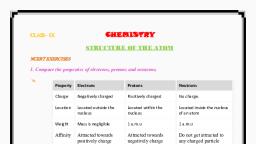
31, , Structure of Atom, , Reason : Elements having the same number of, valence electrons in their atoms possess different, chemical properties., 55. Assertion : For noble gases, valency is zero., Reason : Noble gases have 8 valence electrons., , 58. Assertion : Bohr’s orbits are called stationary, orbits., Reason : Electrons remain stationary in these, orbits for sometime., , 56. Assertion : The size of the nucleus is very, small as compared to the size of the atom., Reason : The electrons revolve around the, nucleus of the atom., , 59. Assertion : The distribution of electrons in, different orbits or shells is governed by a scheme, known as Bohr-Bury scheme., Reason : Electrons are filled in the shells in a, stepwise manner in increasing order of energy of, the energy shell., , 57. Assertion : Electrons moving in the same, orbit will not lose or gain energy., Reason : On jumping from higher to lower, energy level, the electron will gain energy., , 60. Assertion : In Rutherford’s gold foil experiment,, very few a-particles are deflected back., Reason : The size of the nucleus is very small as, compared to the size of the atom, , SUBJECTIVE TYPE QUESTIONS, , Very Short Answer Type Question (VSA), 1. Atomic number is defined in terms of protons, and not in terms of electrons. Why?, , 5. What characteristic feature is seen in the, configurations of chemically inactive elements?, , 2. Given below is a diagram of the nucleus of an, atom., , 6. What would you conclude from the, observation that cathode rays rotate a light, paddle wheel placed in their path?, , 8p, 8n, , (a) Complete the diagram to show the electronic, arrangement of this atom., (b) Write the electronic configuration of the, element., 3. What will be the charge on an atom with, mass number one and atomic number one?, 4. In Rutherford’s model of an atom, fast, moving alpha (a)-particles were made to fall on a, thin gold foil. State two properties of a-particles., , 7. An oxide of an element Z has a formula Z2O3., (a) How many electrons are there in the, outermost shell of an atom of element Z?, (b) Write down the formula for the chloride of Z., 8. Neutrons can be found in all atomic nuclei, except in one case. Which is this atomic nucleus, and what does it consist of?, 9. Find valencies of the elements having atomic, numbers 10 and 15., 10. Why are anode rays also called canal rays?, , Short Answer Type Question (SA I), 11. (a) If the number of electrons in an ion is, 10 and the number of protons is 9, then, (i) what would be the atomic number of the ion?, (ii) what is the charge on the ion?, (b) An ion M 2+ contains 10 electrons and 12, neutrons. What is the atomic number and, mass number of the element M? Name the, element., , 12. Draw Bohr ’s model of an atom with, three shells. How many electrons L-shell can, accommodate?, 13. The atom of an element has 9 protons, 9, electrons and 10 neutrons., (a) What is the atomic number of the element?, (b) What is the mass number of the element?
Page 2 :
CBSE Term-II Science Class-9, , 32, (c) Name the element and give its electronic, configuration., (d) Predict the valency of the element., 14. Element X has a proton number of 7. It also, has seven neutrons., (a) Deduce the number of electrons and the, nucleon number of X., (b) Represent X by writing the chemical symbol,, including the proton and nucleon numbers., 15. Justify the statement ‘atomic number of an, element is equal to the number of electrons in, a neutral atom only and not in anion’., 16. Draw the electronic structures of sodium, (proton number = 11) and lithium (proton number, , = 3). Compare the structures and state one, similarity and one difference between them., 17. Give two points of differences between, isotopes and isobars., 18. An element has two electrons in N-shell., Identify the element., 19. Justify the given statements :, (a) Most of the space in an atom is empty., (b) The elements are identified by their atomic, numbers and not by their mass numbers., 20. Given that the percentage abundance of the, 20, 22, isotope 10, Ne is 90% and that of the isotope 10, Ne, is 10%, calculate average mass of neon., , Short Answer Type Question (SA II), 21. (a) Electronic configuration of a neutral atom, ‘X’ is 2, 8, 6. What is the electronic configuration, of X2– ?, (b) What is a valence shell? How many electrons, can be present in valence shell?, 22. Atoms of elements R, S and T have 8, 9 and, 11 protons respectively. Neon has 10 protons., (a) What is the chemical formula of the, compound formed between?, (i) R and T (ii) S and T, (b) What is the formula of a molecule of R?, 23. (a) Which fact is proved by the following, observation in Rutherford’s scattering experiment, ‘very few alpha particles are deflected back’?, (b) How will you find the valency of nitrogen,, oxygen and fluorine?, 24. (a) Explain, why 23He and 13H are not, considered isotopes., (b) What are octet and duplet rules? How do, elements attain octet?, 25. Elements from A to F have in them the, distribution of electrons, neutrons and protons, as follows :, Atoms/ Number of Number of Number of, Ions, electrons, neutrons, protons, 4, 10, 3, A, B, , 10, , 12, , 11, , C, , 17, , 18, , 17, , D, , 17, , 20, , 17, , E, , 18, , 22, , 18, , F, , 19, , 21, , 19, , Making use of these data, find, (a) a pair of ions, (b) an atom of a noble gas, (c) a pair of isobars, (d) a pair of isotopes., 26. (a) On the basis of Thomson’s model of an, atom, explain how the atom is neutral as a whole., (b) What are canal rays?, 27. For the following statements, write T for, True and F for False., (a) J.J. Thomson proposed that the nucleus of, an atom contains only nucleons., (b) A neutron is formed by an electron and, a proton combining together. Therefore, it is, neutral., 1, (c) The mass of an electron is about, times, 2000, that of proton., (d) An isotope of iodine is used for making, tincture iodine, which is used as a medicine., 28. (a) Helium atom has an atomic mass of, 4 u and two protons in its nucleus. How many, neutrons does it have?, (b) Write the distribution of electrons in carbon, and sodium atoms.
Page 3 :
33, , Structure of Atom, , 29. Summarise the rules for writing the, distribution of electrons in various shells for the, first eighteen elements., 30. (a) What is the number of valence electrons, in the atom of an element A having atomic, number 20? Name the valence shell of this atom., (b) The atom of an element has 9 protons, 9, electrons and 10 neutrons., (i) What is the atomic number of the element?, (ii) What is the mass number of the element?, (iii) Name the element and give its electronic, configuration., (iv) Predict the valency of the element., 31. Use the information to answer the following, questions :, Element, Proton number, , P Q, , R, , S, , T, , U, , V, , 7 8 10 12 15 18 19, , (a) Which of these elements have only four filled, electron shells?, , (b) Which of these elements have a complete, outermost shell?, (c) Which of these elements have 5 valence, electrons?, (d) Which of these elements have 6 valence, electrons?, (e) Which of these elements have 2 valence, electrons?, (f) Write the valencies of each of the elements., 32. (a) Explain the formation of a cation. Give, its main characteristics., (b) What is electronic configuration of Al3+?, 33. The average atomic mass of sample of an, element X is 16.2 u. What are the percentages of, isotopes 168X and 188X in the sample?, 34. (a) Who discovered electron, proton and, neutron?, (b) Compare the properties of electrons, protons, and neutrons. Write five properties., 35. How will you find the valency of chlorine,, sulphur and magnesium?, , Long Answer Type Question (LA), 36. Observe the given figure and answer the, questions that follow :, Gold atoms, , a-particles, , (a) Which experiment is represented by the, given figure?, (b) List three observations of this experiment., (c) S t a t e c o n c l u s i o n s d r a w n f r o m e a c h, observation of this experiment., (d) Write the features of the nuclear model of, an atom., (e) What were the drawbacks of this model of, an atom?, 37. Answer the following :, (a) Are there elements with the same number, of electrons, protons and neutrons? Give few, examples., , (b) An ion M 3+ contains 10 electrons and 14, neutrons. What is the atomic number and mass, number of the element M? Name the element., 38. Give reasons for the following :, (a) Isotopes of an element are chemically similar., (b) An atom is electrically neutral., (c) Noble gases show least reactivity., (d) Nucleus of an atom is heavy and positively, charged., (e) Ions are more stable than atoms., 39. (a) An element X has an atomic number 12, and a mass number 26. Draw a diagram showing, the distribution of electrons in the orbits and the, nuclear composition of the neutral atom of the, element. What is the valency of the element and, why?, (b) If this element X combines with another, element Y whose electronic configuration is 2,, 8, 7. What will be the formula of the compound, formed?, 40. The table shows the numbers of electrons,, neutrons and protons in some atoms and ions of, elements., (The letters used in the table are not the chemical, symbols of the elements.)
Page 4 :
CBSE Term-II Science Class-9, , 34, Atom/Ion Electrons Neutrons Protons, 10, 10, 10, S, 17, 20, 17, T, 10, 12, 11, U, 10, 8, 8, V, 17, 18, 17, W, , V. X will lose two electrons to form a stable compound. It, shows the valency of +2., , OBJECTIVE TYPE QUESTIONS, 1., , (c) :, Ion, 40 2+, 20Ca, 19 –, 9F, 16 2–, 8O, 23 +, 11Na, , Using only the letters from the table, identify, (a) a negative ion., (b) a positive ion., (c) two atoms of the same element., (d) a noble gas., (e) an atom with a nucleon number of 20., , 7. (a) : Aluminium has 13 electrons. Its electron distribution, is 2, 8, 3., , Number of, Protons, , Neutrons, , Electrons, , 20, , 20, , 18, , 9, , 10, , 10, , 9. (c) : The two negative charges can be shown by that, element, which needs two electrons for its stability., , 8, , 8, , 10, , Therefore, it should contain 6 electrons in its valence shell., , 11, , 12, , 10, , 10. (d) : The nucleon number of bromine atom is 79 and its, proton number is 35., , 2. (c) : Two isotopes have same number of electrons and, protons but different number of neutrons., 3. (d) : Number of electrons in O2 = 2 × 8 = 16, Number of electrons in C2H4 = (2 × 6) + (4 × 1) = 16, Number of electrons in N2 = 2 × 7 = 14, Number of electrons in F2 = 2 × 9 = 18, Number of electrons in Cl2 = 2 × 17 = 34, Number of electrons in CO2 = 6 + (2 × 8) = 22, Number of electrons in H2O = (2 × 1) + 8 = 10, Number of electrons in H2S = (2 × 1) + 16 = 18, 4. (c) : Thomson’s atomic model, followed by Rutherford’s, model which is followed by Bohr’s model., 5. (c) : For the atom n = 4, p = 3, hence e = 3, Distribution of electrons = 2, 1, 6. (d) : Number of electrons in X = 12, Number of electrons in Y = 10, Number of electrons in Z = 15, I. Z has five valence electrons, thus, it can form ZCl3 and, ZCl5 as it shows valency of +3 and +5., II. Y is neon and exists in monatomic form., III., X, Z, Valency, 2, 3, Compound X3Z2, IV. Y has a complete octet. Thus, it does not combine with, any element., , 8., , (d), , It has 35 electrons., It has (79 – 35) 44 neutrons., Its electronic configuration contains four shells which has 7, electrons in outermost shell., It has similar chemical properties as chlorine as it has same, valency 1 as chlorine., 11. (b) : Mass number of the atom = 27, Number of neutrons = 14, Number of protons = 27 – 14 = 13, Number of electrons in the atom = 13, Number of electrons in ion with 3 positive charges, �, = 13 – 3 = 10, 12. (c) : First shell can accommodate maximum of two, electrons and second shell can accommodate maximum of, eight electrons., 13. (a), 14. (b) : O2– has 10 electrons., K+ has 18 electrons., Mg2+ has 10 electrons., Cl– has 18 electrons., S2– has 18 electrons., 15. (a) : Isotopes are the atoms of the same element with, different mass numbers i.e. , they have same number of, protons but different number of neutrons., Mass number = No. of protons + No. of neutrons