Page 1 :
Photosynthesis, �, , � Professor Dr. Ismail Hossain�College of Agricultural Sciences, International University of Business Agriculture, And Technology (IUBAT), Sector 10, Uttara Model town, Dhaka
Page 2 :
Photosynthesis, Photosynthesis is a process used by plants and other organisms to convert light energy ( normally from the sun) into chemical energy and this chemical energy is stored in carbohydrate molecules, such as sugars, which are synthesized from carbon dioxide and water. , , Most plants, most algae, and cyanobacteria perform photosynthesis, and such organisms are called photoautotrophs. Photosynthesis maintains atmospheric oxygen levels and supplies all of the organic compounds and most of the energy necessary for life on Earth.
Page 3 :
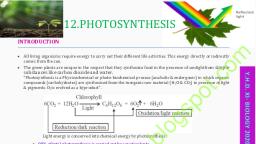
Overall Reaction, 6CO2 + 12 H2O Sunlight, Chlorophyll → C6H12O6 + 6O2+ 6H2O, , Carbohydrate made is glucose, Water appears on both sides because 12 H2O molecules are required and 6 new H2O molecules are made, Water is split as a source of electrons from hydrogen atoms releasing O2 as a byproduct, Electrons increase potential energy when moved from water to sugar therefore energy is required
Page 4 :
Why Photosynthesis is important ?
Page 5 :
Photosynthetic pigments absorb light energy only in the visible part of the spectrum ranging usually between 400-700 nanometer (nm) wavelength range. Such radiations are called as photosynthetically active radiations (PAR). , , PAR changes seasonally and varies depending on the latitude and time of day. Levels are greatest during the summer at mid-day., Photosynthetically Active Radiation (PAR)
Page 7 :
Plant: Autotrophs (self-producers), Green plants have six closely related photosynthetic pigments:, , Chlorophyll a is the most common of the six, present in every plant that performs photosynthesis. , , Chlorophyll a - a blue-green pigment, Chlorophyll b - a yellow-green pigment, Carotene - an orange pigment, Xanthophyll - a yellow pigment, Phaeophytin a - a gray-brown pigment, Phaeophytin b - a yellow-brown pigment
Page 8 :
Chlorophyll a absorbs well at a wavelength of about 400-450 nm and at 650-700 nm; , , Chlorophyll b at 450-500 nm and at 600-650 nm. , , Xanthophyll absorbs well at 400-530 nm. , , However, none of the pigments absorbs well in the green region, which is responsible for the abundant green we see in nature.
Page 12 :
Chloroplast Organelles where photosynthesis takes place., In plants and algae, photosynthesis takes place in organelles called chloroplasts. , A typical plant cell contains about 10 to 100 chloroplasts. , The chloroplast is enclosed by a membrane. This membrane is composed of a phospholipid inner membrane, a phospholipid outer membrane, and an intermembrane space between them., Photosynthetic membranes and organelles, Thylakoid
Page 13 :
Within the membrane is an aqueous fluid called the stroma. The stroma contains stacks (grana) of thylakoids, which are the site of photosynthesis., The thylakoids are flattened disks, bounded by a membrane , f. The site of photosynthesis is the thylakoid membrane, which contains integral and peripheral membrane protein complexes, including the pigments that absorb light energy, which form the photosystems.
Page 14 :
Photosynthesis occurs in two stages. , , In the first stage, light-dependent reactions or light reactions capture the energy of light and use it to make the energy-storage molecules ATP and NADPH. , , During the second stage, the light-independent reactions use these products (ATP and NADPH) to capture and reduce carbon dioxide to carbohydrate., Mechanism of Photosynthesis
Page 15 :
Light Dependent Reaction :-, Light Dependent Reaction are two types , Non Cyclic , Cyclic
Page 16 :
Two photosystems, Photosystem I and Photosystem II work sequentially. , Light hits reaction centers of Photosystem II , Chlorophyll vibrates and causes water to break apart and oxygen is released into air, First, a photon of light ejects a high-energy electron from photosystem II; that electron is used to pump a proton across the membrane, contributing chemiosmotically to the production of a molecule of ATP. , The ejected electron then passes along a chain of cytochromes to photosystem I. , When photosystem I absorbs a photon of light, it ejects a high-energy electron used to drive the formation of NADPH., 1. Non Cyclic Light Dependent Reaction
Page 18 :
This cyclic happened in bacteria cell , It also happened In green plant when NADP supply are closed in plant cell. , Uses photosystem I only, P700 rection center-chlorophyll a, In this cyclic release 1 ATP in one Circulation., 2. Cyclic Light Dependent Reaction
Page 19 :
2. Cyclic Light Dependent Reaction
Page 20 :
Light Independent reactions(Dark Phase), Light Independent reactions are three types-, , Calvin cycle or C3 pathway ., Hatch - Slack cycle or C4 pathway. , CAM pathway.
Page 21 :
C3 plants, accounting for more than 95% of earth's plant species, use rubisco to make a three-carbon compound as the first stable product of carbon fixation. , C3 plants flourish in cool, wet, and cloudy climates, where light levels may be low., � A C4 plant is a plant that cycles carbon dioxide into four-carbon sugar compounds to enter into the Calvin cycle. These plants are very efficient in hot, dry climates and make a lot of energy., , In C4 plants, there can be up to twice as much photosynthesis per gram of water as in C3 plants, but C4 metabolism is inefficient in shady or cool environments. Less than 1% of earth's plant species can be classified as C4. Many foods we eat are C4 plants, like corn, pineapple, and sugar cane., , CAM plants (Crassulacean acid metabolism) also developed because of photorespiration. the difference between CAM and C4 is that CAM plants have only one cell, and they open their stomata at night and close them during the day. the CO2 they take in at night is incorporated into 4 carbon compounds (organic acids) and is sent off to the calvin cycle during the day to make glucose. CAM plants are usually found in dry desert areas.
Page 22 :
Light Independent Reactions or Calvin Cycle, CO2 is added to the 5-C sugar RuBP by the enzyme rubisco and produce unstable 6-C compound., , This unstable 6-C compound splits to two molecules of 3-phosphoglyceric acid.
Page 23 :
The Calvin cycle, For every three molecules of CO2 that enter the cycle, one molecule of the three-carbon compound - glyceraldehyde 3-phosphate (G3P), is produced. Notice that the process requires energy stored in ATP and NADPH, which are generated by the light reactions. This process occurs in the stroma of the chloroplast.
Page 24 :
Leaf Anatomy, • In C3 plants (those that do C3 photosynthesis), all processes occur in the mesophyll cells., Mesophyll cells, Bundle sheath cells, (rt) Arrangement of cells in a C* leaf, Upper epidermis, These cells have rubisco, and fix CO-, to RuBP to, form 3PG., Vein, These cells have few, chloroplasts and no rubisco;, they do not fix C02., Spongy mesophyll cell, Lower epidermis, Stoma
Page 25 :
C4 Pathway, • In C4 plants photosynthesis occurs in both the mesophyll and the bundle sheath cells., f Mesophyll cell, Photosynthetic, cells of C4 plant < Bundle-, sheath, leaf, L cell, Vein, (vascular tissue) “I, C4 leaf anatomy, Stoma
Page 26 :
Kranz anatomy. the special structure of leaves in C4 PLANTS (e.g. maize) where the tissue equivalent to the spongy mesophyll cells is clustered in a ring around the leaf veins, outside the bundle-sheath cells. (The term 'Kranz' means wreath or ring in German).
Page 27 :
CAM Pathway, 1/26/2022, 27
Page 29 :
Hatch and slack cycle
Page 30 :
Mechanism of Photosynthesis
Page 31 :
Photophosphorylation, , In the process of photosynthesis, the phosphorylation of ADP to form ATP using the energy of sunlight is called photophosphorylation. , , In photophosphorylation, light energy is used to create a high-energy electron donor and a lower-energy electron acceptor. Electrons then move spontaneously from donor to acceptor through an electron transport chain., , Only two sources of energy are available to living organisms: sunlight and reduction-oxidation (redox) reactions. All organisms produce ATP, which is the universal energy currency of life.
Page 32 :
Photorespiration occurs when the CO2 levels inside a leaf become low. This happens on hot dry days when a plant is forced to close its stomata to prevent excess water loss. If the plant continues to attempt to fix CO2 when its stomata are closed, the CO2 will get used up and the O2 ratio in the leaf will increase relative to CO2 concentrations. , When the CO2 levels inside the leaf drop to around 50 ppm, Rubisco starts to combine O2 with RuBP instead of CO2. The net result of this is that instead of producing 2 3C PGA molecules, only one molecule of PGA is produced and a toxic 2C molecule called phosphoglycolate is produced.
Page 33 :
Thank you