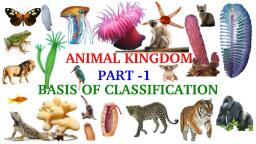
Page 1 : SOHSS-AREEKODE, , 2, ANIMAL KINGDOM, BASIS OF CLASSIFICATION, 1. Levels of Organisation, a) cellular level of organization:, Here the cells are arranged as loose cell, aggregates. Some division of labour, (activities) occur among the cells, zzsda(Sponges), Eg: Phylum Porifera, b) Tissue level of organization :, Here the cells performing the same, function are arranged into tissues, Eg :Phylum coelenterate (Cnidaria), Phylum – Ctenophora, c) Organ level of organization :, Here tissues are organized to form, organs. Each Organs are specialized for a, particular function, Eg: Phylum : Platyhelminthes (Flat worms), d) Organ system level of organization :, Here various organs are grouped organ, system. Each system concerned with a specific, physiological function, Eg:, Phylum Aschelminthes, Phylum Annelids,, Phylum Arthropods,, Phylum Molluscs, Phylum Echinoderms, Phylum Hemichordates, Phylum Chordates, 2. Types of digestive system, a) Incomplete digestive system : Here the, organism has single opening, it act as both, mouth and anus, Eg: Phylum Cnideria,, Phylum Ctenophora, Phylum Platyhelminthes, a) Complete digestive system: A complete, digestive system has two openings, mouth, and anus, Eg, Phylum Aschelminthes to Chordates, • Digestive system absent in Phylum Porifera, SOHSS-AREEKODE, , ANIMAL KINGDOM/2021, 3. Types of circulatory system, a) open type of circulatory system :, in which the blood is pumped out of, the heart and the cells and tissues are directly, bathed in it, Eg: Phylum Arthropoda, Phylum Mollusca, Phylum Hemichordata, b) closed type of circulatory system : in which, the blood is circulated through a series of, vessels of varying diameters (arteries, veins, and capillaries), , 4. Symmetry :, Animals can be categorized on the basis of, their symmetry., a) Asymmetry :, Here the body cannot be divided into two, equal halves in any plane, Or, Any plane that passes through the centre, does not divide them into equal halves, Eg: Phylum Porifera, (Porifera shows various type of symmetry), b) Radial symmetry :, When any plane passing through the, central axis of the body divides the organism, into two identical halves, Eg; Phylum Coelenterata, Phylum Ctenophora, Phylum Echinodermata, c) Bilateral symmetry :, Here the body can be divided into, identical left and right halves in only one, plane is called Bilateral symmetry., ,
[email protected]
Page 3 : SOHSS-AREEKODE, 8. Chordates and non-chordates :, Notochord is a mesodermally derived rod-like, structure formed on the dorsal side during, embryonic development in some animals. Based, on the presence or absence of notochord animals, are classified into Chordates and non chordates., a)Chordata :, Animals with notochord are called chordates, b)Non-Chordata, Those animals which do not form notochord, are called non-chordates,, e.g., Porifera to Echinoderms., , ANIMAL KINGDOM/2021, , CLASSIFICATION OF ANIMALS, The animals are classified into 35, phylum of which 11 phylum are consider as, the major phylum . they are given below, 1. Phylum Porifera, 2. Phylum Cnidaria, 3. Phylum Ctenophora, 4. Phylum platyheminthes, 5. Phylum Aschelminthes, 6. Phylum Annelida, 7. Phylum Arthrodpoda, 8. Phylum Mollusca, 9. Phylum Echinodermata, 10. Phylum Hemichordata, 11. Phylum Chordata, , SOHSS-AREEKODE, ,
[email protected]
Page 4 : SOHSS-AREEKODE, , ANIMAL KINGDOM/2021, , 1. Phylum Porifera, •, •, •, •, •, , Members of this phylum are commonly, known as sponges., They are generally marine (Except Spongilla,, its fresh water sponge), Mostly asymmetrical animals., These are primitive multicellular animals and, have cellular level of organisation., Sponges have a water transport or canal, system. Water enters through minute pores, (ostia) in the body wall into a central cavity,, spongocoel, from where it goes out through, the osculum. This pathway of water transport, is helpful in food gathering, respiratory, exchange and removal of waste., , 2. Phylum Cnidaria, , (Coelenterata), •, •, •, •, •, , Water→Ostia-->Spongocoel→Osculum, •, •, •, •, , •, •, , Choanocytes or collar cells line the, spongocoel and the canals., Digestion is intracellular., The body is supported by a skeleton made up, of spicules or spongin fibres., Sexes are not separate (hermaphrodite), i.e.,, eggs and sperms are produced by the same, individual., Sponges, reproduce, asexually, by, fragmentation and sexually by formation of, gametes., Fertilisation is internal and development is, indirect having a larval stage which is, morphologically distinct from the adult., Examples: Sycon (Scypha),, Spongilla (Fresh water sponge), Euspongia (Bath sponge)., , SOHSS-AREEKODE, , •, •, •, •, , They, are, aquatic,, mostly, marine,, sessile(Attached ) or free-swimming,, Radially symmetrical animals., Cnidarians exhibit tissue level of organization, They are diploblastic, The name cnidaria is derived from the, cnidoblasts or cnidocytes (which contain the, stinging capsules or nematocytes) present on, the tentacles and the body., Functions of Cnidoblasts, ✓ It is used for anchorage,, ✓ It is used defense and, ✓ It is used for the capture of prey, , They have a central gastro-vascular cavity, with a single opening, mouth on hypostome., Digestion is extracellular and intracellular., Some of the cnidarians, e.g., corals have a, skeleton composed of calcium carbonate., Cnidarians exhibit two basic body forms, called polyp and medusa.The Polyp is a, sessile and cylindrical form like Hydra,, Adamsia, etc. whereas, the Medusa is, umbrella-shaped and free-swimming like, Aurelia or jelly fish. Those cnidarians which, exist in both forms exhibit alternation of, generation (Metagenesis), i.e., polyps, produce medusae asexually and medusae, form the polyps sexually (e.g., Obelia)., Polyp, Medusa, Sessile, Free swimming type, Cylindrical form, Umbrella shape, It produce medusa by It produce, polyp,
[email protected]
Page 5 : SOHSS-AREEKODE, , asexual reproduction, Eg: Hydra, Adamsia, , ANIMAL KINGDOM/2021, , sexual reproduction, Eg:Aurelia (Jelly fish), , Examples:, Physalia (Portuguese man-of-war),, Adamsia (Sea anemone),, Pennatula (Sea-pen),, Gorgonia (Sea-fan) and, Meandrina (Brain coral)., , 4. Phylum platyheminthes, •, •, •, •, •, , They have dorso-ventrally flattened body,, hence are called flatworms, Flatworms are bilaterally symmetrical,, They are triploblastic, They are acoelomate animals with organ, level of organisation., These are mostly endoparasites found in, animals including human beings, , Parasitic adaptations, a) Hooks and suckers are present in the, parasitic forms., b) Some of them absorb nutrients from the, host directly through their body surface., c) Presence of anaerobic respiration, • Specialised cells called flame cells help in, osmoregulation and excretion., , •, , 3. Phylum – Ctenophora, •, •, •, •, •, •, , •, , •, , Ctenophores, commonly known as sea walnuts, , or comb jellies, They are exclusively marine, radially, symmetrical, diploblastic, Organisms with tissue level of organisation., The body bears eight external rows of ciliated, comb plates, which help in locomotion, Digestion is both extracellular and, intracellular., Bioluminescence (the property of a living, organism to emit light) is well-marked in, ctenophores., Sexes are not separate. Reproduction takes, place only by sexual means. Fertilisation is, external with indirect development, Examples: Pleurobrachia and, Ctenoplana, , •, , 5. Phylum Aschelminthes, •, •, •, •, •, , SOHSS-AREEKODE, , Sexes are not separate. Fertilisation is internal, and development is through many larval, stages. Some members like Planaria possess, high regeneration capacity., Examples: Taenia (Tapeworm),, Fasciola (Liver fluke)., , The body of the aschelminthes is circular in, cross-section, hence, the name roundworms, They may be freeliving, aquatic and terrestrial, or parasitic in plants and animals., Roundworms have organ-system level of body, organisation., They are bilaterally symmetrical, triploblastic, and pseudocoelomate animals., Alimentary canal is complete with a well, developed muscular pharynx.,
[email protected]
Page 6 : SOHSS-AREEKODE, , •, •, •, •, , An excretory tube removes body wastes from, the body cavity through the excretory pore., Sexes are separate (dioecious), i.e., males and, females are distinct., Often females are longer than males., Fertilisation is internal and development may, be direct (the young ones resemble the adult), or indirect., Examples : Ascaris (Round Worm),, Wuchereria (Filaria worm),, Ancylostoma (Hookworm)., , ANIMAL KINGDOM/2021, , •, •, , 7. Phylum Arthrodpoda, , 6. Phylum Annelida, •, , •, •, •, , •, •, •, , •, •, , They may be aquatic (marine and fresh water), or terrestrial; free-living, and sometimes, parasitic., They exhibit organ-system level of body, organisation and bilateral symmetry., They are, triploblastic,, metamerically, segmented and coelomate animals., Their body surface is distinctly marked out, into segments or metameres and, hence, the, phylum name Annelida (Latin, annulus : little, ring), A closed circulatory system is present., They possess longitudinal and circular, muscles which help in locomotion., Aquatic annelids like Nereis possess lateral, appendages, parapodia, which help in, swimming., Nephridia (sing. nephridium) help in, osmoregulation and excretion., Neural system consists of paired ganglia, connected by lateral nerves to a double, ventral nerve cord., , SOHSS-AREEKODE, , Nereis, an aquatic form, is dioecious, but, earthworms and leeches are monoecious., Reproduction is sexual., Examples :, Nereis,, Pheretima (Earthworm), Hirudinaria (Blood sucking leech)., , •, •, •, •, •, •, •, •, •, •, , •, , This is the largest phylum of Animal kingdom, which includes insects., Over two-thirds of all named species on earth, are arthropods, They, have, organ-system, level, of, organisation., They are bilaterally symmetrical, triploblastic,, segmented and coelomate animals., The body of arthropods is covered by, chitinous exoskeleton., The body consists of head, thorax and, abdomen., They have jointed appendages (arthros-joint,, poda-appendages)., Respiratory organs are gills, book gills, book, lungs or tracheal system. (Insects), Circulatory system is of open type., Sensory organs like antennae, eyes, (compound and simple), statocysts or balance, organs are present., Excretion takes place through malpighian, tubules.,
[email protected]
Page 7 : SOHSS-AREEKODE, , •, , They are mostly dioecious. Fertilisation is, usually internal. They are mostly oviparous., Development may be direct or indirect., Examples:, Economically important insects –, Apis (Honey bee),, Bombyx (Silkworm),, Laccifer (Lac insect), Vectors –, Anopheles, Culex and Aedes (Mosquitoes), Gregarious pest –, Locusta (Locust), Living fossil –, Limulus (King crab)., , ANIMAL KINGDOM/2021, , •, •, •, , The mouth contains a file-like rasping organ, for feeding, called radula, They are usually dioecious and oviparous with, indirect development, Examples:, o Pila (Apple snail),, o Pinctada (Pearl oyster),, o Sepia (Cuttlefish),, o Loligo (Squid), o Octopus (Devil fish), o Aplysia (Seahare),, o Dentalium (Tusk shell), o Chaetopleura (Chiton), , 9. Phylum Echinodermata, 8. Phylum Mollusca, •, •, •, •, •, •, , •, , This is the second largest animal phylum, Molluscs are terrestrial or aquatic (marine or, fresh water), It has organ-system level of organisation., They are bilaterally symmetrical, triploblastic, and coelomate animals., Body is covered by a calcareous shell, Body is unsegmented with a distinct head,, muscular foot and visceral hump. A soft and, spongy layer of skin forms a mantle over the, visceral hump. The space between the hump, and the mantle is called the mantle cavity in, which feather like gills are present. They, have respiratory and excretory functions., The anterior head region has sensory, tentacles., , SOHSS-AREEKODE, , •, , •, •, , •, •, , •, , These animals have an endoskeleton of, calcareous ossicles and, hence, the name, Echinodermata (Spiny bodied), All are marine with organ-system level of, organisation., The adult echinoderms are radially, symmetrical but larvae are bilaterally, symmetrical., They are triploblastic and coelomate animals., Digestive system is complete with mouth on, the lower (ventral) side and anus on the, upper (dorsal) side., The most distinctive feature of echinoderms, is the presence of water vascular system, , Functions of water vascular system, a)It helps in locomotion,, b)It helps to capture and transport of food, c)Helps in respiration., ,
[email protected]
Page 8 : SOHSS-AREEKODE, , •, •, •, •, •, , ANIMAL KINGDOM/2021, , An excretory system is absent., Sexes are separate., Reproduction is sexual., Fertilisation is usually external., Development is indirect with free-swimming, larva., Examples:, Asterias (Star fish),, Echinus (Sea urchin),, Antedon(Sea lily),, Cucumaria (Sea cucumber) and, Ophiura (Brittle star)., , 10. Phylum Hemichordata, •, , Hemichordata was earlier considered as a, sub-phylum under phylum Chordata. But now, it is placed as a separate phylum under nonchordata., , •, , Hemichordates have a rudimentary structure in, the collar region called stomochord, a structure, similar to notochord, , •, , This phylum consists of a small group of, worm-like marine animals ., They have organ-system level of organisation., They are bilaterally symmetrical, triploblastic, and coelomates animals., The body is cylindrical and is composed of an, anterior proboscis, a collar and a long trunk, Circulatory system is of open type., Respiration takes place through gills., Excretory organ is proboscis gland., Sexes are separate. Fertilisation is external., Development is indirect., Examples: Balanoglossus, saccoglossus., , •, •, •, •, •, •, •, , SOHSS-AREEKODE, ,
[email protected]
Page 10 : SOHSS-AREEKODE, Class Cyclostomata, , •, •, •, •, •, •, •, , All living members of the class Cyclostomata, are ectoparasites on some fishes., They have an elongated body bearing 6-15, pairs of gill slits for respiration., Cyclostomes have a sucking and circular, mouth without jaws, Their body is devoid of scales and paired fins., Cranium and vertebral column are, cartilaginous., Circulation is of closed type., , ANIMAL KINGDOM/2021, , •, , •, , •, •, , Some of them have electric organs (e.g.,, Torpedo) and some possess poison sting (e.g.,, Trygon)., They are cold-blooded (poikilothermous), animals, i.e., they lack the capacity to, regulate their body temperature., Sexes are separate., In males pelvic fins bear claspers. They have, internal fertilisation and many of them are, viviparous., Examples:, Scoliodon (Dog fish),, Pristis (Saw fish),, Carcharodon (Great white shark),, Trygon (Sting ray)., , Cyclostomes are marine but migrate for, spawning to fresh water. After spawning, within, a few days, they die. Their larvae, after, metamorphosis, return to the ocean., Examples:, Petromyzon (Lamprey), Myxine (Hagfish)., , Super class Pisces, Class – Chondrichthyes, , •, •, •, •, •, •, •, •, •, , They are marine animals with streamlined, body and have cartilaginous endoskeleton, Mouth is located ventrally., Notochord is persistent throughout life., Gill slits are separate and without operculum, (gill cover)., The skin is tough, containing minute placoid, scales., Teeth are modified placoid scales which are, backwardly directed., Their jaws are very powerful. These animals, are predaceous., Due to the absence of air bladder, they have, to swim constantly to avoid sinking, Heart is two-chambered (one auricle and one, ventricle)., , SOHSS-AREEKODE, , Class – Osteichthyes, , •, •, •, •, •, •, •, •, , It includes both marine and fresh water fishes, with bony endoskeleton., Mouth is mostly terminal, They have four pairs of gills which are covered, by an operculum on each side., Skin is covered with cycloid/ctenoid scales., Air bladder is present which regulates, buoyancy, Heart is two chambered (one auricle and one, ventricle)., They are cold-blooded animals., Sexes are separate. Fertilisation is usually, external. They are mostly oviparous and, development is direct., , • Examples:, Marine fish –, Exocoetus (Flying fish),,
[email protected]
Page 11 : SOHSS-AREEKODE, Hippocampus (Sea horse), Freshwater fish–, Labeo (Rohu),, Catla (Katla),, Clarias (Magur);, Aquarium fish –, Betta (Fighting fish),, Pterophyllum (Angel fish)., , ANIMAL KINGDOM/2021, , Class – Amphibia, •, , •, •, •, •, •, •, , •, •, •, •, Difference between Chondrichthyes and, Osteichthyes, Class –, Class –, Chondrichthyes, Osteichthyes, They are marine animals, , They have cartilaginous, endoskeleton, Mouth is located, ventrally, , It includes both, marine and fresh, water fishes, They have bony, endoskeleton., Mouth is mostly, terminal, , Gill slits are separate, and without operculum, (gill, cover)., , They have four pairs of, gills which are covered, by an operculum on, each side, , The skin minute, placoid scales, Air bladder absent, , Skin is covered with, cycloid/ctenoid scales, Air bladder is present, , many of them are, viviparous, , They are mostly, oviparous, , SOHSS-AREEKODE, , As the name indicates (Gr., Amphi : dual,, bios, life), amphibians can live in aquatic as, well as terrestrial habitats, Most of them have two pairs of limbs., Body is divisible into head and trunk. Tail, may be present in some., The amphibian skin is moist (without scales)., The eyes have eyelids., A tympanum represents the ear., Alimentary canal, urinary and reproductive, tracts open into a common chamber called, cloaca which opens to the exterior., Respiration is by gills, lungs and through skin., The heart is three chambered (two auricles, and one ventricle)., These are cold-blooded animals., Sexes are separate. Fertilisation is external., They are oviparous and development is, indirect., Examples:, Bufo (Toad),, Rana (Frog),, Hyla (Tree frog),, Salamandra (Salamander),, Ichthyophis (Limbless amphibia)., ,
[email protected]
Page 12 : SOHSS-AREEKODE, , ANIMAL KINGDOM/2021, , Class – Reptilia, •, , •, , •, •, •, •, •, •, •, , •, , The class name refers to their creeping or, crawling mode of locomotion (Latin, repere, or reptum, to creep or crawl)., They are mostly terrestrial animals and their, body is covered by dry and cornified skin,, epidermal scales or scutes, They do not have external ear openings., Tympanum represents ear., Limbs, when present, are two pairs., Heart is usually three-chambered, but fourchambered in crocodiles., Reptiles are poikilotherms., Snakes and lizards shed their scales as skin, cast., Sexes are separate. Fertilisation is internal., They are oviparous and development is direct., Examples: Chelone (Turtle),, Testudo (Tortoise),, Chameleon (Tree lizard),, Calotes (Garden lizard),, Crocodilus (Crocodile),, Alligator (Alligator)., Hemidactylus (Wall lizard),, Poisonous snakes – Naja (Cobra),, Bangarus (Krait),, Vipera (Viper)., , Class – Aves, •, , The characteristic features of Aves (birds) are, the presence of feathers and most of them, can fly except flightless birds (e.g., Ostrich)., • They possess beak, • The forelimbs are modified into wings. The, hind limbs generally have scales and are, modified for walking, swimming or clasping, the tree branches. Skin is dry without glands, except the oil gland at the base of the tail., Flght adaptation of birds, a) They possess beak, b) The forelimbs are modified into wings, c) Endoskeleton is fully ossified (bony) and the, long bones are hollow with air cavities, (pneumatic)., SOHSS-AREEKODE, , d) Air sacs connected to lungs supplement, respiration., •, •, •, , •, •, , The digestive tract of birds has additional, chambers, the crop and gizzard., Heart is completely four chambered., They are warm-blooded (homoiothermous), animals, i.e., they are able to maintain a, constant body temperature., Respiration is by lungs. ., Sexes are separate. Fertilisation is internal., They are oviparous and development is direct, Examples : Corvus (Crow),, Columba (Pigeon),, Psittacula (Parrot),, Struthio Ostrich),, Pavo (Peacock),, Aptenodytes (Penguin),, Neophron (Vulture)., , Class mammalia, •, , •, , •, , •, •, •, •, •, •, , They are found in a variety of habitats – polar, ice caps, deserts, mountains, forests,, grasslands and dark caves. Some of them, have adapted to fly( Pteropus (Flying fox) or, live in water., The most unique mammalian characteristic, is the presence of milk producing glands, (mammary glands) by which the young ones, are nourished., They have two pairs of limbs, adapted for, walking, running, climbing, burrowing,, swimming or flying The skin of mammals is, unique in possessing hair., External ears or pinnae are present., Different types of teeth are present in the, jaw., Heart is four chambered., They are homoiothermous., Respiration is by lungs., Sexes are separate and fertilisation is internal., They are viviparous with few exceptions and, development is direct., ,
[email protected]
Page 14 : SOHSS-AREEKODE, , Previous years question paper, 1. Observe the picture and answer the questions., (a) Identify the pictures., (HSE-Sept-2021)(1), (b) How does this structure help the organism ?, , ANIMAL KINGDOM/2021, 7. Identify an oviparous mammals from the, following examples, (HSE Dec-2020)(1), a)Pteropus b)Ornithorhynchus, c)Balaenoptera d)Equus, 8. Match the column A with column B, , (HSE Dec-2020)(2), 2. Mention a single word/term for the following :, (a) File like rasping organ in molluscans., (b) Property of a living organism to emit light., (c) Alternation of generation in Cnidarians., (d) Hollow bones with air cavities., (HSE-Sept-2021)(2), 3. A student of Class XI, collected some specimens, during the field trip conducted by the Science, club. Help him to classify these animals to their, respective phylum/class., (HSE-Sept-2021)(2), (Spongilla, Ctenoplasa, Laccifer, Calotes), 4. Figure (A) and (B) shows the fishes of two, different classes. Identify and differentiate, between them., (HSE-Sept-2021)(2), , 5. Observe the table given below and replace (a),, (b), (c) and (d) from those animals given in, brackets., (HSE-Sept-2021)(2), (Hydra, Shark, Spongilla, Star fish), , 6. Name the distinctive character (responsible for, the group names) of the following animal :, (a) Ctenophora, (HSE-Sept-2021)(3), (b) Echinodermata, (c) Mammalia, (d) Chordata, (e) Annelida, (f) Arthropod, SOHSS-AREEKODE, , 9. Scoliodon,Pristis,Carcharodon and Trygon are the, examples of class in vertebrata, a)Mention the class, (HSE Dec-2020)(3), b)List out any five characters of the class, 10. Identify the word pair applicable to phylum, ctenophora., (HSE-March-2020)(1), (a) Nephridia, Parapodia, (b) Comb plates, Bio luminiscence, (c) Polyp, Metagenesis, (d) Radula, Visceral hump, 11. Characteristics of certain animals are given., Arrange them under the ‘Class’ to which these, animals belong. ., (HSE-March-2020)(2), (i) Skin is moist without scales., (ii) Body is covered by dry and cornified skin., (iii) Shed the scales as skin cast., (iv) Can live in aquatic as well as terrestrial, habitats, 12. Observe the figures., (HSE-March-2020)(3), , (a) Identify the organisms A, B & C.,
[email protected]
Page 15 : SOHSS-AREEKODE, (b) Name the phylum to which each of them, belong, 13. Unlike bony fishes cartilage fishes are swim, constantly to avoid sinking due to the (a) Presence of pharyngeal gill slits, (b) Presence of air bladder, (c) Absence of pharyngeal gill slits, (d) Absence of air bladder, (HSE-July-2019)(1), 14. The following are organs of certain animals :, parapodia, Flame cells, proboscis gland, Comb plates, (a) Select organs helps in excretion., (b) Name the organism bearing these organs and, write its phylum., (HSE-July-2019)(2), 15. Complete the Schematic diagram., (HSE-July-2019)(3), , 16., 17. Complete the flowchart given below., , ANIMAL KINGDOM/2021, 18. "AII vertebrates are chordates but all chordates, are not vertebrates". Do you agree with this, statement? Substantiate, (HSE-March-2019)(2), 19. Find the odd one from each group. Justify your, answer, (HSE-March-2019)(2), , 20. Observe the figure of the given organism, , a) Identify the organism, b) Name and the class in which it belongs., c) Mention any two salient features of the class., (HSE-March-2019)(2), 21. Note the relationship between two words and, find a suitable word for the fourth Place, a)Colenenterate : Radial symmetry, Platyheliminth :………………………….., b)Lizard : Poikilthermous, Crow :…………………………, (HSE-Model-2019)(1), , 22. Which of the following animal exhibit, metagenesis?, (HSE-Model-2019)(1), , (HSE-March-2019)(2), , SOHSS-AREEKODE, , Ascaris, Obelia, Earthworm, Crab, 23. Who am I?, (HSE-Model-2019)(2), 1 live in sea, 2 respire through gills, 3 excrete by proboscis gland, 4 My body consists of proboscis, collar and trunk., a)Identify the phylum., b)Give one example from the phylum, 24. From a fish market, you got a fish, on a close, watching your friend says it is a cartilaginous fish., a) Which characters helped him to identify it as, a cartilaginous fish (any four characters) ?, b) Name the class it belongs,
[email protected]
Page 16 : SOHSS-AREEKODE, , ANIMAL KINGDOM/2021, , (HSE-Model-2019)(2), 25. Note the relation in the first pair and then, complete the second pair., (HSE-Aug-2018)(1), , 26. Find out the odd one and justify your answer, Saw Fish, Jelly fish, flying fish,, Angel Fish, Dog Fish, (HSE-Aug-2018)(2), Name of certain animals are given below. Write, the phylum of each animal. (HSE-Aug-2018)(2), a) Pila, b) Pleurobrachia, c) Nereis, d) Balanoglossus, , b) Which of the above mentioned class is, charecterised by the presence of penumatic bone, ?, , 31. Find out the pseodocoelomate animal from, the following :, (HSE-Model 2018) (1), Tapeworm, hook worm, Earth worm, Honey, bee, 32. a) Classify the given organisms under the, heading, Poikilothermous, and, homoiothermous., Rat, Frog, Dog fish, Ostrich, b) Define the terms poikilotherms and, homiothermous, (HSE-Model 2018) (2), 33. a) IdentifY the organism. (HSE-Model 2018) (2), , 27. Observe, the, diagram, showing the, characteristics of a phylum (HSE-Aug-2018)(3), , a)Identify the Phylum, b)Name the Part labeled 'A", c)Point out the three fundamental characters of, the phylum., , 28. Note the relationship in the first pair and then, complete the second pair. (HSE-March 2018) (1), Osteichthves : Cycloid scales, Chondrichthyes :………………………, 29. Arrange the following terms under two headings, based on symmetry, (HSE-March 2018) (2), ArthroPods., Ctenophores, ,, Molluscs,, Coelenterates, 30. a) A table showing examples of vertebrates given, below. But some of the examPles are wrongly, given. Identify and rearrange it., , (HSE-March 2018) (3), , SOHSS-AREEKODE, , a) Name the class inwhichitbelongs to ?, b) Write any one characteristic feature of the, class, , 34. Match the items in column B and C with A, (HSE-March-2017)(3), A, B, C, Phylum/Class, Common, Unique, example, features, Pisces, Aedes, Presence of, hair, Mammalia, Leech, Open, circulatory, system, Arthhropoda, Felis, Presence of 2, chamered, heart, Scoliodon, Presence of, Nephridia,
[email protected]
Page 17 : SOHSS-AREEKODE, , ANIMAL KINGDOM/2021, , OR, 35. Features of different phyla/class are given, below. Identify the phylum/class and give, examples of each group, (HSE-March-2017)(3), a) Body is covered by scales, heart is 3 or 4, chambered. They respire through lungs, b) They are exclusively marine, commonly, called sea walnuts and show Bioluminescence, ., c) Body is divided into Proboscis, collar and, trunk. They have pen circulatory system and, presence of proboscis gland., 36. Among, the, different, phyla, of, animals............have psudocoelom, (HSE-March-2017)(1), 37. Categorize the following animal under radial, symmetry and bilateral symmetry, (HSE-March-2017)(2), Physalia, Tapeworm, Fasciola, Adamsia, , 38. Characters of a marine invertebrate is given, below, • Spiny skinned body, • Presence of water vascular system, a)Identify and write the phylum?, b)Write any two functions of water vascular, system among them, (HSE-Sept-2016)(2), 39. a) Identify the cell given in the diagram, , b) Mention the name of animal phylum based, on this cell, (HSE-Sept-2016)(1), 40. Two examples of fishes are given below, • Scoliodon (dog fish), SOHSS-AREEKODE, , • Exocoetus (Flying fish ), a)Place them in 2 distinct class ?, b)differentiate the above class based on 2, important characters ?, (HSE-Sept-2016)(3), 41. The characteristic feature of an invertebrate, animal is given, “The phylum include the comb jellies, also, called walnuts, they are noted for their, bioluminescence and comb plate”, Identify the phylum ? (HSE-March-2016)(1), 42. Fill in the blanks with appropriate words, Osteichthyes : cycloid scale, Chondrichthyes:................., (HSE-March-2016)(1), 43. Name the phyla in which the following cells or, structures or organs are present, a)Radula, b)Cnidoblast, c)Pneumatic one, d)Proboscis gland, (HSE-March-2016)(2), 44. The, following, diagram, shows, the, charecterstics feature of a phylum, , a)Identify the phylum, b)Mention four salient features of this, phylum?, (HSE-March-2016)(2), 45. Observe the following features of animal and, answer the following questions, (HSE September-2015) (1), • Moist skin, • Hooks and suckers, • Pneumatic bones, • Dry and non glandular skin, • Metamerism, a) Select the flight adaptation of birds, b) Select the amphibious adaptations of birds, ,
[email protected]
Page 18 : SOHSS-AREEKODE, , 46. Assign the following features of animals given, in the column A to the most appropriate, animal phylum given in the column B, (HSE September-2015) (2), Column A, Column B, a)Metamerism, i)Ctenophora, b)spiny, ii)Platyhelminthes, exoskeleton, c)comp plate, iii)annelida, d)flame cell, iv)cnidaria, v)Echinodermata, vi)Porifera, vii)Hemichordata, 47. The diagram sketch given below represents, hypothetical chordate, (HSE September-2015)(3), , a. If you find any mistake in the labelled part,, copy the diagram and make necessary, correction in the labelling, b. Based on any two labelled parts in the, diagram, mention how this phylum differs, from non chordates, 48. Prawns and insects are included in the, phylum arthropoda while they have different, habit and habitat. Justify your answer?, (HSE march-2015)(1), 49. Figure (X) and (Y) are the fish of two different, classes. Identify them and differentiate, between these classes, (HSE march-2015)(2), , SOHSS-AREEKODE, , ANIMAL KINGDOM/2021, , 50. Birds are well adapted for flying. Give any 3 of, such adaptations?, (HSE march-2015)(3), 51. All vertebrates are chordates but all, chordates are not vertebrates. Justify this, statement with an example?, (HSE march-2015)(3), 52. Find the relationship between the first pair, and fill in the blank, (HSE august-2014)(1), Salamander :amphibia, Chameleon :.................., 53. In your practical, the class teacher brought, the following preserved animals, a)Balanoglossus, b)pila, c)tapeworm, d)Physalia, Identify the phylum of each animal and select, the distinguishing character of each phylum, from the following table, (HSE august2014)(4), 1)Presence of comp plate, 2)presence of flame cell, 3)presence of radula, 4)presence of malpighian tubule, 5)Presence of probosis gland, 6)Presence of cnidocyte, 7)Presence of notochord., 54. “all vertebrates are chordates but all, chordates are not vertebrates”. Evaluate and, substantiate the statement?, (HSE march-2014)(2), 55. Name the distinctive character (Responsible, for their names) of the following animal, groups, (HSE march-2014)(3), a)Cnidaria b)Arthropoda, c)Porifera d)Annelida, e)chordate f)Ctenophora, 56. Your biology teacher exhibited a laboratory, specimen in the classroom. Based on which, feature will you distinguish it as chordate or a, nonchordate?, (HSE march-2014)(3), 57. Observing starfish in a marine aquarium your, friend commented that it is a lower, invertebrate without distinct head, eyes and, legs.Do you agree with him? Evaluate his, statement with reasons?,
[email protected]
Page 19 : SOHSS-AREEKODE, , (HSE october-2013)(2), 58. The following are the key charecterstics of an, animal group, (HSE october-2013)(2), • Circular and sucking mouth without, jaws, • Fish like body without scales and, paired fins, a)Name the class in which this animal, belongs, b)Give two example from this class., 59. Frogs, salamanders, Tortoises and crocodiles, are seen in both water and land. but they are, classified into two different classes of the, phylum vertebrate. Evaluate this classification, comparing salient features of each class?, (HSE october-2013)(2), 60. a .Pick out the acoelomate organism from, the following:, (HSE march-2013)(3), i)Round worm ii)Hook worm, iii)Filarial worm iv)Tape worm, b. Name the phylum to which it belongs, c. Mention its mode of nutrition, d. What is the coelomic condition of other, organisms?, Substantiate your answer, 61. During a sea shore visit, a student collected, two organisms. Observing the morphology, it, is clear that the organisms are radially, symmetrical., One, of, them, shows, bioluminescene, (HSE march-2013)(3), a)To which phylum does this organism, belongs?, b)Identify the possible phyla to which the, other organism can e included, c)Which distinctive feature of this organism, will help you to categorize it into a particular, phylum?, 62. Fill in the blanks, (HSE september-2012)(1), Coelomate: arthropoda ;, Pseudocoelomate :............., 63. Is it possible to compare the water vascular, system of phylum echinodermata to, circulatory system of man in some aspects?, Justify your answer? (HSE september-2012)(2), SOHSS-AREEKODE, , ANIMAL KINGDOM/2021, , 64. Organisms of this phylum are radially, symmetrical, triploblastic, and coelomate, with a complete digestive system, (HSE september-2012)(2), a)Identify this phylum, b)Give an example for this phylum, c)What are the distinctive features of this, phylum?, 65. Find the relationship between given words, and suggests the suitable word for the fourth, place, (HSE march-2012)(1), a)Annelida : Nephridia, Arthropoda :......................, b)Osteichthyes: cycloid scales, Chondrichthyes:.................., 66. Match the column I with II., (HSE march-2012)(2), Column I, Column II, a)Cold, blooded Platypus, animal, b)Living fossil, Sea cucumber, c)Egg lying mammal, Limulus, d)Water, vascular Shark, system, peacock, earthworm, 67. The, following, diagram, shows, the, characteristics of a phylum, (HSE march-2012)(3), , a) Identify the phylum, b) Label A in the diagram, c) Mention four salient features of the, phylum, 68. Complete the column using the appropriate, phylum, distinctive features and excretory, organs, (HSE march-2011)(3), ,
[email protected]