Page 1 :
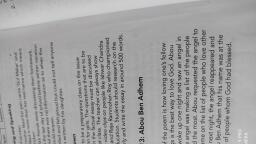
9. Abou Ben Adhem, Leigh Hunt, ASSIGNMENTS, I. (i) Refer to The Real Abu Ben Adhem, under Critical Remarks, section Page 137. The phrase "may his tribe increase" means, that there should be more people like Abou Ben Adhem in this, world. The narrator admires and respects Abou Ben Adhem., Scanned by TapScanner
Page 2 :
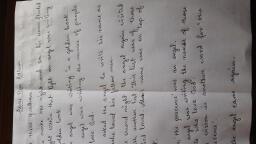
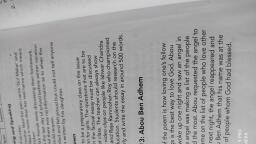
Abou Ben Adhem, 25, (ii) Refer to Notes Section, Page 135. He is at peace as he loves, and serves his fellowmen., (iii) The bright silvery moonlight in Abou's room on a peaceful night, had a magical effect. The room appeared rich and calm., The comparison is made to reflect the similarities between, blossoming lily and the sparkling moonlight. The flower and, the moonlight both are natural, beautiful and pleasing to the, eyes. They fill one with peace and are the symbols of purity, and radiance., (iv) When Abou wakes up he finds his room brightened with, moonlight and an angel writing something in "a book of gold"., The "book of gold" is significant as it adds to the magical and, supernatural quality of the poem. Moreover gold could also be, a symbol purity of the subject matter of the book., (v) The angel visits Abou again the next night with "a great wakening, light." The angel shows him the names of those who had been, blessed by God, Abou Ben Adhem sees that his name appears, at the top, ahead of others., (i) The presence in the above extract is referred to the angel who, woke Abou from his "deep dream of peace". Abou asked the, II., presence in his room, what was he writing., (ii) The vision here refers to the angel, or could be Abou's supernatural, vision., The vision raises its head to answer Abou's query about what, was he writing in his book of gold., (iii) The angel tells Abou that he is writing in his book the names, of all those who love the Lord., (iv) Abou curiously asks the angel if his name was written among, those who love the Lord. The angel replied to him in the negative, which made Abou feel low., (v) Abou feels a little low but only for a moment. The words "cheerly", tells us this. Abou cheerfully requests the angel to write his, name as the one who loves his fellow men., III. (i) The angel might have written Abou's name as one who loves, his fellow men., Refer to Lines 15-18, under The Poem in detail, Page 135., (ii) Abou Ben Adhem was a pure and simple man. He lived on, humanistic ideals. He is the epitome of the idea that when you, love your fellow men, you become worthy to be loved by God., Scanned by TapScanner
Page 3 :
Moreover he was a positive man. On realising that his name, was not there on the list of men who love the Lord, he was, not disheartened, but cheerfully asked the angel to write his, name the as the one who loves his fellow-men., (iii) (a) The line is a reference to the angel's second visit to Abou's, room. His first visit filled Abou's room with moonlight and the, second time his visit is accompanied by "a great wakening light.", (b) This is the last line of the poem. The angel appears the, next night and with a new set of names of people who have, been blessed by God with Ben Adhem's name on top of the, list. The word lo' adds to the climax., (iv) The angel shows Abou the names of people loved by God. Refer, to Climax, under Style section, Page 137., (v) Refer to True Devotion to God, under Themes section, Page 135., Scanned by TapScanner