Notes of JEE-NEET-VKP-CLASSES, Chemistry Interface Chemistry - Study Material
Page 1 :
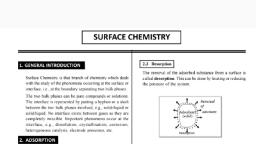
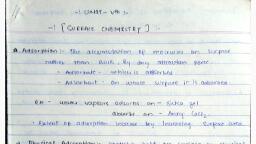
SURFACE CHEMISTRY, , , , Terms Related to Adsorption and Absorption, , * Adsorption : The accumulation of molecular species at the surface rather than bulk of solid, or liquid is known as adsorption., , + Adsorbate : The molecular species or substance which accumulates at the surface is known, as adsorbate., , + Adsorbent : The surface at which accumulation of adsorbate takes place is known as, adsorbent., , Ex : Water vapours (adsorbate) adsorb at the surface of silica gel (adsorbent)., , + Desorption : The process of removing an adsorbed substance from adsorbent is known as, desorption. When equilibrium is established then rate of adsorption and rate of desorption, are equal., , + Absorption : When atoms, molecules or ions enter in bulk phase of solid or liquid is known, as absorption., , Ex. Water vapours absorbed by anhydrous CaCl)., , + Sorption : When adsorption and absorption takes place simultaneously then phenomena is, known as sorption., , Ex. Dyeing of fabric, , Characteristics of Adsorption, + Adsorption is surface phenomena., « In adsorption enthalpy decreases., + In adsorption entropy decreases., « When decrease in free energy takes place then adsorption takes place.
Page 2 :
Types of Adsorption, , (1) Based on concentration :, * Positive adsorption : If the concentration of adsorbate is more at the surface as compared, to its concentration in the bulk phase then it is called positive adsorption, + Negative adsorption : If concentration of adsorbate is less at the surface a, its concentration in the bulk phase then it is called negative adsorption, , (2) Based on forces existing between adsorbate molecule and adsorbent :, , + Physical adsorption : If the forces of attraction existing between adsorbate and, , adsorbent are vander Waal’s forces, then adsorption is called physical adsorption., , + Chemical adsorption : If the forces of attraction existing between adsorbate particles, and adsorbent are almost of the same strength as chemical bonds then adsorption is, called chemical adsorption., , Comparison between physisorption and chemisorption, , s compared to, , , , , , , , , , , , , , , , , , , , , , S.No. Physisorption Chemisorption, , 1. |Low heat of adsorption usually in range of|High heat of adsorption in the range of, 20-40 kJ/mol. 80-240 kJ/mol., , 2. | Forces of attraction are vander Waal’s forces. Forces of attraction are chemical bond forces., , 3. {It is reversible in nature. It is irreversible in nature., It usually takes place at low temp and it decreases|It takes place at high temperature and it increase, with increasing temp. with increasing temperature., , 5. |More easily liquefiable gases are adsorbed readily. |Gases which can react with the adsorbent show, , chemisorption., , 6. —_|It forms multimolecular layers. It forms monomolecular layer., , 7. {It does not require any activation energy. It requires activation energy., , 8. | It is not specific. It is highly specific., , 9. It increases with increase the surface area of|It also increases with increase the surface area of, , , , adsorbent. adsorbent., , , , , , , , , , Factors Affecting Adsorption, + Nature of the gas : Easily liquefiable gases adsorb to greater extent., + Effect of nature of adsorbent : When adsorbent is activated then extent of adsorption, increases., + Specific area of the solid : Greater the specific area of the solid, greater would be its, adsorbent power., , + Effect of pressure of the gas : The adsorption causes a net decrease in pressure as the gas, gets adsorbed and thus the increase in pressure favours the process of adsorption.
Page 3 :
Adsorption Isotherm, Graph between extent of the adsorption | z & pressure (P) at a given temperature is called, \m, , adsorption isotherm. There are two types of adsorption isotherms, , x, (i) Freundlich Adsorption isotherm : a ™*P, , /, Freundlich’s Equation ~ =k xP!" | / Xap, ae x, ™m, , , , where x = mass of adsorbate adsorbed, m = mass of adsorbent, p = pressure, , + At low pressure : x =kxp, m, + At intermediate pressure : ~ =k«P!",wheren> 1, m, + At high pressure : ~* — constant, m, , log log k + Plog, m n, , , , wee, , (ii) Langmuir Adsorption isotherm : According to Langmuir, * There is adsorption of gas molecules on the surface of the solid., + There is desorption of the adsorbed molecules from the surface of the solid., + There is formation of unimolecular layer and so it is chemisorption, + A dynamic equilibrium is attained when rate of adsorption = rate of desorption., eee ai, m 1+ bp, Where a & b Langmuir parameters. | A, x, m, , B Cc, , Case-I At very high pressure, , bp >>> 1,, , Xap id, , — =— =— =constant, , m bp b oO p—, Case-II At very low pressure, , bp <<<1, , —=ap, m, , Adsorption Isobar, , Graph between extent of the adsorption [ 2 T ata given pressure is called adsorption isobar., m
Page 4 :
‘ ‘ F e rises., A physical adsorption isobar shows a decrease in x/m as the temperatur, , (a) Physical adsorption T —>, Physical adsorption isobar, , ie t : : : ie the, The isobar of chemisorption shows an increase in the beginning and then decrease as, temperature rises,, , 3\x ——>, , (b) Chemisorption T —»>, Chemical adsorption isobar, , Application of Adsorption, +, , Activated charcoal is used in gas masks to remove poisonous gases such as CH 4, CO etc., *, , Animal charcoal is used as decolorizer in manufacture of sugar., Silica gel is used for removing moisture and controlling humidity., , * Some industrial processes take place in the presence of catalysts which are based upon, adsorption., , ?, , + Chromatographic purification of compounds which is based upon adsorption., , The ion exchange resins used for removing hardness of water are also based upon adsorption., Catalyst, , 1, Catalyst : A substance which influence the rate of r, remains unchanged in amount a well as in composition., , * Positive catalyst : The catalyst which increase the rate of chemical reaction is known as, positive catalyst. Fe act as positive catalyst in following reaction., , N, +3H, — 5 2NH,, , + Negative catalyst : The catalyst which decrease the rate, negative catalyst. C,H, , >, , eaction is known as catalyst provided it, , of chemical reaction is known as, 5OH act as negative catalyst in following reaction., , CHCl, + 0 £2498, coc, + HCl, , + Auto catalyst : When one of product act as catalyst then such type of catalyst is known as, auto catalyst. Mn** act as auto catalyst in following reactions, , 2MnO; +5C,0% +16H* —> 2Mn** +10C0, +8H,0, , 2. Catalyst promoters : Substance which increase the activi, , ty of catalyst is known as catalyst, promoters. Mo act as catalyst promoters in following reaction.
Page 5 :
N, +3H; —2 > 2NH, ;, , 3. Homogeneous catalytic reaction : If catalyst is present in same phase as reacta, then it is called homogenous catalytic reaction., 280 2(g) + 02(g) 2) 5 280,(g), 4. Heterogeneous catalytic reaction : If catalyst is present in different phase as reacta, then it is called heterogenous catalytic reaction., N2(g) + 3H(g) "5 2NH,(g), 5. Adsorption theory of heterogeneous catalysis : The mechanism —, heterogenous catalysis involves the following steps :, Adsorption of reactant molecules on the catalyst surface., Occurrence of a chemical reaction through the formation of an intermediate., Desorption of products from the catalyst surface., Diffusion of products away from the catalyst surface., , *, , o +, , °, , Enzyme Catalyst, Complex nitrogenous compounds which are produced by living plants and animals are know, as enzymes. The characteristic features of enzyme catalyst are :, + They are highly efficient., + They are highly specific in nature., + They are highly active under optimum temperature., + They are highly active under optimum pH., + There is increase in their activity in the presence of activators and coenzymes., They are influenced by inhibitors and poisons., , Invertase, , Cj9H 9.01, + H gO SS > C6H 206+ C6H 1206, , *, , Glucose Fructose, Maltase, C12H 220), +H,0 —S“* > 2C,H 1.06, Glucose, Diastase, (CH 905), +nH,0 —S"* 5 C,,H01, Starch Maltose, , CgH1,0, —“™* > 2C,H,OH + 2C0,, Glucose, Mechanism of Enzyme Catalysis, , Step 1 : Binding of enzyme to substrate to form an activated complex E + S —-> ES, Step 2 : Decomposition of the activated complex to form products ES —> E +P, , Colloids, , Depending on size of particles mixture are divided into three classes :, , + True solution : In true solution size of particles is less than 1 nm., , + Suspension : In suspension size of particles is greater than 1000 nm., , + Colloidal solution : In colloidal solution size of particles lies from 1 nm to 1000 nm., It consists two phase i.e., dispersed phase and dispersion medium.



 Learn better on this topic