Page 2 :
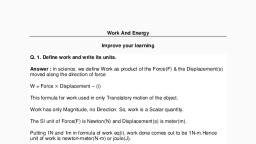
Introduction, ▪, , Introduction to work, , ▪, , As you all know, in daily routine we do a lot of work like cooking, bathing, studying, carrying bag and lots more. But do you know, that actually all of these do not fall in the category of work but are activities. In this chapter we will try to learn a lot about work., , ▪, , Work is said to be done only when applied force produces motion. This means that for work to be done, one needs to apply force, and motion has to be produced in a body., , ▪, , For example : While we are studying, we are using our intelligence but neither we are applying motion nor motion is caused. So,, this doesn’t fall in the category of work. Likewise, if we are pushing a wall, we are applying force (that is the reason our hands start, paining after sometime), but the motion is not produced in the body. So, again, no work is done. Now, if you are playing with your, friend and you push him and he falls. This comes in the category of work because in this, force is also applied while pushing and, motion is also produced (as he falls)., , ▪, , Definition of work, , ▪, , Work can be defined as: Work is done when force is applied which causes displacement in the body in its own direction., Factors on which force depends, W∝F, W ∝ S (Displacement)., Or W ∝ F.S, W = k .F. S, Where k is constant and its value is = 1., Work is a scalar quantity as it specifies only magnitude not direction.
Page 3 :
Expressions to calculate work, ▪ Expression for work done against gravity, , If we pick or drop anything, it falls to the ground. Like a child drops the ball on the ground or a person lifts the bucket from well. So, in this case, work is done in, response to gravity. So, in this case the expression to calculate work is given by:, W = m*g*h, This is obtained by substituting the value of force as mass and acceleration and distance as height. Therefore, the relation becomes W= mgh (where m=mass,, g=acceleration due to gravity and h=height to which the body is raised or dropped)., ▪, , Expression for work done when the force makes an angle with the direction of displacement, , ▪, , Suppose the child is playing with a toy where he is pulling it with the help of a string. Now, in this case, the force is applied on a string and displacement is caused in it due to, force applied., In this case, we have to consider an angle also which force makes with the ground or with the direction of displacement, which is usually taken in terms of theta. So,, expression for work becomes:, W=FScos θ, , ▪, , Now, the value of work depends upon the magnitude of angle. Accordingly, it can be maximum or minimum. Like if angle is 0⁰ then:, W=FScos0⁰, Therefore, W=FS (because cos 0⁰ = 1), , ▪, , Likewise, if angle is 90⁰ then, the work done is :, W=FScos90⁰, Therefore, W =0 (because cos 90⁰ = 0), , ▪, , Please note:, , •, , work done is maximum, when θ = 0⁰, , •, , Work done is minimum, when θ =90⁰
Page 4 :
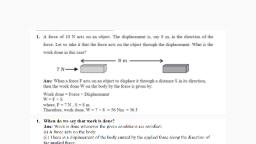
Unit of work, ▪ As we know, every physical quantity is, measured in specific kind of unit., Likewise, the S.I. unit of work is Joule., We know, W = F .S, ▪ So, 1 joule = 1 Newton x 1 meter or 1, nm, We can define 1Joule as: “Work is said to, be 1 joule when 1 Newton of force acts, on a body and causes displacement of, 1m in its own direction”., The bigger units of work are gigajoule,, megajoule, etc., Let us see the relation between joule,, megajoule and kilojoule, 1 GJ = 109 J, 1MJ = 106 J, This Photo by Unknown Author is licensed under, CC BY
Page 5 :
Title and Content Layout with SmartArt, , Now, if we focus on its types, we have three different kinds of, work depending upon the direction of displacement in, accordance with force., As you all have observed that if we kick a ball, it goes in the, direction in which it is being kicked., Similarly, if you notice, while walking on the floor, one foot, pushes the ground backward and the other moves forward., This is how we move. But you are familiar that for walking,, running, etc we need to apply force. The reason is that the, ground doesn’t allow us to move because of the frictional force, (opposing force that comes into play when two bodies are, rubbed with each other)., Similarly, if the coolie carries the load on his head and moves, on the platform. In this case also, force is applied but it is at a, certain angle with the direction of displacement (angle is 90⁰)., Accordingly, we have three different kinds of work:, , Positive work, Negative work, Zero work., Positive work: when force applied causes displacement of body, in its own direction. Like pushing of door, kicking football, etc., Negative work: when applied force causes displacement of, body in its opposite direction. Example : In case of friction., W = – F x S (negative work is done)., , Zero work: It is done when force acts at a right angle to the, direction of displacement., That is: W=FScos θ, W=0, Now if you wonder that work done is zero when a person, carrying suitcase vertically in hand walks in a horizontal, direction. This is because the angle between the direction of, force and the direction of displacement is 90o., We know:, W = F. S cos θ, W= F .S cos 90o, W=F.S.0, W=0, Similarly, for a body moving in a circular path, the work done is, zero due to similar reasons.
Page 6 :
Work and Energy, Part 2- Energy
Page 7 :
Energy, Introduction, , Types of Energy, , ▪ As we have already discussed that we, need to do a lot of work and for doing, work we need strength and that, strength comes from the food we eat., For example, if you need to ride a, bicycle, you need to paddle it and for, paddling you need to do work and for it, you need strength which comes from, food.The strength here refers to energy., So, we can define energy as: energy is, the ability to do work., , ▪ Energy is of different types like a machine, produces mechanical energy, the heating, devices produce heat energy, bulb, etc, produce light energy. So, we actually come, across different forms of energy. The, common form that we are going to consider, here is Mechanical Energy. Let us check it out., , • It is a scalar quantity., • It depends upon work therefore. its unit, is the same as that of work that is Joule., , ▪ Mechanical energy: It is the energy possessed, by a body due to its position or motion., Suppose you notice a book lying on a table., Do you think it possesses any kind of energy?, Yes, it does and that is the energy due to its, position, called potential energy., Likewise, if we notice a girl riding a bicycle or, a car moving on the road, they all are moving, so, they possess energy due to motion that is, kinetic energy.
Page 8 :
Mechanical energy: potential and kinetic energy, ▪ Types of mechanical energy, , • Potential energy, • Kinetic energy, ▪ We can define both as:, 1. Potential energy is the energy possessed by a body by virtue of its position., It is given by the following relation:, P.E. = m g h, Please note: All bodies or objects possess potential energy due to their, position., ▪ 2. Kinetic energy is the energy possessed by a body by virtue of its motion., Example: A speeding train, flowing water, etc.
Page 9 :
Derive expression for kinetic energy
Page 10 :
Law of conservation of energy, ▪, , According to it, Energy can’t be created nor be destroyed but can be converted from one form to another, but the total energy of a system remains constant., , ▪, , Suppose a ball is lying at a height. We know that due to position, it possesses potential energy. Now, due to any reason, it falls down, so, its potential energy gets converted to, kinetic energy. It has been observed that the total energy remains the same only the form of energy changes., , ▪, , Explanation – A theoretical example to illustrate the law of conservation of energy, , ▪, , Consider a body of mass m at a right of h, held by a person. Let the body be released such that it falls freely under the acceleration due to gravity g. Let us consider the total, energy possessed by the body at the height h from the ground level and at the ground level. Let v be the final velocity of the body on reaching the ground level., , ▪, , Case (i) when the body is at a height of h from the ground level., , ▪, , As the body is stationary, its velocity is zero., , ▪, , P.E. = mgh, , ▪, , :. Total energy of the body = P.E. + K.E. = mgh + 0 = mgh, , ▪, , Case (ii) When the body just reaches ground level and its height is zero., , ▪, , Let us calculate the velocity of the freely falling body at ground level., , ▪, , V2 = u2 + 2gh, , ▪, , As initially the body is at rest, therefore u2 = 0, , ▪, , :. V2 = 2gh, , ▪, , P.E. = mgh = m x g x 0 = 0, , ▪, , :. Total energy of the body = P.E. + K.E. = 0 + mgh = mgh.
Page 11 :
Example of conservation of energy, 1., When hands are rubbed, the mechanical energy of hands changes into, heat energy due to friction., 2., When two stones are struck, the mechanical energy changes into heat, energy and sound energy, due to friction., 3., When the blade of a knife is placed against the rotating grinding stone,, the mechanical energy change into heat, light and sound energies., 4., When the brakes are applied on any moving vehicle, the mechanical, energy changes into heat energy as the brakes rub against the moving, wheels., 5., When we wind a watch, the mechanical energy of hands change into, potential energy of the spring. When the spring unwinds, the potential, energy changes into kinetic energy and drives the hands of the clock., 6., When an arrow is stretched in a bow the mechanical energy changes, into potential energy. On releasing the string of the bow, the potential, energy changes into kinetic energy of the arrow., 7., Water stored in hydroelectric dams has potential energy. When this, water is released, the potential energy changes into kinetic energy of the, flowing water. The kinetic energy of the flowing water turns the blades of a, turbine and drives the dynamo. The dynamo then produces electrical, energy., 8., When a torch is switched on, the chemical energy of the cell changes, into electrical energy, The electrical energy, on passing through the filament, of a bulb, changes into heat energy and light energy., 9., In an electromagnet, electrical energy changes into magnetic energy., 10. The electrical energy, on flowing through the coils of an electric motor, or an electric fan, changes into mechanical energy. It partly changes into, heat energy and hence, heats the coils., 11. In microphone, the sound energy changes into electrical energy., 12. Electrical energy, on flowing through the speaker of an audio system,, changes into sound energy., , ▪, , 13. In electric heaters, electric ovens and geysers, the electrical energy, changes into heat energy., 14. In a locomotive, the chemical energy of coal changes into heat, energy. The heat energy then changes into kinetic energy of steam which, drives the locomotive., 15. In an electric generator, the mechanical energy changes into, electrical energy., 16. In a photovoltaic cell, the light energy changes into electrical energy., 17. In television the electrical energy changes into light energy and, sound energy., 18. On burning the fuels, their chemical energy changes into heat, energy and light energy., 19. When a match stick is rubbed against the side of a match box, the, chemical energy changes into heat energy and light energy., 20. When a cracker is exploded, the chemical energy (stored in the, chemical used in the cracker) changes into heat, light and sound, energies., 21. During photosynthesis, light energy changes into chemical energy in, the presence of chlorophyll., 22. During respiration the chemical energy of food changes into heat, energy. It is the heat energy which keeps our bodies warm. It is also the, heat energy which changes into mechanical energy during locomotion., 23. During charging of a battery the electrical energy changes into, chemical energy., 24. During nuclear fission or fusion, it is the nuclear energy which, ultimately changes into heat energy and light energy.
Page 12 :
Power and units, , ▪, , You must have noticed that whenever we buy a bulb or, any electrical appliance we ask for 60W, 100W etc .this, reading is Power .All the electrical appliances possess, certain power which actually shows how much energy it, will consume in a given time., , ▪, , So, Power is defined as the rate of doing work., , ▪, , Or P=W/T, Power is a scalar quantity., Unit is Watt., 1Watt= 1Joule/1second., , ▪, , Power is said to be 1Watt: When 1 joule of work is done, in 1 second., Bigger units of power are:, GW= 109 watts, MW= 106 watts., Older unit is HorsePower =746 Watts, , ▪ If we need to calculate electric energy, consumed by an electrical appliance, we can, calculate by :, E= n PT, Where n specifies the same kind of appliance, with same power and same working hours, Then commercial unit of energy is KWhr, ▪ You must have seen your home electricity bill,, and the bill that we get is like 45 units, 100, units so on. Those units are actually KWhr, 1KWhr= 1 unit, , ▪ We can also relate kW hr with joule as follows1 kWhr= 3.6 x 10⁶ J or 3.6 MJ, 1 kWhr = 1 unit of electricity.
Page 13 :
13th Jan 2022