Notes of UPSC CSE, Polity & History & Geography & Economics UPSC-IAS-Syllabus.pdf, - Study Material
Page 2 :
UPSC IAS EXAM, SYLLABUS + FAQ, BY © IASEXAMPORTAL.COM, CONTENTS, UPSC IAS EXAM SYLLABUS, SYLLABUS FOR CIVIL SERVICES PRELIMINARY EXAMINATION, , 4, 4, , PLAN OF IAS EXAMINATION, , 4, , 1. Scheme and subjects for the Preliminary and Main Examinations, , 5, , 2. List of optional subjects for Main Examination:, , 6, , General Instructions (Preliminary as well as Main Examination), , 8, , Visual Impairment Rules, , 8, , C. Interview test, , 9, , Syllabus for PRELIMINARY Examination, , 10, , Paper I (GENERAL STUDIES) - (200 marks), , 10, , Paper II (CSAT) - (200 marks), , 10, , Syllabus for MAIN Examination, , 10, , QUALIFYING PAPERS ON INDIAN LANGUAGES AND ENGLISH, , 11, , General Studies-1:, , 11, , General Studies-2:, , 12, , General Studies-3:, , 13, , General Studies-4:, , 14, , Optional Subject : Papers I & II, , 15, , ABOUT THE CIVIL SERVICES EXAMINATION, , 16, , NATURE OF THE EXAM, , 16, , WHAT IS UPSC?, , 17, , ALL INDIA SERVICES, , 18, , INDIAN ADMINISTRATIVE SERVICE (IAS), , 18, , INDIAN POLICE SERVICE (IPS), , 19, , INDIAN REVENUE SERVICE (IRS), , 20, , INDIAN RAILWAY SERVICES (IRAS), , 20, , THE INDIAN FOREST SERVICE (IFOS), , 21, , TRAINING, , 21, , CIVIL SERVANTS: PAY SCALES, , 21, , Centres of Civil Services (Preliminary) Examination, , 22, , Centres of Civil Services (Main) Examination:-, , 23, , Eligibility Conditions:, , 24
Page 3 :
Study Material for IAS Exams, https://iasexamportal.com/study-kit, , Age Limits:, , 24, , Number of Attempts, , 25, , CIVIL SERVICES AS A CAREER, , 26, , WHAT ARE THE PROSPECTS FOR ENGINEERING & SCIENCE STREAM STUDENTS?, , 26, , SALARY OF IAS OFFICER, , 26, , PERKS, BENEFITS & FACILITIES ENJOYED BY IAS OFFICERS, , 27, , NATURE OF WORKS, , 27, , GENERAL STRATEGY OF CIVIL SERVICES EXAM, , 28, , CHOOSING CIVIL SERVICES AS A CAREER GOAL, , 28, , Selection of Optional Subjects, , 28, , SELECTION OF MEDIUM OF EXAM, , 30, , IMPORTANCE OF GENERAL STUDIES, , 30, , TAKING YOUR FIRST ATTEMPT, , 30, , TAKING YOUR FURTHER ATTEMPTS, , 30, , GETTING STARTED FOR CIVIL SERVICES EXAMINATION, , 31, , CIVIL SERVICES: WHAT,WHY AND HOW CIVIL SERVICES: AN OVERVIEW, , 31, , IAS PRE: The Right Approach, , 33, , IAS PREPARATION FOR UNDERGRADUATE & CBSE STUDENTS, , 35, , Old Vs. New NCERT: Why the Confusion??, , 43, , PREPARING FOR CIVIL SERVICES WITHOUT COACHING, PREPARING FOR CIVIL SERVICES PRELIMINARY EXAMINATION, , 48, 51, , PAPER-1 GS: THE OCEAN OF GYAAN, , 51, , THE ROLE OF CSAT: THE DARK-KNIGHT, , 52, , TOWARDS VICTORY, , 53, , Frequently Asked Questions (FAQs) and Answers, , 54, , THE HINDU NEWSPAPER: HOW AND WHAT TO STUDY IN IT, , 55, , 9 STEP STRATEGY TO PREPARE FOR THE UPSC INTERVIEW, , 58, , IMPORTANCE OF ECONOMIC SURVEY FOR UPSC EXAMS, , 60, , IMPORTANCE OF YOJANA, KURUKSHETRA MAGAZINE, , 61, , (ARTICLE) CRACK IAS PRELIMINARY IN YOUR FIRST ATTEMPT, , 63, , CIVIL SERVICES: WHAT, WHY AND HOW?, , 65, , IMPORTANCE OF NCERT BOOKS FOR UPSC EXAMS, , 68, , HOW TO READ A NEWSPAPER FOR IAS EXAM, , 70, , www.IASEXAMPORTAL.COM, , UPSC IAS EXAM SYLLABUS + FAQ, , 2
Page 4 :
Study Material for IAS Exams, https://iasexamportal.com/study-kit, , WHAT ARE THE IMPORTANT TOPICS TO READ FROM A NEWSPAPER IN TWO HOURS?, , 71, , MORE TIPS, Choosing UPSC Optional Subject Papers, , 72, 72, , Detailed Road Map for GS (Pre.), , 73, , © IASEXAMPORTAL.COM, , www.IASEXAMPORTAL.COM, , UPSC IAS EXAM SYLLABUS + FAQ, , 3
Page 5 :
Study Material for IAS Exams, https://iasexamportal.com/study-kit, , UPSC IAS EXAM SYLLABUS, , SYLLABUS FOR CIVIL SERVICES PRELIMINARY EXAMINATION, Section-I, , PLAN OF IAS EXAMINATION, 1. The competitive examination comprises two, successive stages:, a. Civil Services (Preliminary) Examinations, (Objective Type) for the selection of, candidates for Main Examination; and, b. Civil Services (Main) Examination (Written, and Interview) for the selection of, candidates for the various services and, posts., 2. The Preliminary Examination will consist of two, papers of Objective type (multiple choice, questions) and carry a maximum of 400 marks in, the subjects set out in subsection (A) of, Section-II. This examination is meant to serve as, a screening test only; the marks obtained in the, , www.IASEXAMPORTAL.COM, , Preliminary Examination by the candidates who, are declared qualified for, admission to the Main Examination will not be, counted for determining their final order of merit., The number of candidates to be admitted to the, Main Examination will be about twelve to thirteen, times the total approximate number of vacancies, to be filled in the year in the various Services and, Posts. Only those candidates who are declared by, the Commission to have qualified in the, Preliminary Examination in the year will be eligible, for admission to the Main Examination of that, year provided they are otherwise eligible for, admission to the Main Examination., 3. Candidates who obtain such minimum, qualifying marks in the written part of the Main, Examination as may be fixed by the Commission, at their discretion, shall be summoned by them, for an interview for a Personality Test vide, subsection ‘C’ of Section-II. Marks obtained in the, , UPSC IAS EXAM SYLLABUS + FAQ, , 4
Page 6 :
Study Material for IAS Exams, https://iasexamportal.com/study-kit, , papers will be counted for ranking. The number of, candidates to be summoned for interview will be, about twice the number of vacancies to be filled., Marks thus obtained by the candidates in the, Main Examination (written part as well as, interview) would determine their final ranking., Candidates will be allotted to the various Services, keeping in view their ranks in the examination and, the preferences expressed by them for the, various Services and Posts., Section-II, , The written examination will consist of the, following papers:, PAPER I, Section 1, , Essay, , 200 Marks, , Section 2, , English, Comprehension &, English Precis (Of, Matriculation/ Xth, standard level), , 100 Marks, , PAPER II, , 1. Scheme and subjects for the, Preliminary and Main Examinations, A. Preliminary Examination, The Examination shall comprise two compulsory, papers of 200 marks each., Note:, a. Both the question papers will be of the, objective type (multiple choice questions), and e, ach will be of two hours duration., b. The General Studies Paper-II of the Civil, Services (Preliminary) Examination will be, a qualifying paper with minimum, qualifying marks fixed at 33%., c. (The question papers will be set both in, Hindi and English. However, questions, relating, to, English, Language, Comprehension skills of Class X level will, be tested through passages from English, Language only without providing Hindi, translation thereof in the question paper., d. Details of the syllabi are indicated in Part, A of Section III., , General Studies - I (Indian, Heritage and Culture, History, and Geography of the World, and Society), , 250 Marks, , PAPER III, General Studies - II, (Governance, Constitution,, Polity, Social Justice and, International relations), , 250 Marks, , PAPER IV, Paper-IV General Studies - III, (Technology, Economic, Development, Biodiversity,, Environment, Security and, Disaster Management), , 250 Marks, , PAPER V, General Studies - IV (Ethics,, Integrity and Aptitude), , 250 Marks, , PAPER VI, , B. Main Examination, , www.IASEXAMPORTAL.COM, , UPSC IAS EXAM SYLLABUS + FAQ, , 5
Page 7 :
Study Material for IAS Exams, https://iasexamportal.com/study-kit, , Optional Subject - Paper 2, , 250 Marks, , PAPER VII, , Gujarati, , Gujarati, , Kannada, , Kannada, , Optional Subject - Paper 2, , 250 Marks, , Kashmiri, , Persian, , Sub Total (Written test), , 1800 Marks, , Konkani, , Devanagari, , Personality Test, , 275 Marks, , Manipuri, , Bengali, , Grand Total, , 2075 Marks, , Malayalam, , Malayalam, , Sindhi, , Devanagari or Arabic, , Marathi, , Devanagari, , Nepali, , Devanagari, , Oriya, , Oriya Punjabi, , Gurumukhi Sanskrit, , Devanagari, , Tamil, , Tamil Telugu, , Telugu Urdu, , Persian, , Bodo, , Devanagari, , Dogri, , Devanagari, , Maithili, , Devanagari, , Santhali, , Devanagari or Olchiki, , {Candidates may choose any optional subject, from amongst the list of subjects given in para 2, below (Group 1). However, a candidate can opt, for the literatures of a language, indicated in, Group-2 below para 2. as an optional subject, only, if the, candidate has graduated in the literature of that, particular of that particular language as the main, subject}, Note:, a. Marks obtained by the candidates for all, papers (Paper I-VII) will be counted for, merit ranking. However, the Commission, will have the discretion to fix qualifying, marks in any or all papers of the, examination., b. For the Language medium/ literature of, languages, the scripts to be used by the, candidates will be as under:Language, , Script, , Assamese, , Assamese, , Bengali, , Bengali, , Hindi, , Devanagari, , Note: For Santhali language, question paper will, be printed in Devanagari script; but candidates, will be free to answer either in Devanagari script, or in Olchiki., , 2. List of optional subjects for Main, Examination:, Group-1, , www.IASEXAMPORTAL.COM, , UPSC IAS EXAM SYLLABUS + FAQ, , 6
Page 8 :
Study Material for IAS Exams, https://iasexamportal.com/study-kit, , 1. Agriculture, 2. Animal Husbandry and Veterinary Science, 3. Anthropology, 4. Botany, 5. Chemistry, 6. Civil Engineering, 7. Commerce and Accountancy, 8. Economics, 9. Electrical Engineering, 10. Geography, 11. Geology, 12. History, 13. Law, 14. Management, 15. Mathematics, 16. Mechanical Engineering, 17. Medical Science, 18. Philosophy, 19. Physics, 20. Political, Science, and International, Relations, 21. Psychology, 22. Public Administration, 23. Sociology, 24. Statistics, 25. Zoology, Group-2, Literature of any one of the following languages:, Assamese, Bengali, Bodo, Dogri, Gujarati, Hindi,, Kannada, Kashmiri, Konkani, Maithili, Malayalam,, Manipuri, Marathi,, Note:, 1. The question papers for the examination, will be of conventional (essay) type., 2. Each paper will be of three hours duration., 3. Candidates will have the option to answer, all the question papers, except Section 2, of the Paper-I (English comprehension and, English précis) in English or Hindi. If the, , www.IASEXAMPORTAL.COM, , candidate has had his/ her graduation in, any of the following language mediums, using the particular language medium for, qualifying the graduate level examination,, then he/she may opt for that particular, language medium to answer all the, question papers, except Section 2 of the, Paper-I (English comprehension and, English précis). Assamese, Bengali, Bodo,, Dogri, Gujarati, Kannada, Kashmiri,, Konkani, Maithili, Malayalam, Manipuri,, Marathi, Nepali, Oriya, Punjabi, Sanskrit,, Santhali, Sindhi, Tamil, Telugu, and Urdu., 4. However, in the interest of maintaining the, quality and standards of examination, a, minimum number of 25 (twenty-five), candidates should opt for a specific, language medium for answering the, question papers in that language medium., In case there are less than 25 (twenty five), candidates opting for any approved, language medium (other than English or, Hindi), then those candidates will be, required to write their examination either, in Hindi or in English only., 5. Candidates exercising the option to, answer Papers in any one of the, languages mentioned above may, if they, so desire, give English version within, brackets of only the description of the, technical terms, if any, in addition to the, version in the language opted by them., Candidates should, however, note that if, they misuse the above rule, a deduction, will be made on this account from the, total marks otherwise accruing to them, and in extreme cases; their script(s) will, not be valued for being in an unauthorized, medium., , UPSC IAS EXAM SYLLABUS + FAQ, , 7
Page 9 :
Study Material for IAS Exams, https://iasexamportal.com/study-kit, , 6. The question papers (other than the, literature of language papers) will be set in, Hindi and English only., 7. The details of the syllabi are set out in Part, B of Section III., , General Instructions (Preliminary as, well as Main Examination), 1. Candidates must write the papers in their, own hand. In no circumstances, will they, be allowed the help of a scribe to write the, answers for them. However, blind, candidates will be allowed to write the, examination with the help of a scribe., Blind candidates will also be allowed an, extra time at each paper @ ten minutes, per hour., 2. An extra time of twenty minutes per hour, shall be permitted for the candidates with, locomotor disability and cerebral palsy, where dominant (writing) extremity is, affected to the extent of slowing the, performance of function (minimum of 40%, impairment) in the Civil Services (Main), Examination only. However, no scribe shall, be permitted to such candidates., Note 1: The eligibility conditions of a scribe,, his/her conduct inside the examination hall and, the manner in which and extent to which he/she, can help the blind candidate in writing the Civil, Services Examination shall be governed by the, instructions issued by the UPSC in this regard., Violation of all or any of the said instructions shall, entail the cancellation of the candidature of the, blind candidate in addition to any other action, that the UPSC may take against the scribe., , www.IASEXAMPORTAL.COM, , Note 2: For the purpose of these rules the, candidate shall be deemed to be a blind, candidate if the percentage of visual impairment, is 40% or more., The criteria for determining the percentage of, visual impairment shall be as follows :, , Visual Impairment Rules, All with corrections, Better, Eye, , Worse, Eye, , Percentage, , Category O, , 6/9-6/18, , 6/24 to, 6/36, , 20%, , Category I, , 6/18-6/36, , 6/60 to, nil, , 40%, , Category II, , 6/60-4/60, or field of, vision, 10-20°, , 3/60 to, nil, , 75%, , Category, III, , 3/60-1/60, or field of, vision 10°, , F.C at 1, ft to nil, , 100%, , Category, IV, , F.C. at 1, ft to nil, field of, vision, 100°, , F.C. at 1, ft to nil, field of, vision, 100°, , 100%, , One eyed, person, , 6/6, , F.C. at 1, ft to nil, , 30%, , Note 3: For availing of the concession admissible, to a blind candidate, the candidate concerned, shall produce a certificate in the prescribed, , UPSC IAS EXAM SYLLABUS + FAQ, , 8
Page 10 :
Study Material for IAS Exams, https://iasexamportal.com/study-kit, , proforma from a Medical Board constituted by, the Central/State Governments along with his, application for the Main Examination., Note 4:, 1. The concession admissible to blind, candidates shall not be admissible to, those suffering from Myopia., 2. The Commission have discretion to fix, qualifying marks in any or all the subjects, of the examination., 3. If a candidate’s handwriting is not easily, legible, a deduction will be made on this, account from the total marks otherwise, accruing to him., 4. Marks will not be allotted for mere, superficial knowledge., 5. Credit will be given for orderly, effective, and exact expression combined with due, economy of words in all subjects of the, examination., 6. In the question papers, wherever required,, SI units will be used., 7. Candidates should use only international, form of Indian numerals (i.e. 1,2,3,4,5,6, etc.) while answering question papers., 8. Candidates will be allowed the use of, Scientific, (Non-Programmable, type), Calculators at the conventional (Essay), type examination of UPSC. Programmable, type calculators will however not be, allowed and the use of such calculators, shall tantamount to resorting to unfair, means by the candidates. Loaning or, interchanging of calculators in the, Examination Hall is not permitted., It is also important to note that candidates are, not permitted to use calculators for answering, objective type papers (Test Booklets). They, should not therefore, bring the same inside the, Examination Hall., , www.IASEXAMPORTAL.COM, , C. Interview test, 1. The candidate will be interviewed by a, Board who will have before them a record, of his/her career. He/she will be asked, questions on matters of general interest., The object of the interview is to assess, the personal suitability of the candidate, for a career in public service by a Board of, competent and unbiased observers. The, test is intended to judge the mental calibre, of a candidate. In broad terms this is really, an assessment of not only his/her, intellectual qualities but also social traits, and his/her interest in current affairs., Some of the qualities to be judged are, mental alertness, critical powers of, assimilation, clear and logical exposition,, balance of judgement, variety and depth of, interest, ability for social cohesion and, leadership, intellectual and moral integrity., 2. The technique of the interview is not that, of a strict cross-examination but of a, natural, though directed and purposive, conversation which is intended to reveal, the mental qualities of the candidate., 3. The interview test is not intended to be a, test either of the specialised or general, knowledge of the candidates which has, been already tested through their written, papers. Candidates are expected to have, taken an intelligent interest not only in, their special subjects of academic study, but also in the events which are happening, around them both within and outside their, own state or country as well as in modern, currents of thought and in new discoveries, which should rouse the curiosity of well, educated youth., , UPSC IAS EXAM SYLLABUS + FAQ, , 9
Page 11 :
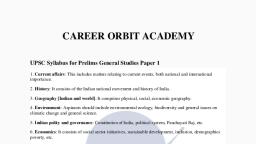
Study Material for IAS Exams, https://iasexamportal.com/study-kit, , ●, ●, , Section-III, , Syllabus for PRELIMINARY, Examination, The Examination shall comprise two compulsory, papers of 200 marks each., , Note 1 : Paper-II of the Civil Services (Preliminary), Examination will be a qualifying paper with, minimum qualifying marks fixed at 33%., , Paper I (GENERAL STUDIES) - (200, marks), Duration : Two hours, ●, , ●, , ●, , ●, , ●, , ●, , ●, , General mental ability, Basic numeracy (numbers and their, relations, orders of magnitude, etc.) (Class, X level), Data interpretation (charts,, graphs, tables, data sufficiency etc. - Class, X level), English Language Comprehension skills, (Class X level)., , Current, events, of, national, and, international importance. History of India, and Indian National Movement., Indian and World Geography - Physical,, Social, Economic Geography of India and, the World., Indian, Polity, and, Governance, Constitution, Political System, Panchayati, Raj, Public Policy, Rights Issues, etc., Economic and Social Development, Sustainable, Development,, Poverty,, Inclusion, Demographics, Social Sector, initiatives, etc., General issues on Environmental Ecology,, Biodiversity and Climate Change - that do, not require subject specialization., General Science., , Note 2 : The questions will be of multiple choice,, objective type., Note 3 : It is mandatory for the candidate to, appear in both the Papers of Civil Services, (Prelim) Examination for the purpose of, evaluation. Therefore a candidate will be, disqualified in case he/she does not appear in, both the papers of Civil Services (Prelim), Examination., , Syllabus for MAIN Examination, The main Examination is intended to assess the, overall intellectual traits and depth of, understanding of candidates rather than merely, the range of their information and memory., , Paper II (CSAT) - (200 marks), , The nature and standard of questions in the, General Studies papers (Paper II to Paper V ) will, be such that a well-educated person will be able, to answer them without any specialized study., , Duration: Two hours, ● Comprehension, ● Interpersonal, skills, including, communication skills;, ● Logical reasoning and analytical ability, ● Decision-making and problem-solving, , The questions will be such as to test a, candidate’s general awareness of a variety of, subjects, which will have relevance for a career in, Civil Services. The questions are likely to test the, candidate’s basic understanding of all relevant, , www.IASEXAMPORTAL.COM, , UPSC IAS EXAM SYLLABUS + FAQ, , 10
Page 12 :
Study Material for IAS Exams, https://iasexamportal.com/study-kit, , issues, and ability to analyze, and take a view on, conflicting socio- economic goals, objectives and, demands. The candidates must give relevant,, meaningful and succinct answers., The scope of the syllabus for optional subject, papers (Paper VI and Paper VII) for the, examination is broadly of the honours degree, level i.e. a level higher than the bachelors’ degree, and lower than the masters’ degree. In the case of, Engineering, Medical Science and law, the level, corresponds to the bachelors’ degree., Syllabi of the papers included in the scheme of, Civil Services (Main) Examination are given as, follows:-, , QUALIFYING PAPERS ON INDIAN, LANGUAGES AND ENGLISH, The aim of the paper is to test the candidates’, ability to read and understand serious discursive, prose, and to express his ideas clearly and, correctly, in E, nglish and Indian language, concerned., The pattern of questions would be broadly as, follows :, ● (i) Comprehension of given passages., ● (ii) Précis Writing., ● (iii) Usage and Vocabulary., ● (iv) Short Essays., Indian Languages:, ● (i) comprehension of given passages., ● (ii) Précis Writing., ● (iii) Usage and Vocabulary., ● (iv) Short Essays., ● (v) Translation from English to the Indian, Language and vice-versa., , www.IASEXAMPORTAL.COM, , Note 1: The papers on Indian Languages and, English will be of Matriculation or equivalent, standard and will be of qualifying nature only. The, marks obtained in these papers will not be, counted for ranking, Note 2: The candidates will have to answer the, English and Indian Languages papers in English, and the respective Indian language (except where, translation is involved)., , PAPER-I, Essay: Candidates will be required to write an, essay on a specific topic. The choice of subjects, will be given. They will be expected to keep, closely to the subject of the essay to arrange their, ideas in orderly fashion, and to write concisely., Credit will be given for effective and exact, expression., , PAPER-II, General Studies-1:, Indian Heritage and Culture, History, Geography of the World and Society., ●, , ●, , ●, , ●, , and, , Indian culture will cover the salient, aspects of Art Forms, Literature and, Architecture from ancient to modern, times., Modern Indian history from about the, middle of the eighteenth century until the, present- significant events, personalities,, issues, The Freedom Struggle - its various stages, and important contributors /contributions, from different parts of the country., Post-independence consolidation and, reorganization within the country., , UPSC IAS EXAM SYLLABUS + FAQ, , 11
Page 13 :
Study Material for IAS Exams, https://iasexamportal.com/study-kit, , ●, , ●, ●, , ●, ●, ●, ●, , ●, , History of the world will include events, from 18th century such as industrial, revolution, world wars, redrawal of, national, boundaries,, colonization,, decolonization, political philosophies like, communism, capitalism, socialism etc.their forms and effect on the society., Salient features of Indian Society, Diversity, of India., Role of women and women’s organization,, population and associated issues, poverty, and developmental issues, urbanization,, their problems and their remedies., Effects of globalization on Indian society, Social empowerment, communalism,, regionalism & secularism., Salient features of world’s physical, geography., Distribution of key natural resources, across the world (including South Asia, and the Indian sub- continent); factors, responsible for the location of primary,, secondary, and tertiary sector industries in, various parts of the world (including India), Important Geophysical phenomena such, as earthquakes, Tsunami, Volcanic, activity,, cyclone etc., geographical, features and their location- changes in, critical geographical features (including, water- bodies and ice-caps) and in flora, and fauna and the effects of such, changes., , ●, , ●, , ●, , ●, , ●, , ●, ●, , ●, ●, , PAPER-III, General Studies-2:, Governance, Constitution, Polity, Social Justice, and International relations., , www.IASEXAMPORTAL.COM, , ●, , Indian, Constitution, historical, underpinnings,, evolution,, features,, amendments, significant provisions and, basic structure., Functions and responsibilities of the, Union and the States, issues and, challenges pertaining to the federal, structure, devolution of powers and, finances up to local levels and challenges, therein., Separation of powers between various, organs dispute redressal mechanisms and, institutions., Comparison of the Indian constitutional, scheme with that of other countries, Parliament and State Legislatures structure,, functioning,, conduct, of, business, powers & privileges and issues, arising out of these., Structure, organization and functioning of, the Executive and the Judiciary Ministries, and Departments of the Government;, pressure groups and formal/informal, associations and their role in the Polity., Salient features of the Representation of, People’s Act., Appointment to various Constitutional, posts,, powers,, functions, and, responsibilities of various Constitutional, Bodies., Statutory,, regulatory, and, various, quasi-judicial bodies., Government policies and interventions for, development in various sectors and issues, arising out of their design and, implementation., Development, processes, and, the, development industry- the role of NGOs,, SHGs, various groups and associations,, donors, charities, institutional and other, stakeholders, , UPSC IAS EXAM SYLLABUS + FAQ, , 12
Page 14 :
Study Material for IAS Exams, https://iasexamportal.com/study-kit, , ●, , ●, , ●, ●, , ●, ●, ●, , ●, , ●, , Welfare schemes for vulnerable sections, of the population by the Centre and States, and the performance of these schemes;, mechanisms, laws, institutions and Bodies, constituted for the protection and, betterment of these vulnerable sections., Issues relating to development and, management of Social Sector/Services, relating to Health, Education, Human, Resources., Issues relating to poverty and hunger., Important, aspects, of, governance,, transparency, and, accountability,, e-governance, applications,, models,, successes, limitations, and potential;, citizens, charters,, transparency, &, accountability and institutional and other, measures., Role of civil services in a democracy., India and its neighborhood- relations., Bilateral, regional and global groupings, and agreements involving India and/or, affecting India’s interests, Effect of policies and politics of developed, and developing countries on India’s, interests, Indian diaspora., Important, International, institutions,, agencies and fora- their structure,, mandate., , ●, ●, ●, ●, , ●, , ●, , ●, ●, , ●, ●, ●, , PAPER-IV, General Studies-3:, , ●, , Technology,, Economic, Development, Bio, diversity, Environment, Security and Disaster, Management., , ●, , ●, , Indian Economy and issues relating to, planning, mobilization of resources,, growth,, , www.IASEXAMPORTAL.COM, , development and employment., Inclusive growth and issues arising from, it., Government Budgeting., Major crops cropping patterns in various, parts of the country, different types of, irrigation and irrigation systems storage,, transport and marketing of agricultural, produce, and issues and related, constraints; e-technology in the aid of, farmers, Issues related to direct and indirect farm, subsidies and minimum support prices;, Public Distribution System- objectives,, functioning, limitations, revamping; issues, of buffer stocks and food security;, Technology missions; economics of, animal-rearing., Food processing and related industries in, India- scope and significance, location,, upstream and downstream requirements,, supply chain management., Land reforms in India., Effects of liberalization on the economy,, changes in industrial policy and their, effects on industrial growth., Infrastructure: Energy, Ports, Roads,, Airports, Railways etc., Investment models., Science and Technology: developments, and their applications and effects in, everyday life., Achievements of Indians in science &, technology; indigenization of technology, and developing new technology., Awareness in the fields of IT, Space,, Computers, robotics, nano-technology,, biotechnology and issues relating to, intellectual property rights., , UPSC IAS EXAM SYLLABUS + FAQ, , 13
Page 15 :
Study Material for IAS Exams, https://iasexamportal.com/study-kit, , ●, , ●, ●, ●, ●, , ●, , ●, , Conservation, environmental pollution and, degradation,, environmental, impact, assessment., Disaster and disaster management., Linkages between development and, spread of extremism., Role of external state and non-state actors, in creating challenges to internal security., Challenges to internal security through, communication networks, role of media, and social networking sites in internal, security challenges, basics of cyber, security; money laundering and its, prevention., Security, challenges, and, their, management in border areas; linkages of, organized crime with terrorism, Various Security forces and agencies and, their mandate, , ●, , ●, , ●, , ●, ●, , PAPER-V, General Studies-4:, Ethics, Integrity, and Aptitude, This paper will include questions to test the, candidates’ attitude and approach to issues, relating to integrity, probity in public life and his, problem solving approach to various issues and, conflicts faced by him in dealing with society., Questions may utilise the case study approach to, determine these aspects. The following broad, areas will be covered., ●, , Ethics and Human Interface: Essence,, determinants and consequences of Ethics, in human actions; dimensions of ethics;, ethics in private and public relationships., Human Values – lessons from the lives, and teachings of great leaders, reformers, , www.IASEXAMPORTAL.COM, , ●, , ●, , and administrators; role of family, society, and educational institutions in inculcating, values., Attitude: content, structure, function; its, influence and relation with thought and, behaviour; moral and political attitudes;, social influence and persuasion., Aptitude and foundational values for Civil, Service , integrity, impartiality and, nonpartisanship, objectivity, dedication to, public service, empathy, tolerance and, compassion, towards, the, weakersections., Emotional intelligence-concepts, and their, utilities and application in administration, and governance., Contributions of moral thinkers and, philosophers from India and world., Public/Civil service values and Ethics in, Public, administration:, Status, and, problems; ethical concerns and dilemmas, in government and private institutions;, laws, rules, regulations and conscience as, sources, of, ethical, guidance;, accountability and ethical governance;, strengthening of ethical and moral values, in, governance;, ethical issues in, international relations and funding;, corporate governance., Probity in Governance: Concept of public, service; Philosophical basis of governance, and probity; Information sharing and, transparency in government, Right to, Information, Codes of Ethics, Codes of, Conduct, Citizen’s Charters, Work culture,, Quality of service delivery, Utilization of, public funds, challenges of corruption., Case Studies on above issues., , PAPER-VI and VII, , UPSC IAS EXAM SYLLABUS + FAQ, , 14
Page 17 :
Study Material for IAS Exams, https://iasexamportal.com/study-kit, , Optional Subject : Papers I & II, Candidates may choose any optional subject, from amongst the list of subjects given in para 2, (Group 1). However, if a candidate has graduated, in any of the literatures of languages indicated in, Group-2, with the literature as the main subject,, then the candidate can also opt for that particular, literature subject as an optional subject., CLICK ON SUBJECT LINK TO GET OPTIONAL, SYLLABUS, 1. AGRICULTURE, 2. ANIMAL HUSBANDRY AND VETERINARY, SCIENCE, 3. ANTHROPOLOGY, 4. BOTANY, 5. CHEMISTRY, 6. CIVIL ENGINEERING, 7. COMMERCE AND ACCOUNTANCY, 8. ECONOMICS, 9. ELECTRICAL ENGINEERING, , www.IASEXAMPORTAL.COM, , 10. GEOGRAPHY, 11. GEOLOGY, 12. HISTORY, 13. LAW, 14. MANAGEMENT, 15. MATHEMATICS, 16. MECHANICAL ENGINEERING, 17. MEDICAL SCIENCE, 18. PHILOSOPHY, 19. PHYSICS, 20. POLITICAL SCIENCE AND, INTERNATIONAL RELATIONS, 21. PSYCHOLOGY, 22. PUBLIC ADMINISTRATION, 23. SOCIOLOGY, 24. STATISTICS, 25. ZOOLOGY, , UPSC IAS EXAM SYLLABUS + FAQ, , 15
Page 18 :
Study Material for IAS Exams, https://iasexamportal.com/study-kit, , ABOUT THE CIVIL SERVICES EXAMINATION, , NATURE OF THE EXAM, Before taking any exam aspirants should, understand the very nature of exam, it will give, them a clear understanding about the exam, process, it exam structure and other aspects of, the exam, in all at the first stance we should, understand the exam and set our target and, strategy accordingly. It is a common trend that, UPSC issues notification in the first week of, December, (for the next exam year) in The, Employment News but we have seen last year, and this year also that it has published the, notification in FEB. For the clear understanding, and the whole exam one should studied complete, notification carefully. The notification can also be, downloaded from UPSC official website, www.upsc.gov.in, Every aspirant has its dream to become an IAS, officer, it is one of the coveted services in the, country, yes there are private sector which are, offering high perks and benefits but still Civil, Service has its own charm. Over the number of, , www.IASEXAMPORTAL.COM, , aspirants are very high and accordingly the, vacancies are very low, in any year of notification, the vacancies is only about 800-1000. So here to, understand the nature of the exam is significant., Aspirants before getting into the preparation, should be very sure about the prerequisites and, the requirements of the examination. As the, nature of the exam suggests that whole full time, preparation is required. The exam has its, competitiveness that comes with hard work., Aspirants needs to start there preparation at least, one year before for the first attempt, as the whole, exam process takes one year thus two year of, completely rigorous and devoted preparation, are very much required for the exam., Every competitive exam has its own nature,, understanding the nature of the exam is half way, towards the success. Our preparation should be, focused on what exactly examination expects, from the aspirants rather what aspirants expects, from the exam. The nature of exam suggests that, your preparation should be relative instead of, absolute. Aspirants are required to be better than, , UPSC IAS EXAM SYLLABUS + FAQ, , 16
Page 19 :
Study Material for IAS Exams, https://iasexamportal.com/study-kit, , the other aspirants. So before preparation I would, suggest the aspirants to have a clear idea and, understanding of the exam and contemplate, thoroughly. First of look yourself at evaluate that, are you fit for the job or not, if yes then go ahead., Read as much as you can for the understanding, of the exam, there are several articles, blogs are, available., Make a realistic assessment of the effort that is, required for the exam and put yourself, accordingly. Rational self assessment always, helps. Remember do not set you target which is, based on your past laurels and achievements as, this exam is not testing intelligence as defined in, the conventional sense. The exam is looking for, broad-based individuals with opinions. It is, important to know the exam, what is the nature of, the exam. For instance it is an All India Exam; it, has three tier, prelims, mains and Interview. What, is the exam process is also required to know, before opting to get into the preparation., Thus think twice before taking the plunge. But, make sure that once you have made the choice to, become an IAS, there should be no looking back., During the whole process you might face failure,, sometimes you will doubt your ability, may have, to start from square one after reaching up to the, last stage. Here is the real test of your mental, strengths rather than your intellectual abilities. In, one way or another the whole process of exam is, a life changing one, whether you come out, successful or unsuccessful. It matters a lot for, the life of yours and your loved ones. You have to, sail through each and every aspect of all these, events., At the same time it becomes essential to make a, realistic assessment of your potential otherwise, the optimum years of your career are lost in, , www.IASEXAMPORTAL.COM, , chasing a subtle target. It is advisable to prepare, yourself for the civil service in the graduation, years by identifying the weak and strong points, and familiarizing yourself with the syllabus and, pattern of examination. It is seen that those who, have taken the exam as soon as they become, eligible are better than then the others so it is best, to take the exam as soon as you are eligible., However here keep your other options open for, your career as a safety net., , WHAT IS UPSC?, HISTORICAL BACKGROUND: Indianisation of the, superior Civil Services became one of the major, demands of the political movement compelling, the British Indian Government to consider setting, up of a Public Service Commission for, recruitment to its services in the territory. The first, Public Service Commission was set up on, October 1st, 1926. The Constituent Assembly,, after independence, with the promulgation of the, new Constitution for independent India on 26th, January, 1950, this Public Service Commission, was accorded a constitutional status as an, autonomous entity and given the title - Union, Public Service Commission., , Constitutional Provisions: the UPSC is a, constitutional body in the sense that it is directly, created by the Constitution of India. It has been, established under Article 315 of the Constitution, of India. Usually, the Commission constitutes 9 to, 11 members including the Chairman., The UPSC is the central recruiting agency in India., The major role played by the Commission is to, select persons to man the various Central Civil, Services and Posts and Services common to the, , UPSC IAS EXAM SYLLABUS + FAQ, , 17
Page 20 :
Study Material for IAS Exams, https://iasexamportal.com/study-kit, , Union and States (viz. All-India Services). Under, the Constitution one of the functions of the, Commission is to conduct examinations for, appointment to Civil Services/Posts of the Union., The Commission usually conducts over a dozen, examinations every year on an all India basis., These include Examinations for recruitment to, services/posts in various fields, such as Civil, Services, Engineering, Medical and Forest Service,, etc., , ALL INDIA SERVICES, The recruitment to these services is made, through the UPSC on the basis of the annual civil, service exam, a competitive exam. Indian, Administrative Service (IAS), Indian Police, Service (IPS), Indian Forest Service (IFS) is, considered as All India Services while others, services recruited through this civil services exam, is known as Central Services. The officers of the, All India Services are recruited and trained by the, federal Union Government (“the Centre”) and, serve in the various State Government (“the, States”) as well as Centre (which is why the IRSis, a “central service” instead of an All India Service, as they work only in the Central Government)., Officers are organized into cadres, derived from, the states they are allotted to work in for as long, as they continue to be a member of the respective, Service. Twenty-four states have their own cadre,, but there are also three joint cadres: Assam,, Meghalaya, Manipur, Tripura, Mizoram and, Arunachal Pradesh, Goa, Union Territories., , INDIAN ADMINISTRATIVE SERVICE, (IAS), IAS is topmost service in the civil services exam., Among 100 vacancies only those who secure, , www.IASEXAMPORTAL.COM, , their position under could make into the IAS, service. IAS officers holds several key positions in, the government. During the normal course of an, IAS career, they are posted at the Sub-Division,, and District, and serve in the State Secretariat or, as Head of Departments. They might be posted in, the Centre., The work definition of an IAS officer would, encompass framing, modifying, interpreting and, Implementation of policy matters in the, Government of India (i.e. in the ministries)., Implementation entails disbursement of funds,, which calls for personal supervision. In each, Ministry you will supervise the allotment and, utilization of funds by the field officers in your, Ministry., Half of an IAS career has spent in the State where, they have allocated. During the initial year of two, years probation you will be attached to various, training schools, to the Secretariat and field, offices and to a district collector’s office. After, the completion of probation an IAS be appointed, as a Sub Divisional Magistrate (SDM). Here you, will look after law and order, general, administration,, revenue, work and such, developmental work as may be assigned to you., In the next three scales i.e.. Senior Scale, Junior, Administrative Grade and Selection Grade an IAS, have to serve as District Magistrate, Director of, any government department, Chief Managing, Director of a Public Sector Unit. In the supertime, scale they appointed as Secretaries or Divisional, Commissioners. The highest post in the State is, that of the Chief Secretary. At the top of the, hierarchy of IAS officers is the Cabinet Secretary, followed by Secretary/ Additional Secretary, Joint, Secretary, Director, Under Secretary and then the, Junior Scale Officers., , UPSC IAS EXAM SYLLABUS + FAQ, , 18
Page 21 :
Study Material for IAS Exams, https://iasexamportal.com/study-kit, , INDIAN POLICE SERVICE (IPS), The Indian Police Service simply known as Indian, Police or IPS, is one of the three All India Services, of the Government of India. The IPS is not a law, enforcement agency; rather it is a civil service, where officers are selected on the basis of, professional merit as proven by competitive, examinations, and to which all police officers are, professionally identified. Indian Police officers, are employed by the police departments of, respective states of India. During the probation, period an IPS has to undergo two year of on- the, job training in the office of a Superintendent of, Police of a district in the State you have been, allocated.On completing your two year probation,, you will be confirmed as a three star Assistant, Superintendent of Police (A.S.P.)., As, Superintendent, of, Police,, Senior, Superintendent of Police of a District and as, Deputy Inspector General of a Range you will be, exclusively responsible for the prevention and, detection of crime. In cities like Delhi, Mumbai, and Bangalore, the law and order duties are the, exclusive responsibility of the police force. In, these cities the ASP, SP, and the DIG are called, Assistant Commissioner of Police (ACPO), Deputy, Commissioner of Police (DCP) and Commissioner, of Police (CP). The Director General of Police, (DG) is the head of the entire Police force of a, state., With the passage of time Indian Police Service’s, objectives were updated and redefined, the rules, and functions of an Indian Police Service Officer, are as follows:, ● To fulfill duties based on border, responsibilities,, in, the, areas, of, , www.IASEXAMPORTAL.COM, , ●, , ●, , ●, , ●, , maintenance of public peace and order,, crime prevention, investigation, and, detection, collection of intelligence, VIP, security,, counter-terrorism,, border, policing,, railway, policing,, tackling, smuggling, drug trafficking, economic, offences, corruption in public life, disaster, management,, enforcement, of, socio-economic legislation, biodiversity, and protection of environmental laws etc., Leading and commanding the Indian, Intelligence Agencies like Research and, Analysis Wing (R&AW), Intelligence, Bureau(IB),, Central, Bureau, of, Investigations (CBI), Crime Investigation, Department (CID) etc., Indian Federal Law, Enforcement Agencies, Civil and Armed, Police Forces in all the states and union, territories., Leading and commanding the Paramilitary, Forces of India (PMF) which include the, Central Police Organisations (CPO) and, Central Paramilitary Forces (CPF) such as, Border Security Force (BSF), Central, Reserve Police Force (CRPF), Indo-Tibetan, Border Police (ITBP), National Security, Guard (NSG), Central Industrial Security, Force (CISF), Vigilance Organisations,, Indian, Federal, Law, Enforcement, Agencies., Serve at the head of the departments in, policy making in the Ministries and, Departments of Central and State, Governments, and, public, sector, undertakings both at the centre and, states, Government of India., To interact and coordinate closely with the, members of other All India Services and, Central Civil Services and also with the, Indian Armed Forces primarily with the, elite Indian Army., , UPSC IAS EXAM SYLLABUS + FAQ, , 19
Page 22 :
Study Material for IAS Exams, https://iasexamportal.com/study-kit, , ●, , ●, , Endeavour to inculcate in the police forces, under their command such values and, norms as would help them serve the, people better., Inculcate integrity of the highest order,, sensitivity to aspirations of people in a, fast-changing social and economic milieu,, respect for human rights, broad liberal, perspective of law and justice and high, standard of professionalism., , Direct Taxes, Nagpur. Being Central Government, Servants, The members of the service are liable to, be posted anywhere in the country and are thus, truly national in character. The respective Boards, are authorized by the statute to regulate the, transfer and promotion policies governing the, members of the service. This helps in keeping the, services highly apolitical and their technical, nature keeps them more professional and skill, oriented., , INDIAN REVENUE SERVICE (IRS), , INDIAN RAILWAY SERVICES (IRAS), , The Indian Revenue Service (IRS) is the revenue, service of the Government of India. It is one of the, Central Civil Services (Group A). The Service, functions under the Department of Revenue in the, Union Ministry of Finance and is concerned with, the collection and administration of the various, direct and indirect taxes accruing to the Union, Government.IRS comprises two branches - IRS, (Customs and Central Excise) and IRS (Income, Tax), which are controlled by two separate, statutory bodies, viz., Central Board of Excise and, Customs (CBEC) and Central Board of Direct, Taxes(CBDT) respectively., , Indian railway is Asia’s largest and second largest, railway in the world. It is called the lifeline of the, country. It carries traffic of both it caters, movement of traffic of both freight and, passenger and also supporting economic growth, and promoting national integration. The, recruitment of Group ‘A’ gazetted employees is, carried out by the Union Public Service, Commission through exams conducted by it., These are the following list of Group A services, which are recruited by the UPSC of India., , Under the service of Indian Revenue Service your, major work is to earn money for the exchequer., The nature of job is “officer oriented” as you are, involved in all the processes from investigation to, decisions and policy planning. Starting with, Assistant Commissioner (AC), members of the, IRS usually rise up to the designation of Chief, Commissioner (CC). Some senior most members, serve as Chairpersons or Members of Central, Board of Direct Taxes(CBDT), Central Board of, Excise and Customs (CBEC), Customs, Excise and, Service Tax Appellate Tribunal (CESTAT) and, Income Tax Appellate Tribunal (ITAT). IRSs, training conducted in the National Academy of, , www.IASEXAMPORTAL.COM, , UPSC Civil Services Exam, ● Indian Railway Traffic Service, Group ‘A’., ● Indian Railway Accounts Service, Group, ‘A’., ● Indian Railway Personnel Service, Group, ‘A’., ● Railway Protection Force, Group ‘A’, UPSC Engineering Services Exam, ● Indian Railway Service of Engineers, Group, ‘A’, ● Indian Railway Stores Service, Group ‘A’, ● Indian Railway Service of Mechanical, Engineers, Group ‘A’, ● Indian Railway Service of Electrical, Engineers, Group ‘A’, , UPSC IAS EXAM SYLLABUS + FAQ, , 20
Page 23 :
What you will get:, ●, ●, ●, ●, ●, ●, ●, ●, ●, ●, ●, ●, ●, ●, ●, , 100% G.S. Syllabus Covered, 1750+ Pages, Total Books: 18, Every section is covered with Multiple Choice Question (MCQs), Flow chart, diagram and figures are exhaustively compiled, NCERT Notes of different section of the syllabus is covered., IAS Planner Booklet - Print Copy, UPSC Syllabus Booklet - Print Copy, UPSC PRE 10 Year Solved Papers - Pdf Copy, IAS PRE 5 MOCK Tests with OMR - Pdf Copy, Online Coaching Access (1 Year Pdf Copy), Weekly Current Affairs (1 Year Pdf Copy), Current Affairs for UPSC IAS (Pre.) Exam (Pdf Copy), Gist of The Hindu, Yojana, Kurukshetra, PIB (1 Year) - Pdf Copy, Guidance & Support from Our Experts, , Price of the Kit:, , Rs. 8,000, , Rs. 3,999/-, , (Limited time Offer), , Order Online (100% Safe), Click here for Other Payment Options (Cash/NEFT/etc), FOR MORE DETAILS VISIT:, http://iasexamportal.com/SK-101
Page 24 :
Study Material for IAS Exams, https://iasexamportal.com/study-kit, , ●, , Indian Railway Service of Signal Engineers,, Group ‘A, , THE INDIAN FOREST SERVICE (IFOS), India has a vast natural resources. For the, balanced and all round development of these, resources vast machinery are also required. India, has an area of 635,400 km to designated as, forests, about 19.32 percent of the country. The, Indian Forest Service (IFS) is the Forestry service, of India. It is one of the three All India Services of, the Government of India. It was created in 1966, for protection, conservation, and regeneration of, forest resources. Selected candidates are sent for, foundation training at the Lal Bahadur Shastri, National Academy of Administration at, Mussoorie. This is followed by Forest, Service-specific orientation at the Indira Gandhi, National Forest Academy at Dehradun, with, training on forest and wildlife management, soil, conservation, surveying, Scheduled Tribes, and, handling weapons., After completing the academies, candidates go, through a year of on-the-job field training in the, state to which he or she is assigned. There is a, probationary period of three years during which, they are posted as Assistant Conservators of, Forests. On completion of this,and after a total, period of four years of service in the junior scale,, officers are appointed to the Senior Time Scale, and are entitled to be posted as the Deputy, Conservators of Forests or Divisional Forest, Officers in charge of districts/ forest divisions., Ranks of the Indian Forest Service are as, follows:, ● Probationary, Officer, /, Assistant, Conservator of Forests, ● Deputy Conservator of Forests, , www.IASEXAMPORTAL.COM, , ●, ●, ●, ●, ●, , Conservator of Forests (CFs), Chief Conservator of Forests (CCFs), Additional Principal Chief Conservator of, Forests (Addl.PCCFs), Principal Chief Conservator of Forests, (PCCF) - highest post in a State, Director General of Forests - highest post, at Centre, selected from amongst the, senior-most PCCFs of states., , TRAINING, In the present form, the identified institutions, offer, training, programmes, designed in, consultation with the Department of Personnel, and Training. The civil service system at the, Centre provides for induction training to, probationers. All new entrants called probationers, (IAS,IPS,IRS etc.) first undergo a 4-month, Foundation Course(common to all officers, recruited through CSE) at Lal Bahadur Shastri, National Academy of Administration, Mussoorie., After the completion of the foundation course, the, probationers are sent to their respective institutes, for professional training, while the IAS, probationers continue to stay at the Academy for, their professional training. The probationers of, the Indian Foreign Service are trained at Delhi., After completing the foundation the probationers, of the Police Service are trained at Sardar, Vallabhbhai Patel National Police Academy,, Hyderabad. The probationers of the Indian, Revenue Service are trained at the National, Academy of Direct Taxes (NADT), Nagpur for the, officers of IRS (IT) and at National Academy of, Customs, Excise and Narcotics (NACEN),, Faridabad for officers of IRS (C&CE)., , CIVIL SERVANTS: PAY SCALES, Approximately the range of salaries drawn at, various levels are as follows:, , UPSC IAS EXAM SYLLABUS + FAQ, , 21
Page 25 :
Study Material for IAS Exams, https://iasexamportal.com/study-kit, , Promotional Grades For Civil Servants:, ● Scale Position/Job (Pre-Revised), Junior Officer Scale Work in their allotted, States, (Pay Band/ PB-3 15600 - 39100 + Grade, Pay/GP 5400), ● Senior Scale Officer (Under Secretary GOI, level), (PB-3 15600 - 39100 + GP 6600), ● Junior Administrative Grade (after 9 years, Deputy Secretary GOI level), (PB-3 15600 - 39100 + GP 7600), ● Selection Grade (after 14th year), (Directors/Deputy Secretary), (PB-4 37400 - 67000 + 8700), ● Super, time, Scale, B, (DIG, grade(IPS)/Conservator of Forest(IFS) etc), (between 14 to 16th year of service), (PB-4 37400 - 67000 + 8900), ● Super Time Scale or Senior Administrative, Grade (Joint Secretary GOI Level), (between 17th to 18th year), (PB-4 37400 - 67000 + 10000), ● Above Super Time Scale or Higher, Administrative Grade/Additional Secretary, GOI Level (after at least 25 years of, service) (67000 - annual increment @3%, -79000), ● Apex Time Scale (75000 - annual, increment @3% -80000) (This scale exist, for certain services like IPS/IFS/IA & AS/, IRS etc.), ● Apex Scale 80000 (fixed) (Secretary GOI, Level) (after 30 years of service), ● Consolidated 90000 (fixed) Cabinet, Secretary ( Only for IAS one post at the, Centre), , www.IASEXAMPORTAL.COM, , Centres of Civil Services (Preliminary), Examination, ●, ●, ●, ●, ●, ●, ●, ●, ●, ●, ●, ●, ●, ●, ●, ●, ●, ●, ●, ●, ●, ●, ●, ●, ●, ●, ●, ●, ●, ●, ●, ●, ●, ●, ●, ●, , AGARTALA, AGRA, AJMER, AHMEDABAD, AIZAWL, ALIGARH, ALLAHABAD, ANANTAPUR (ANDHRA PRADESH), AURANGABAD, BANGALORE, BAREILLY, BHOPAL, BILASPUR, CHANDIGARH, CHENNAI, COIMBATORE, CUTTACK, DEHRADUN, DELHI, DHARWAD, DISPUR, FARIDABAD, GANGTOK, GAYA, GHAZIABAD, GORAKHPUR, GURGAON, GWALIOR, HYDERABAD, IMPHAL, INDORE, ITANAGAR, JABALPUR, JAIPUR, JAMMU, JODHPUR, , UPSC IAS EXAM SYLLABUS + FAQ, , 22
Page 27 :
Study Material for IAS Exams, https://iasexamportal.com/study-kit, , change the Centres at their discretion if the, situation n demands. All the Examination Centres, for CS (P) 2017 Examination will cater to, examination for Low Vision Candidates in their, respective centres. Candidates admitted to the, examination will be informed of the time table, and place or places of examination. The, candidates should note that no request for, change of centre will be entertained., , Eligibility Conditions:, Nationality:, (1) For the Indian Administrative Service and the, Indian Police Service, a candidate must be a, citizen of India., (2) For other services, a candidate must be either:, (a) a citizen of India, or, (b) a subject of Nepal, or, (c) a subject of Bhutan, or, (d) a Tibetan refugee who came over to India, before 1st January, 1962 with the intention of, permanently settling in India, or, (e) a person of Indian origin who has migrated, from Pakistan, Burma, Sri Lanka, East African, countries of Kenya, Uganda, the United Republic, of Tanzania, Zambia, Malawi, Zaire, Ethiopia and, Vietnam with the intention of permanently settling, in India. Provided that a candidate belonging to, categories (b), (c), (d) and (e) shall be a person in, whose favour a certificate of eligibility has been, issued by the Government of India., Provided further that candidates belonging to, categories (b), (c) and (d) above will not be, eligible for appointment to the Indian Foreign, Service., A candidate in whose case a certificate of, eligibility is necessary, may be admitted to the, examination but the offer of appointment may be, , www.IASEXAMPORTAL.COM, , given only after the necessary eligibility certificate, has been issued to him/her by the Government of, India., , Age Limits:, (a) A candidate must have attained the age of 21, years and must not have attained the age of 32, years on the 1st of August (Check Notification for, Exact date calculation). Necessary action to make, corresponding, changes, in, respective, Rules/Regulations pertaining to various services, is being taken separately., (b) The upper age-limit prescribed above will be, relaxable:, (i) up to a maximum of five(5) years if a candidate, belongs to a Scheduled Caste or a Scheduled, Tribe (SC/ST);, (ii) up to a maximum of three(3) years in the case, of candidates belonging to Other Backward, Classes (OBC) who are eligible to avail of, reservation applicable to such candidates;, (iii) up to a maximum of three years in the case of, Defence Services Personnel, disabled in, operations during hostilities with any foreign, country or in a disturbed area and released as a, consequence thereof;, (iv) up to a maximum of five years in the case of, ex-servicemen including Commissioned Officers, and ECOs/SSCOs who have rendered at least five, years Military Service as on 1st August, and have, been released;, (a) on completion of assignment (including those, whose assignment is due to be completed within, one year from 1st August, otherwise than by way, of dismissal or discharge on account of, misconduct or inefficiency; or, (b) on account of physical disability attributable, to Military Service; or, , UPSC IAS EXAM SYLLABUS + FAQ, , 24
Page 28 :
Study Material for IAS Exams, https://iasexamportal.com/study-kit, , (c) on invalidment., (v) up to a maximum of five years in the case of, ECOs/SSCOs who have completed an initial, period of assignment of five years of Military, Service as on 1st August, and whose assignment, has been extended beyond five years and in, whose case the Ministry of Defence issues a, certificate that they can apply for civil, employment and that they will be released on, three months’ notice on selection from the date of, receipt of offer of appointment., (vi) -PLS CHECK OFFICIAL NOTIFICATION FOR FULL, DETAILS, , Number of Attempts, Every candidate appearing at the examination, who is otherwise eligible, shall be permitted six, attempts at the examination. Provided that this, restriction on the number of attempts will not, apply in the case of Scheduled Castes and, Scheduled Tribes candidates who are otherwise, eligible., Provided further that the number of attempts, permissible to candidates belonging to Other, Backward Classes, who are otherwise eligible, shall be nine. The relaxation will be available to, the candidates who are eligible to avail of, reservation applicable to such candidates., , www.IASEXAMPORTAL.COM, , Provided further that a physically handicapped, will get as many attempts as are available to, other non-physically handicapped candidates of, his or her community, subject to the condition, that a physically handicapped candidate, belonging to the General Category shall be eligible, for nine attempts. Necessary action to make, Corresponding, Changes, in, respective, Rules/Regulations Pertaining to various services, is being taken separately. The relaxation will be, available to the physically handicapped, candidates who are eligible to avail of reservation, applicable to such candidates., Note:, (i) An attempt at a Preliminary Examination shall, be deemed to be an attempt at the Civil Services, Examination., (ii) If a candidate actually appears in any one, paper in the Preliminary Examination, he/she shall, be deemed to have made an attempt at the, Examination., (iii), Notwithstanding, the, disqualification/, cancellation of candidature, the fact of, appearance of the candidate at the examination, will count as an attempt, , UPSC IAS EXAM SYLLABUS + FAQ, , 25
Page 29 :
Study Material for IAS Exams, https://iasexamportal.com/study-kit, , CIVIL SERVICES AS A CAREER, WHAT ARE THE PROSPECTS FOR, ENGINEERING & SCIENCE STREAM, STUDENTS?, Civil services is the premier job in the country,, every second student wants to become a civil, servant. But as compared to the private sector, this job offers less at some instances their perks, and salary are three times higher. Even though the, private sector offers best of salaries a majority of, students as well as parents want their children to, be an IAS officer. Here it is true that it doesn’t, offer perks and benefits as other private sectors, are offering but it offers an opportunity to lead, and to work with the common people and at the, grassroots level. It always gives you an, opportunity and chance to impact people’s lives, across a variety of domains such as health,, education, water, sanitation, roads and electricity., In the private sector job you won’t get such a, privilege. However, the debate is still on whether, the civil services should be a best career option, for young people or not will remain unanswered., The very nature of work of civil servant is not only, to maintain law and order but also implementing, policies of the popularly elected governments as, heads of district administration to jobs at the, United Nations and the World Bank, formulating, policies which touch the lives of millions of, people across the globe. It is always being asked, that is civil service as a career suits.Engineering, graduate, to some extent it doesn’t suit because it, couldn’t offer what they are offering but it offers, above all to work with the people whom we, belong to.Its a long matter of in administrative, circle who can be the best administrator, , www.IASEXAMPORTAL.COM, , GENERALIST (simple graduate, master) or, SPECIALIST, (ENGINEERING,, MEDICAL,, MANAGEMENT, ETC).In indian culture both are, suited. At the end we can say that civil services is, the only career in india through civil servants can, change people's lives., , SALARY OF IAS OFFICER, IAS salary structure consists of four Pay Scales:, Junior Scale, Senior Scales, Super Time Scale,, and Above Super Time Scale. Each of the pay, scale further consists of different pay bands., Junior Scale, Pay Band: Rs 15600-39100 Grade Pay Rs 5400, This would be the salary of new recruits. Along, with this basic pay a civil servant is also entitled, to HRA, DA and other allowances., Senior Scales, 1. Senior Time Scale: An IAS Officer is, promoted to the Senior Time Scale usually, after 7-9 years of service. Pay Band: Rs, 15600-39100 Grade Pay Rs 6600, 2. Junior Administrative Grade, Pay Band: Rs 15600-39100 Grade Pay Rs, 7600, At this level an IAS is generally a Deputy, Secretary in the State Secretariat or the, Municipal Commissioner in the field., 3. Selection Grade, Pay Band: Rs 37400-67000 Grade Pay Rs, 8700, In this Selection Grade an IAS Officer will, be the Joint Secretary in the State, Government or a Deputy Secretary in the, Central Government., , UPSC IAS EXAM SYLLABUS + FAQ, , 26
Page 30 :
Study Material for IAS Exams, https://iasexamportal.com/study-kit, , Super Time Scale, Pay Band: Rs 37400-67000 Grade Pay Rs 10000, At this level of the IAS hierarchy an IAS has most, probably be the Secretary of some state, government department or could be posted at the, Centre in the position of Joint Secretary. It takes, about 20 years to reach the Super Time Scale., Above Super Time Scale, There are three Pay Bands in this scale., ● Rs 37400-67000. Grade Pay of Rs 12000., ● The Apex Pay Scale of Rs 80000 (fixed)., No Grade Pay., ● Cabinet Secretary Grade of Rs 90000, (fixed). No Grade Pay., The IAS officers in the Super Time Scale includes, Senior Secretaries, Chief Secretaries, Secretaries, in the Central Government and the Cabinet, Secretary, the highest position an IAS officer can, aspire for in life., , PERKS, BENEFITS & FACILITIES, ENJOYED BY IAS OFFICERS, IAS officers get rent free accommodation or, accommodation at very low rent, official vehicle,, house help, free electricity and other such, facilities. At the posting at the PSUs an IAS officer, enjoys all the benefits that regular PSU, , www.IASEXAMPORTAL.COM, , employees are entitled to in addition to benefits, meant for IAS officers only. This is an added, bonus of the IAS. All these facilities are extended, to the retired Civil Servants also, they also entitled, to subsidized accommodation, telephone and, transport facilities etc., , NATURE OF WORKS, The nature of work attached to a Civil servant, officer is administrative in nature. It involves, interaction with people at each and every level of, society. The work and decision taken by an IAS, ,IPS,IRS etc has been affected many lives, thus, responsible decision-making is another important, aspect of this work. Civil servants are also, required to travel extensively as their nature of job, demands all these, both during inspection tours, of the areas under their jurisdiction in the country,, or as in the IFS, the world. In general rule, the, initial years of an officer’s career are spent in the, districts and small towns. Over year they have, promoted to the senior grades, where the area of, responsibility is wider, posting are usually to, bigger cities, state capitals or at the center. Other, important tasks of Civil Servants are Policy, Formulation and implementation, supervision and, its assessment, Planning etc.In simple way we, can say that civil servants are the real policy, implementing authority., , UPSC IAS EXAM SYLLABUS + FAQ, , 27
Page 31 :
What you will get:, ●, ●, ●, ●, ●, ●, ●, ●, ●, ●, ●, , 100% G.S. Mains Syllabus Covered, Total 04 Booklets on GS Mains (All four papers), More Than 1500+ Pages, Gist of Yojana, Kurushetra, Science Reporter and The Hindu (pdf), Practice papers for GS Mains papers I,II,III & IV (PDF Copy), Model Answers for GS Mains Papers I,II,III & IV (PDF Copy), Weekly Current Affairs – One year (PDF Copy), GS Mains Categorized Papers of last 3 years (PDF Copy), With Guidance & Support from Experts, 3 Years UPSC General Studies Mains Solved Papers, Guidance & Support from Our Experts, , Price of the Kit:, , Rs. 15,000, , Rs. 4,999/-, , (Limited time Offer), , Order Online (100% Safe), Click here for Other Payment Options (Cash/NEFT/etc), FOR MORE DETAILS VISIT:, http://iasexamportal.com/SK-105
Page 32 :
Study Material for IAS Exams, https://iasexamportal.com/study-kit, , GENERAL STRATEGY OF CIVIL SERVICES EXAM, CHOOSING CIVIL SERVICES AS A, CAREER GOAL, Before going into the preparation of the Civil, Services Exam assess your potential, interests,, circumstances, time resources & financial, sustainability so that you can reach a firm,, determined & practicable decision. The first step, towards your success is to choose your goal, honestly. I mean you shouldn’t choose Civil, Services as your goal simply because your father, or mother has a dream or there is pressure from, your social circle. It should come from your heart;, this shouldn’t be the criteria for the selection., The whole examination demands firm patience, and clear determination towards goal, the whole, process span in one year so it is imperative to, give at least one and half-year of full time, preparation with solid determination. It should, clearly understand here that if any aspirants have, done good and have excellent in their academics, will get success in its very first attempt. It is one, sort of presumptions. But the fact is shows other, story there is no any such need, it doesn’t matter, here at all you need not to have a splendid, academic background besides you only need, clear determination and firm belief that you can, go through all the way. It is rightly said” The, difference between the possible and impossible, lies in a person’s determination”, , Selection of Optional Subjects, , www.IASEXAMPORTAL.COM, , Under the scheme of examination aspirants need, two select two optional subjects in the Mains, Written examination. Earlier in the older pattern of, examination aspirants had to select one optional, subject in the Preliminary examination also., Selection of option subject one of the toughest, nuts to crack. One can say this is door to final, selection. The very much selection of the, candidate is dependent on this selection., Nowadays competition involved in the civil, services exam has been on rising. This huddle of, competition will only pass through proper, planning, hard work, perseverance and patience., Selection of optional comes under proper, planning., The selection of optional subjects must be done, most carefully, if it goes wrong, everything will go, in vain. In the field of this battle choosing optional, is half won. Normally candidates select that, optional subject in which they are familiar with, or, have at least studied till graduate level. This is not, hard and fast rule anybody can select any subject, from the 24 optional subjects but it's better in the, candidate that they should be judious while, selecting an optional subject. If you are not, comfortable with the subject, you should not, select the subject as an optional. In my opinion,, optional subject should be chosen on the basis of, own interest in that subject and performance of, subject in the previous few years as scoring, pattern, candidate got qualified from that optional, etc., Availability of study material in that optional will, also taken into account. Any optional subject may, be evaluated on the basis of a number of, parameters. These parameters are: some, , UPSC IAS EXAM SYLLABUS + FAQ, , 28
Page 33 :
Study Material for IAS Exams, https://iasexamportal.com/study-kit, , optional are considered scoring while others are, preferred for their relevance, relevant in either the, General Studies paper or in the essay. Some, candidates are chosen optional for their, comparatively short, clearly defined syllabus., Availability and access of good and study, material is yet another consideration., There is a vast choice of optional subject. There, are 24 optional subjects available to choose for, the aspirants. By the stream the whole optional, may be broadly categorised as science subjects, such as Physics, Chemistry, Botany and Zoology;, Humanities subjects like History, Political, Science, Public Administration, Geography and, Sociology; and languages like Hindi, English, Urdu,, and Pali. The UPSC also allows for subjects like, Anthropology, Psychology and Philosophy., Among the optional subjects History, Psychology,, Sociology, Public Administration etc has been, widely selected, the very reason for this is the, nature of subject, any candidates those not, having special or additional educational, qualifications have been doing reasonably well,, whereas the optional subjects like Mathematics,, Physics, and Engineering are considered as, tougher subjects and the candidates with, exceptionally good preparation only may expect, to do well., History is one of the optional subjects which are, widely selected by the aspirants. Because of the, nature and resources available in the market this, subject has been chosen as safe optional subject., One of the other reasons that candidates select, this optional because it is easy to grasp, it doesn’t, matter what your background is you can easily, understand and do well in this, optional., , www.IASEXAMPORTAL.COM, , Public Administration is another subject which is, popular among aspirants. Public Administration, can also be coupled with other optional like, History or Sociology etc. This optional also covers, significant areas of the General Studies papers., This optional subject does not require any, previous background in the subject this is an, added advantage., Philosophy is another subject that may be taken, with other humanities subjects. This subject may, be coupled with Political Science or Sociology as, there are several similarities between them. It is, also very useful for the essay papers. The subject, has been considered as scoring one and also, requires no previous background., Geography is another optional that is open to, candidates from varied academic backgrounds., The nature of the optional is objective - with its, tables and maps – it makes it highly scoring., Economics is another optional that is often, eschewed by candidates as it is considered as a, difficult subject. However in the past Economics, has helped some students topped the rank list., However care should be taken while selecting this, subject. One subject is Sociology, which is very, useful in the “social issues” section of the General, Studies paper and in answering essay questions., However, it is believed that the primary criteria, should not be the nature of the subject or whether, it is comprehended as scoring or not. Student, interest in the subject should be given, predominant importance. It should be correctly, understood that any optional can be scoring if the, student approaches it strategically and, systematically., , UPSC IAS EXAM SYLLABUS + FAQ, , 29
Page 34 :
Study Material for IAS Exams, https://iasexamportal.com/study-kit, , SELECTION OF MEDIUM OF EXAM, Aspirants need to select as their medium of, instruction for the Mains examination. Selection, of medium should be done with your interest, instead in the fashion. It is seen that some, candidates select medium as others are getting, selection in that particular medium, this should, not be done. You should choose your medium, that suits you best and you can express your, views better than other medium. Availability of, standard books & study material in that medium, should also be taken into account before, choosing the medium. Aspirants should keep in, mind that medium plays a key role in the final, selection, and with the new syllabus it proved. In, the new syllabus of Prelims English medium, candidates must feel safe in Prelims Paper two, instead of Hindi medium candidates. But it’s not, worry for them a little effort can make for the, hindi medium candidate. They should brush up on, their English before opting hindi as a medium of, language., , IMPORTANCE OF GENERAL STUDIES, General Studies is one of the subjects which have, major contribution in the whole examination, in, the Prelims there is one whole Paper of General, Studies and in the Mains it has its contribution. In, this way general studies can’t be underestimated, , www.IASEXAMPORTAL.COM, , it leads you to the final selection. Though, Optional subject also has its importance but at, the same time General Studies has its own, contribution. In the Essay & Interview stage this, helps a lot. So General Studies should be, prepared in well., , TAKING YOUR FIRST ATTEMPT, It is seen among aspirants that they are in a hurry, to take their first attempt. But it’s not a good, strategy at all do not hurry in taking your first, attempt. Take your first attempt as your first and, last attempt and only then you feel that you are, ready to come into the battlefield of exam, because once you are trapped in virulent circle of, examinations, little time remains available for, improvisation., , TAKING YOUR FURTHER ATTEMPTS, Prepare yourself as there is no need for any, further attempt. Even then somehow you could, not get selected then think before taking your, further attempt. Assess yourself well before, taking your further attempt if you has done well in, the previous attempt its good, you only need to, maintain your tempo. But, if you have not, performed well then it is better to quit one or two, attempts and don’t take your further attempt, unless you are ready for the attempt., , UPSC IAS EXAM SYLLABUS + FAQ, , 30
Page 35 :
Study Material for IAS Exams, https://iasexamportal.com/study-kit, , GETTING STARTED FOR CIVIL SERVICES EXAMINATION, CIVIL SERVICES: WHAT,WHY AND, HOW CIVIL SERVICES: AN OVERVIEW, IAS is seen as one of the most reputed careers in, India. Every year, the Union Public Service, Commission (UPSC) conduct the civil services, examination for making the recruitment to, various posts under the Indian administration, like, the IAS, IPS, IFS and other Allied Services. The, examination is conducted to recruit the, administrators, who are supposed to administer, the different departments of the governmental, machinery. Thus, UPSC expects the aspirants to, have a wide knowledge base., The examination is conducted in three stages., The first stage is the Civil Services (Preliminary), Examination, which is generally conducted in the, month of May every year., The Preliminary examination is conducted to test, the basic understanding and awareness of the, candidates. The exam consists of two papers:, Paper-I of General Studies (GS), which includes, Indian history, geography, polity, science and, technology, economy and current affairs. Paper-II,, the Civil Services Aptitude Test (CSAT) was, introduced in 2012, and includes questions to test, general aptitude of the candidates, and include, questions on Reasoning, English comprehension,, Basic Mathematics, Decision Making and Data, interpretation., IAS Examination is open to any citizen of India,, who is between 21 to 32 years of age, for the, General category. However, UPSC has come up, , www.IASEXAMPORTAL.COM, , with the notification giving relaxation in number, of attempts and age eligibility of different, candidates. But the notification is vague and, unclear about the various technicalities. We, would clear the present situation as, soon as UPSC comes up with further, notifications., There is no restriction on candidates, for their, educational background. The only criteria being‘the candidate must hold a degree of any of the, Universities incorporated by an Act of the Central, or State Legislature in India...’, Tackling the Preliminary Examination: Paper-I, The level of difficulty of the civil services, preliminary examination is not too high. Generally,, it is of the level that a person, with basic, awareness of the world around us, can qualify., However, it is important to keep in mind that, tackling the civil services preliminary examination, requires a comprehensive understanding of the, subjects covered by the examination. Given the, nature of the exam and the level of competition,, an aspirant should prepare a study plan, keeping, in mind his/her strengths and weaknesses., Thus, the preparation should start with a plan to, create a basic understanding of the different, subjects. It should be noted that, since the task of, an administrator is to manage the different, aspects of the administration, a civil servant, should be aware of the different issues and, disciplines. Thus, the first task that confronts an, aspirant is to understand the different subjects., The understanding should not limit to just, ‘mugging up’ the topics, but, to understand the, logic and learn the ideas behind it. The recent, , UPSC IAS EXAM SYLLABUS + FAQ, , 31
Page 36 :
Study Material for IAS Exams, https://iasexamportal.com/study-kit, , trends of the UPSC examinations have witnessed, a shift from the traditional descriptive questions, to more analytical questions. Thus, UPSC has, been trying to look out for the candidates who are, able to link the different topics and make, connections between them., , in the study plan. A rational study plan can help in, maintaining the flow of the studies, which can, maintain the interest and productivity., Note: The idea given here is just indicative. You, must prepare as per your understanding and, comfort level., , Thus, the aspirant should study, with an aim of, understanding the underlying logic of the subject., A more logical approach, in this regard is to select, the subjects, that the aspirant is comfortable with,, and then to move towards more complex topics., , Possible Strategy for an Arts/Humanities, Student, The study, for this section, might begin with the, reinforcement of the social science subjects, and, then move towards economy, science and, environment., Note: The idea given here is just indicative. You, must prepare as per your understanding and, comfort level., , Let’s take up an example of how to prepare for, the Prelims Paper-I, Possible Strategy for Science Students, For a person with a Science Background, the, preparation might start with geography. It is, important that while studying any subject, logical, connections are established between the theory, and practice. For example, while studying, geography, study the theory and try to link it with, the reality. This would help in keeping the facts in, mind. Next, complete the subject, and move to the, other subject of interest. For instance, after, geography take history, and then Polity, and, Economy, and so on. This systematic approach, would help the candidate move ahead with a, comprehensive knowledge base, while ensuring, the linkage between different subjects., Note : The idea given here is just indicative. You, must prepare as per your understanding and, comfort level., Possible Strategy for a Commerce Student, For this section, the preparation might start with, an in-depth study of Indian economy and the, latest trends. Since the basics are already clear,, the person might move to studying politics,, history, science, environment, and so on. It shall, be noted that it is important to maintain continuity, , www.IASEXAMPORTAL.COM, , Express Points, 1. Don’t try to mug up everything that is, covered, under, the, Preliminary, examination syllabus., 2. Always maintain a proper link between the, different subjects and topics. This will, help you in the Long run., 3. Try to know your areas of strengths and, weaknesses, and prepare the study plan, according., 4. If something is too difficult to understand, or too complex to grasp, don’t stress, yourself by Over-indulging in it. Rather, try, to compensate for the topic by, strengthening the other topics., 5. It might not be rational to take risk by, attempting the questions that you are not, sure about. A more rational approach is to, secure your place in the merit list, and not, taking the risk of attempting all the, answers., 6. Paper-II (CSAT) is more scoring, as, compared to the Paper-I. Thus, the, , UPSC IAS EXAM SYLLABUS + FAQ, , 32
Page 37 :
Study Material for IAS Exams, https://iasexamportal.com/study-kit, , candidate should try to fetch maximum, marks in the second paper., What’s the CSAT Riddle?, The CSAT examination is conducted to test the, general aptitude of the candidates. An advantage, for the civil services aspirant is that the level of, difficulty is not as high as it is in the CAT or other, management examinations. Thus, any serious, aspirant can fetch as high as 170+ marks in the, CSAT examination., Tackling the CSAT is a simple task. Since the, level of difficulty is not high, a candidate can, fetch high marks by understanding the basic, concepts of reasoning, English, decision making,, and data interpretation. This does not require as, much effort as needed for Paper-I. Initial, preparation can be done by studying any basic, material on aptitude., However, to fetch good marks, practice is very, important. For example- even if you practice 50, questions daily, for about 50 days, it would suffice, For decision making, it is important to understand, the basic principles that guide the decision, making process of an administrator. An added, advantage of the decision making section, in the, CSAT, is that there is no negative marking. Thus,, a, candidate can attempt all the questions in this, section, without the fear of negative marking., Thus, an understanding of the decision making, section can help in giving a boost to the, aggregate marks of the candidate., Express Points, 1. In CSAT, the old saying follow- ‘Practice, makes a Man perfect’. So practice some, questions daily., , www.IASEXAMPORTAL.COM, , 2. The difficulty level of the CSAT is not too, high. Thus, there is no need to feel, panicked by the aptitude section., 3. It is a MYTH that CSAT favors the, students with science and commerce, background. In fact, the level of Questions, in CSAT is that of Class X, and can be, handled with simple Understanding., 4. The biggest advantage of the CSAT is, that- it does not need a whole year for, preparation. It can be easily prepared in, 3-4 months., , IAS PRE: The Right Approach, The Civil Services Preliminary Examination 2018, is scheduled to be held in June 2018. Therefore,, the time has come that a serious aspirant shall, start preparing for the same. However, there are, certain points that should be remembered to the, upcoming examination:, 1. The First and Most Important ‘Mantra’ for, any Civil Services Aspirant is to be, consistent with the studies. Once you lose, touch with the study plan, things start to, deteriorate. Thus, it is a sacred duty of any, civil servant to maintain consistency in the, study plan. However, it is also important to, maintain contact with the outside. Civil, Services, in these days, is not the forte of, the bookworms., 2. Make a concrete plan of study. The, amount of time does not matter. What, matters is the matter that you can grasp, with an adequate level of understanding., Thus, don’t fall for the market rumors of, 10-12 hours study. Rather, prepare a short, and long-term goal for yourself, based on, your strengths and weaknesses., , UPSC IAS EXAM SYLLABUS + FAQ, , 33
Page 38 :
Study Material for IAS Exams, https://iasexamportal.com/study-kit, , 3. Don’t get demotivated by the market, claims. Have trust in yourself and the, material you have. However, it is also, important to check the authenticity and, reliability of the resources that you are, relying on., 4. Read NEWSPAPER daily, whether Hindu,, Indian Express, or any other reputed, paper. It is a cliche, but a necessary one., Learn how and what to read in a, newspaper. Also, instead of jumping, between different papers, stick to a good, daily and develop a comprehensive, understanding, by linking what you read, with what you have read. It is also, important to keep track of major events, and developments. Since, it is humanly, impossible to remember everything for a, long time, it is advisable to maintain a, record of the major developments and, events from the newspaper. However, it is, also an art to develop notes from the, newspaper. Instead of cutting the strips of, paper, just write down the main, development. This would hardly take an, hour, but can be very productive in the, long run., 5. Write down the syllabus and the different, areas, and keep a record of your progress., This would help in evaluating your, performance. After all, self-study is, nothing but a psychological game. Thus,, evaluate yourself regularly., , The first thing is to understand is the structure of, the examination. Given the multiplicity of, disciplines and issues, the weightage of every, topic is in a fixed proportion. Once that is, understood, it is important to decide beforehand,, which sections to be prepared strongly, and which, ones are to be left feeble. However, leaving a, topic does not mean complete abandonment of, it. Even if a topic is difficult, an attempt should be, made to go through it a few times, so as to get, some elementary knowledge., The questions asked in the civil services, preliminary, examination, are, categorized, according to their difficulty level. Thus, going by, the recent trends, about 70% of the questions lie, in the intermediate level of difficulty, while about, 15% questions fall under the category of Easy, level. The remaining 15% questions come under, the high difficulty level. Therefore, an aspirant, shall not waste time in digging deep in search of, resources, rather, one must reinforce the, knowledge base and understand the various, disciplines. A basic understanding of the different, subjects can secure one’s place in the next stage, of the examination process., , How to Cover the Syllabus?, The syllabus of the civil services is a giant. It, might not be possible to cover each and every, topic with full understanding and expertise., Therefore, one must adopt a strategy that can, ensure maximum possible marks., , www.IASEXAMPORTAL.COM, , UPSC IAS EXAM SYLLABUS + FAQ, , 34
Page 39 :
Study Material for IAS Exams, https://iasexamportal.com/study-kit, , IAS, PREPARATION, FOR, UNDERGRADUATE & CBSE STUDENTS, Civil Services examination is one of the most, reputed examinations in India. It is conducted by, the Union Public Service Commission (UPSC), every year, to recruit the future civil servants of, India. No wonder there is craze among the youth, for the civil services. The degree of power and, status linked with the civil services/IAS needs no, explanation. Every year, 5,00,000+ candidates, take the civil services examination, to prove their, metal. However, taking the IAS exam is no child’s, play. The preparations need a good amount of, time and dedication. Thus, a large number of, students dedicate themselves wholeheartedly for, the civil services preparation, since their, schooling age. However, without proper guidance, and support, it becomes hard to crack IAS exam., Thus, IASEXAMPORTAL.COM dedicates this, article to those committed and passionate, students, who prepare themselves for the civil, services exam, since their schooling days., But one thing must be acknowledged before, moving forward:, 1. If your passion and commitment for Civil, services is true, nothing can stop you from, getting success. Given the wide scope of, the IAS exam, it is the best strategy to, dedicate oneself for the civil services as, early in life as possible., 2. Realise the potential of a Student. Being a, student you have the ability to cover any, size of book in a short span of time. You, must have done this many-a-times., however, this might not be possible while, preparing for civil services. Thus you need, , www.IASEXAMPORTAL.COM, , to lay your foundations now, and continue, to construct the tower of your knowledge., Student Life: The Preparatory Stage, It has been rightly said that: ‘the mind of a child is, like clay, it can be moulded in any shape’., In your school life, you get the opportunity to learn, and study a whole lot of subjects. If you are really, serious towards your goal of civil services, you, must study what is taught in the school, curriculum with dedication., Why?? because, when you come to the college, and start preparing for the civil services, examination afresh, you would have to re-study, the whole school stuff again. Thus, instead of, going to college without a solid base, you must, start developing a comprehensive knowledge, base from your school days itself., You might find this task as tiresome, but, remember, it is better to put some effort in the, early stages, than to stress your mind later., NCERT books are a great source of knowledge., You must utilize them. Instead of taking a duel, with the heavy and complicated books, you must, focus on the basics first., What Strategy should be followed?, If you are still in school, but want to prepare for, the civil services examination, you must study, whatever you are taught in the school curriculum, seriously. First, have a good look at the Civil, Services syllabus, as it would give you a good, idea about the nature and trends of the, examination. Once you have gained a good idea, of the exam syllabus and scope, you should start, preparing at your own speed., , UPSC IAS EXAM SYLLABUS + FAQ, , 35
Page 41 :
Study Material for IAS Exams, https://iasexamportal.com/study-kit, , Do not rush through the topics. Since there are, still 3+ years for you to be eligible for the exam,, you must internalize whatever you read. Thus,, take your time, and learn about the various, subjects and topics. Do not jump directly to the, high-level books. Rather, focus on the NCERT, first, and then move gradually to the other study, material., An added advantage can be, if you keep preparing, the notes from the various books you read. By, maintaining the notes of the things you study, you, will be better able to remember and understand, the topics. Another advantage would be that it, would help you in the long run. Coming over to the, issue of reading Newspapers, you must have, received a whole series of lectures from your near, and dear ones, on how important are newspapers, for preparing for civil services examination., However, what the elders miss to lecture is- How, to read a Newspaper. Newspaper reading is not, every person’s forte. You need to be selective, while reading a newspaper., Do not read everything that comes before you., Rather, prepare what is relevant. Or, if you find it, difficult to read a newspaper everyday, you might, also choose to read a good magazine that covers, the current affairs. You might also choose to read, monthly issues like- THE GIST, which provides, you with the important editorials and articles from, IAS exam perspective. Or to keep yourself, up-to-date., Also, it is important that you develop good writing, habits. So, you must practice your writing skills., This would help you to fare well in the Mains. If, you decide to take coaching to improve your, writing skills, keep in point that it is the content, that matters, not the appearance., , www.IASEXAMPORTAL.COM, , Express Points, 1. If you have decided for your future career, in the civil services, you must not waste, your time. Study the books prescribed, under your school curriculum seriously, as, it would help you in the longer run., 2. Do not jump directly to the complex, topics. Rather, take the first step with, great care. Take your time and plan ahead., 3. You have approximately 3-4 years, before, you are eligible for the civil services, examination. Thus, do not take decisions, about your study in haste., 4. At this point of time, quality is more, important than quantity. Thus, your focus, should be on doing a qualitative study, instead of just going through the topics., Going to College: The Big Decision, Though the subject of graduation does not matter, in the civil services eligibility criteria, but it does, matter for your intellectual growth. If you have, made a decision about your career, and the, optional subject, do not get bogged down by the, social forces. Your choice of science, commerce, or humanities does not make a difference, if you, are determined., Thus, if you are planning for your future as a civil, servant, you must choose your graduation subject, which suits your future preparations., Express Points, 1. Since you are passionate for the civil, services as your future, your choice of, graduation should be intelligently made., Choose your subject of interest and, pursue your academics accordingly., 2. Do not fall into the rumors that give hype, to particular subjects. You will benefit, more if you take a subject that is more, , UPSC IAS EXAM SYLLABUS + FAQ, , 36
Page 42 :
Study Material for IAS Exams, https://iasexamportal.com/study-kit, , beneficial for the exam, that you intend to, take in the future., 3. It is very important to cultivate a good, reading habit. Read newspapers and, magazines. If you find it difficult to read, the newspapers daily, you might choose to, read the magazines which provide a, summary of the current affairs., For The Parents, Civil Services Exam is a life changing event., Though you understand the value and prestige, that comes with the civil services, it is also, necessary to understand the time, effort and, devotion that it takes to crack the IAS exam., Thus, if your ward has decided to go for the IAS, exam, be supportive., It is very important to remember that civil services, preparations require a good amount of time and, devotion. Thus, please do not force your ward to, make the extra-efforts. While your support and, guidance is what a child needs to excel, an extra, pressure can easily backfire. Therefore, be, supportive and understanding., Do not force the child to study more than, required. Teach your ward about time, management and prioritization of things in life., At last, but of course, not the least, do not make, the child feel as if he/she is wasting his/her time, doing civil services. Any parent might get this, feeling, looking at the other young people, and, that is normal. But you should understand the, difference between any other job and the CIVIL, SERVICES. Thus, be supportive and encouraging., Your patience and support would yield long-term, benefits for you and your family., , Newspapers are seen as an indispensable tool to, prepare for the civil services examinations. It is, highly unimaginable to think about clearing the, civil services examinations without cultivating a, mature newspaper reading habit. However, most, of the candidates fail to develop the style of, selective reading, that a newspaper requires., A newspaper generally contains information, about different issues and topics. Many of these, issues might not be as relevant for the civil, services preparation. Therefore, it is important to, cultivate a habit of making a selective reading of, a newspaper., This habit requires an understanding of the, syllabus of the civil services examination, as well, as the relevance of any topic from an examination, point of view., To begin with, it is important to remember that an, examination of the level of the civil services, exam, does not bother about the political tussles, and non-decisive debates that are brimming in the, newspaper, these, days., Though, these, developments, might, be, important, in, understanding the contemporary scenario of, politics of the country, but from an exam point of, view, it is unimportant to spend enormous, amount of time in making an in-depth study of, these issues. Thus, an aspirant shall glide through, the articles and news relating to the political, developments of the working of different parties, and groups., What is of importance, from the exam point of, view is the decisions that are being taken, and the, agreements that are concluded by the public, authorities. Also important is to look at the, syllabus and highlight the developments that, , How to Read A Newspaper for IAS Exam, , www.IASEXAMPORTAL.COM, , UPSC IAS EXAM SYLLABUS + FAQ, , 37
Page 43 :
Study Material for IAS Exams, https://iasexamportal.com/study-kit, , particularly relate to the traditional knowledge, given in the books., , Like- a question may refer to the provisions about, a situation of ‘hung assembly’;, , Also, it is important to keep a log of the, developments that an aspirant reads in the, newspapers, because it is practically impossible, to remember each and every news item till the, exam time. Therefore, a more rational practice is, to prepare a log of the important items from the, newspaper. This shall not take much time of the, candidate, as the candidate need to write down, every bit of article from the paper. Also, while, preparing notes from the papers, do not try to, copy down the entire matter as it is. Instead, read, the news items carefully and write down the brief, summary. This would also help you to keep track, of different developments that are covered by the, newspapers. By the time of the examinations, you, would be able to prepare all the current affairs, easily and in an adequate space. This approach, has been utilized by many of the IAS toppers, and, has been proven for its effectiveness., , Example 2 In the case of the recent Syrian Crisis,, it is likely to be asked that- How is India’s interest, involved in the Syrian crisis;, or what is the main factor that has given wind to, the developments in Syria., UPSC might not directly ask about the settlement, of the Syrian issue or the agreements signed., , As a supplement to your newspapers, a candidate, may also use any current affairs magazine, as an, additional resource. However, the value of the, self-made notes cannot be exaggerated., For Instance, Example 1 There has been a rapid rise and fall in, the Delhi Assembly politics., Many of us might feel that a question might be, asked relating to the developments that have, been taking place., However, looking at the recent trends of the UPSC, question papers, it is unlikely that the UPSC would, ask direct questions pertaining to the, developments in this area., However, what the UPSC might ask could still be, related to the recent developments in the political, struggle in Delhi., , www.IASEXAMPORTAL.COM, , Example 3 Though the General Elections are on, our heads, but UPSC is unlikely to ask questions, pertaining to the elections agendas or activities, related to different parties. However, it might still, be asked- How does the Election Commission, recognize a political party; or What are the, possible disqualifications of an election, candidate or a voter., Thus, what is implied here is that it is important to, read a newspaper, by linking it to what we read in, the books. The recent trends of the UPSC has, seen questions more based on the applicability of, the issues, rather the direct factual questions., Thus, what is implied here is that it is important to, read a newspaper, by linking it to what we read in, the books. The recent trends of the UPSC has, seen questions more based on the applicability of, the issues, rather the direct factual questions., Express Points, 1. Newspapers are a very handy tool in, preparation for the civil services, examination., 2. Learn how to do the selective reading, from the newspapers., 3. It is always useful to prepare notes from, the selected news items of the, newspaper. This would also Help in the, long-run., , UPSC IAS EXAM SYLLABUS + FAQ, , 38
Page 44 :
Study Material for IAS Exams, https://iasexamportal.com/study-kit, , 4. Maintaining notes from the newspapers, also help you in better remembering the, current events. Because, you will be, reading the important news items multiple, items, while preparing the notes for them., Newspapers Vs. Magazines, It is often thought about whether to go for the, dailies or the monthly magazines, that are widely, available in the market. However, a candidate, should remember a basic difference between the, two, before going for their study., Since a newspaper is made in haste, it might lack, a sharp analysis and evaluation of an issue., Newspapers are, basically, a reservoir of factual, knowledge on current events and agreements., However, a good newspaper also contains, important editorial articles, which contain a good, analysis of contemporary issues. Many of the, editorials can prove to be of great value, from an, exam point of view. Thus, reading a newspaper, can be useful in expanding the knowledge base of, the candidate. However, this task is fruitful only, when done through a selective reading. A, Magazine, on the other hand, presents a summary, of the events that have taken place in a particular, time frame. Thus, it is very useful for those, candidates, who are not able to cultivate a habit, of selective reading of the newspaper, or does not, have appropriate time for the newspaper reading., Reading a good magazine can particularly help, the working professionals, in getting acquainted, with the current events without devoting time for, the newspaper everyday., Which Paper/Magazine to Read?, ● For Newspapers in English: The Hindu;, Indian Express; Asian Age., ● For, Hindi, Newspapers: Hindustan,, Navbharat Times, , www.IASEXAMPORTAL.COM, , ●, ●, , For Magazines:PratiyogitaDarpan; The, Gist by Iasexamportal.com, Other Sources:, www.IASEXAMPORTAL.COM, Current, Affairs, PIB.nic.in ; www.mea.gov.in ; India, Year Books, , Reading the HINDU for IAS Exam, The Hindu is considered a very good newspaper, for the preparation of the IAS, IPS exam. However,, it should be noted that the language of the Hindu, is generally of a higher level. Thus, a beginner, should prepare his/her notes carefully, and, without any haste., We suggest a stage-wise approach to read the, Hindu. At First, just go through the paper, and, mark the news items that are relevant from the, exam perspective. Remember, avoid getting, indulged in the political and non-significant, controversies. Once you mark the relevant, portions, you can just read the other material, superficially., As the next stage, study each selected news item, carefully, paragraph by paragraph, and write down, a summary of the news item, IN YOUR OWN, WORDS. It is important that you write the, summary in your own words, as it would be, beneficial in the long term. You would notice that, from the paper of each day, there are hardly 8-10, pieces of news items that would require your, serious reading., This strategy would help you to maintain a log of, important current affairs., For the Hindi Medium Students, Aspirants, with the Hindi medium, might feel, at, times, a scarcity of quality material. To tackle this, problem, there are only two options:, , UPSC IAS EXAM SYLLABUS + FAQ, , 39
Page 45 :
Study Material for IAS Exams, https://iasexamportal.com/study-kit, , You should prepare the current affairs section,, from good Hindi newspapers, using the above, mentioned strategy. Remember that you must not, go deep into the irrelevant news articles., The second strategy involves a little more effort,, but also guarantees better results in the future., You might start reading good English newspaper, slowly, and develop your personal notes in Hindi,, in your own language., This would have two advantages: One, you would, better remember the things, as you will be going, through the news material multiple times., Second, your understanding and hold on the, English language would improve substantially,, helping you in the exams as well as in the longer, run., How to Study ? The Ultimate Dilemma, Any IAS aspirant faces a challenge, some or other, time, about How to Study? And How to Cover the, himalayan syllabus, that the UPSC throws at the, candidates., To begin with, anyone and everyone can study, what is given to them. However, the special task, before the civil service aspirant is not only to, apply his mind in to a great variety of subjects, and disciplines, but also to understand, rather, than remember, about the subjects. Thus,, preparing for the civil services require a different, plan., While starting to studies, always remember that it, is not the number of hours that decide your, marks, but the kind of understanding that you are, able to have. Thus, it does not matter if you are, studying for 10 hours or 3 hours, what matters is, the, ‘matter’, that, you, are, able, to, , www.IASEXAMPORTAL.COM, , internalize/understand. Thus, instead of planning, the number of hours you want to study, decide the, portion you should cover in a day. Based upon the, difficulty level of the topic being covered, you, must set your daily goals, and dedicate the, appropriate time. This would serve two positive, purposes:, 1. You would be able to cover the right, amount of syllabus in the right time-frame,, decided by you., 2. By planning your daily goals, you would be, able to get some time for the family and, friends. This is a wholesome study, approach, that ensures a comprehensive, development of the aspirant., Coming over to how to study, always rememberthe best learning is done when it is not done, under compulsion. Thus, do not force yourself to, study, rather, try to take an interest in what you, are studying, by connecting it to the world around, you. UPSC expects the aspirant to be able to, understand the event around, in its multiple, dimensions. Thus, gaining a multi-disciplinary, understanding would help you in attaining a civil, servant mindset., A great philosopher once said: You the more, senses you use in the learning process, the better, you are able to learn. Make the learning process, interesting. Merely reading might become a, source of boredom and frustration. On the, contrary, it becomes interesting when we use, different means to study something. For instance,, writing helps in remembering things better, as it, indulges our different senses in the learning, process., Similarly, people use different methods, like- voice, notes,, slide, show, presentations, group, discussions, flip cards, and many others. All this, does not create any new knowledge but aids in, , UPSC IAS EXAM SYLLABUS + FAQ, , 40
Page 46 :
Free E-Book: IAS Pre General Studies (Paper-1), Previous 10 Years Question Papers Download, , CLICK HERE TO DOWNLOAD, FREE EBOOK PDF
Page 47 :
Study Material for IAS Exams, https://iasexamportal.com/study-kit, , the process of internalization of the subject being, studied., Next, give yourself some time to think and grasp, the topic being studied. There should be no hurry, in the study plan. Human mind needs some time, to internalize the things we feed into it. So, once, you study a topic, think over it later, and try to link, it with the world around you. This would lay a, strong foundation of anything you study., Express Point 1, 1. For those who feel they cannot find, adequate material in their language, try the, above mentioned approach. Once you, study and internalize a concept in any, language, no one else would be able to, explain or express it better than you., 2. Don’t feel demotivated by the lack of, material in the market. Instead, study the, material, even if it is available in the, language, you are not comfortable with,, and reinforce it through discussions., 3. Whatever you read, Link it to the world, around you. And try to understand the, cause-effect relations. This ensures your, command on the subject you find hard to, study., Express Points 2, 1. Study according to your ability, not under, pressure or compulsion., 2. It is important to link what you study to the, world around you. This is also the latest, trend of the UPSC, 3. Always remember Time does not matter., Only Understanding Does. However, it is, also important to Manage your time, adequately, as most of the aspirants fail, because of a fault in their time, management., , www.IASEXAMPORTAL.COM, , 4. Reinforce your knowledge base by using, your knowledge in you life. Remember,, Knowledge is never Worthless. You would, always finds some connection between, what you study and where you live., Being Your Own Judge, It is very important to self-evaluate yourself, from, time to time. This helps you to analyze the, effectiveness of your preparations, and make, necessary amendments. Thus, after you finish, with a topic, check your proficiency for it, by, looking at different questions papers. In this, regard, the previous year question papers could, be of good help., Carefully prepare your study plan, and don’t, hesitate to revise it to suit time and situation., Once you finish with the syllabus, start your, revision, again. Remember, every subsequent, revision should take less time than the previous, one., Also note that, it might not be advisable to spend, your time in re-doing the trivial questions that are, easily answerable. Mark the questions that need, more time and try to devise your own short-cut, methods. For any help and assistance., NCERT and NIOS Books for IAS Preparations, There is a great hype about the NCERT and NIOS, books, for the preparations of the civil services, examination. While everyone suggests the, aspirants to read the NCERT and NIOS books, no, one takes the effort to explain to the candidate,, how, to read these books. Therefore,, IASEXAMPORTAL.COM presents an analysis of, these books, and a rational strategy to deal with, them., , UPSC IAS EXAM SYLLABUS + FAQ, , 41
Page 48 :
Study Material for IAS Exams, https://iasexamportal.com/study-kit, , Indeed, these books are helpful for starting with, the civil services, as these provide the aspirant, with easy to understand language and graphic, illustrations. Understanding any concept from the, NCERT and NIOS books becomes an easy task., Since these books are generally compiled for the, school students, the level of complexity is kept to, a minimal level. Thus, a mature person, preparing, for the IAS exam, is able to comprehend the ideas, and facts given in the books. However, it is, important to learn about how to study the NCERT, and NIOS books, from civil services exam point of, view. The main aim, with which these books are, recommended to the civil services aspirants, is to, gain a comprehensive idea about the various, issues and concepts that form the foundation of, the various disciplines., Since the content of these books provide a bird’s, eye view of the various concepts, one must not, rely on these books entirely. Instead, these should, be used with the aim of forming a broad, understanding of the concepts and topics,, covered under the civil services syllabus. For a, good preparation, you must complement the, content given in the NCERT and NIOS material,, with other resources. Given the level of the civil, services examination, it is necessary to develop a, knowledge base, higher than the standards of the, NCERT and NIOS books. The purpose of these, books is to guide in your initial stages. Once you, are comfortable with the various concepts of, different disciplines, you must shift your attention, to the richer study material., , very crisp and concise language. Thus, you must, be able to get a thorough understanding of all the, relevant topics and issues mentioned in these, books., Express Points, 1. NCERT and NIOS Books are meant to build, your foundation, rather than as a main, source material for the exams. Thus, first, build your base in different disciplines, and, then move on to other material., 2. Study these books Carefully and slowly, as, the starting process is the most important, one. Carefully read and understand the, different concepts., 3. These books are not entirely reliable, as, they are not comprehensive, and upto the, mark, from the IAS exam perspective., Thus, you should complement the, knowledge given in these books, with, other study materials., 4. It is not necessary to study both- NCERT, and NIOS- books for each subject., Reading a single source for your starting, shall suffice., , However, this does not imply that your study of, these books should be cursory. While reading, such books, you must give attention to the, various concepts and terms discussed. Since the, level of complexity is not much, you would be able, to find the concept, defined and discussed in a, , www.IASEXAMPORTAL.COM, , UPSC IAS EXAM SYLLABUS + FAQ, , 42
Page 49 :
Study Material for IAS Exams, https://iasexamportal.com/study-kit, , Old Vs. New, Confusion??, , NCERT:, , Why, , the, , Many of the aspirants are confused about, whether to read the old or the new NCERT books., There is a need to understand the fact that both, the sources are good, and would suffice your, goal. However, the old NCERT are generally more, rich in content and description, but less appealing, in terms of colors and pictures! The New NCERT, books, on the other hand, are made more colorful, and attractive., However, many of the topics in the new NCERT, have been discarded owing to the changing, syllabus and political controversies. However, a, candidate should not bother much about the, reliability of the NCERT books. Generally, bothNew as well as Old NCERT Books would, effectively help you in preparing for the civil, services. Thus, do not waste your time in reading, both books back-to-back. Instead, build your, foundations and proceed to the next stage of, preparations., Moreover, you must take what is readily available, in the market. The old NCERT books are generally, out of stock, and thus unavailable. Therefore,, instead of searching the markets for the old, books, it is better to go to the ones that are easily, available., www.IASEXAMPORTAL.COM has also provided, for the free PDF copies of the NCERT Books and, NIOS books, to the aspirants. So, please make, use of the opportunity and prepare well., Detailed Roadmap for GS (Pre.), What not to do for Civil Services Prelims!!, , www.IASEXAMPORTAL.COM, , All IAS aspirants face a challenge of studying a, whole lot of disciplines and other issues. Many of, us find this a challenging task, as not everyone is, comfortable with the different subjects., Therefore, at IASEXAMPORTAL.COM, we have, started a drive to guide the new aspirants on their, journey through the UPSC. As discussed in our, earlier articles, the aspirant must start by gaining, a knowledge of the different topics and subjects, that are asked in the exam. Also, it is important to, keep track of the latest developments and their, connections to what you have to read., As for what to read, and what not to read, let us, take each part separately:, The GS (Pre) paper broadly consists of several, topics. For a detailed analysis and explanation of, each subject, of the GS paper, please click on the, below links:, ● History, ● Geography, ● Polity, ● Economy and Social Development, ● General Science, Environment, Climate, and Biodiversity, ● Current Affairs, Detailed Roadmap for GS (Pre.), History, Studying History is a quintessential requirement, from the exam perspective. Since an IAS or IPS is, expected to administer the country, it is very, essential to have an understanding of the social, milieu, in which an aspirant is supposed to play., Thus, the history portion is very important, both, for the exam as well as your competency for the, post. Coming to the syllabus of History for the, Prelims, it is important to, first, know the different, topics and issues. The UPSC notification on Civil, Services Examination mentions the history, portion for Prelims as- ‘History of India and Indian, , UPSC IAS EXAM SYLLABUS + FAQ, , 43
Page 50 :
Study Material for IAS Exams, https://iasexamportal.com/study-kit, , National Movement’. Though the scope is topic is, not very clear from this, but from the analysis of, the previous papers, it can be derived that the, History portion includes all- the, Ancient, Medieval and Modern History. A, candidate should handle the different parts of, history. However, many-a-times, one finds it, difficult to cover all the aspects of a subject., Therefore, it is advisable to make a simple, reading for the parts that one finds very difficult., However, it is also important that you do make a, few attempts at reading all the portions, as, leaving a subject, as important as history, could, prove risky., For a comprehensive reading in History, you, might choose to read- Bipin Chandra, NCERT, Study Notes recommend that a candidate should, give special emphasis on understanding and, knowing about the modern history, which includes, the Indian national movement, as it has a great, bearing from both- the exam point of view as well, as in gaining an understanding of the other, topics. If the ancient history part is giving a great, trouble to you, you might choose to move ahead, after a basic reading. However, such an extreme, step should only be taken in extreme cases., Express Point, 1. History is one of the most important, subjects from all points of view. So don’t, take chances with history., 2. Since the questions, under History, are, proportionally divided into Ancient,, Medieval and Modern history, it is, advisable to devote an adequate amount, of time for each of the sections., 3. If you are choosing to skip a section of, history, make sure that the other parts are, reinforced so as to Compensate for the, loss made at the other section., , www.IASEXAMPORTAL.COM, , Detailed Roadmap for GS (Pre.), Geography, Geography is important as a candidate should be, aware of the different physiological conditions of, the country. Since an IAS, IPS could be posted in, any part of the country, it is expected that the, person would be acquainted with the general, topographical and climatic features of the, country., The UPSC notification says that the geography, syllabus for Prelims would include- ‘Indian and, World Geography- physical, social, economic, geography of India and the world’. Again, this, seems a vague description of the vast syllabus, that a subject like geography is capable of., Therefore, our analysis of the relevant parts of, geography is based on the past examinations., The recent trends in the questions from, geography shows that the UPSC has been moving, away from asking direct questions on theories, and feature. Rather, questions have been asked,, more, frequently,, from, sections, likeEnvironmental ecology, biodiversity and climate., Since the relevance of these topics is more apt, than the more traditional subjects, an aspirant, should focus on such concept. Thus, instead of, going deep into the traditional topographical, knowledge of different areas, or mugging up the, census reports, it is more rational to understand, and know about the applicability of different, concepts, from a contemporary perspective. In, 2013, 14 questions were asked from Geography, portion., Express Points, 1. UPSC papers have been moving away, from the traditional theoretical questions., Therefore, instead of spending an, , UPSC IAS EXAM SYLLABUS + FAQ, , 44
Page 51 :
Study Material for IAS Exams, https://iasexamportal.com/study-kit, , enormous amount of time in learning the, theories and technicalities, understand the, application of things that affect our world., 2. Do not waste your time in mugging up the, names of different places, animals and, other facts. Rather, try to establish the, links between various geographical, concepts. This would ease your task, greatly., 3. Focus on the contemporary and new, developments relating to environment and, climate, as it has been asked very often., Detailed Roadmap for GS (Pre.) Indian Polity and, Governance, The UPSC notification mentions the syllabus for, this part as- ‘Constitution, Political System,, Panchayati Raj, Public Policy, Rights Issues etc...’., The syllabus might appear to be too wide to, study, but a rational approach can help you to, cover each part adequately. You might choose to, ignore going deep into the study of constitution,, and instead choose to study only the important, and relevant parts. For instance, while the, structural and working provisions might be, important for the preparations, the technical, aspects of the constitution might be ignored. This, would save your time, which can be dedicated to, other more important topics., Secondly, as mentioned in our earlier articles, it is, useless to devote a substantial amount of your, time in reading about the dynamics of party, politics in the country. Instead, read about the, policy decisions and major agreements by the, government. The recent trend of the UPSC has, been to avoid asking the direct theoretical, question. Instead, there are more analytical, questions, which require your comprehensive, understanding of different events and provisions., , www.IASEXAMPORTAL.COM, , Topics like Panchayati Raj institutions are also, very important, from the exam point of view. If, you are able to develop a proper newspaper, reading habit, you would be able to fetch good, marks for the polity questions. Also, polity is, important for the further stage of examination., Thus, it is advisable to prepare for this part of the, exam well., Express Points, 1. You might choose to ignore going deep, into the study of constitution, and instead, choose to study only the important and, relevant parts., 2. While the structural and working, provisions might be important for the, preparations, the technical aspects of the, constitution might be ignored., 3. Read about the policy decisions and major, agreements by the government., Detailed Roadmap for GS (Pre.) Economic and, Social Development, In the last issues, IASEXAMPORTAL.COM, discussed the strategy to deal with Polity and, Governance, and the issues one needs to focus, on. Now we present an analysis of the Economic, and Social Development section., This part includes issues from- ‘sustainable, development, poverty, inclusion, demographics,, social sector initiatives, etc’. Thus, the scope of, this part of the syllabus is fairly vast. However,, the nature of the topics in this portion is not hard, to understand. Thus, you should study about, these topics., However, some of the aspirants find it difficult to, study about the complex economic concepts., Therefore, a rational approach is to avoid getting, , UPSC IAS EXAM SYLLABUS + FAQ, , 45
Page 52 :
Study Material for IAS Exams, https://iasexamportal.com/study-kit, , involved excessively in the conceptual part of, economics. Instead, a candidate should focus on, the application and impact of economic decisions, on the society, particularly in the context of India., For instance, instead of reading about the theory, of Human Development Index, one must read, about the recent trends in the sphere., The role of functions of the World Bank, IMF,, WTO, Asian Development Bank, UNO etc, should, be given a special focus, as these topics have, gained prominence in the recent years., Express Points, 1. Do not fall deep into the Trench of Facts, and Data. Your understanding and, conceptual clarity matters more than your, date retention capacity., 2. Before going into the complex issues, read, the NCERT books to gain a basic, understanding of economic concepts., 3. Read about the major events and, agreements of recent years., Environment, Biodiversity, Climate Change &, General Science, In the preceding article, we discussed the, significance and strategy for Economy and Social, Development. Now, another topic that often, overlaps with the issues of social development, is, Environment, Biodiversity and Climate Change., This issue has gained prominence lately. Since, the concerns towards the environmental issues, have become visible in the global discourses,, UPSC expects the aspirants to have an, understanding of the various issues related to the, environment and biodiversity., In the recent past, questions have been asked on, various international conventions on climate, , www.IASEXAMPORTAL.COM, , change and biodiversity. Since Indian government, has been taking a keen interest in the climate, issue, there are many developments in the field., Thus, a candidate must understand the various, developmental aspects and the major initiatives., It is important to make an intelligent study of, these topics. Since there is a lot of information, available on these topics, you must first analyze, what is to be read., In Chemistry, important minerals and their ores,, are important. Questions are generally asked, about the economically significant ores. Similarly,, Biology has some important segments from, which at least one question is asked every year., You will find one or two questions relating to the, distribution of flora and fauna, in India or the, world. Thus, you might want to read the, respective topics carefully. However, if you really, find it difficult to read and remember about the, trivial details of some topics, you might choose to, skip them, but only if you have made a better grip, on other topics. Another important segment of, the science and technology relates to the, developments in the field of IT, Space, Defense,, Nuclear Power, Biotechnology etc. However, a, candidate should focus on the application of, these topics, instead of mugging up about the, theory associated. It is in this context that, aspirants from every background are placed on, an equal footing., Express Points, ● Prepare the Science and Environment, section from the point of view of the IAS, (Pre) Exam. Do not attempt to attain, advanced study for the topics, otherwise, you might end up wasting a lot of time., ● Keep an eye on current affairs in the world, of science and technology. It is the main, , UPSC IAS EXAM SYLLABUS + FAQ, , 46
Page 53 :
TOPICS OF THE GIST Magazine:, ●, ●, ●, ●, ●, , The Hindu Newspaper (Monthly), Yojana Magazine (Govt of India), Kurukshetra (Govt of India), Press Information Bureau (Govt of India), Science Reporter Magazine, , Price of the Magazine:, , Rs. 840, , Rs. 499/-, , (Only Rs.42/- Per Month), , No. of Issues: 12 Months (1 Year), Release Date: 20th of Every Month, File Type: PDF File (via Email), , Order Online (100% Safe), Click here for Other Payment Options (Cash/NEFT/etc), FOR MORE DETAILS CLICK HERE
Page 54 :
Study Material for IAS Exams, https://iasexamportal.com/study-kit, , center from where questions are being, asked., ● Biology, Environment and Climate are the, areas to focus., In the preceding article, we discussed the, significance and strategy for Environment,, General Science and Climate Change. This, the, final article about the General Studies paper of, the Prelims deals with the Current Affairs section., There is a lot of hue and cry about the, significance of the current affairs in the IAS (Pre), GS exam. However, it is important to note that the, study of current affairs and general knowledge, should be done judiciously, so as to save one’s, time and effort., The recent analysis of the IAS Prelims have, suggested that- a lesser number of questions are, being asked from the current affairs section, as, compared to the previous years question papers., There has been a change in the approach of the, UPSC., Now, the issues of current affairs are being asked, in the context of the theoretical issues. Thus, it, becomes important to know about the concept, first. Many-a-times, one is able to answer a, question on current affairs, even if one is not, aware of the event itself. This is only due to your, conceptual clarity, which helps you in logically, deducing the answer., However, quite recently, the UPSC has been, asking questions based on the application of the, theory and concepts. Thus, it has become, important to know about the current affairs., Example, Q. Which one of the following statements is, correct?, , www.IASEXAMPORTAL.COM, , a. In India, the same person cannot be, appointed as Governor for two or more, states at the same time., b. The judges of the High Court of the states, in India are appointed by the Governor of, the states just as the judges of the, Supreme Court are appointed by the, President., c. No procedure has been laid in the, constitution of india for the removal of the, Governor from his/her post., d. In the case of a Union Territory having a, legislative setup, the Chief Minister is, appointed by the Lt. Governor on the basis, of majority support., Ans. (c), Thus, remember to study the current affairs, as it, is very important from an exam point of view., However, you must link the study of current, affairs with the basics. It is hard to mug up, everything available in the dailies and internet, till, the exam. Thus, linking the different topics to the, things you study helps in remembering the, concepts and current events both.., To save your effort and time, you might choose to, read The GIST, which provides you with the, important articles and events from the Hindu,, Kurukshetra, Yojana, Science Reporter and PIB., You may also choose to read the Weekly Current, Affairs to keep yourself up-to-date with the, current affairs of India and the World. But, if you, have sufficient time with you, it is best to read the, original sources, This concludes our analysis of the GS paper of, the IAS (Pre). Our further articles would discuss, the nature of the Paper II of the IAS (Pre), and the, right strategy to be followed to deal with it., , UPSC IAS EXAM SYLLABUS + FAQ, , 47
Page 55 :
Study Material for IAS Exams, https://iasexamportal.com/study-kit, , PREPARING FOR CIVIL SERVICES WITHOUT COACHING, , Why does the Coaching Matter?, Given the craze for the civil services, the market, for civil services examination has grown out of, bounds. We see different coaching institutes, spread in clusters, in different cities. However,, before joining a coaching institute, it is important, to analyze the significance of the coaching, institutes, in the preparations for civil services, examination., Most of the IAS coaching institutes attract the, aspirants by claiming their success records and, comprehensiveness of the study materials., However, what a new aspirant fails to notice is, the true nature of these institutes. It is an error to, join any coaching Institute by observing the, success statistics presented by them. Generally,, the proportion of successful candidates, to the, total number of students enrolled under the, coaching institutes, is microscopic., Secondly, the success in the IAS exam is not, defined by the popularity or fee structure of an, institute, but by the effort and hard work of the, aspirant. Thus, while many of the candidates, clear the civil services exam through various, coachings, many others crack it without any, regular coaching classes. See how to study., Thus, IASEXAMPORTAL.COM tries to clear the, confusion about the significance of the coaching, institute, and whether an aspirant should join the, regular coaching classes or not., , www.IASEXAMPORTAL.COM, , What does the Coaching Institutes Do?, Every coaching institute claims to provide a, comprehensive coverage of the syllabus covered, under the civil services examination. However,, only a few actually provide a foundational base to, the civil services aspirants. Generally, most of the, institutes quickly go through the main topics, asked under the civil services examination,, without attempting to lay a foundational, understanding of the different concepts. This, leads to a fractured development of the, knowledge base of an aspirant. This seriously, affects the candidate, by creating confusions and, misunderstandings in the Mains examination., Generally, the coaching institutes bombard the, students with huge collection of notes and, articles and expect them to go through each of, them carefully. However, this does not help the, student community. Any aspirant can prepare by, himself, if he is to read everything available in the, market. The task of a coaching is to guide and, direct the aspirants through the ocean of, resources available in the market., Thus, we would highly recommend, for the, serious candidates, to judge a coaching and its, course structure, before joining such classes. A, poor coaching can lead to wastage of your, precious time, by indulging you in useless, mind-boggling exercise for irrelevant papers and, material., , UPSC IAS EXAM SYLLABUS + FAQ, , 48
Page 56 :
Study Material for IAS Exams, https://iasexamportal.com/study-kit, , Choose your coaching option judiciously. Do not, let the market rumors come over your mind. Most, of the coaching institutes use massive marketing, strategies to attract the budding aspirants., However, a poor coaching institute could ruin the, opportunity for an aspirant by furthering him on a, wrong path., , What to do then? The Right Strategy, Understand a simple fact, that you are the best, teacher of yourself. No external coaching can be, better than a devoted self study. However, you, might consult some experts, when faced with, confusion, and, complexity., IASEXAMPORTAL.COM presents a rational, approach for deciding on the questions of the, right coaching., A Coaching expects you to study the course,, being taught everyday, regularly. Because of the, limitations of time, the coaching institutes are, forced to rush through the syllabus of the civil, services examination. Therefore, you might find, yourself lagging behind the coaching’s speed of, tackling with the syllabus., An analysis of various civil services aspirants, by, the IASEXAMPORTAL.COM, showed that most of, the candidates are unable to keep up with the, pace of the coachings. Thus, by the end of their, coaching classes, most of the students are, unable to link with the different courses, that have, been taught to them. This results in great, confusion and misunderstanding., Also, it is not guaranteed that one would be able, to clear all the concepts and facts, through the, coaching classes. In a class hall of 150-300, students, it becomes difficult to establish a, , www.IASEXAMPORTAL.COM, , communicative environment. Thus, most of the, student, in the coaching classes, are often unable, to absorb the lectures, thus, failing the whole, purpose itself., Thus, a more rational strategy is to opt for the, correspondence courses of the coaching, institutes. A Correspondence course allows you, to go with the syllabus, at your own pace and, comfort level. Also, make sure that the, correspondence, course, offers, you, the, opportunity to contact the reliable experts, to help, you in clearing the concepts and confusions., Remember, it is important to plan your strategy, before going for the preparations., A wisely planned correspondence course material, can help you in covering the syllabus for the exam, with minimal stress. Whereas, it is highly irrational, to dig deep into the available resources on the, subject, without considering their relevance for, the exam., Secondly, if you have all the concepts and basic, knowledge of the course, you would not like to, spend your precious time going around the, coaching institutes. Instead, you must get some, quality notes, that are updated, and embellish, your foundations. Going to the coaching classes, would not be a rational strategy for such, candidates, as these classes are crafted from the, perspective of a fresh aspirant, who needs to be, told about the ‘ABC’ of the subject. Since you, have attained a basic knowledge of the various, concepts, you would want to reinforce your, strengths and work on your weaknesses., One must understand that all coachings have a, perspective, that might not suit the needs of, someone who has a grasp of different concepts, and disciplines. Thus, it is highly recommended, , UPSC IAS EXAM SYLLABUS + FAQ, , 49
Page 57 :
Study Material for IAS Exams, https://iasexamportal.com/study-kit, , that you must fabricate your own study plan, and, merely get the resources from a reliable source., Express Points, 1. For Beginners- before joining any, coaching look carefully at the course, structure and other details. Join only if it, suits your needs. Otherwise, you might, choose to go for correspondence notes, from a good source, and prepare on your, own., 2. For Those with some knowledge and, Experiencejoining, the, coaching, institutes might not be useful for you., Since you have already gone through the, coaching experience, you should now, devote your time in self-studies. However,, you might choose to take help from the, experts from time to time., 3. For the Senior Players- Coaching would, be a waste of time for you. Since you have, enough experience with the UPSC, you can, create a strategy for your own. Coaching, , www.IASEXAMPORTAL.COM, , classes would only waste your time in, going through the same process over, again., 4. Certain coaching institutes teach for a, certain section of the aspirant community., For instance, some coachings excel in, guiding the aspirant with science, background, while some deal with the, aspirants coming from social sciences, background. Thus, before Joining a, coaching, because of its Brand-name, do, some research about it. Your decision can, make a lot of difference., www.IASEXAMPORTAL.COM has come up with a, series of study material for the IAS aspirants. We, also provide support and assistance for the, aspirants, to help them in moments of confusion, and difficulty. You may freely contact us, to help, you in, choosing a right strategy, specially suited to your, needs and requirements. See how to study., , UPSC IAS EXAM SYLLABUS + FAQ, , 50
Page 58 :
Study Material for IAS Exams, https://iasexamportal.com/study-kit, , PREPARING FOR CIVIL SERVICES PRELIMINARY EXAMINATION, The Union Public Service Commission (UPSC) has, come out with the schedule of various, recruitment examinations to be held this year., The Civil Services (Prelims) examination is, scheduled to be held on 0, 3.06.2018., Any serious candidate should have started the, preparations for the upcoming examinations by, now. Still, it’s not too late to start preparations, seriously. This article deals with the right strategy, for dealing with the IAS, IPS exam., First, before going into the studies, prepare a plan, of how to tackle the enormous syllabus. See how, to study. Since, there are a few months left for the, exam, you would need to prepare an extensive, plan, in order to cover maximum part of the, syllabus., Thus, write down your areas of your expertise and, weakness, and then prepare rational plans of, covering the topics one by one. For help and, support with creating a practical study plan, you, may contact our team anytime., Second, do not hurry while studying. Instead, take, your time and develop a comprehensive, knowledge base. It’s better to strongly prepare a, limited part of the syllabus, than to have a, superficial ‘gyaan’., , Third, do not get bogged down by countless, sources of study material, that are available in the, market. Get your study material from a reliable, source, and have faith in your preparation. You’ll, be wasting a whole lot of time in revisiting the, same portions, from different books and notes, available in the market. Thus, read from the, handful of sources properly, and avoid being, panicky about the reliability of your preparations., Next, know the trends that the UPSC has been, following, in the recent years. For instance, the, recent prelims exams has seen a lesser number, of questions from daily events, and an increasing, number of questions from sections like- economy, and social development, environment, politics,, and geography. Knowing the trends of the UPSC, questions can help you in adjusting your study, plans, and fetching the maximum out of your, preparations., , PAPER-1 GS: THE OCEAN OF GYAAN, The syllabus of Paper-I looks to be a giant,, standing before the candidate. However, as, , www.IASEXAMPORTAL.COM, , UPSC IAS EXAM SYLLABUS + FAQ, , 51
Page 59 :
Study Material for IAS Exams, https://iasexamportal.com/study-kit, , mentioned earlier, quite a number of times, a, proper system of tackling it can help the, candidate cover the syllabus adequately., , For more information and guidance on any topic,, one may freely get in touch with the, IASEXAMPORTAL.COM team., , Preparations for the GS paper, should be done, with two main objective- First, and obviously, the, candidate has to prepare for the upcoming, prelims. Thus, the preparation should carefully, cover the topics that are important from the, prelims point of view. Second, as a long term, strategy, a candidate should try to study the GS, portion carefully, as most of it is important from, the MAINS point of view., , THE, ROLE, DARK-KNIGHT, , Preparing the GS paper should be given an, appropriate amount of time. Given the amount of, time left now, for Prelims, the main aim of the, candidate should be to make an initial reading of, the different subjects, first, with an aim to gain a, superficial knowledge of the GS portion. Once the, initial reading is done, one would be able to select, the areas that the candidate is comfortable with., Also, if you feel some topic is taking great amount, of your time and effort. Skip it after the initial, reading. It shall be dealt with later, if possible., , OF, , CSAT:, , THE, , CSAT has emerged as the deciding factor in the, recent prelims examination. Since the difficulty, level of the CSAT examination is not too high, you, need to prepare from the point of view of, answering maximum question correctly. It is, important here to focus on answering the, questions correctly, rather than knowing the, ‘bookish-gyaan’ of handling the aptitude, questions., Many of the questions of the CSAT paper, can be, done without any basic calculations on the paper., Many of the questions can be answered merely, by analyzing the options given for each question., Thus, it is wise to go for the shortcut approach,, rather than wasting time in deriving the answers, through the traditional ways. This technique can, prove to be a catalyst in your marks., , The second reading should be an exhaustive one,, so as to better understand and learn the different, concepts. Along with this, the candidate should, keep the studying process linked to the events, happening around the world, as it would give a, practical knowledge of the different subjects,, which a multipurpose advantage to the candidate., See how to read a newspaper., , Also, do not feel discouraged if your preparation, in the GS paper of the prelims is not up to the, mark. The nature of the CSAT is such that a, candidate can secure high marks even with a, minimal amount of study. In fact, most of the, candidates have, clearing the Prelims, got around, 45-50% marks in GS, while attaining more than, 70% in CSAT., , Given the paucity of time available, it might not be, possible to refer to the different books, thoroughly. thus, you might choose to study, books like- D. D. Basu, The Gist, IGNOU notes, etc., , Thus, many of the candidates secured their place, in the Mains, not because of their consistency of, marks in both papers, but because of their very, good performance in the CSAT. Practice is the, only ‘mantra’ in case of CSAT. For practice and, , www.IASEXAMPORTAL.COM, , UPSC IAS EXAM SYLLABUS + FAQ, , 52
Page 60 :
What you will get:, ●, ●, ●, ●, ●, ●, ●, ●, ●, ●, ●, ●, ●, ●, , UPSC PRELIMINARY G.S. (Paper -1) 100% Syllabus Covered, UPSC MAINS G.S. (Paper -2,3,4,5) 100% Syllabus Covered, Every section is covered with Multiple Choice Question (MCQs), in preliminary paper., Flow chart, diagram and figures are exhaustively compiled, for, better understanding of the Contents., Gist of NCERT for different sections of the IAS syllabus is, covered., IAS Planner Booklet - Print Copy, UPSC Syllabus Booklet - Print Copy, Online Coaching Access (Pdf Copy), Weekly Current Affairs (Pdf Copy), Yearly Current Affairs for UPSC IAS (Pre.) Exam, Gist of The Hindu, Yojana, Kurukshetra, PIB (12 Months) - PDF, Copy, UPSC PRE 10 Year Solved Papers - (Pdf Copy), IAS PRE 5 MOCK Tests with OMR - (Pdf Copy), Guidance & Support from Our Experts, , Price of the Kit:, , Rs. 24,000, , Rs. 7,999/-, , (Limited time Offer), , Order Online (100% Safe), Click here for Other Payment Options (Cash/NEFT/etc), FOR MORE DETAILS VISIT:, http://iasexamportal.com/SK-200
Page 61 :
Study Material for IAS Exams, https://iasexamportal.com/study-kit, , understanding you might refer books like CSAT, Study Kit of IASEXAMPORTAL.COM., Thus, you can compensate for your limitations of, learning and understanding in Paper-I, by, preparing well for CSAT. An average performance, in the GS paper of prelims, accompanied by a, good performance in the CSAT paper, can secure, your place in the MAINS., , TOWARDS VICTORY, A candidate should devote sufficient time for the, two papers of the prelims, so as to maintain a, balance between the two. It should be noted thatwhile GS requires time and devotion; CSAT, on the, other hand, needs a basic understanding of the, concepts along with great practice., Thus, it is advisable to execute the study plan, ASAP, and remain committed to it. Do not let the, market rumors take onto your mind. Rely on, genuine sources of information and have faith in, your preparation, if you are following your plans, properly., , www.IASEXAMPORTAL.COM, , We are always ready to help you, in any way, possible. It is not difficult to conquer the Civil, Services Prelims. As mentioned earlier also, even, an average performance in both the papers would, carry you through the Prelims., It is important to expand your knowledge base to, diverse disciplines, while avoiding to rely, excessively on a few subjects. Preliminary, examination is set to test the width of your, knowledge base. The test of your expertise is, taken in the next phase of examination, which, shall be dealt with in our coming articles., www.IASEXAMPORTAL.COM would soon come, up with a more detailed article on both- GS and, CSAT. In the meanwhile, you should pull your, socks up and work on your study routine., (P.S : lesser study period , say 5-6 hours with full, devotion and concentration is more productive, than longer duration of 14-16 hours with fatigued, mind.), , UPSC IAS EXAM SYLLABUS + FAQ, , 53
Page 62 :
Study Material for IAS Exams, https://iasexamportal.com/study-kit, , Frequently Asked Questions (FAQs) and Answers, Frequently Asked Questions (FAQs) and Answers, 1. The FAQs are designed to provide a better, understanding of common issues, and, sometimes of fairly complex issues/, topics and will often link to more detailed, information., 2. This FAQ is for information purposes only, and is not a substitute for Rules. The, information provided here would not, create any right on the part of the, individual candidate. In case, there is a, lack of clarity on any issue, the position, indicated in the CSE Rules for the, prevailing year governing the CSE would, prevail., 3. The candidates are advised to visit DoPT’s, website, www.persmin.nic.in, for, information details about CSE, Service, Allocation/Cadre Allocation, and Service, Profile etc., FAQ Categories, 1. General Instructions on CSE, 2. Eligibility condition of candidates for, appearing in CSE, 3. Reservation Issues, 4. Medical Examination of candidates, 5. Issues relating to candidates belonging to, PH category, , www.IASEXAMPORTAL.COM, , 6. Service Allocation, General Instructions, ● Under, which rules Civil Service, Examination (CSE) is conducted?, Civil Services Examination (CSE) is, conducted as per provisions contained in, the Civil Service Examination Rules, notified every year by the Department of, Personnel & Training, Government of India, and published on the web-site of the Union, Public Service Commission (UPSC)., ● Which agency is responsible for, conducting the Civil Service Examination?, The Union Public Service Commission, ● What will be the number of vacancies to, be filled on the basis of result of a, particular Civil Services Examination?, The number of vacancies is specified in, the notice issued by the Union Public, Service Commission, after getting the, details from various cadre controlling, authorities (CCAs) for the services to, which recruitment is made by the Central, Government on the basis of Civil Services, Examination (CSE)., , UPSC IAS EXAM SYLLABUS + FAQ, , 54
Page 63 :
Study Material for IAS Exams, https://iasexamportal.com/study-kit, , THE HINDU NEWSPAPER: HOW AND WHAT TO STUDY IN IT, Now that you have taken one of the toughest, decisions of your life which is to prepare for “Civil, Services Examination” conducted by the Union, Public Service Commission (UPSC). This, examination is more of a process than an, examination and one must be ready for all sorts, of obstacles while going through this fanciful yet, mystic journey. As we all know, some ingredients, are essential for any successful journey and, further as the saying goes, there is one secret, ingredient for every successful journey., Unfortunately, Civil Services journey is full of such, ingredients however some basic minimum is, followed by most of the aspirants which is ”THE, HINDU NEWSPAPER”., Why read The Hindu; Not any other newspaper, for government Examinations?, The answer is very simple, because it has a long, history of journalism therefore they maintain the, balance of objectivity and subjectivity while, reporting any issue (social, political, cultural etc.)., Secondly, UPSC has been asking questions in, prelims, mains, interviews which can be traced, back to this newspaper. Thirdly, editorials are not, very long and less biased in the newer The Hindu, edition. Lastly, most of the bureaucrats in our, country read this paper therefore its important, common source for all., The 2nd most basic question arises among, freshers is how/what to read in the newspaper?, Get a hold of 2 weeks of ”The Hindu” Newspaper, then put don’t put all of them at the table because, you won’t read it that way, actually pressure never, works except for some people. Take a copy of, syllabus and if possible memories it first in broad, , www.IASEXAMPORTAL.COM, , terms. For the first 2 days just read and reread the, syllabus the syllabus and finally write it in your, notebook in short forms like 40-50 words for, example: ( Art & Culture, History: Ancient,, Medieval, Modern, World, Geography: India, World, and so on..) Now that you know the syllabus, you, have the tool to operate on the newspaper., Steps to read The Hindu: DO’s, ● Take a look at the Front Page, Mark the, news items/Articles, which are directly or, Indirectly related to CSE syllabus., ● Go to the last page; here mostly Prelims, related stuff can be found such as some, scientific, biological, historical factual, information. Mark such news items., ● Leave the sports section and jump to the, Business Page, mark the news items by, taking the help of syllabus, always, remember CSE syllabus is the only tool to, judge any news item as important or not, from UPSC perspective., ● Now, keep marking like this till you reach, regional section., ● From page number 5 to page number 2, you might be getting 2-3 important, incidents daily which are important for, mains and you may write them and for, humanities people this information is very, relevant to score good marks in optionals., ● Opinion must be read from the, perspective and the context and not, consider them as the only truth or for that, matter completely true. This applies in the, case of subjective articles/opinions., DON’TS, , UPSC IAS EXAM SYLLABUS + FAQ, , 55
Page 64 :
Study Material for IAS Exams, https://iasexamportal.com/study-kit, , ●, ●, , ●, , Stay away from political news, slugfests,, election news., The hindu articles of philosophical, underpinnings are not relevant for this, examination., Book reviews, , ●, , ●, , ●, What kinds of points must be noted in your, notebook:, ● Reports (Global: IMF, WB, WHO, UN, NGO,, WEF, etc.) and National (Think Tanks, Niti, Aayog, RBI, Ministries, Government at all, the 3 level, NGO etc.); who published it, for, what purpose and its possible impact for, India and the world., ● Reports on Issues such as : Poverty,, Unemployment, Climate Change, Gender,, Socio-economic issues., ● Factual information for prelims related to, science and technology and Environment., ● Any data and future prospectus for, syllabus related topics., ● Government, Schemes,, Initiatives,, Projects., ● Report, of, government, appointed, committees, RBI announcements, Now that you know these steps, only required, ingredient is consistency and hard work. There is, always the tendency of why not smart work than, hard work and read some “Bana-Banaya” Notes of, any institutions. There is no harm in that but there, is a problem of reading anything and everything, unless you are done with the syllabus and the self, study for at least a month. Therefore, continue, this hard work for at least 1 month and excluding, those 14 days old papers. Thus total 44 days of, self made notes must be there with you., Learnings from this hard work/Exercise, , www.IASEXAMPORTAL.COM, , ●, , ●, , You will be able to remember the syllabus, to least 80% which is enough at this stage, of preparation., You will get the hold of what to read, what, not to, and therefore pro in skimming of, the newspaper., Your newspaper reading time will be, reduced from 2-3 hours at the beginning, to within 60 minutes by the end of 44, days., You have self-made 1 month current, affairs notes which you can easily, remember., You will be writing daily therefore your, hands will now become smooth and are, ready for answer writing exercises., , Newspaper Reading after 1 month :, ● Time should be less than 1 hour on the, Hindu and for another 30 minutes read, only editorials form live mint, Indian, express, business standard., ● Do this 1.5 hours reading and note making, for another 1.5 months, ● If you can continue with this hectic work,, its good and you love hard work and it will, pay off in your prelims and mains., ● If you are tired of this exercise them, comes the coaching materials help which, is called smart work. Now if all of this, work is being done by some coaching, institutes then why not focus on some, weak areas of one’s preparation and take, the help of daily/monthly magazines of, coaching? It’s an ethical dilemma and it’s, a question of trust which you can answer, for yourself if you have done this exercise., MOST IMPORTANT: For those who can not find, the hindu newspaper in their areas they can utilize, IASEXAMPORTAL resources which is of the, , UPSC IAS EXAM SYLLABUS + FAQ, , 56
Page 66 :
Study Material for IAS Exams, https://iasexamportal.com/study-kit, , 9 STEP STRATEGY TO PREPARE FOR THE UPSC INTERVIEW, , Step1:, Read your DAF (Detailed application form), carefully. Focus on each and every word that you, have written on your resume. Google these words, and look for any resemblance with current affairs., Step2:, In UPSC CSE each topic can be correlated with, any other topic. So remembering the entire, prelims and mains syllabus (Both static and, current part) is a highly recommended. For e.g., Questions asked about education can be related, to women and from there to public administration, to ethics. Like about the institutions in which you, have studied and their history. Any recent major, event related to them. Remember few points in, favour and against the present education system, in India. Few points on girls education, women, empowerment, equal opportunities etc. Hence we, will move from individual to societal to state to, national to global to universal level., , Try to put yourself first as an individual and then, build upon different dimensions like social,, economic, political, geographical, scientific,, literature, hobbies, historical, any particular life, event from which you have learnt something, about the big picture of life, your role model- who, and why ethics and morality that you follow etc., Try to be very specific with respect to the words, written in DAF. Lastly be thorough with your, graduation subject and optional., Step4:, Repeat the same for your state. Like if there is any, river, port, park, the sanctuary of national, importance. Important places of tourism and, recent government schemes to promote it,, population, sex ratio, different major social,, economic, political problems in your state and, how you intend to portray a solution for the, betterment of the same, any famous cuisine of, the state etc. Try to put them under the same, horizontal and vertical parameters as in prelims, , Step3:, , www.IASEXAMPORTAL.COM, , UPSC IAS EXAM SYLLABUS + FAQ, , 58
Page 67 :
Study Material for IAS Exams, https://iasexamportal.com/study-kit, , and mains syllabus of UPSC. Submit Your UPSC, Interview Experience., , ●, ●, , Step5:, Now, use the similar level of analysis for the, country. Be aware of all relevant debates going on, in the society and prepare 4-5 crisp points upon, them in favour and against. For example, major, debates are Demonetization, GST, Simultaneous, Elections, Universal Basic Income, NPAs, Role of, Governor, Budget changes etc., Step6:, Repeat the same for the world. The common, issues recently going on like the Protectionist, policy, Brexit, Automation and 4th Industrial, Revolution, UN reforms, WTO important issues, with respect to India, G20 summit, BRICS summit,, Kigali meeting, COP Paris, Olympics, paralympics, etc. One must be thorough with State, India and, world map., Step7:, Now make excel or handwritten sheet with the, following common questions:, ● Why do you want to join civil services?, ● Why, do, you, want to become, IAS/IFS/IPS/IRS?, , www.IASEXAMPORTAL.COM, , ●, , ●, , Why a particular type of preference that is, to choose one service over other?, What changes would you like to bring if, given the opportunity and how would you, bring about those changes?, Do you think citizens have very little faith, in law and administration these days? If so, how would you recover the same?, If you are a science background student, opting for humanity optional then you, must have a convincing reason for the, same., , Step8:, Write down as many questions as you think can, arise by looking at your DAF. The more questions, you prepare more will be the probability of having, sufficient material to answer their questions., Then take a few mock interviews in any institute, or among serious per aspirants for expert opinion., Step9:, This is the most important step in the whole, preparation phase including interviews. Be, confident and have faith in yourself., , UPSC IAS EXAM SYLLABUS + FAQ, , 59
Page 68 :
Study Material for IAS Exams, https://iasexamportal.com/study-kit, , IMPORTANCE OF ECONOMIC SURVEY FOR UPSC EXAMS, Economic Survey is an annual exercise done by, the finance ministry and prepared by the chief, economic adviser. It comes one day before the, general budget is announced in the parliament., Since this document is prepared by the, government and its various agents, therefore, its, importance is paramount for any government, examination and especially civil services., Here we are outlining, why to read economic, survey?, ● Every year 8-10 questions come directly, from economic survey. The exactness is, so striking that even word by word, matching is present., ● For the Mains GS-3, current part of the, syllabus related to economic and to some, extent social developments can be, prepared from the survey., ● It contains very important and relevant, data which can be directly quoted in the, GS papers, essay and even in some, humanities optional., ● It provides a big picture of the various, sectors, segments, regions and their, contribution to the GDP., ● It helps in understanding the macro, parameters of the economies and get a, government point of view upon conflicting, issues., ● It also discusses challenges to the, economy in the short term and the long, , www.IASEXAMPORTAL.COM, , term. Moreover, it provides some, suggestions which must be noted and, prepared well for the possible similar, issue based mains question., How to read economic survey?, ● Read the 1st Chapter which contains the, summary of the economic survey. You will, get an idea about the issues, topics,, suggestions, problems and major range of, discussions which will follow., ● Read the boxes very well and make short, notes out of it especially from prelims, perspective., ● Note down any relevant data which can be, used in the Mains and the Essay., ● If you find any term rather than, conventional economics term then just, focus on the definition and the context in, which it was used., ● Avoid too much detailed analysis and, mathematical models along with pure, economic analysis and research papers., IAS exam is about generalist., ● Read it page by page for the 1st reading, and in the subsequent readings make, short notes not more than 10-12 pages so, as to revise within 1-2 days before the, final examination., , UPSC IAS EXAM SYLLABUS + FAQ, , 60
Page 69 :
Study Material for IAS Exams, https://iasexamportal.com/study-kit, , IMPORTANCE OF YOJANA, KURUKSHETRA MAGAZINE, Introduction, , ●, , UPSC examination has very huge syllabus of, which many topics can be related to the debates, and issues going on in recent times. Recent times, does not mean not a year, it varies from past 1 to, 3 years. There are always questions in the mind, of the aspirants how to cover so many arrears?, What should be the authentic source for data, related to such topics? How to present those, insights?, , ●, , How to study them?, ●, , Why to study these Magazines?, ●, , ●, , ●, , They are representing government point of, view on issues and also provide data and, analysis for the same., You will get the idea about Essay writing in, different ways. For Example, if you go, through any such magazines, you can see, that same topic has been analysed in, multiple perspectives by various people of, diverse backgrounds. Therefore, these, magazines are very good sources for, essay preparation., In a year, there are 12 months and, therefore there are 24(12+12) magazines, one need to go through. In these you will, get at least 35-40 topics covered., Therefore at least 25% of your mains, preparation especially for the General, Studies can be done. It means this bunch, can prepare for on an average a whole GS, paper., , www.IASEXAMPORTAL.COM, , You can also find out information about, recently launched government schemes,, government initiatives, policy initiatives, etc., Even if you read just the Gist of yojana,, kurukshetra magazines; you will be getting, good quality data for the mains, examination., , ●, , ●, , ●, , There are many ways to read it. Some, read it word by word, for some it is about, topical read, for some it is about just 4-5, important articles and for some it is just, the 1 page summary., We would recommend that a fresher, should read at least 4-5 magazines very, thoroughly. Thereafter, if he/she is, convinced that he is able to find out the, important articles from the UPSC, examination perspective, he/she should, definitely follow just the 4-5 important, articles only., If you have taken a Science Optional and, can’t afford so much time upon these, magazines then just read the lead article, and summary. It would hardly take 30-35, minutes of your entire month., For fresher’s and humanities optional, people, there are many new learning’s and, out of those 35-40 topics as discussed, before at least 10-15 topics are directly, part of the Paper-2 syllabus., , UPSC IAS EXAM SYLLABUS + FAQ, , 61
Page 70 :
Study Material for IAS Exams, https://iasexamportal.com/study-kit, , ●, , ●, , ●, , Don’t give much importance to the, government schemes if you are following, them from the PIB otherwise read about, them briefly too., If possible read the summary of last 2-3, years of these magazines and make 4-5, pages notes out of it., Ultimately, what matters is your own note, upon these magazines, it does not matter, , www.IASEXAMPORTAL.COM, , how you have prepared it. Finally, revise,, re-revise and repeat the same process till, you become Exam ready., CLICK, HERE, FOR, MONTHLY, KURUKSHETRA GIST PDF, https://iasexamportal.com/the-gist, , UPSC IAS EXAM SYLLABUS + FAQ, , YOJANA,, , 62
Page 71 :
Study Material for IAS Exams, https://iasexamportal.com/study-kit, , (ARTICLE) CRACK IAS PRELIMINARY IN YOUR FIRST ATTEMPT, Dear Aspirants,, There are a lot of rumours about civil services, preparations, what should be done what should, not be done. What can be done and what can not, be done etc. One among them is the perception, that UPSC exam can’t be cracked in first attempt., However the fact proves that there are lots of, aspirants who crack this exam in very first, attempt. In this article we will try to give you the, strategy by which you can clear this exam in very, first attempt., First we would like you to go through the entire, and the examination process before starting the, preparation. We would also suggest you to go, through, previous, years, questions, for, understanding the level of questions being asked., Please follow this link for assistance. Also, please take a look at for learning the process and, how to study., As you can see that syllabus of this exam is very, huge and level of questions is also good, so, preparation needs to be thorough. It needs time, to cover big syllabus in detail. So preparation, should be started around a year before the, prelims of next year e.g. if you are planning to, give 2017exam july 2016 would be the ideal time, to start the preparation. This would provide you, with enough time to finish both prelims and, mains s, yllabus., Next big challenge is the choice of the optionals., Your choice of optional can decide your success, in the UPSC exam. Lot of thoughts should be, given to the decision of optionals. First make a, list of few probable optionals, then look at their, syllabus and previous year question papers and, , www.IASEXAMPORTAL.COM, , finally decide the optional which you think is best, for you. Please try to avoid the impulse of taking, an optional because everyone else is taking it., Next challenge is about what to study and where, to study. A list of books have been mentioned in, the portal, please go through them. However,, Initial focus should be on building the concepts,, for that purpose NCERT Books are the best, source. Only and Only when you have finished, NCERT, go to higher level books. UPSC takes, special care to check about the concepts of the, candidates. Having said that, you also need to, remember many things from government sources, but that comes only after your basics are clear., We keep on saying in all our articles that please, go through single source again and again and, don't switch the source. Many people make the, mistake of trying to read many books and they, end up remembering vey things. Its an exam, where reproduction of what you have read is the, only thing which is important, if you have not seen, the same thing multiple times it becomes very, difficult to reproduce., Another thing which will immensely help any, candidate is making short notes. Make it a habit, of preparing daily notes of whatever you study. If, you are making regular notes, it will greatly help, you at the final stage of your process. It is better, to read a few pages than an entire book., Next issue is whether prelims and mains should, be prepared separately or together. Different, people say different things about it, but most of, the successful candidates prepare for mains and, prelims together. However they take special care, about prelims and completely devote themselves, , UPSC IAS EXAM SYLLABUS + FAQ, , 63
Page 73 :
Study Material for IAS Exams, https://iasexamportal.com/study-kit, , to prelims three months before the prelims, examination., The most important part of the strategy is to, remain focused on the main goal, which is, cracking the exam in the first attempt. It is a long, preparation time of around two years till, , www.IASEXAMPORTAL.COM, , interview. Aspirant needs to be very focused to, keep on studying for such a long period of time. It, takes a lot of effort but once you clear it, it is, totally worth it., , UPSC IAS EXAM SYLLABUS + FAQ, , 64
Page 74 :
Study Material for IAS Exams, https://iasexamportal.com/study-kit, , CIVIL SERVICES: WHAT, WHY AND HOW?, Civil Services: An Overview, IAS is seen as one of the most reputed careers in, India. Every year, the Union Public Service, Commission (UPSC) conduct the civil services, examination for making the recruitment to, various posts under the Indian administration, like, the IAS, IPS, IFS and other Allied Services. The, examination is conducted to recruit the, administrators, who are supposed to administer, the different departments of the governmental, machinery. Thus, UPSC expects the aspirants to, have a wide knowledge base., The examination is conducted in three stages., The first stage is the Civil Services (Preliminary), Examination, which is generally conducted in the, month of May or June every year., The Preliminary examination is conducted to test, the basic understanding and awareness of the, candidates., The exam consists of two papers:, Paper-I of General Studies (GS), which includes, Indian history, geography, polity, science and, technology, economy and current affairs., Paper-II, the Civil Services Aptitude Test (CSAT), was introduced in 2012, and includes questions, to test general aptitude of the candidates, and, include questions on Reasoning, English, comprehension, Basic Mathematics, Decision, Making and Data interpretation., IAS Examination is open to any citizen of India,, who is between 21 to 30 years of age, for the, General category. However, UPSC has come up, with the notification giving relaxation in number, of attempts and age eligibility of different, , www.IASEXAMPORTAL.COM, , candidates. But the notification is vague and, unclear about the various technicalities. We, would clear the present situation as soon as, UPSC comes up with further notifications., There is no restriction on candidates, for their, educational background. The only criteria being‘the candidate must hold a degree of any of the, Universities incorporated by an Act of the Central, or State Legislature in India...’, , Tackling the UPSC Preliminary Examination: G.S., Paper-I, Looking at the previous year UPSC Exam Papers,, the level of difficulty of the civil services, preliminary examination is not too high. Generally,, it is of the level that any person, with basic, awareness of the world around us, can qualify., However, it is important to keep in mind that, tackling the civil services preliminary examination, requires a comprehensive understanding of the, subjects covered by the examination., Given the nature of the exam and level of, competition, an aspirant should prepare a study, plan, keeping in mind his/her strengths and, weaknesses., Thus, the preparation should start with a plan to, create a basic understanding of the different, subjects like reading NCERT Books etc. It should, be noted that, since the task of an administrator, is to manage the different aspects of the, administration, a civil servant should be aware of, the different issues and disciplines., , UPSC IAS EXAM SYLLABUS + FAQ, , 65
Page 75 :
Study Material for IAS Exams, https://iasexamportal.com/study-kit, , Thus, the first task that confronts an aspirant is to, understand, the, different, subjects., The, understanding should not limit to just 'mugging, up' the topics, but, to understand the logic and, learn the ideas behind it. The recent trends of the, UPSC examinations have witnessed a shift from, the traditional descriptive questions to more, analytical questions. Thus, UPSC has been trying, to look out for the candidates who are able to link, the different topics and make connections, between them., Thus, the aspirant should study, with an aim of, understanding the underlying logic of the subject., A more logical approach, in this regard is to select, the subjects, that the aspirant is comfortable with,, and then to move towards more complex topics., , Let's take up an example of how to, prepare for the Prelims Paper-I:, Note: the idea given here is just indicative. You, must prepare as per your understanding and, comfort level., , comprehensive knowledge base, while, ensuring the linkage between different, subjects., , Possible Strategy for a Commerce Student:, for these IAS Aspirants, the preparation, might start with an in-depth study of Indian, economy and the latest trends. Since the, basics are already clear, the person might, move to studying polity, history, science,, environment, and so on., It shall be noted that it is important to, maintain a continuity in the study plan. A, rational study plan can help in maintaining, the flow of the studies, which can maintain, the interest and productivity., , Possible Strategy for an Arts/Humanities, Student:, for these IAS Aspirants, you might begin, with the reinforcement of the social science, subjects, and then move towards economy,, science and environment., , Possible Strategy for Science Students:, for a person with a Science Background,, the preparation might start with geography., It is important that while studying any, subjects,, logical, connections, are, established between the theory and, practice. For example, while studying, geography, study the theory and try to link it, with the reality. This would help in keeping, the facts in mind. Next, complete the, subject, and move to the other subject of, interest. For instance, after geography take, history, and then Polity, and then Economy,, and so on., This systematic approach would help the, candidate, move, ahead, with, a, , www.IASEXAMPORTAL.COM, , Express Points:, ● Don't try to mug up every thing that is, covered, under, the, Preliminary, examination syllabus., ● Always maintain a proper link between the, different subjects and topics. This will, help you in the Long run., ● Try to know your areas of strengths and, weaknesses, and prepare the study plan, according., ● If something is too difficult to understand, or too complex to grasp, don't stress, yourself by Over-indulging in it. Rather, try, to compensate for the topic by, strengthening the other topics., , UPSC IAS EXAM SYLLABUS + FAQ, , 66
Page 76 :
Study Material for IAS Exams, https://iasexamportal.com/study-kit, , ●, , ●, , It might not be rational to take risk by, attempting the questions that you are not, sure about. A more rational approach is to, secure your place in the merit list, and not, taking risk of attempting all the answers., Paper-II (CSAT) is more scoring, as, compared to the Paper-I. Thus, the, candidate should try to fetch maximum, marks in the second paper., , www.IASEXAMPORTAL.COM, , UPSC IAS EXAM SYLLABUS + FAQ, , 67
Page 77 :
Study Material for IAS Exams, https://iasexamportal.com/study-kit, , IMPORTANCE OF NCERT BOOKS FOR UPSC EXAMS, This very article may the first one you might be, reading for the journey that you have chosen to, become a civil servant. NCERT books can be, considered as the first step out of many to, conquer this challenging examination. These, books are so well articulated and unbiased that, you may take its information as a complete truth, and make factual notes out of it especially for, history and geography. Now you might be asking, the same question and facing the same dilemma, which every beginner has to tackle which is about, why to study NCERTs when there are so many, books/coaching note/online materials/topper, notes already circulating in the offline and the, online world? And why not skip these books for, the last and just give a passing reference once, you get to the finishing line of the syllabus?, Part 1: Why NCERT books are important?, Explanation: Being the most basic books and, written in very simple language, lucid and neutral, perspective makes NCERTs as the base for the, entire preparation. One will get most of their basic, covered for the geography and history from these, books. Secondly, mains answer writing language, should be similar to the writing style of these, books which make them as the fundamental, element while preparing for the Mains, examination., Now let us analyse from Prelims and Mains, perspective:, ● Every year at least 35-40 prelims, questions are directly asked from the, NCERTs., ● If you read one book for the prelims it also, comes handy in the mains. For Example,, Geography NCERTs of class 11 and 12, and History NCERT of class 10 and 11 are, , www.IASEXAMPORTAL.COM, , ●, , ●, , the most comprehensive books which, must be read by every aspirant., It helps in planned study otherwise, you, may be lost in the vast ocean of data and, coaching materials., If you are planning to choose humanities, optional and you are from the, non-humanities background, then study of, these books will help in choosing the right, optional and further, it may help in your, optional paper too., , NCERT E-books PDF are available in English, Medium and Hindi Medium for FREE! download., What to read from NCERTs?, ● In the history books, read it from the, prelims and mains perspective in different, ways, however, common to both is the, TIMELINE., Therefore, here, factual, knowledge is very important along with, some contextual memory., ● Geography NCERTs: Treat them as the, bible for the geography section of the, prelims and the mains examination. Learn, all the maps, rivers, mountain ranges,, passes etc., ● Art and culture NCERT of the 11th, standard is very important for the mains, examination and it covers the “art and, culture” section of the GS-1., ● Polity NCERT: Don’t make notes from here, just read it as an important book for the, Essay writing exercise of the Mains, examination. It is more on the, philosophical lines that the factual one, and UPSC asks mostly factual questions., , UPSC IAS EXAM SYLLABUS + FAQ, , 68
Page 78 :
Study Material for IAS Exams, https://iasexamportal.com/study-kit, , ●, , ●, , Sociology NCERTs will provide the idea, that how our society is continuously, evolving into new moving equilibrium and, there, are, many, conflicts,, may, perspectives and the explanation to the, many social factors especially issues, related to the women, children, caste,, class, deprived section of the society etc., Therefore read them according to the, GS-1 mains syllabus and its society part., Environment and Biology NCERTs are, important because every year there will be, 10-15 questions will be from this area., , How to read NCERTs?, This is the part where one has ample of resources, and multiple ways. You may choose whatever, suits you the best as per your capability and the, planning. For example, One may start with a, section such as a history and will read all history, NCERTs. Others may move from class 6 NCERTs, to Class 7 NCERTs to 8,9,10,11 and finally 12th, standard. However, the most optimal way of, doing NCERTs is:, , www.IASEXAMPORTAL.COM, , ●, ●, ●, , ●, , ●, , ●, , Underline in the 1st reading., Read and optimise the underlined stuff in, the 2nd reading., Make crisp notes of NCERTs in the final, reading and from now onwards forget, those books and just rely on your notes., Revise them monthly and after 4-5, iterations, you will reach the level that you, may require around 4-5hours only to revise, entire NCERT books from class 6 to class, 12., Always remember, it’s not about reading, and finishing the books but to remember, those concepts, facts then recall them in, the prelims and reproduce them in the, mains examination., Thus NCERTs must be studied and, prepared in such a way that it can be, revised in 10-12 hours only. Never give up, on the hard work, it will pay off someday, if, not today., , UPSC IAS EXAM SYLLABUS + FAQ, , 69
Page 79 :
Study Material for IAS Exams, https://iasexamportal.com/study-kit, , HOW TO READ A NEWSPAPER FOR IAS EXAM, Newspapers are seen as an indispensable tool to, prepare for the civil services examinations. It is, highly unimaginable to think about clearing the, civil services examinations without cultivating a, mature newspaper reading habit. However, most, of the candidates fail to develop the style of, selective reading, that a newspaper r equires., A newspaper generally contains information, about different issues and topics. Many of these, issues might not be as relevant for the civil, services preparation. Therefore, it is important to, cultivate a habit of making a selective reading of, a newspaper., This habit requires an understanding of the, syllabus of the civil services examination, as well, as the relevance of any topic from an examination, point of view. To begin with, it is important to, remember that an examination of the level of the, civil services exam, does not bother about the, , www.IASEXAMPORTAL.COM, , political tussles and non-decisive debates that are, brimming in the newspaper these days. Though, these developments might be important in, understanding the contemporary scenario of, politics of the country, but from an exam point of, view, it is unimportant to spend enormous, amount of time in making an in-depth study of, these issues. Thus, an aspirant shall glide through, the articles and news relating to the political, developments of the working of different parties, and groups., What is of importance, from the exam point of, view is the decisions that are being taken, and the, agreements that are concluded by the public, authorities. Also important is to look at the, syllabus and highlight the developments that, particularly relate to the traditional knowledge, given in the books., , UPSC IAS EXAM SYLLABUS + FAQ, , 70
Page 80 :
Study Material for IAS Exams, https://iasexamportal.com/study-kit, , WHAT ARE THE IMPORTANT TOPICS TO READ FROM A, NEWSPAPER IN TWO HOURS?, As we have already discussed the importance of, reading the newspapers for the preparation of, UPSC. Importance of newspapers is also, increasing now a days as most of the paper is, made out of correct news. In this article we would, discuss how to finish in newspaper in less time, and get the best out of it for the purpose of UPSC., While discussing how to finish the newspaper in, short time preferably it should finish in 2 hours, including the notes, the first thing to decide is, which newspaper to follow. The Hindu has been, the lifeline of UPSC aspirants for a long time. It, still is the most used and probably most relevant, newspaper for the UPSC preparation. However, Indian express is also a very good newspaper, especially if your optional is Public administration, and it is also very useful for the polity section for, mains., , Mainly five pages in the newspaper should be, focused by any candidate preparing for UPSC., These are:, ● Front page, ● National News page, ● Economy news page, ● International news page and, ● The Editorials, , As we have been saying religiously in all our, articles to please go through the syllabus. We, begin the strategy to finish the newspaper in, short time with the same thing. Lot many things, can be striked immediately which are not, important for UPSC only by knowing the syllabus., Similarly special attention will be given to things, which are mentioned in the syllabus., , www.IASEXAMPORTAL.COM, , UPSC IAS EXAM SYLLABUS + FAQ, , 71
Page 82 :
Study Material for IAS Exams, https://iasexamportal.com/study-kit, , ●, , What are the important topics to read from a newspaper in two hours?, , ●, , (Motivational) Did not clear UPSC Pre Exam? Read this Article, , ●, , IAS Preparation for Rural/Remote Areas Students, , ●, , NCERT and NIOS Books for IAS Preparations, , ●, , Strategy for IAS Exam for Working Professionals, , ●, , Overview of UPSC Personality Test (IAS Interview), , ●, , Preparing for Civil Services (Pre.) Examination, , ●, , All About UPSC Interview Panel Board and Profile, , Detailed Road Map for GS (Pre.), ●, , History, , ●, , Geography, , ●, , Polity, , ●, , Economy and Social Development, , ●, , General Science, Environment, Climate and Biodiversity, , ●, , Current Affairs, , ●, , How to Prepare Current Affairs For UPSC IAS (Pre.) Exam, , ●, , IAS Preparation for Undergraduate & CBSE Students, , ●, , Salient features of the Indian society, , ●, , The Significance and Role of Essay Paper in IAS MAINS, , ●, , What does Evaluate, Examine, Critically Discuss and Such Terms Mean??, , ●, , How to Study for Ethics Paper?, , www.IASEXAMPORTAL.COM, , UPSC IAS EXAM SYLLABUS + FAQ, , 73



 Learn better on this topic