Page 3 :
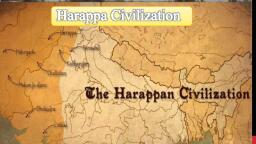
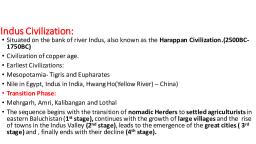
Location, • In the plains and valleys of Indus river and its tributaries like, Saraswati, • Sites from Kashmir to Gujarat and from Balochistan to west, Uttar Pradesh, • Majority of the sites are in present day :, Sindh and Punjab of Pakistan, Rajasthan,Gujarat,Haryana Punjab and UP of India, ©DrMahipalRathore
Page 7 :
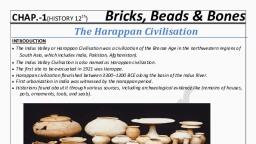
• Bronze age civilization, • Contemporary of Mesopotamia(Iraq) and Nile (Egypt) but, distinct and separate features from both- script, town, planning, religion, • Time period :, Early Phase - 3300- 2600 BC, Mature Phase - 2600 – 1900 BC, Late Phase - 1900 - 1400 BC, *Latest carbon dating has pushed back dates to 6th millennium, BC, ©DrMahipalRathore
Page 8 :
Characteristics, Urban settlements - First urbanisation of India, Town planning – City divided into two parts, CITADEL –, Built on High podium of mud brick, Administrative centre of town, Important ritualistic buildings- Great bath and granary, LOWER TOWN –, surrounding citadel, Residential areas, ©DrMahipalRathore
Page 10 :
•, •, •, •, , Streets aligned east-west or north-south in a ‘grid’, Houses with doors in narrow alleys off the main street, Uniform size Bricks in ratio of 4:2:1, Well engineered sanitation systems – bath + toilets inside, every house, • Drainage system – cesspits + covered drains from, every house, • City protected by walls, , ©DrMahipalRathore
Page 11 :
The People, • Cosmopolitan people trading with other civilizations, • Mainstay – Agriculture boosted by trade and commerce +, artisanship, • Remains of various races have been found – multi ethnic society, • Large Urban centres supported by smaller rural population, • Class stratification in society- administrators, traders, craftsmen,, peasants [evidence-houses & burial], • Women held esteemed position [mother goddess cult], ©DrMahipalRathore
Page 14 :
Agriculture, •, •, •, •, •, , People of IVC grew wheat , barley, lentil chickpea and sesame, Barley - Banawali, Rice – Lothal, Cotton producing areas- fertile Indus basin, Structures to preserve water and for irrigation (Dholavira), , ©DrMahipalRathore
Page 16 :
Trade, • With Mesopotamia/Sumer in present day IRAQ and Egyptian, civilization using boats sailing on rivers and sea, • Inter city trade via rivers, • Evidence of seals and artefacts from IVC found in these, civilizations and vice versa, • Weights used to weigh goods –multiple of 16, • Seals used to authenticate trade (NO COINS), ©DrMahipalRathore
Page 18 :
Arts and Crafts, • Refined and high quality Bronze articles made from Copper, mined at Khetri(Raj.), • Terracotta figurines – toys ?, • Highly decorated pottery, • Different kinds of Jewellery, ornaments, rings,, beads and other cosmetics, , ©DrMahipalRathore
Page 20 :
Religion, •, •, •, •, •, •, •, •, , No temple like structures found, ANIMISM and POLYTHEISM followed, Animal, human and tree forms worshipped, Mother Goddess – cult of feminine worship, Fire altars at Kalibangan – fire worship?, Proto Shiva – PASHUPATINATH, Humped bull venerated, Bearded man/ Priest, ©DrMahipalRathore
Page 22 :
Burials, •, •, •, •, •, , Cremation – most common, Complete burial, Partial burial, Pair buried together – Lothal, Often pots,tools,jewellery etc were buried with the dead- life, after death belief, , ©DrMahipalRathore
Page 23 :
Important Sites of I.V.C., , ©DrMahipalRathore
Page 24 :
Mohan Jo Daro, •, •, •, •, •, •, , ‘Mound of dead’, Indus river , Sindh, Great bath – religious significance,, Great Granary (inside citadel), Assembly hall, Bronze Dancing girl , pashupatinath, bearded man, , ©DrMahipalRathore
Page 26 :
Harappa, •, •, •, •, •, , The first site to be excavated, hence the name of civilization, River Ravi, Punjab, Great granary (outside citadel), Cemetery- partial and coffin burial, Terracotta bullock carts, , ©DrMahipalRathore
Page 32 :
Lothal, •, •, •, •, •, , Gulf of Khambhat , Gujarat, Bhogava/Sabarmati river mouth, World’s oldest Dockyard - connecting Lothal to sea, Trading port, Bead making workshop, terracotta horse figure, joint burial,, rice husk found, • Button shaped Persian seal discovered – evidence of trade, ©DrMahipalRathore
Page 38 :
Theories of Decline, • Massive earthquakes and floods destroyed cities, • Shifting of river Indus and Saraswati, drying of Ghaggar hakra, • Ecological imbalances – climate change and droughts, decreased, rainfall and increased aridity, • No permanent irrigation measures led to food scarcity, • Aryan invasion/ Foreign attack, • The late Harappan phase had population shift to the east towards, Gangetic plains, , ©DrMahipalRathore