Page 4 :
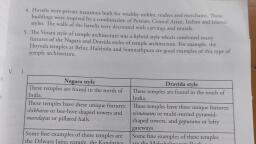
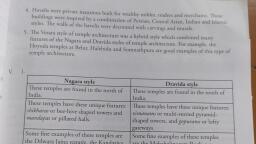
references, Vesara is a hybrid form of Indian temple architecture, with South Indian plan and a shape that features North Indian details. This fusion style likely originated in the historic architecture schools of the Dharwad region. It is common in the surviving temples of later Chalukyas and Hoysalas in the Deccan region, particularly Karnataka. , According to Indian texts, Vesara was popular in central parts of India such as between the Vindhyas and the river Krishna.[2][3][4] , It is one of six major types of Indian temple architecture found in historic texts along with Nagara, Dravida, Bhumija, Kalinga and Varata.[5], The term was used by ancient writers, but possibly not with the same meaning as in modern usage. For this and other reasons, it is avoided by some writers, such as Adam Hardy.[6] , Alternative terms for the whole time span of the tradition, from the 7th to the 13th century CE, include Karnata Dravida (Hardy's choice),[7] , 'Central Indian temple architecture style', 'Deccan architecture', or for shorter periods, terms referring to local dynasties, such as "Chalukyan architecture", or more precisely Early Chalukya or Badami Chalukya architecture and Later or Kalyana Chalukya or Western Chalukya architecture,[8] and Hoysala architecture to those built during the Hoysala dynasty rule.
Page 5 :
Vesara means mule, "an issue of heterogeneous parents", states Stella Kramrisch. , The south Indian text Kamika-agama explains that this name is drived from its mixed nature, where it is a Dravida architecture in plan, yet its shape is Nagara architecture in the details. The same text says that Vesara is also called Sankara – "hybrid" – for the same reason., Vesara reflects the hybrid nature of the style., The Manasara categorizes Nagara to north, Dravida to south and Vesara to the middle. It goes on to state that Nagara emphasizes the four sides, Dravida a polygon (octagon), while Vesara compliments both in between with circular or elliptical forms., Given the many post-10th-century Hindu and Jain temple structures and ruins in Vesara form that have survived in Karnataka, the Vesara style has been linked to Karnataka and texts composed there., There are other theoretical classifications of Hindu temple architecture, with South Indian texts using the plan and North Indian texts using the overall shape and form, in particular of the superstructure., Similarly, even on the walls of Hindu and Jain temples of Karnataka, there is no depiction of elliptical temple. This may be because the sthanpati (architect) and silpins (artisans) in 9th to 11th-century Karnataka were deliberately ignoring the texts and experimenting with novel and innovative synthesis.[4]
Page 6 :
In general, many South Indian texts state that Vesara is a building that is "circular or round" in plan above karna (base) or kantha (neck)., For example, this description is found for Vesara in verse 50.15–17 of the Svayambhuva-agama, , verse 7.117 of the Karana-agama,, verse 12.68 of the Ajita-agama,, verse 30.41 of the Suprebheda-agama and others.[4] , On the other hand, the verse 7.15 of the Dipta-agama, , the verse 9.3 of the Padma-samhita, , and the verse 30.44–45 of Ishana-Sivagurudeva-Paddhati state that a Vesara may be circular, elliptical or apsidal in plan., A third view is proferred in the section 6 of the Marichi samhita, , verses 18.47–48 of the Manasara, and verses 19.36–38 of the Mayamata, which states that a Vesara can be circular or it can be a square up to prastara and then is circular from griva (neck) onwards.
Page 7 :
Unique features of Vesara style of temple architecture, Ornamentation: In case of ornamentation of temple walls and pillars, Chalukyan temple shows indigenous quality., Transformation of Dravida tower: The Chalukyan builders modified the Dravida towers by minimizing the height of each storey and arranging them in descending order of height from base to top with much ornamentation in each storey., Transformation of Nagara tower: Instead of inclined storey here modification is seen in the vertical shape of the tower, Two special features of Chalukya temples – Mantapa and Pillars:, Mantapa: The mantapa has two types of roof – domical ceilings (the dome like ceilings standing on four pillars are very attractive) or Square ceilings (these are vigorously ornamented with mythological pictures)., Pillars: the miniature decorative pillars of Chalukya temples stands with its own artistic value.
Page 11 :
The stepped diamond plan that is a plan of design arrangement as seen in Chalukya temples is from northern region., The most of the temples in kalyani portrays Nagara articulation projecting stepped diamond or stellate plan., The Dravida influence is mainly visible in vimana of the Chalukya temples in first part of the Chalukya rule, Miniature decorative towers and ornamentation of walls in Chalukya temples show combination of both Nagara and Dravida style.
Page 12 :
Famous temples built during the reign of several empires in South India, Chalukyan architecture, Their architecture consisted of admixture of Nagara and Dravidian styles., Temples built during this time can be found in- Aihole, Badami and Pattadakal, Temples built during their time period do not have a covered ambulatory path, The Virupaksha temple at Pattadakal built in imitation of Kailashnath temple is the jewel of Chalukyan architecture, The Rameshwaram temple at Ellora built in 7th century was also built during the Chalukyan time period, Lad Khan temple and Durga temple at Aihole are other noteworthy monuments built during this time period
Page 13 :
Rashtrakuta architecture, They were the successors of the Chalukyas, Their temples were built mostly imitating the Chalukyan style, The Kailas temple at Ellora, built during the time of Krishna II is the representative form of architecture of the empire, The Navalinga Temples in Kukkanur is another temple built during this period, , By the late 7th or early 8th century, the ambitious projects at Ellora became even grander., By about 750 CE, the early western Chalukya control of the Deccan was taken by the Rashtrakutas., Their greatest achievement in architecture is the Kailashnath temple at Ellora, a culmination of at least a millennium-long tradition in rock-cut architecture in India., It is a complete dravida building with a Nandi shrine—since the temple is dedicated to Shiva—a gopuram-like gateway, surrounding cloisters, subsidiary shrines, staircases and an imposing tower or vimana rising to thirty metres., Importantly, all of this is carved out of living rock. One portion of the monolithic hill was carved patiently to build the Kailashnath temple.
Page 15 :
In the southern part of the Deccan, i.e., in the region of Karnataka where some of the most experimental hybrid styles of vesara architecture are to be found., Pulakesin I established the western Chalukya kingdom when he secured the land around Badami in 543., Early Chalukyan activity also takes the form of rock-cut caves while later activity is of structural temples., The earliest is probably the Ravana Phadi cave at Aihole which is known for its distinctive sculptural style., One of the most important sculptures at the site is of Nataraja, surrounded by larger -than-life-size depictions of the saptamatrikas: three to Shiva’s left and four to his right.
Page 16 :
Hoysala temple architecture, Kesava temple at Belur built during the time of Vishnuvardhana to commemorate his victory over the Cholas is a representative art of this period, In this temple, there are multiple shrines grouped around a central pillared hall and laid out in the shape of an intricately-designed star, Such an arrangement could be found in temples during this time in Halebid, Somnathpur and elsewhere, Hoysaleswara temple dedicated to Lord Shiva is another famous temple built during this period
Page 17 :
Vijayanagara architecture, It is a vibrant combination of the Chalukya, Hoysala, Pandya, and Chola styles, Local hard granite was the building material of choice, as it had been for the Badami Chalukyas., Vijayanagar temples are characterized by ornate pillared halls and rayagopurams, or monumental towers adorned with life-sized figures of gods and goddesses that stand at the entrance of the temple., Vijayanagar temples are also known for their carved pillars , which depict charging horses, figures from Hindu mythology, and yali (hippogriphs), Some of the larger temples are dedicated to a male deity, with a separate shrine intended for the worship of his female counterpart. Some famous temples exemplifying the Vijayanagar style include the Virupaksha Temple at Hampi and the Hazara Rama temple of Deva Raya I.