Page 1 :
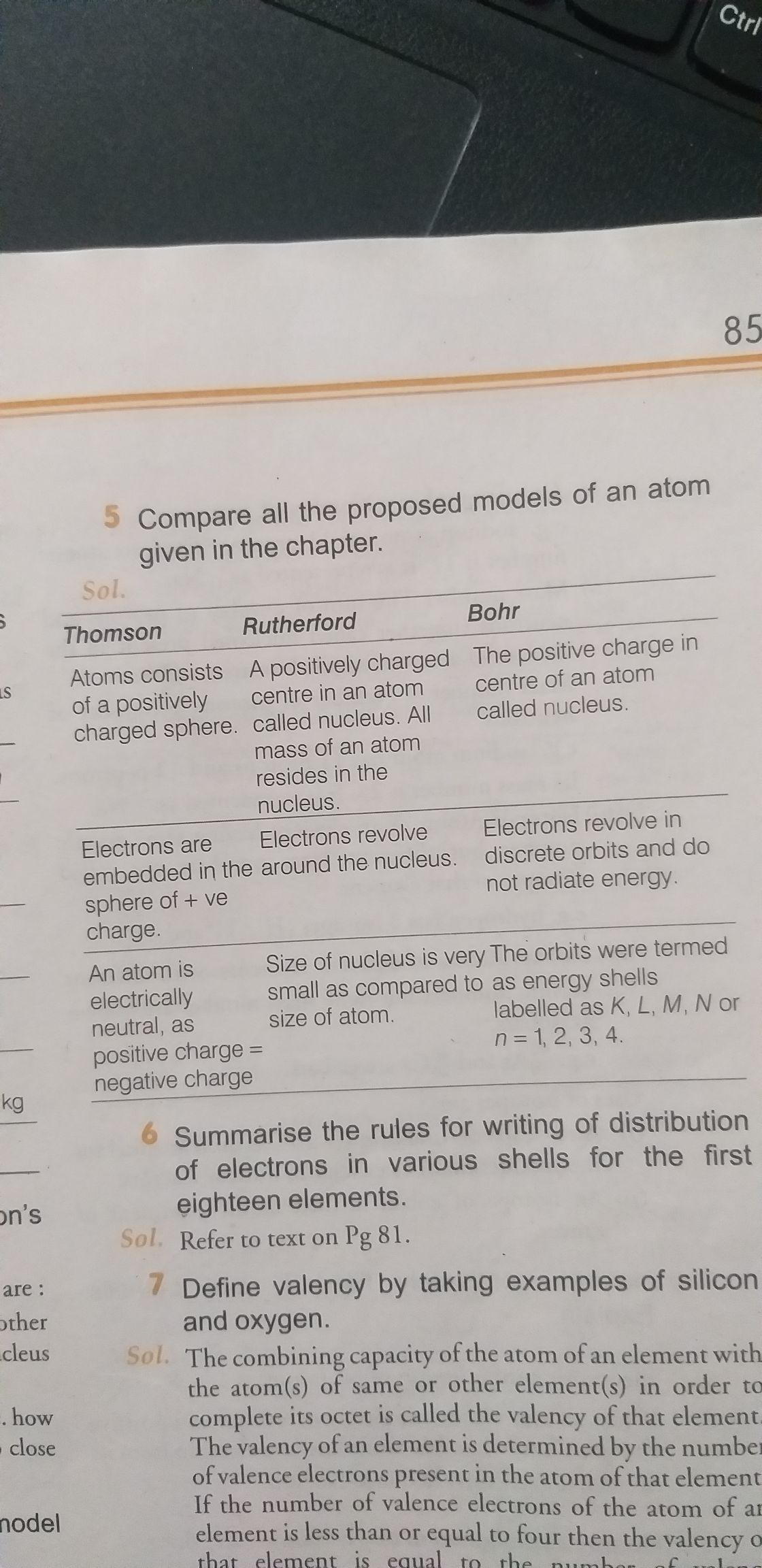
n’s, are ;, other, , cleus, , . how, close, , nodel, , 85, , 5 Compare all the proposed models of an atom, , given in the chapter., , , , Atoms consists A positively charged, of a positively centre in an atom, , Thomson Rutherford Bohr i, , The positive charge in, centre of an atom, , charged sphere. called nucleus. All called nucleus., , mass of an atom, , resides in the, , nucleus., , Electrons revolve Electrons revolve in, discrete orbits and do, , not radiate energy., , Electrons are, embedded in the around the nucleus., , sphere of + ve, , , , charge., , An atom is Size of nucleus is very The orbits were termed, , electrically small as compared to as energy shells, , neutral, as size of atom. labelled as K, L, M, N or, Maly an., , positive charge =, negative charge, , 6 Summarise the rules for writing of distribution, of electrons in various shells for the first, eighteen elements., , Refer to text on Pg 81., , 7 Define valency by taking examples of silicon, and oxygen., , sol. The combining capacity of the atom of an element with, the atom(s) of same or other element(s) i oa, , complete its octet is called the valency of se a ee, , The valency of an element is determined b . oe., , of valence electrons present in the atom a Sh ae, , If the number of valence electrons of i ao a , of ai, , that le T the a oi!, at element 1s equal -D it Ne oC, aioe ee ote ane: eel Bey ne