Notes of SY Mechanical, Fluid Mechanics B-Tech-Mechanical_Second-Third-Yr_Syllabus_copy - Study Material
Page 1 :
Dr. Babasaheb Ambedkar Technological University, (Established as a University of Technology in the State of Maharashtra), (under Maharashtra Act No. XXIX of 2014), P.O. Lonere, Dist. Raigad,, Pin 402 103, Maharashtra, Telephone and Fax. : 02140 - 275142, www.dbatu.ac.in, , Proposed Course Contents for, B. Tech. in Mechanical Engineering, w.e.f. June 2019, , From 3rd Semester - 6th Semester
Page 2 :
Vision, The vision of the department is to achieve excellence in teaching, learning, research and, transfer of technology and overall development of students., Mission, Imparting quality education, looking after holistic development of students and conducting, need based research and extension., , Graduate Attributes, The Graduate Attributes are the knowledge skills and attitudes which the students have at the, time of graduation. These Graduate Attributes identified by National Board of Accreditation, are as follows:, 1. Engineering knowledge: Apply the knowledge of mathematics, science, engineering, fundamentals and an engineering specialization to the solution of complex, engineering problems., 2. Problem analysis: Identify, formulate, research literature, and analyze complex, engineering problems reaching substantiated conclusions using first principles of, mathematics, natural sciences and engineering sciences., 3. Design/development of solutions: Design solutions for complex engineering, problems and design system components or processes that meet the specified, needs, , with, , appropriate consideration for the public health and safety, and the, , cultural, societal, and environmental considerations., 4. Conduct investigations of complex problems: Use research-based knowledge and, research methods including design of experiments, analysis and interpretation of data,, and synthesis of the information to provide valid conclusions., 5. Modern tool usage: Create, select, and apply appropriate techniques, resources, and, modern engineering and IT tools including prediction and modeling to complex, engineering activities with an understanding of the limitations., 6. The engineer and society: Apply reasoning informed by the contextual knowledge to, assess societal, health, safety, legal and cultural issues and the consequent, responsibilities relevant to the professional engineering practice., 7. Environment, , and, , sustainability: Understand the impact of the professional, , engineering solutions in societal and environmental contexts, and demonstrate
Page 3 :
the knowledge of, and need for sustainable development., 8. Ethics: Apply ethical principles and commit to professional ethics and responsibilities, and norms of the engineering practice., 9. Individual and team work: Function effectively as an individual, and as a member, or leader in diverse teams, and in multidisciplinary settings., 10. Communication: Communicate effectively on complex engineering activities with, the engineering community and with society at large, such as, being able to, comprehend and write effective reports and design documentation, make effective, presentations, and give and receive clear instructions., 11. Project management and finance: Demonstrate knowledge and understanding of the, engineering and management principles and apply these to one’s own work, as a, member and leader in a team, to manage projects and in multidisciplinary, environments., 12. Life-long learning: Recognize the need for, and have the preparation and ability to, engage in independent and life-long learning in the broadest context of technological, change., Program Educational Objectives, , PEO 1, PEO 2, PEO 3, PEO 4, PEO 5, , Graduates should excel in engineering positions in industry and other, organizations that emphasize design and implementation of engineering, systems and devices., Graduates should excel in best post-graduate engineering institutes, acquiring, advanced degrees in engineering and related disciplines., Alumni should establish a successful career in an engineering-related field and, adapt to changing technologies., Graduates are expected to continue personal development through professional, study and self-learning., Graduates should be good citizens and cultured human beings, with full, appreciation of the importance of professional, ethical and societal, responsibilities.
Page 4 :
Program Outcomes, At the end of the program the student will be able to:, PO 1, PO 2, PO 3, PO 4, PO 5, PO 6, PO 7, PO 8, PO 9, PO 10, PO 11, PO 12, , Apply the knowledge of mathematics, basic sciences, and mechanical engineering, to the solution of complex engineering problems., Identify, formulate, research literature, and analyze complex mechanical, engineering problems reaching substantiated conclusions., Design solutions for complex engineering problems and design mechanical system, components that meet the specified needs., Use mechanical engineering research-based knowledge related to interpretation of, data and provide valid conclusions., Create, select, and apply modern mechanical engineering and IT tools to complex, engineering activities with an understanding of the limitations., Apply reasoning acquired by the mechanical engineering knowledge to assess, societal and safety issues., Understand the impact of engineering solutions on the environment, and, demonstrate the knowledge for sustainable development., Apply ethical principles and commit to professional ethics and responsibilities and, norms of the engineering practice., Function effectively as an individual, and as a member or leader in diverse teams,, and in multidisciplinary settings., Communicate effectively on complex engineering activities with the engineering, community and with society at large., Understand the engineering and management principles and apply these to the, multidisciplinary environments., Recognize the need for life-long learning in the broadest context of technological, change., Program-Specific Outcomes (PSOs), , PSO 1, , Make the students employable in engineering industries., , PSO 2, , Motivate the students for higher studies and research.
Page 5 :
Abbreviations, PEO:, PO:, CO:, L:, T:, P:, C:, BSH:, BSC:, PCC:, OEC:, PEC:, BHC:, ESC:, HSMC:, NCC:, NSS:, CA:, MSE:, ESE:, , Program Educational Objectives, Program Outcomes, Course Outcomes, No. of Lecture hours (per week), No. of Tutorial hours (per week), No. of Practical hours (per week), Total number of credits, Basic Science and Humanity, Basic Sciences Course, Professional Core Course, Open Elective Course, Professional Elective Course, Basic Humanity Course, Engineering Science Course, Humanity Science and Management Course, National Cadet Corps, National Service Scheme, Continuous Assessment, Mid Semester Exam, End Semester Exam
Page 6 :
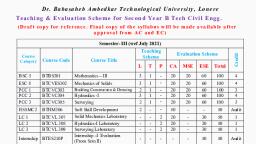
B. Tech. Mechanical Engineering, Course Structure for Semester III [Second Year] w.e.f. 2018-2019, , Course Code, , Type of, Course, , Course Title, , Weekly Teaching, Scheme, L, T, P, , Evaluation Scheme, Credits, CA, , MSE, , ESE, , Total, , BTBSC301, , BSC 7, , Engineering, Mathematics-III, , 3, , 1, , --, , 20, , 20, , 60, , 100, , 4, , BTMEC302, , ESC 11, , Materials Science and, Metallurgy, , 3, , 1, , --, , 20, , 20, , 60, , 100, , 4, , BTMEC303, , PCC 1, , Fluid Mechanics, , 3, , 1, , --, , 20, , 20, , 60, , 100, , 4, , BTMEC304, , PCC 2, , Machine Drawing and, CAD, , 2, , --, , --, , 20, , 20, , 60, , 100, , 2, , BTMEC305, , ESC 12, , Thermodynamics, , 3, , 1, , --, , 20, , 20, , 60, , 100, , 4, , BTHM3401, , HSMC 3, , Basic Human Rights, , 2, , --, , --, , 50, , --, , --, , 50, , Audit, (AU/, NP), , BTMEL307, , ESC 13, , Materials Science and, Metallurgy Lab, , --, , --, , 2, , 60, , --, , 40, , 100, , 1, , BTMEL308, , PCC 3, , Fluid Mechanics Lab, , --, , --, , 2, , 60, , --, , 40, , 100, , 1, , BTMEL309, , PCC 4, , Machine Drawing and, CAD Lab, , --, , --, , 4, , 60, , --, , 40, , 100, , 2, , BTMEF310, , Project 1, , Field Training, /Internship/Industrial, Training I, , --, , --, , --, , --, , --, , 50, , 50, , 1, , 16, , 4, , 8, , 330, , 100, , 470, , 900, , 23, , Total
Page 7 :
B. Tech. Mechanical Engineering, Course Structure for Semester IV [Second Year] w.e.f. 2018-2019, , Course Code, , Type of, Course, , Course Title, , Weekly Teaching, Scheme, L, T, P, , Evaluation Scheme, Credits, CA, , MSE, , ESE, , Total, , BTMEC401, , PCC 5, , Manufacturing, Processes - I, , 2, , 1, , --, , 20, , 20, , 60, , 100, , 3, , BTMEC402, , PCC 6, , Theory of Machines-I, , 3, , 1, , --, , 20, , 20, , 60, , 100, , 4, , BTMEC403, , PCC 7, , Strength of Materials, , 3, , 1, , --, , 20, , 20, , 60, , 100, , 4, , BTMEC404, , BSC 8, , Numerical Methods in, Mechanical, Engineering, , 2, , 1, , --, , 20, , 20, , 60, , 100, , 3, , BTID405, , PCC 8, , Product Design, Engineering – I, , 1, , --, , 2, , 60, , --, , 40, , 100, , 2, , 3, , --, , --, , 20, , 20, , 60, , 100, , 3, , BTBSE406A, , Physics of, Engineering Materials, , BTBSE3405A, , Advanced Engineering, Chemistry, , OEC 1, , Interpersonal, Communication, Skill& Self, Development, , BTHM3402, , BTMEL407, , PCC 9, , Manufacturing, Processes Lab – I, , --, , --, , 2, , 60, , --, , 40, , 100, , 1, , BTMEL408, , PCC 10, , Theory of Machines, Lab- I, , --, , --, , 2, , 60, , --, , 40, , 100, , 1, , BTMEL409, , PCC 11, , Strength of Materials, Lab, , --, , --, , 2, , 60, , --, , 40, , 100, , 1, , BTMEL410, , BSC 9, , Numerical Methods, Lab, , --, , --, , 2, , 60, , --, , 40, , 100, , 1, , 14, , 4, , 10, , 400, , 100, , 500, , 1000, , 23, , Total, , Minimum 4 weeks training which can be completed partially in third and fourth semester or in at one time.
Page 8 :
B. Tech. Mechanical Engineering, Course Structure for Semester V [Third Year] w.e.f. 2019-2020, , Course Code, , Type of, Course, , Course Title, , Weekly Teaching, Scheme, L, T, P, , Evaluation Scheme, Credits, CA, , MSE, , ESE, , Total, , BTMEC501, , PCC 12, , Heat Transfer, , 3, , 1, , --, , 20, , 20, , 60, , 100, , 4, , BTMEC502, , PCC 13, , Applied, Thermodynamics – I, , 2, , 1, , --, , 20, , 20, , 60, , 100, , 3, , BTMEC503, , PCC 14, , Machine Design – I, , 2, , 1, , --, , 20, , 20, , 60, , 100, , 3, , BTMEC504, , PCC 15, , Theory of MachinesII, , 3, , 1, , --, , 20, , 20, , 60, , 100, , 4, , BTMEC505, , PCC 16, , Metrology and Quality, Control, , 2, , 1, , --, , 20, , 20, , 60, , 100, , 3, , BTID506, , PCC 17, , Product Design, Engineering - II, , 1, , --, , 2, , 60, , --, , 40, , 100, , 2, , 3, , --, , --, , --, , --, , --, , --, , Audit, (AU/, NP), , Automobile, Engineering, , BTMEC506A, BTMEC506B, , OEC 2, , Nanotechnology, Energy Conservation, and Management, , BTMEC506C, BTMEL507, , PCC 18, , Heat Transfer Lab, , --, , --, , 2, , 30, , --, , 20, , 50, , 1, , BTMEL508, , PCC 19, , Applied, Thermodynamics Lab, , --, , --, , 2, , 30, , --, , 20, , 50, , 1, , BTMEL509, , PCC 20, , Machine Design, Practice- I, , --, , --, , 2, , 30, , --, , 20, , 50, , 1, , BTMEL510, , PCC 21, , Theory of Machines, Lab- II, , --, , --, , 2, , 30, , --, , 20, , 50, , 1, , BTMEF511, , Project 2, , Field Training, /Internship/Industrial, Training II, , --, , --, , --, , --, , --, , 50, , 50, , 1, , 16, , 5, , 10, , 280, , 100, , 470, , 850, , 24, , Total
Page 9 :
B. Tech. Mechanical Engineering, Course Structure for Semester VI [Third Year] w.e.f. 2019-2020, , Course Code, , Type of, Course, , Course Title, , Weekly Teaching, Scheme, L, T, P, , Evaluation Scheme, Credits, CA, , MSE, , ESE, , Total, , BTMEC601, , PCC 22, , Manufacturing, Processes- II, , 2, , 1, , --, , 20, , 20, , 60, , 100, , 3, , BTMEC602, , PCC 23, , Machine Design-II, , 3, , 1, , --, , 20, , 20, , 60, , 100, , 4, , BTMEC603, , PCC 24, , Applied, Thermodynamics- II, , 2, , 1, , --, , 20, , 20, , 60, , 100, , 3, , 2, , 1, , --, , 20, , 20, , 60, , 100, , 3, , --, , --, , 20, , 20, , 60, , 100, , BTMEC604A, , Engineering Tribology, , BTMEC604B, , IC Engines, PEC 1, , BTMEC604C, , Additive, Manufacturing, , BTMEC604D, , Mechanical, Measurements, , BTMEC605A, , Quantitative, Techniques in Project, Management, , BTMEC605B, , OEC 3, , Sustainable, Development, , BTMEC605C, , Renewable Energy, Sources, , BTMEC606A, , Biology for Engineers, , BTMEC606B, , OEC 4, , Solar Energy, , 3, , 3, , Audit, (AU/, NP), , 3, , --, , --, , --, , --, , --, , --, , --, , --, , 2, , 30, , --, , 20, , 50, , 1, , --, , --, , 2, , 30, , --, , 20, , 50, , 1, , Human Resource, Management, , BTMEC606C, , Metrology and Quality, Control Lab, Machine Design, Practice-II, , BTMEL607, , PCC 25, , BTMEL608, , PCC 26, , BTMEL609, , PCC 27, , IC Engine Lab, , --, , --, , 2, , 30, , --, , 20, , 50, , 1, , BTMEL610, , PCC 28, , Refrigeration and Air, Conditioning Lab, , --, , --, , 2, , 30, , --, , 20, , 50, , 1, , BTMEM611, , Project 3, , Technical Project for, Community Services, , --, , --, , 4, , 30, , --, , 20, , 50, , 2, , 15, , 4, , 12, , 250, , 100, , 400, , 750, , 22, , Total
Page 10 :
Semester III, Engineering Mathematics-III, BTBSC301, , BSC 7, , Teaching Scheme:, Lecture: 3 hrs/week, Tutorial: 1 hr/week, , Engineering Mathematics-III, , 3-1-0, , 4 Credits, , Examination Scheme:, Continuous Assessment: 20 Marks, Mid Semester Exam: 20 Marks, End Semester Exam: 60 Marks(Duration 03 hrs), , Pre-Requisites: None, Course Outcomes: At the end of the course, students will be able to:, CO1, CO2, CO3, CO4, CO5, CO6, CO7, CO8, Mapping of course outcomes with program outcomes, Course, Outcomes, CO1, CO2, CO3, CO4, CO5, CO6, CO7, CO8, , Program Outcomes, PO1 PO2 PO3 PO4 PO5 PO6 PO7 PO8 PO9 PO10 PO11 PO12, , Course Contents:, Unit 1: Laplace Transform[07 Hours], Definition – conditions for existence ; Transforms of elementary functions ; Properties of, Laplace transforms - Linearity property, first shifting property, second shifting property,, transforms of functions multiplied by tn, scale change property, transforms of functions, divided by t, transforms of integral of functions, transforms of derivatives ; Evaluation of, integrals by using Laplace transform ; Transforms of some special functions- periodic, function, Heaviside-unit step function, Dirac delta function., Unit 2: Inverse Laplace Transform[07 Hours], Introductory remarks ; Inverse transforms of some elementary functions ; General methods, of finding inverse transforms ; Partial fraction method and Convolution Theorem for finding
Page 11 :
inverse Laplace transforms ; Applications to find the solutions of linear differential equations, and simultaneous linear differential equations with constant coefficients., Unit 3: Fourier Transform [07 Hours], Definitions – integral transforms ; Fourier integral theorem (without proof) ; Fourier sine and, cosine integrals ; Complex form of Fourier integrals ; Fourier sine and cosine transforms ;, Properties of Fourier transforms ; Parseval’s identity for Fourier Transforms., Unit 4: Partial Differential Equations and Their Applications [07 Hours], Formation of Partial differential equations by eliminating arbitrary constants and functions;, Equations solvable by direct integration; Linear equations of first order (Lagrange’s linear, equations); Method of separation of variables – applications to find solutions of one, dimensional heat flow equation (, Laplace equation :, , ), and two dimensional heat flow equation (i.e., , )., , Unit 5: Functions of Complex Variables (Differential calculus)[07 Hours], Limit and continuity of f(z); Derivative of f(z) ; Analytic functions; Cauchy- Riemann, equations in Cartesian and polar forms; Harmonic functions in Cartesian form;Mapping:, Translation, magnification and rotation, inversion and reflection , bilinear transformation;, Conformal mapping., Unit 6: Functions of Complex Variables (Integral calculus)[07 Hours], Cauchy’s integral theorem; Cauchy’s integral formula; Residues; Cauchy’s residue theorem, (All theorems without proofs)., Text Books:, 1. Higher Engineering Mathematics by B. S. Grewal, Khanna Publishers, New Delhi., 2. Advanced Engineering Mathematics by Erwin Kreyszig, John Wiley & Sons, New York., 3. A Course in Engineering Mathematics (Vol III) by Dr. B. B. Singh, Synergy Knowledge, ware, Mumbai., 4. A Text Book of Applied Mathematics (Vol I & II) by P. N. Wartikar and J. N. Wartikar,, Pune VidyarthiGrihaPrakashan, Pune., 5. Higher Engineering Mathematics by H. K. Das and Er. RajnishVerma, S. Chand & CO., Pvt. Ltd., New Delhi., Reference Books:, 1. Higher Engineering Mathematics by B. V. Ramana, Tata McGraw-Hill Publications, New, Delhi., 2. A Text Book of Engineering Mathematics by Peter O’ Neil, Thomson Asia Pte Ltd.,, Singapore., 3. Advanced Engineering Mathematics by C. R. Wylie & L. C. Barrett, Tata Mcgraw-Hill, Publishing Company Ltd., New Delhi., 4. Integral Transforms and Their Engineering Applications by Dr. B. B. Singh, Synergy., Knowledge ware, Mumbai., 5. Integral Transforms by I. N. Sneddon, Tata McGraw-Hill, New York., General Instructions:
Page 12 :
1. The tutorial classes in Engineering Mathematics-III are to be conducted batch-wise. Each, class should be divided into three batches for the purpose., 2. The Continuous Assessment of the students for 20 marks will be done based on, assignments, surprise tests, quizzes, innovative approach to problem solving and, percentage attendance., 3. The minimum number of assignments should be eight covering all topics., Material Science and Metallurgy, BTMEC302, , ESC 11, , Teaching Scheme:, Lecture: 3 hrs/week, Tutorial: 1 hr/week, , Materials Science and Metallurgy, , 3-1-0, , 4 Credits, , Examination Scheme:, Continuous Assessment: 20 Marks, Mid Semester Exam: 20 Marks, End Semester Exam: 60 Marks(Duration 03 hrs), , Pre-Requisites: None, Course Outcomes: At the end of the course, students will be able to:, CO1, CO2, CO3, CO4, CO5, CO6, , Study various crystal structures of materials, Understand mechanical properties of materials and calculations of same using, appropriate equations, Evaluate phase diagrams of various materials, Suggest appropriate heat treatment process for a given application, Prepare samples of different materials for metallography, Recommend appropriate NDT technique for a given application, Mapping of course outcomes with program outcomes, , Program Outcomes, Course, Outcomes PO1 PO2 PO3 PO4 PO5 PO6 PO7 PO8 PO9 PO10 PO11 PO12, CO1, 2, 2, 1, CO2, 3, 2, 2, 3, 2, CO3, 2, 1, 2, 1, 1, CO4, 1, 2, 2, 1, 2, 1, 2, 1, 1, 1, CO5, 1, 1, 1, 3, 2, 1, 1, CO6, 1, 1, 2, 2, 2, 1, 2, 1, 1, All units carry 10 Marks each for End Semester Examination., Course Contents:, Unit 1: Structure of Materials[08 Hours], Crystal structures, indexing of lattice planes, Indexing of lattice directions, Imperfections in, crystals-point defects, line defects, surface and bulk defects, Mechanism of plastic, deformation, deformation of single crystal by slip, plastic deformation of polycrystalline, materials., Unit 2: Mechanical Properties and their Testing[08 Hours]
Page 13 :
Tensile test, engineering stress-strain curve, true stress-strain curve, types of stress-strain, curves, compression test, bend test, torsion test, formability, hardness testing, different, hardness tests-Vickers, Rockwell, Brinnel, Impact test, fatigue test, creep test., Unit 3: Equilibrium Diagrams[09 Hours], Definitions of terms, rules of solid-solubility, Gibb’s phase rule, solidification of a pure, metal, plotting of equilibrium diagrams, lever rule, Iron-iron carbide equilibrium diagram,, critical temperatures, solidification and microstructure of slowly cooled steels, nonequilibrium cooling of steels, property variation with microstructures, classification and, application of steels, specification of steels, transformation products of austenite,, TTTdiagram, critical cooling rate, CCT diagram., Unit 4: Heat Treatment[07 Hours], Heat treatment of steels, cooling media, annealing processes, normalizing, hardening,, tempering, quenching and hardenability, surface hardening processes-nitriding, carbonitriding, flame hardening, induction hardening., Unit 5: Metallography[08 Hours], Microscopy, specimen preparation, polishing abrasives and cloths, specimen mounting,, electrolytic polishing, etching procedure and reagents, electrolytic etching, optical, metallurgical microscope, macroscopy, sulphur printing, flow line observations, examination, of fractures, spark test, electron microscope., Unit 6: Strengthening Mechanisms and Non-destructive Testing[08 Hours], Refinement of grain size, cold working/strain hardening, solid solution strengthening,, dispersion strengthening, Precipitation hardening. Magnetic particle inspection, dye Penetrant, inspection, ultrasonic inspection, radiography, eddy current testing, acoustic emission, inspection., Texts:, 1. V. D.Kodgire, S.V.Kodgire, “Material Science and Metallurgy for Engineers”, Everest, Publishing House, Pune, 24thedition, 2008., 2. W. D.Callister, “Materials Science and Engineering: An Introduction”, John Wiley and, Sons, 5thedition,2001., 3. V.Raghvan, “Material Science Engineering”, Prentice Hall of India Ltd., 1992., 4. S. H.Avner, “Introduction to Physical Metallurgy”, Tata McGraw Hill, 2ndedition, 1997., 5. R. A.Higgins, “Engineering Metallurgy: Part I”, ELBS, 6thedition, 1996., References:, 1. V. B.John, “Introduction to Engineering Materials”, ELBS, 6thedition, 2001., 2. G. F.Carter, D. E.Paul, “ Materials Science and Engineering”, ASM International, 3rd, edition, 2000., 3. T. E.Reed-Hill, R.Abbaschian, “Physical Metallurgy Principles”, Thomson, 3rdedition,, 2003., Fluid Mechanics, BTMEC303, , PCC 1, , Teaching Scheme:, Lecture: 3 hrs/week, , Fluid Mechanics, , 3-1-0, , 4 Credits, , Examination Scheme:, Continuous Assessment: 20 Marks
Page 14 :
Tutorial: 1 hr/week, , Mid Semester Exam: 20 Marks, End Semester Exam: 60 Marks(Duration 03 hrs), , Pre-Requisites: None, Course Outcomes: At the end of the course, students will be able to:, CO1, CO2, CO3, CO4, CO5, CO6, CO7, , Define fluid, define and calculate various properties of fluid, Calculate hydrostatic forces on the plane and curved surfaces and explain stability of, floating bodies, Explain various types of flow. Calculate acceleration of fluid particles, Apply Bernoulli’s equation and Navier-Stokes equation to simple problems in fluid, mechanics, Explain laminar and turbulent flows on flat plates and through pipes, Explain and use dimensional analysis to simple problems in fluid mechanics, Understand boundary layer, drag and lift, Mapping of course outcomes with program outcomes, , Course, Outcomes, CO1, CO2, CO3, CO4, CO5, CO6, CO7, , Program Outcomes, PO1 PO2 PO3 PO4 PO5 PO6 PO7 PO8 PO9 PO10 PO11 PO12, 3, 3, 2, 2, 1, 1, 3, 3, 1, 1, 1, 1, 3, 3, 1, 1, 1, 1, 3, 3, 1, 3, 3, 1, 2, 3, 1, 2, 3, 1, , All units carry 10 Marks each for End Semester Examination., Course Contents:, Unit 1: Basics[08 Hours], Definition of fluid, fluid properties such as viscosity, vapour pressure, compressibility,, surface tension, capillarity, Mach number etc., pressure at a point in the static mass of fluid,, variation of pressure, Pascal’s law, pressure measurement by simple and differential, manometers using manometric expression., Unit 2: Fluid Statics[08 Hours], Hydrostatic forces on the plane and curved surfaces, centre of pressure, Buoyancy, centre of, buoyancy, stability of floating bodies, metacentre and metacentric height its application in, shipping., Unit 3: Fluid Kinematics[08 Hours], Velocity of fluid particle, types of fluid flow, description of flow, continuity equation,, Coordinate freeform, acceleration of fluid particle, rotational and irrotational flow, Laplace’s, equation in velocity potential and Poisson’s equation in stream function, flownet., Unit 4: Fluid Dynamics[08 Hours], Momentum equation, development of Euler’s equation, Introduction to Navier-Stokes
Page 15 :
equation, Integration of Euler’s equation to obtain Bernoulli’s equation, Bernoulli’s theorem,, Application of Bernoulli’s theorem such as venturimeter, orificemeter, rectangular and, triangular notch, pitot tube, orifices, etc., Unit 5: Types of Flow[08 Hours], a) Laminar Flow: Flow through circular pipe, between parallel plates, Power absorbed in, viscous flow in bearings, loss of head due to friction in viscous flow., b) Turbulent Flow: Reynolds’s experiment, frictional loss in pipe flow, shear stress in, turbulent flow, major and minor losses, HGL and TEL, flow through series and parallel, pipes., Unit6: Dimensional Analysis[08 Hours], a) Dimensional Analysis: Dimensional homogeneity, Raleigh’s method, Buckingham’s, theorem, Model analysis, similarity laws and dimensionless numbers., b) Introductionto boundary layer theory and its analysis., c) Forces on Submerged bodies: Drag, lift, Drag on cylinder, Development of lift in, cylinder., Texts:, 1. P. N. Modi, S. M. Seth, “Fluid Mechanics and Hydraulic Machinery”, Standard Book, House, 10th edition,1991., 2. Robert W. Fox, Alan T. McDonald, “Introduction to Fluid Mechanics”, John Wile and, Sons, 5thedition., References:, 1. V. L. Streeter, K. W. Bedfordand E. B. Wylie, “Fluid Dynamics”, Tata McGraw-Hill,, 9thedition, 1998., 2. S. K. Som, G.Biswas, “ Introduction to Fluid Mechanics and Fluid Machines”, Tata, McGraw Hill, 2ndedition, 2003., Machine Drawing and Computer Aided Drafting, BTMEC304, , PCC 2, , Teaching Scheme:, Lecture: 2 hrs/week, , Machine Drawing and Computer Aided, Drafting, , 2-0-0, , Examination Scheme:, Continuous Assessment: 20 Marks, Mid Semester Exam: 20 Marks, End Semester Exam: 60 Marks(Duration 03 hrs), , Pre-Requisites: None, Course Outcomes: At the end of the course, students will be able to:, CO1, CO2, CO3, CO4, CO5, CO6, , 2 Credits, , Interpret the object with the help of given sectional and orthographic views., Construct the curve of intersection of two solids, Draw machine element using keys, cotter, knuckle, bolted and welded joint, Assemble details of any given part. i. e. valve, pump , machine tool part etc., Represent tolerances and level of surface finish on production drawings, Understand various creating and editing commands in Auto Cad
Page 16 :
Mapping of course outcomes with program outcomes, Course, Outcomes, CO1, CO2, CO3, CO4, CO5, CO6, , Program Outcomes, PO1 PO2 PO3 PO4 PO5 PO6 PO7 PO8 PO9 PO10 PO11 PO12, 2, 3, 2, 1, 2, 1, 2, 1, 1, 2, 2, 1, 2, 2, 1, 2, 1, 1, 1, 1, 1, 2, 1, 1, 1, 1, 1, 2, 2, 1, , Course Contents:, Unit 1: Sectional Views[04 Hours], Full section, half section, partial section, off-set section, revolved sections, removed sections,, auxiliary section, guidelines for hatching, examples on all above types of sections of machine, elements., Unit 2: Study of Machine Elements[04 Hours], Study of simple machine elements and components such as screwed fasteners, shaft, couplings, pipe joints, riveted and welded joints, bearings, gears, etc., Unit 3: Interpenetration of Surfaces (Emphasis on Applied Cases)[04 Hours], Line or curve of intersection of two penetrating cylinders, Cone and cylinder, prism and a, cylinder, cone and prism, Forged ends, etc., Unit 4: Drawing of Assembly and Details[04 Hours], Part drawing of standard machine components such as valves, components of various, machine tools, pumps, shaft couplings, joints, pipe fittings, engine parts, etc., Unit 5: Production Drawing and Reading Blue Prints[04 Hours], Types of production drawings, size, shape and description; limits, fits and tolerances, surface, roughness and surface roughness symbols, reading the blue prints., Unit 6: Computer Aided Drafting[04 Hours], Introduction to Computer Aided Design and Drafting, Advantages of CADD, study of, preliminary AutoCAD commands like drawing, dimensioning, viewing commands. Drawing, 3D views in AutoCAD, Introduction to AutoLISP programming., Texts:, 1. N. D. Bhatt,“Engineering Drawing”, Charotar Publishing House, Anand, India., 2. N. D. Bhatt, “Machine Drawing”, Charotar Publishing House, Anand, India., 3. Ajeet Sing, “Working with AutoCAD 2000”, Tata McGraw Hill, New Delhi., 4. George Omura, “ABC of AutoLISP”, BPB Publications, New Delhi., References:, 1. Narayana, Kannaiah, Reddy, “Machine Drawing”, New Age International Publishers., 2. AutoCAD and AutoLISPmanuals from Autodesk Corp. U.S.A., 3. ISCode: SP46-1988, Standard Drawing Practices for Engineering Institutes.
Page 17 :
Thermodynamics, BTMEC305, , ESC 12, , Teaching Scheme:, Lecture: 3 hrs/week, Tutorial: 1 hr/week, , Thermodynamics, , 3-1-0, , 4 Credits, , Examination Scheme:, Continuous Assessment: 20 Marks, Mid Semester Exam: 20 Marks, End Semester Exam: 60 Marks(Duration 03 hrs), , Pre-Requisites: None, Course Outcomes: At the end of the course, students will be able to:, CO1, CO2, CO3, CO4, CO5, , Define the terms like system, boundary, properties, equilibrium, work, heat, ideal, gas, entropy etc. used in thermodynamics., Study different laws of thermodynamics and apply these to simple thermal systems, like balloon, piston-cylinder arrangement, compressor, pump, refrigerator, heat, exchanger, etc. to study energy balance., Study various types of processes like isothermal, adiabatic, etc. considering system, with ideal gas and represent them on p-v and T-s planes., Apply availability concept to non-flow and steady flow type systems., Represent phase diagram of pure substance (steam) on different thermodynamic, planes like p-v, T-s, h-s, etc. Show various constant property lines on them., Mapping of course outcomes with program outcomes, , Course, Outcomes, CO1, CO2, CO3, CO4, CO5, , Program Outcomes, PO1 PO2 PO3 PO4 PO5 PO6 PO7 PO8 PO9 PO10 PO11 PO12, 1, 1, 1, 2, 1, 1, 1, 2, 1, 1, 1, , All units carry 10 Marks each for End Semester Examination., Course Contents:, Unit 1: Fundamental Concepts and Definitions [08 Hours], Thermodynamic systems; properties, processes and cycles. Thermodynamic equilibrium,, Quasi-static process, Macroscopic vs. Microscopic viewpoint, Work and heat Transfer:, Work transferred and other types of work, Heat transfer, temperature and its measurement, (principle of measurement, various instruments etc.). Zeroth law of thermodynamics, specific, heat and latent heat, point function, path function., Unit 2: First Law of Thermodynamics[08 Hours], First law of thermodynamics for a closed system undergoing a cycle and change of state,, Energy, different forms of energy, Enthalpy, PMM-I control volume., Application of first law of steady flow processes (nozzle, turbine, compressor pump, boiler,, throttle valve etc.)
Page 18 :
Unit 3: Second Law of Thermodynamics[08 Hours], Limitation of first law of thermodynamics, cycle heat engine, refrigerator and heat pump,, Kelvin- Plank and Clausius statements and their equivalence, Reversibility and Irreversibility,, Carnot cycle, Carnot theorem, Absolute thermodynamic temperature scale., Unit 4: Entropy[08 Hours], Introduction, Clausius theorem, T-s plot, Clausius inequality, Entropy and Irreversibility,, Entropy principle and its application, combined I and II law, Entropy and direction, Entropy, and disorder., Unit 5: Availability[07 Hours], Available energy pertaining a cycle, Quality of energy, law of degradation of energy,, maximum work in a reversible process, Dead state, Availability in steady flow and non-flow, processes, Second law efficiency., Unit 6: Ideal Gas[09 Hours], Avogadro’s law, Equation of state, ideal gas and process, relation between Cp and Cv, other, equation of states., Properties of Pure Substance: Phase change of pure substance, phase diagram of pure, substance, p-v, T-s, and h-s diagrams properties of steam, property table, representation of, processes of steam on p-v, T-s, and diagrams, Dryness fraction and its measurement., Texts:, 1. P.K.Nag, “ Engineering Thermodynamics”, Tata McGraw Hill, New Delhi, 3rd, edition,2005., 2. Y. A.Cengel, M. A. Boles, “ Thermodynamics - An Engineering Approach”, Tata, McGraw Hill, 5thedition, 2006., References:, 1. G. J. VanWylen, R. E. Sonntag, “ Fundamental of Thermodynamics”, John Wiley and, Sons, 5thedition, 1998., 2. M. J. Moran, H. N. Shaprio, “Fundamentals of Engineering Thermodynamics”, John, Wiley and Sons, 4th edition, 2004., Basic Human Rights, BTHM3401, , HSMC 3, , Teaching Scheme:, Lecture: 2 hrs/week, , Basic Human Rights, , 2-0-0, , Examination Scheme:, Audit Course, , Pre-Requisites: None, Course Outcomes: At the end of the course, students will be able to:, CO1, CO2, CO3, , Understand the history of human rights., Learn to respect others caste, religion, region and culture., Be aware of their rights as Indian citizen., , Audit
Page 19 :
CO4, CO5, CO6, , Understand the importance of groups and communities in the society., Realize the philosophical and cultural basis and historical perspectives of human rights., Make them aware of their responsibilities towards the nation., Mapping of course outcomes with program outcomes, , Course, Outcomes, CO1, CO2, CO3, CO4, CO5, CO6, , Program Outcomes, PO1 PO2 PO3 PO4 PO5 PO6 PO7 PO8 PO9 PO10 PO11 PO12, 2, , 3, 2, , 2, 1, , Course Contents:, Unit 1: The Basic Concepts[04 Hours], Individual, group, civil society, state, equality, justice. Human Values, Human rights and, Human Duties: Origin, Contribution of American bill of rights, French revolution., Declaration of independence, Rights of citizen, Rights of working and exploited people, Unit 2: Fundamental Rights and Economic Program [04 Hours], Society, religion, culture, and their inter-relationship. Impact of social structure on human, behavior, Social Structure and Social Problems: Social and communal conflicts and social, harmony, rural poverty, unemployment, bonded labour., Unit 3: Workers and Human Rights[04 Hours], Migrant workers and human rights violations, human rights of mentally and physically, challenged. State, Individual liberty, Freedom and democracy., Unit 4: NGOs and Human Rights in India[04 Hours], Land, Water, Forest issues., Unit 5: Human Rights in Indian Constitution and Law[04 Hours], i) The constitution of India: Preamble, ii) Fundamental rights., iii) Directive principles of state policy., iv) Fundamental duties., v) Some other provisions., Unit 6: UDHR and Indian Constitution[04 Hours], Universal declaration of human rights and provisions of India; Constitution and law; National, human rights commission and state human rights commission., References:, 1. Shastry, T. S. N., “India and Human Rights: Reflections”, Concept Publishing Company, India (P Ltd.), 2005., 2. C. J. Nirmal, “Human Rights in India: Historical, Social and Political Perspectives (Law
Page 20 :
in India)”, Oxford India., Material Science and Metallurgy Lab, BTMEL307, , ESC 13, , Practical Scheme:, Practical: 2 hrs/batch, , Material Science and, Metallurgy Lab, , 0-0-2, , 1 Credit, , Examination Scheme:, Continuous Assessment: 60 Marks, External Exam: 40 Marks, , Pre-Requisites: None, Course Outcomes: At the end of the course, students will be able to:, CO1, CO2, CO3, CO4, Mapping of course outcomes with program outcomes, Course, Outcomes, CO1, CO2, CO3, CO4, , Program Outcomes, PO1 PO2 PO3 PO4 PO5 PO6 PO7 PO8 PO9 PO10 PO11 PO12, , List of Practicals/Experiments/Assignments (any ten experiments from the list), 1. Brinell Hardness Test, 2. Rockwell Hardness test, 3. Erichson Cupping Test, 4. Magnaflux Test, 5. Dye Penetrant Test, 6. Specimen Preparation for Microscopy, 7. Sulphur Print Test, 8. Spark Test, 9. Study and drawing of microstructures of plain carbon steels of varying carbon percentage, 10. Study and drawing of microstructures of heat treated steels, 11. Jominy End Quench Test, 12. Study and drawing of microstructures of cast irons, 13. Study and drawing of microstructures of non-ferrous alloys, 14. Hardening of steels of varying carbon percentage, Fluid Mechanics Lab, BTMEL308, Practical Scheme:, Practical: 2 hrs/batch, , PCC 3, , Fluid Mechanics Lab, , 0-0-2, , Examination Scheme:, Continuous Assessment: 60 Marks, External Exam: 40 Marks, , 1 Credit
Page 21 :
Pre-Requisites: None, Course Outcomes: At the end of the course, students will be able to:, CO1, CO2, CO3, CO4, CO5, CO6, CO7, , Understand laminar and Turbulent flow and determine Critical Reynolds number, using Reynolds Apparatus, Verify Bernoulli’s theorem, Determine pressure drop in flow though pipes and pipe fittings, Verify momentum equation using impact of jet apparatus, Determine viscosity using viscometer, Do calibration of pressure gauges, rotameter, Use manometers for pressure measurement, Mapping of course outcomes with program outcomes, , Course, Outcomes, CO1, CO2, CO3, CO4, CO5, CO6, CO7, , Program Outcomes, PO1 PO2 PO3 PO4 PO5 PO6 PO7 PO8 PO9, 1, 1, 1, 3, 1, 1, 1, 1, 1, 3, 1, 1, 1, 1, 1, 3, 1, 1, 1, 1, 1, 3, 1, 1, 1, 1, 1, 3, 1, 1, 1, 1, 1, 3, 1, 1, 1, 1, 1, 3, 1, 1, , PO10 PO11 PO12, 2, 1, 2, 1, 2, 1, 2, 1, 2, 1, 2, 1, 2, 1, , List of Practicals/Experiments/Assignments (any ten experiments from the list), Flow visualization technique: characteristics of laminar and turbulent flow patterns using, Helleshaw Apparatus., 2. Verification of Bernoulli’s theorem, 3 . Determination of Critical Reynolds number using Reynolds Apparatus, 4 . Determination of pressure drop in pipes of various cross-sections, 5 . Determination of pressure drops in pipes of various pipe fittings etc., 6 . Viscosity measurement using viscometer(at least one type), 7 . Verification of momentum equation using impact of jet apparatus, 8 . Determination of metacentric height of a floating body, 9 . Calibration of a selected flow measuring device and Bourdon pressure gauge, 1 0 . Gauge and differential pressure measurements using various types of manometers,, Bourdon type pressure gauge., 11. Demonstration of measurement using these instruments Lab., 12. Experiment to study hydraulic jump., Machine Drawing and Computer Aided Drafting Lab, 1., , BTMEL309, , PCC 4, , Practical Scheme:, Practical: 4 hrs/batch, , Machine Drawing and, Computer-aided Drafting Lab, , 0-0-4, , Examination Scheme:, Continuous Assessment: 60 Marks, , 2 Credits
Page 22 :
External Exam: 40 Marks, Pre-Requisites: None, Course Outcomes: At the end of the course, students will be able to:, CO1, CO2, CO3, CO4, CO5, CO6, , Draw Conventional representation of standard machine components, welds, materials, etc., Draw sectional view of a given machine component., Develop Assemble view from details of given component i.e. valve, pump, machine, tool part, etc., Combine details of given machine component and draw assembled view., Use various Auto-Cad commands to draw orthographic projection, Draw sectional view from pictorial view of given machine component using Auto-Cad, , Mapping of course outcomes with program outcomes, Course, Outcomes, CO1, CO2, CO3, CO4, CO5, CO6, , Program Outcomes, PO1 PO2 PO3 PO4 PO5 PO6 PO7 PO8 PO9 PO10 PO11 PO12, 1, 1, 1, 1, 1, 2, 1, 1, 1, 1, 1, 3, 1, 1, 1, 2, 1, 2, 3, 1, 1, 1, 2, 1, 1, 2, 1, 1, 2, 2, 2, 1, 1, 1, 1, 1, 1, 1, 1, , List ofPracticals/Experiments/Assignments (minimum six assignments should be, completed), 1. One full imperial drawing sheet consisting the drawing/sketches of representation of, standard components, symbols of pipe joints, weld joints, rivet joint etc., surface finish, symbols and grades, limit, fit and tolerance sketches., 2. Two full imperial drawing sheets, one consisting of assembly and the other consisting of, details of any one standard component such as valves, components of various machine, tools, pumps, joints, engine parts, etc., 3. Two assignment of AutoCAD: Orthographic Projections of any one simple machine, component such as bracket, Bearing Housing or Cast component for Engineers such as, connecting rod, Piston, etc.; with dimensioning and detailing of three views of, components., 4. 3-D model at least one simple machine component.
Page 23 :
Semester IV, Manufacturing Processes-I, BTMEC401, , PCC 5, , Manufacturing Processes-I, , 2-1-0, , 3 Credits, , Pre-Requisites: None, Teaching Scheme:, Lecture: 2hrs/week, Tutorial: 1 hr/week, , Examination Scheme:, Continuous Assessment: 20 Marks, Mid Semester Exam: 20 Marks, End Semester Exam: 60 Marks(Duration 03 hrs), , Pre-Requisites: None, Course Outcomes: At the end of the course, students will be able to:, CO1, CO2, CO3, CO4, CO5, CO6, , Identify castings processes, working principles and applications and list various defects, in metal casting, Understand the various metal forming processes, working principles and applications, Classify the basic joining processes and demonstrate principles of welding, brazing and, soldering., Study center lathe and its operations including plain, taper turning, work holding, devices and cutting tool., Understand milling machines and operations, cutters and indexing for gear cutting., Study shaping, planing and drilling, their types and related tooling's, Mapping of course outcomes with program outcomes, , Course, Outcomes, CO1, CO2, CO3, CO4, CO5, CO6, , Program Outcomes, PO1 PO2 PO3 PO4 PO5 PO6 PO7 PO8 PO9 PO10 PO11 PO12, 1, 1, 1, 1, 1, 1, 1, 2, 2, 1, 1, 1, 1, 1, 2, 1, 1, 1, 1, 1, 1, 1, 1, 1, 1, 1, 1, 2, 1, 1, 1, 1, 1, 1, 1, 1, 1, 1, , All units carry 10 Marks each for End Semester Examination., Course Contents:, Unit 1: Introduction and Casting Processes[06 Hours], What is manufacturing? Selection of manufacturing processes, Introduction to casting; solidification of metals: Pure metals, Alloys; fluid flow; fluidity of, molten metal; heat transfer: Solidification time, Shrinkage; defects: Porosity; Metal casting, processes: Introduction; sand casting, shell molding, investment casting; Permanent-mold, casting, vacuum casting, die casting, centrifugal casting; Inspection of casting; melting, practice and furnaces, general design considerations for casting.
Page 24 :
Unit 2: Rolling and Forging Processes[06 Hours], Introduction to Rolling; Flat-rolling Process: Roll Force, Torque, and Power Requirements,, Geometric Considerations; Flat-rolling Practice: Defects in Rolled Plates and Sheets; Rolling, Mills; Various Rolling Processes and Mills., Introduction to forging, Open-die forging; Impression-die and Closed-die forging; various, forging Operations; Forgeability of Metals: Forging Defects; Die Design, Die Materials, and, Lubrication; Forging Machines., Unit 3: Extrusion, Drawing and Sheet Metal Forming[06 Hours], Introduction; Extrusion Process; Hot Extrusion; Cold Extrusion: Impact extrusion,, Hydrostatic Extrusion; Extrusion Defects; Extrusion Equipment; Drawing Process; Drawing, Practice; Drawing Defects and Residual Stresses; Drawing Equipment., Introduction to sheet metal forming; Shearing: Shearing operations, Characteristics and Type, of Shearing Dies; Sheet-metal Characteristics and Formability, Formability Tests for Sheet, Metals; Bending Sheets, Plates, and Tubes; Deep Drawing: Deep Drawability, Deep-drawing, Practice; Spinning; Design Considerations in Sheet-metal Forming; Equipment for Sheetmetal Forming., Unit 4: Joining Processes[06 Hours], Oxy-fuel-gas Welding; Arc-Welding Processes: Non consumable Electrode; Arc-welding, Processes: Consumable Electrode, Shielded Metal-arc Welding, Submerged-arc Welding,, Gas Metal-arc Welding; Electrodes for Arc Welding; The Weld joint, Quality, and Testing:, Weld Quality, Weldability, Testing of Welds; Joint Design and Process Selection., Introduction to solid state welding, Friction Welding, Resistance Welding: Spot, Seam,, Projection Welding. Introduction to brazing and soldering; Brazing: Brazing Methods,, Design for Brazing; Soldering: Types of Solders and Fluxes, Solderability, Soldering, Techniques, Soldering Applications and Design Guidelines; Mechanical Fastening, Design, for Mechanical Fastening., Unit 5: Machining Processes: Turning and Hole Making[06 Hours], Introduction; The Turning Process; Lathes and Lathe Operations: Lathe Components, Work, holding Devices and Accessories, Lathe Operations, Types of Lathes, Turning-process, Capabilities, Design Considerations and Guidelines for Turning Operations, Chip Collection, Systems, Cutting Screw Threads; Boring and Boring Machines; Drilling, Drills, and Drilling, Machines: Drills, Material-removal Rate in Drilling, Thrust Force and Torque, Drill Materials, and Sizes, Drilling Practice, Drilling Machines, Design Considerations for Drilling; Reaming, and Reamers; Tapping and Taps., Unit 6: Machining Processes: Milling, Broaching and Gear Manufacturing[06 Hours], Introduction, Milling and Milling Machines: Peripheral Milling, Face Milling, End Milling,, Other Milling Operations and Milling Cutters, Tool holders, Milling Process Capabilities,, Design and Operating Guidelines for Milling, Milling Machines; Planing and Shaping;, Broaching and Broaching Machines; Gear Manufacturing by Machining: Form Cutting, Gear, Generating, Cutting Bevel Gears, Gear-finishing Processes, Design Considerations and, Economics of Gear Machining., Text:, 1. SeropeKalpakjian and Steven R. Schmid, “Manufacturing Engineering and Technology”,, Addison Wesley Longman (Singapore) Pte. India Ltd., 6thedition, 2009.
Page 25 :
References:, 1. Milkell P. Groover, “ Fundamentals of Modern Manufacturing: Materials, Processes,, and Systems”, John Wiley and Sons, New Jersey, 4th edition, 2010., 2. Paul DeGarmo, J.T. Black, Ronald A. Kohser, “ Materials and Processes in, Manufacturing”, Wiley, 10th edition, 2007., Theory of Machines- I, BTMEC402, , PCC 6, , Teaching Scheme:, Lecture: 3 hrs/week, Tutorial: 1 hr/week, , Theory of Machines-I, , 3-1-0, , 4 Credits, , Examination Scheme:, Continuous Assessment: 20 Marks, Mid Semester Exam: 20 Marks, End Semester Exam: 60 Marks(Duration 03 hrs), , Pre-Requisites: None, Course Outcomes: At the end of the course, students will be able to:, CO1, CO2, CO3, CO4, CO5, , Define basic terminology of kinematics of mechanisms, Classify planar mechanisms and calculate its degree of freedom, Perform kinematic analysis of a given mechanism using ICR and RV methods, Perform kinematic analysis of a given mechanism analytically using vector or complex, algebra method, Perform kinematic analysis of slider crank mechanism using Klein’s construction and, analytical approach, Mapping of course outcomes with program outcomes, , Course, Outcomes, CO1, CO2, CO3, CO4, CO5, , Program Outcomes, PO1 PO2 PO3 PO4 PO5 PO6 PO7 PO8 PO9 PO10 PO11 PO12, 1, 3, 1, 3, 1, 1, 2, 3, 1, 1, 2, 2, 1, 1, 3, 2, , Course Contents:, Unit 1: Introduction [08 Hours], Definition of link, pair, kinematics chain, inversions, inversions of single and double slider, crank chain, kinematic diagrams of mechanisms, equivalent linkage of mechanism, degree of, freedom., Study of various mechanisms such as straight line mechanisms, pantograph, Geneva, mechanism, steering gear mechanisms and Hooke’s joint., Instantaneous centre of rotation, body and space centrodes and their applications, Kennedy’s, theorem and its applications., Unit 2: Velocity Acceleration Analysis [08 Hours], Velocity and acceleration analysis and its purpose, velocity and acceleration diagrams using
Page 26 :
relative velocity method, Corioli’s component of acceleration, Velocity and acceleration, analysis by vector methods, coordinate system, Loop closure equation, Chase solutions,, velocity and acceleration by vector and complex algebra., Velocity and acceleration of slider crank mechanism by analytical method and Klein’s, construction., Unit 3: Friction and Lubrication[08 Hours], Dry friction, friction between nut and screw with different types of threads, Uniform wear, theory and uniform pressure theory, Frication at pivot and collars, Friction in turning pair,, Friction circle and friction axis, Friction in mechanisms., Lubrication, Viscosity, Viscous flow, Boundary lubrication, Thick film lubrication,, Hydrostatic and hydrodynamic lubrications., Unit 4: Clutch, Brakes and Dynamometers[08 Hours], Friction Clutches: Single plate and multi-plate clutch, Cone clutch, Centrifugal clutch,, Torque transmitting capacity, Clutch operating mechanism., Brakes: Shoe brake, Internal and external shoe brakes, Block brakes, Band brakes, Band and, block brakes, Braking torque., Dynamometers: Different types of absorption and transmission type dynamometers,, Construction and working of eddy current dynamometer, Torque measurement., Unit 5: Cams and Followers[08 Hours], Types of cams and followers, Analysis of motion, Jump and ramp of cam, Determination of, cam profiles for a given follower motion, Circular arc cam, Tangent cam, Cycloidal cam., Unit 6: Balancing[08 Hours], Balancing of rotating masses in one and several planes, Balancing of reciprocating, masses in, single and multi-cylinder engine viz., inclined, radial and v-type engines, Primary and, secondary balancing analysis, Concept of direct and reverse cranks, Balancing of locomotive, engines, Effect of partial balancing, Static and dynamic balancing., Texts:, 1. A. Ghosh, A. K. Malik, “Theory of Mechanisms and Machines”, Affiliated East-West, Press Pvt. Ltd., New Delhi., 2. S. S. Rattan, “Theory of Machines”, Tata McGraw Hill, New Delhi., References:, 1. Thomas Beven, “Theory of Machines”, CBS Publishers and Distributors, Delhi., 2. J. E. Shigely, J. J. Uicker, “Theory of Machines and Mechanisms”, Tata McGraw Hill, Publications, New York, International Student Edition, 1995., Strength of Materials, BTMEC403, Teaching Scheme:, Lecture: 3 hrs/week, Tutorial: 1 hr/week, , PCC 7, , Strength of Materials, , 3-1-0, , 4 Credits, , Examination Scheme:, Continuous Assessment: 20 Marks, Mid Semester Exam: 20 Marks, End Semester Exam: 60 Marks(Duration 03 hrs)
Page 27 :
Pre-Requisites: Engineering Mechanics, Course Outcomes: At the end of the course, students will be able to:, CO1, CO2, , CO3, CO4, CO5, CO6, , State the basic definitions of fundamental terms such as axial load, eccentric load,, stress, strain, E, μ, etc., Recognize the stress state (tension, compression, bending, shear, etc.) and calculate the, value of stress developed in the component in axial/eccentric static and impact load, cases., Distinguish between uniaxial and multiaxial stress situation and calculate principal, stresses, max. shear stress, their planes and max. normal and shear stresses on a given, plane., Analyze given beam for calculations of SF and BM, Calculate slope and deflection at a point on cantilever /simply supported beam using, double integration, Macaulay’s , Area-moment and superposition methods, Differentiate between beam and column and calculate critical load for a column using, Euler’s and Rankine’s formulae, Mapping of course outcomes with program outcomes, , Course, Outcomes, CO1, CO2, CO3, CO4, CO5, CO6, , Program Outcomes, PO1 PO2 PO3 PO4 PO5 PO6 PO7 PO8 PO9 PO10 PO11 PO12, , All units carry 10 Marks each for End Semester Examination., Course Contents:, Unit 1: Simple Stresses and Strains[08 Hours], Mechanical properties of materials, analysis of internal forces, simple stresses and strains,, stress-strain curve, Hooke’s law, modulus of elasticity, shearing, thermal stress, Hoop stress,, Poisson’s ratio, volumetric stress, bulk modulus, shear modulus, relationship between elastic, constants., Unit 2: Principal Stresses and Strains[08 Hours], Uni-axial stress, simple shear, general state of stress for 2-D element, ellipse of stress,, principal stresses and principal planes, principal strains, shear strains, strain rosettes, Mohr’s, circle for stresses and strains., Strain energy and resilience: Load-deflection diagram, strain energy, proof resilience,, stresses due to gradual, sudden and impact loadings, shear resilience, strain energy in terms of, principal stresses., Unit 3: Combined Stresses[08 Hours], Combined axial and flexural loads, middle third rule, kernel of a section, load applied off the, axes of symmetry.
Page 28 :
Shear and Moment in Beams: Shear and moment, interpretation of vertical shear and, bending moment, relations among load, shear and moment., Unit 4: Stresses in Beams[08 Hours], Moment of inertia of different sections, bending and shearing stresses in a beam, theory of, simple bending, derivation of flexural formula, economic sections, horizontal and vertical, shear stress, distribution shear stress for different geometrical sections-rectangular, solid, circular, I-section, other sections design for flexure and shear., Unit 5: Beam Deflections[08 Hours], Differential equation of deflected beam, slope and deflection at a point, calculations of, deflection for determinate beams by double integration, Macaulay’s method, theorem of areamoment method (Mohr’s theorems), moment diagram by parts, deflection of cantilever, beams, deflection in simple supported beams, mid-span deflection, conjugate beam method,, deflection by method of superstition., Unit 6: Torsion[08 Hours], Introduction and assumptions, derivation of torsion formula, torsion of circular shafts,, stresses and deformation indeterminate solid/homogeneous/composite shafts, torsional strain, energy., Columns and Struts: Concept of short and long Columns, Euler and Rankine’s formulae,, limitation of Euler’s formula, equivalent length, eccentrically loaded short compression, members., Texts:, 1. S. Ramamrutham, “Strength of Materials”, DhanpatRai and Sons, New Delhi., 2. F. L. Singer, Pytle, “Strength of Materials”, Harper Collins Publishers, 2002., 3. S. Timoshenko, “Strength of Materials: Part-I (Elementary Theory and Problems)”, CBS, Publishers, New Delhi., References:, 1. E. P.Popov, “Introduction to Mechanics of Solid”, Prentice Hall, 2nd edition, 2005., 2. S. H. Crandall, N. C. Dahl, T. J. Lardner, “An introduction to the Mechanics of Solids”,, Tata McGraw Hill Publications, 1978., 3. S. B. Punmia, “Mechanics of Structure”, Charotar Publishers, Anand., 4. B. C. Punmia, Ashok Jain, Arun Jain, “Strength of Materials”, Laxmi Publications., Numerical Methods in Mechanical Engineering, BTMEC404, Teaching Scheme:, Lecture: 2hrs/week, Tutorial: 1 hr/week, , BSC 8, , Numerical Methods in Mechanical, Engineering, , 2-1-0, , 3 Credits, , Examination Scheme:, Continuous Assessment: 20 Marks, Mid Semester Exam: 20 Marks, End Semester Exam: 60 Marks(Duration 03 hrs)
Page 29 :
Course Outcomes: At the end of the course, students will be able to:, CO1, CO2, CO3, CO4, , Describe the concept of error, Illustrate the concept of various Numerical Techniques, Evaluate the given Engineering problem using the suitable Numerical Technique, Develop the computer programming based on the Numerical Techniques, Mapping of course outcomes with program outcomes, , Course, Outcomes, CO1, CO2, CO3, CO4, , Program Outcomes, PO1 PO2 PO3 PO4 PO5 PO6 PO7 PO8 PO9 PO10 PO11 PO12, 3, 3, 1, 3, 3, 3, 1, 3, 3, 3, 1, 3, 3, 3, 1, 3, , Course Contents:, Unit1: Error Analysis [06 Hours], Significant figures, round-off, precision and accuracy, approximate and true error, truncation, error and Taylor series, machine epsilon, data uncertainties, error propagation, importance of, errors in computer programming., Unit2: Roots of Equations [06 Hours], Motivation, Bracketing methods: Bisection methods, Open methods: Newton Raphson, method, Engineering applications., Unit3: Numerical Solution of Algebraic Equations [06 Hours], Motivation, Cramer’s rule, Gauss- Elimination Method, pivoting, scaling, engineering, applications., Unit4: Numerical Integration and Differentiation [06 Hours], Motivation, Newton’s Cotes Integration Formulas: Trapezoidal Rule, Simpson’s rule,, engineering applications Numerical differentiation using Finite divide Difference method, Unit5: Curve Fitting and Interpolation [08 Hours], Motivation, Least Square Regression: Linear Regression, Polynomial regression., Interpolation: Newton’s Divide Difference interpolation, engineering applications., Solution to Ordinary Differentiation Equations: Motivation, Euler’s and Modified Euler’s, Method, Heun’s method, Runge–Kutta Method, engineering applications., Unit6: Computer Programming [04 Hours], Overview of programming language, Development of at least one computer program based, on each unit., Texts:, 1. Steven C Chapra, Reymond P. Canale, “Numerical Methods for Engineers”,, TataMcGraw Hill Publications, 2010., 2. E.Balagurusamy, “Numerical Methods”, TataMcGraw Hill Publications,1999., References:
Page 30 :
1. V. Rajaraman, “Fundamental of Computers”, Prentice Hall of India,NewDelhi,2003., 2. S. S. Sastri,“IntroductoryMethodsofNumericalMethods”,PrenticeHallofIndia,NewDelhi,, 3rdedition,2003., 3. K. E. Atkinson, “An Introduction to Numerical Analysis”,Wiley,1978., 4. M.J. Maron, “Numerical Analysis: A Practical Approach”, Macmillan, New York, 1982, , Product Design Engineering - I, BTID405, , PCC 8, , Product Design Engineering - I, , Teaching Scheme:, Lecture-cum-demonstration: 1 hr/week, Design Studio/Practical: 2 hrs/week, , , , , , 1-0-2, , 2 Credits, , Examination Scheme:, Continuous Assessment: 60 Marks, End Semester Exam: 40 Marks, , Pre-requisites: Knowledge of Basic Sciences, Mathematics and Engineering, Drawing, Design Studio/Practical: 2 hrs to develop design sketching and practical skills, Continuous Assessment: Progress through a product design and documentation of, steps in the selected product design, End Semester Assessment: Product design in studio with final product specification, , Course Outcomes: At the end of the course, students will be able to, 1., 2., 3., 4., , Create simple mechanical designs, Create design documents for knowledge sharing, Manage own work to meet design requirements, Work effectively with colleagues, , Course Contents:, Unit 1: Introduction to Engineering Product Design, Trigger for Product/Process/System, Problem solving approach for Product Design,, Disassembling existing product(s) and understanding relationship of components with each, other, Sketching of components, identifying materials and their processing for final product,, fitting of components, understanding manufacturing as scale of the components, Reverse, engineering concept, case studies of products in markets, (or in each discipline), underlying, principles, Case studies of product failures, Revival of failed products, Public/Society’s, perception of products, and its input into product design., Unit 2: Ideation, Generation of ideas, Funneling of ideas, Short-listing of ideas for product(s) as an individual, or group of individuals, Sketching of products, Market research for need, competitions, Scale, and cost, Initial specifications of products., Unit 3: Conceptualisation
Page 31 :
Designing of components, Drawing of parts and synthesis of a product from its component, parts, Rendering the designs for 3-D visualization, Parametric modelling of product, 3-D, visualization of mechanical products, Detail engineering drawings of components., Unit 4: Detailing, Managing assembling, product specifications – data sheet, Simple mechanical designs,, Workshop safety and health issues, Create documents for the knowledge sharing., , , Hands-on Activity Charts for Use of Digital Tools:, No. of hrs, , Activity 1, , Learn the basic vector sketching tools, , 2, , Activity 2, , General understanding of shading for adding depth to, objects. Understanding of editing vectors, , 2, , Activity 3, , Begin developing a thought process for using digital, sketching, , 3, , Activity 4, , Create a basic shape objects sphere, box cylinders, , 3, , Activity 5, , Create automotive wheel concepts, , 3, , Activity 6, , Understanding navigation and data panel interface, , 2, , Activity 7, , Solid and surface modelling, rendering 3-D models, , 4, , Activity 8, , Product market and product specification sheet, , 3, , Activity 9, , Documentation for the product, , 2, , Reference:, 1. Model Curriculum for “Product Design Engineer – Mechanical”, NASSCOM (Ref. ID:, SSC/Q4201, Version 1.0, NSQF Level: 7), 2. Eppinger, S., & Ulrich, K.(2015). Product design and development. McGraw-Hill Higher, Education., 3. Green, W., & Jordan, P. W. (Eds.).(1999).Human factors in product design: current practice, and future trends. CRC Press., 4. Sanders, M. S., & McCormick, E. J. (1993). Human factors in engineering and design., McGRAW-HILLbookcompany., 5. Roozenburg, N. F., &Eekels, J. (1995). Product design: fundamentals and methods (Vol. 2)., John Wiley & Sons Inc., 6. Lidwell, W., Holden, K., & Butler, J.(2010). Universal principles of designs, revised and, updated: 125 ways to enhance usability, influence perception, increase appeal, make better
Page 32 :
design decisions, and teach through design. Rockport Pub., Physics of Engineering Materials, BTBSE406A, , OEC 1, , Physics of Engineering Materials, , Teaching Scheme:, Lecture: 3hrs/week, , 3-0-0, , 3 Credits, , Examination Scheme:, Continuous Assessment: 20 Marks, Mid Semester Exam: 20 Marks, End Semester Exam: 60 Marks(Duration 03 hrs), , Pre-Requisites: None, Course Outcomes: At the end of the course, students will be able to:, CO1, CO2, CO3, CO4, CO5, CO6, CO7, , Understand the different types of structures of solid, defects in solids and analysis of, crystal structure by X-ray diffraction technique., Understand the origin and types of magnetism, significance of hysteresis loo in, different magnetic materials and their uses in modern technology, Understand the band structure of solids and conductivity, categorization of solids on, the basis of band structure, significance of Fermi-Dirac probability functions, Understand the principles of superconductivity, their uses in modern technology, Understand the position of Fermi level in intrinsic and extrinsic semiconductors,, Semiconductor conductivity, Understand the electric field in dielectric, Understand basics of Nano materials, synthesis methods and characterization, techniques, Mapping of course outcomes with program outcomes, , Course, Outcomes, CO1, CO2, CO3, CO4, CO5, CO6, CO7, , Program Outcomes, PO1 PO2 PO3 PO4 PO5 PO6 PO7 PO8 PO9, 3, 2, 3, 3, 1, 3, 3, 1, 2, 2, 2, 2, 1, 1, 3, 3, 1, 3, 1, 3, 2, 2, 1, 1, 3, 2, 2, 2, 3, 2, 3, 1, 3, 1, 3, 1, , PO10 PO11 PO12, 3, 1, 2, 3, 1, 2, 1, 1, 2, 1, , Course Contents:, Unit 1: Crystallography [06 Hours], Crystal directions and planes, Diatomic Crystal (CsCl, NaCl, Diamond, BaTiO3) Crystal, imperfection, Point defects, Line defects, Surface and Volume defects, Structure properties, relationship, structure determination by X-ray diffraction., Unit 2: Magnetic Materials [06 Hours]
Page 33 :
Origin of magnetization using atomic theory, classification of magnetic materials and, properties, Langevin’s theory of Dia, Para and ferromagnetism, Soft and Hard magnetic, materials and their uses, Domain theory of ferromagnetism, Hysteresis loss,, Antiferromagnetic and Ferrimagnetic materials, Ferrites and Garnets, magnetic bubbles,, magnetic recording., Unit 3: Conducting and Superconducting Materials[06 Hours], Band theory of solids, Classical free electron theory of metals, Quantum free electron theory,, Density of energy states and carrier concentration, Fermi energy, Temperature and Fermi, energy distribution, Superconductivity, Factor affecting Superconductivity, Meissner effect,, Type-I and Type-II superconductors, BCS theory, Josephson effect, High temperature, superconductors, Application of superconductors ( Cryotron, magnetic levitation), , Unit 4: Semiconducting Materials [06 Hours], Band structure of semiconductor, Charge carrier concentration, Fermi level and temperature,, Electrical conductivity, Hall effect in semiconductors, P-N junction diode, Preparation of, single crystals, LED, Photovoltaic Cell, Unit 5: Dielectric Materials [06 Hours], Dielectric constant and polarizability, types of polarization, temperature and frequency, dependences of Dielectric parameter, internal fields in solids, Clausius-Mosotti equation,, dielectric loss, dielectric breakdown, ferroelectric, pyroelectric and piezoelectric materials,, applications of dielectric materials, Unit 6: Nano Materials [06 Hours], Nano materials: Introduction and properties, synthesis of nano materials, Carbon Nano, Tubes, Characterization techniques of nano materials- SEM, TEM, EDAX, FMR, XRD., Applications of Nano materials., Texts:, 1. Kittle, “Introduction to Solid state Physics”, John Wiley and Sons, 8th edition, 2004., 2. M. Srivastava, C. Srinivasan, “Science of Engineering Materials and Carbon Nanotubes”,, New Age International Publication, 3rd edition, 2010., 3. A. J. Dekker, “Solid State Physics”, Pan Macmillan and Co. Ltd., London, 01stJuly,, 1969., References:, 1. V. Raghavan, “Material Science and Engineering”, Prentice Hall Publication, 5th edition,, 2007., 2. A. J. Dekker, “Electrical Engineering Materials”, Prentice Hall Publication, 1st edition,, 1959., Advanced Engineering Chemistry, BTBSE3405A, Teaching Scheme:, Lecture: 3 hrs/week, , OEC 1, , Advanced Engineering Chemistry, , 3-0-0, , Examination Scheme:, Continuous Assessment: 20 Marks, , 3 Credits
Page 34 :
Mid Semester Exam: 20 Marks, End Semester Exam: 60 Marks(Duration 03 hrs), Pre-Requisites: None, Course Outcomes: At the end of the course, students will be able to:, CO1, CO2, CO3, CO4, CO5, , Classify and explain various types of Corrosion and should apply methods to, minimize the rate of corrosion., Understand and apply the concepts of Photochemical and Thermal reactions., Understand the basic concepts of Polymers, Polymerization and Moulding, techniques; Determine molecular weight of High-Polymers., Understand and apply the basic techniques in Chemistry and capable to explain the, concepts of Solvent Extraction., Understand and apply various types of Spectroscopic, Chromatographic techniques, and also able to explain the concepts of Thermo-Gravimetric Analysis (TGA)., Mapping of course outcomes with program outcomes, , Program Outcomes, Course, Outcomes PO1 PO2 PO3 PO4 PO5 PO6 PO7 PO8 PO9 PO10 PO11 PO12, CO1, 2, 2, 1, 2, 1, 1, CO2, 2, 2, 1, 2, 1, 1, 1, CO3, 2, 2, 2, 3, 1, 1, 1, 1, 1, CO4, 3, 2, 1, 3, 2, 1, 1, CO5, 3, 2, 1, 3, 2, 1, 1, Course Contents:, Unit 1: Corrosion and Its Control [08 Hours], Introduction, Fundamental reason, Electrochemical Corrosion, Direct Chemical Corrosion,, Factors affecting the rate of corrosion, types of corrosion-Galvanic, Pitting Corrosion, Stress, corrosion, methods to minimize the corrosion- Proper design, Cathodic and Anodic, protection., Unit 2: Photochemical and Thermal Reactions [06 Hours], Introduction, Laws of Photochemistry, Measurement of absorbed intensity, Quantum yield or, efficiency, Jablonski Diagram, Photosynthesis reaction of Hydrogen Bromide, Brief, Discussion on Thermal Reactions – Cope Rearrangement., Unit 3: Polymers [06 Hours], Introduction, Nomenclature of Polymers, Type of Polymerization, Molecular Weight, Determination by Osmotic Pressure and Viscosity Method, Plastic and its Classification,, Constituents of Plastic, Moulding of Plastic by Injection Method., Unit 4: Reaction Mechanism and Reaction Intermediates [06 Hours], Introduction of Reaction Mechanism, Brief introduction of Reactivity of Substrate (Inductive, Effect, Mesomeric Effect, Electromeric Effect, Hyperconjugative Effect), Bond Fission:, Homolytic and Heterolytic Bond Fission, Reaction Intermediates: Carbocation (Structure,, Stability and Applications)., Rearrangement Reactions, Intramolecular Rearrangement: Isomerisation, Beckmann Rearrangement, Benzidine
Page 35 :
Rearrangement., Intermolecular Rearrangement: Orton Rearrangement, Diazoamino Rearrangenment., Unit 5: Spectroscopy [08 Hours], Brief introduction to spectroscopy, UV–Visible Spectroscopy: Laws of absorption,, instrumentation and application. IR spectroscopy: introduction, theory, instrumentation and, application. Brief discussion on NMR Spectroscopy, AAS (Atomic Absorption, Spectroscopy)., Unit 6: Instrumental Methods of Analysis [06 Hours], Introduction to Chromatography, Types of Chromatography (Adsorption and partition, chromatography), Thin Layer Chromatography, Gas Chromatography – introduction, theory,, instrumentation. Brief discussion of Thermo gravimetric analysis (TGA)., Texts:, 1. Bhal and Bhal, “Advance Organic Chemistry”, S. Chand and Company, New Delhi,, 1995., 2. P. C. Jain, Monica Jain, “Engineering Chemistry”, Dhanpat Rai and Sons, Delhi, 1992., 3. Bhal, Tuli, “Text book of Physical Chemistry”, S. Chand and Company, New Delhi,, 1995., 4. Chatwal Anand, “Instrumental Methods of analysis”, Himalaya Publication., 5. Text Book of Organic Chemistry by Rakesh K. Parashar, V.K. Ahluwalia., References:, 1. L. Finar, “Organic Chemistry”, Vol. I and II, Longman Gr. Ltd and English Language, Book Society, London., 2. G. M. Barrow, “Physical Chemistry”, Tata McGraw Hill Publication, New Delhi., 3. Shikha Agarwal, “Engineering Chemistry-Fundamentals and applications”, Cambridge, Publishers, 2015., 4. O. G. Palanna, “Engineering Chemistry”, Tata McGraw Hill Publication, New Delhi., 5. WILEY, Engineering Chemistry, Wiley India, New Delhi 2014., 6. Willard, “Instrumental Methods of analysis”, Merrit, Tata McGraw Hill Publications., 7. Glasstone, “Physical Chemistry”, D. Van Nostrand Company Inc., 2nd edition, 1946., 8. Peter Atkins, “Physical Chemistry”, W. H. Freeman and Co., 9th edition, 2009., Interpersonal Communication Skill & Self Development, BTHM3402, Teaching Scheme:, Lecture: 3 hrs/week, , OEC 1, , Interpersonal Communication Skill&, Self Development, , 3-0-0, , 3 Credits, , Examination Scheme:, Continuous Assessment: 20 Marks, Mid Semester Exam: 20 Marks, End Semester Exam: 60 Marks(Duration 03 hrs), , Pre-Requisites: None, Course Outcomes: At the end of the course, students will be able to:, CO1, CO2, CO3, CO4, , Acquire interpersonal communication skills, Develop the ability to work independently., Develop the qualities like self-discipline, self-criticism and self-management., Have the qualities of time management and discipline.
Page 36 :
CO5, CO6, , Present themselves as an inspiration for others, Develop themselves as good team leaders, Mapping of course outcomes with program outcomes, , Course, Outcomes, CO1, CO2, CO3, CO4, CO5, CO6, , Program Outcomes, PO1 PO2 PO3 PO4 PO5 PO6 PO7 PO8 PO9 PO10 PO11 PO12, 1, 2, 2, 1, 2, 3, , Course Contents:, Unit 1:Development of Proficiency in English[06 Hours], Speaking skills, Feedback & questioning technique, Objectivity in argument (Both one on, one and in groups). 5 Wsand 1 H and 7 Cs for effective communication., Imbibing etiquettes and manners. Study of different pictorial expressions of non-verbal, communication and their analysis, Unit 2: Self-Management[06 Hours], Self-Management, Self-Evaluation, Self-discipline, Self-criticism; Recognition of one’s own, limits and deficiencies, dependency, etc.; Self-Awareness, Self-Management, Identifying, one’s strengths and weaknesses, Planning & Goal setting, Managing self-emotions, ego,, pride. Leadership and Team Dynamics, Unit 3: Time Management Techniques[06 Hours], Practice by game playing and other learning strategies to achieve the set targets Time, Management Concept; Attendance, Discipline and Punctuality; Acting in time, Quality, /Productive time., Unit 4: Motivation/Inspiration[06 Hours], Ability to shape and direct working methods according to self-defined criteria, Ability to, think for oneself, Apply oneself to a task independently with self-motivation., Motivation techniques: Motivation techniques based on needs and field situations, Unit 5: Interpersonal Skills Development[06 Hours], Positive Relationship, Positive Attitudes, Empathise: comprehending others’ opinions, points, of views, and face them with understanding, Mutuality, Trust, Emotional Bonding, Handling, Situations (Interview), Importance of interpersonal skills., Unit 6: Effective Computing Skills[06 Hours], Designing an effective Presentation; Contents, appearance, themes in a presentation, Tone, and Language in a presentation, Role and Importance of different tools for effective, presentation., References:
Page 37 :
1. Mitra, Barun, “Personality Development and Soft Skills”, Oxford University Press, 2016., 2. Ramesh, Gopalswamy, “The Ace of Soft Skills: Attitude, Communication and Etiquette, for Success”, Pearson Education, 2013., 3. Stephen R. Covey, “Seven Habits of Highly Effective People: Powerful Lessons in, Personal Change”, Free Press Publisher, 1989., 4. Rosenberg Marshall B., “Nonviolent Communication: A Language of Life” 3rd edition,, Puddle dancer Press, 1st September, 2003., Manufacturing Processes Lab-I, BTMEL407, , PCC 9, , Manufacturing Processes Lab - I, , Practical Scheme:, Practical: 2 hrs/batch, , 0-0-2, , 1 Credit, , Examination Scheme:, Continuous Assessment: 60 Marks, External Exam: 40 Marks, , Pre-Requisites: None, Course Outcomes: At the end of the course, students will be able to:, Perform plain turning, step turning, knurling, eccentric turning, chamfering and facing, CO1, operations on lathe., CO2 Prepare setup and fabricate composite job using milling, shaping and drilling machine., CO3 Making spur gears on a milling machine., CO4 Prepare sand casting setup using split pattern for simple component., CO5 Perform joining of two plate using TIG/MIG welding., CO6 Demonstrate cutting of a sheet metal using flame cutting., Mapping of course outcomes with program outcomes, Course, Outcomes, CO1, CO2, CO3, CO4, CO5, CO6, , PO1, 1, 1, 1, 2, 2, 1, , Program Outcomes, PO2 PO3 PO4 PO5 PO6 PO7 PO8 PO9 PO10 PO11 PO12, 1, 3, 1, 1, 1, 2, 1, 1, 3, 1, 1, 1, 2, 1, 1, 3, 1, 1, 1, 2, 1, 1, 3, 1, 1, 1, 2, 1, 1, 3, 1, 1, 1, 2, 1, 1, 3, 1, 1, 1, 1, 1, , List of Practicals/ Experiments/ Assignments, Each student shall be required to submit any six jobs from the following:, 1. Making a job with a process plan involving plain, step and taper turning as well thread, , cutting as operations on a Centre lathe., 2. Preparation of process planning sheet for a job including operations such as milling,, drilling and shaping., 3. Making a spur gear using universal dividing head on milling machine., 4. Making a simple component by sand casting using a split pattern., 5. Cutting of a steel plate using oxyacetylene flame cutting /plasma cutting.
Page 38 :
6., 7., 8., 9., , Making a butt joint on two stainless steel plates using TIG/MIG Welding., An experiment on shearing operation., An experiment on blanking operation., An experiment on drawing operation, , Theory of Machines Lab-I, BTMEL408, , PCC 10, , Practical Scheme:, Practical: 2 hrs/batch, , Theory of Machines Lab- I, , 0-0-2, , 1 Credit, , Examination Scheme:, Continuous Assessment: 60 Marks, External Exam: 40 Marks, , Pre-Requisites: None, Course Outcomes: At the end of the course, students will be able to:, CO1, CO2, CO3, CO4, , Perform graphically kinematic analysis of any planar mechanism using ICR and RV, methods., Perform graphically kinematic analysis of slider crank mechanism using Klein's, construction., Demonstrate use of graphical differentiation method for kinematic analysis of slider, crank mechanism or any other planar mechanism with a slider., Sketch polar diagram for a Hooke's joint., , Mapping of course outcomes with program outcomes, Course, Outcomes, CO1, CO2, CO3, CO4, , Program Outcomes, PO1 PO2 PO3 PO4 PO5 PO6 PO7 PO8 PO9 PO10 PO11 PO12, , List of Practicals/Experiments/Assignments, 1. Four sheets (half imperial size), Graphical solution of problems on velocity, acceleration in mechanisms by relative, velocity method, instantaneous center of rotation method and Klein’s, construction.Atleastone problem containing Corioli’s component of acceleration., 2. Experiments (any 2), a) Experimental determination of velocity and acceleration of Hooke’sjoint., b) Determination of displacement of slider-crank mechanism with the help of model and, to plot velocity and acceleration curves from it., c) Experiment on Corioli’s component of acceleration., 3. Assignment, Develop a computer program for velocity and acceleration of slider-crank mechanism.
Page 39 :
Strength of Materials Lab, BTMEL409, , PCC 11, , Practical Scheme:, Practical: 2 hrs/batch, , Strength of Materials Lab, , 0-0-2, , 1 Credit, , Examination Scheme:, Continuous Assessment: 60 Marks, External Exam: 40 Marks, , Pre-Requisites: None, Course Outcomes: At the end of the course, students will be able to:, CO1, CO2, CO3, CO4, Mapping of course outcomes with program outcomes, Course, Outcomes, CO1, CO2, CO3, CO4, , Program Outcomes, PO1 PO2 PO3 PO4 PO5 PO6 PO7 PO8 PO9 PO10 PO11 PO12, , List of Practicals/Experiments/Assignments (any ten experiments from the list), 1. Tension test on ferrous and non-ferrous alloys (mid steel/cast iron/aluminum, etc., 2. Compression test on mild steel, aluminum, concrete, and wood, 3. Shear test on mild steel and aluminum (single and double shear tests), 4. Torsion test on mild steel and cast iron solid bars and pipes, 5. Flexure test on timber and cast iron beams, 6. Deflection test on mild steel and wooden beam specimens, 7. Graphical solution method for principal stress problems, 8. Impact test on mild steel, brass, aluminum, and cast iron specimens, 9. Experiments on thermal stresses, 10. Strain measurement in stress analysis by photo-elasticity, 11. Strain measurement involving strain gauges/ rosettes, 12. Assignment involving computer programming for simple problems of stress, strain, computations., , Numerical Methods Lab, BTMEL410, , BSC 9, , Practical Scheme:, Practical: 2 hrs/batch, Pre-Requisites: None, , Numerical Methods Lab, , 0-0-2, , Examination Scheme:, Continuous Assessment: 60 Marks, External Exam: 40 Marks, , 1 Credit
Page 40 :
Course Outcomes: At the end of the course, students will be able to:, CO1, CO2, CO3, CO4, Mapping of course outcomes with program outcomes, Course, Outcomes, CO1, CO2, CO3, CO4, , Program Outcomes, PO1 PO2 PO3 PO4 PO5 PO6 PO7 PO8 PO9 PO10 PO11 PO12, , Student should develop the computer programme along with the results on following topics., (Any six), 1., 2., 3., 4., 5., 6., 7., 8., , Programme to demonstrate the effect of round off error and significant number, Programme to find real single root of an Equation by Bisection Method, Programme to find real single root of an Equation by Newton- Raphson Method, Programme to solve linear simultaneous algebraic equations, Programme to solve the integration using Multi Trapezoidal Rule, Programme to solve the integration using Simpson’s 1/3 rule, Programme to solve simple practical problem using finite difference method, Programme to solve ODE, , It is expected that student should take up the simple real life problem for writing the, programme., Student should maintain a file containing all the programmes with results in printed form and, also submit a CD containing all the programmes in soft form.
Page 41 :
Semester - V, Heat Transfer, BTMEC501, , PCC 12, , Teaching Scheme:, Lecture: 3 hrs/week, Tutorial: 1 hr/week, , Heat Transfer, , 3-1-0, , 4 Credits, , Examination Scheme:, Continuous Assessment: 20 Marks, Mid Semester Exam: 20 Marks, End Semester Exam: 60 Marks (Duration 03 hrs), , Pre-Requisites: None, Course Outcomes: At the end of the course, students will be able to:, CO1, CO2, CO3, CO4, CO5, CO6, , Explain the laws of heat transfer and deduce the general heat conduction equation, and to explain it for 1-D steady state heat transfer in regular shape bodies, Describe the critical radius of insulation, overall heat transfer coefficient, thermal, conductivity and lumped heat transfer, Interpret the extended surfaces, Illustrate the boundary layer concept, dimensional analysis, forced and free, convection under different conditions, Describe the Boiling heat transfer, mass transfer and Evaluate the heat exchanger, and examine the LMTD and NTU methods applied to engineering problems, Explain the thermal radiation black body, emissivity and reflectivity and evaluation, of view factor and radiation shields, Mapping of course outcomes with program outcomes, , Course, Outcomes, CO1, CO2, CO3, CO4, CO5, CO6, , PO1 PO2 PO3, 2, 1, 3, 2, 3, 1, 3, 3, 3, 3, 3, 2, 3, , Program Outcomes, PO4 PO5 PO6 PO7 PO8 PO9 PO10 PO11 PO12, 1, 1, 1, 2, 2, 1, 1, 1, 1, 1, 2, 2, 2, 2, 1, , Course Contents:, Unit 1: Introduction, Heat transfer mechanism, conduction heat transfer, Thermal conductivity, Convection heat, transfer, Radiation heat transfer, laws of heat transfer, Steady State Conduction: General heat conduction equation, Boundary and initial, conditions, One-dimensional steady state conduction: the slab, the cylinder, the sphere,, composite systems., Unit 2: Overall Heat Transfer and Extended Surfaces, Thermal contact resistance, Critical radius of insulation, Electrical analogy, Overall heat
Page 42 :
transfer coefficient, Heat source systems, Variable thermal conductivity, Extended surfaces., Unsteady State Conduction: Lumped system analysis, Biot and Fourier number, Heisler, chart (No numerical examples)., Unit 3: Principles of Convection, Continuity, Momentum and Energy equations, Hydrodynamic and Thermal boundary layer, for a flat plate and pipe flow. Dimensionless groups for convection, relation between fluid, friction and heat transfer, turbulent boundary layer heat transfer., Unit 4: Forced Convection, Empirical relations for pipe and tube flow, flow across cylinders, spheres, tube banks., Free Convection: Free convection from a vertical, inclined and horizontal surface, cylinder, and sphere., Unit 5: Boiling and Condensation, Film-wise and drop-wise condensation, pool boiling regimes, forced convection boiling, (Internal flows)., Introduction to Mass Transfer: Introduction, Mechanism of diffusion, Fick’s law of mass, transfer, mass diffusion coefficient., Heat Exchangers: Types of heat exchangers, the overall heat transfer coefficient, Analysis of, heat exchangers, the log mean temperature difference (LMTD)method, the effectivenessNTU method, selection of heat exchangers, Introduction to TEMA standard., Unit 6: Radiation Heat Transfer, Introduction, Thermal radiation, Black body radiation, radiation laws, Radiation properties,, Atmospheric and Solar radiation, The view factor, Radiation heat transfer from black, surfaces, gray surfaces, diffuse surfaces, Radiation shields and the radiation effect., Texts:, 1. F. P. Incoropera, D. P. Dewitt, “Fundamentals of Heat and Mass Transfer”, John-Wiley,, 5th edition, 1990., 2. S. P. Sukhatme, “A Textbook on Heat Transfer”, Tata McGraw Hill Publications, 3rd, edition., References:, 1. Y. A. Cengel, “Heat Transfer – A Practical Approach”, Tata McGraw Hill Publications, ,3rd edition, 2006., 2. J. P. Holman, “Heat Transfer”, Tata McGraw Hill Publications, 9th edition, 2004., Applied Thermodynamics - I, BTMEC502, , PCC 13, , Teaching Scheme:, Lecture: 2 hrs/week, Tutorial: 1 hr/week, Pre-Requisites: None, , Applied Thermodynamics - I, , 2-1-0, , 3 Credits, , Examination Scheme:, Continuous Assessment: 20 Marks, Mid Semester Exam: 20 Marks, End Semester Exam: 60 Marks (Duration 03 hrs)
Page 43 :
Course Outcomes: At the end of the course, students will be able to:, , CO1, , CO2, CO3, CO4, CO5, , Define the terms like calorific value of fuel, stoichiometric air-fuel ratio, excess air,, equivalent evaporation, boiler efficiency, etc. Calculate minimum air required for, combustion of fuel., Study and Analyze gas power cycles and vapour power cycles like Otto, Diesel, dual,, Joule and Rankine cycles and derive expressions for the performance parameters like, thermal efficiency, Pm, Classify various types of boiler, nozzle, steam turbine and condenser used in steam, power plant., Classify various types of IC engines. Sketch the cut section of typical diesel engine, and label its components. Define the terms like TDC, BDC, rc, etc., Draw P-v diagram for single-stage reciprocating air compressor, with and without, clearance volume, and evaluate its performance. Differentiate between reciprocating, and rotary air compressors., Mapping of course outcomes with program outcomes, , Program Outcomes, Course, Outcomes, PO1 PO2 PO3 PO4 PO5 PO6 PO7 PO8 PO9 PO10 PO11 PO12, CO1, 1, 1, CO2, 1, 2, CO3, 1, CO4, 1, 1, CO5, 2, Course Contents:, Unit 1: Fuels and Combustion, Types of fuels, calorific values of fuel and its determination, combustion equation for, hydrocarbon fuel, determination of minimum air required for combustion and excess air, supplied conversion of volumetric analysis to mass analysis, fuel gas analysis., Unit 2: Steam Generators, Classification of boilers, boiler details, requirements of a good boiler; merits and demerits of, fire tube and water tube boilers, boiler mountings and accessories., Boiler Draught: Classification of draught, natural draught, efficiency of the chimney,, draught losses, types of boiler draught., Performance of Boilers: Evaporation, equipment evaporation, boiler efficiency, boiler trial, and heat balance, Introduction to IBR., Unit 3: Vapor and Gas Power Cycles, Carnot cycle, ideal Rankine cycle, Reheat and Regeneration, Stirling cycle, Joule-Brayton, cycle. Calculation of thermal efficiency, specific steam/fuel consumption, work ratio for, above cycles., Unit 4: Steam Nozzles, Types of Nozzles, flow of steam through nozzles, condition for maximum discharge,, expansion of steam considering friction, super saturated flow through nozzles, General, relationship between area, velocity and pressure.
Page 44 :
Unit 5: Steam Turbines, Advantages and classification of steam turbines, compounding of steam turbines,, velocity diagrams, work one done and efficiencies, losses in turbines., Condensers and Cooling Towers: Elements of steam condensing plants, advantages of, using condensers, types of condensers, thermodynamic analysis of condensers, efficiencies,, cooling towers., Unit 6: Reciprocating Air Compressor, Classification constructional details, theoretical and actual indicator diagram, FAD, multi, staging, condition for maximum efficiency, capacity control., Rotary Compressor – Concepts of Rotary compressors, Root blower and vane type, compressors, Centrifugal compressors. Velocity diagram construction and expression for, work done, introduction to slip factor, power input factor., Texts:, 1. T. D. Eastop, A. McConkey, “Applied Thermodynamics”, Addison Wesley Longman., 2. Rayner Joel, “Basic engineering Thermodynamics”, Addison Wesley Longman., References:, 1. Yunus A. Cengel, “Thermodynamics- An Engineering Approach", Tata McGraw Hill, Publications., 2. P. K. Nag, “Basic and Applied Thermodynamics", Tata McGraw Hill Publications., 3. P. K. Nag, “Power Plant Engineering”, Tata McGraw Hill Publications, 2nd edition., 4. Sharma and Mathur, “Internal Combustion Engines”, Tata McGraw Hill Publications., , Machine Design - I, BTMEC503, , PCC 14, , Teaching Scheme:, Lecture: 2 hrs/week, Tutorial: 1 hr/week, , Machine Design - I, , 2-1-0, , 3 Credits, , Examination Scheme:, Continuous Assessment: 20 Marks, Mid Semester Exam: 20 Marks, End Semester Exam: 60 Marks (Duration 03 hrs), , Pre-Requisites: Strength of Materials, Course Outcomes: At the end of the course, students will be able to:, CO1, CO2, CO3, CO4, CO5, CO6, , Formulate the problem by identifying customer need and convert into design, specification, Understand component behavior subjected to loads and identify failure criteria, Analyze the stresses and strain induced in the component, Design of machine component using theories of failures, Design of component for finite life and infinite life when subjected to fluctuating, load, Design of components like shaft, key, coupling, screw and spring, Mapping of course outcomes with program outcomes
Page 45 :
Course, Outcomes, CO1, CO2, CO3, CO4, CO5, CO6, , Program Outcomes, PO1 PO2 PO3 PO4 PO5 PO6 PO7 PO8 PO9 PO10 PO11 PO12, 1, 1, 1, 1, 3, 2, 1, 1, 1, 1, 1, 1, 1, 1, 1, 1, 1, 3, 3, 2, 1, 2, 1, 1, 1, 1, 1, 1, 1, 1, 1, 2, 2, 2, 1, 1, 1, 1, 1, , Course Contents:, Unit 1: Mechanical Engineering Design Process, Traditional design methods, general industrial design procedure, design considerations,, phases in design, creativity in design, use of standardization, preferred series, introduction to, ISO9000, use of design data book, aesthetic and ergonomic considerations in design., Unit 2: Design of Machine Elements against Static Loading, Theories of Failure (Yield and Fracture Criteria): Maximum normal stress theory, Maximum, shear stress theory, Maximum distortion energy theory, comparison of various theories of, failure, Direct loading and combined loading, Joints subjected to static loading e.g. cotter and, knuckle joint, turnbuckle, etc. introduction to fluctuating loads., Unit 3: Design against Fluctuating Loads, Stress concentration, stress concentration factors, fluctuating stresses, fatigue failure,, endurance limit, notch sensitivity, approximate estimation of endurance limit, design for, finite life and finite life under reversed stresses, cumulative damage in fatigue, Soderberg, and Goodman diagrams, fatigue design under combined stresses., Unit 4: Design of Shafts Keys and Couplings, Various design considerations in transmission shafts, splined shafts, spindle and axles, strength, lateral and torsional rigidity, ASME code for designing transmission shaft., Types of Keys: Classification and fitment in keyways, Design of various types of keys., Couplings: Design consideration, design of rigid, muff and flange type couplings, design of, flexible couplings., Unit 5: Design of Threaded Joints, Stresses in screw fasteners, bolted joints under tension, torque requirement for bolt tightening,, preloading of bolt under static loading, eccentrically loaded bolted joints., Power Screws: Forms of threads used for power screw and their applications, torque analysis, for square and trapezoidal threads, efficiency of screw, collar friction, overall efficiency, selflocking in power screws, stresses in the power screw, design of screw and nut, differential and, compound screw, re-circulating ball screw., Welded Joints: Type of welded joints, stresses in butt and fillet welds, strength of welded, joints subjected to bending moments., Unit 6: Mechanical Springs, Stress deflection equation for helical spring, Wahl’s factor, style of ends, design of helical, compression, tension and torsional spring under static loads, construction and design, consideration in leaf springs, nipping, strain energy in helical spring, shot peening.
Page 46 :
Texts:, 1. V. B. Bhandari, “Design of Machine Elements”, Tata McGraw Hill Publications, New, Delhi, 2008., 2. R. L. Nortan, “ Machine Design: An Integrated Approach”, Pearson Education Singapore,, 2001., References:, 1. R. C. Juvinall, K. M. Marshek, “ Fundamental of machine component design”, John, Wiley & Sons Inc., New York, 3rd edition, 2002., 2. B. J. Hamrock, B. Jacobson and Schmid Sr., “Fundamentals of Machine Elements”,, International Edition, New York, 2nd edition, 1999., 3. A. S. Hall, A. R. Holowenko, H. G .Langhlin, “Theory and Problems of Machine, Design”, Schaum’s Outline Series, Tata McGraw Hill book Company, New York, 1982., 4. J. E. Shigley and C. Mischke, “Mechanical Engineering Design”, Tata McGraw Hill, Publications, 7th edition, 2004., 5. M. F. Spotts, “Design of Machine Elements”, Prentice Hall of India, New Delhi., , Theory of Machines - II, BTMEC504, , PCC 15, , Theory of Machines - II, , Teaching Scheme:, Lecture: 3 hrs/week, Tutorial: 1 hr/week, , 3-1-0, , 4 Credits, , Examination Scheme:, Continuous Assessment: 20 Marks, Mid Semester Exam: 20 Marks, End Semester Exam: 60 Marks (Duration 03 hrs), , Pre-Requisites: Engineering Mechanics, TOM - I, Course Outcomes: At the end of the course, students will be able to:, CO1, CO2, CO3, CO4, CO5, CO6, , Identify and select type of belt and rope drive for a particular application, Evaluate gear tooth geometry and select appropriate gears, gear trains, Define governor and select/suggest an appropriate governor, Characterize flywheels as per engine requirement, Understand gyroscopic effects in ships, aeroplanes, and road vehicles., Understand free and forced vibrations of single degree freedom systems, Mapping of course outcomes with program outcomes, , Course, Outcomes, CO1, CO2, CO3, CO4, , Program Outcomes, PO1 PO2 PO3 PO4 PO5 PO6 PO7 PO8 PO9 PO10 PO11 PO12, 2, 2, , 3, 3, 2, 2, , 1, , 2, , 1, , 1, 1, , 2, , 2, 3, 2
Page 47 :
CO5, CO6, , 2, 2, , 3, 3, , 2, 3, , 3, 3, , Course Contents:, Unit 1: Belt and Rope Drives, Flat belts, Effect of slip, Centrifugal tension, Creep, Crowing of pulley, Initial tension in, belts. V- Belts, Virtual coefficient of friction, Effect of V-groove on torque transmitted. Rope, drives, Rope constructions, Advantages of rope drives., Unit 2: Toothed Gears, Classification of gears, Terminology of spur gears, Conjugate action, Involute and cycloidal, profiles, Path of contact, Contact ratio, Interference, Undercutting, Rack shift, Effect of, center distance variations, Friction between gear teeth, Internal gears., Helical gear terminology, Normal and transverse module, Virtual number of teeth, Torque, transmitted by helical gears, Spiral gears, Efficiency of spiral gears, Worm gears, Bevel gear, terminology, Tooth forces and geometric relationship, Torque capacities., Unit 3: Gear Trains, Velocity ratios, Types of gear trains, Tooth load, Torque transmitted and holding torque., Unit 4: Governor and Flywheel, Governors: Function of governor, Inertia and centrifugal type of governors, Controlling force, analysis, Governor Effort and governor power, Sensitivity, stability, Isochronisms and, Hunting, Friction insensitiveness., Flywheel: Turning moment diagram, Fluctuation of energy and speed, Determination of, flywheel size for different types of prime movers and machines., Unit 5: Gyroscope, Gyroscope: Principles of gyroscopic action, Precession and gyroscopic acceleration,, gyroscopic couple, Effect of the gyroscopic couple on ships, aeroplanes and vehicles,, inclined rotating discs, gyroscopic stabilization., Unit 6: Vibration, Basic concepts and definitions; vibration measuring parameters - displacement, velocity, and, acceleration., Mechanical Vibration: Single degree of freedom system, SHM, Undamped free vibrations,, damped free vibrations, Types of damping., Forced Vibration: Effect of excitation, Excitation due to reciprocating and rotating unbalance,, Vibration isolation and transmissibility., Critical Speeds: Whirling of vertical and horizontal shaft carrying single rotor with damped, and un-damped system, Whirling speed of multi rotor shafts., Torsional Vibrations: Single degree of freedom system Forced an free damped and, undampedvibratins, Two rotor and three rotor system, Geared rotor system , Natural, frequency , Modes of vibrations, Torsional dampers, Introduction to Holzer’s method for, multi rotor system., Texts:, 1. S. S. Rattan, “Theory of Machines”, Tata McGraw Hill Publications, New Delhi., 2. Thomas Beven, “Theory of machines”, CBS Publishers, Delhi, 1984.
Page 48 :
3. Kelly, Graham S., “Mechanical Vibrations”, Schaum’s Outline Series, McGraw, Hill, New York, 1996., 4. Rao, J.S., “Introductory Course on Theory and Practice of Mechanical Vibration”, New, age International (P) Ltd, New Delhi, 2nd edition, 1999., References:, 1. Rao Singiresu, “Mechanical Vibrations”, Pearson Education, New Delhi, 4th edition 2004., 2. J. E. Shigley, J. J. Vicker, “Theory of Machines and Mechanisms”, Tata McGraw Hill, International., Metrology and Quality Control, BTMEC505, , PCC 16, , Teaching Scheme:, Lecture: 2 hrs/week, Tutorial: 1 hr/week, , Metrology and Quality Control, , 2-1-0, , 3 Credits, , Examination Scheme:, Continuous Assessment: 20 Marks, Mid Semester Exam: 20 Marks, End Semester Exam: 60 Marks (Duration 03 hrs), , Pre-Requisites: None, Course Outcomes: At the end of the course, students will be able to:, CO1, CO2, CO3, CO4, CO5, CO6, , Identify techniques to minimize the errors in measurement, Identify methods and devices for measurement of length, angle, and gear and thread, parameters, surface roughness and geometric features of parts., Choose limits for plug and ring gauges., Explain methods of measurement in modern machineries, Select quality control techniques and its applications, Plot quality control charts and suggest measures to improve the quality of product, and reduce cost using Statistical tools., Mapping of course outcomes with program outcomes, , Course, Outcomes, CO1, CO2, CO3, CO4, CO5, CO6, , Program Outcomes, PO1 PO2 PO3 PO4 PO5 PO6 PO7 PO8 PO9 PO10 PO11 PO12, 3, 2, 2, 2, 2, 2, 3, 2, 3, 1, 2, 3, 3, 3, 2, 1, 2, 3, 3, 2, 2, , Course Contents:, Unit 1: Measurement Standard and Comparators, Measurement Standard, Principles of Engineering Metrology, Line end, wavelength,
Page 49 :
Traceability of Standards. Types and Sources of error, Alignment, Temperature, Plastic, deformation, Slip gauges and gauge block, Linear and Angular Measurement ( Sine bar, Sine, center, Autocollimator, Angle Décor and Dividing head), Calibration. Comparator:, Mechanical, Pneumatic, Optical, Electronic (Inductive), Electrical (LVDT)., Unit 2: Interferometry and Limits, Fits, Tolerances, Principle, NPL Interferometer, Flatness measuring of slip gauges, Parallelism, Laser, Interferometer, Surface Finish Measurement: Surface Texture, Measuring Surface Finish by, Stylus probe, Tomlinson and Talysurf, Analysis of Surface Traces: Methods., Design of Gauges: Types of Gauges, Limits, Fits, Tolerance; Terminology for limits and Fits., Indian Standard (IS 919-1963) Taylor’s Principle., Unit 3: Metrology of Screw Thread, Gear Metrology: Gear error, Gear measurement, Gear Tooth Vernier; Profile Projector, Tool, marker’s microscope. Advancements in Metrology: Co-ordinate Measuring Machine,, Universal Measuring Machine, Laser in Metrology., Unit 4: Introduction to Quality and Quality Tools, Quality Statements, Cost of Quality and Value of Quality, Quality of Design, Quality of, Conformance, Quality of Performance, Seven Quality Tools: Check sheet, Flow chart, Pareto, analysis, cause and effect diagram, scatter diagram, Brain storming, Quality circles., Unit 5: Total Quality Management, Quality Function Deployment, 5S, Kaizan, Kanban, JIT, Poka yoke, TPM, FMECA, FTA,, Zero defects., Unit 6: Statistical Quality Control, Statistical Quality Control: statistical concept, Frequency diagram, Concept of Variance, analysis, Control chart for variable & attribute, Process Capability., Acceptance Sampling: Sampling Inspection, OC curve and its characteristics, sampling, methods., Introduction to ISO 9000: Definition and aims of standardizations, Techniques of, standardization, Codification system, Varity control and Value Engineering., Texts:, 1. I. C. Gupta, “Engineering Metrology”, Dhanpat and Rai Publications, New Delhi, India., 2. M. S. Mahajan, “Statistical Quality Control”, Dhanpat and Rai Publications., References:, 1. R. K. Jain, “Engineering Metrology”, Khanna Publications, 17th edition, 1975., 2. K. J. Hume, “Engineering Metrology”, McDonald Publications, 1st edition, 1950., 3. A. W. Judge, “Engineering Precision Measurements”, Chapman and Hall, London, 1957., 4. K. L. Narayana, “Engineering Metrology”, Scitech Publications, 2nd edition., 5. J. F. Galyer, C. R. Shotbolt, “Metrology for Engineers”, Little-hampton Book Services, Ltd., 5th edition, 1969., 6. V. A. Kulkarni, A. K. Bewoor, “Metrology & Measurements”, Tata McGraw Hill Co., Ltd., 1st edition, 2009., 7. Amitava Mitra, “Fundamental of Quality Control and Improvement”, Wiley Publication.
Page 50 :
8. V. A. Kulkarni, A. K. Bewoor, “Quality Control”, Wiley India Publication, 01st August,, 2009., 9. Richard S. Figliola, D. E. Beasley, “Theory and Design for Mechanical Measurements”,, Wiley India Publication., 10. E. L. Grant, “Statistical Quality Control”, Tata McGraw Hill Publications., 11. J. M. Juran, “Quality Planning and Analysis”, Tata McGraw Hill Publications., Product Design Engineering - II, BTID506, , PCC 17, , Product Design Engineering - II, , Teaching Scheme:, Lecture-cum-demonstration: 1 hr/week, Design Studio/Practical: 2 hrs/week, , 1-0-2, , 2 Credits, , Examination Scheme:, Continuous Assessment: 60 Marks, End Semester Exam: 40 Marks, , Pre-requisites:, Product Design Engineering: Part-I, Basic Knowledge of electronics, electrical, computer, and Information Technology, , Design Studio/Practical: 2 hrs to develop design sketching and practical skills, Continuous Assessment: Progress through a product design and documentation of, steps in the selected product design, End Semester Assessment: Product Design in Studio with final product, specifications, Course Outcomes: At the end of the course, students will be able to, 1.Create prototypes, 2. Test the prototypes, 3. Understand the product life cycle management, Unit 1: Testing and Evaluation, Prototyping, Design Automation, Product architecture, Prototype testing and, evaluation, Working in multidisciplinary teams, Feedback to design processes, Process, safety and materials, Health and hazard of process operations., Unit 2: Embedded Engineering- User Interface, Firmware and Hardware Design, UI programming, Algorithm and Logic Development,, Schematic and PCB layout, Testing and Debugging., Unit 3: Manufacturing, Design models and digital tools, Decision models, Prepare documents for, manufacturing in standard format, Materials and safety data sheet, Final Product, specifications sheet, Detail Engineering Drawings (CAD/CAM programming),, Manufacturing for scale, Design/identification of manufacturing processes., Unit 4: Environmental Concerns
Page 51 :
Product life-cycle management, Disposal of product and waste., Hands-on Activity Charts for Use of Digital Tools, , Activity 1, Activity 2, , Prototyping/Assembly, Testing and evaluation, , Hrs., 4, 3, , Activity 3, Activity 4, , UI Programming, PCB Layout, Testing and debugging, , 3, 3, , Activity 5, Activity 6, , CNC Programming, CNC Programming with CAM software, , 3, 3, , Activity 7, Activity 8, , Product market and Product Specification Sheet, Documentation for the product, , 3, 2, , References:, 1.Model Curriculum for “Product Design Engineer – Mechanical”, NASSCOM (Ref. ID:, SSC/Q4201, Version 1.0, NSQF Level: 7), 2. Eppinger, S., & Ulrich, K.(2015). Product design and development, McGraw-Hill, Higher Education., 3. Green, W., & Jordan, P. W. (Eds.).(1999), Human factors in product design: current, practice and future trends. CRC Press., 4. Sanders, M. S., & McCormick, E. J. (1993), Human factors in engineering and design., McGRAW-HILL Book Company., 5. Roozenburg, N. F., &Eekels, J. (1995), Product design: Fundamentals and Methods, (Vol. 2). John Wiley & Sons Inc., 6. Lidwell, W., Holden, K., & Butler, J.(2010), Universal principles of designs, revised, and updated: 125 ways to enhance usability, influence perception, increase appeal,, make better design decisions, and teach through design. Rockport Publication., Automobile Engineering, BTMEC506A, , OEC 2, , Teaching Scheme:, Lecture: 3 hrs/week, , Automobile Engineering, , 3-0-0, , Examination Scheme:, Audit Course, , Pre-Requisites: None, Course Outcomes: At the end of the course, students will be able to:, CO1, , Identify the different parts of the automobile., , Audit
Page 52 :
CO2, CO3, CO4, CO5, CO6, , Explain the working of various parts like engine, transmission, clutch, brakes etc.,, Demonstrate various types of drive systems., Apply vehicle troubleshooting and maintenance procedures., Analyze the environmental implications of automobile emissions. And suggest, suitable regulatory modifications., Evaluate future developments in the automobile technology., Mapping of course outcomes with program outcomes, , Course, Outcomes, CO1, CO2, CO3, CO4, CO5, CO6, , Program Outcomes, PO1 PO2 PO3 PO4 PO5 PO6 PO7 PO8 PO9 PO10 PO11 PO12, 2, 1, 1, 2, 2, 1, 1, 1, 1, 1, 2, 3, 1, 2, 1, 1, 2, 1, 2, 2, , Course Contents:, Unit 1: Introduction, Vehicle specifications, Classifications, Chassis layout, Frame, Main components of, automobile and articulated vehicles; Engine-cylinder arrangements, Power requirements,, Tractive efforts and vehicle performance curves., Unit 2: Steering and Suspension Systems, Steering system; Principle of steering, Centre point steering, Steering linkages, Steering, geometry and wheel alignment, power steering., Suspension system: its need and types, Independent suspension, coil and leaf springs,, Suspension systems for multi-axle vehicles, troubleshooting and remedies., Unit 3: Transmission System, Clutch: its need and types, Gearboxes: Types of gear transmission, Shift mechanisms,, Over running clutch, Fluid coupling and torque converters, Transmission universal joint,, Propeller shaft, Front and rear axles types, Stub axles, Differential and its types, Four wheel, drive., Unit 4: Brakes, Wheels and Tyres, Brake: its need and types: Mechanical, hydraulic and pneumatic brakes, Disc and drum type:, their relative merits, Brake adjustments and defects, Power brakes, Wheels and Tyres: their, types; Tyre construction and specification; Tyre wear and causes; Wheel balancing., Unit 5: Electrical Systems, Construction, operation and maintenance of lead acid batteries, Battery charging system,, Principle and operation of cutout and regulators, Starter motor, Bendix drive, Solenoid drive,, Magneto-coil and solid stage ignition systems, Ignition timing., Unit 6: Vehicle Testing and Maintenance, Need of vehicle testing, Vehicle tests standards, Different vehicle tests, Maintenance:
Page 53 :
trouble shooting and service procedure, over hauling, Engine tune up, Tools and equipment, for repair and overhauling, Pollution due to vehicle emissions, Emission control system and, regulations., Texts:, 1. Kripal Singh, “Automobile Engineering”, Vol. I and II, Standard Publishers., 2. G. B. S. Narang, “Automobile Engineering”, Dhanpat Rai and Sons., References:, 1. Joseph Heitner, “Automotive Mechanics”, East-West Press., 2. W. H. Crouse, “Automobile Mechanics”, Tata McGraw Hill Publishing Co., Nanotechnology, BTMEC506B, , OEC 2, , Teaching Scheme:, Lecture: 3 hrs/week, , Nanotechnology, , 3-0-0, , Audit, , Examination Scheme:, Audit Course, , Pre-Requisites: None, Course Outcomes: At the end of the course, students will be able to:, CO1, CO2, CO3, CO4, CO5, , Demonstrate the understanding of length scales concepts, nanostructures and, nanotechnology., To impart basic knowledge on various synthesis and characterization techniques, involved in Nanotechnology, To educate students about the interactions at molecular scale, Evaluate and analyze the mechanical properties of bulk nanostructured metals and, alloys, Nano-composites and carbon nanotubes., To make the students understand about the effects of using nanoparticles over, conventional methods, Mapping of course outcomes with program outcomes, , Course, Outcomes, CO1, CO2, CO3, CO4, CO5, , Program Outcomes, PO1 PO2 PO3 PO4 PO5 PO6 PO7 PO8 PO9 PO10 PO11 PO12, 1, 1, 3, 3, 2, 1, 3, 1, 3, 3, 2, 3, 3, 2, 1, 3, 1, 1, 1, 3, 2, 2, 1, 1, 1, 1, 3, 3, 2, 1, 3, 1, 3, 1, 1, 1, 3, 2, 2, 1, 1, , Course Contents:, Unit 1: Scientific Revolutions, Types of Nanotechnology and Nano machines: the Hybrid nanomaterial. Multiscale, hierarchical structures built out of Nano sized building blocks (nano to macro)., Nanomaterials in Nature: Nacre, Gecko, Teeth. Periodic table, Atomic Structure, Molecules
Page 54 :
and phases, Energy, Molecular and atomic size, Surfaces and dimensional space: top down, and bottom up., Unit 2: Forces between Atoms and Molecules, Particles and grain boundaries, strong Intermolecular forces, Electrostatic and Vander Waals, forces between surfaces, similarities and differences between intermolecular and inter particle, forces covalent and coulomb interactions, interaction polar molecules., Thermodynamics of self-assembly., Unit 3: Opportunity at the Nano Scale, Length and time scale in structures, energy landscapes, Inter dynamic aspects of inter, molecular forces, Evolution of band structure and Fermi surface., Unit 4: Nano Shapes, Quantum dots, Nano wires, Nano tubes, 2D and 3D films, Nano and mesopores, micelles,, bilayer, vesicles, bionano machines, biological membranes., Unit 5: Influence of Nano Structuring, Influence of Nano structuring on mechanical, optical, electronic, magnetic and chemical, properties-gram size effects on strength of metals- optical properties of quantum dots., Unit 6: Nano Behaviour, Quantum wires, electronic transport in quantum wires and carbon nano-tubes, magnetic, behavior of single domain particles and nanostructures, surface chemistry of Tailored, monolayer, self-assembling., Texts:, 1. C. Koch, “Nanostructured materials: Processing, Properties and Potential Applications”,, Noyes Publications, 2002., 2. C. Koch, I. A. Ovidko, S. Seal and S. Veprek, “Structural Nano crystalline Materials:, Fundamentals & Applications”, Cambridge University Press, 2011., References:, 1. Bharat Bhushan, “Springer Handbook of Nanotechnology”, Springer, 2nd edition, 2006., 2. Laurier L. Schramm, “Nano and Microtechnology from A-Z: From Nano-systems to, Colloids and Interfaces”, Wiley, 2014., Energy Conservation and Management, BTMEC506C, , OEC 2, , Teaching Scheme:, Lecture: 3 hrs/week, , Energy Conservation and, Management, , 3-0-0, , Examination Scheme:, Audit Course, , Pre-Requisites: None, Course Outcomes: At the end of the course, students will be able to:, CO1, , Understand energy problem and need of energy management, , Audit
Page 55 :
CO2, CO3, CO4, CO5, , Carry out energy audit of simple units, Study various financial appraisal methods, Analyse cogeneration and waste heat recovery systems, Do simple calculations regarding thermal insulation and electrical energy, conservation, Mapping of course outcomes with program outcomes, , Course, Outcomes, CO1, CO2, CO3, CO4, CO5, , Program Outcomes, PO1 PO2 PO3 PO4 PO5 PO6 PO7 PO8 PO9 PO10 PO11 PO12, 1, 2, 3, 2, 3, 2, 2, 2, 1, 1, 3, 1, 2, 3, 2, 2, 2, 2, 1, 1, 1, 2, 3, 3, 2, 3, 1, 3, 2, 1, , Course Contents:, Unit 1: Introduction, General energy problem, Energy use patterns and scope of conservation. Energy, Management Principles: Need, Organizing, Initiating and managing an energy management, program., Unit 2: Energy Auditing, Elements and concepts, Types of energy audits, Instruments used in energy auditing., Economic Analysis: Cash flows, Time value of money, Formulae relating present and future, cash flows-single amount, uniform series., Unit 3: Financial Appraisal Methods, Payback period, Net present value, Benefit-cost ratio, Internal-rate of return, Life cycle, costs/benefits. Thermodynamics of energy conservation, Energy conservation in Boilers and, furnaces, Energy conservation in Steam and condensate system., Unit 4: Cogeneration, Concept, Types of cogeneration systems, performance evaluation of a cogeneration system., Waste Heat Recovery: Potential, benefits, waste heat recovery equipment’s., Space Heating, Ventilation Air Conditioning (HVAC) and water heating of building,, Transfer of heat, Space heating methods, Ventilation and air conditioning, Heat pumps,, Insulation, Cooling load, Electric water heating systems, Electric energy conservation, methods., Unit 5: Insulation and Heating, Industrial Insulation: Insulation materials, Insulation selection, Economical thickness of, insulation., Industrial Heating: Heating by indirect resistance, direct resistance heating (salt bath, furnace), and Heat treatment by induction heating in the electric arc furnace industry., Unit 6: Energy Conservation in Electric Utility and Industry, Energy costs and two part tariff, Energy conservation in utility by improving load factor,, Load curve analysis, Energy efficient motors, Energy conservation in illumination systems,
Page 56 :
Importance of Power factor in energy conservation, Power factor improvement methods,, Energy conservation in industries, Texts:, 1. Callaghan, “Energy Conservation”., 2. D. L. Reeg, “Industrial Energy Conservation”, Pergamon Press., References:, 1. T. L. Boyen, “Thermal Energy Recovery”, Wiley Eastern., 2. L. J. Nagrath, “System Modeling and Analysis”, Tata McGraw Hill Publications., 3. S. P. Sukhatme, “Solar Energy”, Tata McGraw Hill Publications., Heat Transfer Lab, BTMEL507, , PCC 18, , Practical Scheme:, Practical: 2 hrs/batch, , Heat Transfer Lab, , 0-0-2, , 1 Credit, , Examination Scheme:, Continuous Assessment: 30 Marks, End Semester Exam: 20 Marks, , Pre-Requisites: None, Course Outcomes: At the end of the course, students will be able to:, CO1, CO2, CO3, , Understand the various heat transfer mode of heat transfer and its application and, verify, Learn the experimental methodology, Describe the concept the terms like least count, calibration of the instruments, Mapping of course outcomes with program outcomes, , Course, Outcomes, CO1, CO2, CO3, , Program Outcomes, PO1 PO2 PO3 PO4 PO5 PO6 PO7 PO8 PO9 PO10 PO11 PO12, 2, 3, 3, 2, 3, 3, 3, 2, 2, 3, 3, 3, 2, 2, , List of Practicals/Experiments/Assignments, Any eight experiments from the list:, 1. Determination of thermal conductivity of a metal rod., 2. Determination of thermal conductivity of insulating powder., 3. Determination of conductivity of a composite slab., 4. Temperature distribution on a fin surface., 5. Determination of film heat transfer coefficient for natural convection., 6. Determination of film heat transfer coefficient for forced convection., 7. Determination of heat transfer coefficient for cylinder in cross flow in forced, convection., 8. Performance of Double pipe Heat Exchanger/Shell and Tube Heat Exchanger., 9. Determination of emissivity of a metal surface.
Page 57 :
10. Determination of Stefan Boltzman’s constant., 11. Determination of critical heat flux., 12. Calibration of measuring instruments pressure gauge, thermocouple, flow-meter etc., Applied Thermodynamics Lab, BTMEL508, , PCC 19, , Practical Scheme:, Practical: 2 hrs/batch, , Applied Thermodynamics Lab, , 0-0-2, , 1 Credit, , Examination Scheme:, Continuous Assessment: 30 Marks, End Semester Exam: 20 Marks, , Pre-Requisites: Thermodynamics, Applied Thermodynamics - I, , CO1, CO2, CO3, CO4, CO5, , Course Outcomes: At the end of the course, students will be able to:, Conduct test on Bomb calorimeter, nozzle, steam turbine, condenser, compressor, etc. to study their performance., Draw performance curves of these machines., Analyze the results obtained from the tests., Draw conclusions based on the results of the experiments, Based on your visit to Industry, sketch its layout and write specifications., Mapping of course outcomes with program outcomes, , Course, Outcomes, CO1, CO2, CO3, CO4, CO5, , Program Outcomes, PO1 PO2 PO3 PO4 PO5 PO6 PO7 PO8 PO9 PO10 PO11 PO12, 1, 2, 2, 1, 1, 1, 2, 1, 2, 1, 1, 2, 1, 1, 2, 2, , List of Practicals/Experiments/Assignments, Experiment Number 10 and any seven experiments from 1-9 experiments from the list:, 1. Determination of calorific value by Bomb calorimeter, 2. Measurement of dryness fraction of steam using separating & throttling calorimeter., 3. Trial on boiler, 4. Trial on convergent/convergent-divergent type nozzle, 5. Performance evaluation of steam turbine (Reaction / Impulse)., 6. Performance evaluation of surface condenser., 7. Flue gas analysis using emission measuring instruments, 8. Study & trial on single stage/two-stage reciprocating air compressor, 9. Trial on centrifugal blower, 10. Visit to appropriate industry to study and experience some of the above listed, systems (Compulsory).
Page 58 :
Machine Design Practice - I, BTMEL509, , PCC 20, , Machine Design Practice - I, , Practical Scheme:, Practical: 2 hrs/batch, , 0-0-2, , 1 Credit, , Examination Scheme:, Continuous Assessment: 30 Marks, End Semester Exam: 20 Marks, , Pre-Requisites: None, Course Outcomes: At the end of the course, students will be able to:, CO1, CO2, CO3, CO4, CO5, CO6, CO7, , Apply design process to an open ended problem, Determine suitable material and size for structural component of machine/system, Apply iterative technique in design including making estimate of unknown values for, first computation and checking or revisiting and re-computing, Choose logically and defend selection of design factors, Design of components for given part/system i.e. shaft, keys, coupling, links, screws,, springs etc., Work effectively as a part of design group/team, Have good communication skill, orally, graphically as well as in writing, Mapping of course outcomes with program outcomes, , Course, Outcomes, CO1, CO2, CO3, CO4, CO5, CO6, CO7, , PO1 PO2 PO3 PO4, 1, 1, 2, 2, 1, 3, 2, 1, 3, 2, 2, 1, 2, 2, 2, 2, 3, 3, 2, 1, , Program Outcomes, PO5 PO6 PO7 PO8 PO9 PO10 PO11 PO12, 2, 1, 1, 1, 1, 1, 1, 1, 1, 1, 1, 2, 1, 1, 1, 1, 1, 2, 2, 2, 1, 1, 2, 2, 3, , List of Practicals/Experiments/Assignments, 1. The term work shall consist of two design projects based on the syllabus of Machine, Design I. Each design project shall consist of two imperial size sheets- one involving, assembly drawings with a part list and overall dimensions and other sheet involving, drawings of individual components. Manufacturing tolerances, surface finish symbols, and geometric tolerances should be specified, wherever necessary, so as to make it, working drawing, 2. A design report giving all necessary calculations for the design of components and, assembly should be submitted in a separate file., 3. Two assignments based on topics of syllabus of Machine Design I.
Page 59 :
Theory of Machines Lab - II, BTMEL510, , PCC 21, , Practical Scheme:, Practical: 2 hrs/batch, , Theory of Machines Lab - II, , 0-0-2, , 1 Credit, , Examination Scheme:, Continuous Assessment: 30 Marks, End Semester Exam: 20 Marks, , Pre-Requisites: None, Course Outcomes: At the end of the course, students will be able to:, CO1, CO2, CO3, CO4, , Explain various types of gear boxes, gear trains, belt and rope drives, Interpreting physical principles and phenomenon of governor, gyroscopic, flywheel, Measure vibration parameters in single degree of freedom systems, Evaluating natural frequency of 1 dof, , Mapping of course outcomes with program outcomes, Program Outcomes, Course, Outcomes PO1 PO2 PO3 PO4 PO5 PO6 PO7 PO8 PO9 PO10 PO11 PO12, CO1, 2, 2, 1, 2, 2, 2, CO2, 2, 2, 1, 2, 2, 3, CO3, 3, 3, 3, 3, 3, CO4, 2, 3, 3, 3, 3, List of Practicals/Experiments/Assignments, Term work should consist of total 10 experiments from the below given list., 1. Study of various types of gear boxes such as Industrial gear box, Synchromesh gear box,, Differential gear box, etc., 2. To draw conjugate profile for any general shape of gear tooth, 3. To generate gear tooth profile and to study the effects under cutting and rack shift using, models, 4. To draw cam profile for various types of follower motions, 5. To study various types of lubricating systems, 6. To study various types of dynamometers, 7. To determine speed vs. lift characteristic curve of a centrifugal governor and to find its, coefficient of insensitiveness and stability., 8. Verification of principle of gyroscope and gyroscopic couple using motorized gyroscope, 9. Study of any tow gyro-controlled systems, 10. To study the dynamic balancing machine and to balance a rotor such as a fan or the rotor, of electric motor or disc on the machine, 11. To determine the natural frequency of damped vibration of a single degree of freedom, system and to find its damping coefficient, 12. To verify natural frequency of torsional vibration of two rotor system and position of, node, 13. To determine critical speed of a single rotor system, 14. To determine transverse natural frequency of a beam experimentally using frequency, measurement setup
Page 60 :
15. To determine the frequency response curve under different damping conditions for the, single degree of freedom system, 16. To study shock absorbers and to measure transmissibility of force and motion., 17. Study of epicyclic gear train and its dynamic behaviour., Field Training/Internship/Industrial Training - II, BTMEF511, , Project 2, , Field Training/Internship/Industrial, Training - II, , ---, , 1 Credit, , Examination Scheme:, End Semester Exam: 50 Marks, Pre-Requisites: None, Course Outcomes: At the end of the course, students will be able to:, CO1 To make the students aware of industrial culture and organizational setup, CO2 To create awareness about technical report writing among the student., Mapping of course outcomes with program outcomes, Course, Outcomes, CO1, CO2, , Program Outcomes, PO1 PO2 PO3 PO4 PO5 PO6 PO7 PO8 PO9 PO10 PO11 PO12, 1, 1, 2, 1, 3, 3, 1, 1, 2, 1, 3, 2, , Students will have to undergo 4 weeks training programme in the Industry during the summer, vacation after IVth semester examination. It is expected that students should understand the, organizational structure, various sections and their functions, products/services, testing, facilities, safety and environmental protection measures etc., Also, students should take up a small case study and propose the possible solution(s)., They will have to submit a detailed report about the training programme to the faculty, coordinator soon after joining in final year B.Tech. Programme. They will have to give a, power point presentation in front of the group of examiners.
Page 61 :
Semester - VI, Manufacturing Processes - II, BTMEC601, , PCC 22, , Teaching Scheme:, Lecture: 2 hrs/week, Tutorial: 1 hr/week, , Manufacturing Processes - II, , 2-1-0, , 3 Credits, , Examination Scheme:, Continuous Assessment: 20 Marks, Mid Semester Exam: 20 Marks, End Semester Exam: 60 Marks (Duration 03 hrs), , Pre-Requisites: None, Course Outcomes: At the end of the course, students will be able to:, CO1, CO2, CO3, CO4, CO5, CO6, , Understand the process of powder metallurgy and its applications, Calculate the cutting forces in orthogonal and oblique cutting, Evaluate the machinability of materials, Understand the abrasive processes, Explain the different precision machining processes, Design jigs and fixtures for given application, Mapping of course outcomes with program outcomes, , Course, Outcomes, CO1, CO2, CO3, CO4, CO5, CO6, , PO1, 3, 3, 3, 3, 3, 3, , Program Outcomes, PO2 PO3 PO4 PO5 PO6 PO7 PO8 PO9 PO10 PO11 PO12, 3, 1, 1, 2, 1, 3, 1, 3, 1, 2, 3, 1, 3, 2, 1, 3, 1, 3, 1, 1, 3, 3, 3, 2, 1, , Course Contents:, Unit 1: Abrasive Machining and Finishing Operations, Introduction; Abrasives and Bonded Abrasives: Grinding Wheels, Bond Types, Wheel Grade, and Structure; Grinding Process: Grinding-wheel wear, Grinding Ratio, Dressing, Truing and, Shaping of Grinding Wheels, Grindability of Materials and Wheel Selection; Grinding, Operations and Machines; Design Considerations for Grinding; Finishing Operations, Unit 2: Mechanics of Metal Cutting, Geometry of single point cutting tools, terms and definitions; chip formation, forces acting on, the cutting tool and their measurement; specific cutting energy; plowing force and the “size, effect”; mean shear strength of the work material; chip thickness: theory of Ernst and merchant,, theory of Lee and Shaffer, friction in metal cutting, Unit 3: Thermal aspects, Tool wear, and Machinability
Page 62 :
Temperature in Metal Cutting: Heat generation in metal cutting; temperature distribution in, metal cutting, effect of cutting speed on temperatures, measurement of cutting temperatures, Tool life and tool Wear: progressive tool wear; forms of wear in metal cutting: crater wear,, flank wear, tool-life criteria,, cutting tool materials: basic requirements of tool materials, major classes of tool materials:, high-speed steel, cemented carbide, ceramics, CBN and diamond, tool coatings; the work, material and its machinability, Cutting fluids: Action of coolants and application of cutting fluids., Unit 4: Processing of Powder Metals, Introduction; Production of Metal Powders: Methods of Powder Production, Particle Size,, Shape, and Distribution, Blending Metal Powders; Compaction of Metal Powders:, Equipment,Isostatic Pressing, Sintering; Secondary and Finishing Operations; Design, Considerations., Unit 5: Processing of Ceramics and Glasses, Introduction; Shaping Ceramics: Casting, Plastic Forming, Pressing, Drying and Firing,, Finishing Operations; Forming and Shaping of Glass: Flat-sheet and Plate Glass, Tubing and, Rods, Discrete Glass Products, Glass Fibers; Techniques for Strengthening and Annealing, Glass: Finishing Operations; Design Considerations for Ceramics and Glasses, Unit 6: Processing of Plastics, Introduction; Extrusion: Miscellaneous Extrusion Processes, Production of Polymer, Reinforcing Fibers; Injection Moulding: Reaction-injection Molding; Blow Moulding;, Rotational Moulding; Thermoforming; Compression Moulding; Transfer Moulding; Casting;, Foam Moulding; Cold Forming and Solid-phase Forming; Processing Elastomers, Texts:, 1. Serope Kalpakjian and Steven R. Schmid, “Manufacturing Engineering and Technology”,, Addison Wesley Longman (Singapore) Pte. India Ltd., 6thedition, 2009., 2. Geoffrey Boothroyd, Winston Knight, “Fundamentals of Machining and Machine Tools”,, Taylor and Francis, 3rd edition, 2006., References:, 1. Milkell P. Groover, “ Fundamentals of Modern Manufacturing: Materials, Processes, and, Systems”, John Wiley and Sons, New Jersey, 4th edition, 2010., 2. Paul De Garmo, J. T. Black, Ronald A. Kohser, “ Materials and Processes in, Manufacturing”, Wiley, 10th edition, 2007., 3. M. C. Shaw, “Theory of Metal Cutting”, Oxford and I.B.H. Publishing, 1st edition, 1994., Machine Design - II, BTMEC602, , PCC 23, , Teaching Scheme:, Lecture: 3 hrs/week, Tutorial: 1 hr/week, Pre-Requisites: None, , Machine Design - II, , 3-1-0, , 4 Credits, , Examination Scheme:, Continuous Assessment: 20 Marks, Mid Semester Exam: 20 Marks, End Semester Exam: 60 Marks (Duration 03 hrs)
Page 63 :
Course Outcomes: At the end of the course, students will be able to:, CO1, CO2, CO3, CO4, CO5, CO6, , Define function of bearing and classify bearings., Understanding failure of bearing and their influence on its selection., Classify the friction clutches and brakes and decide the torque capacity and friction, disk parameter., Select materials and configuration for machine element like gears, belts and chain, Design of elements like gears, belts and chain for given power rating, Design thickness of pressure vessel using thick and thin criteria, Mapping of course outcomes with program outcomes, , Course, Outcomes, CO1, CO2, CO3, CO4, CO5, CO6, , Program Outcomes, PO1 PO2 PO3 PO4 PO5 PO6 PO7 PO8 PO9 PO10 PO11 PO12, 1, 1, 1, 1, 3, 2, 1, 1, 1, 1, 1, 1, 1, 1, 1, 1, 1, 3, 3, 2, 1, 2, 1, 1, 1, 1, 1, 1, 1, 1, 1, 3, 2, 2, 1, 1, 1, 1, 1, , Course Contents:, Unit 1: Rolling Contact Bearings, Types, Static and dynamic load carrying capacities, Stribeck’s Equation, Equivalent load,, load and life relationship, selection of bearing life, Load factor, selection of bearing from, manufacturer’s catalogue, Taper roller bearings and their selection, Cyclic loads and speeds,, Design for probability of survival other than 90% Lubrication and mountings of rolling, contact bearings., Sliding Contact Bearings: Methods of lubrication, Viscosity and its measurement, Effect of, temperature, viscous flow through rectangular slot, Hydrostatic step bearing, Load capacity, and energy losses, Reynolds equation, Raimondi and Boyd method, temperature rise,, Constructional details of bearing, Bearing material, Lubrication oils, Additives and greases,, Sintered metal bearings, Comparison of rolling and sliding contact bearings., Unit 2: Spur Gear, Gear drives, Classification of gears, Law of gearing, Terminology of spur gear, Standard, system of gear tooth force analysis, gear tooth failures, Selection of materials Constructional,, Number of teeth, Face with, Beam strength equation, Effective load on gear tooth, Estimation, of module based on beam strength., Design for maximum power capacity, Lubrication of gears., Helical Gears: Terminology, Virtual number of teeth, Tooth proportions, Force analysis,, Beam strength equation, Effective load on gear tooth, Wear strength equation., Unit 3: Bevel Gears, Types of bevel gears, Terminology of straight bevel, force analysis, Beam and Wear strength,, Effective load on gear tooth., Worm Gears: Terminology, Proportions, Force analysis, Friction in worm gears, Vector
Page 64 :
method, Selection of materials, Strength and wear rating, Thermal considerations, Unit 4: Belt and Chain Drives, Flat and V belts, Geometric relationship, analysis of belt tensions, condition for maximum, power, Selection of flat and V belts from manufacturer’s catalogue, Adjustment of belt, tensions. Roller chains, Geometric relationship, polygonal effect, power rating of roller chain,, sprocket wheels, and Silent chains., Flywheel: Introduction, types of flywheel, stresses in disc and armed flywheel., Unit 5: Brakes and Clutches, Types of clutches, torque capacity, single and multi-plate clutches, cone clutch, centrifugal, clutch, friction materials., Types of brakes, energy equation, block with shoe brake, pivoted brake with long shoe,, internal expanding shoe brake, thermal considerations., Unit 6: Pressure Vessel, Thin cylinders, thick cylinders, principal stresses, Lame’s equation, Clavirino and Birnie’s, equation, cylinder with external pressure, autofrettage, compounding of cylinders, gasketed, joint, unfired pressure vessel, thickness of cylindrical and spherical pressure shells, end, closure, opening in pressure vessel, area compensation method, Texts:, 1. V. B. Bhandari, “Design of machine Elements”, Tata McGraw Hill Publications, New, Delhi, 1998, 2. R. L. Nortan, “Machine Design: An Integrated Approach”, Pearson Education., References:, 1. J. E. Shigley, C. Mischke, “Mechanical Engineering Design”, Tata McGraw Hill Inc,, New York, 6th edition, 2003., 2. R. C. Juvinall, K. M. Marshek, “Fundamentals of Machine Component Design”, John, Wiley & Sons, Inc, New York, 2002., Applied Thermodynamics – II, BTMEC603, , PCC 24, , Teaching Scheme:, Lecture: 2 hrs/week, Tutorial: 1 hr/week, , Applied Thermodynamics – II, , 2-1-0, , Examination Scheme:, Continuous Assessment: 20 Marks, Mid Semester Exam: 20 Marks, End Semester Exam: 60 Marks (Duration 03 hrs), , Pre-Requisites: Thermodynamics, Applied Thermodynamics - I, Course Outcomes: At the end of the course, students will be able to:, CO1, CO2, CO3, CO4, CO5, , 3 Credits
Page 65 :
CO6, Mapping of course outcomes with program outcomes, Course, Outcomes, CO1, CO2, CO3, CO4, CO5, CO6, , Program Outcomes, PO1 PO2 PO3 PO4 PO5 PO6 PO7 PO8 PO9 PO10 PO11 PO12, , Course Contents:, Unit 1: Fundamentals of IC Engines, Applications, nomenclature, engine components, Engine classification, two and four stroke, cycle engines; fundamental difference between SI and CI engines; valve timing diagrams., Power Cycles: Air standard Otto, Diesel and Dual cycles; Valve timing diagrams, Fuel-Air, cycles and deviation of actual cycles from ideal cycles., Combustion: Introduction, important qualities and ratings of SI Engines fuels; qualities and, ratings of CI Engine fuels., Combustion in S.I. Engines, Combustion in C.I. Engines, types of SI and CI Engine, combustion chambers., Unit 2:, Various Engine Systems, Starting systems, fuel supply systems, engine cooling system, ignition system, engine friction, and lubrication systems, governing systems., Engine Testing and Performance of SI and CI Engines, Parameters, Type of tests and characteristic curves., Super charging in IC Engine: Effect of attitude on power output, types of supercharging., Engine Emissions and control: Pollutants from SI and CI engines and their control,, emission regulations such as Bharat and Euro., Alternate fuels for SI and CI engines: Alcohols, Biodiesels, vegetable oil extraction, Transesterification process, properties of alternative fuels and fuel blends., Unit 3: Refrigeration, Fundamental of refrigeration, Unit, Applications, Methods of cooling, Refrigeration systems,, Thermodynamics of Refrigeration, Air refrigeration system, Vapour Compression System, Theoretical and actual cycle, use for P-h and T-s charts for problem solving, various effects, on system performance. Refrigerants, Vapour Absorption System: Introduction, comparison with vapour compression system, Aqua-ammonia system, lithium bromide-water system.
Page 66 :
Unit 4: Air Conditioning, Properties of moist air, psychometric chart, Sensible and latent heat loads SHF, GSHF,, RSHF, bypass factor, air conditioning processes. Refrigeration and air conditioning controls., Unit 5: Source of Energy for Power Plant, Fossil fuels, petroleum products, Hydel, Nuclear, Wind, Tidal and Geo-thermal energy etc., Cycle for Steam and Gas Turbine Power Plant: Rankine cycle, Reheat cycle,, Regenerative cycle, Reheat-regenerative cycle, Binary cycle, topping cycle, Cogeneration,, Regeneration, and Intercooling., Unit 5: Types of Power Plant, Thermal Power Plant: Introduction, general layout of modern thermal power plant,, working, site selection and material requirements, Diesel Power Plant: Introduction, field of use, plant layout, comparison of diesel power, plant with other power plants., Gas Turbine power plant: Introduction, classification and comparison with other types,, types GTPP, advantages and disadvantages over other power plants, Hydro-electric Power Plant: Introduction, general layout of hydro-electric power plant, Site, selection, Classification, Advantages of hydro-electric power plant, Nuclear Power Plant: Introduction, nuclear reactions, nuclear fuels, site selection,, components of reactors, types of reactors, material requirement, effect of nuclear radiation,, disposal of nuclear waste, safety requirement of nuclear power plant., Texts:, 1. V. Ganeshan, “Internal Combustion Engines”, Tata McGraw Hill Publications, New, Delhi, 3rd edition., 2. C. P. Arora, “Refrigeration and Air Conditioning”, Tata McGraw Hill Publications,, New Delhi, 2nd edition, 2000., 3. W. F. Stoeker, J. P. Jones, “Principles of Refrigeration and Air Conditioning”, Tata, McGraw Hill Publications, New York, 2nd edition, 1982., 4. P. K. Nag, “Power Plant Engineering”, Tata McGraw Publishing Hill Co., 5. El Wakil, “Power Plant Technology”, Tata McGraw Hill Publishing Co., References:, 1. J. B. Heywood, “Internal Combustion Engine Fundamentals”, Tata McGraw Hill, Publications, New York, International Edition, 1988., 2. ASHRAE Handbook, “Fundamentals and Equipment”, 1993., 3. ASHRAE Handbook – Applications, 1961., 4. ISHRAE Handbook, 5. Prof. Ram Gopal, NPTL Lectures, www.nptel.com, IIT Kharagpur., 6. Carrier Handbook, 7. R.C. Jordan, G. B. Priester, “Refrigeration and Air Conditioning”, Prentice Hall of, India Ltd., New Delhi, 1969., 8. J. L. Threlkeld, “Thermal Environmental Engineering”, Prentice Hall, New York,, 1970., 9. S. C. Arora, S. Domkundwar, “ A Course in Power Plant Engineering”, Dhanpat Rai, and Sons, New Delhi., 10. Frederick T. Morse, “Power Plant Engineering”, Affiliated East-West Press Pvt. Ltd., New Delhi.
Page 67 :
Engineering Tribology, BTMEC604A, , PEC 1, , Teaching Scheme:, Lecture: 2 hrs/week, Tutorial: 1 hr/week, , Engineering Tribology, , 2-1-0, , 3 Credits, , Examination Scheme:, Continuous Assessment: 20 Marks, Mid Semester Exam: 20 Marks, End Semester Exam: 60 Marks (Duration 03 hrs), , Pre-Requisites: None, Course Outcomes: At the end of the course, students will be able to:, CO1, CO2, CO3, CO4, CO5, CO6, , Understand the basic concepts and importance of tribology., Evaluatethenatureofengineeringsurfaces,theirtopographyandsurface characterization, techniques, Analyze the basic theories of friction and frictional behavior of various materials, Select a suitable lubricant for a specific application, Compare different wear mechanisms, Suggest suitable material combination for tribological design., Mapping of course outcomes with program outcomes, , Course, Outcomes, CO1, CO2, CO3, CO4, CO5, CO6, , Program Outcomes, PO1 PO2 PO3 PO4 PO5 PO6 PO7 PO8 PO9 PO10 PO11 PO12, 2, 2, 1, 2, 2, 1, 2, 3, 1, 2, 1, 1, 1, 2, 2, 2, 1, 1, 2, 1, 1, 1, 1, 1, 1, 1, 2, 2, 2, 2, 2, 2, 1, 1, 1, , Course Contents:, Unit 1: Introduction, Definition of tribology, friction, wear and lubrication; importance of the tribological studies., Surface Topography: Methods of assessment, measurement of surface roughnessdifferent statistical parameters (Ra, Rz, Rmax, etc.), contact between surfaces, deformation, between single and multiple asperity contact, contact theories involved, Unit 2: Friction, Coulomb and Amontons laws of friction, its applicability and limitations, comparison, between static, rolling and kinetic friction, friction theories, mechanical interlocking,, molecular attraction, electrostatic forces and welding, shearing and ploughing, models for, asperity deformation., Unit 3: Lubrication, Types of lubrication, viscosity, characteristics of fluids as lubricant, hydrodynamic, lubrication, Reynold’s equation, elasto-hydrodynamic lubrication: partial and mixed,
Page 68 :
boundary lubrication, various additives, solid lubrication., Unit 4: Wear, Sliding wear: Abrasion, adhesion and galling, testing methods pin-on-disc, block-on-ring,, etc., theory of sliding wear, un-lubricated wear of metals, lubricated wear of metals, fretting, wear of metals, wear of ceramics and polymers., Wearing by plastic deformation and brittle fracture. Wear by hard particles: Two-body, abrasive wear, three-body abrasive wear, erosion, effects of hardness shape and size of, particles., Unit 5: Wear and Design, Introduction, estimation of wear rates, the systems approach, reducing wear by changing the, operating variables, effect of lubrication on sliding wear, selection of materials and surface, engineering. Principles and applications of tribo design., Unit 6: Materials for Bearings, Introduction, Rolling bearings, Fluid film lubricated bearings, marginally lubricated and dry, bearings, gas bearings., Texts:, 1. I. M. Hutchings, “ Tribology, Friction and Wear Engineering Materials”, Edward Arnold,, London., 2. R. C. Gunther, “Lubrication”, Baily Brothers and Swinfen Limited., 3. F. T. Barwell, “Bearing Systems, Principles and Practice”, Oxford University Press., References:, 1. B. C. Majumdar, “Introduction to Tribology of Bearings”, A. H. Wheeler & Co. Private, Limited, Allahabad., 2. D. F. Dudley, “ Theory and Practice of Lubrication for Engineers”, John Willey and, Sons., 3. J. Halling, “Principles of Tribology”, McMillan Press Limited., 4. Cameron Alas Tair, “Basic Lubrication Theory”, Wiley Eastern Limited., 5. M. J. Neale, “Tribology Handbook”, Butterworth’s., 6. D. D. Fuller, “Lubrication”., IC Engines, BTMEC604B, Teaching Scheme:, Lecture: 2 hrs/week, Tutorial: 1 hr/week, , PEC 1, , IC Engines, , 2-1-0, , Examination Scheme:, Continuous Assessment: 20 Marks, Mid Semester Exam: 20 Marks, End Semester Exam: 60 Marks (Duration 03 hrs), , Pre-Requisites: Applied Thermodynamics – I, Course Outcomes: At the end of the course, students will be able to:, CO1, CO2, , 3 Credits
Page 69 :
CO3, CO4, CO5, CO6, Mapping of course outcomes with program outcomes, Course, Outcomes, CO1, CO2, CO3, CO4, CO5, CO6, , Program Outcomes, PO1 PO2 PO3 PO4 PO5 PO6 PO7 PO8 PO9 PO10 PO11 PO12, , Course Contents:, Unit 1: Fundamentals of IC Engines, Applications, nomenclature, engine components, Engine classification, two and four stroke, cycle engines; fundamental difference between SI and CI engines; valve timing diagrams., Power Cycles: Air standard Otto, Diesel and Dual cycles; Valve timing diagrams, Fuel-Air, cycles and deviation of actual cycles from ideal cycles., Unit 2: Combustion, Introduction, important qualities and ratings of SI Engines fuels; qualities and ratings of CI, Engine fuels., Combustion in S.I. Engines, flame speed, ignition delay, normal and abnormal combustion,, effect of engine variables on flame propagation and ignition delay, Combustion in C.I., Engines, combustion of a fuel drop, stages of combustion, ignition delay, combustion knock;, types of SI and CI Engine combustion chambers., Unit 3: Various Engine Systems, Starting systems, fuel supply systems, engine cooling system, ignition system, engine friction, and lubrication systems, governing systems., Unit 4: Engine Testing and Performance of SI and CI Engines, Parameters, Type of tests and characteristic curves., Super charging in IC Engine: Effect of attitude on power output, types of supercharging., Engine Emissions and control: Pollutants from SI and CI engines and their control,, emission regulations such as Bharat and Euro., Unit 5: Alternate fuels, Need for alternative fuels, applications, various alternate fuels etc, Gaseous Fuels, Alcohols, Biodiesels, vegetable oil extraction, Trans-esterification process,, properties of alternative fuels and fuel blends., Fuel Cell Technology: Operating principles, Types, construction, working, application,, advantages and limitations., Unit 6: Layout of Electric vehicle and Hybrid vehicles
Page 70 :
Advantages and drawbacks of electric and hybrid vehicles, System components, Electronic, control system – Different configurations of Hybrid vehicles, Power split device. High energy, and power density batteries – Basics of Fuel cell vehicles, Texts & References:, 1. V. Ganeshan, “Internal Combustion Engines”, Tata McGraw Hill Publications, New, Delhi, 3rd edition., 2. J. B. Heywood, “Internal Combustion Engine Fundamentals”, Tata McGraw Hill, Publications, New York, International Edition, 1988., 3. “Alternative Fuels”, Dr. S. S. Thipse, Jaico publications., 4. “IC Engines”, Dr. S. S. Thipse, Jaico publications., 5. “Engine Emissions, pollutant formation”, G. S. Springer and D.J. Patterson, Plenum, Press., 6. ARAI vehicle emission test manual., 7. Gerhard Knothe, Jon Van Gerpen, Jargon Krahl, “The Biodiesel Handbook”, AOCS, Press, 8. Champaign, Illinois 2005., 9. Richard L Bechtold P.E., Alternative Fuels Guide book, Society of Automotive, Engineers,, 10. 1997, ISBN 0-76-80-0052-1., 11. Transactions of SAE on Biofuels (Alcohols, vegetable oils, CNG, LPG, Hydrogen,, Biogas etc.)., Additive Manufacturing, BTMEC604C, , PEC 1, , Teaching Scheme:, Lecture: 2 hrs/week, Tutorial: 1 hr/week, , Additive Manufacturing, , 2-1-0, , 3 Credits, , Examination Scheme:, Continuous Assessment: 20 Marks, Mid Semester Exam: 20 Marks, End Semester Exam: 60 Marks (Duration 03 hrs), , Pre-Requisites: None, Course Outcomes: At the end of the course, students will be able to:, CO1, CO2, CO3, CO4, CO5, , Understand the importance of Additive Manufacturing, Classify the different AM processes, Design for AM processes, Understand the applications of AM, Differentiate the post processing processes, Mapping of course outcomes with program outcomes, , Course, Outcomes, CO1, , Program Outcomes, PO1 PO2 PO3 PO4 PO5 PO6 PO7 PO8 PO9 PO10 PO11 PO12, 3, 3, 2, 2, 2, 2, 2, 1
Page 71 :
CO2, CO3, CO4, CO5, , 2, 2, 3, 2, , 2, 2, 3, 3, , 3, 3, 3, 3, , 3, 3, 2, 2, , 3, 3, 2, 2, , 3, 2, 2, , 1, 2, 2, 2, , 1, 1, 1, 1, , Course Contents:, Unit 1: Introduction to Additive Manufacturing (AM), Introduction to AM, AM evolution, Distinction between AM and CNC machining,, Advantages of AM., AM process chain: Conceptualization, CAD, conversion to STL, Transfer to AM, STL file, manipulation, Machine setup, build , removal and clean up, post processing., Classification of AM processes: Liquid polymer system, discrete particle system, molten, material systems, and solid sheet system., Unit 2: Design for AM, Motivation, DFMA concepts and objectives, AM unique capabilities, Exploring design, freedoms, Design tools for AM, Part Orientation, Removal of Supports, Hollowing out parts,, Inclusion of Undercuts and Other Manufacturing Constraining Features, Interlocking, Features, Reduction of Part Count in an Assembly, Identification of markings/ numbers etc., Unit 3: Guidelines for Process Selection, Introduction, selection methods for a part, challenges of selection, example system for, preliminary selection, production planning and control, Unit 4: AM Applications, Functional models, Pattern for investment and vacuum casting, Medical models, art models,, Engineering analysis models, Rapid tooling, new materials development, Bi-metallic parts,, Re-manufacturing. Application examples for Aerospace, defence, automobile, Bio-medical, and general engineering industries, Unit 5: Post Processing of AM Parts, Support material removal, surface texture improvement, accuracy improvement, aesthetic, improvement, preparation for use as a pattern, property enhancements using non-thermal and, thermal techniques., Unit 6: Future Directions of AM, Introduction, new types of products, employment and digiproneurship., Texts:, 1. Chua Chee Kai, Leong Kah Fai, “Rapid Prototyping: Principles and Applications”, World, Scientific, 2003., 2. Ian Gibson, David W. Rosen, Brent Stucker, “Additive Manufacturing Technologies:, Rapid Prototyping to Direct Digital Manufacturing”, Springer, 2nd edition, 2010., References:, 1. Ali K. Kamrani, Emand Abouel Nasr, “Rapid Prototyping: Theory and Practice”,, Springer, 2006.
Page 72 :
2. D. T. Pham, S. S. Dimov, “Rapid Manufacturing: The Technologies and Applications of, Rapid Prototyping and Rapid Tooling”, Springer, 2001., 3. Andreas Gebhardt, “Understanding Additive Manufacturing”, Hanser Publishers, 2011., Mechanical Measurements, BTMEC604D, , PEC 1, , Teaching Scheme:, Lecture: 2 hrs/week, Tutorial: 1 hr/week, , Mechanical Measurements, , 2-1-0, , 3 Credits, , Examination Scheme:, Continuous Assessment: 20 Marks, Mid Semester Exam: 20 Marks, End Semester Exam: 60 Marks (Duration 03 hrs), , Pre-Requisites: None, Course Outcomes: At the end of the course, students will be able to:, CO1, CO2, CO3, , Define measurement parameters, and Identify errors in measurement, Identify methods and devices for measurement of length, angle, Identify methods and devices for measurement of pressure, flow, force, torque,, strain, velocity, displacement, acceleration, temperature, , Mapping of course outcomes with program outcomes, Course, Outcomes, CO1, CO2, CO3, , Program Outcomes, PO1 PO2 PO3 PO4 PO5 PO6 PO7 PO8, 1, 3, 3, 1, 1, 2, 2, 1, 1, 1, 1, 3, 2, 1, , PO9 PO10 PO11 PO12, 2, 2, 1, , Course Contents:, Unit 1: Mechanical Measurement, Need of mechanical measurement, Basic definitions: Hysteresis, Linearity, Resolution of, measuring instruments, Threshold, Drift, Zero stability, loading effect and system response., Measurement methods, Generalized Measurement system, Static performance characteristics,, Errors and their classification., Unit 2: Linear and Angular Measurements, Linear Measurement Instruments, Vernier calliper, Micrometer, Interval measurements: Slip, gauges, Checking of slip gauges for surface quality, Optical flat, Limit gauges, Problems on, measurements with gauge., Unit 3: Measurement of Pressure, Gravitational, directing acting, elastic and indirect type pressure transducers. Measurement of, very low pressures (high vacuum). Flow Measurement: Measurement of fluid velocity, Hot, Wire Anemometry, Laser Doppler Velocimetry. Flow measuring devices, Rotameter.
Page 73 :
Unit 4: Measurement of Force, Torque and Strain, Force measurement: load cells, cantilever beams, proving rings, differential transformers., Measurement of torque: Torsion bar dynamometer, servo controlled dynamometer,, absorption dynamometers. Power measurements., Measurement of strain: Mechanical strain gauges, electrical strain gauges, strain gauge:, materials, gauge factors, theory of strain gauges and method of measurement, bridge, arrangement, temperature compensation., Unit 5: Displacement, Velocity/Speed and Acceleration Measurement, Working principal of Resistive Potentiometer, Linear variable differential transducers,, Electro Magnetic Transducers, Mechanical, Electrical and Photoelectric Tachometers,, Piezoelectric Accelerometer, Seismic Accelerometer,, Unit 6: Temperature Measurement, Temperature Measuring Devices: Thermocouples, Resistance Temperature Detectors,, Thermistor, Liquid in glass Thermometers, Pressure Thermometers, Pyrometer, Bimetallic, strip. Calibration of temperature measuring devices, Numerical Examples on Flow, Measurement., Texts:, 1. I. C. Gupta, “Engineering Metrology”, Dhanpat Rai and Sons., 2. R. K. Jain, “Mechanical & Industrial Measurements”, Khanna Publishers., References:, 1. E. O. Doebelin, “Measurement Systems, Application and Design”, Tata McGraw Hill, Publications., 2. G. Beckwith and G. Thomas, “Mechanical Measurements”, Pearson Education., Quantitative Techniques in Project Management, BTMEC605A, Teaching Scheme:, Lecture: 3 hrs/week, , OEC 3, , Quantitative Techniques in Project, Management, , 3-0-0, , 3 Credits, , Examination Scheme:, Continuous Assessment: 20 Marks, Mid Semester Exam: 20 Marks, End Semester Exam: 60 Marks (Duration 03 hrs), , Pre-Requisites: Engineering Mathematics-I/II/III, Course Outcomes: At the end of the course, students will be able to:, CO1, CO2, CO3, CO4, , Define and formulate research models to solve real life problems for allocating, limited resources by linear programming., Apply transportation and assignment models to real life situations., Apply queuing theory for performance evaluation of engineering and management, systems., Apply the mathematical tool for decision making regarding replacement of items in
Page 74 :
CO5, CO6, , real life., Determine the EOQ, ROP and safety stock for different inventory models., Construct a project network and apply CPM and PERT method., Mapping of course outcomes with program outcomes, , Course, Outcomes, CO1, CO2, CO3, CO4, CO5, CO6, , Program Outcomes, PO1 PO2 PO3 PO4 PO5 PO6 PO7 PO8 PO9 PO10 PO11, 2, 1, 1, 3, 2, 3, 1, 3, 3, 1, 1, 3, 2, 3, 2, 3, 3, 1, 1, 3, 2, 3, 2, 3, 3, 1, 1, 3, 2, 1, 3, 2, 3, 3, 1, 1, 3, 2, 1, 3, 2, 3, 3, 1, 1, 3, 2, 2, 3, 2, 3, , PO12, 1, 1, 1, 1, 1, 1, , Course Contents:, Unit 1: Introduction, Introduction to Operations Research, Stages of Development of Operations Research,, Applications of Operations Research, Limitations of Operations Research Linear, programming problem, Formulation, graphical method, Simplex method, artificial variable, techniques., Unit 2: Assignment and Transportation Models, Transportation Problem, North west corner method, Least cost method, VAM, Optimality, check methods, Stepping stone, MODI method, Assignment Problem, Unbalanced, assignment problems, Travelling salesman problem., Unit 3: Waiting Line Models and Replacement Analysis, Queuing Theory: Classification of queuing models, Model I (Birth and Death model) M/M/I, (∞, FCFS), Model II - M/M/I (N/FCFS)., Replacement Theory, Economic Life of an Asset, Replacement of item that deteriorate with, time, Replacement of items that failed suddenly., Unit 4: Inventory Models, Inventory Control, Introduction to Inventory Management, Basic Deterministic Models,, Purchase Models and Manufacturing Models without Shortages and with Shortages, Reorder, level and optimum buffer stock, EOQ problems with price breaks., Unit 5: Project Management Techniques, Difference between project and other manufacturing systems.Defining scope of a project,, Necessity of different planning techniques for project managements, Use of Networks for, planning of a project, CPM and PERT., Unit 6: Time and Cost Analysis, Time and Cost Estimates: Crashing the project duration and its relationship with cost of, project, probabilistic treatment of project completion, Resource allocation and Resource, leveling., Texts:, 1. P. K. Gupta, D. S. Hira, “Operations Research”, S. Chand and Company Ltd., New Delhi,
Page 75 :
1996., 2. L. C. Jhamb, “Quantitative Techniques for managerial Decisions”, Vol. I and II, Everest, Publishing House, Pune, 1994., 3. N. D. Vohra, “Operations Research”, Tata McGraw Hill Co., New Delhi., References:, 1. H. Taha, “Operations Research–An Introduction”, Maxwell Macmillan, New York., 2. J. K. Sharma, “Operations Research–An Introduction”, Maxwell Macmillan, New Delhi., 3. Harvey M. Wagner, “Principles of Operations Research with Applications to Managerial, Decisions”, Prentice Hall of India Pvt. Ltd., New Delhi, 2nd edition, 2005., 4. Rubin and Lewin, “Quantitative Techniques for Managers”, Prentice Hall of India Pvt., Ltd., New Delhi., Sustainable Development, BTMEC605B, , OEC 3, , Teaching Scheme:, Lecture: 3 hrs/week, , Sustainable Development, , 3-0-0, , 3 Credits, , Examination Scheme:, Continuous Assessment: 20 Marks, Mid Semester Exam: 20 Marks, End Semester Exam: 60 Marks (Duration 03 hrs), , Pre-Requisites: None, Course Outcomes: At the end of the course, students will be able to:, CO1, CO2, CO3, CO4, CO5, , Explain the difference between development and sustainable development, Explain challenges of sustainable development and climate change, Explain sustainable development indicators, Analyze sustainable energy options, Understand social and economic aspects of sustainable development, Mapping of course outcomes with program outcomes, , Course, Outcomes, CO1, CO2, CO3, CO4, CO5, , Program Outcomes, PO1 PO2 PO3 PO4 PO5 PO6 PO7 PO8 PO9 PO10 PO11 PO12, 1, 2, 3, 2, 3, 3, 3, 2, 2, 2, 1, 1, 3, 1, 2, 3, 3, 3, 2, 2, 2, 2, 1, 1, 3, 2, 1, 2, 3, 3, 2, 3, 3, 2, 1, 3, 2, 3, 2, 1, , Course Contents:, Unit 1: Introduction, Status of environment, Environmental, Social and Economic issues, Need for, sustainability, nine ways to achieve sustainability, population, resources, development and, environment., Unit 2: Global Warming and Climate Change, Global Warming and climate Change since industrial revolution, Greenhouse gas emission,
Page 76 :
greenhouse effect, Renewable energy, etc., Unit 3: Challenges of Sustainable Development and Global Environmental Issues, Concept of sustainability, Factors governing sustainable development, Linkages, among sustainable development, Environment and poverty, Determinants of sustainable, development, Case studies on sustainable development, Population, income and urbanization, Health care, Food, fisheries and agriculture , Materials and energy flows., Unit 4: Sustainable Development Indicators, Need for indicators, Statistical procedures Aggregating indicators, Use of principal, component analysis, Three environmental quality indices., Unit 5: Environmental Assessment, National environmental policy act of 1969, Environmental Impact Assessment,, Project categories based on environmental impacts, Impact identification methods,, Environmental impact assessment process., Unit 6: Environmental Management and Social Dimensions, Revisiting complex issues, Sector policies concerning the environment, Institutional, framework for environmental management, Achievements in environmental management,, People’s perception of the environment, Participatory development, NGOs, Gender and, development, Indigenous peoples, Social exclusion and analysis., Texts:, 1. J. Sayer, B. Campbell, “The Science of Sustainable Development: Local Livelihoods and, the, Global, Environment”,, Biological, Conservation,, Restoration, and, Sustainability, Cambridge University Press, London, 2003., 2. J. Kirkby, P. O‟Keefe, Timberlake, “Sustainable Development”, Earth scan, Publication, London, 1993., 3. Peter P. Rogers, Kazi F. Jalal, John A. Boyd, “An introduction to sustainable, development”, Glen Educational Foundation, 2008., References:, 1. Jennifer A. Elliott, “An introduction to sustainable development”. London: Routledge:, Taylor and Francis group, 2001., 2. Low, N. “Global ethics and environment”, London, Rout ledge, 1999., 3. Douglas Muschett, “Principles of Sustainable Development”, St. Lucie Press, 1997., Renewable Energy Sources, BTMEC605C, , OEC 3, , Teaching Scheme:, Lecture: 3 hrs/week, , Renewable Energy Sources, , 3-0-0, , 3 Credits, , Examination Scheme:, Continuous Assessment: 20 Marks, Mid Semester Exam: 20 Marks, End Semester Exam: 60 Marks (Duration 03 hrs), , Pre-Requisites: None, Course Outcomes: At the end of the course, students will be able to:
Page 77 :
CO1, CO2, CO3, CO4, , Explain the difference between renewable and non-renewable energy, Describe working of solar collectors, Explain various applications of solar energy, Describe working of other renewable energies such as wind, biomass, Mapping of course outcomes with program outcomes, , Course, Outcomes, CO1, CO2, CO3, CO4, , Program Outcomes, PO1 PO2 PO3 PO4 PO5 PO6 PO7 PO8 PO9 PO10 PO11 PO12, 1, 2, 3, 2, 3, 3, 3, 2, 2, 2, 1, 1, 3, 1, 2, 3, 3, 3, 2, 2, 2, 2, 1, 1, 3, 2, 1, 2, 3, 3, 2, 3, 3, 2, 1, , Course Contents:, Unit 1: Introduction, Energy resources, Estimation of energy reserves in India, Current status of energy conversion, technologies relating to nuclear fission and fusion, Solar energy., Unit 2: Solar Radiations, Spectral distribution, Solar geometry, Attenuation of solar radiation in Earth’s atmosphere,, Measurement of solar radiation, Properties of opaque and transparent surfaces., Unit 3: Solar Collectors, Flat Plate Solar Collectors: Construction of collector, material, selection criteria for flat, plate collectors, testing of collectors, Limitation of flat plate collectors, Introduction to ETC., Concentrating type collectors: Types of concentrators, advantages, paraboloid, parabolic, trough, Heliostat concentrator, Selection of various materials used in concentrating systems,, tracking., Unit 4: Solar Energy Applications, Air/Water heating, Space heating/cooling, solar drying, and solar still, Photo-voltaic, conversion., Unit 5: Wind Energy and Biomass, Types of wind mills, Wind power availability, and wind power development in India., Evaluation of sites for bio-conversion and bio-mass, Bio-mass gasification with special, reference to agricultural waste., Unit 6: Introduction to Other Renewable Energy Sources, Tidal, Geo-thermal, OTEC; Mini/micro hydro-electric, Geo-thermal, Wave, Tidal System, design, components and economics., Texts:, 1. Chetansingh Solanki, “Renewable Energy Technologies”, Prentice Hall of India, 2008., References:, 1. S. P. Sukhatme, “Solar Energy: Principles of Thermal Collection and Storage”, Tata, McGraw Hill Publications, New Delhi, 1992., 2. G. D. Rai, “Solar Energy Utilization”, Khanna Publisher, Delhi, 1992.
Page 78 :
Biology for Engineers, BTMEC606A, , OEC 4, , Teaching Scheme:, Lecture: 3 hrs/week, , Biology for Engineers, , 3-0-0, , Audit, , Examination Scheme:, Audit Course, , Pre-Requisites: None, Course Outcomes: At the end of the course, students will be able to:, CO1, CO2, CO3, CO4, CO5, , Explain origin of life and Evolution, Cells, Biomolecules-Lipids, Understand Biomolecules, Understand Cell structure and function and cell cycle, Explain Mendelian genetics, Understand and Explain DNA structure, DNA replication, Transcription, Translation, Mapping of course outcomes with program outcomes, , Program Outcomes, Course, Outcomes PO1 PO2 PO3 PO4 PO5 PO6 PO7 PO8 PO9 PO10 PO11 PO12, CO1, 1, 2, 3, 1, 1, 1, 1, CO2, 1, 2, 3, 1, 1, 1, 1, CO3, 1, 2, 3, 1, 1, 1, 1, CO4, 1, 2, 3, 1, 1, 1, 1, CO5, 1, 2, 3, 1, 1, 1, 1, Course Contents:, Unit 1: Introduction, Origin of life and Evolution, Cells, Biomolecules-Lipids, Unit 2: Biomolecules, Carbohydrates, water, Amino acids and proteins, Enzymes, Nucleotides, Unit 3: Cell structure, Cell structure and function, Prokaryotes, Eukaryotes, Unit 4: Cell cycle, Cell division, mitosis, meiosis, culture growth,, Unit 5: Genetics, Mendelian genetics, genetic disorders, Mendelian inheritance principle, pedigree analysis,, Non- Mendelian inheritance, Unit 6: DNA, Chromatin, DNA structure, DNA replication, Transcription, Translation., Texts:
Page 79 :
1. Arthur T. Johnson, “Biology for Engineers”, CRC Press., References:, 1. N. A. Campbell, J. B. Reece, “Biology”, International edition, Benjamin Cummings, New, York, 7th edition or later, 2007 or later., 2. G. Karp, “Cell and Molecular Biology: Concepts and Experiments”, Wiley, New York,, 7th edition, 2013., Solar Energy, BTMEC606B, , OEC 4, , Teaching Scheme:, Lecture: 3 hrs/week, , Solar Energy, , 3-0-0, , Audit, , Examination Scheme:, Audit Course, , Pre-Requisites: None, Course Outcomes: At the end of the course, students will be able to:, CO1, , Describe measurement of direct, diffuse and global solar radiations falling on, horizontal and inclined surfaces., , CO2, , Analyze the performance of flat plate collector, air heater and concentrating type, collector., , CO3, , Understand test procedures and apply these while testing different types of, collectors., , CO4, , Study and compare various types of thermal energy storage systems., , CO5, , Analyze payback period and annual solar savings due to replacement of, conventional systems., , CO6, , Design solar water heating system for a few domestic and commercial applications., Mapping of course outcomes with program outcomes, , Course, Outcomes, CO1, CO2, CO3, CO4, CO5, CO6, , Program Outcomes, PO1 PO2 PO3 PO4 PO5 PO6 PO7 PO8 PO9 PO10 PO11 PO12, 1, 1, 2, 1, 2, 1, 1, 2, 1, 1, 2, 1, 2, 3, 1, 1, , Course Contents:, Unit 1: Solar Radiation
Page 80 :
Introduction, spectral distribution, solar time, diffuse radiation, Radiation on inclined, surfaces, measurement of diffuse, global and direct solar radiation., Unit 2: Liquid Flat Plate Collectors, Introduction, performance analysis, overall loss coefficient and heat transfer correlations,, collect or efficiency factor, collect or heat removal factor, testing procedures., Unit 3: Solar Air Heaters, Introduction, types of air heater, testing procedure., Unit 4: Concentrating Collectors, Types of concentrating collectors, performance analysis, Unit 5: Thermal Energy Storage, Introduction, sensible heat storage, latent heat storage and thermo chemical storage, Solar Pond: Solar pond concepts, description, performance analysis, operational problems., Unit 6: Economic Analysis, Definitions, annular solar savings, payback period., Texts:, 1. J. A. Duffie, W. A. Beckman, “Solar Energy Thermal Processes”, John Wiley, 1974., 2. K. Kreith,J. F. Kreider, “Principles of Solar Engineering”, Tata McGrawHill, Publications, 1978., References:, 1. H. P. Garg, J. Prakash, “Solar Energy: Fundamentals and Applications”, Tata McGraw, Hill Publications, 1997., 2. S. P. Sukhatme, “Solar Energy Principles of Thermal Collection and Storage”, Tata, McGraw Hill Publications, 1996., Human Resource Management, BTMEC606C, , OEC 4, , Teaching Scheme:, Lecture: 3 hrs/week, , Human Resource Management, , 3-0-0, , Audit, , Examination Scheme:, Audit Course, , Pre-Requisites: None, Course Outcomes: At the end of the course, students will be able to:, CO1, CO2, CO3, CO4, , Describe trends in the labor force composition and how they impact human resource, management practice., Discuss how to strategically plan for the human resources needed to meet, organizational goals and objectives., Define the process of job analysis and discuss its importance as a foundation for, human resource management practice, Explain how legislation impacts human resource management practice.
Page 81 :
CO5, CO6, CO7, CO8, , Compare and contrast methods used for selection and placement of human, resources., Describe the steps required to develop and evaluate an employee training program, Summarize the activities involved in evaluating and managing employee, performance., Identify and explain the issues involved in establishing compensation systems., Mapping of course outcomes with program outcomes, , Course, Outcomes, CO1, CO2, CO3, CO4, CO5, CO6, CO7, CO8, , Program Outcomes, PO1 PO2 PO3 PO4 PO5 PO6 PO7 PO8 PO9 PO10 PO11 PO12, 2, 1, 3, 2, 2, 2, 2, 3, 1, 3, 2, 2, 2, , Course Contents:, Unit 1: Introduction to Human Resource Management, Concept of management, concept of human resource management, personnel to human, resource management, human resource management model, important environmental, influences like government regulations, policies, labor laws and other legislation., Acquisition of human resources: Human resource planning, Demand for manpower,, Weaknesses of manpower planning, job analysis, job specification, recruitment sources,, recruitment advertising, the selection process, selection devices, equal opportunities: Indian, and foreign practices, socializing the new employee, Unit 2: Development of Human Resources, Employee Training and Management Development: Training, Training and Learning,, Identification of training needs, training methods, Manager Development, Methods for, developing managers, evaluating training effectiveness, Career Development: Concept of career, value of effective career development, external, versus internal dimensions to a career, career stages, linking career dimensions with stages, Unit 3: Motivation of Human Resources, Definition of motivation, Nature and Characteristics of Motivation, Theories of motivation:, Maslow’s Need Hierarchy Theory, Drucker Theory, Likert Theory, Herzberg Two Factor, Theory, McClell and Theory, McGregor Theory X and Y, etc., Psychological approach., Job Design and Work Scheduling: Design, Scheduling and Expectancy Theory, Job, characteristics model, job enrichment, job rotation, workmodules, flex-time, new trends in, work scheduling., Unit 4: Performance Appraisal, Performance appraisal and expectancy theory; appraisal process, appraisal methods, factors, that can destroy appraisal.
Page 82 :
Rewarding the Productive Employee: Rewards and expectancy theory, types of rewards,, qualities of effective rewards, criterions for rewards., Unit 5: Maintenance of Human Resources, Compensation Administration: Concept of Compensation Administration, Job evaluation,, Pay structures, Incentives compensation plans., Benefits and Services Benefits: Something for everybody, Services, Trends in benefits and, services., Discipline: Concept of Discipline, types of discipline problems, general guidelines,, disciplinary action, employment-at-will doctrine, disciplining special employee groups, Safety and Health: safety programs, health programs, stress, turn out., Unit 6: Labor Relations, Unions, Major laborl egislation, goals of group representation., Collective Bargaining: Objectives, scope, participants of collective bargaining, process of, collective bargaining, trends in collective bargaining, Research and the future: What is research? Types of research, why research in human, resource management, Secondary sources: where to look it up, Primary sources: relevant, research methods, current trends and implications for human resource management., Texts:, 1. David A. DeCenzo, Stephen P. Robbins, “Personnel/Human Resources Management”,, Prentice Hall of India Pvt. Ltd, 3rd edition,2002., 2. Trevor Bolton, “An Introduction to Human Resource Management”, Infinity Books,, 2001., References:, 1. Ellen E. Kossek, “Human Resource Management – Transforming the Workplace”,, Infinity Books, 2001., 2. G.S.Batra, R.C.Dangwal, “ Human Resource Management New Strategies”, Deep and, Deep Publications Pvt. Ltd., 2001., 3. D. M. Silvera, “ HRD: The Indian Experience”, New India Publications, 2nd edition,, 1990., Metrology and Quality Control Lab, BTMEL607, , PCC 25, , Practical Scheme:, Practical: 2 hrs/batch, , Metrology and Quality Control Lab, , 0-0-2, , 1 Credit, , Examination Scheme:, Continuous Assessment: 30 Marks, End Semester Exam: 20 Marks, , Pre-Requisites: None, Course Outcomes: At the end of the course, students will be able to:, CO1, CO2, CO3, , Measure linear, angular circular features, dimensional and geometric features, Measure surface roughness of components, Calibration of metrological equipment
Page 83 :
Mapping of course outcomes with program outcomes, Course, Outcomes, CO1, CO2, CO3, , Program Outcomes, PO1 PO2 PO3 PO4 PO5 PO6 PO7 PO8 PO9 PO10, 1, 1, 1, 3, 1, 2, 2, 1, 1, 3, 2, 1, , PO11 PO12, 2, 2, 2, , List of Practicals/Experiments/Assignments, A] Any Four from experiment No. 1 to 5 and Any Four from experiment No. 6 to 10, 1. Determination of linear and angular dimensions of given composite part using, precision/non precision measuring instruments., 2. Error determination with linear / angular measuring instruments., 3. Calibration of measuring instrument. Example – Dial gauge, Micrometer, Vernier, (any one), 4. Verification of dimensions & geometry of given components using Mechanical &, Pneumatic comparator., 5. Machine tool alignment testing on any two machines., 6. Identification of surfaces using optical flat/interferometers and measure surface, roughness using surface roughness tester., 7. Determination of geometry & dimensions of given composite object using profile, projector and measurement of various angles of single point cutting tool using tool, maker’s microscope., 8. Measurement of thread parameters using floating carriage diameter measuring, machine., 9. Measurement of spur gear parameters using Gear Tooth Vernier, Span, Gear Rolling, Tester., 10. Determination of given geometry using coordinate measuring machine (CMM)., B] Statistical Quality Control (SQC) (Any Two), Note - Use of computational tools are recommended, 1. Analyze the fault in given batch of specimens by using seven quality control tools for, engineering application., 2. Determination of process capability from given components and plot variable control, chart/ attribute chart., 3. Case study on various tools in Total Quality Management (TQM)., C] Industrial visit to Calibration lab /Quality control lab / Gear manufacturing unit /, Automotive Industry / Engineering Industry., Machine Design Practice - II, BTMEL608, , PCC 26, , Practical Scheme:, Practical: 2 hrs/batch, , Machine Design Practice - II, , 0-0-2, , Examination Scheme:, Continuous Assessment: 30 Marks, , 1 Credit
Page 84 :
End Semester Exam: 20 Marks, Pre-Requisites: None, Course Outcomes: At the end of the course, students will be able to:, CO1, CO2, CO3, CO4, CO5, CO6, CO7, , Apply design process to an open ended problems, Determine suitable material and size for structural component of machine/system, Apply iterative technique in design including making estimate of unknown values, for first computation and checking or revisiting and re-computing, Choose logically and defend selection of design factors, Design of components for given part/system i.e shaft, keys, coupling, links, screws,, springs etc., Work effectively as a part of design group/team, Have good communication skill, orally, graphically as well as in writing, Mapping of course outcomes with program outcomes, , Course, Outcomes, CO1, CO2, CO3, CO4, CO5, CO6, CO7, , Program Outcomes, PO1 PO2 PO3 PO4 PO5 PO6 PO7 PO8 PO9 PO10 PO11 PO12, 1, 1, 2, 2, 2, 1, 1, 3, 2, 1, 1, 1, 1, 3, 2, 2, 1, 1, 1, 1, 2, 2, 2, 2, 1, 1, 1, 3, 3, 2, 1, 2, 1, 1, 1, 1, 1, 2, 2, 2, 1, 1, 2, 2, 3, , List of Practicals/Experiments/Assignments, 1. The term work shall consist of 2 design projects based on syllabus of Machine Design-II., Each design project shall consist of 2 full imperial size sheets-one involving assembly, drawings with a partlist and overall dimensions and other sheet involving drawings of, individual components. Manufacturing tolerances, surface finish symbols and geometric, tolerances should be specified, wherever necessary, so as to make it a working drawing., A design report giving all necessary calculations for the design of components and, assembly should be submitted in a separate file. Sheets for one of the projects will be, drawn using AutoCAD and computer printouts using plotter of the same will be attached, along with the design report., 2. At least two assignments based on topics of syllabus of Machine Design-II., IC Engine Lab, BTMEL609, , PCC 27, , Practical Scheme:, Practical: 2 hrs/batch, , IC Engine Lab, , 0-0-2, , Examination Scheme:, Continuous Assessment: 30 Marks, End Semester Exam: 20 Marks, , 1 Credit
Page 85 :
Pre-Requisites: None, Course Outcomes: At the end of the course, students will be able to:, CO1, CO2, CO3, CO4, , Conduct test on IC Engines to study their performance., Draw performance curves of these machines/systems., Analyse the results obtained from the tests., Draw conclusions based on the results of the experiments, Mapping of course outcomes with program outcomes, Program Outcomes, PO1 PO2 PO3 PO4 PO5 PO6 PO7 PO8 PO9 PO10 PO11 PO12, 2, 2, 1, 1, 1, 1, 1, 1, 2, , Course, Outcomes, CO1, CO2, CO3, CO4, , List of Practicals/Experiments/Assignments (Any Six from the list and Industrial Visit), 1. Study of Carburetor, Fuel Injector, 2. Study of Ignition System, 3. Trial on Diesel engine- variable load test and energy balance., 4. Trial on Petrol engine- variable speed test and energy balance., 5. Trial on Petrol Engine- Morse Test., 6. Measurements of exhaust emissions of Petrol engine & Diesel engine., 7. Measurement of smoke density using smoke meter, 8. Measurement of flash point of fuel sample, 9. Oil extraction by using Soxhelet apparatus, 10. Production of Biodiesel using Homogeneous/Heterogeneous catalysts, 11. Visit to Large Vehicle Service Center/Industry related Automobiles/Components., Refrigeration and Air Conditioning Lab, BTMEL610, , PCC 28, , Practical Scheme:, Practical: 2 hrs/batch, , Refrigeration and Air Conditioning, Lab, , 0-0-2, , 1 Credit, , Examination Scheme:, Continuous Assessment: 30 Marks, End Semester Exam: 20 Marks, , Pre-Requisites: None, Course Outcomes: At the end of the course, students will be able to:, CO1, CO2, CO3, , Conduct test on Refrigeration and air conditioning test units to study their, performance., Draw performance curves of these machines/systems., Analyse the results obtained from the tests.
Page 86 :
CO4, , Draw conclusions based on the results of the experiments, Mapping of course outcomes with program outcomes, Program Outcomes, PO1 PO2 PO3 PO4 PO5 PO6 PO7 PO8 PO9 PO10 PO11 PO12, 2, 2, 1, 1, 1, 1, 1, 1, 2, , Course, Outcomes, CO1, CO2, CO3, CO4, , List of Practicals/Experiments/Assignments, , , Refrigeration (Any Six from the list) and Air-conditioning (Any Three from the, list), , 1. Trial on vapour compression Refrigeration system, 2. Trial on Ice Plant, 3. Trial on Window Air Conditioner, 4. Trial on Water to Water Heat Pump, 5. Trial on Air to Water Heat Pump, 6. Trial on Vortex Tube Refrigeration system, 7. Trial on Electrolux Vapour Absorption Refrigeration system, 8. Study and practice of sensible heating and cooling Air- conditioning process, 9. Study and practice of cooling and dehumidification Air- conditioning process, 10. Study and practice of heating and humidification Air- conditioning process, 11. Study and practice of adiabatic air mixing Air- conditioning process, 12. Study and practice of reheating Air- conditioning process, 13. Study and practice of direct Evaporative cooling Air- conditioning system, 14. Study and practice of indirect – direct Evaporative cooling Air- conditioning system, 15. Field visit to Central Air-conditioning plant/Ice plant/Refrigeration plant, Technical Project for Community Services, BTMEM611, , Project 3, , Technical Project for Community, Services, , 0-0-4, , 2 Credits, , Examination Scheme:, Continuous Assessment: 30 Marks, End Semester Exam: 20 Marks, Pre-Requisites: None, Course Outcomes: At the end of the course, students will be able to:, CO1, CO2, CO3, , Visit nearby places to understand the problems of the community, Select one of the problems for the study, state the exact title of the project and, define scope of the problem, Explain the motivation, objectives and scope of the project
Page 87 :
CO4, CO5, CO6, , Evaluate possible solutions of the problem, Design, produce, test and analyze the performance of product/system/process, Modify, improve the product/system/process, Mapping of course outcomes with program outcomes, , Course, Outcomes, CO1, CO2, CO3, CO4, CO5, CO6, , Program Outcomes, PO1 PO2 PO3 PO4 PO5 PO6 PO7 PO8 PO9 PO10 PO11 PO12, 2, 1, 1, 2, 1, 2, 2, 1, 1, 2, 1, 1, 2, 1, 2, 1, 1, 2, 3, 1, 1, 1, 2, 1, 1, 1, 2, 1, 1, 1, 1, , Rationale, The role of technical institutes in giving technical and advisory services to the surrounding, community need not be emphasized. It is desirable that each faculty member and student be, involved in rendering services to community and economy. Moreover, as per Section (4) of, the Act of this University, technical services to community, particularly the backward areas,, is one of the basic objects of the University. In view of this, “Technical Project related to, Community Services” has been included in the curriculum. This will ensure the participation, of each student as well as faculty in this activity., The weekly contact hours and the evaluation scheme for this project are as stated above. The, nature of project work should be as given below in the course contents., List of Practicals/Experiments/Assignments, The projects may be of varying nature such as a technical study/survey, design/development, of a technology solution for an identified need, infusion/transfer of technology, etc. All this, will be within the ambit of technology and expertise available within the University., The student may form small groups, typically of 2 to 3 students, and carry out the project under, the supervision of a faculty member.



 Learn better on this topic