Page 1 :
Sentence, and, clause
Page 2 :
•Whenever we speak or, converse....how do we, converse?
Page 3 :
We converse in, sentences
Page 4 :
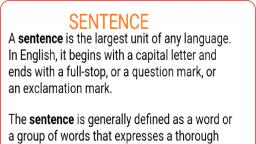
•How can we define a, sentence?
Page 5 :
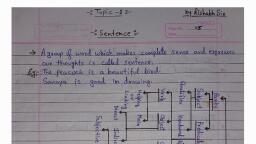
Sentence, •A group of words that, gives a complete, thought or idea
Page 6 :
For instance, •I have a pen., •They are praying to, God., , Predicate, , Subject, , Subject, , Predicate
Page 7 :
•What are the, components of a, sentence?
Page 8 :
•A subject and predicate, •Starts with a capital letter, •Ends with a suitable, punctuation mark.....(.)(?)(!)
Page 9 :
A sentence can be, • a statement,, •a question,, •a command, •an exclamation
Page 10 :
Kinds of sentences, • Assertive : Expresses statements, ., , The duster is on the table., , • Imperative : Expresses commands wishes requests., , Open the door., , • Interrogative: asks a question., , What is your name?, , • Exclamatory: Expresses suddenfeelings., , What a beautiful flower it is!
Page 11 :
Clause
Page 12 :
How can we define a, clause?
Page 13 :
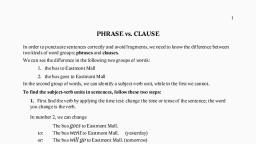
•A clause is a group of words which, contains a subject and predicate of it’s, own and depends on another clause to, give its complete idea, •Note: it’s an incomplete sentence
Page 14 :
•It can be categorised, into two, •Independent clause, •Dependent clause
Page 15 :
Independent clause, •It’s a clause that can stand alone as a, sentence, •Because it expresses a complete thought, •The secret of life is honesty
Page 16 :
Dependent /Subordinate clause, •It’s a clause that can’t stand alone, •It depends on another clause, •It is combined with a Subordinating conjunction., •Hence it is called subordinate clause, • My sister who lives in London was arrested.
Page 17 :
Subordinating conjunctions, •after, •although, • as, •because, •before, •even if, •even though, , • that, •though, •unless, •until, •if, •since, •so that, , • when, • where, • why, • who, • whom, • which, • what
Page 18 :
•If we identify the given, Subordinating conjunctions, we can conclude that it’s a, subordinate clause
Page 19 :
•Based on the function of the clause in a, sentence., •Subordinateclauses are divided into the, following ways, •Adjectival Clauses, •Adverbial Clauses, •Noun Clauses
Page 20 :
Adjectival Clauses, • Palys the role of an adjective, • They are introduced by relative pronouns, • Answers the question..... Which? ..... What type of?...., • My sister who lives in london was arrested
Page 21 :
Adverbial Clauses, •Plays the role of an adverb, •It answers why?..when ....?, Where?..., •I stopped running when I saw my friend
Page 22 :
Noun Clauses, •Plays the role of noun ., •It answers.. What?/ to what?, Whom?/to whom?, •What my father advised helps me a lot.
Page 23 :
Let’s see the sentence, structures
Page 24 :
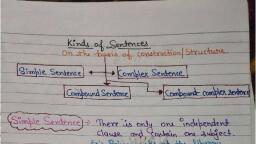
Type, , Structure, , Example, , Simple Sentence, , One independent only, , Humour is reason gone, mad., , Complex Sentence, , One independent and at, least dependent, , No man goes before his, time, unless the, boss leaves early., , Compound Sentence, , two independents, , I have had a perfectly, wonderful evening,, but this wasn't it., , Compound-Complex, Sentence, , two independents and at, least one dependent, , Those are my principles, and, if you don’t like, I have others.
Page 25 :
Simple Sentence
Page 26 :
Definition, , A simple sentence contains a, subject and a predicate., It expresses a single, complete thought that can, stand on its own.
Page 27 :
Subject, , Predicate, , •The baby cried for food.
Page 28 :
Compound Sentence
Page 29 :
Definition, , A compound sentence, contains two independent, clauses.
Page 30 :
•These independent clauses, are joined by a coordinating, conjunction .
Page 31 :
Coordinating Conjunctions, F, , For, , A, , And, , N, , Nor, , B, , But, , O, , Y, , Or, , S, , Yet, , So
Page 32 :
Examples, • The shoplifter had stolen clothes and he ran away, Independent Clause, , Independent Clause, , •Both sides of the conjunction “and” are complete, sentences. “The shoplifter had stolen clothes” can, stand alone and so also He ran away, • Therefore, this is a compound sentence.
Page 33 :
Complex Sentence
Page 34 :
Definition, , A complex sentence is an, independent clause joined by one or, more dependent clauses., A complex sentence always has a, subordinator
Page 35 :
Subordinating conjunctions, after, although, as, because, before, even if, even though, , that, though, unless, until, if, since, so that, , when, where, why, who, whom, which, what
Page 36 :
Examples, • After eating lunch at the restaurant,, Subordinate clause, Ramu went to the gym to exercise. Independent Clause, • If one is to say “after eating lunch at the restaurant” it, would be an incomplete thought., • So it is dependent on independent Clause “Ramu went, to the gym to exercise.”
Page 37 :
Compound –complex, sentence
Page 38 :
Definition, , •A compound-complex, sentence has two, independent clauses and at, least one dependent clause.
Page 39 :
Example, • After the two players lost their game, Subordinate Clause, they joined their other teammates for lunch and, they went to the movies., Independent Clauses, , • the dependent clause “after the two players lost, their game,”, • we have compound sentences joined by and., • Subordinate clause makes sentence compound-complex
Page 40 :
Let’s Recap, Identify the type of sentence, 1. Our teacher will congratulate us when we win our first, game., 2. Bhargavi and Bhanu went to the movies., 3. My mother prepared buns and my sister made a salad., 4. Since I got first rank, My father gifted me a bicycle., 5. Before Arun called me, he called his mom and his mom, asked him to look after his brother.
Page 41 :
Let’s Do, 1. Our teacher will congratulate us when we win our first, game. (Complex), 2. Bhargavi and Bhanu went to the movies.(Compound), 3. My mother prepared buns but my sister made a salad., (Compound), 4. Since I got first rank, My father gifted me a bicycle., (Complex), 5. Before Arun called me, he called his mom and his mom, asked him to look after his brother. (CompoundComplex)