Page 1 :
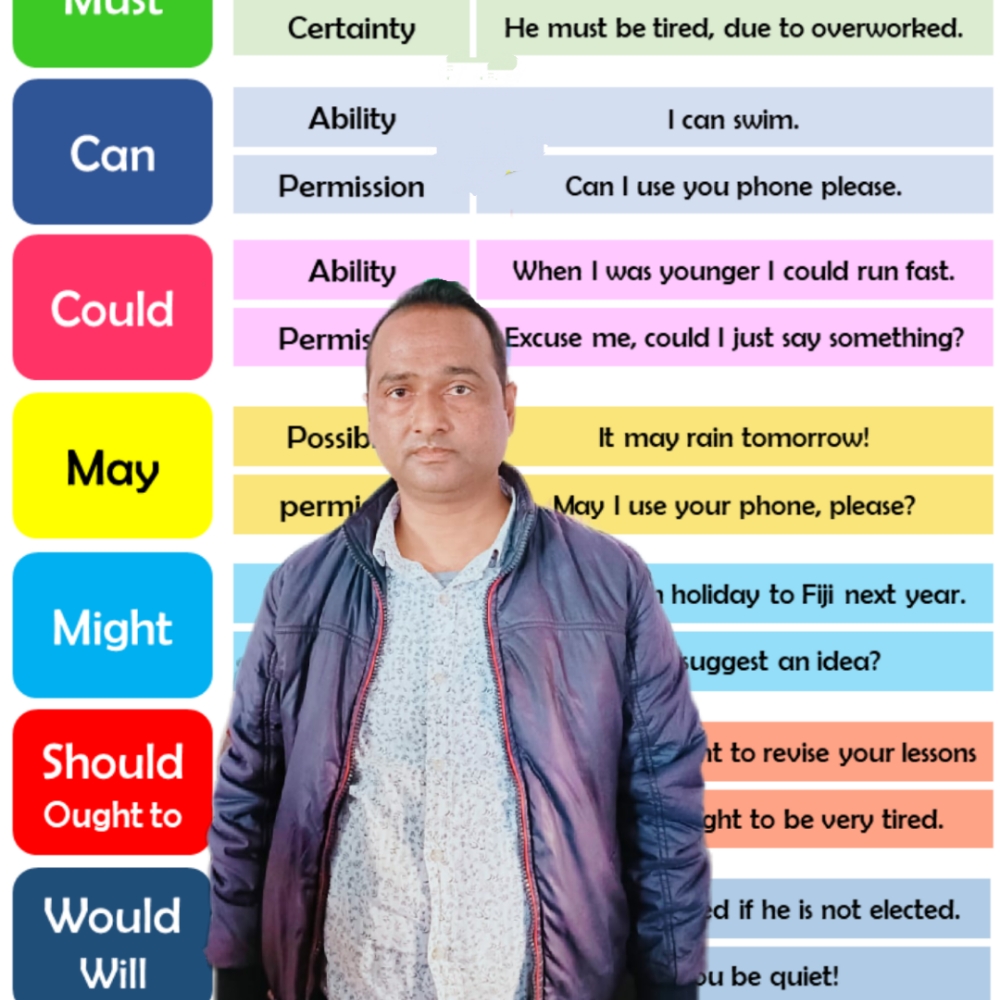
MODAL AUXILIARIES, Modal auxiliaries are auxiliary verbs that lend different shades of meaning to the main verb to, which they are attached. Modals help to express the mood or attitude of the speaker and, convey ideas about possibility, probability, necessity, obligation, advisability, and permission., The single-word modal auxiliaries are:, Can, Could, , May, Might, , Must, , Shall, Should, , Will, Would, , Have to, Have got to, , Ought to, Used to, , Have better, , Some phrasal modal auxiliaries are:, Be able to, Be going to, , Be supposed to, Be to, , SINGLE-WORD MODAL AUXILIARIES, Single-word modal auxiliaries are always followed by the simple (or “stem”) form of the verb., Here are some examples of the how single-word modal auxiliaries influence meaning:, Statement, , Meaning, , I can go., , I am able to go. / I have permission to go., , I could go., , If certain conditions were met, I would be able to go., , I may go., , It’s not certain, but there’s a chance that I’ll go. / I have, permission to go., , I might go., , It’s not certain, but there’s a chance I’ll go., , I must go., , I am obliged to go., , I shall go., , I am going (in the future)., , I should go., , It is advisable/recommended/obligatory that I go., , I will go., , It’s certain that I am going (in the future). / I am willing to go., , I would go., , My going is uncertain; it depends on certain conditions., , Copyright Marianopolis College. Used with permission.
Page 2 :
2, The following chart demonstrates some uses for single-word modal auxiliaries. Notice that in, some cases when the verb tense changes, the modal is replaced with another word or group of, words. Empty spaces denote non-existent forms., , MODAL, Can, , MEANING, , PRESENT FORM, , PAST FORM, , He can play the piano., , He could play the, piano., , He will be able to play, the piano., , He cannot play the, piano., , 2. Opportunity, , I can go now that I’ve, finished working., , I was able to go when I, finished working., , I can go when I finish, working later tonight., , I cannot go., , 3. Permission, , Their parents say they, can have a party., , Their parents said they, Their parents will surely They cannot have a, were allowed to have a say that they can have party., party., a party., , 5. Possibility, (usually a, generalization), , Can I borrow your, book?, It can be tiring to study, and work at the same, time., , 1. Past of can, , Before I hurt my wrist, I, could toss pizza dough., , 2. Conditional, , I could have made an, omelet if we had had, the ingredients., , 3. Suggestion, , You could have taken a You could take a long, long weekend to visit, weekend to visit your, your family., family., , Even before I hurt my, wrist, I couldn’t toss, pizza dough., I could make an, omelet if we have the, ingredients., , I couldn’t make an, omelet even if we had, the ingredients., , Could you phone me, when you arrive?, , Couldn’t you phone me, when you arrive?, Ms. Stevens couldn't be, the electors’ choice for, mayor., , 5. Possibility /, Impossibility, , Ms. Stevens could be, Ms. Stevens could have, the electors’ choice for been the electors’, mayor., choice for mayor., , Ms. Stevens could, become mayor., , 1. Permission, , You may submit your, paper via email now., , You may not submit, When you finish, you, may submit your paper your paper via email., via email., , You were allowed to, submit your paper via, email., , May I use your phone?, , 2. Polite Request, (refers to near future), 3. Possibility, Might, , Can’t I borrow your, book?, It can’t be tiring to sit, around and watch TV, all day!, , 4. Polite Request, (refers to near future), , May, , NEGATIVE FORM, , 1. Ability, , 4. Informal request, (refers to near future), , Could, , FUTURE FORM, , The bakery may be, open now., , The bakery may have, opened earlier today., , If you give me a, chance, I might, impress you!, , 3. Suggestion, , 4. Possibility, , The bakery may not, open., , Might I use your, phone?, , 1. Request (refers to, near future), 2. Conditional, , The bakery may open, later today., , My dog might be the, one who made the, mess., , If you had given me a, chance, I might have, impressed you!, , If you will give me a, chance, I might, impress you!, , Even if you give me a, chance, I might not, impress you., , You might have called, to say you weren’t, coming., , You might call to say, you aren’t coming., , You might not want to, call to say you aren’t, coming., , My dog might have, made the mess., , My dog might make a, mess., , My dog might not make, a mess., , Copyright Marianopolis College. Used with permission.
Page 3 :
3, MODAL, Must, , MEANING, , PRESENT FORM, , PAST FORM, , FUTURE FORM, , 1. Certainty, , She must be the best, athlete in our school’s, history., , She must have been the, best athlete in our, school’s history., , She must not be the, best athlete in our, school’s history., , 2. Strong, recommendation, , To be healthy, you must, eat well., , To have stayed healthy,, you should have eaten, better., , To be healthier, you, should eat better., , To be healthy, you, mustn’t eat poorly., , 3. Necessity, , Visitors must sign in at, reception., , In the past, visitors had to, sign in at reception., , In the future, visitors, must sign in at, reception., , Visitors don’t have to, sign in at reception., You must not disrupt his, concentration., , (Must not) 4. Prohibition, Shall, , Should, , 1. Inevitability, , One day, we shall, overcome our, dependence on oil., , Humanity shall never, abandon the quest for, immortality., , 2. Promising, (British usage), , I shall ensure that, everything goes, according to plan., , I shall not let you down., , 3. Future Action, (British usage), , Our train shall arrive, ahead of schedule., , Our train shall not arrive, ahead of schedule, after all., , For strong bones, you, should start drinking, milk., , You shouldn’t drink too, much milk., , 1.Recommendation For strong bones, you, should drink milk., , For stronger bones, you, should have drunk milk., , I should return this, library book., , 2. Obligation, 3. Expectation, , Will, , Would, , NEGATIVE FORM, , She should be at the, airport right now., , She should have arrived, at the airport by now., , She should arrive at the She shouldn’t be at the, airport before 9 o’clock airport yet., tonight., , 1. Future Action, , We will go to the movie We will not go to the, tonight., movie tonight., , 2. Promising, , I will ensure that, everything goes, according to plan., , 1. Past of will, 2. Conditional, , 3. Repetition in, the past /, habitual action, or behaviour, , You said we would go to, the movie., If I were in trouble, I would If I had been in trouble, I, If I got into trouble, I, would have asked him for would ask him for help., ask him for help., help., When we were kids, we, would always play street, hockey in the alley., , I will not disappoint you., , You said we wouldn’t, go., Even if I got into trouble,, I would not ask him for, help., When we were kids, we, would not play street, hockey in the alley., , Copyright Marianopolis College. Used with permission.
Page 4 :
4, , PHRASAL MODAL AUXILIARIES, Like single-word modal auxiliaries, phrasal modals are always followed by the simple (or “stem”), form of the verb., Unlike single-word modals, however, most phrasal modals contain the verbs be or have, which, must be conjugated to identify tense and number (I am, you are, he/she/it is, I was, you were,, he/she/it was, etc). Exceptions are used to and ought to, which require no change in verb form., Had better is never conjugated, and it does not include the word to as the other phrasal modals, do. Like single-word modals, it is followed immediately by the simple form of the verb., Here are some examples of how phrasal modal auxiliaries influence meaning:, Statement, , Meaning, , I am able to go., , I can go. / I have permission to go., , I am going to go., , I will be going (in the future)., , I am supposed to go., , It is understood/expected/agreed-upon that I will go., , I am to go., , I am expected/obliged to go. / I have been ordered, to go., , I have to go., , I am obliged to go., , I have got to go., , I am obliged to go (extra emphasis on the obligation)., , I ought to go., , It is recommended/advisable that I go., , I used to go., , I went on a regular basis (habitual action in the past)., , I had better go., , It is advisable that I go., , Copyright Marianopolis College. Used with permission.
Page 5 :
5, The following chart demonstrates some uses for phrasal modal auxiliaries. Notice that in some, cases when the verb tense changes, part of the modal is replaced with another word or group, of words. Empty spaces denote non-existent forms., , MODAL, , MEANING, , Be able to, , Ability, , Be going to, , Plan (for the future), , PRESENT FORM, She is able to join us., , Be supposed to Expectation, , Be to, , Expectation /, obligation, , Have to, , Have got to, , Ought to, , Used to, , FUTURE FORM, , NEGATIVE FORM, , She was able to join us., , She will be able to join, us., , She is not able to join, us., , I was going to start, university next fall., , I am going to start, university next fall., , I am not going to, start university next, fall., , He was supposed to, bring dessert, but I, guess he forgot., , He is supposed to bring He is not supposed to, dessert tonight., bring anything, tonight!, , She was to see the, project through to its, end, but she left before, its completion., , She is to see the, project through to its, end, no matter how, long it takes., , She is not to see the, project through to its, end after all., , I have to leave in, approximately 10, minutes., , I do not have to, leave., , Obligation, (= must), , I have to leave now., , I had to leave then., , Strong obligation, , I have got to prepare, my presentation now., , I needed to prepare my I have got to prepare, presentation at that, my presentation as, time., soon as I finish dinner., , I do not need to, prepare my, presentation, anymore. I’m ready!, , 1.Recommendation, , One ought to express, one’s gratitude., , We should have sent a, note to our hostess., , We ought not forget., *to is dropped in the, negative, , 2. Certainty, , When one studies, hard, one ought to, pass., , With all the studying she With all the studying, did, she ought to have, she’s done, she ought, to pass her exam., passed her exam., , Habitual past action /, behaviour, , Had better, , PAST FORM, , We ought to send a, thank you note to our, hostess., , My grandfather used to, walk 3 miles to and, from school every day!, You had better go. It’s, getting late!, , Recommendation, , You had better not, go. The weather, looks pretty nasty!, , For more information on modals and other auxiliary verbs, please refer to the following websites:, , , , , http://www.englishpage.com/modals/modalintro.html, http://www.chompchomp.com/terms/auxiliaryverb.htm, http://grammar.ccc.comment.edu/grammar/cgi-shl/quiz.pl/, , You are also welcome to make an appointment with The Learning Centre staff:, , , http://www.vaniercollege.qc.ca/tlc/booknow/, , Copyright Marianopolis College. Used with permission.