Page 1 :
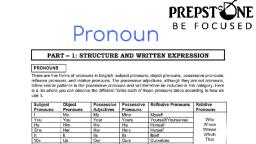
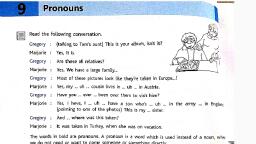
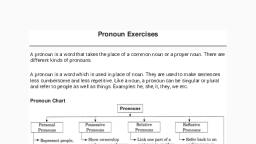
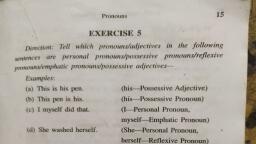
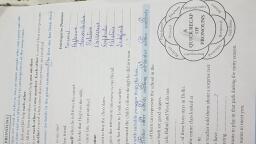
ee, Pronouns, elindiereaarainiie et“ —_, , ead the paragraph and underline the pronouns., , nya and her brother are going to their grandmother’s house. She is called Stella. Though she’s 80, ears old, she cooks for her grandchildren herself when they visit her. She loves each of them very, much. The big house that she lives in is hers., , , , Pronouns are words that are used in place of nouns, Pronouns agree with the nouns they replace in, number and gender, , , , Pronouns can be categorized into the following types., , 1. Personal pronouns 4. Emphatic pronouns 7. Demonstrative pronouns, 2. Possessive pronouns 5. Interrogative pronouns 8. Distributive pronouns, 3. Reflexive pronouns 6. Relative pronouns 9. Indefinite pronouns, , Personal Pronouns, , Personal pronouns are used in place of the names of people and things. If the personal pronoun is the, doer of the action, i.e. the subject of the sentence, it is called a subject pronoun. If the pronoun receives, the action done by the subject, it is called the object pronoun, , Examples: They liked her very much. (They - subject pronoun; her - object pronoun), She gave the book to him. (She - subject pronoun; him - object pronoun), , This table lists the personal pronouns, , , , , , , , , , , , , , , , , , Tad alate Ob, i Singular Plural Singular, First person (speaker) | we me, Second person (person spoken to) you yo, bow (person spoken he, she, it they him, her, it
Page 2 :
ronouns., , D Fill in the blanks with the correct personal P', (You and |/Me, , 1, are good friends from now on., , and you/! and you/You and me), , chicken stew and appams for, , ; d, 2, My mother has made F erdefre aid, , __ (my friends and me/I and my, my friends/my friends and |), ris very angry with —_————— (us/we/they/he), , 3, The teache, ness soon. (Lina and, , are going to start a busi, \/l and Lina/Me and Lina/Lina and me), , 5. The workers have put in long hours. The employers have, a holiday next week. (them/we/, , romised ——————, you/I), 6. Her dog loves —————, , 7 _____~ are the winners of tl, and I/Mohan and me/Me and Mohan/I and Mohan), , _ (me and her/I and her/us/we), , are going on a trip to Sri Lanka. (, , 8, —————_—, , and she), , Possessive Pronouns, , Possessive pronouns show ownership. They tell us who or what something belongs to., , — — ————, , he musical contest. (Mohan, , | always comes |, , set of pioneer, are used together,, She and | [7], , Tina, Ramesh and | iv], |, Tina and Ramesh | x], , Nouns, , Do not use me in place, , of /, when /is part of the, subject of the sentence,, Anish and | are siblings. \v], Anish and me are siblings. [x], , a, , She and I/She and me/| and she/Me, , J, , Examples: We bought two hats. The blue one is Meena’s and the pink one is mine., , Suresh and Rina have two cars. The jeep is his and the sedan is hers., , Look at this list of possessive pronouns., , , , , , , , , Possessive pronouns, , , , , ee Re, Singular Plural, , , , , , , , , , , , , , First person mine ours, Second person __yours ES, \_ Third person his, hers theirs D, , , , , , Reflexive Pronouns, , , , , Reflexive pronouns are used when we w, they can act as the object of the sentent, , , , The reflexive pronouns are myself, you, Examples: | looked at myself in the mirroi, , Please help yourself, there’s ple, 26 ), , The students solved the problei, , Its is not a possessive, pronoun., , Do not add apostrophe, before s in ours, yours,, and hers., , theirs
Page 3 :
Emphatic Pronouns, , , , ‘, , , , Emphatic pronouns are used to emphasize the action © If the gender of an animal is known,, , of the subject. They have the same forms as reflexive usually she or he is used instead of it., , pronouns © We often use possessive pronouns, after the preposition of., , Examples: / myself agreed to organize the picnic. Example: Rehan is one of my favourite ', The children themselves joined their parents in cousins. = Rehan is a favourite, helping out their aged neighbours. cousin of mine ;, She herself admitted her mistake. ae oe ple, , 0 Fill in the blanks with suitable pronouns., 1. I can only help you so much. You have to do the rest, . Tony was ashamed of ______ because he had lied to his parents., . People who take care of ______ have a better chance of staying healthy., , 2, 3, 4. All of you have done a very good job. You should be proud of, 5. Aryan did his homework by, , 6, , . Anish exclaimed, ‘The tyres of our car are punctured! Where, , , , shall we go to get ______ repaired?’, , 7. ‘Don’t _______ worry, sir! | can do _______. It’s a, really easy job for _____,’ replied the watchman., , 8. She said, ‘If ________ are ready, _______ shall start.’, , ‘ have lost a lot of weight. Look at _________,’ my mother said to me., , 10. We, along with our neighbours, had bought two LCD TVs last month from the same, shop. My neighbours say that —_____ Is working fine, but _________ often has, problems., , Interrogative Pronouns, , , , , , , , , , , , , Interrogative pronouns are used to ask questions. The five interrogative pronouns, which, whom and whose 4, , Examples: Who went to pick up grandpa?, What are you searching for?, Which of these books are you going to buy?, , Whom do you want to meet?, Whose is this car? wit), ve, e Fill in the blanks with suitable interrogative pronouns., 1, will come with me to the 3., market?, 2. are these books? 4.
Page 4 :
28, , , , >, —, , 5 do you want? 7, —_——_— sthe Matter with, lu?, __ is this purse? 8. isthe road to th, : station? Metro, , Relative Pronouns, , , , , , , used to refer to nouns mentioned earlier in the sentence, They also, , h, relative pronouns are who, whom, whose, that and which, elp us, , Relative pronouns are, join two sentences. The, , ——_—, , Look at the way the different relative pronouns are used, , , , , , , Be bry Used for [actuary, , , , , The passenger who sat next to the old lady helped her unbuckle the, whose seat belt., whom People The man whose house you are buying is my neighbour., , The guests whom you met at the party are from Malaysia,, , , , , , , , animals The snake which bit the boy has been caught., anen and things The car which they bought is expensive., both people | The people that | met on the way were very friendly., that and things The problem that you are talking about can be easily solved,, , , , , , , , Xe, , We also use what as a relative pronoun in the sense, of ‘that which’ or ‘the thing which’, , Examples: What you want cannot be given to you, (that which) / We often incorrectly use who in place of, You got what you deserved. (the thing which) whom. Remember that who functions as a, , : sub whom functions as an object ina, Whose is used as a relative pronoun for inanimate ject anil Whom functions 4, , objects too. sentence., Doctors who care for their patients are respected., Examples: The bottle whose cap is broken 1s leaking. (The relative pronoun is a subject, so we, The house whose roof is broken was use who. ), abandoned several years ago. Patients want doctors whom they can trust., The blanket, whose edges are embroidered (The relative pronoun is an object, so we, with lace, belongs to me. use whom.), , =, , © Fill in the blanks with suitable relative pronouns., , 1. The director _____ made this film passed away two years ago., , 2. She won the finals of the tough curnpetition, —______ no one had expected her to., 3. Tell me _____ your friends are and | will tell you what kind of a person you are, 4. The swimmer _____ won the gold medal trained for m1n\ yea, 5. The sweater ______| bought yesterday shrank after a wash
Page 5 :
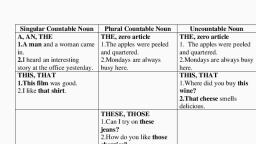
6. The name of the eleven players, announced tomorrow., , 7. Roti, we eat for dinner, is part of our staple diet., 8. Where did you buy the earrings, 9. Salman Rushdie’s latest book,, 10. The tea shop, , ——______ made it to the national team will be, , ———____ you gave Minu?, , — was published last year, was an instant bestseller., ———— we used to visit often has closed down suddenly., , Omission of Relative Pronouns, , The relative pronoun is omitted, preposition in the sentence., , Examples: The boy to whom you gifted the books did very well in the exams,, The boy you gifted the books to did very well in the exams, (, to changes.), , These are the colours with which he painted the walls., , These are the colours he painted the walls with. (, changes. ), , ifit acts as the object. In such cases, we change the position of the, , The position of the preposition, , The position of the preposition with, , @ Rewrite the following sentences omitting the relative pronouns. Change the position of the, prepositions., , 1. This is a house in which you can maintain a big lawn., , 2. The person about whom you are asking is known to our family., , 3. This is the road beside which the Ganga flows., , 4. Zootopia is the animated film about which | was telling my brother., , 5. Cynthia is the girl with whom | shared a room during our school trip., 6. This is the organization in which my brother works., 7, , . The professor with whom we requested a meeting has not, arrived yet., , . This is the museum beside which the restaurant is located., , \o ©, , . Who is the person with whom you discuss your troubles?, , , , 10. The hill on top of which the monastery is situated is very high., , Demonstrative Pronouns, , |_ Demonstrative pronouns point to specific people and things. These are this, that, these and those., —_—_—_— —— ae ), , Examples: This is the boy who is a member of the music group., That is the lake where we can go rowing, —, These cookies are tastier than those in the jar.