Page 1 :
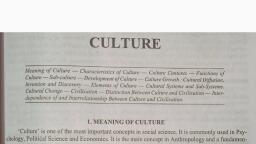
Chapter, , Meaning of Culture, Culture is the expression of our nature in our mode of thinking and, living in our everyday intercourses. It is a key concept in both, sociology and anthropology. It is culture which shapes our values,, beliefs, norms, and to a great extent our attitudes and the way we, perceive the world around us. The way we dress, speak, greet one, another, and the structures and institutions we build are determined, by our culture. Culture refers to a group's social heritage that has, been transmitted from generation to generation. Scientific, knowledge, philosophical systems, literary traditions, art forms,, and customs and manners are handed down from one generation to, the other. Culture also includes religious, political, economic and, other types of activities. Culture encompasses not only material, objects such as tools, technology, fashion, jewelry and buildings. It, includes all the means of human survival which includes man's, inventions and inventories as well as the means by which man, adjusts to his environment. Culture includes all that man has, acquired in his individual and social life. In the words of Maclver, and Page, culture is "the realms of styles, of values, of emotional, attachments, of intellectual adventures". It is the entire 'social, 1
Page 2 :
heritage' which the individual receives from the group. In short we, can say that culture is the sum total of man's life experiences., Whatever knowledge or experience a man acquired in life is his, culture provided that they are manifested in the social contacts., In sociology we use the word culture to denote acquired, behaviors that are shared by and transmitted among the members, of the society. It is an accumulation that a new generation inherits., Man learns his behavior and behavior that is learnt denotes his, culture. Thus culture is a system of learned behavior shared by and, transmitted among the members of a group. Culture is not innate., Traits learnt through socialization, habits and thoughts are what is, called culture. Culture is learned. Any behaviour that is socially, acquired is called learned behavior. Culture is inclusive of the, expectations of the members of the group. It is a social product that, is shared by most members of the group. Culture embodies the, ideas and norms of the group. It is a sum-total of the ideal patterns, and norms of behavior of a group. Culture fulfills those ethical and, social needs of the groups that are ends in themselves. Culture, possesses an order and system. Its various parts are integrated with, each other and any new element that is introduced is also, integrated. Culture evolves into more complex forms through, division of labour that develops special skills and increases the, 2
Page 3 :
interdependence of society’s members., Definitions, E. B. Taylor, an English anthropologist, has defined culture as, "that complex whole which includes knowledge, beliefs, art,, morals, law, custom, and any other capabilities and habits acquired, by man as a member of society.", George Simmel, a German sociologist is of the opinion that, "culture refer to the cultivation of individual through the agency of, external forms, which have been objectified in the course of, history.", C.C North is of the opinion that "culture consists in the, instruments constituted by man to assist him in satisfying his, wants.", T.S Elliot is of the view that the term culture "includes all the, characteristic activities and interests of people.", Robert Bierstedt is of the opinion that "culture is the complex, whole that consists of all the ways we think and do and everything, we have as members of society. ", Ellwood says, "culture includes all of man's material civilization,, tools, weapons, clothing, shelter, machines and even system of, industry.", Ralph Linton" culture is the configuration of learned behaviour,, 3
Page 4 :
and the result of behaviour, whose component elements are shared, and transmitted by the members of a particular society.", The university education commission 1948-49 states “culture is, an attitude of mind, an inclination of the spirit and those who yearn, for it, wish to have a vision of greatness, sit in the presence of, nobility, see the highest reach and scope of the spirit of man.", Swami Dayanand " culture consists of the acceptance of truth and, abandonment of untruth.", Jawaharlal Nehru thinks , " culture is the widening of mind and, of the spirit.", Gandhi remarks," culture is the foundation, the primary thing. It, should show itself in the smallest detail of your conduct and, personal behaviour, how you sit, how you walk, how you dress,, etc. Inner culture must be reflected in your speech, the way in, which you treat visitors and guests and behave towards one another, and towards your teachers and elders.", , Characteristics of Culture, For clear understanding of the concept of culture it is necessary for, us to know its main characteristics., , 4
Page 5 :
1. Culture is learnt, Culture refers to the learned ways of behavior. Cultural objects, are not organic or biological; they can only be acquired through, social life. Man learns culture by socialization. No one brings, thoughts and ideas by birth but one learn them by interacting with, other persons of society .For example, hunger and sexual urges are, biological facts, but it is culture which determines how these, biological urges are channeled. According to Hoebel, "culture acts, as an integrated system of learned behaviour patterns, which are, characteristics of the members of a society and which are not a, result of biological inheritance.”, , 2. Culture is social, Culture cannot become a personal property of a man. It is social, because neither one man can make the whole culture and nor it is, property of anyone. It is shared by the members of society. No one, can acquire culture without association with other human beings., For example when anyone invents anything then that invention is, not his personal thing but becomes the property of society because, that thing will be used by the whole society. In this regard Linton, has said that "culture is the social heritage of man." It is the culture, which helps man to develop human qualities in a human, 5
Page 6 :
environment., , 3. Culture is transmissive, Culture is transmissive as it is transmitted from one generation to, another. It is transmitted not through genes but by means of, language. Language is the main vehicle of culture. Language in it, is different forms like reading, writing and speaking makes it, possible for the present generation to understand the achievement, of earlier generations. Transmission of culture may also take place, by imitation as well as by instruction. Woodward says," culture, includes anything that can be communicated from one generation, to another.", , 4. Culture is dynamic and adaptive, No culture ever remains constant or unchangeable. Change is the, law of nature. Culture is subject to constant and consistant changes., For example when a particular culture is transmitted to the next, generation, the recipient generation modifies it according to its, own needs and then this modified form of culture is transmitted to, third generation. This process of modification never stops and thus, 6
Page 7 :
continuous enrichment of culture is seen. A certain region or part of, culture may however, be kept preserved at every stage of, transmission. Culture is responsive to the changing conditions of, physical world. It is adaptive and helps in the process of, adjustment., 5. Culture is shared, Culture in the sociological sense, is something shared. It is not, something that an individual alone can possess. For example, customs, traditions, beliefs, ideas, values, morals etc., are all shared, by people of a group or society. “Culture is something adopted,, used, believed, practised, or possessed by more than one person. It, depends upon group life for its existence.”(Robert Bierstedt), 6. Culture has distinct entity, Different societies of world have different cultural patterns, because of their differences in beliefs, morals, practices,, philosophies, ideologies, institutions, material or spiritual progress,, attitude towards life, geographical conditions and physical, environment. Culture of every society is unique to itself. Cultures, around the world are not uniform. People of different cultures form, their own traditions, thoughts and ideals according to the, atmosphere in which they live. For example culture of the people, living in hilly areas is different than the culture of people living in, 7
Page 8 :
plain areas and that's why their way of life is quite different from, each other., 7. Culture is consistent and integrated, Culture has a tendency to be consistent and at the same time, different parts of culture are interconnected. For example, the value, system of a society is closely connected with its other aspects such, as morality, religion, customs, traditions, beliefs, values and so on., , 8. Culture is gratifying, Culture provides proper opportunities and prescribes means for the, satisfaction of our needs and desires. These needs may be, biological or social in nature. Our need for food, shelter, and, clothing on the one hand, and our desires for status, name, fame,, money, mates, etc., is all, for example, fulfilled according to the, cultural ways. Culture determines and guides the varied activities, of man. Infact, culture is defined as the process through which, human beings satisfy their wants., , 8
Page 9 :
9. Culture can be observed, Culture can be visualised or seen in its physical form. Even nonmaterial or metaphysical cultures can be seen when they are, translated by people into action. For example, God fearing society, will also be just and honest in its manifestation of behaviour that, can be observed., , 10. Culture is continuous and cumulative, The process of culture is continuous. It also tends to become, cumulative. Culture is a 'growing whole' which includes in itself,, the achievements of past and the present and makes provisions for, the future achievements of mankind. Culture may thus be, conceived as a kind of stream flowing down through the centuries, from one generation to another. As coons (1951) writes, “culture is, the sum total of the ways in which human beings live and are, transmitted from generation to generation by learning.", , Interrelationship between Education and Culture, Meaning and concept of culture testifies to the fact that education, and culture are integrally and intimately connected. Both culture, and education go hand in hand with one another. Culture has, 9
Page 10 :
profound implications for education. The social living is influenced, by education and education is itself governed by the social life., Without culture can be no growth and progress of man. According, to Wodkowksi (1995), "teacher must relate teaching content to the, cultural background of their students, if they want to be effective in, multicultural classroom.", The culture of a society has its inevitable impact on its, educational system. The educational system points to the various, needs of the society concerned, because it is towards the fulfillment, of the same that education is organized. If the culture of a society is, chiefly materialistic, the education system there is based on, competition and the efforts of the individual there is directed, towards the achievement of material goals, and nor towards, spiritual or aesthetic ones. If individualism is at the top in a culture, the educational system of the society, too, becomes colored by, individualism. Whatever we learn through education is immensely, influenced by culture. Now we will study the interrelationship, between the two here., Influence of Education on Culture, Culture is influence by education in following ways:, 1. Conservation/Preservation of culture. Conservation of, culture is an important function of education. Each country, 10
Page 11 :
believes and flaunts the superiority of its own culture over, the rest. Hence, it tries to preserve its culture in its original, form and education is the only means to complete this task., Pt. Nehru once said, “Education must help in preserving the, vital elements of our cultural heritage.”Education therefore, is said to be the agency of social conservation., 2. Transmission of culture. Education is the savior of cultural, traditions, experiences, values and norms. It helps in the, transmission of cultural patterns. In the words of Ottaway,, “One of the tasks of education is to handover the cultural, values and behaviour pattern of the society to its young, potential members.” Without transmission of culture there, can be no growth and progress of man. If culture is not, transmitted consciously then there will be chaos in the, society and this will lead to instability in the society. So, transmission of culture by education is a must for the, survival of our cultural heritage., 3. Promotion of culture. Education helps in the modification, and promotion of culture. It helps in the establishment of a, better and happier society. As D.J.O. Cannon remarked, “If, each generation had to learn for itself what has been learned, by its predecessors, no sort of intellectual or social, 11
Page 12 :
development would be possible and present state of society, would be little different from the society of the old stone, age.” Thus education performs the important function of, constantly, , re-organizing, , and, , restructuring, , human, , experiences for the promotion of culture and civilization., 4. Removing cultural conflicts: There are several cultures, found in the world. Even a nation may have different, cultures. Because of these differences, followers of one, culture look down upon the representatives of other culture., For example, followers of one culture may allow their, women folk to walk without veil while many people, consider this veil necessary for their female folk. This, attitude may create cultural conflicts when one group, considers its culture better and tries to impose it on people of, the other cultures. Only education can remove these cultural, conflicts by making the people tolerant. Children will be, taught good and common elements of all cultures and their, prejudices will be removed. Children will learn many good, elements of different cultures either through books or, through imitating the behaviour of their teachers., , 5. Cultural reforms: Culture is always dynamic in nature. So, 12
Page 13 :
many new things are added to culture every time. But all, these additions or modifications are not always desirable for, the good of the society. Education analyses the culture, scientifically and brings out all those undesirable elements, which are not conducive for their development., 6. Maintaining the continuity of culture: No society can, survive without its culture. Cultural identity is must for, creating self consciousness in man. Education saves a subculture from the dominance of a powerful culture and thus it, maintains the continuity of culture through its diverse, activities and programmes. This move is not against cultural, integration among different societies. It only means to, safeguard one culture from the dominance of other culture., 7. Removing cultural lags: Material culture generally grows, at a faster rate than non material culture. It creates, ideological conflicts in man in his internal behaviour., Education redefines the concepts, beliefs and ideals, according to the changing needs and thus cultural lag is, removed., 8. Development of a composite culture: When different, cultures come in contact with each other a composite culture, is created due to exchange of cultures. In this type of culture, 13
Page 14 :
something is given to other cultures and something is taken, from them. This culture may be more acceptable as, compared to a particular culture imposed on people by force, as is the case of India. Education can play a significant role, in creating such cultures and in integrating the whole nation, into one unit., Influence of culture on education: Cultural pattern affects, education in the following ways:, 1. Formulating educational aims: Whatever ideals, values, and beliefs people in the society have, the aims of education is, to preserve them. Thinking and pattern of behaviour of the, people and their standard and style of living will also play an, important role in determining educational aims., 2. Constructing curriculum: Culture is not genetically, inherited, it is rather acquired. So, curriculum will be, constructed to acquire the desired culture by the people. Culture, becomes the need of the society in the sense that its acquisition, increases material or spiritual comforts. Curriculum will be so, developed as to increase these comforts., Besides, all elements of culture are not universal.Culture, differs from society to society. This variability of culture will, also be accommodated in the curriculum to increase the, 14
Page 15 :
adjustability of people in the society., 4. Methods of teaching: Whether the culture of the society, is accommodative or impenetrable also determines the, behaviour of the teachers and their methods of teaching., Whether education will be teacher centered, curriculum, centered or child centred will depend on whether the cultural, pattern of the society is autocratic or democratic. If the, society follows democratic culture, teacher will teach the, students according to their needs, interest and aptitude., , 6. Discipline: No other aspect of education is so, directly affected by culture than discipline. Problem of, indiscipline is generally seen in those societies where, education is not given priority by the people i.e.,, culture of the labour class. Children belonging to these, cultures are dealt with very strictly in a repressionistic, manner. On the contrary, children representing, cultured societies are very much cooperative to the, school discipline. So, they are democratically treated, by their teachers., 7. Research activities: Culture or sub culture of the, society, , determines, 15, , the, , directions, , as, , well, , as
Page 16 :
dimensions of researches. For example if people, believe that AIDS can be treated by magical hyms or, verses of Bible recited by Pope, no efforts will be, made to find out the causes or remedies of the killer, disease. On the other hand if people believe that there, is no disease on this earth which is not curable, they, will work hard to discover the cure of this disease., 8. Development of arts, music and literature: Arts,, literature and music reflect the culture of a particular age., We can study the culture of the past on the basis of these, cultural elements and can relate them to the present in, order to predict about future. Thus it is culture alone that, binds past, present and future into a single time unit. This,, phenomenon of culture can reduce many of the social or, cultural conflicts that we see today., , 9. Effects on teacher’s behaviour: Teacher of the class, is the practical being and living form of culture., Whatever culture he has acquired from the society is fully, reflected through his behaviour in the society. Thus a, teacher can make the process of acculturation very easy, and natural. He tries to inculcate those ideals and values, 16
Page 17 :
in children which he considers good. Thus a teacher can, modify and transform the culture of his students by his, own behaviour., 10. School system as a whole: School exists for the, purpose of inducting the young into the culture to which, school belongs. For this very reason, linguistic and, religious minorities establish their own educational, institutions to preserve and transmit their culture. The, total activities and programmes of the school are, organized accord to the cultural pattern of the society., , Dimensions of culture, There are two main dimensions of culture :, Material and non-material culture, (i)Material culture, Material, , culture, , consists, , of, , manmade, , objects, , such, , as, , tools,implements,furniture,automobiles,buildings,roads,dams,bridg, es,and infact, the physical substances which been changed and used, by man. It is concerned with the external, mechanical and, utilitarian objects. It includes technical and material objects like a, 17
Page 18 :
printing press, a telephone, a television, a machine gun etc. It, includes our banks, insurance schemes, currency system, etc. It is, referred to as civilization., (ii)Non Material culture, The term culture when used in ordinary sense means non material, culture. It is something internal and intrinsically valuable, reflects, the inward nature of man. Non material consists of the words, people use or the language they speak, the beliefs they hold, values, and virtues they cherish, habits they follow, rituals and practices, they do and the ceremonies they observe. It also includes our, customs and tastes, attitudes and outlook, in brief, our ways of, acting, feeling and thinking., , Components of culture, Although cultures have evolved over thousands of years and vary, considerably, in general terms we may identify at least four broad, categories of components such as beliefs, values, norms and, 18
Page 19 :
language. The content of each of these components varies, tremendously from culture to culture., 1. Belief, Beliefs are shared ideas people hold collectively within a given, culture, and these beliefs are also the basis for many of the culture's, norms and values. A belief is an idea or statement about reality, which people accept as true. It may be based on their experiences, in the past, scientific evidence, religious faith or public opinion., Some beliefs are scientific and empirically verifiable. However,, belief in God and beliefs about soul, hell and heaven are based, solely on faith. Although a given belief may be unprovable or even, logically impossible, it nonetheless guides people through their, lives. For example, many people in India have unshakable belief, about horoscope, astrology, and auspicious hour. Hindu weddings, are always scheduled on the most auspicious day and hour., 2. Values, Values are shared standards among members of a society as to, what is desirable or undesirable in social life. Values are, generalized standards by which people define what is considered, right and wrong, beautiful and ugly, good and bad. Since they are, generalized standards and only provide broad behavioral, preferences, people are free to disagree on specific goals, norms or, 19
Page 20 :
practices. Freedom, justice, equality, patriotism, and democracy are, some of the almost universal values. Generally speaking,, capitalism, materialism and individualism are supposed to be, integral parts of the western value system. Children are expected to, be polite and respectful in front of elders. Dignity of labour is the, hallmark of the American work ethic. Even graduate students from, rich families undertake any types of part-time work: cleaning, public toilets, digging burial pits in the cemetery, waiting at tables, or washing dishes at the cafeteria., 3. Norms, Norms are the standards of group behaviour. Groups are the, products of interaction among individuals. When a number of, individuals interact, a set of standards develop that regulate their, relationship and modes of behaviour. These standards of group, behavoiour are called as social norms. Norms are the specific, cultural expectations for how to behave in a given situation. Norms, provide guidelines to patterns of behaviour and define them as, appropriate or in appropriate according to the specific social, situations. Norms may be explicit or implicit. Explicit norms are, those norms that are stated formally or in written form. For, example, several schools and colleges have explicit rules about the, uniforms their students are required to wear. Implicit norms are not, 20
Page 21 :
written rules but those generally understood by the members of the, group and their violation may produce a harsher response. For, example, when waiting in line, an implicit norm is that you should, not barge in front of those ahead of you., William Graham Sumner (1906) has identified two types of, norms: folkways and mores., Folkways are recognised ways of, , behaviour. Folkways are thus, , the recognised ways of behaving and acting in society which arises, automatically within a group to meet the problems of social living., The folkways of a group include the mores and all the other ways, of behaving that are considered interesting. Folkways are general, standards of behaviour adhered by a group. They are appropriate, ways of doing things. They simply specify the way the things are, customarily done. Their violation may result in a raised eyebrow or, a murmur of disapproval but no punishment. For example, vacate, your seat on the bus in favour of an elderly passenger, cover your, face when you sneeze in front of other people , do not pick your, nose in public., Mores (pronounced "more-ays") are stricter norms than folkways., Some mores are backed by law and enforced by the government, but others are not. Forgery, rape, murder, child abuse are violation, of mores as well as the established laws of the state. But cheating, 21
Page 22 :
in a friendly card game, spreading ugly rumors about your, neighbour, adultery and prostitution are violation of mores. A, violation of mores always invokes sanctions which vary from, ridicule, avoidance, excommunication, and formal punishments., Laws are formalized mores, and their violation can bring serious, repercussions. They are usually formulated by governmental, authorities and enforced by the police. They vary from simple laws, such as fastening the seat belt payment of tax and prevention of, corruption. The difference between mores and law is that the, former may or may not be written but the laws are always explicit, and recorded., Sanctions are the means by which society enforces its norms. They, involve punishments for violations or rewards for conformity., Thus, there are positive and negative sanctions. A positive sanction, expresses approval of good behavoiur. It may be as simple as a, smile, a pat on back, a reward or a trophy. A negative sanction, refers to punishments for violation of norms. It may vary from a, frown a murmur of disapproval, avoidance, suspension and, dismissal, to fines, imprisonment and capital punishment., 4. Languages, Language is a set of symbols and rules that, put together in a, meaningful way, provides a complex communication system (Cole, 22
Page 23 :
1988).The formation of culture among humans is made possible by, language. Learning the language of a culture is essential to, becoming part of a society. Becoming part of any social group such, as a friendship circle, fraternity or sorority, or a professional, organization involves learning the language the group uses., Otherwise, you cannot participate fully in its culture. You have to, learn the common language to become a member of any social, group. Lawyers have their own vocabulary and their own way of, constructing sentences of intricate prose commonly known as, “legalese". If you are not adept in the language of the law, you are, likely to be at a disadvantage in any legal proceedings. Likewise,, becoming a sociologist requires learning the words and concepts, that sociologist use to communicate their ideas. In other words we, −−can say that language is the most important element of a, symbolic culture. It is the part of society’s cultural heritage;, language expresses and preserves that cultural heritage., , Cultural Diffusion, The term cultural diffusion refers to the process of borrowing, cultural elements from another society. The process of diffusion, involves the spread of cultural elements─both material artifacts and, ideas─from one culture to another. Cultural diffusion is the trans23
Page 24 :
mission of cultural elements from one society or cultural group to, another. Cultural diffusion can occur by means of trade, migration,, mass, , communication, , media,, , and, , social, , interaction., , The, , anthropologist Ralph Linton (1937) alerted us some time ago to the, fact that many things people often regard as “American” originally, came from other lands—cloth developed in Asia, clocks were, invented in Europe, coins originated in Turkey, and much more., Cultural diffusion can occur from one culture in a society to, another in the same society. Barbecued ribs were originally eaten, by Black slaves in the United States after the ribs were discarded, by White slave-owners who preferred meatier parts of the pig., They are now a delicacy enjoyed throughout the United States by, virtually all ethnic and racial groups. One contemporary theorist,, Robert Ferris Thompson (1993), points out that an exceptionally, large range of elements in material and non-material culture that, originated in Africa have diffused throughout virtually all groups, and subcultures in the United States, including aspects of language,, dance, art, dress, decorative styles, and even forms of greeting., These examples all illustrate cultural diffusion not only from one, place to another (West Africa to the United States), but also, diffusion across time, from a community in the past to many, diverse ethnic groups in the present., 24
Page 25 :
Similarly, the immigration of Latino groups into the United, States over time has dramatically altered U.S. culture by, introducing new food, music, language, slang, and many other, cultural elements (Muller and spenshade 1985). By a similar token,, popular culture the United States has diffused into many other, countries and cultures: Witness the adoption of American clothing, styles, rock, rap, and Big Macs in countries such as Japan,, Germany, Russia, and China. In grocery shops worldwide, from the, rain forests of Brazil to the floes of Norway, you can find the CocaCola logo., , Cultural Lag, Due to rapid progress of scientific inventions and discoveries, and technological advancement material aspect of culture has gone, ahead of non-material aspects. The difference between material and, non-material aspect of culture is termed as cultural lag. William F., Ogburn, in his famous book ‘social change’ has formulated the, hypothesis of ‘cultural lag’ that distinguishes between ‘material’, and ‘non-material’ culture. By material aspect of culture he means, things like tools, utensils machines, dwellings, the manufactured, goods and transportation. In the non-material aspects he includes, family, morals, values, religion, government and education etc., 25
Page 26 :
When changes occur in the material aspects, these in turn stimulate, changes in the non-material aspects. The non-material culture, according to Ogburn, is often slow to respond to the rapid, inventions in, material culture. When non-material culture does not, adjust itself readily to the material changes it fails behind the, material culture and the result is a lag between the two. The word, lag denotes crippled movement. This lag between non-material and, material culture has been called “cultural lag.” In Ogburn's words,, "The strain that exists between two correlated parts of culture that, change at unequal rates of speed may be interpreted as a lag in the, part that is changing at the slower rate for the one lags behind the, other." In material culture, discoveries and inventions and rapidly, made to which the non-material culture is to adjust itself and if it, cannot, a lag occurs. If society is to maintain equilibrium, both the, parts of culture, material and non-material should be properly, adjusted. It implies action which requires a high degree of, planning. The failure of the modern society to make quick and, effective adaptations to changes in the material culture is not due to, its technical inability to do so but due to the rigidity of the, ideological system. The lags that have appeared in our society, during the past few hundred years have generally been between a, rapidly advancing technology and old elements of belief and, 26
Page 27 :
organization. In other words, man in order to remove the gaps, between two parts of culture should adapt his ways of thinking and, behaving to the state of his technology., , Culture shock, Culture shock refers to the psychological and social maladjustment, people suffer when they travel to a different culture. People are, suddenly exposed to a number of norms, practices, and beliefs that, are so different from their own that they need time to adjust and, adapt. Indians who walk on to certain beaches in Brazil will be, shocked to see that the entire family—mother, father, and, children—enjoys swimming together in the nude. They will be, horrified to see that the Masai in Kenya extract blood from a live, cow, mix it with milk and drink it on a regular basis. Westerner’s, are horrified to see that so many Indians urinate and defecate so, shamelessly in public places., , 27