Notes of SDMN Career Katta, All 5_6098277699694888346.pdf - Study Material
Page 2 :
Development Roadmap, https://upscpdf.com, , Reform and Perform, << Download From >>, , https://upscpdf.com, , NEAT 3.0, National Educational Alliance for Technology (NEAT) 3.0, a single platform to provide the, best-developed ed-tech solutions and courses to students of the country, has been launched recently. NEAT is, an initiative to provide the use of best-developed technological solutions in the education sector to enhance, the employability of the youth on a single platform for learners’ convenience. These solutions use Artificial, Intelligence (AI) for a personalised and customised learning experience, for better learning outcomes and, skill development in the niche areas., NEAT will be a game-changer in bridging the digital divide, especially among the economically, disadvantaged students and also in fulfilling the knowledge-based requirement of India and the world., Around 58 global and Indian startup ed-tech companies are onboard NEAT and are offering 100 courses &, e-resources for bettering learning outcomes, developing employable skills, and overcoming learning loss., More than 12 lakh socially and economically disadvantaged students have received free ed-tech course, coupons worth over 253 crore under NEAT 3.0., In today’s time, e-content & resources and Digital frameworks like NEAT are a step in the right direction, in minimising learning loss. Integrating NEAT with Skill India, to tap the opportunities in emerging areas of, skill, will boost employability and prepare our youth for the future. All India Council for Technical Education, (AICTE), MoE is acting as the facilitator in the process while ensuring that the solutions are freely available, to a large number of socially and economically backward students., AICTE-prescribed technical books in regional languages were also launched during the event. Learning, in regional languages can help develop the critical thinking capacity and enable youth to become global, citizens. Diverse regional languages are the country’s strength and harnessing them is the key to building an, innovative society., Source: PIB, , Google it:- https://upscpdf.com
Page 3 :
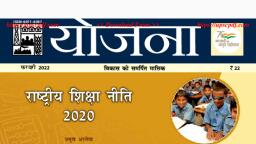
https://upscpdf.com, , February 2022, Editor, , Shuchita chaturvedi, PANKHURI AWASTHI, , << Download From >>, , Volume-66, No. 02, , Let noble thoughts come to us from all sides., Rig Veda, , Production Officer, , YOJANA, , https://upscpdf.com, , Since 1957, , By TricksterIAS, , In This Issue, , D K C Hrudhainath, Cover Design, , Bindu Verma, Our Representatives, Ahmedabad: Janhavi Patel, Bengaluru: BK Kiranmai,, Bhubaneswar: Itishree Singh Rathaur, Chennai: Sanjay, Ghosh, Guwahati: Ramanikant Sharma, Hyderabad:, Krishna Vandana P, Jalandhar: Gagandeep Kaur, Devgan, Kolkata: Rama Mandal, Mumbai: Umesh, Ujgare: Thiruvananthapuram: Roy Chacko., , Lead Article, , NEP-2020: Vision and, Pathways, dr Avinash Kumar Singh...................... 9, , Quality Education For All, , Yojana (English): Room No. 647, Soochna Bhawan,, CGO Complex, Lodhi Road, New Delhi-110 003., E-mail (Editorial):
[email protected], , Maneesh Garg.................................. 25, , Equitable and Inclusive, Education, Dr Anupam Ahuja, Zoya Chadha. .......... 31, , YOJANA, a development monthly published since, , 1957, is a theme-based journal providing in-depth, analyses and views on socio-economic issues in, the broader framework of government policies., Although published by the Ministry of Information, and Broadcasting, YOJANA is not restricted to, expressing the official point of view., , DISCLAIMER, l The views expressed in various articles are, those of the authors and they do not necessarily, reflect the views of the Government or the, organisation/s they work for., , NIPUN Bharat Mission, , Rashi Sharma..................................... 37, , Focus, , Assessment Reforms, , Manoj Ahuja, Aanchal Chomal..........13, , l Maps/flags used in the articles are only, indicative and they do not reflect the political, map or legal representation of the flag of India/, any other country., , Teach them Young, , Shankar Maruwada. ........................... 51, , l Images, graphics and illustrations, wherever, used, are mostly sourced from government, channels and are indicative in nature., , l YOJANA doesn't endorse or promote any brands, or private entities presented as case studies in any, of the articles., , SUBSCRIPTION/GRIEVANCES, Email:
[email protected], Phone: 011-24367453, (Monday-Friday, 9:30 am- 6:00 pm), Postal Address: Abhishek Chaturvedi, Editor,, Journals Unit, Publications Division, Room No., 779, Soochna Bhawan, CGO Complex, Lodhi, Road, New Delhi-110 003., Please note that it will take atleast eight, weeks to start your subscription. Kindly raise, your queries/grievances about non receipt of the, journals only after this period., , SUBSCRIPTION-RELATED DETAILS : Page 61, Website: www.publicationsdivision.nic.in, @DPD_India, @publicationsdivision, @dpd_india, , Dr M K Sridhar,, Dr Manasa Nagabhushanam................ 43, , Recruitment, Training, and, Assessment of Teachers, Ranjitsinh Disale................................. 47, , l The infographics/figures are provided by the, authors through their reliable sources and, YOJANA claims no responsibility for the same., , l YOJANA does not own responsibility, regarding the contents of the advertisements., The readers are requested to verify the claims, made in the advertisements regarding courses,, career-guidance books or institutions., , Bridging Education and, Communities, , Music and its Significance, Dr Kasturi Paigude Rane. .................... 57, Special ARTICLEs, , Reinventing Teacher, Education, Santosh Sarangi. .............................17, Skilling Youth for Future, , Santosh Yadav. ................................21, Regulars, Development Roadmap............................................................................ Cover-II, Our books............................................................................................................. 62, , Next Issue - Union Budget, Number of pages: 64, Details of the Sales Outlets of the Publications Division on Page 24, YOJANA is published in Assamese, Bengali, English, Gujarati, Hindi, Kannada, Malayalam,, Marathi, Odia, Punjabi, Tamil, Telugu, and Urdu., , Google it:- https://upscpdf.com
Page 4 :
https://upscpdf.com, , << Download From >>, , Inbox, , https://upscpdf.com, ,
[email protected], , – G.V. Srivatsava Raju, Hyderabad, , Atmanirbhar Bharat, There is a very famous proverb that ‘need is the, mother of invention’. Atmanirbhar Bharat is need of the, hour for Indian economy as well as for all Indians during, Covid-19. Atmanirbhar Bharat is not only a term but it is, a vision of our Prime Minister Narendra Modi to enable, India to overcome from this difficult time. It is actually, the vision to make India and Indians self reliant by, starting production of all mandatory items locally. Vocal, for Local is also integral of Atmanirbhar Bharat, Abhiyaan. Atmanirbhar Bharat Abhiyaan has promoted, various innovations and new product development in, India. By this, import of India will decrease and export, will increase, thus in the long run our trade deficit will, reduce. Export promotion will help us save and earn more, foreign currency. Atmanirbhar Bharat package will help, in growing Indian small and medium enterprises and the, manufacturing sector will flourish. Thus, this vision is a, 4, , true way to nurture and flourish India’s innovations and, to make India a Global Leading country in all terms., – Nita Mishra, Asansol, West Bengal, , Recognising India’s Efforts, I would like to express what the monthly magazine, ‘Yojana’ means to me and quite possibly, to others like, me. Reading Yojana is like taking a journey through, the heartland of India. Its comprehensive coverage, of multiple dimensions of an issue provides us with a, greater understanding of how India is moving forward. It, is an emotional ride, from recognising an issue, reading, about many efforts to solve it, followed by exhilaration at, realising positive outcomes as fruits of labour. It makes, us appreciate the silent machinery of bureaucracy, often, misunderstood and undervalued, working day and night, , Google it:- https://upscpdf.com, , YOJANA February 2022
Page 5 :
https://upscpdf.com, , << Download From >>, , to support and strengthen India’s growth. It also helps us, recognise the resilience of our heartland, fighting all odds, to emerge better and stronger. Thank you for helping us, connect with our country at such great level., – Anjali Singh, Delhi, , Useful for All, People who read Yojana, are really thankful to its, makers. Really useful for the aspirants who are preparing, for UPSC, as knowing new things really makes one, bright. Many aspirants suggest Yojana to new aspirants., Firstly, I wondered why, then I understood the reason, when I finished my reading. My response was that this, magazine is really useful for all. Thank you to the entire, team of Yojana., – Deepika Manipatruni, Srikakulam, Andhra Pradesh, , Covers Multiple Dimensions, I am one of the recent readers of Yojana. The book is, easy to read and understand. And it also covers all topics, regarding updated content. The recent published topic, ‘Atmanirbhar Bharat’ in December 2021 was superb. It, visualises all dimensions. The book is excellent to crack, civil services. Thank you to the entire team of Yojana., – Mamilla Ganesh, Anantapur, Andhra Pradesh, , Interactive and Valuable, Dear Yojana team, all I want to say is that, your work, for collecting information about the current topics and, the way you represent all are amazing. I must say that, it’s not just coverage of topics for competitive exams, it’s, also a great platform to know the government schemes, and remain up-to-date with the nation’s information. As, you wrote in December about ‘Atmanirbhar Bharat’ and, YOJANA February 2022, , https://upscpdf.com, , about water, we came to know how water is so important, for us as government is trying to provide clean water to, all the rural and urban areas. I hope we all might know, that how women stand in the queue for collecting the, water. In starting pages, you wrote about “GI-Tagging, of Rural Products”. It is explained well and the way, of presenting in the form of photos and diagrams is, interactive and valuable. I feel so glad that I am reading, this magazine since 2017 and I really want to continue, reading it. Thank you so much!, – Rinku Ram, Chamba, Himachal Pradesh, , Builds Perspective, Firstly, I would like to thank Yojana team for this, long awaited issue on Atmanirbhar Bharat (December, 2021). The articles written by respective experts give, us in-depth understanding of the issue. Building our, own opinion on the issues is an indispensable part, in CSE preparation for which Yojana helps us. Also, I would like to suggest topics like Climate Change,, United Nation etc., – Rutik Mohite, Solapur, Maharashtra, , Powerhouse of Knowledge, I am an architect and an interior designer, and I'm, following Yojana Magazine from past 5 years. Yojana, gives me a better understanding of socio-economic, problems the country and its people are facing today, and, it makes me think of out-of-the-box solutions, not only in, terms of my background like how Swachh Bharat scheme, can be further improved, ramps of public buildings can, be made better, but other aspects as well. To conclude,, Yojana serves as a powerhouse of knowledge, without, any fake news or propaganda., , Google it:- https://upscpdf.com, , – Saikrishna Kumbham, Hyderabad, Telangana, 5
Page 7 :
https://upscpdf.com, , Editorial, , << Download From >>, , YOJANA, , https://upscpdf.com, , Transforming Learning, , W, , ith the arrival of National Education Policy (NEP), 2020, there has been a vital shift in the Indian education, system aligned with the aspirational goals of the 21st century., The policy envisages a complete overhaul of teaching-learning, process from the traditional teacher-centred to learner-centric, approach; to ensure the holistic development of students by, accentuating their creative potential. The policy stresses on, the core principles that education must develop not only the, cognitive skills– both ‘foundational skills’ of literacy and, numeracy, and ‘higher-order’ skills such as critical thinking, and problem solving, but also social and emotional skills–, also referred to as ‘soft skills’, including cultural awareness, and empathy, perseverance and grit, teamwork, leadership,, communication, etc., NEP 2020 emphasises on universalisation of school, education and maximising enrolment. There is a special focus, on Early Childhood Care and Education (ECCE). Foundational learning accounts for children’s, ability to read and meaningfully comprehend, as well as use basic mathematical operations in real, life. With this aim, NIPUN Bharat Mission has been launched to create an enabling environment for, every child, to achieve the desired learning competencies in reading, writing, and numeracy at the, end of Grade III in the next five years., Visualising assessments as an ongoing process that is instrumental in understanding how students, think and learn, NEP 2020 has put in place certain fundamental reforms in the purpose, design, and, implementation of students’ assessment. It also suggests redesigning of Board examinations to make, them more valid, reduce academic stress and pressure, and de-emphasise coaching culture., There is significant impetus on capacity building of students, teachers, and institutions. Being, multidisciplinary, institutions will restructure the pedagogy, permitting the scope for choices of, subjects to students. It is also expected that affiliated colleges will gradually phase out, giving, ways to multidisciplinary universities and colleges by 2035. Certainly, everyone recognises the, key role teachers play. NEP recommends that teachers be given continuous opportunities for selfimprovement and to learn the latest innovations and advances in their profession. Accordingly,, scope of teacher education has also been revamped in line with the current trends, including its, structure, regulation, and governance., Ensuring equitable and inclusive quality education for all, the policy reaffirms the commitment, of bridging up the social category gaps in access, participation, and learning outcomes at all levels, of education. The policy considers equity as an inclusive notion focusing on Socio-Economically, Disadvantaged Groups (SEDGs) and areas., The policy is both global and local in its outlook and intent. It makes a significant headway from, earlier policies by putting quality education as the topmost agenda, strengthening the foundations of, education, catering to the educational needs of the most disadvantaged, and making India a global, leader in education. This issue of Yojana intends to be a part of the comprehensive discussion about, vision and purpose of NEP, and its increased relevance in the post-pandemic world. We hope the, insights from subject experts and stakeholders will broaden the understanding of our readers about, , the transformative scope of NEP 2020., , YOJANA February 2022, , Google it:- https://upscpdf.com, , 7
Page 9 :
https://upscpdf.com, REFORMING EDUCATION, , << Download From >>, , https://upscpdf.com, lead ARTICLE, , NEP-2020: Vision and Pathways, Dr Avinash Kumar Singh, After thirty-four years since the launch of the National Policy on Education in 1986, a new, National Education Policy-2020 has been announced and is currently under implementation., The National Education Policy envisions to have an education system that is second to none, with equitable access to the highest quality education for all learners regardless of social or, economic background. The vision of NEP-2020 is in sync with Goal 4 of the UN Sustainable, Development Goal (SDG4), which seeks `to ensure inclusive and equitable quality education, and promote lifelong learning opportunities for all’., , T, , he New Education Policy, aligned with India’s, aspirational goals of 21st century, proclaims, to transform India into a global knowledge, superpower. Besides being global in its, outlook, the policy is also India-centric, as it intends ‘to, instill among the learners a deep rooted pride in being, Indian, not only in thought, but also in spirit, intellect,, and deeds, as well as to develop knowledge, skills, values,, and dispositions that support responsible commitment to, human rights, sustainable development and living, and, global wellbeing, thereby reflecting a truly global citizen.’1, Based on the vision, NEP-2020 has set 2040 as the deadline, to fulfill the goals, targets, and pathways so that the child, who gets entry into the education system under the new, , policy would exit with having gone through the new policy, processes. The distinctive thrusts of the new education, policy are as follows:, Universalisation of Education, The New Education Policy aims at universalising, school education (achieving 100% GER i.e. Gross, Enrolment Ratio in preschool to secondary level) by, 20302 and higher education (increasing the GER in higher, education to 50 %) by 20353. The universalisation of goals, and targets need to be seen in terms of areas and groups, as, the states and groups within a State are at different levels of, educational attainment. It is expected that universalisation, of school education will provide scope for maximising, , The author is Professor and Head, Department of Educational Policy, NIEPA, New Delhi. Email:
[email protected], , YOJANA February 2022, , Google it:- https://upscpdf.com, , 9
Page 10 :
https://upscpdf.com, , << Download, From >> Principles, National Education, Policy-2020:, , https://upscpdf.com, , •, , recognising, identifying, and fostering the unique, capabilities of each student;, , •, , respect for diversity and respect for the local, context;, , •, , according the highest priority to achieving, Foundational Literacy and Numeracy (FLN) by, all students by Grade 3;, , •, , full equity and inclusion as the cornerstone of all, educational decisions;, , •, , flexibility in their own paths in life according to, their talents and interests;, , •, , synergy in curriculum across all levels of education, from early childhood care and education to school, education to higher education;, , •, , no hard separations between arts and sciences,, between curricular and extra-curricular activities,, between vocational and academic streams, etc.;, , •, , teachers and faculty as the heart of the learning, process;, , •, , multidisciplinarity and a holistic education across, the sciences, social sciences, arts, humanities, and, sports for a multidisciplinary world;, , •, , a ‘light but tight regulatory framework’ to ensure, integrity, transparency, and resource efficiency of, the educational system;, , •, , emphasis on conceptual understanding rather, than rote learning and learning-for-exams;, , •, , outstanding research as a requisite for outstanding, education and development;, , •, , creativity and critical thinking to encourage, logical decision-making and innovation;, , •, , continuous review of progress based on sustained, research;, , •, , ethics and human & Constitutional values;, , •, , •, , promoting multilingualism and the power of, language in teaching and learning;, , a rootedness and pride in India, and its rich,, diverse, ancient, and modern culture and knowledge, systems and traditions;, , •, , •, , life skills such as communication, cooperation,, teamwork, and resilience;, , education is a public service; access to quality, education must be considered a basic right of every, child;, , •, , focus on regular formative assessment for learning;, , •, , •, , extensive use of technology in teaching and, learning, removing language barriers, increasing, access for Divyang students;, , substantial investment on public education system, as well as the encouragement and facilitation of true, philanthropic private and community participation;, , enrolment in higher education. Besides providing universal, access and enrolment, the policy also suggests to undertake, measures to bring back drop-out children to schools and to, prevent this from occurring further., Curricular and Pedagogical Restructuring, , (Source: NEP-2020, p. 5-6), , student should attain foundational literacy and numeracy, (FLN) by grade 3. The curricular and pedagogical structure, of school education should match with developmental, needs and interests of learners at different stages of their, development corresponding to the age ranges/grades4., , The main thrust of structural reforms in higher, Following Liberal Education approach, NEP-2020, education, is transforming higher education institutions, envisages restructuring of the existing curriculum and, into, large, multidisciplinary universities, colleges, and, pedagogy in both school and higher education, to realise, knowledge, hubs. Multidisciplinary education based on, the vision and fulfill the policy’s goals and targets. It, liberal education is an academic and pedagogical approach, recommends modifying the existing 10+2 pedagogical, to develop multiple capacities in the, structure in the form of a new structure of, 5+3+3+4, having a strong base of Early The curricular and pedagogical students by integrating formal and, informal learning opportunities such, Childhood Care and Education (ECCE), structure of school, as teaching, research, and community, from the age of 3 years. The policy, education should match with engagements, and, promoting, recommends universal provisioning, developmental needs and, interdisciplinary perspective academic, of quality early childhood care and, education based on strong pedagogical interests of learners at different practice.5 Being multidisciplinary,, institutions will restructure the, components to be achieved by 2030., stages of their development, pedagogy, permitting the scope for, NEP considers the 3-8 years age as the, corresponding to the age, choices of subjects to students and, foundational stage of a child critical, ranges/grades., it is also expected that affiliated, for his/her overall development. Every, 10, , Google it:- https://upscpdf.com, , YOJANA February 2022
Page 11 :
colleges will gradually phase out, , complexes/clusters, b) setting up of, school standardshttps://upscpdf.com, and authority, and, universities and colleges by 2035., c) reforming school examination, greater internationalisation in boards. The governance reforms in, The policy also recommends building, education, by creating avenues higher education include setting up a, world class multidisciplinary Higher, for having larger number, Education Institutions (HEIs) called, single regulator on Higher Education, Multidisciplinary Educational Research, Commission of India (HECI) with, of international students, University (MERU)., studying in India and providing four verticals for regulation, namely, National Higher Education Resource, opportunities to students, Equity and Inclusion in Education, Centre, (NHERC) accreditation,, NEP 2020 envisages achieving interested in studying abroad. National Assessment and Accreditation, Equitable and Inclusive quality, Council (NAAC), funding Higher, education for all. It reaffirms the commitment of bridging, Education Grants Council (HEGC), and academic setting, up the social category gaps in access, participation, and, of General Education Council (GEC). The idea behind, learning outcomes at all levels of education. The policy, creating a single regulator is to initiate the problems of, considers equity as an inclusive notion focusing on, over-regulation in higher and professional education.8, Socio-Economically Disadvantaged Groups (SEDGs), Standard Setting and Accreditation for School and, and areas.6 Recognising the large intra-state variations,, Higher Education, the policy recommends declaring the regions with large, populations from the disadvantaged groups as Special, As far as Standard Setting and Accreditation for, Education Zones (SEZs), where all the schemes and, School and Higher Education is concerned regarding, policies can be implemented more effectively. The policy, school education, the NEP-2020 advocates for the, suggests implementing suitable strategies to address the, institutionalisation of effective quality assurance and, problems of access, participation, and learning outcomes, accreditation system by establishing State School, for the SEDGs and to eliminate different types of disparities, Standards Authority (SSSA) as an independent state wide, (both group and area specific) in both school and higher, body; in higher education the policy envisages to set up, education. Promoting equity in learning outcomes from, NAC as one of the verticals of HECI. It is expected that, early childhood care and education through higher, the new governance will make the system more transparent, education is one of the major goals of NEP-2020.7, and accountable., , https://upscpdf.com, giving ways to multidisciplinary, , <<NEP-2020, Download, From >>, advocates for, , Reforms for Effective Governance, , Vocational Education, , Following the ‘light but tight approach’, the policy, sets up transformative agenda in governance for achieving, the goals and targets in education. In school education,, some of the major reforms include: a) setting up school, , NEP envisages strengthening the skills component, in general education and raise the status of vocational, education by integrating it into the mainstream formal, education. It is expected that by 2025, over 50% of the, , YOJANA February 2022, , Google it:- https://upscpdf.com, , 11
Page 12 :
learners through the school and higher, , https://upscpdf.com, education system will have exposure to, vocational education.9, , Quality Academic Research, The, policy, advocates, for, developing a strong culture of research, and knowledge creation to make, India a knowledgeable superpower., It calls for setting up the National, Research Foundation (NRF) with a, special mandate to foster research and, innovation in universities and colleges, including interdisciplinary research., , << Download From >>, , The gaps between the current, and desired educational, outcomes are to be bridged, by major systemic reforms and, suitable strategies/programme, interventions from early, childhood through higher, education. The policy is both, global and local in its outlook, and intent., , Use of Technology, The new NEP 2020 proposes to set up a National, Educational Technology Forum (NETF) to serve as a, platform to better the ideation process, improve learning,, assessment, planning, and administration., This policy aims to see that technology is, appropriately integrated into all levels of education for:, improving teaching, learning, and evaluation processes;, supporting the preparation of teachers and their continuous, professional development; enhancing educational access, to disadvantaged groups; and streamlining educational, planning, administration, and management., Raising Public Expenditure on Education, The policy commits to raise the public expenditure, on education to the recommended level of 6% of GDP as, envisaged by the 1968 Policy., The policy also identifies the following key longterm significant areas for financing to cultivate an, education system; (a) universal provisioning of quality, early childhood care education; (b) ensuring foundational, literacy and numeracy; (c) providing adequate and, appropriate resourcing of school complexes/clusters;, (d) providing food and nutrition (breakfast and midday, meals); (e) investing in teacher education and continuing, professional development of teachers; (f) revamping, colleges and universities to foster excellence; (g), cultivating research; and (h) extensive use of technology, and online education., , facilitating such entry will be put in, place, and suchhttps://upscpdf.com, universities will be, given special dispensation regarding, regulatory, governance, and content, norms on par with other autonomous, institutions of India. 10, Promotion of Indian Languages, Art, and Culture, , NEP-2020 advocates the use of, Indian languages, art, and culture, at all levels of education. The, policy has proposed establishing an, Indian Institute of Translation and, Interpretation (IITI) to promote Indian languages. It has, also been pointed that Sanskrit will be mainstreamed in, schools and higher education institutions. The policy also, makes it explicit that proficiency in Indian languages, will be included as part of qualification parameters for, employment opportunities., Conclusion, Thus, the vision of the National Education, Policy-2020 is quite comprehensive and long standing., Keeping in mind the comprehensive nature of the, vision and principles of the policy, pathways have been, chalked out to realise the associated goals and targets., The gaps between the current and desired educational, outcomes are to be bridged by major systemic reforms, and suitable strategies/programme interventions from, early childhood through higher education. The policy, is both global and local in its outlook and intent. It, makes a significant headway from earlier policies by, putting quality education as the topmost agenda of, educational reforms, strengthening the foundations, of education, catering to the educational needs of the, most disadvantaged, and making India a global leader in, , education., References, 1., , NEP-2020, p.6, , 2., , NEP 2020, Section 3, para 3.1, , 3., , NEP 2020, Section 10, para 10.06, , 4., , NEP 2020, para 4.1, p.11, , 5., , NIEPA, 2020, p.114; Kasturirangan,2021, , Internationalisation in Education, , 6., , NEP 2020, p. 24-25, , NEP-2020 advocates for greater internationalisation, in education by creating avenues for having larger, number of international students studying in India and, providing opportunities to students interested in studying, abroad. NEP 2020 points out that high performing Indian, universities will be encouraged to set up campuses in other, countries, and similar selected universities, e.g., those, from among the top 100 universities in the world will, be facilitated to operate in India. A legislative framework, , 7., , NEP 2020,p.3, , 8., , NIEPA, 2021, p.152, , 9., , NIEPA, 2020, p.129, , 12, , 10. NEP, 12.8, p.39, , Endnotes, 1., , 2020’ Ministry of Human Resource Development, New Delhi., , 2., , Kasturirangan, K 2021 `Liberal Education – A 21st Century, Initiative’, Fifteenth Foundation Day Lecture, NIEPA, New Delhi,, 11th August, , Google it:- https://upscpdf.com, , YOJANA February 2022
Page 13 :
https://upscpdf.com, HOLISTIC LEARNING, , << Download From >>, , https://upscpdf.com, FOCUS, , Assessment Reforms, Manoj Ahuja, Aanchal Chomal, , S, , everal national level committees and policies have highlighted, the aspect regarding examinations being extremely content heavy,, leading to rote memorisation and narrowing down of the syllabus, that gets transacted in schools. In such a situation, assessments do, not live up to the potential they have in ensuring quality education., , High quality educational, assessment is central to any, well-functioning schooling, system. Such a system would, be typically characterised, with assessments that are, valid, reliable, fair, and, equitable for its wide diversity, of student population., However, at present, across, a majority of school systems, in the country, assessments, are commonly perceived, as examinations or tests, that end up measuring, a very narrow range of, competencies across subjects, and fail to accurately, measure the overall potential, of the students. Such a system, creates undue pressure,, stress, and anxiety among, students and reduces the, goal of education to merely, scoring high marks in key, examinations., , What is needed today is a progressive system of assessment that could, lead the path towards quality education in schools. Assessments need to be, more comprehensive, to measure not only learning of the textbook, but also, other abilities like analysis, critical thinking, creativity, socio-emotional skills,, etc. In this context, the National Education Policy (NEP) 2020 suggests certain, fundamental reforms in the purpose, design, and implementation of assessment., To begin with, the very culture of assessment in our schooling system must, change to become more constructive, developmental, and learning-focused., Assessment needs to be visualised as an ongoing process that is instrumental in, understanding how students think and learn. Evidences about student learning, emerging from assessment data should be used for analysing and interpreting, how it is best to address students’ learning needs. Such a system of ongoing, assessment will also enable teachers in introspecting about the effectiveness of, teaching strategies by providing valuable insights on what and how to change., It will also provide inputs to schools on how much they are able to function, as learning institutions by reflecting on their processes, their culture, and, , Manoj Ahuja is the Chairman of CBSE. Email:
[email protected], Aanchal Chomal is Associate Professor at Azim Premji University. Email:
[email protected], , YOJANA February 2022, , Google it:- https://upscpdf.com, , 13
Page 14 :
https://upscpdf.com, , << Download From >>, , curriculum. At the systemic level, thoughtfully designed, and administered assessments will provide inputs to, policy-makers about the overall performance of the, ecosystem with reference to key learning in the context, of specific geographies and diverse socio-economic, groups. The role of assessment to enable learning must, be center-stage– for this, all involved, whether teachers,, schools, parents, system must understand that assessment, is to enable learning of students and help them realise the, goals of education., , https://upscpdf.com, , 360-degree, multidimensional report that reflects in, great detail the progress as well as the uniqueness of, each student in the cognitive, affective, and psychomotor, domains. While this may appear to be a massive mandate,, implementing these reforms will be foundational in, transitioning to a high quality assessment system. In, achieving this, we need to adhere to certain principles, that are briefly outlined below:, , Building consensus among stakeholders is the first, principle. What is often found missing in our education, The, policy, also, makes, some, concrete, system is conversations among institutions and key, recommendations for transforming Board examinations., stakeholders. Such conversations trigger new ideas that, Any effective schooling system should have a very, enable active collaborations. Institutions need to actively, credible and robust mechanism of certification. Boards, collaborate and maintain continuous dialogue. For, serve the purpose of such certifications after 10-12 years, example, NCERT, SCERT, and Boards should together, of schooling. Over the years, policies have pointed out, work towards reforming the curriculum, the syllabus,, key issues in the design and implementation of Board, and associated assessments. It will be impossible to, examinations, and made specific suggestions. NEP 2020, change one in the absence of reform in the other. It is, also suggests redesigning of Board examinations to make, also important to recognise the need for a deep alignment, them more valid, reduce academic stress and pressure, and, between curricular goals and assessment processes., de-emphasise coaching culture. The Board examinations, Therefore, it is critical that institutions developing these, should primarily assess core capacities rather than, approaches work collaboratively. Such collaboration need, content memorisation. The focus of such certification, not be limited to only government institutions. Competent, examinations should be on holistic, and well-meaning organisations,, learning and development rather than The role of assessment to enable universities, and researchers should, a narrow range of content or textbook, learning must be center-stage– also be consulted regarding such, material learnt in a single stream. In, decisions., for this, all involved, whether, this context, NEP 2020 offers choice, Second, we need agreement, teachers, schools, parents,, and flexibility to students to reduce the, among stakeholders on what are, system must understand that, stress and anxiety currently associated, the core and essential competencies, with Board examinations., assessment is to enable learning that must be assessed through various, Concomitant with the above, suggested reforms, NEP 2020 also, discusses the need for a holistic,, 14, , of students and help them, realise the goals of education., , systems of assessment. To enable, this, we need contextualised learning, standards, competency frameworks,, , Google it:- https://upscpdf.com, , YOJANA February 2022
Page 15 :
and assessment processes for all, In addition to teachers, training, << Download From >> and capacity https://upscpdf.com, standards, building of paper, NEP 2020 also suggests, will provide a common vocabulary, setters, evaluators, and moderators, redesigning of Board, among stakeholders. These standards, of Board examinations should, examinations to make them, must take into account higher order, also be undertaken to enable these, thinking skills, 21st century skills, and, more valid, reduce academic improvements., socio-emotional skills that are needed, stress and pressure, and deIn its efforts to facilitate, for holistic development of students., emphasise coaching culture. assessment reforms, CBSE has been, Such standards and frameworks, making ongoing changes. It has, The Board examinations, must provide adequate direction to, provided training to its teachers on, should primarily assess core, teachers, curriculum designers, and, various pedagogic and assessment, Board examination paper setters in capacities rather than content reforms suggested in NEP 2020. It has, assessing appropriate and relevant, memorisation., undertaken various definitive measures, competencies. This will also enable, in the past few years to include key, equivalence across Boards, something that is sorely, competencies in Board examinations. It has conducted, missing in our schooling system today. It is practically, an exhaustive review of its certification examination, impossible to compare performance across Boards in, (Board) papers to evaluate the reliability and validity of, the absence of such commonly shared frameworks of, the test instruments. In order to support teachers with, standards and processes. These standards and processes, implementing competency based education, learning, need to be developed collaboratively and disseminated, standards framework for various subjects at secondary, and, among key stakeholders., senior secondary level have been developed in alignment, , https://upscpdf.com, subjects. The learning, , Third, in the context of Boards, any change in, the policy envisages a shift in assessment, both at the, classroom and school level as well as the systemic, level. Therefore, generating awareness among, key stakeholders, such as teachers, parents, school, principals, block/district officers, etc., is necessary to, successfully implement these changes. It is important, that the rationale and motivation for any change in Board, Policy be explicitly communicated to all stakeholders, impacted by these changes., , with the NCERT learning outcomes. In addition to that,, to provide equal attention to the growth of learners in all, aspects of development, Holistic Progress Cards (HPCs), have been developed. The HPC will form an important, link between the home and school, and will capture the, uniqueness of each learner in the cognitive, affective, and, psychomotor domains as opposed to the conventional, report cards which measure the achievements of children, in quantitative terms, only once in an academic year., It has also initiated efforts to build capacity of Board, personnel in standards and processes of test development, and standardisation. The handbooks, guidebooks, and, other reference materials have been developed to be used, as reference materials for test developers. CBSE has, collaborated with various government and not-for-profit, institutions in instituting these changes., , Fourth, key stakeholders entrusted with the task of, assessment and evaluation must be provided ongoing, capacity building on various aspects of assessment., To enable teachers to conduct more reliable and valid, assessments, comprehensive assessment guidelines,, handbooks and manuals, exemplar assessment tools, and processes must be available. Teacher capacity for, Assessment reform has been in the discourse for, designing, implementing, and using valid and reliable, several decades now. NEP 2020 reiterates key areas, assessments must be strengthened through regular, of reforms from reports and policies that preceded it., training. Teacher capacity to analyse, report, and use, Therefore, the need to build on what exists, to learn, results of assessment will also need to be developed., from what has worked before, and the lessons learnt, As teachers are the primary evaluator, are vital. We need to be creative, of the student, they require freedom, and innovative in our efforts and, to take independent decisions about Teacher capacity for designing, solutions to transform the way, implementing, and using valid assessments are perceived and used, teaching-learning and assessment, processes based on their individual, and reliable assessments must across our country. The continuity, needs. Support from the school head be strengthened through regular of effort towards the envisaged, is needed for the teacher to exercise, processes and systems must be, training. Teacher capacity to, this autonomy. The trust, support,, the basis of all action– creating, analyse, report, and use results repositories of best practices will, and encouragement from the latter, will enhance the level of motivation of assessment will also need to enable consolidation of efforts,, be developed., of teachers and they will feel more, as will dialogue and collaborative, , confident using the new approach., action across institutions., YOJANA February 2022, , Google it:- https://upscpdf.com, , 15
Page 17 :
https://upscpdf.com, LEADERS FOR THE YOUNG << Download From >>, , https://upscpdf.com, Special ARTICLE, , Reinventing Teacher Education, Santosh Sarangi, India’s aspiration to become a knowledge society, reverberating with educated and skilled, individuals of high standards that are required to meet the challenges of the 21st century will, require us to ensure a strong foundation to our school education system. Based on the principles, of equity, quality, accessibility, and affordability, the National Education Policy, 2020 brings the, focus back on the children as well as teachers., , T, , he National Education Policy’s stated goal is, to “reinstate” teachers as the “most respected, members of our society.” Empowerment of, teachers remains a recurrent theme in the, policy, and it is understood that this can be achieved, by ensuring their “livelihood, respect, dignity and, autonomy”, while ensuring quality and accountability., Evolution of Teacher Education, In the ancient times in India, teaching in the pristine, environs of ‘gurukuls’ was truly multidisciplinary as, it focussed on teaching life skills, martial skills, and, imparting the teaching of “Vedas”. A formal system of, teachers’ training was introduced in India during the, spread of Buddhism. The monastic system was prevalent, in which every learner was to be placed under the, supervision and guidance of a preceptor (Upajjhaya)., The current style of schooling and teaching emerged, during the British rule in India. Inspired by the Victorian, schooling system, this system focused on a behaviourist, paradigm where education was concerned with, preparing students to be disciplined, English-speaking, clerks, to submissively execute the tasks of the British, administration. It prepared teachers too as mechanics, mainly concerned with classroom teaching., , NCFTE, 2009, the teacher education strategy is aimed at, imbuing the teachers with skills to become facilitators of, knowledge rather than gatekeepers of information as well, as to make teaching less textbook-oriented and to connect, knowledge to life outside the school.., The Justice Verma Commission in 2012 also stressed, upon the need to improve the quality of pre-service, and in-service teacher education. In 2014, the erstwhile, Ministry of Human and Resource Development (MHRD), restructured its B Ed. programme by doubling the duration, of the programme to two years. The new teacher education, curriculum, designed by the National Council for Teacher, Education (NCTE) introduced several changes in the, curriculum such as Yoga education, ICT, peace and value, education, health and physical education, environmental, education and population education., Challenges, Certain challenges with teacher education have, continued to plague the sector including a system of, training and recruitment that is churning ill-equipped and, , There has been a slow paradigm shift in the system of, teacher education in India, with the successful introduction, of National Curriculum Framework (NCF)-2005,, National Curriculum Framework for Teacher Education, (NCFTE) 2009, and Right to Education Act (RTE), 2009., Over time, the focus of the system has shifted away from, disciplinarian, rote memorisation, to a collaborative, construction of knowledge. Following the NCF 2005 and, The author is the Additional Secretary, Department of School Education & Literacy, Ministry of Education, GoI. Email:
[email protected], , YOJANA February 2022, , Google it:- https://upscpdf.com, , 17
Page 18 :
https://upscpdf.com, , << Download From >>, , https://upscpdf.com, , Source: SE Shagun, www.repository.education.gov.in, , poorly trained teachers. As on date, the National Council, for Teacher Education (NCTE) has given approval to, 11139 D.El.Ed. Courses with intake capacity for 690840, students. Similarly, 9455 number of B.Ed courses have, been registered with intake capacity of 937660 students., This is much higher than the annual requirement of new, teachers which would be in the range of 3.5 to 4 lakh., Teacher Education Institutions have been working in, isolation from rest of the Higher Education Institutions, (HEIs). The multidisciplinary education, essential in, developing a well-rounded personality, has been missing, in the Teacher Education Institutions, which hitherto, have been operating in a stand-alone manner. There has, been no system to ensure only motivated and meritorious, individuals select teaching as a profession., Teacher Education Post NEP- 2020, Teachers, today, need to keep, abreast with not only the curriculum, in the textbooks but also the everevolving technology, changing market, trends as well as continuously update, themselves with the culture and, beliefs that shape up the students of, today. Teachers also need to play a, more conscious role in supporting the, parents, community, as well as school, management in developing the child., As technology and blended learning, becomes a part of our daily lives, and, life skills like collaboration, creativity,, 18, , and curiosity become more essential to succeed as, professionals and individuals in the world, teachers also, need to mentor students and link real-life experiences, and skills with the curriculum that they teach. Most, importantly, teaching needs to be student-centric and, joyful to foster the joy of learning and discovering among, young people who will be leaders and entrepreneurs of, the world. Keeping this in mind, NEP 2020 has proposed, to revise and revamp aspects of teacher education, in line, with the current trends, including its structure, regulation,, and governance, through radical action so as to raise, standards and restore integrity, credibility, efficacy, and, high quality to the teacher education in the country., Recognising the ‘power of teacher’, NEP 2020 has put in, place systemic reforms that would help ‘teaching’ emerge, as an attractive profession of choice for bright and talented, young minds and has put in place, different interventions like Integrated, Following the NCF 2005 and, Teacher Education Programme (ITEP),, NCFTE, 2009, the teacher, National Professional Standards for, education strategy is aimed, Teachers (NPST), National Mission, for Mentoring (NMM) and at least, at imbuing the teachers with, 50 hours of Continuous Professional, skills to become facilitators, Development (CPD) for every teacher, of knowledge rather than, in a year., , gatekeepers of information, as well as to make teaching, less textbook-oriented and, to connect knowledge to life, outside the school.., , The four-year Integrated Teacher, Education Programme (ITEP), a, dual-major holistic bachelor’s degree, programme offering B.A., B.Ed/B., Sc., B. Ed., and B.Com. B.Ed, will, be the minimum entry requirement, , Google it:- https://upscpdf.com, , YOJANA February 2022
Page 19 :
for teachers. Since, a multidisciplinary environment, healthy competition among teachers to be the best in their, Downloadfield, From, >>as set clear pathways for, https://upscpdf.com, development of<<, individuals,, as well, career progression., multidisciplinary universities and institutions will be, National Mission for Mentoring (NMM) for schools, encouraged to establish education departments and run, will be operationalised by NCTE by creating a large, teacher education programmes, in collaboration with, pool of outstanding senior/retired faculty as potential, other departments such as psychology, philosophy,, mentors for mentees (school teachers, Principals, teacher, sociology, neuroscience, languages, arts, science, etc. All, educators, etc.), regardless of the age or position of the, stand-alone Teacher Education Institutes (TEIs) will be, mentor and mentee who will contribute towards realising, required to transform to multidisciplinary institutions by, 21st century developmental goals of our nation. Mentoring, 2030., is a process for the informal/formal transmission of, , https://upscpdf.com, is key for the holistic, , ITEP will teach cutting-edge pedagogy and offer, knowledge and the psychosocial support perceived by, a foundation in Early Childhood Care and Education, the recipient as relevant to work, career, or professional, (ECCE), Foundational Literacy and Numeracy (FLN),, development. NMM underlines the importance of the, toy-based pedagogy, stage-based pedagogy, inclusive, short and long-term mentoring/professional support to, education, and a comprehension of India and its values/, teachers and teacher educators., ethos/art/traditions, among others. In-classroom training, The Department of School Education, NCERT are, and internships will also form an essential part of, working with State Governments and SCERT to design, the programme. Teachers are expected to have good, short-term modules for assisting teachers in continuous, knowledge of the social, physical,, professional development. NEP, 2020, emotional, cognitive, moral, and, envisages each teacher to undergo, As technology and blended, aesthetic development of the child as, at least 50 hours of CPD per year., well as the experience of using the learning becomes a part of our To realise the vision of NEP-2020,, daily lives, and life skills like, kind of pedagogy, content, medium, recently, NCERT under the aegis of, of instruction as well as learning, collaboration, creativity, and, the Ministry of Education (MoE), in, approaches that are relevant for her/ curiosity become more essential collaboration with States/UTs and, his pupils. Teachers are also expected, to succeed as professionals and autonomous bodies have initiated the, to understand the different needs of, NISHTHA (National Initiative for, children who come from socially and individuals in the world, teachers School Heads’ and Teachers’ Holistic, also need to mentor students, economically disadvantages groups,, Advancement) integrated training, students with special needs, and and link real-life experiences and programme 1.0, 2.0, and 3.0 online for, students who are gifted and require, skills with the curriculum that different stages of school education–, additional exposure and support than, they teach., Teachers, Head Teachers/Principals,, their peers., and other stakeholders in Educational, The roll out of National Professional Standards for, Teachers (NPST) is a continuum in teacher education, so far as it would cover expectations for the role of, teacher at different levels of expertise/experience at, different stages of his/her career, and the competencies, required for that stage. As and when it fully evolves,, linkage of career promotion, financial incentives, etc., will enable the teachers to strive for the next level of, professional competence. A tech-enabled platform for, self-assessment by teachers followed by a wide range of, accrediting bodies (including SCERT/DIETs) will play, a key role in assessing the beginner teacher, proficient, teacher, expert teacher, and the lead teacher. Availability, of online, offline, and blended modules to assist the inservice teachers in increasing domain expertise, deeper, understanding of socio-psychological understanding, new, methods in pedagogy, use of technology in education and, leadership skills are being planned under the NPST. NPST, which sets clear benchmarks of the skills, competencies,, disposition, and knowledge required among teachers,, will also infuse a spirit of increased professionalism and, YOJANA February 2022, , Management and Administration., Conclusion, , It has been clearly established in the past that, focus on pre-service and in-service teacher significantly, impacts learning outcome of students. The multipronged, approach adopted by NEP, 2020 is likely to revitalise, the teacher education, allow bright students to opt for, ITEP as a matter of choice rather than by chance, and, interventions like NPST, NMM, CPD, etc. contribute to, qualitative changes in teachers’ pedagogic transaction., Simultaneously, efforts will also have to be made to phase, out the sub-par teacher training institutes and D. El. Ed, courses., Dr APJ Abdul Kalam had said “Enlightened, citizenship has three components: education with value, system, religion transforming into spiritual force, and, creating economic prosperity through development”. We, repose faith in our teachers to become torch-bearers for, the young generation and shape India’s development and, , sustained progress in the right direction., , Google it:- https://upscpdf.com, , 19
Page 20 :
https://upscpdf.com, , << Download From >>, , https://upscpdf.com, , MISSION, PRELIMS, 2022, , CURRENT AFFAIRS, 12-weeks course, Coverage of Current Affairs, from 01 January 2021, , 300+ hours of lectures for, rapid revision, Chapter-wise quiz, , 28 Tests, , ������ �� �, 20, , ���������������������, , �����������������������, , Google it:- https://upscpdf.com, , YE-1741/2022, , Current Affairs tests from 2020, , YOJANA February 2022
Page 21 :
https://upscpdf.com, WAY FORWARD, , << Download From >>, , https://upscpdf.com, Special ARTICLE, , Skilling Youth for Future, Santosh Yadav, India is celebrating its 75th year of Independence and as our Hon’ble Prime Minister said “Today’s, youth, born in the 21st century, are going to carry India’s development journey forward till, the 100th year of Indian independence. That is why skill development of the youth of this new, generation is a national need; it is the foundation stone for a self-reliant India”., , H, , istorically, vocational education in schools has, been accorded high priority since National, Policy on Education, 1986, and Centrally, Sponsored Scheme (CSS) of Vocationalisation, of Secondary Education was launched in 1988. Considering, various bottlenecks in infrastructure, finance, and policy,, the scheme was revised in 2011. The scheme was further, revised in 2014 with the specific objectives of integrating, vocational education with general academic education;, enhancing the employability of youth; filling the gap, between educated and employable; and decreasing the, pressure on academic higher education. Currently, the, scheme is being implemented as part of the Centrally, Sponsored Scheme ‘Samagra Shiksha’ and has been aligned, with the National Skills Qualification Framework (NSQF)., The vocational subjects are introduced as an additional, subject at the Secondary level and as a compulsory elective, subject at Senior Secondary level. The scheme covers, Government schools and Government aided schools., An important part of this vision is providing skill, education to millions of children in their school years in an, integrated and holistic manner., Under Samagra Shiksha, 14,435 schools have been, approved to impart Vocational Education., , There are 62 skill courses available at Secondary, and Senior Secondary level from 20 sectors such, as Agriculture, Automotive, Beauty and Wellness,, Construction, Electronics, Healthcare, IT/ITES, Media and, entertainment, Plumbing, Retail, Tourism, and Hospitality, etc., CBSE has also been considering Vocational Education, as an important component of holistic education. Vocational, Courses offered by CBSE also provide wide choices, for schools and students to choose from the relevant, competency-based courses. Currently, about 3.5 million, students are undergoing vocational courses in Secondary, and Senior Secondary schools in the country, including the, schools affiliated to CBSE., As mentioned by the National Education Policy, 2020, ‘The aim of education will not only be cognitive, development, but also building character and creating, holistic and well-rounded individuals equipped with, the key 21st century skills’. Though skill education in, schools is one of the means towards this aim, NEP also, mentions various challenges faced in its manifestation, like perceived social status hierarchy associated with, vocational education, lack of vertical mobility pathways, , The implementation of Vocational Education has, expanded almost 10-fold in the last six years, from only, 960 schools in 2014-15 to 11,710 schools across the nation, in 2021-22., Currently, more than 1.5 million students are, undertaking vocational education under Samagra Shiksha, as a part of their Secondary and Senior Secondary, curriculum with the help of a trained instructor facilitating, learning in a trade specific laboratory setup within the, school itself., The author is Joint Secretary, Department of School Education & Literacy, Ministry of Education, GoI. Email:
[email protected], , YOJANA February 2022, , Google it:- https://upscpdf.com, , 21
Page 22 :
https://upscpdf.com, , << Download From >>, , for its students of post 12th as well as lack of its integration, with mainstream education at all levels., Hence, NEP has also set a goal that by 2025, at least, 50% of learners through the school and higher education, system, shall have exposure to vocational education,, making them learn at least one vocation and expose them, to several more by integrating vocational education into, all schools and Higher Education Institutions (HEIs) in a, phased manner over the next decade. Importantly, NEP, 2020 also encourages different models of Vocational, Education in schools so that locally relevant skill education, can be offered in appropriate manner., , https://upscpdf.com, , cooperation, teamwork, judicious use of raw materials,, creativity, quality consciousness, etc. The desirable attitudes, and values with respect to the appreciation of manual work, and dignity of labour will be developed though activitybased learning, where discipline, persistence, and creativity, will be achieved through teamwork and cooperativeness., Its implementation can be done with minimal resources, available at the school or community level, as well as can, be facilitated by regular teachers from all subjects, thus, making it easily replicable at a larger scale., , At Secondary and Sr. Secondary level, NSQF, compliant vocational courses are offered to the students, alongwith other academic subjects. NSQF is a nationally, Let us discuss several efforts that are being made to, integrated education and competency-based framework, further the goals set by National Education Policy 2020., and organises qualifications according to a series of, Child at the Core, levels of knowledge, skills, and aptitude. Students not, only engage in learning of the vocational skills in any, Any intervention of providing Vocational Education, particular sector in the school lab, guest lectures, and, needs to keep the child at the Core and care about the, field visits but also gain real life experience of the, outcomes that are being achieved for the child. Hence,, particular vocation by participating in Internship/Onthere is an effort to provide age appropriate and customised, the-Job Training. The State Governments have been, Vocational education at each level of the school (Primary,, advised that Vocational courses are to be treated at par, Secondary and Higher Secondary)., with other academic subjects and accorded a similar, Provisions have been made to provide exposure to, status in the scheme of subjects. Employability Skills, Vocational Education at Upper Primary level (Grade 6-8),, module consisting of Communication Skills, Selfwith an aim to provide opportunities to the students to, Management Skills, Information and Communication, orient themselves with the skills required for the various, Technology Skills, Entrepreneurship, occupations in a sector and to equip, Skills, and Green Skills has been made, them to make informed choices while, a mandatory part of the Vocational, NEP, has, also, set, a, goal, that, by, selecting their subjects in higher, Courses., 2025,, at, least, 50%, of, learners, classes. The pre-vocational education, This lifecycle-based approach for, through the school and, programme to be introduced from, higher education system, shall the student from Upper Primary to, Grades 6 to 8 will mainly focus on, Grade 12, helps change the narrative, activity-based teaching-learning. It will, have exposure to vocational, of Vocational Education as “Applied, not only reduce the boundaries between, education, making them learn Learning” as well as provides them, the bookish knowledge and practical, at least one vocation and, with much needed “life skills”, thus, knowledge, but will also expose, making them future ready for higher, expose, them, to, several, more, by, children to the skill requirements in the, education, employment, or livelihood., work areas, thus helping them to decide integrating vocational education, Adaptability, into all schools and higher, the future career path. These activities,, would also foster the development of, education institutions., Another important aspect about, soft skills, such as aesthetic values,, vocational education that NEP aims, 22, , Google it:- https://upscpdf.com, , YOJANA February 2022
Page 23 :
to address is integration of vocational, , https://upscpdf.com, education into all schools and Higher, , Education Institutions (HEIs) and, this provides mobility between, general and Vocational Education. In, order to enable this, a unified credit, accumulation and transfer framework, is being devised for integration of, academics and Vocational Education,, and to facilitate the aforementioned, mobility between the two. This will, also help Vocational Education become, more aspirational and remove the hard, separation between the two., Coverage and Convergence, , << Download, >>, The, pre-vocationalFrom, education, programme to be introduced, from Grades 6 to 8 will, mainly focus on activity-based, teaching-learning. It will not, only reduce the boundaries, between the bookish knowledge, and practical knowledge, but, will also expose children to the, skill requirements in the work, areas, thus helping them to, decide the future career path., , With respect to achieving the goal of upto 50% of, learners into Vocational Education, let us look at the, models which are trying to increase the coverage of, Vocational Education in this age group. Under Samagra, Shiksha, new schools are being approved every year, for the implementation of Vocational Education, where, schools are provided with infrastructure and resources, for providing Vocational Education in school premises. In, addition, the Hub and Spoke model is being implemented, where schools with requisite infrastructure will act as, hubs and provide skill education to the children from, surrounding spoke schools. Scheme guidelines provide for, additional funds for such Hubs, as well as transportation of, children between the hub and its spokes., Covid-19 has forced implementers to look for agile, solutions mostly enabled by the technology for various, components of education including skill education. The need, spans from availability of solutions, and digital infrastructure, to digital capacity of the learners and implementers. AI, For All is one of such initiatives which is co-developed, with technology partners providing a self-paced online, learning programme for AI (Artificial Intelligence) skills., , P, , Similar initiatives will provide more, opportunities andhttps://upscpdf.com, increase coverage of, Vocational Education exponentially., States’ Capacities, , States and UTs are key partners in, implementing Vocational Education in, schools and appropriate adoption and, implementation of national policies by, the State/UT Governments is critical, for reaching the goals set by National, Education Policy. Currently, various, components of Vocational Education, are being supported by national, agencies/institutions viz., Pandit, Sunderlal Sharma Central Institute, of Vocational Education (PSSCIVE), National Skill, Development Corporation, Sector Skill Councils, etc., Similarly, Capacities of State level institutions like, State Council for Vocational Education and Training, (SCVET), State Council of Educational Research and, Training (SCERT) and its subordinate bodies (DIETs), can be developed for identification of locally relevant, courses, adoption and/or development of textbooks,, reference material, digital learning material, etc., as, well as training of vocational trainers or instructors, engaged in providing skill education at school level., Considering NEP 2020’s focus on the principle of, respect for diversity and respect for the local context, it, becomes imperative to build States’ capacity in terms of, these components., Significance, With ever changing socio-economic conditions, Skill, Education also needs to keep up the pace and keep it relevant, for students, industry, as well as communities. Skill courses,, methodology, and assessments should remain effective for, students’ holistic growth as envisaged in NEP., Vocational Education and Training (VET) or, , 25th National Youth Festival inaugurated in Puducherry, , rime Minister, Shri Narendra Modi inaugurated, the 25th National Youth Festival in Puducherry, via, video conferencing on 12th January, the birth anniversary, of Swami Vivekananda, which is observed as National, Youth Day every year., Commenting on the young profile of the ancient, country, the Prime Minister said, the world looks at India, with hope and faith. Because, India’s demography is young,, and the mind of India is also young. India is young in its, thoughts as well as in its consciousness. India’s thinking, and philosophy has always accepted change and there is, modernity in its antiquity, he said. The Prime Minister said, that the youth of the country have always come forward, , YOJANA February 2022, , in times of need, further adding that today’s youth has a, ‘Can Do’ spirit which is a source of inspiration for every, generation. The Indian youth is a force to be reckoned with, in the unicorn ecosystem all over the world., Giving highlights of the National Youth Festival (1216 January, 2022), Shri Anurag Singh Thakur, Minister of, Youth Affairs & Sports, and Information & Broadcasting, said, “During the youth festival, experts from different, fields like Sports including Olympians, Environment,, Climate, Technology, Entrepreneurship including leaders, of start-ups, History, Natural farming will guide and, share their experience with youth”., , Google it:- https://upscpdf.com, , Source: PIB, , 23
Page 24 :
https://upscpdf.com, , 21st century skills. Digital skilling should become, , << Download Fromthe>>, core programme of allhttps://upscpdf.com, the skill development, activities. Artificially intelligent training delivery, system needs to be developed and promoted so, that the training can be customised according, to the needs of the learner and its outreach be, enhanced. We also need to work on Future, Skills like Cloud Computing, Coding through, Gamification, Additive Manufacturing (3D, Printing) Operator, Low voltage EV service, technician, Telematics data analyst, Drone, Technology, Augmented Reality & Virtual, Reality (AR-VR). CBSE has already introduced, courses like Data Science, Coding, and AI., , Skilling Programmes will be successfully implemented, if the supply of skilled manpower matches with the, demand in the industry or the world of work. Therefore,, it is important to assess the emerging requirements for, knowledge and skills and match them through the VET, or Skill Programmes., The sectors which require a greater focus to meet the, skill requirements of the future workforce are IT-ITeS,, Renewable Energy/Green Energy, Power, Hospitality,, Tourism, Electronics, Green Construction, Sustainable, Mining, Green Logistics, Telecom, Green Agriculture,, Disposable Plastics, and Chemicals., Emerging trends, such as Internet of Things (IoT),, machine learning, Artificial Intelligence (AI), and robotic, process automation need to be explored besides the, , Outcomes of skill education will be seen, as students make transition from school to, higher education, employment, or livelihoods., This transition needs to be enabled by creating, awareness among students, industries, and, institutions about available pathways, career, counselling, and advocacy on vocational skills as an, aspirational career pathway., As highlighted by the Prime Minister, “Ramping up, skills, particularly in trades, through Vocational Education, has emerged as a recurrent and increasingly critical, priority for India.” Hence, the education ecosystem needs, to offer skill education in schools that touch various crucial, aspects of holistic education and overcome the social status, hierarchy associated with Vocational Education. India is, on its way to implement the key reforms for integrating, and mainstreaming of vocational education with general, education. At the same time, the role of all stakeholders at, all levels becomes really crucial for ensuring that children, are provided with vocational and life skills required for the, , 21st century., , Sales Outlets of Publications Division, New Delhi, Soochna Bhawan, CGO Complex, Lodhi Road, 110003, , Navi Mumbai, 701, B Wing, 7th Floor, Kendriya Sadan, Belapur, 400614, Kolkata, 08, Esplanade East, 700069, Chennai, 'A' Wing, Rajaji Bhawan, Basant Nagar, 600090, Thiruvananthapuram Press Road, Near Government Press, 695001, Hyderabad, 204, II Floor CGO Towers, Kavadiguda, Secunderabad, 500080, Bengaluru, I Floor, 'F' Wing, Kendriya Sadan, Koramangala, 560034, Patna, Bihar State Co-operative Building, Ashoka Rajpath, 800004, Lucknow, Hall No 1, II Floor, Kendriya Bhawan, Sector-H, Aliganj, 226024, Ahmedabad, 4-C, Neptune Tower, 4th Floor, Nehru Bridge Corner, Ashram Road, 380009, Guwahati, Assam Khadi and Village Industries Board, Ground Floor,, MRD Road, Chandmari, 781003, , 24, , Google it:- https://upscpdf.com, , 011-24365609, 011-24365610, 022-27570686, 033- 22486696, 044-24917673, 0471-2330650, 040-27535383, 080-25537244, 0612-2675823, 0522-2325455, 079-26588669, 0361-2668237, , YOJANA February 2022
Page 25 :
https://upscpdf.com, Paradigm S, hift, , << Download From >>, , https://upscpdf.com, , Quality Education For All, Maneesh Garg, , Q, , uality education is a comprehensive term that includes learners,, teachers, learning environment, appropriate curriculum, engaging, pedagogy, learning outcomes, continuous formative assessment,, and adequate student support. Quality is more a systemic trait rather, than only a feature of instruction or attainment. As an overarching attribute,, quality expresses the system’s capacity to reform itself for enhancing its ability, to address its own weakness and to develop new capabilities. It is not merely a, measure of efficiency but also has a value dimension., , With the arrival of the, National Education, Policy (NEP) 2020, the, paradigm shift in the, teaching- learning, process from the, traditional teachercentred to learnercentric approach,, envisions to ensure the, holistic development, of students by, accentuating their, creative potential., The policy stresses, on the core principle, that education must, develop not only the, cognitive skills– both, ‘foundational skills’ of, literacy and numeracy,, and ‘higher-order’ skills, such as critical thinking, and problem solving,, but also social and, emotional skills., , Attempt to improve quality of education will succeed only if it goes hand, in hand with steps to promote equity and inclusion. This requires schools to be, sufficiently equipped and prepared to address the diverse learning needs of all, children with special focus on children belonging to SC, ST and Minorities,, CwSN (Child with Special Needs), as well as the girl children. Another, dimension of quality is to address the rural-urban divide and regional disparities, as also the digital divide., Learning should be holistic, integrated, inclusive, enjoyable, and engaging., In order to encourage holistic development and 21st century skills such as, critical thinking, creativity, scientific temper, communication, collaboration,, multilingualism, problem solving skills, ethics, social responsibility, and digital, literacy– the curriculum, textbooks, pedagogy, and assessment need to be, transformed., As Education is in the concurrent list of the Constitution, the Government, of India through the erstwhile Centrally Sponsored Schemes of Sarva Shiksha, Abhiyan (SSA), Rashtriya Madhyamik Shiksha Abhiyan (RMSA), and Teacher, Education (TE) has been aiming to– enhance access, promote equity through, the inclusion of disadvantaged groups and weaker sections, and improve the, quality of education for all. With the persistent efforts of the Central and State, Governments, these schemes have significantly addressed major gaps in access, to schooling and have contributed towards laying a foundation for an equitable, quality school education system in the country., The Right of Children to Free and Compulsory Education Act (RTE), 2009, also mandates good quality elementary education conforming to the standards, and norms specified in the Act. The Section 29 of the RTE Act, 2009 provides, for, an academic authority as notified by the appropriate government to lay, down the curriculum and the evaluation procedure under sub-section (1), taking, into consideration:, yy, , the values enshrined in the Constitution;, , yy, , all-round development of the child;, , yy, , building up child’s knowledge, potentiality, and talent;, , yy, , development of physical and mental abilities to the fullest extent;, , The author is Joint Secretary, Department of School Education & Literacy, Ministry of Education, GoI. Email:
[email protected], , YOJANA February 2022, , Google it:- https://upscpdf.com, , 25
Page 26 :
of learning outcomes., , https://upscpdf.com, , << Download From, >>, https://upscpdf.com, With the arrival of the National Education Policy (NEP), 2020, the paradigm shift in the teaching-learning process, from the traditional teacher-centred to learner-centric, approach, envisions to ensure the holistic development of, students by accentuating their creative potential. The policy, stresses on the core principles that education must develop, not only the cognitive skills– both ‘foundational skills’ of, literacy and numeracy, and ‘higher-order’ skills such as, critical thinking and problem solving, but also social and, emotional skills– also referred to as ‘soft skills’, including, cultural awareness and empathy, perseverance and grit,, teamwork, leadership, communication, etc. The new, policy proposes revamping of all aspects of the education, structure, its regulation and governance, to create a new, system that is aligned with the aspirational goals of 21st, century, while remaining consistent with India’s traditions, and value systems., , yy, , learning through activities, discovery, and exploration, in a child-friendly and child-specific manner;, , yy, , medium of instruction shall, as far as practicable, be in, child’s mother-tongue;, , yy, , making the child free of fear, trauma, and anxiety and, helping to express views freely;, , yy, , comprehensive and continuous evaluation of child’s, understanding of knowledge and the ability to apply, the same., , The overarching 2030 Agenda for Sustainable, Development Goals for Education (SDG 4) also commits, to provide inclusive and equitable quality education at, all levels. It aims at ensuring access to and completion of, quality education for all children. This necessitates that at, a minimum, all learners develop Foundational Literacy, and Numeracy (FLN) skills as building blocks for further, learning as well as higher order skills in order to lead to, relevant, equitable, and effective learning outcomes at all, levels and all settings., However, the challenges remain in, the provision of quality of education for, all. Some of the major challenges are, persistent gaps in learning outcomes,, including lack of clear definition and, lack of understanding of the same among, teachers and parents, children being, unprepared for schooling, teachers, lacking the skills and motivation to, be effective, time spent on different, activities in classroom transactions,, and ineffective school leadership., Also, there is a need to orient the entire, education system towards achievement, 26, , The major recommendations of National Education, Policy 2020 for enhancing quality of school education are:, 1., , Transforming Curricular & Pedagogical Structure–, It recommends a new pedagogical and curricular, structure of school education (5+3+3+4)–, Foundational stage (5 years upto class II) multilevel,, play/activity-based learning; Preparatory Stage, (3 years from class 3 to 5) having play, discovery,, activity-based, and interactive classroom learning;, Middle Stage (3 years from class 6 to 8) offering, experiential learning in sciences, mathematics, arts,, and social sciences, and Secondary Stage offering, 4 years of multidisciplinary study, critical thinking,, flexibility, and choice of subjects., , 2., , Integration of Experiential Learning, Play-based,, Sports-integrated, art-integrated, storytelling, toybased pedagogies at all the stages of school education., , 3., , Integration of Pre-vocational education into the, curriculum from upper primary level onwards., , 4., , Strengthening and universalisation of Early Childhood Care and Education (ECCE), and, Foundational Literacy and Numeracy, of the, (FLN)., , With the arrival, National Education Policy, (NEP) 2020, the paradigm shift, in the teaching-learning process, from the traditional teachercentred to learner-centric, approach, envisions to ensure, the holistic development of, students by accentuating their, creative potential., , 5., Development of National and, State Curriculum Frameworks for–, ECCE, School Education, Teacher, Education, and Adult Education,, which will integrate key 21st century, skills, mathematical thinking, and, scientific temper. There will also be, a reduction in curriculum content, to enhance essential learning and, critical thinking, competency based, education, experiential and joyful, , Google it:- https://upscpdf.com, , YOJANA February 2022
Page 27 :
learning, increased flexibility, and, particularly, in secondary school– including, physical education, arts and crafts,, and vocational skills., , https://upscpdf.com, choice of subjects, , << Download, >>, There, will also be From, a reduction, in curriculum content to, enhance essential learning and, critical thinking, competency, based education, experiential, and joyful learning, increased, flexibility, and choice of subjects, particularly in secondary, school– including physical, education, arts and crafts, and, vocational skills., , 6., , Reform in Assessment and, Examination– Creating Holistic, Progress Card., , 7., , Enhancing quality of pre-service, and in-service training of teachers., , 8., , Tracking Student Progress for, Achieving Learning Outcomes., , 9., , National Professional Standards, for Teachers (NPST) and National Mission for, Mentoring (NMM) for teachers., , Enhancing Quality of School Education, The Samagra Shiksha Scheme was launched in, 2018-19 as an overarching centrally sponsored scheme, for school education that sees learning as a continuum, from pre-primary to higher secondary with focus on, contextual, experiential, and holistic learning. It subsumed, the three erstwhile Centrally Sponsored Schemes of SSA,, RMSA and Teacher Education. It has been formulated in, accordance with the Sustainable Development Goal for, Education (SDG-4) and in 2021-22, it has been aligned, with recommendations of NEP 2020 to ensure inclusive, and equitable quality education. The Scheme covers, nearly 1.16 million schools, 156 million students and, 5.7 million teachers of government and aided schools., This will help in bringing coherence in the system,, enhancing collaboration with different agencies, removing, duplication of work at different levels, provision of good, teaching-learning material, capacity building of teachers, , through convergence among different, stages of school https://upscpdf.com, education, and teacher, education., The major objectives of the, Samagra Shiksha Scheme are:, yy, Support States and UTs in, implementing the recommendations of, NEP 2020 and RTE Act, 2009;, yy, , Focus on ECCE and FLN;, , yy, Thrust on Holistic, Integrated,, Inclusive,, and, activity-based, Curriculum and Pedagogy to impart, 21st century skills to students;, , yy, , Provision of quality education and enhancing learning, outcomes of students;, , yy, , Bridging Social and Gender Gaps; ensuring equity, and inclusion at all levels of school education;, , yy, , Strengthening and upgradation of State Councils for, Educational Research and Training (SCERTs), and, State/District Institutes of Education and Training, (DIET) as nodal agency for teacher training;, , yy, , Ensuring safe, secure, and conducive learning, environment and minimum standards in schooling, provisions., , The Scheme focuses on improvement in quality of, education by providing support for different interventions, to all States and UTs, like in-service training of teachers, and school heads, conduct of achievement surveys at State, and National level, composite school grant to every school, for providing a conducive learning environment including, sanitation and hygiene, grants for library, sports and physical, activities, support for Rashtriya Avishkar Abhiyan (RAA), (to connect school-based knowledge to life outside the, school, and making learning of Science and Mathematics a, joyful and meaningful activity), ICT and digital initiatives,, School Leadership development, Learning enhancement, programmes, Padhe Bharat Badhe Bharat, etc., Further, to improve the quality of education in the, country, the Government has taken several steps,, yy, , YOJANA February 2022, , The Central RTE Rules 2010, were amended on 20, February, 2017 to include reference on class-wise,, subject-wise learning outcomes at the elementary, level. Accordingly, the learning outcomes for all, subjects from grade 1 to 8 have been framed by, NCERT and notified. This will help all stakeholders, to understand what is expected of them and hence, enhance measurement and accountability in schooling., Subsequently, learning outcomes for Secondary level, have been notified and those at senior secondary level, for various subjects are under finalisation., , Google it:- https://upscpdf.com, , 27
Page 28 :
targets or Lakshyas for each level from Balvatika to, , https://upscpdf.com, , << Download From, https://upscpdf.com, Grade>>, 3, so that children maintain, good health and, well-being, become effective communicators and, involved learners, and connect with their immediate, environment., , yy, , yy, , yy, , yy, , 28, , The National Achievement Survey (NAS) is conducted, periodically to enable a health check on the education, system, identify gaps in learning outcomes, and, take remedial steps. NAS is a sample-based survey, conducted by NCERT or any other external agency for, classes 3, 5, 8, and 10 with a district level sampling for, all categories of schools., A comprehensive 70 indicator-based matrix called, Performance Grading Index (PGI) has been developed, to grade the States/UTs, against certain common, benchmarks and provide them a roadmap for making, improvements. This has helped instill the concept, of competition among States on status of school, education., , yy, , Digital Initiatives: Given the importance of, leveraging technology for enhancing teachinglearning experiences as envisaged in NEP 2020,, the Government accords high priority to provision, of ICT labs and smart classrooms in schools at the, upper primary to senior secondary level, which are, supported under Samagra Shiksha. Smart classrooms, and ICT labs have also been set up in the Kendriya, Vidyalayas and Navodaya Vidyalayas., , yy, , PM eVidya: It is a comprehensive initiative under, Atmanirbhar Bharat Programme, which unifies all, efforts related to digital/online/on-air education to, enable coherent multi-mode access to education., It includes access to a variety of e-resources in 33, languages including Indian Sign Language over, DIKSHA (One nation; One digital platform), Swayam, Prabha DTH TV channels (One Class; one channel for, class 1 to 12), Extensive use of Radio, Community, radio, and Podcast- ShikshaVani., , yy, , PM Poshan Shakti Nirman is a right-based Centrally, Sponsored Scheme under National Food Security Act,, 2013 and covers all children of Balvatika to Class VIII, in Government and Government-Aided schools for, provision of supplementary nutrition at school., , yy, , NCERT has prepared ‘Alternative Academic Calendar’, and ‘Students’ Learning Enhancement Guidelines’ to, suggest models for the different scenarios of access, to digital devices to ensure that no child is deprived, of education. These comprise of engaging weekly, activities that can be conducted at home, leading to, achievement of desired learning outcomes., , Focus on teachers’ training and capacity building:, National Initiative for School Heads' and Teachers', Holistic Advancement (NISHTHA) is a first of its, kind teacher training programme under Samagra, Shiksha wherein the Government of India, through its, yy, academic bodies, NCERT and NIEPA, is taking a lead, role in changing the landscape of, in-service teacher training., National Initiative, National Initiative for Proficiency, in Reading with Understanding, and Numeracy (NIPUN Bharat), has been launched on 5 July 2021,, for ensuring that every child in, the country attains Foundational, Literacy and Numeracy (FLN), at Grade 3 by 2026-27. It has, codified learning outcomes at the, foundational level (age 3-9 years), under three major Development, Goals (DG) and lays down, , Home-based learning is an alternative method in, times of pandemic when schools remain closed. Parent, and community participation can go a, long way in helping children overcome, for School, the challenges they face and providing, heads' and Teachers' Holistic, a safe and conducive environment and, Advancement (NISHTHA), support for learning., , is a first of its kind teacher, training programme under, Samagra Shiksha wherein the, Government of India, through, its academic bodies, NCERT and, NIEPA, is taking a lead role in, changing the landscape of inservice teacher training., , yy, NEP 2020 recommends the, development of 3-month play-based, ‘school preparation module’ for all, Grade 1 Students’ with and without, preschool education, to ensure that all, children are grade I ready till universal, provisioning of quality preschool, education is achieved. Accordingly,, NCERT has developed the VIDYA, , Google it:- https://upscpdf.com, , YOJANA February 2022
Page 29 :
PRAVESH module that can be, , https://upscpdf.com, adapted or adopted by States and, UTs as per their need., , yy, , yy, , yy, , <<, Download, Fromthe, >>, NEP, 2020 recommends, development of 3-month play-, , and, of course, enjoyable. Moreover,, https://upscpdf.com, learning outcomes, need to be seen as, an integral part of pedagogy., , SAFAL (Structured Assessment, yy, Assessment- Assessment is, based ‘school preparation, for, Analysing, Learning module’ for all Grade 1 Students’ vital to track children’s progress in a, levels): This Competency-based, continuous and comprehensive manner, with and without preschool, assessment will be introduced, using multiple techniques. The shift is, education, to ensure that all, in CBSE schools for grades 3,, towards Competency based learning, children are grade I ready till, 5, and 8 as per NEP 2020, from, i.e. children advance to the next level, 2021-22 academic session. It will universal provisioning of quality only upon mastering the current level, focus on testing for core concepts, preschool education is achieved. of learning outcomes defined for each, application-based questions, and, grade., higher order thinking skills. This will benefit over 50, yy Capacity Building and Teacher Training- Creating, lakh students of nearly 24,000 CBSE schools and the, a resource pool to address different aspects of quality, States/UTs who adapt/adopt this framework., and disseminating its perspective and mentoring of, Vidyanjali 2.0: A volunteer management programme;, it will help the community/volunteers to interact, and connect directly with the Government and, Government-aided schools of their choice and share, their knowledge and skills and/or contribute in, the form of assets/material/equipment to meet the, requirement of these schools., School Quality Assessment and Accreditation, (SQAA): CBSE has been designated as Standards, Setting Authority (SSA) for Kendriya Vidyalayas,, Navodaya Vidyalayas, Private Independent Schools,, and Government schools affiliated to the Board., Accordingly, CBSE has prepared standards in different, areas of school functioning like curriculum, pedagogy,, assessment, infrastructure, inclusive practices,, human resources, management and governance, and, leadership., , Planning for quality therefore needs to reflect on the, following aspects and accordingly, decisions need to be, taken as to which aspects need more attention:, yy, , Curricular Material- The quality dimension needs to, be examined from the point of view of the experience, designed for the child in terms of knowledge and, skills., , yy, , Linkages across levels of school educationLinkages between foundational, preparatory, middle, and secondary levels in the processes of designing and, preparing curricular material are vital., , yy, , Synergy- Setting up of structures that enable school, teachers and subject experts drawn from institutions, of higher learning to work together for revision of, curriculum and development of learning material., , yy, , Innovative pedagogy- Every teacher needs to be, given autonomy to choose the pedagogy relevant to her, learners’ needs to make education more experiential,, holistic, integrated, inquiry-driven, discoveryoriented, learner-centred, discussion-based, flexible, , YOJANA February 2022, , teachers is vital. NEP recommends that teachers be, given continuous opportunities for self-improvement, and to learn the latest innovations and advances in, their profession. Similarly, school Principals and, school complex leaders need similar opportunities for, Continuous Professional Development., , Careful consideration of above elements before, planning school activities will help in creating a quality, classroom, as an interactive place buzzing with activity, that facilitates quality learning. It is a place where children, learn spontaneously and confidently without inhibition, and construct their own knowledge. The increased use, of technology has brought about paradigm shift in how, teachers teach and how children learn with each learner, moving at her own pace. Learning is delivered via a variety, of channels: classroom instruction, online courses, videos,, assignments, group projects, etc. Classrooms should also, become a centre for cultivating resilience in children,, helping them emerge from challenging experiences, with a positive sense of themselves and their futures., Children who develop resilience are better able to face, disappointment, learn from failure, cope with loss, and, adapt to changes, be it the pandemic, global warming,, climate change, natural disaster, or technology boom. For, ensuring quality in classrooms, what is needed is a multipronged approach. The various dimensions mentioned are, not mutually exclusive; rather they are intertwined, and are, completing and complementing one another., Conclusion, The increased focus on improving overall quality, of education by introducing new policy reforms like, encouraging multilingualism, research, innovation,, curriculum reforms technology-enabled teaching,, innovative pedagogy, and providing prevocational, skills depict the Government’s commitment towards, transformation of school education, bridging the, learning gaps, and providing education to the last child, , in the last mile., , Google it:- https://upscpdf.com, , 29
Page 30 :
https://upscpdf.com, , << Download From >>, , https://upscpdf.com, , EXPERIENCE, , INDIA'S NUMBER 1, , EDUCATIONAL CHANNEL, , 1000 + UPSC CSE, selections in last, 5 years., Helping lakhs of students, across all government exams., High-quality content is our motto to success., , 1 crore Youtube, Subscribers, , 2500 +, , Videos, , 30 + Courses available on the platform, FLAT, , 35% OFF, , Use Code, “YOJANA35”, , Limited Time Offer*, , to download the app, , or, , YE-1754/2022, , 9580048004, , Scan the QR Code, , 30, , Google it:- https://upscpdf.com, , YOJANA February 2022
Page 31 :
https://upscpdf.com, EDUCATION FOR ALL, , << Download From >>, , https://upscpdf.com, , Equitable and Inclusive Education, Dr Anupam Ahuja, Zoya Chadha, , For any accessible reading material, it is important that the content to be adapted is also, inclusive. This means that the material must show diverse characters, and they must be relevant, for children from different backgrounds. When developing any teaching-learning material, we, must think of all children, with variations in their ability, socio-economic backgrounds, interests,, strengths, and access as being able to use it and find it relevant. The attention and focus given, by NEP on inclusion and equity in education is built on years of efforts and advocacy by State, and national initiatives, and several other stakeholders in their respective capacities to build a, better schooling system where children with disabilities can learn together with all children in, an equitable manner., , I, , n a grade four classroom, the teacher asks, the students to choose a picture book from the, small class library and read it together with a, partner. The students pair up with their desk, partners, choose a book together, and begin reading., Rashi and her desk partner Priya comment on every page, as they finish it- sometimes they giggle, sometimes they, say, “Wow! What will happen next?” and sometimes, they say, “That has happened with me too.” Across the, classroom, Sumit and his partner Feroza are also reading, together and asking each other questions like “What, does this word mean?” and “How old do you think these, characters are?”. The teacher takes rounds of the room,, gives feedback and praises each student. After everyone, finishes their book, they discuss it with their partner., , and high-resolution visuals, text in Devanagari, and, braille in the same page, and more inclusive features., With these books, all children - those with and without, disabilities - can read together and engage with the same, reading material. This exemplary material was developed, by the Department of Education of Groups with Special, Needs (DEGSN) at NCERT, as a Ministry of Education, (formerly the Ministry of Human Resource Development), approved project. It provides a direction for developing, similarly accessible material in the form of textbooks and, other learning resources for all school stages., , In the above situation, all the children in a class,, read, enjoyed, and thought about the book together, with others. In fact, Priya and Sumit are students with, visual impairments- Priya has low vision, and Sumit has, blindness. How did they read the same book together, that, too with engagement and interest?, The students in the classroom were reading, supplementary books from a series called Barkhaa: A, Reading Series for ‘All’, which is developed with tactile, , Students at an inclusive school during the tryout of the material, in November 2019., , Dr Anupam Ahuja is Professor and Head, International Relations Division and Professor, Special Needs Education at NCERT., Email:
[email protected], Zoya Chadha is a librarian and educator based in New Delhi. She previously held the position of Senior Research Associate at the, Department of Education of Groups with Special Needs, NCERT., , YOJANA February 2022, , Google it:- https://upscpdf.com, , 31
Page 32 :
https://upscpdf.com, , and advocacy by State and national initiatives, and, , << Downloadseveral, Fromother, >>stakeholders in theirhttps://upscpdf.com, respective capacities, to build a better schooling system where children with, disabilities can learn together with all children in an, equitable manner. While the needs and necessary shifts, listed in NEP are essential, this by no means is the first, time that the inclusion of children with disabilities has, been prioritised by educators across the country and, efforts are being undertaken to transform the same. In, this article we will discuss some of these projects as, undertaken by the NCERT - projects which have learnt, from and been built on each other as well as on the, National Curriculum Framework (NCF 2005). What, NEP will hopefully achieve is the bringing together of, initiatives under the umbrella of systemic support and, therefore strengthen how inclusion and equity is planned,, executed, and monitored., Accessibility in the Current NCERT Curriculum, , Encourages Inclusive Education, , Due to how central textbooks are in the education of all, children from a young age, it is imperative that textbooks, espouse ideas that are inclusive, that are representative of, people and stories of diverse backgrounds and abilities,, and that do not perpetuate discriminatory attitudes or, stereotypes., , The National Education Policy 2020 makes available, the provisions for exemplars like Barkhaa: A Reading, Series for ‘All’ and other accessible material, which, have not been used widely so far, to reach classrooms, In the current NCERT textbooks developed post the, and transform the way in which all students learn. This, NCF 2005, inclusion has been ensured in the content of, support in the nationwide policy document is essential, various chapters and subjects across school grades, rather, so that initiatives in inclusion and equitable education do, than being limited to one chapter or subject. Inclusion is, not remain limited in use and scope, and so that there can, covered in various forms in the textbooks— in chapters,, be systemic support for the development of accessible, poems, notes for teachers, and evaluation questions. In the, and language-appropriate teaching-learning material,, primary classes, this is done through the activities which, assistive devices and technology-based tools, inclusion, involve all children through the use of concrete objects, funds, teacher training, resource centres, and more so that, schools are equipped to include children with disabilities., along with stories and class engagement activities. In, Taking all these needs of the education system into, the higher classes, there are sections in the psychology, account, NEP 2020 has clarified a move to prioritise, textbooks which discuss disability in a detailed manner., “the inclusion and equal participation of children with, When it comes to accessing NCERT textbooks, efforts, disabilities in ECCE and the schooling system. . . Children, have been made via print and digital initiatives. On the, with disabilities will be enabled to fully participate in, ePathshala portal, e-versions are freely available for, the regular schooling process from the Foundational, all textbooks from grades 1-12. The ePathshala mobile, Stage to higher education.”1. NEP, app allows for Text To Speech (TTS), is also affirming a commitment to, which makes the content accessible to, NEP 2020 has clarified a move persons with disabilities related to low, actualising the provisions of RPwD, Act, 2016 on adapting the schooling to prioritise “the inclusion and vision. Further, there are diagrams in, equal participation of children both braille and text for Economics,, system to the needs of children with, disabilities so that children with and with disabilities in ECCE and the and educational learning kits for, without disabilities learn together, and, schooling system. . . Children Mathematics, Science, and Languages, also the SDG 4 - To ensure inclusive, with disabilities will be enabled at upper primary, secondary and senior, and equitable quality education, secondary levels which include 3-D, and promote lifelong learning to fully participate in the regular shapes, paper cut-outs, geo-boards,, schooling process from the, opportunities for all., abacus, etc., which due to their tactile, Foundational, Stage to higher, nature promote learning environments, The attention and focus given, education.”, for all children, including those with, by NEP on inclusion and equity in, disabilities in a regular classroom., education is built on years of efforts, 32, , Google it:- https://upscpdf.com, , YOJANA February 2022
Page 33 :
These, , developments, , in, , the, , https://upscpdf.com, NCERT textbook provide the impetus, , for more projects that focus on creative, inclusive learning environments in the, following years., Barkhaa: Reading for ‘All’ Children, , <<, Fromapp, >>, TheDownload, ePathshala mobile, allows for Text To Speech, (TTS) which makes the content, accessible to persons with, disabilities related to low vision., Further, there are diagrams, in both braille and text for, Economics, and educational, learning kits for Mathematics,, Science, and Languages at upper, primary, secondary and senior, secondary levels which include, 3-D shapes, paper cut-outs, geoboards, abacus, etc., , The Barkhaa Reading series, was developed originally by the, Department of Elementary Education, (DEE) at the NCERT, and consisted, of 40 slim storybooks in Hindi that, featured a range of diverse young, children in a variety of relatable yet, interesting situations. These books are, predominantly visual, graded into four, levels, and cover a number of different, themes which make adaptation into, tactile material more complex. The, Barkhaa series is hugely popular with children, and, in 2017 it was adapted by the DEGSN at NCERT into, Barkhaa: A Reading Series for ‘All’. The goal of this, adaptation was to promote inclusion with the belief that, all children should be given an opportunity to read the, same book in their early years., , The adaptation of Barkhaa to Barkhaa: A Reading, Series for ‘All’ is an attempt to provide reading material, in both print and digital versions with additional, accessible features. In the print version, there is braille, and text on the same page, along with tactile and highresolution images, page gradation, and other features, that make the stories of Barkhaa accessible to children, with various disabilities and create a better reading, , experience for all the children. Arrows, indicate how tohttps://upscpdf.com, move to the next, page, and green and red dots denote, where a sentence begins and ends. In, both print and digital, difficult words, and their meanings are explained in, different ways suitable to the medium, of reading., , The features give a multi-sensory, experience to readers - auditory, and visual. They create reading, environments where children with, disabilities can read together with their, classmates, parents, and teachers. For, instance, before each story begins in, the digital version, there is an audiovideo introduction in Hindi and in, sign language. This helps prepare the, child to begin imagining and thinking about the story. In, a simple way, it activates interest in a child by asking, them questions about their own lives and connecting their, experiences with the story. The material also introduces, young children to sign language and braille, hence, creating a foundation to nurture inclusive attitudes in the, early years., Over the years, the digital version of Barkhaa:, A Reading Series for ‘All’ has been widely used and, received an overwhelmingly positive response for, its pedagogically effective features and user-friendly, interface. It is accessible on smartphones, tablets,, laptops, desktops, and with features such as changing the, background and font colours to suit vision needs, it sets, the stage for reading for many children with and without, disabilities. The print version of this series remains an, exemplar, and has not been yet circulated widely despite, an excellent national and international response. With the, support of the provisions in NEP, it may be possible to, see a time when this series and many others like it are, developed and shared widely, so that each school library, is equipped with accessible reading material., It is important too that the accommodations and, features developed in and through this series do not remain, limited to it, rather they must affect the ways in which, teaching-learning material is conceptualised, developed,, and used in a widespread manner. Whereas Barkhaa was, originally a supplementary reading series, in 2019, the, experience gleaned from it was carried into an NCERT, initiative that worked with textbooks themselves., Accessible Textbooks for ‘All’, NCERT’s module ‘Towards Accessible Textbooks, for All’ in collaboration with the National Institute of, Special Education, the Republic of Korea, took forward, , YOJANA February 2022, , Google it:- https://upscpdf.com, , 33
Page 34 :
https://upscpdf.com, , << Download From >>, , A screenshot of the video with subtitles, illustrations, and an expressive teacher, using sign languages, , the learning from the Barkhaa series to adapt nine stories, and poems from NCERT textbooks of Class 1 to 5 into, accessible digital formats (different types of audio tracks,, videos which included sign language)., Whereas Barkhaa adapted supplementary reading, material for the early years, in this module NCERT moved, onto textbook chapters from the primary stages. The nine, poems and stories for adaptation were chosen from Hindi,, English, and EVS NCERT textbooks of classes 1 to 5., Each adaptation is prefaced by an introductory question, like in Barkhaa, and further there are reflective and, subjective questions at the end of each adaptation so that, readers continue to think about the story or poem after it, is over., For any accessible reading material, it is important, that the content to be adapted is also inclusive. This, means that the material must show diverse characters,, and they must be relevant for children from different, backgrounds. When developing any teaching-learning, material, we must think of all children, with variations in, ability, socio-economic backgrounds, interests, strengths,, and access as being able to use it and find it relevant. With, the increased reliance on online education since 2020,, this becomes all the more important when thinking about, digital material or e-content., E-Content for Accessibility, , students but particularly those who, https://upscpdf.com, were already vulnerable, when it came, to accessing education. With an attempt, to shift to online education, the losses, have been immense. Children with, disabilities who require hands-on support, and guidance from regular teachers and, special educators were also left at risk of, losing out on their education. With online, education, came a surge in the number of, e-learning platforms and digital content., However, this did not necessarily mean, that all platforms and content were, inclusive or accessible to students from, diverse backgrounds and abilities., , The Guidelines for the Development, of e-content for Children with Disabilities thus proved a, timely intervention. They aim to promote the development, of high-quality accessible content for children with, disabilities and strengthen momentum for inclusive, classrooms as envisioned in NEP 2020. They are framed, on the basis of four cardinal principles, namely, that the, e-content must be perceivable- students must be able, to perceive content via any sense, operable- students, must be able to manipulate and control the content,, understandable- students should be able to comprehend, the content and the operations such as the instructions,, and robust, which means that students should be able to, access the content on a range of devices— a laptop, a, desktop, a tablet, or a smartphone., The Guidelines lay out standards and guidelines, for three components of e-content— namely pedagogy,, technology, and content. They emphasise that e-content, developed must be user-friendly and tested to see how, children from diverse backgrounds and abilities respond, to it., NCERT Handbooks for Teachers, Over the years, NCERT has also undertaken, numerous interactions and consultations with various, stakeholders and published several handbooks that, tackle the ‘how’ of practising inclusion in schools, for, e.g., Including Children with Special Needs: Primary, , All the initiatives in accessibility by NCERT that we, have discussed so far include at least a digital component,, if not more. The e-content guidelines by NCERT were, in the works before the Covid-19 pandemic, building, on the Universal Design for Learning (UDL)-based, exemplar materials already developed and the ways in, which e-learning could be made more accessible for all,, particularly children with disabilities., The pandemic in early 2020 meant sudden school, closure and heightened inequity, which affected all, 34, , Google it:- https://upscpdf.com, , YOJANA February 2022
Page 35 :
Stage (2014) and Including Children with Special Needs:, , Sumits in the country. It is not their responsibility, nor the, , to classrooms accommodating the needs of all learners., Other handbooks that have become valuable resources, since their publication cover specific subjects such as, including children with Autism Spectrum Disorder, and, the education of children from minority backgrounds., The Educational Rights of Children with Special Needs:, Frequently Asked Questions (2020) handbook demystifies, the Right to Education Act for teachers and parents, and, has also been an important intervention in ensuring that, the provisions of the Act reach those who need it., , the education system which has historically failed and, excluded them. Nor is it the responsibility of parents or, the community, even though we have much to learn from, them and we must forge meaningful collaborations with, them. It is our responsibility— teachers and educators,, Policy makers, administrators, and governments to come, together and always keep the child as our priority in, whatever we do. In doing this, we can hope to make our, schools places where all children, regardless of disability,, can learn together in a community. And when the schools, are provided support to teach children with disabilities,, all children, including those without disabilities, learn, better., , https://upscpdf.com, Download, From >> of any child with a https://upscpdf.com, responsibility, disability to navigate, Upper Primary Stage (2015) emphasise the<<, need, to shift, , These publications, along with the initiatives, discussed further above, form a series of important, resources in the field of Inclusive Education. The everpresent question, ‘How can students from various, backgrounds and abilities learn in the same classroom?’ is, broken down and addressed via these various initiatives., Moving Forward, Inclusion in education is a process- it will not take, place overnight with NEP 2020, nor with any single, project or publication. But all of these are critical, landmarks on our path towards building a society which, is inclusive and just for all children., , References, 1., , NEP 2020, 6.10., , YE-1743/2022, , There are thousands and thousands of Priyas and, , As the late Bell Hooks, the celebrated professor, and feminist said, “I celebrate teaching that enables, transgressions— a movement against and beyond, boundaries. It is that movement which makes education, the practice of freedom.” It is only when all students have, the right to move beyond the boundaries set for them by, an inequitable world, that we will create a society where, , freedom abounds., , YOJANA February 2022, , Google it:- https://upscpdf.com, , 35
Page 37 :
https://upscpdf.com, PRIMARY LEARNING, , << Download From >>, , https://upscpdf.com, , NIPUN Bharat Mission, Rashi Sharma, , V, , arious researches have clearly pointed out that foundational, learning forms the cornerstone to successful academic development, in later grades1 and is considered to be the gateway to learning2., Moreover, there are several associated long-term benefits from, investing in foundational learning, such as better life outcomes3 and higher, economic growth., , The renewed focus on, foundational learning in, recent years is the most, positive phenomenon, in the education sector., It is now scientifically, proven that the brain, develops faster in first, six years and quality, early-childhood care and, education can actually, bring transformation in, education. It is important, to provide children the, exposure to flexible, multifaceted, multi-level, playbased, activity-based, and, inquiry-based learning., Ensuring that children, learn to read early and well, is the most important way, of ensuring that every child, has an equal opportunity, to learn at the primary, stage of schooling., , 6-9 years age group, Projected Population: 7,07,44,000, Number of children enrolled in Govt. schools: 3,98,95,694 (56.39%), Number of children enrolled in Govt. Aided schools: 29,40,018 (4.16%), Number of children enrolled in private unaided schools: 2,77,35,600 (39.21%), Number of children not enrolled in the any of the above: 1,72,688 (0.24%), India has a gigantic number of Anganwadi centres and almost 3.46 crore, children of age group of 3 to 6 are enrolled in 13.87 lakh Anganwadis. As per, UDISE 2019-20, there are 15 lakh schools including all categories (govt., govt., aided, and private unaided) with total enrolment of 25 crore children. Further, India, has progressed substantially towards achieving universalisation of elementary, education; the gross enrolment ratio (GER) at the primary level is 102.7% (as per, UDISE + 2019-20) which indicates that nearly all children at primary level are, enrolled in schools. The details of children studying in grade I to III are detailed, in Graph 1., , Graph 1, The author is Director (TE), Department of School Education & Literacy, Ministry of Education, GoI. Email:
[email protected], , YOJANA February 2022, , Google it:- https://upscpdf.com, , 37
Page 38 :
However, the status of foundational, In order to address above challenges, <<vision, Download, From, >>, https://upscpdf.com, different in The, and, achieve the, goal of attaining, of the NIPUN Bharat, India; learning levels have remained, foundational literacy as envisaged by, Mission is to create an enabling, consistently low. As per the results, NEP, Department of School Education, of National Achievements survey environment to ensure universal and Literacy has launched a National, acquisition of Foundational, conducted in 2017, almost 18% and 13, mission namely ‘NIPUN Bharat’, % children in language and numeracy Literacy and Numeracy (FLN), (National Initiative for Proficiency, in Class III are below basic level, and so that every child achieves the in Reading with Understanding and, 15% and 18% children in language and desired learning competencies in Numeracy)4 on 5 July, 2021. The vision, numeracy in Class V are below basic, reading, writing, and numeracy of the NIPUN Bharat Mission is to create, level. Only 47% and 53% children in, an enabling environment to ensure, class III and 47% and 44% children in at the end of Grade III in next universal acquisition of Foundational, five years., Class V have achieved proficiency in, Literacy and Numeracy (FLN), so that, language and numeracy respectively., every child achieves the desired learning, This situation requires urgent and focused attention to, competencies in reading, writing, and numeracy at the end, ensure that the students are able to achieve desired learning, of Grade III in next five years. The mission will cover, competencies at each grade., the learning needs of children in the age group of 3 to 9, years. There will be a strong linkage and smooth transition, NEP 2020 and NIPUN Bharat Mission, between pre-school stage and Grade I, National Curriculum, The National Education Policy 2020 (NEP 2020), framework for ECCE being developed by NCERT will be, recommended a paradigm shift in the current education, followed by both Anganwadis and Pre-primary schools to, system. NEP 2020 not only takes cognizance of unique, ensure smooth transition to Grade I. The NIPUN Bharat, potential of each learner but also advocates scientific approach, Mission will be executed across the nation through a, while propagating the new curriculum and pedagogical, five-tier implementation mechanism including Nationalstructure divided in four stages, i.e 5+3+3+4 (Foundational,, State-District-Block-School level. Play and Activity based, Preparatory, Middle and Secondary). With the revolutionary, learning, comprising of alphabets, languages, numbers,, recommendations such as low stake board exams, thrust on, counting, colours, shapes, indoor and outdoor play, puzzles, formative assessments, experiential learning at all stages,, and logical thinking, problem-solving, drawing, painting, innovative and activity-based pedagogies to promote critical, and other visual art, craft, drama, puppetry, music, and, thinking, creativity and curiosity amongst the children, and, movement are going to be integral part of innovative, establishing crucial role of foundational learning, the Policy, pedagogies being adopted for NIPUN Bharat Mission., envisions to transform the education system and make it, Holistic Development of Learners, compatible with the aspirations of the 21st century. One of, the major recommendations of NEP 2020 is emphasis on, NIPUN Bharat Mission has been envisioned to make, universal acquisition of foundational skills by all children, learning Holistic, Integrated, Inclusive, Enjoyable, and, at the end of Grade III. Foundational learning accounts for, Engaging. The Mission keeps in mind the underlying, children’s ability to read and meaningfully comprehend,, theme of NEP 2020 and focuses on holistic development, as well as use basic mathematical operations in real life., of learners. The three developmental goals emphasised by, The policy clearly states that until we take urgent steps, the mission encompasses whole gamut of different domains, for improving foundational learning, the whole policy will, of development like physical and motor development,, become irrelevant., socio-emotional development, literacy and numeracy, development, cognitive development, spiritual and moral, development, art, and aesthetic development which are, interrelated and interdependent. These developmental, aspects make child competent to deal with complex life, situations. All these domains have been subsumed into three, following major goals:, , https://upscpdf.com, learning is not much, , Graph 2, , 38, , •, , Developmental Goal 1: Children maintain good health, and well-being, , •, , Developmental Goal 2: Children become effective, communicators, , •, , Developmental Goal 3: Children become involved, learners and connect with their immediate, environment., , Google it:- https://upscpdf.com, , YOJANA February 2022
Page 39 :
Competency, , Each developmental, https://upscpdf.com, << Download From, >>, The Competencies for each developmental goal have, , been identified. They are generic in nature and can be, related to more than one learning outcomes. Competencies, specify what children will know, be able to do, or be able, to demonstrate when they have completed or participated, in a course or programme. In competency-based education,, teaching and learning focuses on acquiring these basic, competencies which can be measured through Learning, Outcomes., Learning Outcomes (LOs) and its codification, Learning Outcomes are specific and measurable, statements that describe exactly what a student will be, able to do. In order to achieve the competencies identified,, learning outcomes under each goal have also been identified, and codified to understand the progression of a child from, one grade to another; these are codified from 3 years of, preschool to grade III (level 1 to 6)., The cycle of progression of the child while achieving a, learning outcome from pre-school 1 to grade III is depicted, in Chart I., , Another distinctive feature of the NIPUN Bharat, Mission is Lakshya Soochi or Targets for Foundational, Literacy and Numeracy which has specifically been, developed to generate greater awareness among the, parents, community, volunteers, etc. The Lakshyas has, been developed from Balvatika to Grade 3 and are based, on the learning outcomes developed by the NCERT and, international research and ORF studies. For example, a child, should be able to read 45 to 60 words per minute and at least, 60 words per minute correctly by the end of Grade II and, III respectively from an age appropriate unknown text with, comprehension and clarity., , gool given a number/code, for easy, https://upscpdf.com, identification and referencing. It is important to understand, that these numbers are not hierarchical., , HW, , Goal/Area, , 1, , Level (Year), , 1, , Learning outcome, number, , Graph 3, , VIDYA PRAVESH, In India, access to quality Early Childhood Care and, Education (ECCE) is still a goal to be achieved. There are, many children who directly enter grade I without having, any exposure to pre-school. Therefore, NEP 2020 has, recommended a 3-month-activity-based school preparation, module so that children become ready for Grade I. In, accordance of this recommendation, NCERT has developed, Vidya Pravesh, a 3 Months Play Based ‘School Preparation, Module’ as an integral part of the NIPUN Bharat mission, that can be adapted or adopted by States and UTs as per their, need for children entering Grade I. The objectives of Vidya, Pravesh is to provide age and developmentally appropriate, early learning experiences to all children coming from, diverse settings and to promote strong foundation for, development and learning of all children with a focus on, FLN. This module will also ensure a smooth transition to, class 1 and getting children acquainted with school routine., Assessment for Learning, NIPUN Bharat mission promotes 21st century skills and, replaces rote memorisation with critical thinking, scientific, temper, and activity-based learning. It realises that the, primary aim of education is that the learner will acquire, knowledge, understand what has been acquired and make, informed decisions in the application of that knowledge to, solve problems. If the learner is unable to make connections, between the content and their day to day life, the content, loses meaning. Schools should provide an environment, where students can develop the ability to see relationships, between subjects, content, and skills as well as between, school and life outside of the classroom., Assessment involves the gathering of information, from all possible sources, regarding knowledge, skill,, attitude, ability, and beliefs of the students, document the, same, and use this data to make informed instructional, decisions, refine or restructure processes, and ultimately, improve the students’ learning. At the foundational level,, school-based assessment is the most appropriate way of, tracking the progress of learning. NIPUN Bharat mission, , YOJANA February 2022, , Google it:- https://upscpdf.com, , 39
Page 40 :
https://upscpdf.com, , Chart 1, , << Download From >>, , recommends a stress-free, non-threatening, and qualitative, observation-based assessment at school level. School-Based, Assessment (SBA) is principally aimed to see the individual, as well as collective impact of the classroom transactions,, and experiences at home in attaining the desired learning, outcomes as intended in the curriculum., The school-based assessment will help in monitoring the, quality of education in a decentralised manner. It would be, conducted through day-to-day observation and documentation, of stated outcomes achieved as well as children’s development, in terms of their health and nutrition status, their participation, and involvement in learning experiences, artwork, games, and exercises, music and movement, etc. including their, behaviour in classroom and outside. Assessment at this stage, is done to recognise and encourage strengths, identifying, areas that need additional support, and addressing learning/, developmental gaps. In addition to SBA, periodic National, Achievement Survey (NAS) will also be conducted to assess, the health of the education system., Stakeholders’ Participation, The key factor to make any programme successful, and sustainable is dependent on the participation of all, stakeholders. NIPUN Bharat Mission cannot succeed, without the participation of community including parents, and volunteers., The involvement of parents and community is even, more critical to provide extended academic support. Even, after entering the formal schooling system, family and, community continue to be the places where major learning, takes place as children spend more than 80% of their, time at home. Additionally, ensuring effective community, involvement, especially in early years can make local, 40, , https://upscpdf.com, , context, culture, and language an integral part of a child’s, education that positively influences learning levels. The, recent Covid-19 pandemic has also demonstrated the, limitations of the formal schooling system and the vitality of, the involvement of parents in ensuring continuity of learning, process. All the stakeholders are required to be made aware, of the targets of NIPUN Bharat and its criticality and impact, on future learning path of the child., Conclusion, The existing 10+2 system has created a notion that, class 10th and 12th are most important in terms of academic, achievements and children are essentially required to do, well in these classes. However, this perception requires to, be changed and focus should be shifted to early classes as, enough evidences are available which clearly show that if, children are unable to attain foundational skills by Grade III,, it become very difficult for them to fulfil the expectations, of curriculum in higher classes. Grade III is the inflection, point where children are expected to ‘read to learn’ and this, is where children who have not made it, essentially get left, behind and maintain flat learning trajectories5. The time, is now ripe for every citizen to understand importance of, foundational learning and participate wholeheartedly in the, endeavours to make NIPUN Bharat Mission a grand and, , sustainable success., References, 1., 2., 3., 4., 5., , Duncan et. al, 2007, World Bank, 2009, Graham and Kelly, 2018, NIPUN Bharat: Guidelines are available: https://www.education.gov., in/sites/upload_files/mhrd/files/nipun_bharat_eng1.pdf, Muralidharan and Zieleniak, 2013., , Google it:- https://upscpdf.com, , YOJANA February 2022
Page 43 :
https://upscpdf.com, COMMUNITY BUILDING, , << Download From >>, , https://upscpdf.com, , Bridging Education and Communities, Dr M K Sridhar, Dr Manasa Nagabhushanam, , Education has been the foundation of Indian society since the beginning of civilisation. Prior, to colonisation, the Gurukula system was prevalent and worked on informal structures. This, provided a greater scope for interaction with the society and the connect between knowledge, and its application. During times of Nalanda and Takshashila, the history of higher education in, India was more holistic and connected to the society. The current education system is rooted in, the British education system which brought in a formal structure and contributed significantly, to the growth of education in India. Universities, colleges, and schools were structured and, developed on these lines., , A, , great amount of emphasis is laid on the, importance of education in India. The first, two Education policies of the country have, aimed at compulsory education for children, and achieving uniformity across social groups.They have, been successful in establishing regulatory structures,, systems, and processes to achieve access, quality, and, equity outcomes.With the growth of the education sector,, there have also been several challenges. The focus on, excellence has made education more knowledge-oriented, with lesser importance to the application of knowledge to, the society., Community, engagement, is, an, essential, element which links education to the society. The, interconnectedness can be established only through, community extending its ownership to the educational, endeavours and educational institutions offering its, programmes and services, that in turn empowers, the society. In the current structure, community, takes ownership by participating through School, Development and Monitoring Committees (SDMCs), and Educational institutions work with communities, through programmes of NSS, NCC, Red Cross, and, other voluntary efforts of institutions., The flexibility and autonomous dimensions of the, National Education Policy 2020 makes community, , engagement an intrinsic element of education rather, than making it a discreet effort. The flexibility element, provides for greater opportunities to build community, engagement at institutional level and autonomy gives, the power to institutions. Institutions with flexibility and, autonomy are free to design and develop programmes, to bring interconnectedness with the society. All aspects, of the 2020 Policy make us realise that social justice, and social transformation are at the backdrop and, education is a vehicle to attain them. NEP articulates, the role of community in education both explicitly and, implicitly. Some of those which are explicit include, bringing Anganwadis in the education fold; integrating, skills at various levels; making education holistic and, multidisciplinary; focusing on experiential learning;, creating an atmosphere of autonomy; integrating local, skills in the main course of education focusing on, impactful research; and so on., Community Engagement in School Education, NEP envisages a public education system with true, philanthropic private and community participation. The, community is an integral part of School Education and, has a major role to play in shaping it. There have been, evidences that village schools function effectively only, when the local community is active and participates in the, functioning of the schools., , Prof. M K Sridhar is President, Centre for Educational and Social Studies. He served as Member of the drafting committee of the National, Education Policy, 2020. Email:
[email protected], Prof. Manasa Nagabhushanam is a professor at M. S. Ramaiah Institute of Management, Bengaluru. Email:
[email protected], , YOJANA February 2022, , Google it:- https://upscpdf.com, , 43
Page 44 :
development has a critical role in school, https://upscpdf.com, across inputs,, processes, and, outcomes. The Policy recommends the, participation of community, alumni, and, volunteers in making learning more effective, and in achieving Foundational Literacy and, Numeracy (FLN) outcomes., , https://upscpdf.com, , << Download From >>, improvement, , To use the unutilised capacity of, school infrastructure and to promote social,, intellectual, and volunteer activities for the, community, the policy suggests ‘Samajik, Chetna Kendra’ which could promote social, cohesion during non-teaching/schooling hours., Community, Education, , Regarding Early Childhood Care and Education, (ECCE), NEP 2020 states that Anganwadis shall be fully, integrated complexes/clusters, and children’s parents and, teachers will be invited to participate in school complex, programmes. All these years, Anganwadis have focused on, mother and child nutrition, their integration with education, enables supporting parents and building communities, in providing early childhood education along with the, necessary nutrition and health care., , Engagement, , in, , Higher, , In higher education, the policy contains, several important elements fostering social, responsibility and community engagement, in Higher Education Institutions (HEIs). In, Higher Education, community engagement, enables bridging the gap between theoretical, concepts and its practice. Education has no, meaning unless real-time problems of the society are, identified and solutions are provided. This can happen, only through deeper interactions between higher education, institutions and communities. Education and communities, have a symbiotic relationship as education must contribute, to society in finding solutions to the real time problems and, in turn society has to support the institutions in facilitating, curriculum development, teaching learning, and research., , The major recommendation of NEP is to make higher, education broad-based and holistic. Universities and, colleges have to become multidisciplinary institutions, of higher learning, offering undergraduate and graduate, programmes, with quality teaching, research, and, community engagement. Multidisciplinary approach binds, the courses to the needs of the society with flexible and, innovative curriculum. The Choice Based Credit System, (CBCS) structure calls for varied combination of courses, with integration of experiential learning. To make learning, broad-based, courses are suggested in the areas concerning, community service, environmental, education, and value-based education,, the 2020 Policy and projects in the areas of climate, make us realise that social justice change, pollution, waste management,, sanitation, conservation of biological, and social transformation are, at the backdrop and education diversity, management of biological, resources and biodiversity, forest and, is a vehicle to attain them., wildlife conservation, and sustainable, NEP articulates the role of, development and living. Value-based, community in education both education includes development of, explicitly and implicitly., humanistic, ethical, constitutional,, and universal human values as also, , The concept of cluster schools brings in the role of, community in building schools and enhancing learning., A school complex groups neighbouring schools into a, cluster. Apart from the benefits of pooling and sharing, resources like teachers, learning, and physical resources;, the biggest benefit would be the communities around, the school complex. Broad-based school complexes and, clusters enable innovations specific to the location and, context. The school cluster management committees, consisting of various stakeholders include the community, along with local management experts, who can take care of the governance, All aspects of, and management of school clusters., Non-governmental philanthropic, organisations are encouraged to, build and develop schools. Schools, with participation of community in, the management and development, of schools have proved to be more, proactive in achieving outcomes., Community participation in school, 44, , Google it:- https://upscpdf.com, , YOJANA February 2022
Page 45 :
spirit and pro-activeness. Community, life-skills; lessons in seva/service;, <<Community, Download, From, >>, engagement has https://upscpdf.com, to be institutionalised, community, participation, by incorporating the same in the, service programmes. Students are, in school development has, vision, mission, objectives, and, to be provided with opportunities, a critical role in school, the institutional plans. Institutional, for internships with local industry,, improvement across inputs,, mechanisms have to be developed to, businesses, artists, crafts persons, etc.,, integrate community engagement with, as well as research internships with, processes, and outcomes., other areas of teaching-learning and, faculty and researchers at their own or, The policy recommends the, research. However, institutions are, other HEIs, so that students actively, participation of community,, feeling the need to be hand-held during, engage with the practical side of, alumni, and volunteers in making the implementation., their learning through sports, culture,, learning more effective and in, environment clubs, and community, With the available direction and, service projects. NEP, in line with the achieving Foundational Literacy in anticipation of a few guidelines, Global Citizenship Education (GCED), and Numeracy (FLN) outcomes. from the Government and governing, recommends empowering learners, bodies, the way forward for institutions, to become aware of and understand global issues and, is to proactively respond and implement community, to become active promoters of more peaceful, tolerant,, engagement at their level., inclusive, secure, and sustainable societies., Institutions have three options in making community, Directional Efforts, engagement a reality. Firstly, anticipating directions from, the government and implementing accordingly. Secondly,, In its pursuit of implementing the policy, the, taking the spirit of the policies, implementing them with or, government and concerned bodies are in the process of, without anticipating directions from the Government and, developing guidelines for the implementation both at the, other concerned bodies by setting teams, preparing plans,, national level and at respective States. The University, involving community stakeholders, and working towards, Grants Commission (UGC) has also developed the National, implementation. Lastly, thinking beyond NEP, innovating, Curricular Framework and guidelines, 2020 specifically, newer ways of bringing community closer to the institution., on fostering community engagement in higher educational, It is the Institutions which can build the interconnectedness, institutions (HEIs). There are efforts to develop courses, within the society, in order to achieve this, the institutions, and curriculum to engage students with rural communities, have to instill amongst the stakeholders that they belong, under the ‘Unnat Bharat Abhiyan’. The Ministry has also, to the society and bring society closer to the institutions to, entrusted Mahatma Gandhi National Council of Rural, respond to their needs., Education (MGNCRE) with the task of preparing and, running Massive Online Open Courses (MOOCs) on, The new policy attempts to address the need of social, SWAYAM platform on “Fostering Social Responsibility, connect through education. The role of government bodies,, and Community Engagement”., institutions, NGOs, and other organisations is crucial in, , https://upscpdf.com, and participation in, , Implementing Community Engagement in Institutions, , The depth of community engagement depends on the, priority that institutions place on involving communities in, Governance, Teaching learning, Research, and Institutional, Development. The policy has paved way to the Institutions, to become an integral part of the society, draw resources,, and contribute knowledge to the, communities., The policy gives great clarity, on what Schools, Colleges and, Universities have to do for better, community engagement and why such, an engagement is necessary. It is now, to the institutions to move forward in, the directions laid down by the Policy., The challenge is how to go ahead, with the implementation at individual, schools and colleges with its true, YOJANA February 2022, , realising these goals and creating an adequate ecosystem, and opportunity for individuals to build a connect., , It also focuses on the establishing a logical end to, the process of learning which is not just accumulation, of knowledge, instead building a robust environment, that enables application of concept and understands the, practical usage of the same in societal, necessities., , Education and communities, have a symbiotic relationship, as education must contribute, to society in finding solutions, to the real time problems and, in turn society has to support, the institutions in facilitating, curriculum development,, teaching learning, and research., , The ideology behind NEP is to, bridge the divide between the society, and education. Education is intended to, be part of the society and society needs, contribution of educational institutions, to have a synergetic relationship. This, relationship could be strengthened only, when institutions recognise their role, and work towards making community, , engagement a reality., , Google it:- https://upscpdf.com, , 45
Page 47 :
https://upscpdf.com, TRAINING and evaluation << Download From >>, , https://upscpdf.com, , Recruitment, Training, and Assessment of Teachers, Ranjitsinh Disale, , The education system aims to develop good human beings capable of rational thought and, action, possessing compassion and empathy, courage and resilience, scientific temper, and, creative imagination with sound ethical moorings and values. Its motive is to produce engaging, and productive citizens who can contribute to building an equitable, inclusive, and plural society, as envisaged by our constitution. There are swift changes taking place in the education sector, across the globe., , T, , he new National Education Policy 2020, reflects on how the Indian education system, is dynamic. The policy also stresses on the, importance of the role of teachers, it states, “Teachers truly shape the future of our children - and,, therefore, the future of our nation.” Teachers who are also, called ‘Guru’, one of the oldest words for teachers in Indian, culture tells us how teachers have been the most respected, members of our society for ages. Thanks to their noble work, of passing on the skills, knowledge, and even ethical values, to generation after generation., However, over time the role of these human resource, creators has been looked upon as uninspiring with rampant, exploitation. But with the constantly changing world, there, is a need for complete overhaul by keeping teachers at the, core of the reforms in the education system. And to do so,, there is a need for change in recruitment, training, and meritbased assessment of teachers., Teacher Recruitment Process, , process more transparent by halting mass transfers, using, computerised systems for automation of the transfer process,, and also encouraging States to have technology-enabled, planning and forecasting exercises to determine vacancies, by subject., One of the major challenges is the scarcity of teachers., Usually, it has been an issue particularly in the disciplines, of art, physical, and vocational education, as well as among, counsellors, and technical staff. The policy promotes the, idea of hiring local experts to a school complex and sharing, them across the cluster of schools adopted by State or UT, governments to deal with inadequate number of teachers., It is to be noted that there is a hindrance among the, teachers for the rural posting for various reasons. However,, the policy suggests incentives for teachers to take up teaching, jobs in rural areas, by the provision of local housing near or, on the school premises, or increased housing allowances. In, addition, merit-based scholarships will be provided for rural, students and teachers., , For the recruitment in government and private schools,, teachers must possess a professional degree and qualify, Teacher Eligibility Tests (TET). NEP 2020 recommends, strengthening the TET in various ways and inclusion of, evaluation of subject knowledge and teaching competencies, through demonstrations and interviews. These interviews, would also assess comfort and proficiency of teaching in the, local language., Apart from strengthening TET, there are various, positive points the NEP highlights about teachers’, recruitment. The policy aims to make the teacher recruitment, The author is the first Indian teacher to win Global Teacher Prize 2020. Email:
[email protected], , YOJANA February 2022, , Google it:- https://upscpdf.com, , 47
Page 48 :
Also, it is laudable that the policy encourages the, , teacher will be expected to participate in at least 50 hours of, , instructors’ in various subjects, such as in traditional local, arts, vocational crafts, entrepreneurship, agriculture, or any, other subject where local expertise exists. This will benefit, students and help preserve and promote local knowledge, and professions., , driven by their own interests. CPD opportunities will,, in particular, systematically cover the latest pedagogies, regarding Foundational Literacy and Numeracy (FLN),, formative and adaptive assessment of learning outcomes,, competency-based learning, and related pedagogies, such as, experiential learning, arts-integrated, sports-integrated, and, storytelling-based approaches, etc.”, , https://upscpdf.com, << as, Download, From >>, https://upscpdf.com, appointment of local eminent persons or experts, ‘master, Continuous, Professional Development, (CPD) opportunities,, , Training, Teacher recruitment is not the end but the beginning of, the process towards achieving the goal of having the best, education system. After recruitment, shaping of teachers’, career is also equally essential., With changes in the global ecosystem and employment, landscape, it has become more important for children to, know how to learn. For the same, the education must focus, on learning critical thinking, creativity, multidisciplinary, adaption, innovation, problem-solving among others., The motive of education should also be to make, education more learner-centered, enjoyable, experiential,, discovery-oriented. The system must embrace basic arts,, humanities, sports, games along with science and maths., The importance of incorporation of languages, literature,, culture, and values cannot be forgotten because it will help, in the development of all aspects of learners and enhance, their capabilities., The way teachers interact with students in the classroom,, and the experiences that teachers provides them, can make, all the difference in ensuring students’ emotional, academic,, and social learning. Therefore, teachers’ training becomes, more important., Let’s have a look at a cricket team. Apart from 11 players, who actually play on the ground, a team has extra players and, other members like the main coach, batting coach, bowling, coach, mind and physical coach. With their strong support, system, players give their best on the ground. What if we, apply the same for teachers? If teachers get strong support like, a cricket player gets on the ground, then even they can give, their best. Therefore, along with teacher, training, it is also important that the, The policy, training process should be continuous., NEP states “Teachers will be, given continuous opportunities for, self-improvement and to learn the, latest innovations and advances in their, professions. These will be offered in, multiple modes, including in the form, of local, regional, state, national, and, international workshops as well as, online teacher development modules., Platforms (especially online platforms), will be developed so that teachers may, share ideas and best practices. Each, 48, , Considering the diversity and different socio-economic, strata in the society, there is a need for tailored teachers, training. The training should be customised/need-based,, continuous, practical, and more focused., •, , Tailored Training: Present day training system is ‘fit to, all’, which means, there is only one training module for, all. Our country being a diverse country, training should, be according to the needs of the teacher considering, different factors like urban, rural, tribal, remote areas, where the teacher is teaching. Training should be, aligned with the teachers’ needs and environment., , •, , More practical: Present day teachers’ training is, theoretical; for the best results it has to be more, practical. To simplify this, let’s take an example of the, football team. If a football coach teaches how to score, goals on paper without making the team practice on the, ground, will that suffice? Like we conduct training for, students, we can also conduct it for teachers through, varied activities. Information about the new curriculum, is given through lectures in training sessions. There, could be ways to combine it with activities?, , There should be need-based training for teachers., Considering what teachers need to do in the classroom, they, should be given more opportunities to practice, polish their, skills, and receive feedback for improvement., , Focused training: Recently, the training is conducted, only when there are changes in the syllabus or, something new is introduced to it. These kinds of, trainings are generalised trainings. There should be, focused training that can be measurable, and result-oriented. For example, in, aims to make, teachers training programme for a, the teacher recruitment, language course, the trainee can be, process more transparent, taught on effective use of technology, by halting mass transfers,, to deliver the poems. In this way, we, using computerised systems, can move from generalised to focused, for automation of the, training to achieve better results., •, , transfer process, and also, encouraging States to have, technology-enabled planning, and forecasting exercises to, determine vacancies by subject., , On-going training: The teachers’, training is considered to be completed, once it is imparted. There is a need to, change this approach. There should be, a follow-up system, where teachers, should be asked whether they face, , Google it:- https://upscpdf.com, , YOJANA February 2022
Page 49 :
any difficulties while teaching in the, , https://upscpdf.com, <<motive, Download, Fromshould, >>, classroom after completing their training. The, of education, If yes, the system can provide them, assistance to overcome those hurdles., Teachers should be given continuous, support even after the training. They, should be provided feedback based on, observations after their training., Independent Training Wing, , also be to make education more, learner-centered, enjoyable,, experiential, discovery-oriented., The system must embrace, basic arts, humanities, sports,, games along with science and, maths. The importance of, incorporation of languages,, literature, culture, and values, cannot be forgotten., , For teachers training programme,, three to four teachers from each district, are selected and trained at the State, level. These trainees then work as, trainers for teachers from the district, level. This continues at tehsil and then at the block level. In, this process, students may suffer academically due to loss of, classes and disturbed schedule, when their teachers are busy, with the training., , To address the same, there could be a separate training, wing where interested and additional teachers can be, appointed as permanent trainers. These trainers will be, given an advanced training which will help in moulding, them into competent trainers who can then train others from, the district, tehsil to block level. This change can be made at, the SCERT training wing available in States and UTs., We can also check whether this system can be, implemented on a PPP basis where private organisations will, work as trainers on a voluntary basis. Teachers are not trained to, train other teachers. They are just trained to teach students. This, thus highlights the need of professionals or the formation of, the independent training wing with a skilled and professional, training team.With the availability of many courses online, on various platforms, teachers can be given choices to attend, various programmes available at their time of convenience., , Source: Twitter account of National Council for Teacher Education, MoE, GoI, , YOJANA February 2022, , Merit-based Assessment, , https://upscpdf.com, , After teachers’ training, another, important aspect that comes in the loop, is the assessment of teachers. According, to NEP, teachers doing outstanding, work must be recognised, appreciated,, promoted, and given an increment in, the salary. Incentivisation of all teachers, to encourage them to do their best is, needed. Therefore, a robust merit-based, structure of tenure, promotion, and, salary structure may be developed., , The policy also hinted at, the development of the National, Professional Standards for Teachers (NPST). This will be, developed by 2022. It is suggested that, the standards would, cover expectations of the role of a teacher at different levels, of expertise/stage, and the competencies required for that, purpose. It will also comprise of standards for performance, appraisal, for each stage, that would be carried out on a, periodic basis. The NPST will also inform the design of, pre-service teacher education programmes. This could, be then adopted by States and determine all aspects of, teacher career management, including tenure, professional, development efforts, salary increment, promotions, and, other recognitions. Promotions and salary increment will, not occur based on the length of tenure or seniority, but only, on the basis of such appraisal. The professional standards, will be reviewed and revised in 2030, and thereafter every, ten years, on the basis of rigorous empirical analysis of the, efficacy of the system., Evaluating Teachers, Currently, there is a Confidential Report (CR), method used for the evaluation of teachers. This is not a, performance and target-based method. This system does not, give weightage to evaluation of children’s learning ability, as a result and outcome of teacher’s efforts. There needs, to be some method to make it more objective. Teachers’, performance should be measurable. The increment should, be based on performance and not the tenure like it has, been done presently. Because with the present day system,, salary increment of teachers is the same, irrespective of, their performance. There is a need for a system where, increments are given based on the performance. Also there, may be a provision of incentives. This will help improve, the performance. With these improved performances,, desired results can be achieved., , The NEP looks promising as it rightly highlights the, changes necessary in the 21st century. With the addition of, some more alterations to teachers’ training programme and, their implementation, the system will achieve greater goals,, assist teachers to think out of the box to attain great heights,, , and support children to realise their potential., , Google it:- https://upscpdf.com, , 49
Page 51 :
https://upscpdf.com, The Early Years, , << Download From >>, , https://upscpdf.com, , Teach them Young, Shankar Maruwada, , At present, there are likely to be about 100 million children between the ages of 3-6 years.1 These, years are the bridge years between home and school, critical for physical, cognitive, socioemotional, language, and early numeracy development - components together comprising, Early Childhood Care and Education (ECCE). These years have the “most important influence in, subsequent learning, behaviour and health.”2 The damage ensued by no early learning for the, majority of little children of India is no different from the devastation caused by climate change, and the pandemic. Despite the setback due to the pandemic, with the trend of children returning, back to schools for a brief period before the recent wave, we need to expand the opportunities, to the youngest children of India, for the future depends on how our youngest children are, empowered to learn and craft their own future in a fast-paced, ever changing world., , T, , he pandemic has further exacerbated the, problem for the most vulnerable children., It has become imperative to lay a solid, foundation of ECCE since population trends, show that India’s child population has reached a peak;, hereafter we can expect a slow decline.3 Over the next, decade, about 23-24 million births are expected per, year.4 If we do the heavy lifting of educating this one, generation, future generations will reap rich dividends., Foundation for the Future, Consider the year 2040- 25 year old Raksha looks, back to 2020 when the pandemic caused destruction in, the lives and livelihood of her poor parents. 20 years, hence, she walks the same path of uncertainty. Five, year old Raksha was uncared for, had not attended any, preschool and dropped out of school in class 8. She, wondered what could have helped break this ‘chain of, pain’ passed down from generations. She wanted her, 3-year-old daughter not to live a life like hers., , yy Stimulation that fosters curiosity particularly, , “planned play, adult-child interactions, childchild interactions, and opportunities for holistic, development”.5, , NEP 2020 notes: “Over 85% of a child’s cumulative, brain development occurs prior to the age of 6,, indicating the critical importance of appropriate care, and stimulation of the brain in the early years...”6, Neuroscience tells us that “a young child’s brain, develops through stimulation of the sensing pathways, , For overall development, a child in the early years, needs:, , yy Care, in the form of good health & nutrition and a, safe environment, as well as,, , The author is CEO and Co-Founder of EkStep Foundation. Email:
[email protected], , YOJANA February 2022, , Google it:- https://upscpdf.com, , 51
Page 52 :
https://upscpdf.com, , << Download From >>, , Sensitive Periods for Early Development, (MWCD 2013, adapted), , (e.g. seeing, hearing, touching,, smelling,, tasting), from, early, experiences”2. A mother singing a, lullaby to her child or a father playing, with his child are such critical early, experiences. The child’s brain in these, years is plastic, rapidly growing, and, yearning for experiences to prepare, itself for the future. Greater the, number of experiences, more the, neurons create neural pathways for, optimal learning and development., Child and adolescent mental, health therapist Dr Shelja Sen states, about the brain that:, “...the more it lights up, makes, synaptic connections and builds, pathways, the more complex, and stronger it grows., Especially the pre-frontal, cortex or the conductor, of the whole neural, orchestra,, which, seats what we call, the, executive, skills– ability to, think clearly, self, regulate,, manage, time, organise self,, be goal directed., In short– the key, ingredients, for, optimal living.”7, Therefore, missing, this critical window of, opportunity would be to, deprive the child an opportunity, for learning and a better future., 52, , https://upscpdf.com, , Heckman’s Curve: Economic Impact of Early Childhood, Learning (Heckman 2021), , A mother singing a lullaby to, her child or a father playing, with his child are such critical, early experiences. The child’s, brain in these years is plastic,, rapidly growing, and yearning, for experiences to prepare, itself for the future. Greater, the number of experiences,, more the neurons create neural, pathways for optimal learning, and development., , Nobel Laureate James Heckman, strongly argues that investing in early, childhood education produces the, greatest returns in terms of human, capital and ensures quality economic, returns. It results in far greater, returns than the same investment in, schooling8. It thus achieves the most, impact for those most impacted., “It takes a village to raise a child.”, , This adage is befitting of the, early year children more than anyone, else. They begin to form a sense of, self but their agency is mediated by, caring adults who surround them–family,, teachers, anganwadi workers, etc.,, who would provide for their food,, care, learning, and safety, and, shape a sense of self., They play with their, peers in the community., Across these spaces,, they learn all the, time: “Children learn, from anything and, everything they see., They learn wherever, they are, not just, in special learning, places”9. How can, this be optimised for, learning, at home and, community, during play, or interacting with the, family?, What is required to, empower caring adults to engage, in children’s early learning? What, , Google it:- https://upscpdf.com, , YOJANA February 2022
Page 53 :
support do these caring adults need?, , https://upscpdf.com, , <<It Download, proposes thatFrom, change>>, , ECCE in India, , Decades of state effort has gone, into delivering care and learning for, the little child. India has, among other, programmes, one of largest network, of child care or anganwadi centres,, set up under the Ministry of Women, & Child Development’s Integrated, Child Development Services (ICDS), Scheme (1975), that provides a range, of services, from health and nutrition, to pre-school non-formal education., , be brought about through, campaigns, events, etc., drawing, on key insights from successful, public programmes like Polio, eradication and Swachh, Bharat in order to make ECCE, a Jan Andolan or People’s, movement., , particularly children from socioeconomically https://upscpdf.com, disadvantaged, backgrounds.”6 A strong investment in, ECCE will ensure school-readiness,, which is the achievement of preschool, level learning outcomes across key, developmental goals. These can be:, 1. Children maintain good health, and wellbeing, 2. Children become, effective communicators, 3. Children, become involved learners and connect, with their immediate environment.12, , ECCE: a core Policy imperative, , Civil society organisations have played a, significant role- conducting pioneering research,, working extensively with States in building capacity, for anganwadis and schools, spreading awareness,, implementing programmes, and interventions and, creating a number of practitioner resources., , The NEP 2020 has taken a big step in making ECCE, a core Policy imperative:, , In addition, private preschool, and day care services, have been accessible at various price points due to, increased demand particularly between 2008 and 2020.10, Despite multiple actors and a variety of interventions, and initiatives, achieving quality ECCE still remains a, challenge., , Following NEP 2020, detailed guidelines for ECCE, and FLN have been formulated through the National, Initiative for Prociency in Reading with Understanding, & Numeracy or NIPUN Bharat. These have generated, a buzz in the ecosystem to create impact in the ECCE, space and maximise opportunities for every child’s, future in India. What is critical now is implementation., , Unprepared Schooling, Of the nearly 25 million children born in India, every year, about 99% enroll in school at the age of 5 or, 6. However, as ASER 2019: ‘Early Years’ reveals, many, enter school without being school-ready. Only 10.7% of, children aged 5 could match pictures beginning with the, same sound, and only 17.5% could complete a simple, pictorial pattern.11, The root cause for this, as the National Education, Policy (NEP) 2020 points out is: “Presently, quality, ECCE is not available to crores of young children,, , “Universal provisioning of quality early childhood, development, care, and education must … be achieved, as soon as possible, and no later than 2030, to ensure, that all students entering Grade 1 are school ready.”6, , Improving ECCE, NEP 2020 and NIPUN Bharat emphasise the need, to involve parents/family in the learning., The current parent/caregiver mindset is “These are, the days for play.” NIPUN Bharat directs us to barriers, such as parents/caregivers “do not have a role to play in, education if they themselves are not literate, or that their, role ends at sending their child to school.” It proposes, that change be brought about through campaigns, events,, etc., drawing on key insights from successful public, , How school-ready are children in India? (ASER 2020), , YOJANA February 2022, , Google it:- https://upscpdf.com, , 53
Page 54 :
activity, it carries immense potential to become optimal, , https://upscpdf.com, , << Downloadlearning, Frommoments., >>, , https://upscpdf.com, , It is critical for both mother as well as father to play, a role in the creation of learning moments. Though it is, well recognised that it is the mother who is primarily, involved in the child’s learning, studies show the, unique role that fathers play in the cognitive skills, development of a child.14 It has been found that male, caregivers report higher levels of overall satisfaction, compared with female caregivers15, thus opening up an, opportunity for planned interventions to involve fathers/, male caregivers., In addition to awareness, empowering caring adults, to create learning moments is critical, for instance:, , yy Can access to local language resources (games,, stories, activities etc) be enabled for caregivers,, anganwadi workers, teachers?.12, , yy Can the learning outcomes for preschoolers, , Ministry of Education tweet emphasising parents’ involvement in, children’s learning (2021c), , programmes like Polio eradication and Swachh Bharat, in order to make ECCE a Jan Andolan or People’s, movement.12, The MoE “Guidelines for Parent Participation, in Home Learning” mentions a key strategy for early, learning, that is to “turn every day routines into fun, playful moments for learning and brain development”., Underlying this conversion is the important fact that, a child is learning all the time, and therefore, play is, learning. The “Guidelines” provide an A-Z listing of, moments and activities that can be conducted, for eg., Kitchen drummer: Turn over safe, shatter-proof bowls,, pots, and pans to make a set of drums straight from, your kitchen; Connect with nature: Encourage children, to observe the flowers, trees, plants, leaves, birds,, butterflies, insects in the local environment.13 In all this,, the child is learning– while drumming, playing outside, in nature, while interacting with, parents/caregivers, peers, etc., As early as the 1950s, Robert, Havighurt in his book Human, Development and Education spoke of, ‘teachable moments’ in the context of, children learning: “When the timing, is right, the ability to learn a particular, task will be possible. This is referred, to as a ‘teachable moment’, or for the, child, a learning moment during play,, because a child is immersed in the, 54, , across the three developmental goals12 be made, understandable, accessible, and usable for parents?, This would align with the MoE’s “Guidelines”, that stress the importance of parents/caregivers, to measure learning progress, “For pre-schoolers, monitoring of progress must be part of the activities, that are conducted with them.”12 The ability to, measure could serve as caregiver motivation to, sustain participation in children’s early learning., , yy Can there be a national caregiver helpline where, caring adults can get guidance, in their local, language, about child development- from tips, on nutrition, child care, early learning to initial, assessments on developmental delays and learning, difficulties?, , yy Can there be a platform that offers everything “Early, Learning” – from curriculums, TLMs & resources,, including books, toys & how-to guides for teachers,, anganwadi workers, caregivers?, , yy Can ‘words’ become a means to open the world of, language to children- with word activities and word, games messaged to caregivers?, , As early as the 1950s, Robert, Havighurt in his book Human, Development and Education, spoke of ‘teachable moments’ in, the context of children learning:, “When the timing is right, the, ability to learn a particular task, will be possible. This is referred, to as a 'teachable moment'.”, , Technology Divide to Dividend, Technology is a means to fulfill a, societal purpose. For this, technology, has to mould itself to fit the needs of, caring adults rather than caring adults, having to mould themselves to fit, technology. Technology in the ECCE, space is not child facing but can, become a powerful tool to empower, and enable caring adults (caregivers,, teachers, anganwadi workers) to, , Google it:- https://upscpdf.com, , YOJANA February 2022
Page 55 :
yy the need to bridge the alienation children from, raise the quality of interactions with their children in, << Download, From, https://upscpdf.com, can aid in the creation, of more, tribal >>, communities experience,, both culturally and, learning moments through providing relevant, usable, academically, information, and easing discovery of child resources., yy certain geographical areas contain significantly, , https://upscpdf.com, the physical world. It, , Two key findings of the ASER Report 2021 on the, use of technology for learning during the Covid-19, lockdown are that availability of smartphones has almost, doubled from 2018-2021 and that since the lockdown, 1, in about 28 households have purchased a smartphone for, studies.11 This signals a critical shift in parental mindset, about the use of smartphones for learning. How can this, be leveraged for ECCE at home?, , larger proportions of SEDGs, and hence these areas, should be declared Special Education Zones (SEZs),, where all the schemes and policies are implemented, to the maximum, , yy specially targeting girls, who cut across all, , underrepresented groups, making up about half of, all SEDGs and as a means to secure learning for “not, just in the present but also in future generations.”, , Language as a Resource, not Barrier, , yy ensuring inclusion and equal participation of, Multilingualism in the context of teaching-learning, children with disabilities in ECCE, in particular, has conventionally been seen as a challenge. Can the, through assistive devices, appropriate technologymultilingual classroom be turned into a resource rather, based tools, and language-appropriate teachingthan a barrier for learning? NEP 2020 lays emphasis on, learning materials. Technology-based solutions, “multilingualism and the power of language” arguing, for orientation of parents/caregivers and learning, for a promotion of home, local, and regional languages, materials to actively support their children’s, as “It is well understood that young, learning needs will be accorded, children learn and grasp nontrivial, priority., NEP 2020 lays emphasis on, concepts more quickly in their, Support to teachers to sense &, “multilingualism and the, home language/mother tongue.”6, identify learning disabilities early, power, of, language”, arguing, The UNICEF-LLF “Guidelines for, and plan for their mitigation. Not, for a promotion of home,, Implementation of Early Learning, the least, it emphasises a change, Programs” reiterates that including, local, and regional languages in school culture to remove biases, children’s languages helps to promote as “It is well understood that and stereotypes in order to develop, “an equitable learning environment”,, young children learn and, respect for diversity.6, “a strong scaffold for learning the, grasp nontrivial concepts, Conclusion, school language”, and “higher order, more, quickly in their home, work like thinking, reasoning and, Now is the moment in India, language/mother tongue.”, expression.”16, to target the challenge of quality, early childhood education. With a, NEP 2020 argues for children to be exposed to, decreasing, child, demographic,, the problem is a solvable, multilingualism early on “as research clearly shows that, one., Despite, the, setback, due, to the pandemic, with, children pick up languages extremely quickly between the, the, trend, of, children, now, returning, back to schools,, ages of 2 and 8 and that multilingualism has great cognitive, 6, we, need, to, expand, the, opportunities, to the youngest, benefits to young students”. It recommends generation, children, of, India,, for, the, future, depends, on how, of textbooks, TLMs, and “enjoyable and inspirational, our, youngest, children, are, empowered, to, learn, and, books” in local languages to support the multilingual, craft, their, own, future, in, a, fast-paced,, ever, changing, approach, including through technology-assisted, world. Policy intent exists, what is now required is, translation.6, an ecosystem to create, contribute, and leverage, Inclusion of All, building blocks required to create diverse solutions, NEP 2020 advocates inclusion of all Socioand resources as public goods for the sake of the early, , Economically Disadvantaged Groups (SEDGs), years child., at the three levels of access, participation, and, References, learning outcomes. NEP 2020 specifically calls, 1. Dept. of School Education & Literacy (DoSEL) 2021, UDISE+, out that “children who come from families that are, Projected Population of India (in ‘000) by Gender, Age-group, economically disadvantaged” reap the “greatest, and Social Category (2011–2021). Ministry of Education., dividends” with an early childhood education. It, https://dashboard.udiseplus.gov.in/#/reportDashboard/sReport, draws attention to:, 2. McCain & Mustard 1999. Early Years Study: Reversing the, yy disparities experienced by socio-cultural groups, based on caste, tribe, and religion, , YOJANA February 2022, , Real Brain Drain. Toronto, April., , 3., , United Nations-Population Division 2019 Revision. accessed, , Google it:- https://upscpdf.com, , 55
Page 57 :
https://upscpdf.com, EXPERIENTIAL LEARNING, , << Download From >>, , https://upscpdf.com, , Music and its Significance, Dr Kasturi Paigude Rane, , Food, shelter, and clothing have traditionally been the basic needs of survival for the human race., The modern times require one to depend upon art, education, health care, and sanitation which, are equally important for humans to thrive. As we progress from being a developing nation to a, developed one, there is a shift in the basic needs of human beings. Music plays a significant role, in our daily lives. India has a rich cultural heritage with varied traditions of music and art forms, all across the country. Some of these can be traced back to the Vedic Ages. While some have, evolved over the time and stayed, a few have got lost with time and forgotten., , T, , he first line of a shloka in Bhartruhari, Neetishatakam says, साहित्यसङ्गीतकलाविहीनःसाक्, , षात्पशःु पचु ्छविषाणहीनः।, , It means that a person devoid of the, knowledge of literature, music, and arts is no different from, an animal without a tail or horns. Such an animal would, be perceived as imperfect; similarly, a person without the, knowledge of literature, music, and arts cannot be called, learned. Music is important at every step in education. It, is all the more necessary in school education. And yet, it, is being inadequately promoted in most schools across, the country. It is often treated as an extra-curricular, activity. Unfortunately, due to this outlook, many schools have started excluding, music from their curriculum or, have limited it to a single, music session of forty-five, minutes once a week to, make room for other, subjects. If music is, removed from school, education or is given, lesser importance,, younger generation, will, no, longer, enjoy the benefits of, intangible results that, music offers. Instead,, schools should take on robust, music programmes for students., , Importance of Music in Schools, Integrates Varied Subjects, Music integrates varied subjects simultaneously., Music education not only allows children to develop their, musical aptitude, but it also gives them an opportunity to, develop their mathematical skills- incorporate fractions,, science skills, and gain knowledge of history. Additionally,, it improves their grades, motor skills, and cognitive ability., Moreover, it enhances brain functions,, increases the happiness index,, leads to better emotional, development, and lowers, stress levels in children in, the process., Instills, Discipline, Concentration, , and, , Learning and practicing, music, develops, time, management skills and, gives children a direction, and focal point. Inculcating, these values early in life, has innumerable benefits, on a child’s future. For, example, if children begin to, learn these values during preprimary or primary school, they, will be able to deal with the work, load in high school more effectively, , The author is a Hindustani classical vocalist, academician and visiting faculty of music at Lalit Kala Kendra, Savitribai Phule Pune, University. Email:
[email protected], , YOJANA February 2022, , Google it:- https://upscpdf.com, , 57
Page 58 :
Many researchers and music practitioners from, , https://upscpdf.com, , << Download From, the >>, western world are in awehttps://upscpdf.com, of our music and on, the other hand, we have to continuously struggle, to retain music as a subject in schools and junior, colleges in India. Every child in our country has, the right to get exposed to classical music and, other art forms. The responsibility of giving the, right exposure to the children lies largely with, parents and schools, and early exposure of classical, music during their school years becomes helpful, when a child is receptive and their sensitivities are, developing., Music in Secondary School, Music not only relieves the burden of syllabus, on children, but also brings down the conflicts, and disputes in their mind. Moreover, it offers, them opportunities to bring out their emotions., Expressing creatively through music enables, children to keep up their emotional stability and, harmony due to enhanced aesthetic standards, developed in them. At this crucial stage, if music, becomes a discipline which the child can pursue, for higher studies, it can prove to be beneficial for, them as music learning at this stage can be linked, with college education., , Encouraging practice and theory of the subject, and giving equal importance to both would prove, to be useful. Discussions about how musical instruments, and the chances of them excelling at high school would, work will involve understanding about physics of sound, be higher. Excelling in high school would allow a student, and can be interesting and engaging for the students., to choose a reputable institute of their choice for higher, Not only is it crucial to develop a historical viewpoint, education, resulting in better job prospects as an adult., of our age-old traditional musical forms, but it is equally, Stimulates and Enhances Brain Development in, important to inspire the students to learn the language and, Children, vocabulary of the subject and give a clear understanding, Various studies have shown that learning and, of the different terminologies of music. At this point in, practicing music can lead to improved brain development, time, students can develop an ear for aesthetics and they, of children. A study at Northwestern University found that, can be encouraged to understand the qualities of a raga, the students who sing or play a musical instrument have, and identify different ragas by singing or playing its, better neural processing than the students who simply, swaras. Developing aesthetics happens through listening, listen to music. Thus, receiving music, sessions and from experiences such, education is important rather than just, as attending live classical music, turning the music on in the background Music education not only allows performances by a guru. A basic sense, while children are working on other children to develop their musical of classical music can be developed, subjects., through teaching taal, notation, aptitude, but also gives them, Exposure to Indian Classical Music an opportunity to develop their systems, singing swaras, and basic, compositions., and Arts, India has a rich cultural heritage, with varied traditions of music and art, forms all across the country. Some of, them are hundreds of year-old traditions., While some traditions have evolved, and stayed, some are endangered, and, a few have even been lost with time., 58, , mathematical skills- incorporate, fractions, science skills, and, gain knowledge of history., Additionally, it improves, their grades, motor skills, and, cognitive ability., , Music as an Established Subject, , Music should be encouraged and, included in schools and colleges as, a mainstream subject. ‘Music’ and, ‘Culture’ are often very widely and, loosely used terms in our society, because of which many inappropriate, , Google it:- https://upscpdf.com, , YOJANA February 2022
Page 59 :
concepts are conveniently clubbed, Music has, an inherent quality of engaging, but, problems arise when parents and, schools only seek ‘entertainment’ in, music whereas Indian classical music, and our age-old art forms offer benefits, to children way beyond entertainment, which often go unnoticed. Students, who engage themselves in music, and devote more time to learning, and practicing it indulge less in, non-productive activities such as, watching screen for longer hours. The, advantages of music are extensive, and far-reaching and do not lead up, to any child’s race, ethnicity, or social, background., , https://upscpdf.com, under these categories., , << Download From >>, Discussions about how musical, instruments work, will involve, understanding about physics of, sound and can be interesting, and engaging for the students., Not only is it crucial to develop, a historical viewpoint of our age, old traditional musical forms,, but it is equally important to, inspire the students to learn, the language and vocabulary, of the subject and give a clear, understanding of the different, terminologies of music., , Anyone who has mastered singing, or playing a musical instrument would know that musical, excellence is hard to come by. It requires years of practice, and a willingness to keep going. It requires perseverance, to refine and progress in music. School-going children, having an understanding that they have to keep their, nose to the grindstone to achieve something that is, unbelievably powerful and something they will depend, on for the rest of their lives. There are only a few better, options to inculcate perseverance other than music., Musicians devote their life practicing music with focus, and discipline. Improvisation in music offers unlimited, capacity and opportunities for improvement which can, encourage the students to constantly push the limits and do, better, thus helping in development of brain, sensitivities,, and formation of human connections. Improvisation is, the first step towards innovation which can prove to be, beneficial for a student., Music education from a young age has proved to be, a well-founded predictor of success in higher education, and professional life as well. According to the records,, the first rate engineers and technical designers in Silicon, Valley in the US along with a large number of students, studying at the IITs, IIMs, IISERs, IIScs, and many, other top colleges and universities in India are practicing, musicians., Let us not fail to remember that Albert Einstein,, the greatest physicist of the late 19th-20th century was, a highly skilled musician. Einstein used music as, a doorway and means to dwell upon and create his, significant inventions., Dr APJ Abdul Kalam, the former President of India, had learnt to play veena during 1985-95 when he was with, the Defence Research and Development Organisation, (DRDO). He practiced playing veena whenever he, YOJANA February 2022, , felt relaxed and was free from his, https://upscpdf.com, demanding schedule., The great violin teacher Shinichi, Suzuki once said “The purpose of, music education is to train children,, not to necessarily be professional, musicians but to be fine musicians and, to show high ability in any other field, they enter.”, , Schools and colleges should take, the responsibility along with parents,, to foster and nurture the knowledge,, understanding, and skill of arts in, students so that they become balanced,, sensitive, creative, progressive, and, inspired members of the society., Needless to say, the most fundamental, subjects such as maths, science, and, history are crucial. Nonetheless,, subjects like music are also equally essential and important., For the many, worthwhile advantages and benefits that, music education offers needs to be encouraged, nurtured,, and promoted as a key module of elementary and secondary, education., Today, few movements like SPIC MACAY (Society, for the Promotion of Indian Classical Music And Culture, Amongst Youth) are working voluntarily in India and, abroad to take Indian classical music to each and every, child in the country. Though SPIC MACAY drives this, cause and acts as a facilitator between an artist and a school,, it is important for institutions to be equally passionate, towards this cause and drive it further. It will help music, to be included in our education system to a great extent., Yearly allocation of a separate budget for classical music, to such movements and for central and state universities, through education department will encourage and enable, music education in its truest sense., Conclusion, Lastly, along with learning music, a regular exposure, of experiencing a live concert by a guru performing in, front of children can give magical results. The time spent, in the ‘Sangat’ of an inspired soul or guru can be a life, changing experience for a student which probably would, be treasured for the rest of his life. Our responsibility, hence should be to create such opportunities often., Therefore, the benefits that music education offers, are way beyond academic excellence and consist of no, language barrier. Its applications in today’s fast moving, world are truly inspiring and liberating. Hence, music, education should not only be retained in schools and, colleges but should be made mandatory and not kept, , optional anymore., , Google it:- https://upscpdf.com, , 59
Page 61 :
https://upscpdf.com, , << Download From >>, , https://upscpdf.com, , OUR JOURNALS, YOJANA, , A Development Monthly, (English, Hindi, Urdu & 10 other Indian languages), , AJKAL, , A Literary & Cultural Monthly, (Hindi & Urdu), , KURUKSHETRA, , Monthly on Rural Development, (English & Hindi), , BAL BHARTI, , Children’s Monthly, (Hindi), , EMPLOYMENT NEWS, , A Comprehensive Career & Jobs Weekly, (English, Hindi & Urdu), , Subscribing to our Journals is simply a click away..., , Just login to the following link of Bharat Kosh and make payment digitally for the journal of your choicehttps://bharatkosh.gov.in/Product/Product, , Subscription Rates (In Indian Rupees), PLAN, , Yojana, Kurukshetra, Ajkal, (All languages), , Year, , Registered Post, , 1, , 434, , 2, , 838, , 3, , 1222, , The Subscription amount includes registered postage, charges. In the wake of the Covid-19 pandemic, now all, Registered Post Print Version (Ordinary Post) e-Version Journals, except ‘Employment News’ will be sent to the, 364, 530, 400, NEW SUBSCRIBERS by the Registered Post only. The, OLD SUBSCRIBERS will continue to get journals as per, 708, 1000, 750, subscription plan they have opted for., 1032, 1400, 1050, Bal Bharti, , Employment News, , Apart from online payment, you can also send Demand Draft, Postal Order or Money Order of the requisite amount as per, subscription plan by post. These should be made in favour of ‘Additional Director General, Publications Division, Ministry, of Information and Broadcasting’ payable in New Delhi., Plan for 6 months’ subscription of Employment News is also available, Print Edition Rs. 265, e-Edition Rs. 200/-, For online, payment, please visit the link https://eneversion.nic.in/membership/login. Demand Draft should be made in favour of, ‘Employment News’ payable in New Delhi., Send your Demand Draft, Postal Order or Money Order with duly filled ‘Subscription Coupon’ or its photo copy to Editor, Journals Unit, Publications Division, Room no. 779, Soochna Bhawan, CGO Complex, Lodhi Road, New Delhi-110003., For more information, please email us on-
[email protected], You may also contact us on Phone No.- 011-24367453, (Monday to Friday from 9.30 am to 6 pm on all working days), , PLEASE NOTE THAT IT WILL TAKE ATLEAST EIGHT WEEKS TO START YOUR SUBSCRIPTION. KINDLY RAISE, YOUR QUERIES/GRIEVANCES ABOUT NON RECEIPT OF THE JOURNALS ONLY AFTER this period., , SUBSCRIPTION COUPON (New Membership/Renewal/Change in Address), Please send me _________________________________________________(Journal’s Name & Language) for 1 yr./ 2 yrs./ 3 yrs., Name (in BLOCK LETTERS)_____________________________________________________________________________, Address_________________________________________________________________________________________, ______________________________ District _____________________________________ PIN ___________________, Email______________________________________________________ Mobile_______________________________, DD/IPO/MO No. __________________________date____________Subscription No. (if already a subscriber)______________, , YOJANA February 2022, , Google it:- https://upscpdf.com, , 61
Page 62 :
<< Download, From >>, Our books, , https://upscpdf.com, , https://upscpdf.com, , Dr S Radhakrishnan, by P. Nagaraja Rao, , T, , he first Vice-President of free India who went on to become the President, later, Dr S Radhkrishnan, was a great scholar and philosopher of our, times. He picked up gems from the treasure of ancient Indian religious, and philosophical literature like Bhagvad Gita, Upanishads, Brahma, Sutra, etc., and wrote commentaries on them. He was an erudite scholar, on varied facets of Indian wisdom. The striking features of his works are, the supremacy of spiritual values to be imbibed, the need for a positive, attitude towards life and compassion for all. He received many honours, including the Knighthood and the Bharat Ratna., The author of this book, a distinguished scholar of philosophy and, academician, was associated with several prestigious universities. He has, , written several books on ancient Indian philosophy and religion., , Author: P. Nagaraja Rao, Price: Rs 110, , The Mighty and Mystical Rivers of India, , I, , by Alaka Shankar, , ndia abounds in rivers that transcend from the peak of the Himalayas, whose, waters merge into the many seas landscaping the continent and finally, flow into the Indian ocean. Each river, be it Ganga, Yamuna, Brahmaputra,, and many more, has its own glorious past and unique personality, as distinct, as the land with its rich culture. The Mighty and Mystical Rivers of India is a, story of rivers that are the main arteries of sustenance, throbbing with hope, and life, detailing the richness and importance of their presence. This book, prompts to explore and seek more about the rivers that branch out from their, main source, carrying along with them the resonances of the people, their, culture, and the invaluable heritage of the years gone by., Author: Alaka Shankar, Price: Rs 350, , The author of this book is a distinguished personality known for her, versatility and her work as a broadcaster. She has published several books, and created over a hundred cassettes of diverse literary and cultural interests, for children., , , For more books on Azadi ka Amrit Mahotsav, visit: www.publicationsdivision.nic.in, 62, , Google it:- https://upscpdf.com, , YOJANA February 2022



 Learn better on this topic