Page 1 :
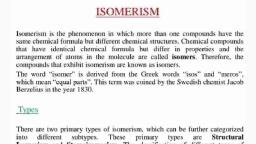
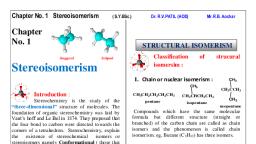
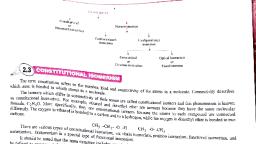
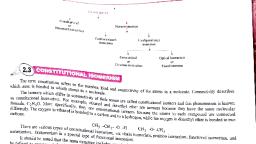
ISOMERISM, Isomerism is a phenomenon where two or more compounds have the same molecular formula but different structures. Organic Compounds that exhibit this kind of relationship are called isomers., There are two broad classification of isomerism. They are, a. Structural isomerism, b. Stereoisomerism, Structural Isomerism, Structural isomerism can further be classified into three, chain isomerism, positional isomerism and functional group isomerism., Chain isomerism involves the carbon skeleton restructuring. Example is seen in butane and 2-methyl propane. Both have molecular formula of C4H10, n-butane 2-methylpropane, For alkanes the number of possible isomers is given by 2(n-4) + 1 where n= number of carbon atoms., Pentane has 5 carbons (C5H12) and will have three isomers., 1. n-pentane, 2. 2-methyl butane, 3. 2,2-dimethyl propane, Positional isomerism involves the change in position of a substituent or bonds. For example, Example 1: C5H10 will have the following isomers, Example 2: Chloropropane C3H7Cl, Functional group isomerism is between compounds from different homologous series., Example 1: C6H12 will have two functional group isomers, a. Hexene b. Cyclohexane, Example 2: C2H6O will have 2 functional group isomers, Stereo isomerism, Stereo isomerism can be sub-divided into two: Geometric isomerism and Optical isomerism., Geometric isomerism is also called the cis-trans isomerism. For geometric isomerism to exist, the following criteria must be met., The presence of double bond (C=C), Identical pair of species are attached to each of the carbons sharing the double bond, These isomers are always in pairs. They have the same name but are distinguished by the prefixes cis- and trans-, Example 1: C2H2Cl2 will have the following pairs of geometric isomers., Example 2: C4H8 will have the following pair of geometric isomers, or Trans-but-2-ene or cis-but-2-ene, Note that in both cases, the difference is the relative positions of the substituents with respect to the double bond. In cis isomer, they are both on the same side, while in the trans isomer, one is up and the other is down., Exercise: consider the organic compound below, State with reasons whether it will exhibit geometric isomerism., Name the compound., Optical Isomerism involve two identical compounds which are mirror images of each other. Optical isomers are also in pair and they rotate plane polarized light in opposite directions. Two conditions must be met for optical isomerism to exist. A compound is said to be optically active when, There is a carbon atom bonded to four entirely different species, The two molecules involved are not superimposable (they must be mirror images of each other), The isomer which rotates plane polarized light to the right is known as the dextro- isomer denoted by the letter D- or (+). The isomer which rotates plane polarized light to the left is known as the laevo- isomer, denoted by the letter L- or (-)., Examples of optical isomers include, Alanine, Note. The triangular bond represents a bond that is pointing from the carbon, out of the plane(pointing towards you), while the dotted lines represent bonds pointing into the plane from the carbon atom (pointing away from you)., Lactic acid, Notice that in all the optical isomers, there are four different species bonded to the carbon center. They are not superimposable, just like the palms of your hand., Assignment, Mention one other example of compounds that exhibit optical isomerism. Write their names and structures., Give one other example of compounds that exhibit geometric isomerism. Write their names and structure., How many isomers does C6H14 have? Write their names and structures, Consider the structures below. State if they are isomers and name the compounds., 5. Draw and name the possible isomers of the following, b. C5H10, c. C3H6Cl2