Page 1 :
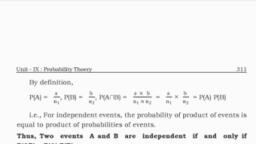
Unit - IX : Probability Thoery 311, By definition,, , axb 2 ay 2 _ pia) PB), mxm my he, , , , Pa)= 2, pip)= 2, Plane) =, , i.e., For independent events, the probability of product of events is, , equal to product of probabilities of events., Thus, Two events Aand B are independent if and only if, P(AB) = P(A) P(B)., Note: IfA,,A,,..., A, are ‘k’ independent events,then,, P(A,NA,N ... M.A,) = P(A,) * P(A,) * ...* P(A), Example : 34., , The first bag contains 3 red and 2 green balls. The second bag, contains 4 red and 5 green balls. A ball is selected from each bag. What, is the probability that they are red ?, , Solution :, , Let A be an event of getting a red ball from the first bag and B be an, , event of getting a red ball from the second bag., 3, , + P(A)= 2 and P(B)- +. Here, events A and B are independent, , 4, , «. P(ANB) = P(A) P(B eS, , , , = 0.2667, , , , 204, =x-=, 5° 9, , Example : 35., A fair coin and a fair die are thrown. Find the probability that coin, shows a head and die shows a multiple of 3., Solution :, Let A be an event of getting head on the coin and B be an event of, getting a multiple of 3 on the die., , 1 2, =P(A)= 5 and P(B)= =. Here, events A and Bare independent, , , , «. P(AB) = P(A) P(B) = ; x 2, , 312 I PUC - Statistics Text Book
Page 2 :
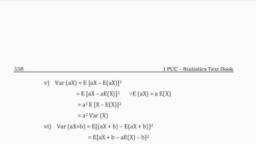
Unit - X - Random Variable 337, , , , The square root of variance is the standard deviation., ie, S.D(X) = /Var(X), 3. If X is a random variable and a, b are constants then;, i) Efa)=a, ii) E(ax) =a E(X), iii) E(aX +b) =aE(X) +b, iv) Var (a) = 0, v) Var (aX) = a? Var(X), vi) Var (aX + b) = a? Var(X), Proof : Let ‘X’ be a discrete random variable with probability mass, function (pmf) p(x) then,, E(X) = 2 x p(x), i) E(h(X)] = ¥ h(x) p(x), E(a) = Za. p(x), = ad p(x), =ax1 + Yp(xj=1, =a, ii) E(aX) = ¥ ax p(x), =a xp(x), =a E(X), i) E(aX +b) = (ax +b) p(x), = Zax p(x) + b p(x), =a Dx P(x) +b p(x), =aEk(X)+b + Yp(x)=1, iv) Var(a) = E[a- E(a)]*, = E[a-a]? vE(a)=a, =E(0)?=0, , 338, 1 PUC - Statistics Text Book
Page 3 :
=e Ff es ee ££ 8 Ct, “i 5 3 15, i) P(AnB) = P(A) P@BIA) = 3 x 5=, , , , Example : 58., , A box has 3 red and 2 green balls. Two balls are drawn one after the, other. Find the probability that the balls drawn would be red if the ball, drawn first is, Unit - IX : Probability Thoery 321, (a) Returned to the box before the second draw is made. (Draw, with replacement), (b) Not returned to the box before the second draw is made. (Draw, without replacement), Solution :, Let A be an event of getting red ball in the first draw and B be an, ji . 3, event of getting red ball in the second draw. Here, P(A)= =, When the ball is replaced getting red ball in the second draw becomes, 3, unconditional. i.e., P(B) = 2, When the ball is not replaced getting red ball in the second draw, becomes conditional., , i, P(BIA) = = (+ Remaining total balls are 4), , , , 9, , (a) P(ANB) = P(A) P(B) = 2 x 5 = 350.36, , 5 2!, , (b) P(ANB) = P(A) P(BIA) = 2 x : = 4-03, , Example : 59., , The first box contains 2 red and 3 green marbles. The second box, contains 4 red and 5 green marbles. One marble is transferred from the, first box to the second and then one marble is drawn from the second, box. Find the chance that it is green., , Solution:, , Let A be an event of transferring red marble from the first to the, second, B be an event of transferring green marble from the first to the, second, (C| A) be an event of drawing green marble from the second box, given that the transferred marble is red and (C|B) be an event of drawing, green marble from the second box given that the transferred marble is, green
Page 4 :
Example : 57., , A box contains 5 white and 3 black balls. Two balls are drawn one, after the other. Find the probability of getting a white ball in the first, draw and a black ball in the second draw when (i) the first drawn ball is, replaced (ii) the first drawn ball is not replaced., , Solution :, Let A be an event of getting white ball in the first draw and B be an, , event of getting black balll in the second draw. Here, P(A)= = and when, the ball is replaced, getting black ball in the second draw becomes, , unconditional i.e., PB)=3, when the ball is not replaced, getting black, ball in second draw becomes conditional, , i.e, P(BA) = ; (+: Remaining total balls are 7), 5 3, # () P(AnB) = P(A) P(B) = = =, , (ii) P(ANB) = P(A) P(BIA) =, , ola, , 3, xis, 7, , Example : 58., , A box has 3 red and 2 green balls. Two balls are drawn one after the, other. Find the probability that the balls drawn would be red if the ball, drawn first is, Unit - IX: Probability Thoery 321, , , , (a) Returned to the box before the second draw is made. (Draw, with replacement), , (b) Not returned to the box before the second draw is made. (Draw, without replacement), , Solution :, , Let A be an event of getting red ball in the first draw and B be an, event of getting red ball in the second draw. Here, P(A)=, , When the ball is replaced getting red ball in the second draw becomes, unconditional. i.e., P(B) = 2, , When the ball is not replaced getting red ball in the second draw, becomes conditional., , i, P(BIA) = = (+ Remaining total balls are 4), , (a) P(ANB) = P(A) P(B) = 2 x 2, , , , 3.2 3
Page 5 :
Unit-X, RANDOM VARIABLE, Introduction :, , Logically by a random variable we mean a real number “X* associated, with the outcomes of a random experiment. It can take any one of the, various possible values each with definite probability., , Suppose two fair coins are tossed, the sample space is S ={HH, HT,, TH, TT}., , If to every sample points in the sample space, a number is assigned, as below:, , Sample Point TT TH HT HH, Number 0 1 i 2, , , , , , , , , , , , , , , , , , , , Here, the assigned numbers indicate the number of heads obtained in, each case. Let, The number of heads be denoted by 'X’, then X is a function, on the sample space. It takes the values 0, 1 and 2 with respective, , 12 1 1, probabilities ma and a i.e., P(X=0) = P (no head) = a, , a, 2, P(X=1) = P (one head) = 7, , P(X=2) = P (two heads) = i, Here, ‘X’ is called a random variable or a variate., Definition : Random variable is a function which assigns a real number, to every sample point in the sample space., The set of such real values is the range of the random variable., , ‘Types of Random Variables : Broadly random variables are classified as, below:, , i) Discrete random variable., , ii) Continuous random variable.