Page 1 :
CHAPTER, , 1, Basic Concepts of Chemistry, Matter, , • Mixtureswhichcontaindifferentphaseseachwithits, , • Anythingwhichhasmassandoccupiesspaceismatter., • Onthebasisofstate,thematterisclassifiedintosolid,, , •, , liquidandgaseoussubstances;e.g.,waterintheform, oficeissolid,waterisliquidandwatervapourisgas., , •, , • Solidshavehighdensity,rigidshape,slightcompres, sibility,onlyslightexpansionatatmosphericpressure, withriseintemperature., , • Liquids arecharacterisedbyhighdensity,lackofdefi, , •, , niteshape,slightcompressibilityandslightexpansion, atatmosphericpressurewhenheated., , •, , • Gaseous state ischaracterisedbylowdensity,indefi, , •, , niteshapeandvolume,highcompressibilityandcon, siderableexpansionwhenheatedatconstantpressure., , • A substance which cannot be broken down into yet, simpler substances by any means is known as an, element., , •, •, , • Anelementconsistsofonlyonekindofatom., • Acompound isapuresubstancecomposedoftwoor, moreelementsjoinedinchemicalcombinationintoa, definiteproportionbyweight., , •, , • Molecules areidentifiableunitsofmatterconsistingof, twoormoreatomsofthesameelementorofdifferent, elementscombinedinadefiniteratio., , • Atomicity isthenumberofatomsinamolecule., • Puresubstancescontainonlyasinglesubstance., • Mixtureisamaterialobtainedasaresultofmixing, two or more substances (elements or compounds) in, anyproportionsothatthecompoundsdonotlosetheir, identity,e.g.,air,gasoline,etc., , • A mixture that is uniform throughout is referred, to as homogeneous if it has the same composition, throughout., , ownsetofpropertiesarereferredtoasheterogeneous., Conversion of one substance into another is called a, chemical change, e.g.,rustingofiron., Ifasubstancechangesfromonestatetoanotherstate, without any chemical change, it is referred to as a, physical change,e.g.,conversionofwaterintoiceor, watervapour., Inachemicalchange,thesubstancesthatarepresent, initially(thereactants)disappear., Oneorseveralnewsubstances(theproducts)appear, asthereactionproceeds., Thepropertiesofproductsaredifferentfromthoseof, thereactants., Energy in the form of heat, light or electricity is re, leasedorabsorbedinthecourseofachemicalchange., Themassofanobjectisameasureoftheamountofmat, teritcontains,whiletheweightisameasureoftheforce, withwhichtheobjectisattractedtotheearthbygravita, tionalforce.Weightisalwaysproportionaltomass., Massandweightofasubstancearenumericallyequal, atthesealevel.Iftheobjectismovedawayfromearth, thegravitationalattractiondecreasesandthereforethe, weightdiminishes,butthemassremainsconstant., , Physical Quantities and their Measurement, , • Properties of matter like mass, length, time, tem, , •, •, , perature, which can be quantified and expressed in, numerals with suitable units are called as physical, quantities., Massofanymattercanbedeterminedbymeasuring, resistancetomovement., Thesizeoftheobjectismeasuredintermsoflength,, areaandvolume.
Page 2 :
1.2, , Objective Chemistry - Vol. I, , • Lengthreferstoonedimension,areatotwodimensions, andvolumetothreedimensionsofspace., , • Time is another term of measurement used to know, •, •, •, , •, •, •, , howlongittakesaprocessorachemicaltransforma, tiontotakeplace., Temperatureisaphysicalquantityusedformeasuring, thedegreeofhotnessandcoldness., Temperaturedeterminestheheatflowfromabodyata, highertemperaturetoabodyatlowertemperature., The physical quantities which are derived with the, help of two or more physical quantities are called, derived physical quantities., e.g., density is a derived physical quantity, derived, frommassandvolume., Thethreeaspectsofthenumericalresultofmeasure, ment are (i) numerical magnitude, (ii) precision and, (iii)indicatorscale., The physical quantities which depend on the size of, the sample like mass, weight, volume, pressure, etc., arecalledextensive properties., The physical quantities which do not depend on the, sizeofthesampleliketemperature,density,refractive, index,surfacetensionviscosity,etc.arecalledintensive properties., , Measurement and Significant Figure, , • Precision istheclosenessofthesetofvaluesobtained, •, •, •, •, , , , , , fromidenticalmeasurementsofaquantity., Accuracy istheclosenessofsinglemeasurementtoits, truevalue., Thedigitsinaproperlyrecordedmeasurementareknown, assignificant figures orsignificantfiguresarethemean, ingfuldigitsinameasuredorcalculatedquantity., Thegreaterthenumberofsignificantfiguresinare, ported result, the smaller is the uncertainty and the, greatertheprecision., Rulesforreportingthenumberofsignificantfigures:, (i) All nonzero digits are significant, starting with, thefirstdigitthatisnotzero., (ii) Zerosbetweennonzerodigitsaresignificant., (iii) Zerostotherightofsignificantfiguresaresignifi, cantforanumberlessthanthat., (iv) Whenanumberendsinzerosthatarenottothe, right of a decimal point, the zeros may not be, significant., , Calculation Involving Significant Figures, , , (i) W, hile carrying out addition or subtraction of a, numberoftermstheresultshouldbereportedto, , , , , , •, , , , , thesamenumberofdecimalplacesasthatofthe, termwiththeleastnumberofdecimalplaces., (ii) Inthecalculationinvolvingmultiplicationordivi, sion,thenumberofsignificantfiguresinthefinal, answershouldnotbegreaterthanthenumberof, significantfiguresintheleastprecisionfactor., (iii) The number that comes from direct count of, objectsorthoseresultsfromdefinitionsiscalled, anexactnumberandisconsideredtopossessan, infinitenumberofsignificantfigures., Rounding up is the procedure of dropping non, significant digits in a calculation result and adjusting, thelastdigitreported.Thegeneralprocedureislisted, hereunder:, (i) Ifthedigitis5orgreateradd1tothelastdigitto, beretainedanddropalldigitsfarthertotheright., (ii) If the digit is less than 5, simply drop it and all, digitsfarthertotheright., , Objective Questions, 1. SIunitoftimeis, (1) second , (3) hour, , , (2) minute, (4) day, , 2. Whichofthefollowingstatementsisincorrect?, (1) Allelementsarehomogeneous, (2) Compoundsmadeupofanumberofelementsare, heterogeneous, (3) Amixtureisnotalwaysheterogeneous, (4) Airisanheterogeneousmixture, 3. Whichofthefollowingisnotanelement?, (1) Diamond, (2) Graphite, (3) Silica , (4) Ozone, 4. Whichoneisaphysicalchange?, (1) BurningofSinair, (2) BurningofCinair, (3) Conversion of white phosphorous to red, phosphorous, (4) Corrosionofmetals, 5. Apuresubstancecanonlybe, (1) acompound, (2) anelement, (3) anelementoracompound, (4) aheterogeneousmixture, 6. A pure substance which contains only one type of, atomsiscalled, (1) anelement, (2) acompound, (3) asolid , (4) aliquid
Page 3 :
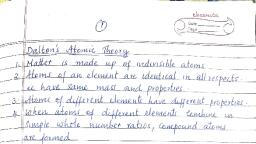
Basic Concepts of Chemistry 1.3, , 7. Thenumberofsignificantfiguresin0.0500is, (1) one, , (2) three, (3) two, , (4) four, 8. The correctly reported answer of the addition of, 29.4406,3.2and2.25willhavesignificantfigures, (1) three , (2) four, (3) two, , (4) five, 9. The correctly reported answers of the addition of, 294.406,280.208and24willbe, (1) 598.61 , (2) 599, (3) 598.6 , (4) 598.614, 10. Twostudents,XandY,reportedthemassofthesame, substanceas7.0gand7.00g,respectively.Whichof, thefollowingstatementiscorrect?, (1) Bothareequallyaccurate, (2) XismoreaccuratethanY, (3) YismoreaccuratethanX, (4) Bothareinaccuratescientifically, 11. Thenumberofsignificantfiguresinπis, (1) one, , (2) two, (3) three, , (4) infinite, , • Law of definite proportions: Proposed by Proust,, verified by Strass and Richards.When two elements, combinetoformacompoundtheycombineindefinite, proportion by weight (or) a chemical compound has, samecompositionbywhatevermethoditisprepared., , • Law of multiple proportions: Proposed by Dalton,, proved by Berzelius and Strass. When two elements, combinetoformmorethanonecompoundthedifferent, weightofoneoftheelementscombiningwithafixed, weightoftheotherareinproportionsofwholenumber., , • Law of reciprocal proportions: ProposedbyRitcher., The weight of two or more substances which sepa, ratelyreactchemicallywithidenticalweightsofthird, element are also the weights in which they combine, witheachotherormultiplesofthem., , • Gay Lussac’s law of gaseous volumes: Volumes of, gasesusedandproducedinachemicalreactionstand, in a simple integral ratio when these volumes are, measured under the same conditions of temperature, andpressure., , • Berzelius Hypothesis: Equalvolumesofallgasesun, der the same conditions of temperature and pressure, containequalnumberofatoms., , 12. Giventhenumbers786,0.786and0.0786thenumber, ofsignificantfiguresforthethreenumbersis, (1) 3,4and5,respectively, (2) 3,3and3,respectively, (3) 3,3and4,respectively, (4) 3,4and4,respectively, , • Avogadro’s Hypothesis: Equal volumes of all gases, , 13. In which of the following numbers all zeros are, significant?, (1) 0.0005 , (2) 0.0500, (3) 50.000 , (4) 0.0050, , • Dalton’s atomic Theory: Theobservationsoflawof, , underthesameconditionsoftemperatureandpressure, containequalnumberofmolecules(or)thevolumeof, agasatfixedpressureandtemperatureisproportional, tothenumberofmoles(ormoleculesofagaspresent)., Mathematically,Avogadro’slawisVαn., multiple proportions led to the formation of atomic, theory., , • Anatomisthesmallestindivisibleparticleofanele, mentthatcantakepartinachemicalchange., , • Allatomsofagivenelementareidenticalbothinmass, , answers, (1) 1, (6) 1, (11) 4, , (2) 2, (7) 2, (12) 2, , (3) 3, (8) 1, (13) 3, , (4) 3, (9) 2, , (5) 3, (10) 3, , andchemicalproperties., , • Atomsofdifferentelementshavedifferentmassesand, differentchemicalproperties., , • Compoundsareformedbythecombinationofdiffer, entatomsintheratioofsmallwholenumbers., , LawS oF CheMICaL CoMbInatIon, , • Laws of conservation of mass: It was proposed by, Lavoiser. Total amount of matter in the universe, is unaltered whatever the change take place in its, distribution (or) the sum of the weights of reacting, substancesareequaltothesumoftheweightsofprod, ucts(or)mattercanneitherbecreatednordestroyed., , • Chemicalreactionsinvolveonlycombination,separa, tionandrearrangementofatoms., , • Atomsareneithercreatednordestroyedinthecourse, ofanordinarychemicalreaction., , • ThetwomodificationsmadeinthehypothesisofJohn, Daltonare, (i) anatomisdivisibleanddestructive, (ii) allatomsofanelementarenotidenticalinmass
Page 4 :
1.4, , Objective Chemistry - Vol. I, , Objective Questions, 14. ElementA reacts with oxygen to form a compound, A2O3.If0.359gramofacompoundcontains0.128g, ofoxygen,atomicweightofAwillbe, (1) 51amu , (2) 43.08amu, (3) 49.7amu, (4) 47.9amu, 15. Oxygen combines with two isotopes of carbon, 12C, and 14C,toformtwosamplesofcarbondioxide.The, dataillustrates, (1) Lawofconservationofmass, (2) Lawofmultipleproportions, (3) Lawofreciprocalproportions, (4) Noneofthese, 16. Suppose thatA and B are two elements which form, compoundsB2A3andB2A,respectively.If0.05mole, of B2A3 weighs 9.0 g and 0.10 mole of B2A weighs, 10g,thentheatomicweightofAandB,respectivelyis, (1) 30and40, (2) 40and30, (3) 20and5, (4) 15and20, 17. Inthereaction,N2+3H2→2NH3,ratiobyvolumeof, N2,H2andNH3is1:3:2.Thisillustrates, (1) definiteproportions, (2) multipleproportions, (3) reciprocalproportions, (4) gaseousvolumes, 18. OnepartofanelementXcombineswithtwopartsof, another elementY. Six parts of the element Z com, bineswithfourpartsofelementY.IfXandYcombine, together,theratiooftheirweightswillbegovernedby, (1) Lawofmultipleproportions, (2) Lawofdefiniteproportions, (3) Lawofreciprocalproportions, (4) Lawofconservationofmass, 19. Twosamplesofleadoxidewereseparatelyreducedto, metallicleadbyheatinginacurrentofhydrogen.The, weightofleadwasobtainedfromtheotheroxide.The, dataillustrates, (1) Lawofreciprocalproportions, (2) Lawofconstantproportions, (3) Lawofmultipleproportions, (4) Lawofequivalentproportions, 20. Chemicalequationisbalancedaccordingtothelawof, (1) Multipleproportions, (2) Reciprocalproportions, (3) Conservationproportions, (4) Definiteproportions, , 21. Lawofreciprocalproportionscanbeusedtodetermine, (1) Atomicweightofagas, (2) Equivalentweightofagas, (3) Molecularweightofagas, (4) Noneofthese, 22. SO2gaswaspreparedby(i)burningsulphurinoxygen,, (ii) reacting sodium sulphite with dilute H2SO4 and, (iii) heating copper with conc. H2SO4. It was found, thatineachcasesulphurandoxygencombinedinthe, ratioof1:1.Thedataillustratethelawof, (1) Conservationofmass, (2) Multipleproportions, (3) Constantproportions, (4) Reciprocalproportions, 23. H2S contain 5.88% hydrogen, H2O contain 11.11%, hydrogen while SO2 contains 50% sulphur.The data, illustratethelawof, (1) Conservationofmass, (2) Constantproportions, (3) Multipleproportions, (4) Reciprocalproportions, 24. 6gofcarboncombineswith32gofsulphurtoform, CS2.12gofCalsocombinewith32gofoxygento, formcarbondioxide.10gofsulphurcombineswith, 10gofoxygentoformsulphurdioxide.Whichlawis, illustratedbythem?, (1) Lawofmultipleproportions, (2) Lawofconstantcomposition, (3) Lawofreciprocalproportions, (4) GayLussac’slaw, 25. TwoelementsX(atmass16)andY(atmass14)com, binetoformcompoundsA,BandC.Theratioofdif, ferentmassesofYwhichcombinewithafixedmass, ofXinA,BandCis1:3:5.If32partsbymassofX, combineswith84partsbymassofYandB,theninC, 16partsbymassofXwillcombinewith, (1) 14partsbymassofY, (2) 42partsbymassofY, (3) 70partsbymassofY, (4) 84partsbymassofY, , answers, (14) 2, (19) 3, (24) 3, , (15) 4, (20) 3, (25) 3, , (16) 2, (21) 2, , (17) 4, (22) 3, , (18) 3, (23) 4
Page 5 :
Basic Concepts of Chemistry 1.5, , MoLe ConCept, , • Atomic weight scale isatablethatliststheweightsof, alltheelementsrelativetothesamecommonstandard., , • ThemassofC-12istakenasstandard anditsmassis, assignedexactly12.Atomicmassunit(amu)andmass, esofallotheratomsaregivenrelativetothisstandard., , • Reciprocal of Avogadro’s number is known as, Avogram., Avogram =, , 1, 1, =, = 1.67 × 10⁻²³, N 6.022 × 10 23, , • Thenumberofmoleculespresentin1ccofagasat, , STP is known as Loschmidt number. Its value is, 2.617×10¹⁹., twelfththemassofoneC12atom.1amu=1.66056×, • The mole is the amount of substance containing the, 10–24g., same number of atoms in exactly 12 grams of C12, Many naturally occurring elements consist of more, isotope., thanoneisotope.Forsuchelements,theatomicweights, • Numberofmoles“n”’, determinedaretheaverageatomicweightsofisotopes., Weight in grams, W, = =, Molecular weight or molecular mass ofamolecule, Gram molecular weight, M, of a substance is the sum of the atomic weights or, • Weightofasubstancecontainingadefinitenumberof, atomicmassesofatomspresentinthemolecule., moles=Numberofmoles×Grammolecularweight, Forioniccompoundswhichdonotcontainmolecules,, (W=n×MW), formulaweightsarecalculatedasindicatedinthefor, • No.ofmoleculespresentinagivensubstance., mulaofanioniccompound., , • One amu is defined as a mass exactly equal to one, •, •, •, , • The atomic weight expressed in grams is known as, gram atomic weight., , • Molecular weight expressed in grams is known as, gram molecular weight orgram mole., , • At STP, one gram mole of any gas occupies 22.414, litres or 22414 cc of volume. It is known as gram, molar volume., , • One gram mole of any substance will contain, , Weight, × Avogadro number, Gram molecular weight, W, =, ×N, MW, =, , • No.ofatomspresentinagivenelement, =, , Weight, × Avogadro number, Gram molecular weight, , 6.022×10²³molecules., , • Thenumberofatomsinonegramatomofanelement, orthenumberofmoleculespresentinonegrammole, ofsubstance,i.e.,6.022×1023isknownasAvogadro’s, number orAvogadro’sconstant denotedbyN., , • Themassof1moleofasubstanceingramsisknown, , •, , asmolar mass., Gram molecular weight = weight of molecule in, g×6.022×10²³., Wt.ofonemoleculeingrams, Molecular Wt., Molecular Wt., =, =, N, 6.022 × 10 23, Wt.ofoneatomingrams, =, , Atomic weight, Atomic weight, =, N, 6.023 × 10 23, , • ThegaseoussubstancesatNTPwillhave6.022×1023, moleculesin22.4litresor22400ccwhoseweightis, equaltotheirmolecularweight., , Objective Questions, 26. OnemoleofCO2contains, (1) 6.02×10²³atomsofC, (2) 6.02×10²³atomsofO, (3) 18.1×10²³atomsofCO2, (4) 3gramsofcarbon, 27. Howmanywatermoleculeswillbelostondehydrating, 0.684gofsucrose?, (1) 1.3244×10²², (2) 6.622×10²¹, (3) 6.02×10²⁰, (4) 7.224×10²¹, 28. Which one of the following gas contains the same, numberofmoleculesas16gofoxygen?, (1) 16gofO3, , (2) 16gofSO2, (3) 32gofSO2, , (4) Alltheabove
Page 6 :
1.6, , Objective Chemistry - Vol. I, , 29. 18gofwatercontains, (1) 1gatomofhydrogenatom, (2) 2gatomofhydrogenatom, (3) 3gatomofhydrogenatom, (4) Noneofthese, 30. VolumeatNTPof0.44gofCO2isthesameasthatof, (1) 0.02gofH2, (2) 0.085gofNH3, (3) 320mgofgaseousSO2, (4) Alltheabove, 31. 4.4gofanunknowngasoccupies2.24litresofvolume, atSTP.Thegasmaybe, (1) carbondioxide (2) carbonmonoxide, (3) oxygen , (4) sulphurdioxide, 32. Which of the following has the smallest number of, molecules?, (1) 0.1moleofCO2gas, (2) 11.2litresofCO2gas, (3) 22gofCO2gas, (4) 22.4×10³mlofCO2gas, 33. Choosethewrongstatement., (1) 1molemeans6.023×1023particles, (2) Molarmassismassof1molecule, (3) Moleismassof1moleofsubstance, (4) Molar mass is molecular mass expressed in, grams, 34. Whichofthefollowingpairscontainequalnumberof, atoms?, (1) 11.2ccoftheN2and0.015gofnitricoxide, (2) 22.4litresofnitrousoxideand22.4litresofnitric, oxide, (3) 1millimoleofHClandand0.5millimoleofH2S, (4) 1moleofH2O2and1moleofN2O4, 35. Apieceofcopperweighs0.635g.Howmanyatomsof, copperdoesitcontain?, (1) 6.02×10²²electrons, (2) 6.02×10²¹electrons, (3) 6.023×10²³electrons, (4) 6.012×1024electrons, 36. Howmanyelectronsarepresentin1.6gofmethane?, (1) 6.02×10²³electrons, (2) 6.02×10²²electrons, (3) 6.02×1024electrons, (4) 6.02×1025electrons, 37. HowmanyyearswouldittaketospendoneAvogadro, number of rupees at a rate of 10 lakh of rupees per, second?, , (1), (2), (3), (4), , 19.089×10⁹years, 18.089×10⁹years, 19.089×10¹⁰years, 19.089×10¹¹years, , 38. 4.6 × 10²² atoms of an element weigh 13.8 g. The, atomicmassoftheelementis, (1) 290 (2) 180 (3) 13.4 (4) 10.4, 39. ThenumberofmolesofSO2Cl2in13.5gis, (1) 0.1 (2) 0.2 (3) 0.3 (4) 0.4, 40. The total number of protons in 10 g of calcium, carbonateis, (1) 3.0115×1024, (2) 1.5057×1024, (3) 2.0478×1024, (4) 4.0956×1024, 41. Whichofthefollowingiswrong?, (1) Onemoleofhydrogenweighslessthanonemole, ofglucose, (2) Twomolesofhydrogenandonemoleofhelium, weighthesame, (3) 0.1moleofoxygenweighsmorethanonemoleof, hydrogen, (4) Onemoleofnitrogenandhalfamoleofoxygen, weighthesame, 42. Avogadro’slawfindsapplicationinthedeterminationof, (1) Atomicityofgases, (2) Molecularweightofgases, (3) Molecularformulaofcertaingaseouscompounds, (4) Alltheabove, 43. Assuming the density of water is 1g/ml, the volume, occupiedbyonemoleculeofwateris, (1) 3×10–23cc, (2) 1.5×10⁻²³cc, –23, (3) 6×10 cc, (4) 3×10–22cc, 44. Molecularweightofhaemoglobinis67200.Ifhaemo, globin contains 0.33% of iron atoms, the number of, ironatomsthatarepresentinonemoleculeofhaemo, globinis(At.wt.ofiron=56), (1) 2 (2) 4 (3) 6 (4) 8, 45. Howmanymolesofatomsarepresentinonemoleof, CH3COOHmolecule?, (1) 2molesofCatoms,4molesofHatoms,2moles, ofOatoms, (2) 1moleofCatoms,2molesofHatoms,1moleof, Oatoms, (3) 2molesofCatoms,3molesofHatoms,2moles, ofOatoms, (4) None
Page 7 :
Basic Concepts of Chemistry 1.7, , 46. Whichcontainsthegreatestnumberofoxygenatoms?, (1) 1gofO2, (2) 1gofO2, (3) 1gofO3, (4) Allhavethesamenumberofatoms, 47. Whichofthefollowingpairsofgasescontainthesame, numberofmolecules?, (1) 16gofO2,14gofN2, (2) 8gofO2,22gofCO2, (3) 28gofN2,22gofCO2, (4) 32gofO2,32gofN2, 48. Aglassofjuicecontains9gofglucose.Thenumberof, carbonatomsintheglassofjuiceis, (1) 1.8069×10²³, (2) 1.5012×10²³, 23, (3) 2.5012×10, (4) None, 49. Weightof6.023×1021atomsofzinc(At.wt.ofZn=, 65.4)is, (1) 0.645g , (2) 0.0654g, (3) 6.54g , (4) 0.00654g, 50. The number of ions produced by 0.1 mole of, AlCl3.6H2Oinalitresolutionis, (1) 5×6023×1022 , (2) 4×6.023×1023, –22, (3) 4×6.023×10 , (4) 4×6.023×1022, 51. TwocontainershaveequalweightsofNO2andN2O., Theonecontainingmorenumberofmolesis, (1) NO2, (2) N2O, (3) bothhavesamenumberofmoles, (4) cannotbedetermined, 52. Whichofthefollowingmixturescontainlessnumber, ofions?, (1) 2MK2SO4;3MNa2CO3, (2) 2MNaCl;2MKCl, (3) 2MMnSO4;2MK2SO4, (4) 2MK2SO4;2M(NH4)2SO4, , answers, (26) 1, (31) 1, (36) 1, (41) 4, (46) 4, (51) 2, , 55. Thenumberofgramatomsofsulphurthatrepresents, 0.5moleofsulphuricacidis, (1) 0.2 (2) 0.4 (3) 0.5 (4) 0.9, , (28) 3, (33) 2, (38) 2, (43) 1, (48) 1, (53) 2, , (29) 2, (34) 1, (39) 1, (44) 2, (49) 1, (54) 1, , (30) 1, (35) 2, (40) 1, (45) 1, (50) 4, (55) 3, , CaLCULatIon oF eMpIRICaL FoRMULa, anD MoLeCULaR FoRMULa, , • Empirical formula ofacompoundgivesthesimplest, •, •, , , , , , , •, •, , 53. Caffeine (molecular weight = 194) contains 28.9%, nitrogen. The number of nitrogen atoms in caffeine, moleculeis, (1) 2 (2) 4 (3) 7 (4) 8, 54. SugarcostsRs.10/kg.Thecostofonemoleofsugaris, (1) Rs.3ps42, (2) Rs.6ps84, (3) Rs.1ps80, (4) None, , (27) 1, (32) 1, (37) 1, (42) 4, (47) 1, (52) 2, , ratioofthenumberofatomsofdifferentelementspre, sentinonemoleculeofacompound., Empiricalformulawillnotgivetheactualnumberof, atomsofdifferentelementspresentinonemoleculeof, thecompound., Calculation of the empirical formula involves the, followingsteps., 1. Percentagecompositionbyweightofeachelement, inthecompoundshouldbedetermined., 2. Thepercentageofeachelementshouldbedivided, byitsatomicweighttogettherelativenumberof, atomsofeachelement., 3. Thenumbersobtainedintheabovestep(2) should, bedividedtogetthesimplestratio., 4. I fthenumbersobtainedintheabovestep(3) are, notwholenumbers;for,theyshouldbemultiplied, byasuitableintegertogetthewholenumberratio., 5. Theratioobtainedintheabovestep(4) givesthe, empiricalformula., Molecular formula represents the actual number of, atomsofdifferentelementspresentinonemoleculeof, thecompound., For certain compounds, the empirical formulae and, molecularformulamaybesame., Molecularformula=Empiricalformula×n, n=, , Molecular weight, Empirical formula weight, , • Molecularweightofasubstancecanbedeterminedby, , •, , different methods such as (i) vapour density method, and(ii)methodsbasedoncolligativeproperties., 2×vapourdensity=Molecularweight, The molecular weights of volatile compounds are, determinedbyVictorMayer’smethod.
Page 8 :
1.8, , Objective Chemistry - Vol. I, , StoIChIoMetRy anD StoIChIoMetRIC, CaLCULatIonS, , Objective Questions, 56. The vapour density of gasA is four times that of B., If the molecular mass of B is M then the molecular, massofAis, (1) M (2) 2M (3) M/4 (4) 4M, , • Stoichiometric calculations help in calculating, , 57. Vapourdensityofavolatilesubstanceis4(CH4=1)., Itsmolecularweightwouldbe, (1) 8 (2) 2 (3) 64 (4) 128, , , , , , , 58. Anoxideofmetal(M)has40%bymassofoxygen., MetalMhasarelativeatomicmassof24.Theempiri, calformulaofoxideis, (1) M2O (2) M2O3 (3) MO (4) M3O4, 59. Acompound(60g)onanalysisgaveC=24g,H=4g,, O=32g.Itsempiricalformulais, (1) C2H4O2 , (2) C2H2O2, (3) CH2O2 , (4) CH2O, 60. Acompoundcontains38.8%C,16.0%Hand45.2% N., Theformulaofthecompoundwouldbe, (1) CH3NH2, (2) CH3CN, (3) C2H5CN, (4) CH2(NH2)2, 61. Anorganiccompoundonanalysiswasfoundtocon, tain0.032%sulphur.Themolecularmassofthecom, pound,ifitsmoleculecontainstwosulphuratomsis, (1) 200, , (2) 2000, (3) 20,000 , (4) 2,00,000, 62. 15 ml of a gaseous hydrocarbon requires 45 ml of, oxygenforcompletecombustionand30mlofCO2is, formed.Theformulaofthehydrocarbonis, (1) C3H6 (2) C2H6 (3) C4H10 (4) C2H4, 63. Insulin contains 3.4% of sulphur. The minimum, molecularmassofinsulinis, (1) 940 (2) 560 (3) 470 (4) 350, 64. TheconcentrationofC=85.45%andH=14.55%is, notobeyedbytheformula, (1) CH2 (2) C2H4 (3) C2H6 (4) C4H8, , •, , •, , •, , , , , •, , MethoDS FoR expReSSIng the, ConCentRatIon oF SoLUtIonS, Mass per cent, , •, , •, , (56) 4, (61) 4, , (57) 3, (62) 4, , (58) 3, (63) 1, , •, •, , answers, (59) 4, (64) 3, , (60) 1, (65) 4, , Masspercent=, , Mass of solute, × 100, Mass of solution, , • Mole fraction istheratioofthenumberofmolesof, , –1, , 65. The density of air is 0.001293 gm L . Its vapour, densityis, (1) 143 (2) 14.3 (3) 1.43 (4) 0.143, , whether the production of a particular substance is, e conomicallycheapornot., Stoichiometriccalculationsareoffourtypes:, (i) Calculationsbasedonweight–weightrelationships, (ii) Calculationsbasedonweight–volumerelationships, (iii) Calculationsbasedonvolume–volumerelationships, (iv) Calculations based on weight–volume–energy, relationships, If the amount of reactant in a particular reaction is, known, then the amount of the other substance re, quired in the reaction or the amount of the product, formedinthereactioncanbecalculated., For stoichiometric calculations, the following steps, shouldbeconsidered., (a) abalancedchemicalequationusingchemicalfor, mulaeofreactantsandproductsmustbewritten., (b) Thecoefficientsofabalancedchemicalequation, givethemoleratioofthereactantsandproducts., (c) The mole ratio can be converted into weight, weight ratio, weightvolume ratio or volume, volumeratio., Limiting reactant or limiting reagent isthereactant, thatisentirelyconsumedwhenareactionproceedsto, completion.The reactant that is not completely con, sumedinareactioniscalledasanexcess reactant., , one component to the total number of moles (solute, andsolvent)inabinarysolution., n2, MolefractionofsoluteχA=, n1 + n2, wheren1andn2arethenumberofmolesofsolventand, solute,respectively., W, Thenumberofmolesofasubstance=, M, MolefractionofasubstanceAinasolventBisgivenby, WA, MA, χA=, WA, W, + B, MA, MB
Page 9 :
Basic Concepts of Chemistry 1.9, , • Foradilutesolution,thenumberofmolesofasolute, , • Number of moles present in a solution = Molarity ×, Vol.inlitres., , inthedenominatorcanbeneglected.Then, χA=, , • Number of milli moles present in a solution =, , WA, M, × B, M A WB, , • Inasolution,thesumofmolefractionsofallcompo, , •, , nents=1., , Molarity, , • Molarity:Misthenumberofmolesofasolutepre, sentinonelitreofasolution., MolarityisrepresentedbyM., M=, M=, orM=, M=, , Number of moles of solute, Volume of solution in litres, , •, •, , normality, , • Normalityisthenumberofgramequivalentsofasol, utepresentinonelitreofasolution.ItisdenotedbyN., , Weight of the solute (W ), Molecular ( MW ) × volume in litres (V ), , Normality N =, , W, M .W . × V in lit, , N=, , W × 1000, M .W . × V in cc, , • Ifonegrammolecularweightofthesubstanceispresent, •, •, , •, , inonelitreofthesolutionitissaidtobe1M(onemolar)., If0.1gmolecularweightofthesubstanceispresent, in one litre of the solution, it is said to be 0.1M or, decimolarorM/10ofthesolution., Weight of the substance present in one litre =, Molarity× Mol.wt.IfthesolutionofM1ofvolumeV1, isdilutedtovalencyV2,itsmolarityM2canbecalcu, latedbyV1M1=V2M2., Thevolumetobeaddedtodiluteasolutionofvolume, V1ofmolarityM1toaconcentrationofM2isgivenby, volumeofwatertobeadded=, Volumeafterdilution–VolumebeforedilutionorV2–V1, Volumeofwatertobeadded=, , V1 M1, − V1, M2, , • When thesolutions oftwodifferent substancesreact, together,then, , , •, , Molarity×Vol.incc., Molarityofamixtureofsolutionsofdifferentconcen, trationsofthesamesubstancecanbecalculatedby, V M + V M + ...... + Vn M n, M= 1 1 2 2, Total Volume, Molarityistemperaturedependent., Unitsofmolarityaremoleslitre–1, , V1 M1, V M, = 2 2, n1, n2, , whereV,Mandnarevolume,molarityandnumberof, moleculesparticipatinginthereactionofasubstance,, respectively., Ifdensity(d)andpercentbyweightofasubstancein, asolutionareknown,thenitsmolarity, M=d×percent×, , 10, M.W., , Number of gram equivalents of solute, Volume of solution in litres, , Weight of the solute (W ), Equivalent weight ( EW ) × volume in litres (V ), , orN=, , W, EW × V in litres, , orN=, , W × 1000, EW × V in cc, , • If one gram equivalent weight of a substance is pre, •, •, , sentinonelitreofasolution,itissaidtobe1N(one, normal)., If0.1gramequivalentweightofasubstanceispresent, inonelitreofasolution,itissaidtobe0.1Nordeci, normalorN/10ofthesolution., Weight of the substance present in one litre =, Normality×Equivalentweight., W=VNE, , • IfthesolutionofN1ofvolumeV1isdilutedtoavol, umeV2thenitsnormalityN2canbecalculatedby, V1N1=V2N2, , • Thevolumeofwatertobeadded=, Volume after dilution – Volume before dilution or, , , V2–V1., VN, Volumeofwatertobeadded= 1 1 −V1, N2, , • When thesolutions oftwodifferent substancesreact, with each other, then V1N1 = V2N2 where V1 and N1, arethevolumeandnormalityofonesubstancewhile, V2 and N2 are volume and normality of the other, substance.
Page 10 :
1.10 Objective Chemistry - Vol. I, , • The weight of a substance that can react with a par, , •, , •, , •, , ticularvolume(V)ofasolutionofanothersubstance, havingnormality(N)andequivalentweight(E)canbe, calculatedby, W=VNE, Ifthedensity(d)andpercentbyweightofasubstance, in a solution are known, then its normality can be, calculatedby, 10, N=d×percent×, EW, Number of gram equivalents present in solution =, Normality×Volumeinlitres(N×Vinlitres).Number, ofmilliequivalentspresentinasolution=Normality×, VolumeinCC(N×VinCC)., Normalityofamixtureofsolutionsofdifferentcon, centrationsofthesamesubstance, N=, , Equivalentweightofbase=, Molecular weight or formula weight of the base, Acidity of the base, , • Acidityofabaseisthenumberofreplaceablehydrox, yl(–OH)groupsinthemoleculeofabase., Formula weight of NaOH, E.Wt.forNaOH=, 1, Formula weight of KOH, E.Wt.forKOH=, 1, , •, , V1 N1 + V2 N 2 + ........... + Vn N n, Total volume, , • Inacid–baseneutralisationreactions,theexcesssub, stanceisgivenby, V N −V N, N= 1 1 2 2, Total Volume, , • Relation between molarity (M) and normality (N) of, anysolutionis, , , Molarity×, , Molecular weight, =normality, Equivalent weight, , , , Molarity=, , Normality × Equivalent weight, Molecular weight, , equivalent Weights, , • For acids: Equivalentweightofanacid=, , , • For bases, , Molecular weight or formula weight of the acid, Basicity of the acid, , • Basicityofanacidisthenumberofreplaceablehydro, gen(bymetalions)inamoleculeoftheacid., E.Wt.forHCl=, , Formula weight of HCl, 1, , E.Wt.forBa(OH)2=, , For Salts, Equivalentweight, =, , Formula weight of Ba ( OH )2, 2, , Formula weight of the salt, Total charge on the cation or the anion of thhe salt, , • For oxidants and reductants, Equivalentweight, =, , Formula weight, Number of electrons transfered in the reaction per moole, , • Equivalentweightofcertaincompounds., Substance, Acids, HCl, HNO3, H2SO4, C2H2O4.2H2O, H3PO4, Bases, NaOH, KOH, Ba(OH)2, Fe(OH)3, Salts, NaCl, Na2CO3, AgNO3, Oxidants, KMnO4, K2Cr2O7, , Equivalent weight in g, 36.5, 63, 49, 63(oxalicacid), 32.7, 40, 56, 85.67, 35.7, 58.5, 53, 170, , E.Wt.forHNO3=, , Formula weight of HNO3, 1, , , , E.Wt.forH2SO4=, , Formula weight of H 2SO 4, 2, , • Molality isthenumberofmolesofasolutepresentin, , , , Formula weight of H 3 PO 4, E.Wt.forH3PO4=, 3, , 1kg(100g)ofasolvent., Molalityisrepresentedby“m”.Itsunitsaremolekg–1., , •, , 31.6(acidmedium), 49(acidmedium)
Page 11 :
Basic Concepts of Chemistry 1.11, , • Molality=, , , •, •, , orm=, , Number of moles of solute, Weight of solvent in kg, W, MW × Wt of solvent in kg, , W × 1000, , orm=, MW × Wt of solvent in gram, Temperature has no effect on molality and mole, fractionssincethequantitiesofsoluteandsolventare, expressedbyweights., Molarity and normality changes with temperature, sincethevolumeofsolventchangeswithtemperature., , Objective Questions, 66. Inaclinicallaboratory,asampleofurinecontaining, 0.120gofureaNH2CONH2(M.Wt.60)wastreated, withexcessofnitrousacid.Theureareactedaccording, tothefollowingequation, NH2CONH2+ 2HNO2 , → CO2 + 2N2 + 3H2O, Thegasformedwaspassedthroughaqueoussodium, hydroxideandfinalvolumeismeasuredatSTP.What, wasthevolume?, (1) 89.6cc , , (2) 179.2cc, (3) 44.8cc , , (4) 22.4cc, 67. Howmanygramsofwaterareproducedbythecom, pletecombustionof1.00litreatSTPofmethane?, 1.00, ×2, 22.4, 1.00, (3), × 18 , 2.24 × 2, (1), , , , , 1.00, × 2 × 18, 22.4, 1.00 × 2, (4), 22.4 × 18, (2), , 68. TheweightofNa2CO3thatwouldbeneededtoreact, with0.1moleofHClaccordingtotheequationis, → 2NaCl + H2O + CO2, Na2CO3 + 2HCl , (1) 5.3g , (2) 53g, (3) 0.53g , (4) 0.053g, 69. The amount of silver chloride formed on mixing, 250mlof0.1MAgNO3with400mlof0.1MNaClis, (1) 0.10M , (2) 0.05M, (3) 0.025M , (4) 0.2M, 70. How much of 0.1M of HCl must be added to, 0.55 litre of 0.1M Na2CO3 if all of this is to be, convertedtoCO2?, (1) 0.55litre, , (2) 1.1litre, (3) 0.275litre, , (4) 100ml, , 71. 1.0gofpurecalciumcarbonatewasfoundtoreactwith, 50 ml of dilute HCl for completion of the reaction., ThestrengthoftheHClsolutionis, (1) 4M (2) 2M (3) 0.4M (4) 0.2M, 72. 12gofmagnesium(At.Wt.=24)willreactcomplete, lywithanacidtogive, (1) onemoleofH2 (2) onehalfmoleofH2, (3) onemoleofO2 (4) noneofthese, 73. WhatvolumeofCO2measuredatSTPcanbeobtained, byreacting50gofCaCO3withexcesshydrochloricacid?, → CaCl2+H2O+CO2, CaCO3+2HCl , (1) 22.4litres, (3) 1.12litres, , (2) 11.2litres, (4) 44.8litres, , 74. InthehydrogenationofphenylethyleneC6H5CH=CH2, using a platinum catalyst the volume of hydrogen, (measuredatSTP)thatreactswithonemoleofphenyl, ethylenecouldbe, (1) 11.2litres, (2) 22.4litres, (3) 44.8litres, (4) 1litre, 75. What is the volume of oxygen required for complete, combustionofamixtureof5ccofCH4and5ccofC2H4?, (1) 25cc (2) 5cc (3) 50cc (4) 10cc, 76. A certain sample of coal contains 1% sulphur by, weight. What is the weight of sulphur dioxide pro, ducedwhen2×106kgofthiscoalisburnt?, (1) 2×10⁴kg, (2) 4×10⁴kg, 5, (3) 4×10 kg, (4) 2×10⁵kg, 77. A certain grade coal contains 1.6 per cent sulphur., Assumingthatonburningthecoal,Sinitisoxidised, toSO2,howmanymolesofSO2wouldbeformedon, burning1metricton(1000kg)ofcoal?, (1) 16, , , , (2) 16000 ×, , (3) 16000 ×, , 2, , 32, , (4), , 2, 64, , 16000, 64, , 78. The amount of a given product calculated to be ob, tainedinachemicalreactionthatgoestocompletionis, (1) Thepercentefficiencyofthereaction, (2) Theyieldofthereaction, (3) Thetheoreticalyieldofthereaction, (4) Noneoftheabove, 79. 5.6gofcarbonmonoxideisheatedwithexcessofO2, toformcarbondioxide.Whatisthetheoreticalyieldin, gramsofcarbondioxide(2CO+O2 , → 2CO2)?, (1) 44g (2) 88g (3) 4.4g (4) 8.8g
Page 12 :
1.12 Objective Chemistry - Vol. I, , 80. Lactose commonly used as a binder in tablets has a, molecularweight342.WhatweightofCO2wouldbe, formed when 1/12 mole of this compound is burnt, completely?, → 12CO2+11H2O), (C12H22O11+12O2 , (1)12g, , (2) 44g, (3) 4.4g, , (4) 440g, , 88. A mixture of 20 ml of methane and 20 ml of O2 is, exploded and cooled to room temperature. If the, reactionbetweenthetwosubstancesiswrittenas, CH4+2O2 , → CO2+2H2O, thenthefinalvolumeofthegaseousmixtureis, (1) 10ml , (2) 20ml, (3) 30ml , (4) 60ml, , 81. Whatmoleratioofmolecularchlorine(Cl2)tomolec, ularoxygen(O2)wouldresultfromthebreakupofthe, compoundCl2O7?, (1) 1:1 (2) 7:2 (3) 1:3.5 (4) 2:4, , 89. FindthenumberofmolesofKClO3requiredtocom, pletethereaction, KClO3+C12H22O11 , → KCl+CO2+H2O, , 82. When100gofethylenepolymerisestopolyethylene, according to the equation nCH2 = CH2 , → ........, (.....CH2–CH2...)n.....theweightofpolyethylenepro, ducedwillbe, n, (1) gm , (2) 100g, 2, 100, (3), g , (4) 100ng, n, 83. HowmanymolesofFe2+ionsareformedwhenexcess, ofironistreatedwith50mlof4.0MHClunderinert, atmosphere?Assumenochangeinvolume., (1) 0.4 (2) 0.1 (3) 0.2 (4) 0.8, → 2CO is carried out by, 84. The reaction 2C + O2 , taking24gofcarbonand96gofO2.Whichoneisthe, limitingreagent?, (1) C (2) O2 (3) CO2 (4) None, → C,5molesofAand8, 85. ForthereactionA+2B , molesofBwillproduce, (1) 5molesofC, (2) 4molesofC, (3) 8molesofC, (4) 13molesofC, 3, 86. Theequation2Al(s)+ O2(g)→Al2O3(s)showsthat, 2, (1) 2molesofAlreactwith3/2moleofO2toproduce, 7/2moleofAl2O3, (2) 2 g ofAl react with 3/2 mole of O2 to produce, 1moleofAl2O3, (3) 2gmoleofAlreactwith3/2litreofO2toproduce, 1moleofAl2O3, (4) 2molesofAlreactwith3/2moleofO2toproduce, 1moleofAl2O3, 87. Element A (atomic weight 12.01) and element B, (atomicweight16)combinetoformanewsubstance, X. If two moles of B combines with one mole ofA,, thentheweightofonemoleofXis, (1) 28.01g , (2) 44.01g, (3) 40.02g , (4) 56.02g, , (1) 8 (2) 7 (3) 4 (4) 2, 90. The weight of magnesium that will be required to, produce just sufficient hydrogen, from an acid to, combinewithalltheoxygenthatcanbeobtainedby, the complete decomposition of 24.5 g of potassium, chlorateis, (1)10.4g , (2) 14.4g, (3) 9.32g , (4) 12.4g, 91. 10gofcarbonburnsgiving11.2litresofCO2atNTP., Aftercombustion,theamountofunburntcarbonis, (1) 2.5g (2) 4g (3) 3g (4) 1g, 92. TheweightofMnO2requiredtoproduce1.78litresof, chlorinegasatSTPaccordingtothereaction, MnO2+4HCl , → MnCl2+2H2O+Cl2is, (1) 6.905g , (2) 5.905g, (3) 6.509g , (4) 6.059g, 93. 100 g potassium hydrogen carbonate on strong heat, inggives69gofasolidresidue.Theequationwhich, representsthereactionis, (1) KHCO3 , → K2CO3+H2O+CO2, → K2CO3+H2, (2) 2KHCO3 , 1, 1, 1, → K2CO3+ H2O+ CO2, (3) KHCO3 , 2, 2, 2, → 2KOH+2CO2, (4) 2KHCO3 , 94. Chlorophyllcontains2.68%ofmagnesium.Thenum, berofmagnesiumatomspresentin2gofchlorophyllis, (1) 1.34×10²¹, (2) 6×10²⁰, 22, (3) 5.34×10 , (4) 5.34×10²³, 95. 100mlof0.2MK2SO4isdilutedwith100mlofwater., TheK+ioninthesolution, (1) 0.4M (2) 0.1M (3) 0.2M (4) 0.8M, , answers, (66) 1, (71) 3, , (67) 2, (72) 2, , (68) 1, (73) 2, , (69) 3, (74) 2, , (70) 2, (75) 1
Page 13 :
Basic Concepts of Chemistry 1.13, , (76) 2, (81) 3, (86) 4, (91) 2, , (77) 2, (82) 2, (87) 2, (92) 1, , (78) 3, (83) 2, (88) 2, (93) 3, , (79) 4, (84) 1, (89) 1, (94) 1, , (80) 2, (85) 2, (90) 2, (95) 3, , Practice exercise Level-1, 1. In a sample of pure compound, Na = 0.0887 mole,, O=0.132moleandC=2.651022atoms.Theempiri, calformulaofthecompoundis, (1) Na2CO3, (2) Na3O2C5, (3) Na0.0887O0.132C2.65×1022, (4) NaCO, 2. ThenumbersofatomsofCrandOare4.8×1010and, 9.6×10¹⁰,respectively.Theempiricalformulais, (1) Cr2O3 , (2) CrO2, (3) Cr2O4 , (4) Noneofthese, 3. OneatomofanelementAweighs6.644×10–23g.The, gramatomsofthesameelementin40kgwillbe, (1) 40, , (2) 400, (3) 4000 , (4) 1000, 4. Atomicityofoleumis, (1) 11 (2) 8 (3) 7 (4) 18, 5. Whenwateriselectrolysed,hydrogenandoxygenwere, obtained which were collected and found to be 16.8, litresatSTP.Then,theweightofwaterelectrolysedis, (1) 18g (2) 36g (3) 9g (4) 45g, 6. 3.2gofahydratedsaltlost1.8gofH2Oonheating., Molecular weight of the anhydrous salt is 160. The, numberofmolesofwaterofcrystallisationis, (1) 2 (2) 3 (3) 5 (4) 10, 7. 0.3moleofhydrocarbononcombustiongave26.4g, ofCO2.IfthathydrocarbondecolourisesBayer’srea, gentandgaveaprecipitatewithTollen’sreagent,the, molecularweightofhydrocarbonis, (1) 28 (2) 26 (3) 30 (4) 14, 8. A compound has 50% ofA (at. wt. 20) and 50% B, (at.wt.30).Ifthemoleculeofthecompoundcontains, 6atomsofA,thenthemolecularformulais, (1) A4B6 (2) A6B4 (3) A3B8 (4) A6B2, 9. Avesselcontains0.32gofO2andundersimilarcon, ditions another vessel contains 0.26 g of compound, X. If X contains C and H in 1:1, then the molecular, formulaofXis, , (1) C6H6, (3) C2H2, , , , , (2) C8H8, (4) Anyoneofthese, , 10. Ifaniodisedsaltcontains1%ofKIandapersontakes, 2.5gofthesalteveryday,theiodideionsgoinginto, hisorherbodyeverydaywouldbeapproximately, (1) 7.2×10²¹, (2) 7.2×10¹⁹, 21, (3) 3.6×10 , (4) 9.03×10¹⁹, 11. Amixtureofmagnesiumchlorideandmagnesiumsul, phateisknowntocontain0.6molesofchloridesions, and0.2molesofsulphateions.Thenumberofmoles, ofmagnesiumionspresentis, (1) 0.4 (2) 0.5 (3) 0.8 (4) 1.0, 12. A sample of ammonium phosphate contains 3.18, moles of hydrogen atoms. The number of moles of, oxygenatomsinthesampleis, (1) 0.265 (2) 0.795 (3) 1.06 (4) 3.18, 13. Which of the following statements aboutAvagodro’s, constantistrue?, (1) It isthenumber ofelectrons required todeposit, onemoleofatomsofanymetallicelementfroma, solutionofoneofitssalts., (2) Itisthenumberofatomscontainedinonemoleof, atomsofanymonoatomicelement., (3) Itisthenumberofgramsofanyelementwhich, contains6.02×1023atomsoftheelement., (4) It is the number of particles (ions, atoms and, molecules)requiredtomakeonegramofthesub, stanceunderconsideration., 14. Thenumberofmolesofoxygenin1litreofaircontain, ing21%oxygenbyvolumeinstandardconditionsis, (1) 0.186mol, , (2) 0.21mol, (3) 2.1moles, , (4) 0.0093mol, 15. On mixing equal volumes of 0.08 M Pb(NO3)2 and, 0.1 M KIO3, a white Pb(IO3)2 precipitates. Assum, ing the reaction goes to completion, the ratio of the, , numberofmolesofPb(IO3)2tothenumberofmoles, ofthereactantleftunreactedis, (1) 10/3 (2) 5/3 (3) 2/3 (4) 3/10, 16. ThenumberofmolesofH2Oformedwhen0.1moleof, Ba(OH)2istreatedwith0.25moleofHClO3according, totheequation, → Ba(ClO3)2+2H2Ois, Ba(OH)2+2HClO3 , (1) 0.05 (2) 0.2 (3) 0.15 (4) 0.3, 17. The reaction between aluminium metal and dilute, hydrochloric acid produced H2 and Al3+ ions. The, molarratioofaluminiumusedtoproducehydrogenis, (1) 1:2 (2) 2:1 (3) 3:2 (4) 2:3
Page 14 :
1.14 Objective Chemistry - Vol. I, , 18. Equal volumes of 0.2M HCl and 0.4M KOH are, mixed.Theconcentrationsoftheprincipalionsinthe, resultingsolutionsare, (1) [K+]=0.4M;[Cl–]=0.2M;[H+]=0.2M, (2) [K+]=0.2M;[Cl–]=0.1M;[OH–]=0.1M, (3) [H+]=0.1M;[Cl–]=0.1M;[OH–]=0.1M, (4) [H+]=0.2M;[Cl–]=0.1M;[H+]=0.1M, 19. ZincreactswithCuSO4accordingtotheequationZn+, CuSO4 , → ZnSO4 + Cu. If excess zinc is added, to 100 ml of 0.05 M CuSO4 solution, the amount of, copperformedis, 1, 1, (1), moles , moles, , (2), 200, 250, 200, 7, (3), moles , moles, , (4), 7, 200, 20. 2.79gofironiscompletelyconvertedintorust(Fe2O3)., Theweightofoxygenintherust(At.Wt.ofFe=55.8)is, (1) 2g (2) 1.2g (3) 3g (4) 1.8g, 21. Acompoundcontains69.5%oxygenand30.5%nitro, genanditsmolecularweightis92.Theformulaofthe, compoundis, (1) N2O, , (2) N2O3, (3) N2O4, , (4) N2O5, 22. One mole mixture of CO and CO2 requires exactly, 20 g of NaOH to convert all the CO2 into Na2CO3., HowmanymoregramsofNaOHwoulditrequirefor, conversionintoNa2CO3,ifthemixtureiscompletely, oxidisedtoCO2?, (1) 80g (2) 60g (3) 40g (4) 20g, 23. Thecorrectarrangementofthefollowinginorderof, increasingmassis, I.Nitrogenmolecule, II.Oxygenatom, III. 1Avogram, IV. 1×10⁻¹⁰gatomsofcopper, (1) I>II>III>IV , (2) I<II<III<IV, (3) III<II<I<IV , (4) II<III<I<IV, , 26. 10 grams of CaCO3 is completely decomposed to X, andCaO.Xispassedintoanaqueoussolutioncontain, ingonemoleofsodiumcarbonate.Whatisthenumber, of moles of sodium bicarbonate formed (Mol. Wts.:, CaCO3=100;Na2CO3=106andNaHCO3=84)?, (1)0.2 (2) 0.1 (3) 0.01 (4) 10, 27. Studythefollowingtable, Compound, Mol. Wt., , Weight of compound, Taken (in g), , I, , CO2(44), , 4.4, , II, , NO2(46), , 2.3, , III, , H2O2(34), , 6.8, , IV, , SO2(64), , 1.6, , Whichtwocompoundshavetheleastweightofoxy, gen? (Molecular weights of compounds are given in, brackets.), (1) IIandIV, , (2) IandIII, (3) IandII , , (4) IIIandIV, 28. In the decomposition of 10 g of MgCO3, 0.1 mol of, CO2and4.0gofMgOareobtained.Hence,theper, centagepurityofMgCO3is, (1) 50% (2) 60% (3) 40% (4) 84%, 29. Inwhichcasethepurityofasubstanceis100%?, (1) 1moleofCaCO3gave11.2LofCO2(atSTP), (2) 1moleofMgCO3gave40.0gofMgO, (3) 1moleofNaHCO3gave4gofH2O, (4) 1moleofCa(HCO3)2gave1moleofCO2, 30. X+,Y2+ and Z– are isoelectronic of CO2. Increasing, orderofprotonsinX+,Y2+andZ–is, , (1) X+=Y2+=Z–, (2) X–<Y2+<Z–, –, +, 2+, (3) Z <X <Y , , (4) Y2+<X+<Z–, 31. PercentyieldofNH3inthefollowingreactionis80%:, → Na2CO3 + 2NH3. If, NH2CONH2 + 2NaOH ∆, 6gofNH2CONH2reactwith8gofNaOHtheNH3, formedis, (1) 3.4g, (2) 2.72g (3) 4.25g (4) 11.2g, , 24. C12 and C14 isotopes are found as 98% and 2%,, respectivelyinanysample.ThenthenumberofC14, atomsin12gofthesamplewillbe, (1) 1.5moleatoms , (2) 1.032×10²²atoms, 21, (3) 2.06of×10 atoms, (4) 2gatom, , 32. Cortisone is a molecular substance containing 21, atomsofcarbonpermolecule.Themasspercentageof, carbonincortisoneis69.98%.Itsmolarmassis, (1) 176.5 (2) 252.2 (3) 287.6, (4) 360.1, , 25. A sample of copper sulphate pentahydrate, (CuSO4.5H2O)contains3.2gofCu(Atomicweight, =64).HowmanygramsofO2areinthissample?, (1)7.2g (2) 3.2g (3) 14.4g (4) 0.8g, , 33. OnemoleofBaF2istreatedwith2molesofH2SO4.To, maketheresultingmixtureneutral,NaOHisadded.The, numberofmolesofNaOHrequiredinthisprocessis, (1) 4 (2) 2 (3) 3 (4) 1
Page 15 :
Basic Concepts of Chemistry 1.15, , 34. IfmgramofametalAdisplacesm2gramofanother, metal B from its salt solution and if the equivalent, weightsareE1andE2,respectivelythentheequivalent, weightofAcanbeexpressedby, m, m × E2, (1) E1 = 1 × E2 , , (2) E1 = 2, m2, m1, (3) E1 =, , m1 × m2, , E2, , , , (4) E1 =, , m1, × E2, m2, , 35. IfAl,ZnandFescrapshasthesamerateperKgthen, fortheproductionofH2bytheactionofdiluteH2SO4, (1) FewillbecheapestandAlwillbecostliest, (2) Alwillbecheapestandzincwillbecostliest, (3) Fewillbecheapestandzincwillbecostliest, (4) ZnwillbecheapestandAlwillbecostliest, 36. Choosethecorrectstatement:, The use of 12C scale has superseded the older scale, of atomic mass based on 16O isotope, one important, advantageoftheformerbeing, (1) T, he atomic masses on 12C scale became whole, numbers., (2) 12Cismoreabundantintheearth’scrustthan16O., (3) The difference between physical and chemical, atomicmassesgotnarroweddownsignificantly., (4) 12, Cissituatedmidwaybetweenmetalsandnon, metalsintheperiodictable., 37. 2.2gofcompoundsofphosphorousandsulphurcon, tain1.24gofphosphorous.Theempiricalformulaof, thecompoundis, (1) P4S3, (2) P3S4, (3) P3S2, (4) P2S3, 38. 0.1 mole of a compound containing sulphur and, chlorine is subjected to a number of chemical reac, tions which resulted in the precipitation of 0.1 mole, ofPbCl2and0.2moleofBaSO4.Theformulaofthe, originalcompoundis, (1) SCl2, , (2) S2Cl2, (3) SCl4, , (4) S2Cl, 39. Under the same conditions of temperature and pres, sure, equal volumes of oxygen and hydrocarbon, weights are 0.32 g and 0.26 g, respectively.The for, mulaofhydrocarbonis, (1) C2H4 (2) C2H6 (3) C2H2 (4) CH4, 40. Comparing CO, CO2, HCHO and CH4 the per cent, compositionofcarbonismaximumin, (1) CO (2) CO2 (3) HCHO (4) CH4, 41. 0.01moleofiodoform(CHI3)reactswithAgpowder, toproduceagaswhosevolumeatSTPis, , (1) 224mL , (3) 336mL , , (2) 112mL, (4) noneofthese, , 42. WhichamongMnO2,Mn2O3,MnO3andMn2O7con, tainsthemaximumpercentagebyweightofcombined, oxygen?, (1) MnO2 , (2) Mn2O3, (3) MnO3 , (4) Mn2O7, 43. Three samples of iron of equal weights are used to, formFeO,Fe2O3andFe3O4independently.Then,the, amount(ingrams)ofO2requiredis, (1) maximumfortheformationofFe3O4, (2) maximumfortheformationofFe2O3, (3) minimumfortheformationofFe2O3, (4) thesamefortheformationofallthethree, 44. On analysis, a certain compound was found to con, tainiodineandoxygenintheratio254gofiodineand, 80gofoxygen.Theatomicmassofiodineis127and, thatofoxygenis16.Whichistheformulaofthecom, pound?, (1) IO (2) I2O (3) I5O2 (4) I2O5, 45. A metal M forms a chloride MCl2, the formula of, phosphoricacidisH3PO4.Theformulaofphosphate, ofthemetalis, (1) MPO4 , (2) M2PO4, (3) M3(PO4)2, (4) M(PO4)2, 46. A compound of carbon, hydrogen and nitrogen con, tainsthreeelementsintherespectiveratioof9:1:3.5., Itsempiricalformulais, (1) C3H4N , (2) C2H4N, (3) CH2N , (4) C3H6N, 47. Inagaseousreactionofthetype, → cC+dD, aA+bB , whichiswrong?, (1) a litre of A combines with b litre of B to give, CandD, (2) amoleofAcombineswithbmoleofBtogive, CandD, (3) agramofAcombineswithbgramofBtogive, CandD, (4) a molecules ofA combine with b molecules of, BtogiveCandD, 48. Whichofthefollowingaboutchemicalequationisfalse?, (1) Itgenerallydescribesonlytheoverallchange,that, isthenumberofatoms,moleculesorionsbefore, andafterareaction., (2) It indicates nothing about how products are, formedfromreactants.
Page 16 :
1.16 Objective Chemistry - Vol. I, , (3) I tdoesnotshowhowlongitwilltakeforthereac, tiontooccur., (4) Itcannotindicatetheactualmoleratioinwhich, reactantsreact., 49. Sodiumcombineswith35Cland37Cltogivetwosam, plesofNaCl.Theirformationfollowsthelawof, (1) Definiteproportions, (2) Multipleproportions, (3) Reciprocalproportions, (4) Noneofthese, 50. Gay Lussac’s law is not applicable for those gases, whichonmixing, (1) donotreact, (2) diffuse, (3) reactwitheachother, (4) allarewrong, , answers, (1) 1, (6) 3, (11) 2, (16) 2, (21) 3, (26) 1, (31) 2, (36) 3, (41) 2, (46) 1, , (2) 2, (7) 2, (12) 3, (17) 4, (22) 2, (27) 1, (32) 4, (37) 1, (42) 4, (47) 3, , (3) 5, (8) 2, (13) 2, (18) 2, (23) 3, (28) 4, (33) 1, (38) 2, (43) 2, (48) 4, , (4) 1, (9) 3, (14) 4, (19) 1, (24) 2, (29) 2, (34) 1, (39) 3, (44) 4, (49) 1, , (5) 3, (10) 4, (15) 2, (20) 2, (25) 1, (30) 3, (35) 2, (40) 4, (45) 3, (50) 3, , Practice exercise Level-II, 1. ThevapourdensityofcompletelydissociatedNH4Cl, wouldbe, (1) HalfthatofNH4Cl, (2) lessthanhalfthatofNH4Cl, (3) morethanhalfthatofNH4Cl, (4) dependsontheamountofNH4Cltakenatstart, 2. Asampleofclaywaspartiallydried.Itcontains50%, silicaand10%water.Theoriginalclaycontained19%, water.Thepercentageofsilicapresentinthesampleis, (1) 45% (2) 47.3% (3) 52% (4) 59.1%, 3. ThenumberofC2O42–ionsin100mlof0.2Maqeous, Na2C2O4is(assumecompleteionisation), (1) 0.62×10²², , (2) 1.204×10²², 22, (3) 1.86×10 , , (4) 18.6×10²², , 4. A1.04gsampleofametalcarbonatesofAandBon, heatinggave0.6gofmixtureofoxidesAandB.Given, thatAis80%byweightandBis60%weightintheir, oxides,thenthecompositionobtainedandfinalmix, turesofcompoundsofAandB,respectivelyare, (1) 0.62g,0.42g,0.4gand0.2g, (2) 0.42g,0.62g,0.4gand0.2g, (3) 0.31g,0.73g,0.2gand0.4g, (4) Noneofthese, 5. IfthepercentageofwaterofcrystallisationinMgSO4., xH2Ois13%,whatisthevalueofx(relativeatomic, massesH=1,O=16,Mg=24andS=32)?, (1) 1 (2) 4 (3) 5 (4) 7, 6. Sodium salt of an acid dye contains 7% of sodium., Whatistheminimummolarmassofthedye?, (1) 336.5 , (2) 286.5, (3) 300.6 , (4) 306.5, 7. AnelementXisfoundtocombinewithoxygentoform, X4O6. If 8.4 g of this element combine with 6.50 g of, oxygen,thentheatomicweightoftheelementingramsis, (1) 24.0 (2) 31.0 (3) 50.4 (4) 118.7, 8. Usingscientificnotation1000metreincentimetresup, totwosignificantfiguresisexpressedas, (1) 1.0×10⁴, (2) 1×10⁵, 5, (3) 1.0×10 , (4) 1.00×10³, 9. Whichofthefollowinghasthreesignificantfigures?, (1) 0.52, , (2) 543.00, (3) 126, , (4) 0.0600, 10. Amongthefollowingpairs,lawofmultipleproportion, isillustratedby, (1) H2SandSO2, , (2) BeOandBeCl2, (3) NH3andNO2 , (4) N2OandNO, 11. Which of the following statements is true regarding, roundingoffthedigits?, (1) If the digit coming after the desired number of, significant figures is more than 5, the preceding, digitisincreasedbyone., (2) If the digit coming after the desired number of, significantfigureislessthan5,theprecedingdigit, isnotchanged., (3) I fthedigitcomingafterthedesirednumberofsig, nificantfigureis5,theprecedingdigitisincreased, byoneifitisoddandnotchangedifitiseven., (4) Allofthese., 12. Fouronelitreflasksareseparatelyfilledwiththegases,, hydrogen,helium,oxygenandozoneatthesameroom
Page 17 :
Basic Concepts of Chemistry 1.17, , temperature and pressure. The ratio of total number, ofatomsofthesegasespresentinthedifferentflasks, wouldbe, (1) 1:1:1:1 , (2) 1:2:2:3, (3) 2:1:2:3 , (4) 3:2:2:1, 13. If two compounds have the same empirical formula, butdifferentmolecularformulae,theymusthave, (1) differentpercentcompositions, (2) differentmolecularweights, (3) sameviscosity, (4) samevapourdensity, 14. If1021moleculesareremovedfrom200mgofCO2,, thenthenumberofmolesofCO2leftis, (1) 2.88×10⁻³, (2) 4.54×10⁻³, –3, (3) 1.66×10 , (4) 1.66×10⁻², 15. Thepercentagecompositionoffourhydrocarbonsisas, follows, , , , (i), , (ii), , (iii), , (iv), , %ofC, , 75, , 80, , 85.791.3, , 91.3, , %ofH, , 25, , 20, , 14.38.7, , 8.7, , Thedataillustratethelawof, (1) constantproportions, (2) reciprocalproportions, (3) multipleproportions, (4) conservationofenergy, , 16. Thefollowingdataareavailable, (a)%ofMginMgOandinMgCl2, (b)%ofCinCOandCO2, (c)%ofK2Cr2O7inK2CrO4, (d)%ofCuisotopesincoppermetal, Thelawofmultipleproportionsmaybeillustratedby, thedata, (1) aandb , (2) bonly, (3) a,bandd, (4) conly, 17. Zinc sulphate contains 22.65% of Zn and 43.9% of, H2O. If the law of definite proportions is true, then, themassofzincrequiredtogive20gofthecrystals, willbe, (1) 0.453g , (2) 4.53g, (3) 45.3g , (4) 453g, 18. Which of the following is a best example of law of, conservationofmass?, (1) 12gofCcombineswith32gofO2toform44g, ofCO2., (2) 12gofCisheatedinvacuumthereisnochange, inmass., , (3) T, hemassofapieceofPtisthesamebeforeand, afterheating., (4) Asampleofairincreasesinvolumewhenheatedat, constantpressurebutthemassremainsunchanged., 19. Lawofdefiniteproportionsdoesnotapplytonitrogen, oxidebecause, (1) Massnumberofnitrogenisnotconstant., (2) Atomicweightofoxygenisvariable., (3) Equivalentweightofnitrogenisvariable., (4) Molecularweightofnitrogenisnotfixed., 20. GayLussac’slawofgaseousvolumeisderivedfrom, (1) Lawofdefiniteproportions, (2) Lawofmultipleproportions, (3) Lawofreciprocalproportions, (4) Experimentalobservations, 21. ThecompositionofcompoundAis40%xand60%y., ThecompositionofcompoundBis25%xand75%y., Accordingtothelawofmultipleproportions,theratio, oftheweightofelementyincompoundsAandBis, (1) 1:2 (2) 2:1 (3) 2:3 (4) 3:4, 22. Equal masses of oxygen, hydrogen and methane are, kept under identical conditions.The ratio of the vol, umesofthegaseswillbe, (1) 2:16:2 , (2) 2:16:1, (3) 1:16:2 , (4) 1:1:1, 23. H2 combines with O2 to form H2O in which 16 g of, oxygencombineswith2gofhydrogen.H2alsocom, bineswithcarbontoformCH4inwhich2gofhydro, gencombinewith6gofcarbon.IfCandO2combine, togetherthentheywilldosointheratio, (1) 6:18 (2) 6:16 (3) 1:2 (4) 12:24, 24. Themassofnitrogenpergraminthecompoundhydra, zineisexactlyoneandhalfthemassofnitrogeninthe, compoundammonia.Thefactillustrates, (1) Lawofconservationofmass, (2) Multiplevalencyofnitrogen, (3) Lawofmultipleproportions, (4) Lawofdefiniteproportions, 25. A sample of AlF3 contains 3.0 × 1024 F− ions. The, numberofformulaunitsinthissampleis, (1) 9.0×1024, (2) 3.0×1024, 24, (3) 0.75×10 , (4) 1×1024, 26. 400mgofcapsulecontains100mgofferrousfuma, rate.Thepercentageofironpresentinthecapsuleis, approximately, (1) 8.2% , (2) 25%, (3) 16%, , (4) unpredictable
Page 18 :
1.18 Objective Chemistry - Vol. I, , 27. Assume that the nucleus of the fluorine atom is a, sphereofradius5× 10–13cm.Whatisthedensityof, matterinthenucleus?, (1) 6.02×10²³gmL–1 (2) 6.02×10¹³gmL–1, (3) 12.02×10²³gmL–1 (4) 12.02×10¹³gmL–1, 28. InamoleofwatervapouratSTP,thevolumeactually, occupied or taken by the molecules (i.e.,Avogadro’s, No.×volumeofonemolecule)is, (1) zero, (2) lessthan1%of22.4litres, (3) 1%to2%of22.4litres, (4) between2%and5%of22.4litres, 29. 2.59gofamixtureofcalciumcarbonateandmagnesi, umcarbonateisstronglyheatedtoaconstantweightof, 1.3g.Theatomicweightsofcalciumandmagnesium, are40and24,respectively.Statewhichofthefollow, ingweightsexpressestheweightofcalciumcarbonate, intheoriginalmixture., (1) 980mg , (2) 400mg, (3) 1.75mg, (4) 0.84g, 30. Whichofthefollowingisacharacteristicofbothmix, tureandcompounds?, (1) Theycontaincomponentsinfixedproportions., (2) Their properties are the same as those of their, components., (3) Their weights equal the sum of weights of their, components., (4) Energyisgivenoutwhentheyaremade., 31. 100mLofPH3whendecomposesproducesphospho, rousandhydrogen.Thechangeinvolumeis, (1) 50mL , (2) 500mL, (3) 100mL , (4) 150mL, 32. Rydberg’sconstantis1.097373157×107m–1.Itcanbe, expressedtothreesignificantfiguresas, (1) 1.0974×10⁷m–1 (2) 1.09×10⁷m–1, (3) 1.10×10⁷m–1 (4) 1.10×10⁻¹, 33. Themassofapieceofpaperis0.02gandthemassof, a solid substance along with the same piece of paper, is20.036g.Ifthevolumeofthesolidis2.16cm3,its, densitytothepropernumberofsignificantdigitswillbe, (1) 9.27gcm–3, (2) 9.3gcm–3, –3, (3) 9.267gcm , (4) 43.24gcm–3, 34. Onreductionwithhydrogen3.6gofanoxideofmetal, left3.2gofthemetal.Iftheatomicweightofthemetal, is64,thesimplestformulaoftheoxidewouldbe, (1) M2O3 (2) M2O, (3) MO, (4) MO2, 35. Ametaloxideisreducedbyheatingitinastreamof, hydrogen. It is found that after complete reduction, , 3.15 g of the oxide has yielded 1.05 g of the metal., Wemaydeducethat, (1) theatomicweightofthemetalis8, (2) theatomicweightofthemetalis4, (3) theatomicweightofthemetalis4, (4) theatomicweightofthemetalis8, 36. WhenKClO3isheatedtoitsmeltingpoint,itdispro, portionatesintoKClandKClO4.HowmanyofKClO4, areformedonheating0.1moleofKClO3?, (1) 01 (2) 0.05 (3) 0.75 (4) 0.075, 37. 10litresofpollutedairispassedthroughlimewaterso, thatalltheCO2isprecipitatedasCaCO3.Theweight, ofCaCO3formedis0.05g.Whatisthepercentageof, CO2intheairsample?(1moleofgasunderexperi, mentalconditionshasavolumeof24litres.), (1) 0.12 (2) 1.2 (3) 0.03 (4) 0.6, 38. Forcompleteoxidationof1moleofanorganiccom, pound,3molesofoxygengasarerequired.Hence,the, compoundislikelytobe, (1) ethyne , (2) ethanol, (3) ethane , (4) methanol, 39. Whichofthefollowingfertilizersistherichestnitro, gensourceonamasspercentagebasis?, (1) NH4NO3, (2) (NH2)2CO, (3) NH3, , (4) (NH4)2SO4, 40. ThedrugnicotinehasthemolecularformulaC10H14N2., If 0.1 mole of this is combusted, what would be the, weightofCO2obtained?, (1) 440g (2) 4.4g, (3) 44g, (4) 100g, , answers, (1) 1, (6) 4, (11) 4, (16) 2, (21) 1, (26) 1, (31) 1, (36) 4, , (2) 1, (7) 2, (12) 3, (17) 1, (22) 3, (27) 2, (32) 3, (37) 1, , (3) 2, (8) 2, (13) 2, (18) 1, (23) 2, (28) 2, (33) 1, (38) 2, , (4) 1, (9) 4, (14) 1, (19) 3, (24) 3, (29) 4, (34) 2, (39) 3, , (5) 1, (10) 4, (15) 3, (20) 4, (25) 4, (30) 3, (35) 3, (40) 3, , Statement-type Questions, Ineachofthefollowingquestions,astatementIisgiven, followedbycorrespondingstatementIIjustbelow.Mark, thecorrectanswerasindicated.
Page 19 :
Basic Concepts of Chemistry 1.19, , 1. If both statementI and statementII are true and the, statementIIisthecorrectexplanationofstatementI., 2. IfbothstatementIandstatementIIaretruebutstate, mentIIisnotthecorrectexplanationofstatementI., 3. IfstatementIistruebutstatementIIisfalse., 4. IfstatementIisfalsebutstatementIIiscorrect., 1. Statement-I: The number of O atoms in 16 g of, oxygenand16gofozoneissame., Statement-II: Eachofthespeciesrepresent1gatom, ofoxygen., 2. Statement-I: The atomic masses of most of the, elementsareinfractions., Statement-II: Theatomicmassrepresentstheratioof, theaveragemassoftheatomtooneavogram., 3. Statement-I: Molarityofpurewateris55.5M., Statement-II: Molarity is a temperaturedependent, parameter., 4. Statement-I: TheratiobyvolumeofH2:Cl2:HClina, reactionH2+Cl2 , → 2HClis1:1:2., Statement-II: Substancesalwaysreactinsuchaway, thatthevolumeratioisasimplewholenumber., 5. Statement-I: 1Avogramisequalto10amu., Statement-II: 1amuisequaltoxgramwherexisthe, reciprocalofAvogadronumber., 6. Statement-I: 1gatomofironrepresentsthenumber, ofironatomspresentin1gofit., Statement-II: 1gatomofelementweightisequalto, gramatomicweightofelement., , answers, (1) 1, (6) 4, , 8. Statement-I: 1moleofsulphuricacidrepresents98g, ofthespecies., Statement-II: 1moleofsulphuricacidcontains32g, eachofsulphurandoxygenelements., 9. Statement-I: Equal volumes of the gases contain, equalnumberofatoms., Statement-II: Atom is the smallest particle which, takespartinchemicalreactions., 10. Statement-I: Both 12 g of carbon and 27 g of alu, miniumwillhave6.02×1023atoms., Statement-II: Gramatomicmassofanelementcon, tainsAvogadronumberofatoms., , (3) 2, (8) 3, , (4) 3, (9) 4, , (5) 4, (10) 1, , hIntS, Multiple Choice Questions with Only One, answer, 2. Compounds are homogeneous though made up with, differentelements., 3. Silicaisacompound(SiO2)., 4. Conversionofoneallotropeintoanotherisaphysical, change., 14. 0.128gofacombineswith0.231gofA., 48g.................?, 16. M.Wt.=B2A3=180M.Wt.ofB2A=100., 180 − 100, = 40, , ∴At.Wt.of=, 2, 25. InB,32partsofxcombineswithy=84parts., 16partsofxwillcombinewithy=42parts., Now,thenumberofpartsofxinbothBandcisof, equal different masses of y which combine with a, fixedmassofxinBandCintheratio3:5., Mass of y in B 3, =, , Mass of y in C 5, 42 parts, 3, =, Mass of y in C 5, , 7. Statement-I: TheformulaofcalciumcarbideisCaC2., Statement-II: 1 mole of calcium carbide contains 2, molesofcarbonatoms., , (2) 1, (7) 2, , , , 5, MassofyinC= × 42 = 70 parts, 3, , 27. M.Wt.ofsucrose=342, → 12C+11H2O, C12H22O11 ∆, No.ofmoleculeslostonheating0.684=, , , 0.684 × 11× 6 ×10 23, =1.32×10²², 342, , 35. GramatomicmassofCu=63.5, 0.635, No.ofmolesof0.635ofCu=, = 0.01, 63.5, No.ofCuatomsinonemole=6.02×10²³, No.ofCuatomsin0.01mole=0.01×6.02×1023, , , , , =6.02×10²¹
Page 20 :
1.20 Objective Chemistry - Vol. I, , 36. Mol.Wt.ofCH4=16, No.ofmolesin1.6g=0.1, No.ofmoleculesin1.6g=0.1×6×1023, Eachmoleculecontains6+4=10electrons, No.ofelectronspresentin1.6g=0.1×6×1023×10, =6×10²³, , 44, =1mole, 44, So,N2Ocontainsmorenumberofmolecules, NumberofmolesofN2O=, , 52. (1) 2MK2SO4gives6Mions(2MK+and1MSO42–), , 3MNa2CO3gives9Mions(6MK+and3MCO32–), , Total15M, (2) 2M NaCl gives 4M ions (2M Na+ 2MCl–) and, 2M KCl also gives 4M ions (2M K+ 2MCl–)., Total3M., (3) 2M MnSO4 gives 2M Mn2+ and 2M SO42– ions, and3MK2SO4gives6MK+and3MSO42–ions., Total10M., (4) 2MK2SO4gives4MK+ions2MSO42–ionsand, 2M(NH4)SO4gives4MNH4+and2MSO42–ions., Total12N., , 2M NaCl and 2M KCl mixture contains less, numberofions., , 37. No.ofrupeesspentinonesecond=106, No.ofspentin1year=106×60×60×24×365, Avogadronumberrupeeswillbespentin, 6.02 × 10 23, = 19.089 × 10⁹ years, 10 × 60 × 60 × 24 × 365, 6, , 43. Thevolumeof6×1023moleculesofwateris18cc., 18, Thevolumeof1molecule=, = 3 × 10 −23 cc, 6.023 × 10 23, 44. 100 g of haemoglobin contains 0.33 g of iron and, 67200gofhaemoglobincontains, 67200 1, × = 224, 100 3, 224, =4, No.ofironatoms=, 56, 45. EachmoleculeofCH3COOHcontainstwoatomsofC,, 2atomsofO2and4atomsofH2., So, one mole of CH3COOH contains 2 moles of C, atoms,4molesofHatomsand2molesofOatoms., 47. (1) 16gofO2is0.5moleand14gofN2is0.5mole, (2) 8gof0.25moleand22gofCO2is0.5mole, (3) 28gofN2is1moleand22gofCO2is0.5mole, (4) 32gofis1moleand32gofN2is1.143mole, , So,16gofO2and14gofN2containthesame, numberofmolecules., 48. Eachmoleculeofglucose(C6H12O6)contains6carbon, atomsand9gofglucosecontain, 9, × 6.023 × 10 23, 180, =3.0115×10²²glucosemoleculesor, 6×3.0115×1022, =1.8069×10²³carbonatoms, 49. Theweightof 6.023 × 10 23 atomsofzincis65.49, Theweightof 6.023 × 10 21 atomsofzincis0.654g, 50. AlCl3ionisesgiving4ions(AlCl3 , → Al3++3Cl−), So,0.1moleofAlCl3gives 4 × 6.023 × 10 22 ions, 51. LettheweightofNO2andN2Ois44gm., NumberofmolesofNO2=, , 44, =0.9565mole, 46, , 53. 100gofcaffeinecontains28.9gofN2., 194gofcaffeinecontains, , 194 × 28.9, = 56 g, 100, , 56, =4, 14, 54. Thecostof1000gofsugarisRs.10., 342 × 10, Thecostof1moleor342gofsugaris, = 3.42, 1000, No.ofnitrogenatomsincaffeine=, , 55. Each molecule of sulphuric acid (H2SO4) contains, 1 sulphur atom. So, 0.5 mole of sulphuric acid con, tains0.5gramatomofsulphur., 342 × 10, = 3.42, 1000, 56. ∴VapourdensityofAis4timesthatofB.Hence,the, molecularweightofAmustbe4timesthatofB., , , 57. SinceVDofthesubstanceis4timesthatofmethane,the, M.W.ofthesubstancemustalsobe4timesthatofCH4., 58. Ratiooftheelements, 40 60 5 5, : or : ∴Theempiricalformula=MO, 16 24 2 2, 59., , 60., , 24 4 32, : :, = 2 : 4 : 2 ∴Theempiricalformula=CH2O, 12 1 16, 38.8 16 45.2, =, : :, 3=, .23 : 16 : 3.22 1 : 5 : 1, 12 1 14, TheempiricalformulaofthecompoundisCH5N.The, compoundisCH3NH2.
Page 21 :
Basic Concepts of Chemistry 1.21, , 61. 0.032gofSpresentin100, 2 × 32 × 100, = 2, 00, 000, 232gofSpresentin, 0.032, 63. Minimum molecular mass must contain at least one, Satom., 32 × 100, = 941, 0.34, 64., , 85.45 14.55, :, = 7.12 : 14.55 or 1 : 2, 12, 1, , So,theempiricalformulaisCH2., ForC2H6,theempiricalformulashouldbeCH3., 65. VDofairisweightof11200ccor11.2litres, 0.001293 × 11.2 = 0.143, 62. LettheformulaofhydrocarbonisCxHy., y, y, , CxHy+ x + O2 , → xCO2+ H2O, 4, 2, , y, 1mole x + moles xmoles, 4, 15ml, 45moles, 30ml, 13 , 2, y, y, = 3 = 3 − 2 (∴ x = 2) or y = 4, 4, 4, Hence,theformulaofhydrocarbon=C2H4, ∴x = 2x +, , 66. Accordingtothereaction, → CO2+N2+3H2O, NH2CONH2+2HNO2 , 60gofureagives222,400ccofN2atSTP, 0.120gofureagives, 0.12 × 22400 × 2, = 89.6 cc, 60, → CO2+2H2O, 67. CH4+2O2 , 22.4litresofmethaneatSTPonburninggive218g, ofwater., 1litreofmethaneatSTPonburninggives, , , 1.0 × 2 × 18, g of water, 22.4, , 68. Na2CO3+2HCl , → 2NaCl+H2O+CO2, 2molesofHClreactwith1moleofNa2CO3, 0.1moleofHClreactswith0.05moleofNa2CO3, ∴0.05moleofNa2CO3=0.05106=5.3g, → AgCl+NaNO3, 69. NaCl+AgNO3 , 1moleofNaClreactswith1moleofAgNO3., 250mlof0.1MAgNO3=0.025mole, 400mlof0.1MNaCl=0.04mole, ∴0.025moleofAgNO3canreactwith0.025moleof, NaClforming0.025moleofAgNO3., , 70. Na2CO3+2HCl , → 2NaCl+H2O+CO2, Applying, , V1 M1 V2 M 2, 0.55 × 0.1 V2 × 0.1, =, =, =, n1, n2, 1, 2, V2=1.1litre, , 71. CaCO3 , → CaO+CO2, 100g, 56g44g, 56 g of CaO is obtained from 100 g of CaCO3 and, 56kgofCaOwillbeobtainedfrom100kgofCaCO3., → MgCl2+H2, 72. Mg+2HCl , 1 gatomofMgliberates1moleofH2fromacidand, 12 g of Mg or 0.5 g atom of Mg liberates 0.5 mole, ofH2., → CaCl2+H2O+CO2, 73. CaCO3+2HCl , 100gofCaCO3gives22.4litresofCO2atSTP, 50gofCaCO3gives11.2litresofCO2atSTP, → C6H5CH2CH3, 74. C6H5CH=CH2+H2 Pt, onemoleofphenylethylenecombineswith1moleof, H2,i.e.,22.4litresofH2atSTP, → CO2+2H2O, 75. CH4+2O2 , 1vol2vol, 5ccofmethanerequires10ccofO2, → 2CO2+2H2O, C2H4+3O2 , 1vol3vol, 5ccofC2H4requires15ccofO2, ∴TotalvolumeofO2requiredis10+15=25cc, 76. 100gofcoalcontain1gofsulphur., 2 × 106 × 1000 g of coal contains, 2 × 106 × 1000, = 2 × 10 7 g of sulphur, 100, S, ulphuronburninggivesSO2accordingtotheequation, S+O2 , → SO2, 32gofsulphurgives64gofSO2, 2 × 10 7 g ofsulphurgives, 2 × 10 7 × 64, = 4 × 10 7 g, 32, or 4 × 10 4 kgSO2, 77. Followtheabovequestion(76), 2, 16000 ×, 64, 78. The amount of product to be obtained according to, a chemical reaction is called theoretical yield of the, reaction.
Page 22 :
1.22 Objective Chemistry - Vol. I, , → 2CO2, 79. 2CO+O2 , According to the equation, 56 g of CO gives 88 g, ofCO2., So,5.6gofCOgives8.8gofCO2., → 12CO2+11H2O, 80. C12H22O11+12O2 , 1moleoflactosegives12molesofCO2., 1, ∴ moleoflactosegives1moleof44gofCO2., 12, 81. Cl2O7decomposesaccordingtotheequation:, 2Cl2O7 , → 2Cl2+7O2, TheratioofCl2:O2is2:7or1:3.5., 82. Sincealltheethylenemoleculesin100gpolymerises,, thepolyethyleneformedwillbe100g., → FeCl2+H2, 83. Fe+2HCl , 2molesofHClwillproduce1moleofFe2+ions., 50, × 4 = 0.2 mole, 1000, ∴No.ofFe2+ionsformedis0.1mole., NumbersofmolespresentinHCl=, , → 2CO, 84. 2C+O2 , 24 32, Since24gofcarboncanreactonlywith32gofoxy, gen,theexcessoxygenwillbeleftover.Thus,carbon, isthelimitingreagent., 85. A+2B , → C, 1 mole of A reacts with 2 moles of B to produce, 1moleofC., ∴8molesofBcanreactwith4molesofAtoproduce, 4molesofC., 86. Thereactionshowsthat2molesofAlreactwithmoles, ofO2toproduce1moleofAl2O3., 87. Mol.wt.ofx=12.01+(2×16)=44.01g, 88. CH4+2O2 , → CO2+2H2O, 20mLofO2canoxidiseonly10mLofCH4topro, duce10mLofCO2and20mLofH2O(g).Butwhen, cooledtoroomtemperature,H2O(g)becomesH2O(l), and its volume is negligible. So, after explosion the, reactionmixturecontains10mLofCH4and10mLof, CO2(atotalof20mL)., , 2H2+O2 , → 2H2O, 32gofO2cancombinewith4gofH2, 9.6gofO2cancombinewith1.2gofH2, → MgCl2+H2, Mg+2HCl , 2gofH2canbeliberatedby24gofMg, 1.2gofH2canbeliberatedby14.4gofMg, → CO2, 91. C+O2 , 12gofcarbongives22.4litresofCO2, ∴11.2litresofCO2isgivenby6gofC, Theunburntcarbonis10–6=4g, → MnCl2+2H2O+Cl2, 92. MnO2+4HCl , 22.4litresofCl2atSTPcanbeproducedby87gof, MnO2, 1.78litresofCl2atSTPcanbeproducedby, 1.78 × 87, = 6.905 g, 22.4, → K2CO3+H2O+CO2, 93. 2KHCO3 , 200gofKHCO3givesresidueof138gofK2CO3, 1, 1, 1, ∴ KHCO3 → K 2 CO3 + H 2 O + CO2, 2, 2, 2, 94. In100gofchlorophyll,thequantitiyofMgis2.68g., In2gofchlorophyll,thequantityof, 2 × 2.68, Mg=, = 0.0536 g, 100, 24gofMgcontain6×1023atoms, ∴0.0536gofMgcontains=, 0.0536 × 6 × 10 23, = 1.34 × 10 21 atoms, 24, 95. K2SO4 , → 2K++SO42–, Since 1 mole of K2SO4 gives 2 moles of K+ ions on, diluting100mlof0.2MK2SO4with100mlofwater,the, concentrationofK+ionsinthesolutionbecomes0.2M., , Practice exercise Level-I, 1., , 2.65 × 10 22, = 0.0442 mole, 6 × 10 23, 0.0887 0.0442 0.132, Mole ratio =, :, :, =2:1:3, 0.0442 0.0442 0.0442, ∴Theempiricalformula=Na2CO3, , 89. 2KClO3 , → 2KCl+3O2, → 12CO2+11H2O, C12H22O11+12O2 , ∴molesofKClO3required=8, , 2. Ratio of the atoms is 1:2. So, the empirical formula, isCrO2., , 90. 2KClO3 , → 2KCl+3O2, 245gofKClO3gives96gofO2, 24.5gofKClO3cangive9.6gofO2, , 3. Gramat.Wt.= 6.644 × 10 −23 × 6 × 10 23 = 40, 40 × 1000, No.ofgramatoms=, = 40, 40
Page 23 :
Basic Concepts of Chemistry 1.23, , 4. OleumisH2S2O7.Atomicity=11., → 2H2+O2, 5. 2H2O , 36gofwatergives67.2litresofH2andO2mixture, and16.8litresofH2andO2mixtureisobtainedfrom, , , 16.8 × 36, = 9 gm of H 2O, 67, , 6. 3.2ofsaltlost1.8gofH2O, 160gloses90gofH2Oand5molesofH2O, 7. 0.3molegives26.4gofCO2, 1molegives88gofCO2, So,thehydrocarboncontains2carbonatoms., Since it decolourises Bayer’s reagent and gives, precipitate(withTollen’sreagentitshouldbealkyne., Hence,thehydrocarbonisC2H2., 50 50, :, = 3:2, 20 30, Since the compound contains 6 atoms of A, the, formulaisA6B4., , 8. Ratioofatoms, , 0.32, = 0.01, 32, Therefore,themolesofcompoundxisalso0.1Mol., Wt.ofx=26.Molecularformula=C2H2., , 9. MolesofO2=, , 10. Iodinepresentin2.5is0.025gm., 167gofKIcontain6×1023iodideions, 0.025gofKI?, 0.025 × 6 × 10 23, = 9.03 × 10¹⁹, 167, 11. 0.6moleofchlorideion=0.3moleofMgCl2, 0.2moleofsulphateion=0.2moleofMgSO4, 12. (NH4)3PO4contains12molesofHatomsand4moles, ofOatoms.So,, 3.18molesofHatomsisequalto1.06atomofO., , → 2AlCl3+3H2, 17. 2Al+6HCl , 2moles, → KCl+H2O, 18. HCl+KOH , 0.2M0.4M0.2M, HClcompletelyreacts0.2MKOHleft,0.2MKClare, formed.Sincethevolumeisdoubledthesolutioncon, tains0.2MK+,0.1MOH–and0.1MCl–., 19. 0.05MCuispresentin100mL., No.ofmoles=, , 0.05 × 100, 1, =, 1000, 200, , 20. 111gofironcombineswith48gofO2inFe2O3and, 2.79gofironcombineswith1.2g., 69.5 30.5, 21. = =, 16, 14, 4.34:2.17⇒ 4:2, TheformulaisN2O4., 22. 2NaOH+CO2 , → Na2CO3+H2O, 80, 1mole, TheNo.ofmolesofCO2inthemixtureis0.25., Sinceitreactswithonly20gofNaOH.So,theNo., ofmolesofCOis0.75.ItisconvertedintoCO2and, requires60gofNaOHforthesame., 25. CuSO4.5H2Ocontains64gofCuand144gofoxygen., ∴TheCuSO4⋅ 5H2Ocontaining3.2gofCuhave7.2g, ofoxygen., 26. CaCO3 , → CaO+CO2, 1moleofCaCO3gives1moleofCO2, 10gofCaCO3=0.1moleofCaCO3, 0.1moleofCaCO3gives0.1moleofCO2, → 2NaHCO3, Na2CO3+H2O+CO2 , 1moleofCO2gives2molesofNaHCO3, ∴0.1moleofCO2gives0.2molesofNaHCO3., , 14. Theoxygenpresentin1litreofairis0.21litreofO2., 0.21, ∴No.ofmolesofO2=, = 0.0093 mole, 22.4, , 27. Allthemoleculescontainthesamenumberofoxygen, atoms.Themorethemolecularweight,thelesserthe, weightofoxygen., , → Pb(IO3)2+2KNO3, 15. Pb(NO3)2+2KIO3 , 1mole 2moles, 0. M of KIO3 reacts with 0.5 mole of Pb(NO3)2. So, 0.3 mol of Pb(NO3)2 left behind and 0.5 mol of, Pb(IO3)2isformed.Hencetheratiois5/3., , → MgO+CO2, 28. MgCO3 , 84g=1mole, ∴10gofMgCO3contain8.4g, Hence,percentpurityofMgCO3=84., , 16. LimitingreagentisBa(OH)2.ForonemoleofBa(OH)2, twomolesofwaterareformed.So,from0.1moleof, Ba(OH)2,0.2moleofwaterisformed., , 29. Followtheabovequestion(28)., 30. CO2contains22protons.So,z–contains21,x+con, tains25andy2+contains24electrons.
Page 24 :
1.24 Objective Chemistry - Vol. I, , 31. Accordingtotheequation,60gofureareactwith80g, ofNaOHgiving34gofammonia.So,6gofureacan, give3.4gofNH3.Butthepercentyieldisonly80%., 3.4 × 80, = 2.72 g, 100, , 46. TheratioofC,HandNis9:1:3.5, 9 1 3.5, : :, or 0.75 :1 : 0.25 or 3 : 4 : 1, , 12 1 14, ∴TheempiricalformulaisC3H4N., , 32. No.ofcarbonatomsincortisone=21, Wt.of21Catoms=21×12=252, 69.98gofcarbonin100gofcortisone, 252gofcarboncontainin, 252 × 100, = 360.1, 69.98, , Practice exercise Level-II, , → BaSO4+2HF, 33. BaF2+H2SO4 , 2NaOH+H2SO4 , → Na2SO4+2H2O, 1 mole of H2SO4 reacts with BaF2 and produces 2, molesofHF.Toreactwith2molesofHFtheNaOH, requiredis2molesandtoreactwith1moleofH2SO4, leftrequired2molesofNaOH.Thus,atotalof4moles, ofNaOHisrequired., 35. Since the gram atomic weight of Al is less, more, amountscanbeobtainedforthesamerate., 1.24, MolesofP=, = 0.04, 31, 0.96, = 0.03, MolesofS=, 32, RatioofmolesofP:S=0.04:0.03=4:3., ∴Empiricalformula=P4S3., 38. For precipitating 0.2 moles of BaSO4, 0.2 moles of, H2SO4andtoprecipitate0.1moleofPbCl2,0.2mole, of HCl are required. These can be obtained from, 0.1moleofS2Cl2., → C2H2+6AgI, 41. 2HCI3+6Ag , 2molesofCHI3gives1moleofC2H2, 0.01 mole of CHI3 gives 0.005 mole of C2H5 that, occupies., 42. Themoleratioofoxygenthatcombineswith1mole, ofmanganeseinMnO2,Mn2O3,MnO3andMn2O7is, 2:1.5:3:3.5.So,Mn2O7containsmaximumpercentage, byweightofcombinedoxygen., 43. Themoleratioofoxygenthatcombineswith1moleof, ironinFeO,Fe2O3andFe3O4is1:1.5:1.33,respective, ly.Therefore,theamountofO2requiredismaximum, fortheformationofFe2O3., 254 80, :, = 2 : 5.So,thecompoundisI2O5., 44., 127 16, 45. SincethemetalionisM2+andphosphateisPO43–the, formulaofmetalphosphatewouldbeM3(PO4)2., , 1. NH4Cl ∆, → NH3+HCl, SinceonemoleofNH4Clisgivingtwomolesofgase, ousNH3andHCl,vapourdensitybecomeshalf., 2. Claycontainsx%silica,81–x%impurities,19%H, , 2O., After partial drying 50% silica, 40% impurities and, 10%H2Oareobtained., x 81 − x, =, So,, 50, 40, x=45%, 3. MolesofC2O42–=0.02, No.ofions=0.02×6.02×1023=1.204×10²², → A2Ox+XCO2, 4. A2(CO3)x , → B2Oy+yCO2, B2(CO3)y , 5. 120gMgSO4contains18xgofH2O, 87gofMgSO4contains13gofH2O, 120 18 x, =, 87, 13, ∴ x=1., 6. 7gofsodiumcombineswith93gofanionpresentin, thesodiumsaltofdye., 23 × 93, gofanion, 23gofsodiumreactwith, 7, Mol.wt.ofaciddye=1+305.5=306.5, 7. 8.4gofxcombineswith6.5gofoxygen., 96 g of oxygen combines with, x gofx, , 96 × 8.4, = 124 g of , 6.5, , 124, = 31., 4, 14. Initialno.ofmolesofCO2, ∴At.Wt.=, , =, , 200 × 10 −3, = 4.545 × 10 −3, 44, , No.ofmolesofCO2removed=1.66 × 10 −3, No.ofCO2molesremained= 2.88 × 10 −3, 17. 100gofcrystalscontainzinc=22.65g, 22.65, 20gofcrystalscontainzinc =, × 20 = 4.53 g, 100
Page 25 :
Basic Concepts of Chemistry 1.25, , 21. Compound Composition, , A, 40%x;60%y, , B, 25%x;75%x, IncompoundA,40gofxcombinewith60gofy., IncompoundB,25gofxcombinewithy=75g, 75, 40gofxcombinewithy = × 40 = 120 g, 25, Ratiobetweentheweightofywhichcombinewiththe, fixedweightofx(40g)=60:120=1:2., 22. Letthemassofeachsubstanceis32a., Then.moleratiois, 32, 32, 32, O2 = ; H 2 =, and CH 4 =, , 32, 2, 2, ∴Thevolumeratioisalso1:16:2, 25. 3F–;1FormulaunitAlF3, 3.0 × 10 24 F − = 1× 10 24 formulaunits., , 26. Mol.massofFe(HCOO)2=170, Fein100mgofFe(HCOO)2, 56 × 100, , =, = 32.9 mg, 170, TotalFein400mgcapsule=32.9mg, 32.9 × 100, = 8.2, ∴%ofFeincapsule=, 400, 27. Sincealmostwholethemassofanatomisinthenucleus, MassofFnucleus=MassofFatom, 19, g, , , =, 6.02 × 10 23, , , = 3.15 × 10 −23 g, (At.massofF=19), 4, Volumeofnucleus = π r 3, 3, 4 22, , = × × (5 × 10 −13 )3 cm3, 3 7, , , , , = 5.24 × 10 −37 cm3, Density=, , 3.15 × 10 −23 g, Mass, =, Volume 5.24 × 10 −37 cm3, , = 6.02 × 10¹³ g cm − 3 = 6.02 × 10¹³ g / mL., , 28. Wesupposethat at4°C(when ithasmaximum den, sity)thereisnoemptyspacebetweenthemoleculesof, water=18mL, Vol.of1moleofwatervapouratSTP=22400mL, PercentageofVolumeoccupied= 18 × 100 = 0.08%, 22400, , Thevolumeactuallyoccupiedislessthan1%., , 29. LettheweightofCaCO3=xg, , CaCO3 , → CaO+CO2, → Mgo+CO2, , MgCO3 , , WeightofCaO+MgO=1.3g, , , , 56, 40, × x + (259 − x ), = 1.3 g, 100, 84, x=0.84g., ∴, , 31. 2PH3 , → 2P+3H2, , 2moles , 3moles, , 100mL , 150mL, , Increaseinvolume=150100=50mL., 33. Mass=20.036–0.02=20.016g=20.02g, Reportedtotwodecimalplaces., 20.02, .268 9.27, Density= = 9=, 2.16, asitshouldcontainthreesignificantfigures., 34. Weightofmetaloxide =3.6g, Weightofmetal, =3.2g, Weightofoxygen, =0.4g, Element, RelativeNo.ofatoms, Metal, 3.2/64=1/20, Oxygen 0.4/16=1/40, ∴Formulaofthecompound=MnO, , Simpleratio, 2, 1, , 36. 4KClO3 , → (3KClO4+KCl), 4moles, 3moles, 0.1mole, 0.75mole, 37. Ca(OH)2+CO2 , → CaCO3+H2O, 1mole, , 1mole, 100gofCaCO3=1mole, 0.05gofCaCO3=0.0005mole, ∴0.0005moleofCO2=0.012litre, 0.012litreofCO2ispresentin10litresofair, PercentofCO2inair=1.12., 5, 38. C2H2+ O2 , → 2CO2+H2O, 2, 7, C2H6+ O2 , → 2CO2+3H2O, 2, 3, CH3OH+ , → O2CO2+2H2O, 2, C2H5OH+2CO2 , → 2CO2+2H2O, Wt.of nitrogen, ×100 ∴NH3hasmaxi, M.W.of fertiliser, mumpercentofN., , 39. %ofN=, , 40. Onemoleofnicotinegives10molesofCO2, , 0.1moleofnicotinegives1moleofCO2=44g