Notes of Physics, Physics Physics Revision Notes Term 1.pdf - Study Material
Page 1 :
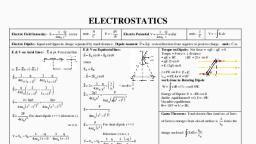
ELECTROSTATICS, 1 Q, vector, 40 r 2, , Electric Field Intensity:- E =, , N, C, , unit:-, , E=−, , dV, dr, , Electric Potential V =, , 1 Q, scalar, 40 r, , unit:-, , J, C, , , , V = − E.dr, , Electric Dipole:- Equal and Opposite charge separated by small distance, Dipole moment P = 2ql vector(direction from negative to positive charge, E & V on Axial Line:- E at pt. P on axial line, , E = EA cos + EB cos , since, , is E = E B + ( −E A ), , EA = EB, , E=, , 1, q, 1, q, −, 40 ( r − l )2 40 ( r + l )2, , E=, , q 1, 1 , −, , , 40 ( r − l )2 ( r + l )2 , , , 2 2qrl, , E=, , 40 ( r2 − l2 ), , 2, , E=, , 2P, 3, , 40r, , =, , E = 2EA cos , 1 q l, l, , cos =, 40 x2 x , x, 2ql, P, E=, =, 3, 40x3, 40 x2 + l2, , E = 2, , (, , 2pr, 40 ( r2 − l ), , 2, , V = VA + VB =, =, , 1, −q, 1, q, +, 40 ( r + l ) 40 ( r − l ), , P, 1, P, V=, 40 ( r2 − l2 ), 4 r2, , 3, , 40 ( r2 + l2 ) 2, , For short dipole r >> l (direction (-), to (+)), , ), , P, , E=, , E=, , P, , 40 ( r3 ), , unit:- C m, , Torque on Dipole:- Net force = +qE – qE = 0, Torque = Force × ⊥ distance, = qE × BC, [BC = 2l × sin θ, = qE 2l sin θ, = E (2ql) sin θ, , E & V on Equitorial line:-, , For short dipole r >> l, , τ = PE sin θ = P E, τmax = PE for θ = 90o, work done in Rotating Dipole, , W=, , d = (1 − cos ) PE, , Energy of Dipole: U = –PE cos θ, Stable equilibrium θ = 0, U= –PE, Unstable equilibrium, Θ = 180o ⇒ U = PE., Gauss Theorem:- Total electric flux (total no. of lines, 1, of forces) emerges from closed surface is, times the, 0, , E.dS = , , qin, , Direction (+) to (-), 1 q, 1 ( −q ), V = VA + VB =, +, =0, 40 x 40 x, , charge enclosed, , E due to charged plane sheet:, , E due to charged Hallow Sphere:, , q, Surface charge density =, A, For non conducting plate charge is on both side, q, 2 E.dS =, 0, , Volume charge density =, , 0, , 0, , E due to long charged wire:, q, Linear charge density =, l, , E.dS = , , qin, 0, , E.dS + E.dS + E.dS = , 1, , 2, , 3, , qin, 0, , For dS2 and dS3 θ = 90, For curved surface dS1 θ = 0, q, q, E dS = ⇒ E ( 2rl ) =, 0, 0, , , , 2EA =, , o, , , , E=, , 2q, q, 1 2, = l ⇒E=, 40 r, 2rl0 40r, , E=, , q, 0, , For conducting sheet E =, , , 0, , * E is independent of distance from the sheet., , Capacitor:- Q = CV unit:- Farad, * C depends on dimensions, Capacitance for parallel plate, Surface charge Density, Q, capacitor, = Q = A, A, Consider || plate capacitor with, area of plate A, capacitance C and Electric field, E = Eair + Edielectric, dist. b/w plates d, Q, Q, =, V Ed, , =, , E=, , , 0, , Potential V = E × d, , Q, =, A, , V =, , for surface charge density, , A, A, C=, = 0, , d, d, 0, , If dielectric with dielectric, constant k is filled b/w the plates., C’ = kC, , , , q, 0, , E=, , 1 q, On surface, 40 R 2, , E=, , 1 q, Outside & E = 0 as q = 0 inside, 40 r2, , Energy of Capacitor, Energy = work done in bringing charge, at potential V, q, dW = V dq = .dq, C, Q, , , , (, , a + b) +, t, 0, k0, , , t, a + b + , 0 , k, , V=, , , t, d − t + , 0 , k, , C=, , 0, , q, E dS =, 0, , Q, , 1, 1 q2 , 1 Q2, U = dW =, q dq = =, C, C 2 0 2 C, , V=, , Now, , qin, , Q, , , , +, 0 k0, , C=, , for charged sheet, , E.dS = , E( 4r2 ) =, , q, , E=, 20 A, 20, , q, V, , Q, A, =, V , t, d − t + , 0 , k, , , , 0, , U=, , 0, , 2, , 1Q, 1, 1, = CV 2 = QV, 2 C 2, 2, , Energy Density (energy per unit volume), 2, 1 0 A (, 1 2, E d), CV, 1, = 2, =2 d, = 0E2, volume, Ad, 2, , Unit of energy density:- J/m3
Page 2 :
CURRENT ELECTRICITY, Electric Current: i =, , A – Area, n – number of free electrons in unit volume, , q, , unit - Ampere, t, i =q/t =, , * Scalar quantity, Drift velocity:- v = u + a, if u = 0 − relaxation time (10, , –14, , eE, m, eV, Vd =, ml, Vd =, , resistivity ρ =, , Current I = neAVd, , eV, I = neA, ml, , eE, m, , (10–5 m/s), , RA, l, , ρ =, , m, ne2, , Also J = E, , s), , Vd = a, Also ma = eE = f a =, , nAle, t, , J=, , I ne 2 A, =, V, ml, , I, = current density (vector), A, , V = IR, as, , V = Exl, , V, ml, =, I ne2 A, V, Mobility = d, E, R=, , Temperature dependence of resistivity, , (m2/sV), , Electric Energy & power, , with increase in temperature, , Colour Coding of Resistor, , Power = Energy / Time = Work done / Time, It is a scalar quantity, , conductors : decrease. inc., , semiconductors; n increase dec, , E = V.I.t = I 2 Rt =, P = V.I = I 2 R =, , V2, t, R, , V2, R, , 1 unit = 1 KWh, , Series combination of resistance:- R = R1 + R2., Parallel combination of resistance:- 1/R = 1/R1 + 1/R2, , Current same, Voltage same, , KIRCHOFF’S LAW, i. i = 0, Junction law, ii. iR = E = 0, Voltage law, , E = V + ir charging, E = V – ir discharging, , Cell in series, , I = nE /nr + R, , Meter Bridge:, , Cell in parallel, , nE, i=, r + nR, , Let Unknown Resistance = X, , R, l, =, X 100 − l, R(100 − R), X=, l, , Wheatstone Bridge:, Balance condition, , P/Q=R/S, , Potential at A & B same at null pt., Resistivity =, , Position of Galvanometer &, battery can be interchanged at null pt., , RA, L, , Meter bridge in most sensitive when null pt. in middle., Potentiometer:, Principle:- If constant current flows through wire of uniform cross section, then drop in directly proportional to length of that portion, Advantage of Potentiometer over voltmeter:E, K = = Potential gradient, 1. Preferred over voltmeter as it give exact reading draw no, L, current, When K1 inserted then E1 = K × L1, 2. Sensitivity increase with increase in length, When K2 inserted then E2 = K × L2, 3. A small P. D can be measured accurately with the help of, E1 L1, potentiometer. The resistance of voltmeter is high but not, =, infinity to work as an ideal voltmeter., E 2 L2, 4. The internal resistance of a cell can be measured with the, help of potentiometer., , When only K1 is inserted then E = K × L1, When K1 and K2 both are inserted then, V = K × L2 = E – r, , l, , r = R 1 − 1, l2
Page 3 :
MOVING CHARGES & MAGNETISM, Magnetic Field:- Produced by magnet, moving charge, Vector quantity. Unit:- Tesla (weber/m2), gauss (maxwell/cm2), IT = 104 G, Oested Experiment:- Current carrying conductor produces magnetic field., Bio Savart Law:- It gives M.F. at a point around, Ampere’s Circuital Law:B.dl = 0i The line integral of magnetic field B for, current carrying conductor., idl sin , any closed circuit is equal to μ0 times current i threading through this closed loop, dB = 0, and this closed loop is called Amperian loop., 4 r 2, B. Due to Infinitely Long Wire:0, = 10−7 TmA−1, Magnetic field at P due to wire, 4, μ0 – Permeability of free space, B.dl = 0i, Direction of B:- Perpendicular to dl and r., B = 0 if sin θ = 0, B dl = 0i, B = max sin θ = 1 θ = 90o, B(2πr) = μ0i, idl r, Vector Form dB = 0, 2l, 4 r 3, B= 0, 4 r, Mag. Field At Centre of Coil:Direction:- Right Hand Thumb Rule curly finger gives field direction if thumb of, idl sin 90o, right hand points current outside, dB = 0, 4, r2, B. due to Solenoid: i, Bdl = B.dl cos , B =, dB = 0 2, dl, 4 r, N – Total Turns, i, = 0 2 (2r ), d, 4 r, B.dl = 0i, i, Ni, B = 0 or B = 0, a, 2r, 2r, b, c, d, a, Direction:- Right Hand Thumb Rule., B.dl + B.dl + B.dl + B.dl = 0 ( Ni ), On Axis of Coil:-, , , , , , , , , , , , , , , , dB =, , 0 idl sin 90o, 4, x2, , B =, =, , dB sin , , 0i ( 2a ) a, ., x, 4x2, , B=, , 0 Nia, , , , , , a, , b, , , , , , c, , d, , b, , B.dl + 0 + 0 + 0 = ( Ni ), 0, , a, , b, , , , B. dl = 0 Ni, , 2, , 2 ( a2 + r 2 ), B. Due to Toroid:- (Closed solenoid), 3/ 2, , B.L = 0 ni ⇒ ∴ B = μ0ni, , n=, , N, L, , (Turns per unit Length), , a, , Force on charge in Electric field:F = qE (both for rest & motion), , Magnetic Field:F = qV Bsin θ (only for moving charge), , B.dl = Ni, 0, , B (2r ) = 0 Ni, 0 Ni , N , n =, , 2 r , 2r , B = 0 ni [at P], , B=, , Lorentz Force:- F = qE + qvB sin θ = q (E + vB sin θ), Cyclotron:- Used to accelerate charge Particles., Force b/w 2 parallel current carrying wire:- Force acting on a due to b., Principle:- The repeated motion of charged particles under mag. & ele., 2i , F = 0 1 i2l sin 90o, field accelerates it. E.F. provides energy while M.F. changes direction., 4 r , Construction:- Dees, Sources, M.F., R.F. Oscillator, 2i i, 1 2, F = 0 1 2 (For unit Length), Working:- Max KE = mvmax, 4 r, 2, By Flemings LHR force is of attraction for same, 2, 1 qBr , direction of current and force of repulsion for opposite, = m, , 2 m , direction of current., 2 2 2, if i1 = i2 = 1 A, r = 1m., 1q B r, K .E. =, 2 m, then F = 2 × 10⁻⁷ N., Current Sensitivity:- Deflection per unit current, Radian, BAN, Moving Coil Galvanometer:- Device Torque Experienced By a, Is = =, to detect & measure electric current., Current loop in uniform, i, C, Ampere, Principle:- Current loop experience, Magnetic Field:Voltage Sensitivity:- Deflection per unit voltage, torque in uniform M.F., τ = F × ⊥ distance, I, BAN, Radian , Construction:- Light Coil, concave, = Bil × bsin θ, Vs = s = =, =, , , R V iR, CR, Volt , magnetic Poles → radial field., τ = Bi A sin θ, Theory:- Deflecting torque, For N Turns:Limitation:- Only charged particles can be acceleration, Application:= Restring force (torque), τ = BiNa sin θ, For circular path:For nuclear, B × i × N × A × sin θ = CØ, reaction & other, mv, mv2, (θ = 90o) as field is radial, = qvB ⇒ r =, ⇒r∝v, research purpose., r, qB, C, ∴ B AiN = CØ ⇒ i =, ABN, 1 q 2 B2r 2, K .E. =, 2 m, Time period = Distance / Velocity = 2πr / v ⇒ T = 2πm / qB, Frequency of Revolution:- f = 1/T = qB/2πm
Page 4 :
Conversion of Galvanometer into Ammeter:(i – ig)S = ig.G, ig .G, S =, i − ig, , Conversion Into Voltmeter:- By connecting high resistance in series, {For Ideal voltmeter, R = ∞}, V = ig ( R + G ), V (, = R + G), ig, , {For Ideal Ammeter R = 0}, , ELECTROMAGNETIC INDUCTION (E.M.I), The phenomena of producing induced current due to change in magnetic flux is called electromagnetic induction., Faraday Law:- (i) Change in magnetic flux induces current which last till there is change., −d , (ii) e =, dt, Lenz’s Law:- Induce current opposes the factor due to which it is produced., Method of producing emf:acc. to law of conservation of energy., − d − dBAcos , e=, =, dt, dt, Induced current / charge:−d , e −d dq −d , e=, ,i = =, , =, dt, R Rdt dt Rdt, −d , dq =, R, Motional emf:- The emf induced due to motion of a conductor in M. field., Motional emf:- e =, , −d , dt, , Rotating rod:- e =, , =, , − dB.A, dt, , e=, , − dBA, dt, , =, , − BdA − Bldx, =, dt, dt, , e=, , BdA, dt, , e = − Bvl, Direction = Anticlockwise, Bvl, Force:- i =, R, Bvl , F = Bil = − B , l, R , , −d , dt, , BL2, 2, , 1, 1, e = BL2 or e = BR2, 2, 2, No. of spokes is increased emf remain same., , Eddy Current:- The circulating induced, current in a oscillating metallic block kept in, magnetic field. In can be reduced by using, laminated core, or cutting slots in block., Application:(i) Magnetic brakes, (ii) Induction furnace, (iii) Dead beat galvanometer, , e=, , − B2vl 2, R, Power:- P = Fv, F=, , − B2v2l 2, R, Self – Induction:- Change in current in a coil, induced, current is produced which opposes the change in same coil., P=, , Unit:- L = 1 Henry (H), Dimension Formula:- [ML2T–2A–2], Solenoid:ϕ = Li, ϕ = BAN = (μ0niA) × N, Li = μ0n2 × i × A × l, (n = N/l), L = μ0n2Al, , Mutual – Induction:- when the change in current, in primary coil induces current in secondary coil., ϕ∝i, ϕ = Mi, Unit – Henry, ∈0 = Farad/m, μ0 = Henry/m, Solenoid:- B2 = μ0n2i2, ϕ = B2AN1, ϕ = (μ0n2i2)AN1, ϕ = Mi2, Mi2 = μ0n1n2Ali2, M = μ0n1n2Al, , *No. of turns is double than inductance, become four times ( L ∝ n2)., Electrical Resonance:1, 1, F=, 2 LC, Power in A.C. circuit:1, P = V0i0 cos , 2, V i, P = 0 0 cos , 2 2, , P = VRMS iRMS Cos , R, , Cos = Z
Page 5 :
MAGNETISM & MATTER, Properties of Magnet:, 1. Magnets have north pole and south pole., 2. Likes poles repel & unlike attract each other., 3. Freely suspended magnet rests in N – S direction., 4. Monopole do not exist., 5. Mag. Length is eq to 0.84 times of their geometric, length., Magnetic Dipole Moment: N 2l → S, M = m2l, unit: Am2, m → pole Strength., M → Magnetic Dipole Moment, M. Due to Current Loop: When current is passed, through a loop it, behaves like a magnet. (M = iA) =, current × Area, M = NiA, ⸫ M=, , q, evr, ( r) 2 =, t, 2, , {for e-, v = 2r/t}, , Magnetic Dipole Moment of a revolving:, , q, evr, {for e-, v = 2r/t}, M = iA = ( r 2 ) =, t, 2, , Permanent Magnets are made up of steel:, Hysteresis Loop / curve: The graph plotted b/w, external field (H) & mag. induction (B) is called “BH, curve ‘or hysteresis Loop., Energy Loss: Work done (energy loss) in, magnetization and demagnetization is eq. to area of, BH curve., Elements of Earth’s magnetic field:, 1. Angle of Dip: Angle b/w horizontal line & mag., meridian as a freely suspended magnet., 2. Angle of Declination: Angle b/w geographical, meridian & mag. meridian is called Angle of, Declination, 3. Horizontal Intensity of Earth Mag., The horizontal component of to. Earth’s field at any, point is called horizontal intensity, , Magnetic Material:, Paramagnetic, 1. odd no of e–, in outer most, orbit &, possess net, dipole, moment., , Diamagnetic, 1. Even no of, e– and, possess net, dipole, moment is 0., , Ferromagnetic, 1., Ferromagnetic, materials, have some, unpaired, electrons so, their atoms, have a net, magnetic, moment. They, get their strong, magnetic, properties due, to the presence, of magnetic, domains., , 2. Aligns || to, field & get, weakly, magnetized, along ext., field., , 2. Align ⊥, to ext. field., , 2. When, a magnetizing, force, is applied, the, domains, become aligned, to produce a, strong magnetic, field, within the part., , 3. Mag. field, pass through, substance, , 3. Mag. field, repelled by, substance., , 3. Temp. at, which, ferromagnetic, substance, becomes, paramagnetic, called curie, Temperature., , BV Bsin , 2, =, = tan , B2 = (BH ) 2 + ( BV ), BH Bcos , , B = BH 2 + BV 2, , Magnetic Field of Earth:, Magnetic Field Intensity due to magnetic Dipole:, , 0 2M, 4 r 3, M, 2. On Equatorial line: B = 0 3, 4 r, 1. On Axial line: B =, , Torque Acting on dipole in Mag. field:, , = f dis. = mB2 l sin = m2 lBsin, = MBsin, , ⸫, , = MBsin , , →Torque is ⊥ to mag. field and mag. dipole, moment (M), → max = MB (sin = 1), = 90° {Due to torque, rotation motion or liner. }, → min = 0 = (sin = 0) , = 0, Work done in Rotating the Dipole:, W = MB [cos1 – cos2], , 4.Increase, with decrease, in temp., Electromagnets: Are prepended by passing electric, current in a solenoid. The magnet lasts till the current, is passed., It can be increased by:, 1. Increasing number of turns., 2. Increasing current., 3. using soft iron core., , 4. Increase, with increase, in temp
Page 6 :
ALTERNATING CURRENT (A.C), TRANSFORMER: - It is a device use the, change AC voltage., Principle: It is based on principle of mutual, induction., Construction: two coil primary & secondary, Step up: Increase voltage (k>1) and decrease, current., Step down: decrease voltage (k < 1) and, increase current., , A.C. Generator :- It is a device which convert mechanical, energy into electrical energy., Principle: It is based on principle of electromagnetic, induction., Construciton:, (i) Arumature coil., (ii) Field magnet, (iii) Slip ring, (iv) Brushes ., , V, , ip, N, Theory: s = S = = K , Vp N p is, , , − d, e=, dt, – dBA cos t, e=, dt, , , , output, 100% , =, input, , , , Alternating Current: D.C – Direction & magnitude are fixed., A.C – Change in both magnitude and direction., , , HALF– CYCLE: Vavg. =, , 0, , 1, , Vavg . =, Vav =, , 1, , Vav =, , V sin d, , , , , , Vav =, , e = BA(–ωsinωt), e = BAN ωsin ωt, emax = e0 = BANω, e = e0sinωt, , V, , , , 0, , 0, , −V0 cos 0, , , , −V0, , cos − cos 0, , 2V0, , or Iav =, , , , , , Vav =, , Full Cycle:, , Vavg =, , 1, 2, , 2I0, , , , 2, , 1, 2, , V d, 0, , 2, , V sin d, 0, , 0, , V0, 2, ( − cos )0, 2, V, V, = 0 ( − cos 2 + cos ) = 0 ( −1 + 1), 2, 2, =0, or Iavg = 0, , Vavg =, Pure Resistive Circuit: (Circuit containing, resistance), , V V0, =, sin t, R R, , A.C. Circuit: Pure capacitor circuit (circuit containing capacitor only), Q = CV, , d, dV, =C, dt, dt, , ,, , i=C, , d, (V0 sinωt), dt, , i = CV0, , d, sin t, dt, , Vavg, , Vavg, , Root mean Square:, , i = i0 sin t V = V0 sin t , V, I, Resistance is independent frequency of A.C., , 1, 2, , VRMS =, V 2 RMS, ωCV0 cosωt, , V0, sin( t + / 2), 1, C, V, i= 0, 1, C, i=, , 1, =, 2, , V 2 RMS =, , VRMS =, , 2, , V, , 2, , 0, , 2, , V, , 2, , =, , 0, , 2, , V, , 2, 0, , V0, 2, , Series LCR circuit: -, , Ldi, dt, +Vdt, di =, L, V0 sin tdt, di =, L, V0, V, di = L sin t dt = L0 ( − cos t ), , v2 = VR2 + (Vc − Vc)2, , sin 2 d, , 0, , V02, V2, ( ) = 0, 2, 2, , Pure inductive circuit:, V = V0 sin ωt, , V=, , 1, 2, , or, , 1 − cos 2 , 2, sin =, , 2, , , I0, IRMS =, 2, , (IZ)2 = (IR) 2 + (IX L − IXC ) 2, Z = R 2 + (XL − XC )2, , 1 , , Z = R 2 + L −, , C , , , 2, , 1 , , L −, , C, ⇒ tan = XL − XC , tan =, , R, R , , , ,



 Learn better on this topic