Page 1 :
BLOOD GROUPS
Page 2 :
Human Blood Groups, • RBC membranes have glycoprotein, antigens on their external surfaces, • These antigens are:, • Unique to the individual, • Recognized as foreign if transfused into, another individual, • Presence or absence of these antigens is, used to classify blood groups
Page 4 :
TYPES, ABO SYSTEM, M&N SYSTEM, Rhesus [Rh]
Page 6 :
Karl Landsteiner, • The Nobel Prize in, Physiology or Medicine, 1930
Page 7 :
Landsteiner’s Law, 1. If an agglutinogen is present in the RBC of an, individual, the corresponding agglutinin must, be absent from the plasma., 2.If the agglutinogen is absent in the individuals, RBC the corresponding agglutinin must be, present in the plasma.

Page 8 :
Exception for the Second part of the, Lansteiner’s Law, • Rh System and MN System
Page 9 :
ABO Blood Groups, • Based on the presence or absence of, two antigens, •Type A, •Type B, • The lack of these antigens is called, type O
Page 10 :
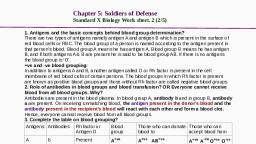
• Type A--- individuals have A antigens, and anti-B antibodies, • Type B--- individuals have B antigens, and anti-A antibodies, • Type AB ---individuals have A and B, antigens and no antibodies, • Type O ----individuals have no antigens, and anti-A and anti-B antibodies
Page 12 :
Inheritance of Blood Groups
Page 14 :
Determination of Blood Groups
Page 15 :
Blood Typing, • When serum containing anti-A or anti-B, agglutinins is added to blood, agglutination, will occur between the agglutinin and the, corresponding agglutinogens
Page 17 :
Cross matching, , • 2types:, • Major Cross matching -donors cell, suspension is matched with, recipient plasma, • Minor Cross matching -donors, plasma with recipient‘s cell, suspension
Page 18 :
Rhesus Blood Group
Page 19 :
Rh Blood Groups, , • Named because of the presence, or absence of Rh antigens, (agglutinogen D), • Problems can occur in mixing Rh+, blood into a body with Rh– blood
Page 20 :
• Rh positive- individuals have the Rh, antigen, • Rh negative- individuals do not have, the Rh antigen, • Rh antibodies are only made when, an Rh negative person comes in, contact with Rh positive blood, antigens
Page 21 :
• Discovery of Rh Factor from Rhesus monkey, • Rh antigen (D-antigen) and its antibody is, anti-D, • Rh antibodies are IgG which can cross, placenta, • Genotype DD and Dd are Rh positive, • dd Rh negative
Page 22 :
Rh Incompatibility
Page 26 :
During second Pregnancy
Page 31 :
Exchange transfusion, • Removing small amounts of infants blood and, replacing it will compatible Rh negative blood., So Rh positive RBC’S are removed from the, circulation.
Page 32 :
Prevention of Hemolytic disease, • Single dose of anti-Rh antibodies (antibodies, against Rh antibody), – Rh immune globulins.
Page 33 :
Imporatance of blood grouping, , • For blood transfusion, • Important in medicolegal aspects, • Geographical distribution of races, • Disputed paternity