Page 1 :
EXTREME EDUCATION, , National Income Accounting Important, Questions for class 12 economics Methods, of Calculating National Income, 1. Methods of Calculating National Income, (i) Income method, (ii) Expenditure method, (iii) Product method or value added method or output method, 2. Income Method By this method, the total sum of the factor payments received during, a given period is estimated to obtain the value of Domestic Income. Depending on the, way, the income is earned., It can be classified into following components:, (i) Compensation of employees, (ii) Operating surplus (rent, profit and interest), (iii) Mixed income of self-employed, 3. Computation of National Income (By Income Method), , 4. Precautions While Using Income Method, (i) Income from illegal activities like smuggling, theft, gambling, etc, should not be, included., (ii) Corresponding to production for self consumption, the generation of income of, economy to be taken into account., (iii) Brokerage on the sale/purchase of shares and bonds is to be included., , (iv) Income in terms of windfall gains should not be included.
Page 2 :
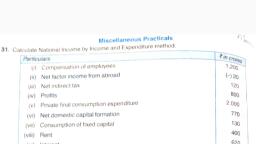
EXTREME EDUCATION, (v) Transfer earnings like old age pensions, unemployment allowances, scholarships, pocket, expenses, etc, should not be included., , 5. Expenditure Method By this method, the total sum of expenditures on the purchase, of final goods and services produced during an accounting year within an economy is, estimated to obtain the value of domestic income., 6. Final Expenditure It is the expenditure on the purchase of final goods and services, during an accounting year. It is broadly classified into four categories:, (i) Private final consumption expenditure., (ii) Government final consumption expenditure., (iii) Investment expenditure or gross domestic capital formation., (iv) Net exports, i.e. difference between exports and imports during an accounting year., 7. Computation of National Income (By Expenditure Method), , 8. Precautions While Using Expenditure Method, (i) Only final expenditure is to be taken into account to avoid error of double counting., (ii) Expenditure on second hand goods is not to be included., (iii) Expenditure on transfer payments by the government is not to be included., (iv) Imputed value of expenditure on goods produced for self consumption should be, taken into account., (v) Expenditure on shares and bonds is not to be included in Total Expenditure., 9. Value Added Method/Product Method/Output Method By this method, the total value, of all the final goods and services produced in an economy during a given time period, are estimated to obtain the value of domestic income., 10. Computation of National Income (By Value Added Method)
Page 3 :
EXTREME EDUCATION, , 11. Precautions While Using Value Added Method, (i) The value of intermediate goods should not be included., (ii) Purchase and sale of second hand goods should not be included., (iii) Imputed value of self-consumed goods should be included, but self-consumed, services should not be included., (iv) Own account production should be included., (v) Commission earned on account of sale and purchase of second hand goods is, included., (vi) If sales are given, then exports are not included separately., (vii) If intermediate purchases are given, then imports are not included., , Previous Years Examination Questions, 3 Marks Questions, 1. Calculate sales from the following data (All India 2013), , –
Page 4 :
EXTREME EDUCATION, , 2. Calculate sales from the following data, , (Delhi 2013), , 3. Calculate sales from the following data, , (Delhi 2013)
Page 5 :
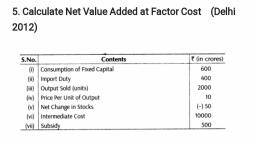
EXTREME EDUCATION, , 4. Calculate Gross Value Added at Factor Cost (Delhi 2012), , 5. Calculate Net Value Added at Factor Cost, , (Delhi 2012)
Page 6 :
EXTREME EDUCATION, , —, , 6. Find Net Value Added at Market Price, , (Delhi 2012)
Page 7 :
EXTREME EDUCATION, , 7. Find Net Value Added at Market Price, , (All India 2012), , 8. Find Gross Value Added at Factor Cost (All India 2012)
Page 8 :
EXTREME EDUCATION, , 9. Find out Net Value Added at Factor Cost (All India 2012), , 10. From the following data calculate Net Value Added at Factor, Cost, 2011), , (Delhi
Page 9 :
EXTREME EDUCATION, Ans. Net Value Added at Factor Cost (NVAFC) = Value of Output (Sales + Change in, Stock)-Purchase of, Intermediate Goods – Consumption of Fixed Capital – Indirect Taxes, = 3500 + 50 – 2000 – 500 – 350, = 3550-2850 = Rs. 700 crore, 11. From the following data calculate Net Value Added at Factor Cost, (All India 2011), , Ans. Net Value Added at Factor Cost (NVAFC) = Sales + Change in Stock (Closing StockOpening Stock)- Purchase of Intermediate Goods – Consumption of Fixed Capital –, Indirect Tax, = 500+ (80-60)-350-90-50, = 520-490 = Rs. 30 crore, 12. From the following data calculate Net Value Added at Factor, Cost, 2011 c), , (Delhi, , Ans. Net Value Added at Factor Cost (NVAFC) = Value of Output (Sales + Change in, Stock) – Purchase of Intermediate Goods – Depreciation – Net Indirect Taxes
Page 10 :
EXTREME EDUCATION, = 750+ (-30)-500-60-100, = 750 – 690 = Rs. 60 crore, 13. Calculate value of output from the following data (Delhi 2008), , Ans. Value of Output = Net Value Added at Factor Cost (NVAFC) + Depreciation, + (Excise Duty – Subsidy) + Intermediate Consumption, = 100+10+ (20-5) + 75, = 185+15, = Rs. 200 crore, 14. Calculate intermediate consumption from the following data, (Delhi 2008), , Ans. Intermediate Consumption = Value of Output – Net Value Added, at Factor Cost (NVAFc)+ Depreciation + (Sales Tax-Subsidy), = 200-[80+ 20+ (15 -5)], = Rs. 90 lakh, 15. Calculate sales from the following data, , (Delhi 2008)
Page 11 :
EXTREME EDUCATION, , Ans. Sales = Net Value Added at Factor Cost (NVAFC)+ Intermediate Consumption –, Change in Stock+ Indirect Tax + Depreciation, = 300+ 200-(-50)+ 20+ 30, = Rs. 600 lakh, 16.Calculate Net Value Added at Factor Cost from the following data, (All India 2008), , Ans. Net Value Added at Factor Cost (NVAFC) = Value of Output (Sales + Change in, Stock) – Intermediate Cost- Depreciation – Net Indirect Tax, = [140+ (-10)]-90-20-(-5), = 140-110 + 5, = 30 + 5 = Rs. 35 lakh, 17. Calculate Gross Value Added at Factor Cost from the following data, (All India 2008)
Page 12 :
EXTREME EDUCATION, , Ans. Gross Value Added at Factor Cost (GVAFC) = Value of Output (Sales + Change in, Stock)- Purchase of Raw Materials – Indirect Tax (Sales Tax + Excise Duty), = [400+ (-40)]-250-(20+ 30), = 400 – 340 = Rs. 60 lakh, 18.Calculate Net Value Added at Factor Cost from the following data, (All India 2008), , Ans. Net Value Added at Factor Cost (NVAFC) = Value of output (Sales + Change in, Stock) – Purchase of Raw Materials – Consumption of Fixed Capital + Subsidies, = [700 + (-30)] – 400 -20 + 50, = 750-450 = Rs. 300 lakh, 19. Calculate Net Value Added at Factor Cost from the following data, (All India 2008)
Page 13 :
EXTREME EDUCATION, , Ans. Net Value Added at Factor Cost (NVAFC) = Value of Output (Sales + Change in, Stock)- (Purchase of Raw Material + Import of Raw Material) – Consumption of Fixed, Capital + Subsidies, = (800 + 50) – (400 +100) – 40 + 30, = 880-540, = Rs. 340 lakh, 20. From the following information about firm X, calculate Net Value Added at Factor, Cost, (Delhi 2008 C), , Ans. Net Value Added at Factor Cost (NVAFC) = Value of Output [Sales + Change in Stock, (Closing Stock – Opening Stock)] – Purchase of Raw Material – Depreciation (Gross, Capital Formation – Net Capital Formation) + Subsidies, = [800 + (40 – 50)] – 500 – [200 -180] + 60, = 790-500-20+60, = 850-520, = Rs. 330 lakh, 21. From the following data calculate Net Value Added at Factor, Cost, 2008 C), , (Delhi
Page 14 :
EXTREME EDUCATION, , Ans. Net Value Added at Factor Cost (NVAFC) = Sales + Change in Stock – Purchase of, Raw Materials- Consumption of Fixed Capital + Subsidies, = 500 + (-20) – 250 -40 + 30, = 530-310, = Rs. 220 lakh, 4 Marks Questions, 22.Giving reason, explain how should the following be treated in estimating, National Income (Delhi 2012), (i) Expenditure on fertilisers by a farmer., (ii) Purchase of tractor by a farmer, Ans. (i) Expenditure on fertilisers by a farmer is ‘not included’ in the estimation of, National Income as it is an intermediate consumption as fertilisers are meant for further, production., (ii) Purchase of a tractor by a farmer is included in the estimation of National Income as, it is capital formation or investment expenditure., 23.Giving reason, explain how should the following be treated in the estimation, of National Income (Delhi 2012), (i) Payment of bonus by a firm., (ii) Payment of interest on loan taken by an employee from the employer., Ans. (i) Payment of bonus by a firm is not Included in the estimation of National Income, as it is not a part of factor income., (ii) Payment of interest on loan taken by an employee from the employer will ‘not’ be, included in the estimation of National Income as it will be treated as transfer income,, also loan is taken for consumption purpose., 24. Giving reason, explain how should the following be treated in estimation, of National Income (Delhi 2012)
Page 15 :
EXTREME EDUCATION, (Interest paid by banks on deposits by individuals., (ii) National debt interest., Ans. (i) Interest paid by banks on deposits by individuals should be included in, estimation of National Income as it will be treated as factor income., (ii) National debt interest should ‘not’ be included in estimation of National Income as it, is assumed that government borrows for consumption and hence, it is treated as, transfer income., 25.Giving reason, explain how should the following be treated while, estimating National Income (All India 2012), (i) Expenditure on free services provided by government., (ii) Payment of interest by a government firm., Ans. (i) Expenditure on free services provided by government should be Included’ in the, estimation of National Income, as it is a final expenditure of the government., (ii) Payment of interest by a government firm should ‘not’ be included in the estimation, of National Income, as it is a transfer payment., 26.How should the following be treated while estimating National Income?, Give reasons. (All India 2012), (i) Expenditure on education of children by a family., (ii) Payment of electricity bill by a school., Ans. (i) Expenditure on education of children by a family is ‘included’ in the estimation, of National Income as it is a part of final consumption expenditure by the household., (ii) Payment of electricity bill by a school is ‘included’ in the estimation of National, Income as it is a part of final consumption expenditure., 27. Giving reason, explain the treatment assigned to the following while, estimating National Income, (All India 2011), (i) Family members working free on the farm owned by the family., (ii) Payment of interest on borrowings by general government., Ans. (i) Family members working free on the farm owned by the family should included’, as it is a part of mixed income., (ii) Payment of interest on borrowings by general government should ‘not’ be included in, the estimation of National Income as it is not mentioned and not clear whether the, government has borrowed for consumption or production., 28.Giving reason, explain the treatment assigned to the following while, estimating National Income (All India 2011)
Page 16 :
EXTREME EDUCATION, (i) Social security contributions by employees., (ii) Pension paid after retirement., Ans. (i) Social security contributions by employees is ‘included’ in the estimation of, National Income, as it is a part of compensation of employees and it is an earned, income., (ii) Pension paid after retirement is ‘not’ included in the estimation of National Income, as it is a kind of deffered payment to employees., , 29.Giving reason, explain how are the following be treated in estimation of, National Income by income method, (All India 2010), (i) Interest paid by banks on deposits., (ii) National debt interest., Ans. (i) Interest paid by banks on deposits will be ‘included’ while estimating National, Income by income method, as it is an income earned by depositors and bank uses, these deposits for commercial purposes., (ii) National debt interest will ‘not be included’ while estimating National Income by, income method, as the government takes loan for both productive and non-productive, activities., 30.Giving reason, explain how are the following treated in estimating National Income, method (Delhi 2010 c), (i)Interest on a car loan paid by an individual., (ii) Interest on a car loan paid by a government owned company., Ans. (i) Interest on a car loan paid by an individual should not be ‘included’ while, estimating National Income as the loan is taken for consumption purpose., (ii) Interest on a car loan paid by a government owned company should included while, estimating National Income as it is a part of government final consumption expenditure., 6 Marks Questions, 31. Calculate Net Domestic Product at Factor Cost and Net National, Disposable Income from the following (Delhi 2014)
Page 17 :
EXTREME EDUCATION, , 32. Giving reason explain how should the following be treated in estimating, Gross Domestic Product at Market Price ? (Delhi 2014), (i) Fees to a mechanic paid by a firm., (ii) Interest paid by an individual on a car loan taken from a bank., (iii) Expenditure on purchasing a car for use by a firm, Ans. (i) it is included in the GDPMP, as it is a part of government final consumption, expenditure., (ii) It is not included in the estimation of GDPMP because loans are not used for, production purpose., (iii) It is included in the estimation of GDPMP because it is a part of final expenditure by a, firm., 33. Calculate Net National Product at Factor Cost and private income from the, following (Delhi 2014)
Page 18 :
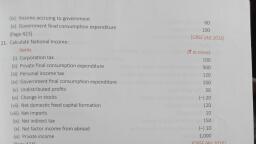
EXTREME EDUCATION, , 34. Calculate National Income and Net National Disposable Income from the, following (All India 2014), , Ans. (a) National Income (NNPFc)= Private Final Consumption Expenditure +, Government Final Consumption Expenditure + Gross Domestic Fixed Capital Formation, + Net Change in Stocks – Net Imports – Depreciation – Net Indirect Tax – Net Factor, Income to Abroad, = 500 + 100 +200 +50-40-70- 120- (- 10)
Page 19 :
EXTREME EDUCATION, = 860 – 230, =Rs. 630 arab, (b) Net National Disposable Income (NNDI), = NNPFc + Net Indirect Tax – Net Current transfer to Abroad, = 630 + 120 – 30 = Rs. 720 arab, 35. Calculate Net National Product at Market Price and Gross National Disposable, Income from the following: ( All India 2014), , 36. How should the following be treated in estimating National Income of a country?, You must give reason for your answer., (i) Taking care of aged parents, (ii) Payment of corporate tax, (iii) Expenditure on providing police services by the government, Ans. (i) It is not included in the estimation of National Income as it does not involve any, production of goods and services., (ii) It is included in the estimation of National Income as it is a part of profit.
Page 20 :
EXTREME EDUCATION, (iii) It is included in the estimation of National Income as it is a part of government final, consumption expenditure., 37. Calculate Net National Product at Factor Cost and Gross National Disposable, Income from the following: (Delhi 2014), , 38. Calculate National Income and Gross National Disposable Income from the, following: (Delhi 2014)
Page 21 :
EXTREME EDUCATION, , Ans. (a) National Income (NNPFC)= Private Final Consumption Expenditure +, Government Final Consumption Expenditure + Net Domestic Capital Formation – Net, Imports – Net Indirect Tax- Net Factor Income to Abroad, = 600 + 100 + 110-20-(120-20)-5, = 810- 125 = Rs. 685 arab, (b) Gross National Disposable Income (GNDI), = NNPFC + Net Indirect Tax + Consumption of Fixed Capital – Net Current Transfer to, Abroad = 685 + (120-20) + 35 -(- 15), = Rs. 835 arab, 39.Calculate Net Value Added at Factor Cost form the following data:, (Compartment 2014)
Page 22 :
EXTREME EDUCATION, , 40. Calculate Personal Disposable Income:, , (Compartment 2014), , Ans. Private Income = Net Domestic Product at Factor Cost Accuring to Private Sector +, NFIA + Current Transfer from Government + National Debt Interest + Net Current, Transfers from Abroad, = 700+ (-20)+ 80+ 60+ 10, –, = Rs. 830 crore, Personal Disposable Income = Private Income – Corporation Tax – Corporate Savings –, Direct Tax, = 830-40-150-70 = Rs. 570 crore, 41. Calculate National Income: (Compartment 2014)
Page 23 :
EXTREME EDUCATION, , Ans. National Income (NNPFC), = Government Final Consumption Expenditure + Private Final Consumption Expenditure, + Net Domestic Capital Formation + Net Exports – NIT + NFIA, = 300 + 600 +150 + 50-90 + (-20), = Rs. 990 crore, 42. How should the following be treated while estimating National Income? (Foreign, 2014), You must give reason in support of your answer., (i) Bonus paid to employees., (ii) Addition to stocks during a year., (iii) Purchase of taxi by a taxi driver., Ans. (i) No, it is not included while estimation of National Income as it is not a factor, income., (ii) Yes, it is included while estimation of National Income as it is considered as a, change in stock during the year., (iii) Yes, it is included while estimation of National Income as it is an investment, expenditure by the producer., 43. Calculate Gross National Product at Market Price and Net National, Disposable Income from the following: (Foreign 2014)
Page 24 :
EXTREME EDUCATION, , 44. Calculate National Income from the following data, , Ans. National Income (NNPFC), , (Delhi 2013)
Page 25 :
EXTREME EDUCATION, = Private Final Consumption Expenditure + Government Final Consumption Expenditure, + Gross Domestic Capital Formation – Net Imports – Net Indirect Taxes – Consumption, of Fixed Capital + Net Factor Income from Abroad, = 900 + 400 + 250-30-100-20 + (-40), = 1550 – 190 = Rs. 1360 crore, 45. Calculate Gross National Product at Market Price from the following, data, (All India 2013), , Ans. Net Domestic Product at Factor Cost(NDPFC) = Compensation of Employees +, Interest + Rent+ Profits + Mixed Income of Self Employed, = 2000 + 500 + 700 + 800 + 1500, = Rs. 5500 crore, Gross National Product at Market Price (GNPmp) = NDPFC + Net Indirect Taxes – Net, Factor, Income to Abroad + Consumption of Fixed Capital, = 5500 + 250- 150 + 100 = 5850- 150, = Rs. 5700 crore, 46. Find out, (a) Net National Product at Market Price and, (b) Gross National Disposable Income from the following data
Page 26 :
EXTREME EDUCATION, , 47.Find out, (i) National Income, (ii) Net National Disposable Income, , ., (Delhi 2012)
Page 27 :
EXTREME EDUCATION, , 48.Find out, (i) Gross National Product at Market Price, (ii) Net Current Transfers from Abroad (All India 2012)
Page 28 :
EXTREME EDUCATION, , 49.Find out, (i) National Income, (ii) Net National Disposable Income, , (All India 2012)
Page 29 :
EXTREME EDUCATION, , 50. Calculate, (a) Net Domestic Product at Factor Cost and, (b) Private income from the following data (All India 2011), , Ans. (a) Net Domestic Product at Factor Cost (NDPFC) = Wages and Salaries + Rent +, Interest Paid byProduction Units + Corporation Tax + Dividends + Undistributed Profits, + Social Security Schemes by Employers, = 1000+100 + 130 + 50+100 + 20+200 = Rs. 1600 crore, (b) Private Income = NDPFC – Domestic Product Accruing to Government, – Net Current Transfers to Abroad + National Debt Interest + Current Transfers by
Page 30 :
EXTREME EDUCATION, Government + Net Factor Income from Abroad, = 1600-300-(-20)+ 30+ 40+0, = Rs. 1390 crore, 51. Calculate, (a) Net National Product at Market Price, (b) Private Income from the following data, , (All India 2011), , 52. Calculate, (a) Gross National Product at Market Price and, (b) Personal Disposable Income from the following data (All India 2011)
Page 31 :
EXTREME EDUCATION, , 53.Calculate, (a) Gross Domestic Product at Factor Cost and, (b) Net National Disposable income from the following data, (All India 2011)
Page 32 :
EXTREME EDUCATION, , Ans. (a) Gross Domestic Product at Factor Cost (GDPFC) = Government Final, Consumption Expenditure, + Private Final Consumption Expenditure + Gross Domestic Capital Formation – Net, Imports – Net Indirect Tax, =100 + 500+160 -20-130, =Rs. 610 crore, (b) Net National Disposable Income = GDPFC+ Net Indirect Tax – Net Factor Income to, Abroad – Net Current Transfers to Abroad – Depreciation, =610 +130-30 -10-40, =Rs. 660 crore, 54. Calculate National Income and Gross National Disposable Income from the, following (Delhi 2011)
Page 33 :
EXTREME EDUCATION, Ans. (a) National Income (NNPFC) = Private Final Consumption Expenditure, + Government Final Consumption Expenditure + Net Domestic Fixed Capital Formation, + Change in Stock + Consumption of Fixed Capital- Net Imports – Net Indirect Tax – Net, Factor Income to Abroad, = 500 +200+120 + (-20) + 20-30 -100 -(-10) -20, = 700+100+10-130 = Rs. 680 crore, (b) Gross National Disposable Income (GNDI) =NNPFC+ Net Indirect Taxes +, Consumption of Fixed Capital – Net Current Transfer to the Rest of the World, = 680 + 20+100- (-5) = Rs. 805 crore, 55. Calculate Net National Product at Market Price and Gross National Disposable, Income., (Delhi 2011), , 56.Calculate, (i) Gross National Product at Market Price, (ii) Net National Disposable Income, (All India 2011)
Page 34 :
EXTREME EDUCATION, , 57. Calculate ., (i) National Income, (ii) Gross National Disposable Income from the following data, (All India 2011)
Page 35 :
EXTREME EDUCATION, , Ans. (a) National Income (NNPFC) = Private Final Consumption Expenditure+, Government Final Consumption Expenditure + Net Domestic Capital Formation +, Change in Stock – Net Exports – Net Indirect Taxes – Net Factor Income to Abroad, = 700+100+120+ (-20) -80-10, = 920-110 = Rs. 810 crore, (b) Gross National Disposable Income (GNDI) =NNPFC + Consumption of Fixed Capital +, Net Indirect Taxes – Net Current Transfers to Abroad, = 810 + 60 + 80-(-10), = Rs. 960 crore, 58.Calculate, (a) Gross Domestic Product at Market Price and, (b) Factor Income from Abroad from the following data (All India 2010)
Page 36 :
EXTREME EDUCATION, , 59. How will you treat the following while estimating National Income of India?, (i) Dividend received by an Indian firm from its investment in shares of a foreign, company., (ii) Money received by a family in India from relatives working abroad., (iii) Interest received on loans given to a friend for purchasing a, car., (Delhi, 2010), Ans. (i) Dividend received by an Indian firm from its investment in shares of a foreign, company will be included in the estimation of National Income, as dividend is a part of, profit and treated as factor income from abroad which is added to domestic income.
Page 37 :
EXTREME EDUCATION, (ii) Money received by a family in India from relatives working abroad will not be, included while estimating National Income, as it is merely remittance from abroad and, no flow of goods or services are involved., (iii) Interest received on loans given to a friend for purchasing a car will not be included, in the estimation of National Income as loan is given for consumption purpose., 60. How will you treat the following while estimating National Income of India?, Give reasons for your answer., (All India 2010), (i) Dividend received by a foreigner from investment in share of an Indian company., (ii) Profits earned by a branch of an Indian bank in Canada., (iii) Scholarship given to Indian students studying in India by a foreign company., Ans. (i) Dividend received by a foreigner from investment in shares of an Indian, company will be deducted from National Income as it is factor income to abroad., (ii) Profits earned by a branch of Indian bank in Canada is factor income received from, abroad. It is included in National Income., (iii) Scholarship given to Indian students studying in India by a foreign firm will not be, included while estimating National Income, as it is a transfer payment., 61.Explain the problem of double counting in estimating national income, with the help, of an example. Also explain, two alternative ways of avoiding the problem. While, estimation of National Income., (All India 2010), Ans. The counting of the value of a commodity more than once while estimation of, National Income is called double counting. This leads to over estimation of the value of, goods and services produced. In other words, problem of double counting arise when, the value of intermediate goods is also added in total output, e.g. suppose if we include, the price of wheat, then the price of floor and finally price of bread. It will lead to the, problem of double counting. As the price of wheat is included three time and that of, floor two times., The, problem of double counting can be avoided by the following two alternative ways:, (i) Final output or final product method In this method, only final products (goods and, services) are added to obtain the GDP. Intermediate products are ignored. Here, final, products are only those products which are ready for end use or consumption by their, final users (consumers or producers)., (ii) Value added method This approach or method is a way to avoid the problem of, double counting. The value added by a firm is the difference between value of output, and the value of intermediate products of each firm of the country. The sum of Value, added’ by all the firms gives us the GDP of the country. Hence, the problem of double, counting is avoided., Value Added by a Firm = Value of Output of the Firm – Intermediate Consumption of the, Firm.
Page 38 :
EXTREME EDUCATION, 62.Calculate (a) Gross Domestic Product at Market Price and, (b) Factor Income to Abroad from the following data (All India 2011), , 63. Calculate National Income by the, (a) Expenditure method and, (b) Production method from the following data (Delhi 2011)
Page 39 :
EXTREME EDUCATION, , Ans. (a) By Expenditure Method, National Income (NNPFC) = Private Final Consumption Expenditure + Government, Final Consumption Expenditure + Net Domestic Fixed Capital Formation + Change in, Stocks – Net Imports – Net Indirect Taxes + Net Factor Income from Abroad, = 750 +150 + 220 + (-20) -50 -120 + 20 = 1140 -190=? 950 crore, (b) By Production Method, National Income (NNPFC) = Gross Value Added at Market Price by the Primary Sector+, Gross Value Added at Market Price by the Secondary Sector + Gross Value Added at, Market Price by the Tertiary Sector-Net Indirect Taxes-Consumption of Fixed Capital +, Net Factor Income from Abroad, = 300+200 + 700-120-150 + 20, ,,, = 1220-270 = Rs. 950 crore, 64. Calculate Net Domestic Product at Factor Cost by, (a) Income method and, (b) Production method from the following data (All India 2011)
Page 40 :
EXTREME EDUCATION, , Ans. (a) By Income Method, Net Domestic Product at Factor Cost (NDPFC) = Wages and Salaries + Social Security, Contribution by Employers + Corporation Tax + Retained Earnings of Private, Corporations + Dividend + Rent + Interest, = 2000+100 + 30+10+60 + 300 + 300 = Rs. 12800 crore, (b) By Production Method, Net Domestic Product at Factor Cost (NDPFC), = Net Value Added by Primary Sector + Net Value Added by Secondary Sector, + Net Value Added by Tertiary Sector – Net Indirect Taxes, = 1000 + 600+1400-200= 3000 -200 = Rs. 2800 crore, 65. Calculate Net Domestic Product at Factor Cost by the expenditure method and, production method (All India 2010)
Page 41 :
EXTREME EDUCATION, , Ans. (a) By Expenditure Method, Net Domestic Product at Factor Cost(NDPFC) = Private Final Consumption Expenditure+, Government Final Consumption Expenditure + Net Domestic Fixed Capital Formation +, Net Change in Stocks – Net Imports – Indirect Taxes, = 1450 + 400 + [200 + (- 50)] – (-50) -100 = Rs. 1950 crore, (b) By Production Method, Net Domestic Product at Factor Cost (NDPFC) = Value of Output in Economic Territory(Intermediate Purchase by Primary Sector+ Intermediate Purchase by Secondary Sector, + Intermediate Purchase by Tertiary Sector)-Consumption of Fixed Capital – Indirect, Taxes, = 4100- (600 + 700 + 700) – 50 -100, = 4100 -2150, = Rs. 1950 crore, 66. Calculate ‘Gross National Product at Market Price’ by production method and, income method (All India 2010)
Page 42 :
EXTREME EDUCATION, , 67. How will you treat the following while estimating domestic factor income of India?, Give reasons for your answer., (i) Remittances from non-resident Indians to their families in India., (ii) Rent paid by embassy of Japan in India to a resident Indian., (iii) Profits earned by branches of foreign bank in India. (Delhi 2009)
Page 43 :
EXTREME EDUCATION, Ans. (i) Remittances from non-resident Indians to a resident in India should not be, included in the estimation of domestic factor income as it is not a part of domestic, income and the income is not generated in domestic territory of India., (ii) Rent paid by the embassy of Japan is not included in the domestic factor income as, the embassy is a part of Japan’s domestic operation territory., (iii) Profits earned by branches of a foreign bank in India as profit is earned in the, domestic territory of India. So, it is a part of domestic factor income., 68.Calculate Gross National Product at Factor Cost from the following data by, (a) Income method and, (b) Expenditure method., (Delhi 2009), , Ans. (a) By Income Method, Gross National Product at Factor Cost (GNPFC) = Compensation of Employees + Profits, + Rent + Interest + Consumption of Fixed Capital + Net Factor Income from Abroad, = 800+ 400+ 250+150+ 60+ (-10), = Rs. 1650 crore, (b) By Expenditure, Method, Gross National Product, at Factor Cost (GNPFC) = Private Final Consumption Expenditure+ Government Final, Consumption Expenditure + Net Domestic Capital Formation + Consumption of Fixed, Capital + Net Exports – Net Indirect Taxes + Net Factor Income from Abroad, = 1000+ 500 + 200 + 60 + (- 20) – 80 + (-10), = 1760-110, = Rs. 1650 crore
Page 44 :
EXTREME EDUCATION, 69. How will you treat the following while estimating National Income of India? Give, reasons to your answer., (i) Salaries received by Indian residents working in Russian Embassy in India., (ii) Profits earned by an Indian bank from its abroad branches., (iii) Entertainment tax received by government. (Delhi 2009), Ans. (i) Salaries received by Indian residents working in Russian Embassy in India will, be included while estimating National Income in India, as it is a factor income from, abroad., (ii) Profits earned by an Indian bank from its abroad branches is included while, estimating National Income of India as it is a factor income from abroad., (iii) Entertainment tax received by government is not included while estimating the, National Income of India as it is a indirect tax and not included at factor cost., 70. How will you treat the following while estimating National Income of India? Give, reasons for your answer., (i) Salaries paid to Russians working in Indian Embassy in Russia., (ii) Profits earned by an Indian company from its branches in Singapore., (iii) Capital gains to Indian residents from sale of shares of a foreign company., Ans. (i) Salaries paid to Russians working in Indian Embassy in Russia will not be, included in estimation of National Income of India, as it is a factor income paid to, abroad., (ii) Profits earned by an Indian company from its branches in Singapore will be included, while estimating National Income of India, as it is a factor income from abroad., (iii) Capital gains to Indian residents from sale of shares of a foreign company will not, be included while estimating National Income in India, as it is a kind of transfer income., 71. Calculate Gross National Product at Factor Cost by, (a) Income method and, (b) Expenditure method from the following data (Delhi 2009)
Page 45 :
EXTREME EDUCATION, , Ans. (a) By Income Method, Gross National Product at Factor Cost (GNPFC) = Compensation of Employees + (Rent +, Interest+ Profits) + Net Factor Income from Abroad + Consumption of Fixed Capital, =1850 + (400 + 500+1100 + 100 + (-50), = 3950-50 = Rs. 3900 crore, (b) By Expenditure Method, Gross National Product at Factor Cost(GNPFC) = Private Final Consumption, Expenditure + Government Final Consumption Expenditure + Net Domestic Capital, Formation + Consumption of Fixed Capital + Net Exports + Net Factor Income from, Abroad – Net Indirect Taxes, = 2600 + 1100 + 500+100 + (-100) + (-50) -250, = 4300 – 400, = Rs. 3900 crore, 72. While estimating National Income, how will you treat the following? Give, reasons for your answer. (All India 2009), (i) Imputed rent of self occupied houses., (ii) Interest received on debentures., (iii) Financial help received by flood victims., Ans. (i) Imputed rent of self occupied houses are included while estimating National, Income, as it is a factor income., (ii) Interest received on debentures are not included in National Income as it is a
Page 46 :
EXTREME EDUCATION, transfer income., (iii) Financial help received by flood victims are not included while estimating National, Income, as it is a kind of transfer payment., 73.Calculate National Income by, (a) Income method and, (b) Expenditure method from the following data (All India 2009), , Ans. (a) By Income Method, National Income (NNPFC) = Compensation of Employees + Rent + Interest + Profit – Net, Factor Income to Abroad, = 1000 + 250+150 + 640 -30=Rs. 2010 crore, (b) By Expenditure Method, National Income (NNPFC) = Private Final Consumption Expenditure + Government Final, Consumption Expenditure + Net Domestic Capital Formation + Net Exports – Net, Indirect Taxes – Net Factor Income to Abroad, = 1200 + 600+ 340 + (-40)-60-30, = Rs. 2010 crore, 74. How will you treat the following while estimating National Income? Give reasons, for your answer., (i) Capital gain on sale of a house., (ii) Prize won in a lottery., (iii) Interest on public debt., (All India 2009), Ans. (i) Capital gain on sale of a house will not be included while estimating National, Income, as it is already included in the year when it is built., (ii) Prize won in a lottery will not be included while estimating National Income, as it is a, transfer income.
Page 47 :
EXTREME EDUCATION, (iii) Interest on public debt will not be included while estimating National Income, as it is, the loan taken for consumption purpose., 75. Giving reasons, explain whether the following are included in National Income., (i) Profits earned by a branch of foreign bank., (ii) Interest paid by an individual on a loan taken to buy a car., (iii) Expenditure on machine for installation in a factory. (Delhi 2009), Ans. (i) Profits earned by a branch of foreign bank will not be included while estimating, National Income, as it is a factor income paid to abroad., (ii) Interest paid by an individual on loan taken to buy a car will not be included while, estimating Ntional Income, as loan is taken for consumption purpose., (iii) Expenditure on machines for installation in a factory will be included while, estimating National Income, as it is a final consumption expenditure by factory, management., 76. There are only two producing sectors A and B in an economy. Calculate, (a) Gross Value Added at Market Price by each sector, (b) National Income. (Delhi 2009)
Page 48 :
EXTREME EDUCATION, , 77. Giving reason, explain whether the following are included in domestic product of, India., (i) Profits earned by a branch of foreign bank in India., (ii) Payment of salaries to its staff by an embassy located in New Delhi., (iii) Interest received by an Indian resident from its abroad, firms., (All, India 2009), Ans. (i) Profits earned by a branch of foreign bank in India will be included in domestic, income of India, as the profits are earned in domestic territory of India., (ii) Payment of salaries to its staff by an embassy located in New Delhi will not be, included in domestic income of India, as it is not a part of domestic territory of India., (iii) Interest received by an Indian resident from its abroad firms will not be included in, domestic income of India as it is factor income from abroad., 78. There are only two producing sectors A and B in an economy. Calculate, (a) Gross Value Added at Market Price by A and B, (b) National Income, (All India 2009)
Page 49 :
EXTREME EDUCATION, , Ans. (a) Gross Value Added (GVA) by A = Sales by A + Net Change in Stock of A –, Intermediate Consumption of A, = 500 + 10-200=Rs. 310 crore, Gross Value Added (GVA) by B = Sales by B + Net Change in Stock of B, – Intermediate Consumption of B, = 600 + (-10)-300 = Rs. 290 crore, (b) National Income = Gross Value Added (GVA) by A and B = (310 + 290) crores, = Rs. 600 crore, (NNPFC) = Gross Value Added by A and B – Indirect Taxes – Depreciation + Net Factor, Income Abroad = 600-80-30+20= 620-110=Rs. 510 crore, 79. Calculate Gross National Product at Market Price and Net National Disposable, Income from the following data (Delhi 2009 c)
Page 50 :
EXTREME EDUCATION, , 80. Calculate, (a) Net Domestic Product at Factor Cost and, (b) Gross National Disposable Income from the following data, (Delhi 2008)
Page 51 :
EXTREME EDUCATION, , Ans. (a) Net Domestic Product at Factor Cost (NDPFC) = Private Final Consumption, Expenditure+ Government Final Consumption Expenditure + Net Domestic Capital, Formation + Net Exports – Net Indirect Taxes (Indirect Taxes – Subsidies), NDPFC= 250+ 50+ 30+ (- 10)- (20- 10) crore = 330 -20 =Rs. 310 crore, (b) Gross National Disposable Income (GNDI) =NDPFC + Net Indirect Tax + Net Factor, Income from Abroad + Depreciation + Net Current Transfer from Abroad, = 310+ (20- 10)+ 15+ 25+ (- 5), = 360 -5, = Rs. 355 crore, 81. Calculate, (a) Gross National Product at Market Price and, (b) Net National Disposable Income from the following data (Delhi 2008)
Page 52 :
EXTREME EDUCATION, , 82. Calculate National Income and Net National Disposable Income from the following, data (Delhi 2008), , Ans. (a) National Income (NNPFC) = Private Final Consumption Expenditure+, Government Final Consumption Expenditure + Net Domestic Capital Formation + Net, Exports + Net Factor Income from Abroad – Net Indirect Taxes (Indirect Taxes –, Subsidy), = 400 +100 + 50 + (-20) + 10- (30 – 5), = 560-45 = Rs. 515 crore, (b) Net National Disposable Income (NNDI) = NNPFC + Net Indirect Taxes + Net Current, Transfers from Abroad, = 515+(30-5) +15 = 515+25+15, = Rs. 555 crore
Page 53 :
EXTREME EDUCATION, 83. Calculate National Income and Private Income from the following data, 2008), , (All India, , Ans. (a) National Income (NNPFC) = Private Final Consumption Expenditure +, Government Final Consumption, Expenditure + Net Domestic Capital Formation + Net Exports + Net Factor Income from, Abroad- Net Indirect Taxes, = 600+100 +70+(-20)+ 10-30 = 780-50, = Rs. 730 crore, (b) Private Income = NNPFC – Net Domestic Product at Factor Cost Accruing to, Government+ Transfer Payments + National Debt Interest, = 730-25 + (10 + 5) +15 = 760-25, = Rs. 735 crore, 84. Calculate, (a) Gross National Product at Factor Cost and, (b) Net National Disposable Income from the following data (Delhi 2008 c)
Page 54 :
EXTREME EDUCATION, , Ans. (a) Gross National Product at Factor Cost (GNPFC), = Private Final Consumption Expenditure + Government Final Consumption Expenditure, + Net Domestic Fixed Capital Formation + Change in Stock + Net Export + Consumption, of Fixed Capital – Net Factor Income to Abroad – Net Indirect Tax, = 5000 + 2000 + 500 + (-30) + (-150) + 100-50- 800 = 7600-1030 = Rs. 6570 crore, (b) Net National Disposable Income (NNDI) = GNPFC + Net Indirect tax – Consumption of, Fixed Capital+ Net Current Transfers from Rest of the World = 6570+ 800 – 100 + (70 –, 40), = 7370 – 70 = Rs. 7300 crore, 85. Calculate, (a) Gross National Product at Market Price and, (b) Personal Income from the following data (All India 2008)
Page 55 :
EXTREME EDUCATION, , 86.Calculate, (a) Net National Product at Market Price and, (b) Private Income from the following data (All India 2008)
Page 56 :
EXTREME EDUCATION, , 87. Giving reasons, explain how the following are treated while estimating National, Income?, (i) Payment of fees to a lawyer by a firm., (ii) Rent free house to an employee by an employer., (iii) Purchase by foreign tourists., (Delhi 2008), Ans. (i) Payment of fees to a lawyer engaged by a firm will not be included while, estimating National Income, as it is a kind of intermediate expenditure for the firm., (ii) Rent free house to an employee by an employer will be included while estimating, National Income, as it is a part of compensation to the employee., (iii) Purchase by a foreign tourists will be included while estimating National Income as, it is considered as exports of goods and services., 88.Giving reason, explain, how the following are treated in estimating National, Income?
Page 57 :
EXTREME EDUCATION, (i) Wheat grown by farmer but used entirely for family’s consumption., (ii) Earning of shareholders from the sales of shares., (iii) Expenditure by government on providing free education., (All India 2008), Ans. (i) Wheat grown by farmer but used entirely for family’s consumption will be, included while estimating National Income, as the production is done for selfconsumption purpose and relate to current production., (ii)Earning of shareholders from the sale of shares will not be included while National, Income, as it will be considered as transfer payment., (iii) Expenditure by government on providing free education will be included while, estimating National Income, as it is a part of government’s final consumption, expenditure., 89. Are the following a part of country’s Net Domestic Product at Market Price?, Explain., (i) Net Indirect Taxes, (ii) Net exports, (iii) Net Factor Income from Abroad, (iv) Consumption of fixed capital, (All India 2008)