Page 1 :
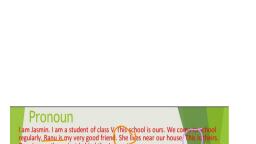
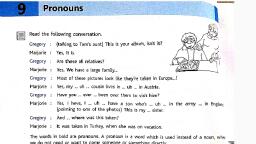
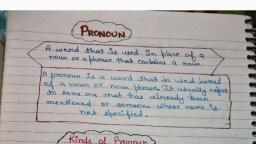
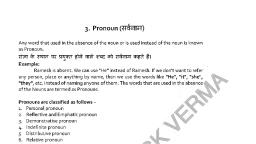
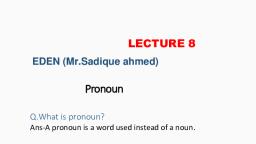
Pronouns, The underlined words are used to replace the naming words, (nouns). These words are called Pronoun., Pro + Noun = Pronoun, ‘Pro’ means ‘instead of’ (পরিবর্তে ) and ‘noun’ refers to the, naming words., Pronoun: Pronouns are words which are used in place of nouns.

Page 2 :
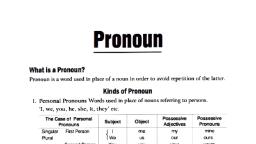
Personal Pronoun, The pronouns that are in bold font stand for persons or animals., Those pronouns are called Personal Pronoun., So, the words “He, I, We, Me, She, They, It, You, him, her,, them” are personal pronouns., • ‘He’, ‘him’ stand for a boy, man and sometimes a male, animal. ‘He’ and ‘him' indicate Masculine Gender., • ‘She' and ‘her’ stand for a girl, woman, lady and sometimes, a female animal. ‘She' and ‘her’ indicate Feminine Gender., • ‘They’ and ‘them’ stand for many people, animals, things, and insects., • It stands for anything not belonging to masculine or, feminine gender, that is, insect, animal, bird, or any other, object of neuter gender. It is also called Impersonal, Pronoun.
Page 3 :
1. Write the personal pronouns in the appropriate boxes., Singular, He, she, I, him, her, me, It,, you., , 1st Person, I, me, we, us,, , Plural, They, them, us, we, you., , 2nd Person, You, , 3rd Person, He, she, him, her,, it, they, them
Page 4 :
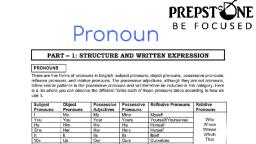
Singular, 1st Person, 2nd Person, 3rd Person, , I, Me, You, He, She, It, Him, Her, , Plural, We, Us, You, They, Them, , Personal Pronouns in Subjective Form and Objective Form, Subjective, 1st Person, , I, we, , Objective, Me, us, , 2nd Person, , You, , You, , 3rd Person, , He, she, they, it, , Him, her, them, it
Page 5 :
Some Important Rules of Using Personal Pronouns, Rule No. 01: The pronouns ‘he’ and ‘she' usually refer to human, beings. However, he or she may also be used to refer to an, animal, if the gender of the animal is known to the speaker., Examples:, a) My sister is very clever. She has a degree in maths., b) His uncle was there, because he had to wait for us., c) Her dog is well trained. He is a good ball catcher., d) The tiger saw a girl sitting on a tree. He tried to attack her., Rule No. 02: Pronoun ‘It’ is used for things without life, for, animals, for young child (if the speaker doesn’t know the gender, of the child/baby)., Examples: a) They have a computer. It is black., b) I have a dog. It is very faithful., c) There is a cat. It is beautiful., d) When he saw the child, it was playing., e) The baby has spoiled its dress., Rule No. 03: When a personal pronoun is the subject of a verb,, the pronoun must be in the Subjective case., Examples: a) We wake up early in the morning .
Page 6 :
b) She is a genius teacher., c) Me and my friends went to Bishnupur Mela. (Incorrect), My friends and I went to Bishnupur Mela. (Correct), Rule No. 04: When a personal pronoun is the object of a verb,, the pronoun must be in the objective case., Examples: a) They understand him., b) I purchased a rose for her., Rule No. 05: When a pronoun follows ‘let’s, we use the, objective form of the pronoun., Examples:, a) Let you and I decide the matter once for all. (incorrect), Let you and me decide the matter for all. (Correct), b) We said, “Let us go to hospital.”, Rule No. 06: If pronouns are in singular form then the good, manners demand that second person pronoun should come, first and then the third person. The first person should take the, last position i.e 2nd Person 》3rd Person 》 1st Person., Examples: a) You, he and I are partners., b) He and I are good friends., c) You and he are working in the same office., d) You and I can do this work.
Page 7 :
Rule No. 07: If pronouns are in plural forms then the sequence, should be 1st Person 》2nd Person 》3rd Person., Examples: a) We and you cannot live together., b) We, you and they can purchase that complex., Rule No. 07: Sometimes the sentences has some apologetic, sense or negative sense or sense of some error committed, etc., in such sentences the good manners demand to accept the, guilt first by the speaker, that means by the first person. In such, case the sequence should be 1st Person 》2nd Person 》3rd, Person., Examples: a) I and you are responsible for the loss., b) You and he spoiled the party., c) I and he will beg sorry for the misconduct., Rule No. 08: When the verb (to be) is immediately followed by a, personal pronoun, the pronoun must be in the subjective case., Examples: a) It is I who telephoned you., b) It is he, who can solve this problem., , Thank you 😊, Prepared By,, Pappu Shaw
Page 8 :
Online Study