Page 1 :
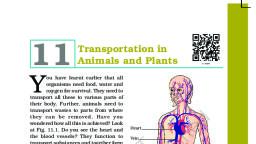
11, , Transportation in, Animals and Plants, , Y, , ou have learnt earlier that all, organisms need food, water and, oxygen for survival. They need to, transport all these to various parts of, their body. Further, animals need to, transport wastes to parts from where, they can be removed. Have you, wondered how all this is achieved? Look, at Fig. 11.1. Do you see the heart and, the blood vessels? They function to, transport substances and together form, the circulatory system. In this chapter,, you shall learn about transport of, substances in animals and plants., , Heart, Vein, , Artery, , 11.1 CIRCULATORY SYSTEM, Blood, What happens when you get a cut on, your body? Blood flows out. But what, is blood? Blood is the fluid which, flows in blood vessels. It transports, substances like digested food from the, small intestine to the other parts of the, body. It carries oxygen from the lungs, to the cells of the body. It also transports, waste for removal from the body., How does the blood carry various, substances? Blood is composed of a, fluid, called plasma in which different, types of cells are suspended., Why is the colour of, blood red ?, , Fig. 11.1 Circulatory system, (Arteries are shown in red colour and veins in blue), , 2020-21
Page 2 :
One type of cells are the red blood, cells (RBC) which contain a red pigment, called haemoglobin. Haemoglobin, binds with oxygen and transports it to, all the parts of the body and ultimately, to all the cells. It will be difficult to, provide oxygen efficiently to all the cells, of the body without haemoglobin. The, presence of haemoglobin makes blood, appear red., The blood also has white blood cells, (WBC) which fight against germs that, may enter our body., Boojho fell down while playing a, game and his knee got injured. Blood, was coming out from the cut. After some, time, he noticed that bleeding had, stopped and a dark red clot had plugged, the cut. Boojho was puzzled about this., The clot is formed because of the, presence of another type of cells in the, blood, called platelets., , Blood vessels, There are different types of blood vessels, in the body. You know that during, inhalation a fresh supply of oxygen fills, the lungs. Oxygen has to be transported, to the rest of the body., Also, the blood picks up the waste, materials including carbon dioxide from, the cells. This blood has to go back to, the heart for transport to the lungs for, removal of carbon dioxide as you have, learnt in Chapter 10. So, two types of, blood vessels, arteries and veins are, present in the body. (Fig. 11.1), Arteries carry oxygen-rich blood, from the heart to all parts of the body., , Since the blood flow is rapid and at a, high pressure, the arteries have thick, elastic walls., Let us perform an activity to study, the flow of blood through arteries., , Activity 11.1, Place the middle and index finger of, your right hand on the inner side of your, left wrist (Fig. 11.2). Can you feel some, throbbing movements? Why do you, think there is throbbing? This, throbbing is called the pulse and it is, due to the blood flowing in the arteries., Count the number of pulse beats in one, minute., How many pulse beats could you, count? The number of beats per minute, is called the pulse rate. A resting, person, usually has a pulse rate between, 72 and 80 beats per minute. Find other, places in your body where you can feel, the pulse., Record your own pulse beats per, minute and those of your classmates., Insert the values you obtained in Table, 11.1 and compare them., , 122, , Fig. 11.2 Pulse in the wrist, SCIENCE, , 2020-21
Page 3 :
Table 11.1 Pulse rate, S. No., 1., 2., 3., 4., 5., , Name, , Pulse per minute, , I am confused! I have learnt, that an artery always, carries oxygen-rich blood., Paheli explained that the, pulmonary artery carries blood, from the heart, so it is called an, artery and not a vein. It carries, carbon dioxide-rich blood to the, lungs. Pulmonary vein carries, oxygen-rich blood from the, lungs to the heart., , Veins are the vessels which carry, carbon dioxide-rich blood from all parts, of the body back to the heart. The veins, have thin walls. There are valves present, in veins which allow blood to flow only, towards the heart., Lungs, , Pulmonary, vein, , Pulmonary, artery, Heart, Vein, , Artery, , Capillaries, , Fig. 11.3 Schematic diagram of circulation, , Blood Donation, Hundreds of people die due to, unavailability of blood. Voluntary, blood donation is harmless and, painless and can save precious lives., Blood can be donated at hospitals and, other places authorised by the, government. Donated blood are stored, with special care in Blood Banks., , Refer to Fig. 11.3. Do you see the, arteries divide into smaller vessels? On, reaching the tissues, they divide further, into extremely thin tubes called, capillaries. The capillaries join to form, veins which empty into the heart., , Heart, The heart is an organ which beats, continuously to act as a pump for the, transport of blood, which carries other, substances with it., Imagine a pump working for, years without stopping! Absolutely, impossible. Yet our heart works like a, pump non-stop. Let us now learn about, the heart., The heart is located in the chest, cavity with its lower tip slightly tilted, towards the left (Fig. 11.1). Hold your, fingers inwards on your palm. That, , TRANSPORTATION IN ANIMALS AND PLANTS, , 123, , 2020-21
Page 4 :
makes your fist. Your heart is roughly, the size of your fist., What will happen if the blood rich in, oxygen and the blood rich in carbon, dioxide mix with each other? To avoid, this from happening, the heart has four, , chambers. The two upper chambers are, called the atria (singular: atrium) and, the two lower chambers are called the, ventricles (Fig. 11.4). The partition, between the chambers helps to avoid, , Vena Cava, , Aorta, , Pulmonary artery, , Pulmonary vein, , Left atrium, , Right atrium, , Partition completely, separating the two, halves, , Left ventricle, , Right ventricle, , Fig. 11.4 Sections of human heart, , Paheli wonders which side of, the heart will have oxygen-rich, blood and which side will have, carbon dioxide-rich blood., , mixing up of blood rich in oxygen with, the blood rich in carbon dioxide., To understand the functioning of the, circulatory system, start from the right, side of the heart in Fig. 11.3 and follow, the arrows. These arrows show the, direction of the blood flow from the heart, , 124, , SCIENCE, , 2020-21
Page 5 :
to the lungs and back to the heart from, where it is pumped to the rest of the, body., , Heartbeat, The walls of the chambers of the heart, are made up of muscles. These muscles, contract and relax rhythmically. This, rhythmic contraction followed by its, relaxation constitute a heartbeat., Remember that heartbeats continue, every moment of our life. If you place, your hand on the left side of your chest,, you can feel your heartbeat. The doctor, feels your heartbeats with the help of, an instrument called a stethoscope., A doctor uses the stethoscope as a, device to amplify the sound of the heart., It consists of a chest piece that carries a, sensitive diaphragm, two ear pieces and, a tube joining the parts. Doctors can, get clues about the condition of your, Tube, , heart by listening through a, stethoscope., Let us construct a model of a, stethoscope with the materials that are, available around us., , Activity 11.2, Take a small funnel of 6 –7 cm in, diameter. Fix a rubber tube (50 cm long), tightly on the stem of the funnel. Stretch, a rubber sheet (or a balloon) on the, mouth of the funnel and fix it tightly, with a rubber band. Put the open end, of the tube on one of your ears. Place, , Chest Piece, (a) Stethoscope, , (b) Model of, stethoscope, , Ear Piece, Fig. 11.5 Instrument to hear heartbeat, , Table 11.2 Heartbeat and pulse rate, Name of student, , While resting, Heartbeat, Pulse rate, , TRANSPORTATION IN ANIMALS AND PLANTS, , After running (4 –5 minutes), Heartbeat, Pulse rate, , 125, , 2020-21
Page 6 :
the mouth of the funnel on your chest, near the heart. Now try to listen, carefully. Do you hear a regular, thumping sound ? The sound is that of, heart beats. How many times did your, heart beat in a minute ? Count again, after running for 4–5 minutes. Compare, your observations., Record your own pulse rate and heart, beat and that of your friends while, resting and after running and record in, Table 11.2. Do you find any relationship, between your heart beat and pulse rate?, Each heart beat generates one pulse in, the arteries and the pulse rate per, minute indicates the rate of heart beat., The rhythmic beating of the various, chambers of the heart maintain, circulation of blood and transport of, substances to the different parts of the, body., Boojho wonders if sponges and, hydra also have blood? Animals such, as sponges and Hydra do not possess, any circulatory system. The water in, which they live brings food and oxygen, The English physician, William Harvey, (A.D.1578 –1657), discovered the, circulation of blood. The current, opinion in those days was that blood, oscillates in the vessels of the body., For his views, Harvey was ridiculed, and was called “circulator”. He lost, most of his patients. However, before, he died, Harvey’s idea about, circulation was generally accepted as, a biological fact., , as it enters their bodies. The water, carries away waste materials and carbon, dioxide as it moves out. Thus, these, animals do not need a circulatory fluid, like the blood., Let us now learn about the removal, of waste other than carbon dioxide., , 11.2 EXCRETION, , IN, , ANIMALS, , Recall how carbon dioxide is removed, as waste from the body through the, lungs during exhalation. Also recall that, the undigested food is removed during, egestion. Let us now find out how the, other waste materials are removed from, the body. You may wonder where these, unwanted materials come from!, When our cells perform their, functions, certain waste products are, released. These are toxic and hence need, to be removed from the body. The, process of removal of wastes produced, in the cells of the living organisms is, called excretion. The parts involved in, excretion form the excretory system., , Excretory system in humans, The waste which is present in the blood, has to be removed from the body. How, can this be done? A mechanism to filter, the blood is required. This is done by, the blood capillaries in the kidneys., When the blood reaches the two kidneys,, it contains both useful and harmful, substances. The useful substances are, absorbed back into the blood. The, wastes dissolved in water are removed, as urine. From the kidneys, the urine, goes into the urinary bladder through, , 126, , SCIENCE, , 2020-21
Page 7 :
contains water and salts. Boojho has, seen that sometimes in summer, white, patches are formed on our clothes,, especially in areas like underarms., These marks are left by salts present in, the sweat., Does sweat serve any other function?, We know that the water kept in an, earthen pot (matka) is cooler. This is, because the water evaporates from the, pores of the pot, which causes cooling., , Kidney, , Ureter, , Paheli wants to know, whether other animals also, urinate?, Urinary bladder, , Urethra, , Urinary opening, Fig. 11.6 Human excretory system, , tube-like ureters. It is stored in the, bladder and is passed out through the, urinary opening at the end of a, muscular tube called urethra (Fig. 11.6)., The kindeys, ureters, bladder and, urethra form the excretory system., An adult human being normally, passes about 1–1.8 L of urine in 24, hours. The urine consists of 95% water,, 2.5% urea and 2.5% other waste, products., We have all experienced that we sweat, on a hot summer day. The sweat, , The way in which waste chemicals, are removed from the body of the, animal depends on the availability, of water. Aquatic animals like fishes,, excrete cell waste as ammonia which, directly dissolves in water. Some, land animals like birds, lizards,, snakes excrete a semi-solid, white, coloured compound (uric acid). The, major excretory product in humans, is urea., Sometimes a person’s kidneys may, stop working due to infection or, injury. As a result of kidney failure,, waste products start accumulating in, the blood. Such persons cannot, survive unless their blood is filtered, periodically through an artificial, kidney. This process is called dialysis., , TRANSPORTATION IN ANIMALS AND PLANTS, , 127, , 2020-21
Page 8 :
Similarly, when we sweat, it helps to cool, our body., , 11.3 TRANSPORT, PLANTS, , OF, , SUBSTANCES, , IN, , In Chapter 1 you learnt that plants take, water and mineral nutrients from the soil, through the roots and transport it to the, leaves. The leaves prepare food for the, plant, using water and carbon dioxide, during photosynthesis. You also learnt in, Chapter 10 that food is the source of, energy and every cell of an organism gets, energy by the breakdown of glucose. The, cells use this energy to carry out vital, activities of life. Therefore food must be, made available to every cell of an, organism. Have you ever wondered how, water and nutrients absorbed by the, root are transported to the leaves? How, is the food prepared by the leaves carried, to the parts which cannot make food?, , The root hair increase the surface area, of the root for the absorption of water, and mineral nutrients dissolved in, water. The root hair is in contact with, the water present between the soil, particles [Fig. 11.7 (a)]., Can you guess how water moves, from the root to the leaves? What kind, of transport system is present in plants?, Boojho thinks that plants, may have pipes to transport, water to the entire plant like, we have in our homes for the, supply of water., , Transport of water and, minerals, Plants absorb water and minerals by, the roots. The roots have root hair., , Root hair, (b), , (a), Xylem vessels, , Fig. 11.7 Transport of water and minerals in, (a) a section of root, (b) a tree, , 128, , SCIENCE, , 2020-21
Page 9 :
Well, Boojho is right. Plants have, pipe-like vessels to transport water and, nutrients from the soil. The vessels are, made of special cells, forming the, vascular tissue. A tissue is a group of, cells that perform specialised function, in an organism. The vascular tissue for, the transport of water and nutrients in the, plant is called the xylem [Fig. 11.7 (a)]., The xylem forms a continuous, network of channels that connects roots, to the leaves through the stem and, branches and thus transports water to, the entire plant [Fig. 11.7 (b)]., , Fig. 11.8 (a) Stem placed in coloured water, , (b), , (c), Fig. 11.8 (b) Water moves up in the stem, (c) Enlarged view of open end of stem, , Paheli says her mother puts, ladyfinger and other vegetables in, water if they are somewhat dry., She wants to know how water, enters into them., You know that leaves synthesise, food. The food has to be transported to, all parts of the plant. This is done by, the vascular tissue called the phloem., Thus, xylem and phloem transport, substances in plants., , Activity 11.3, We would require a glass tumbler, water,, red ink, a tender herb (e.g., Balsam),, and a blade for this activity., Pour water to fill one-third of the, tumbler. Add a few drops of red ink to, the water. Cut the base of the stem of, the herb and place it in the glass as shown, in Fig. 11.8(a). Observe it the next day., , Does any part of the herb appear, red? If yes, how do you think the colour, reached there?, You can cut the stem across and look, for the red colour inside the stem (Fig., 11.8(b) and 11.8(c))., From this activity we see that water, moves up the stem. In other words, stem, conducts water. Just like the red ink,, minerals dissolved in water also move, up the stem, along with water. Water, and minerals go to leaves and other, plant parts, through narrow tubes, (xylem) inside the stem (Fig. 11.7(b))., , TRANSPORTATION IN ANIMALS AND PLANTS, , Boojho wants to know why, plants absorb a large quantity, of water from the soil, then give, it off by transpiration!, , 129, , 2020-21
Page 10 :
Transpiration, In Class VI you learnt that plants, release a lot of water by the process of, transpiration., Plants absorb mineral nutrients and, water from the soil. Not all the water, absorbed is utilised by the plant. The water, evaporates through the stomata present, , on the surface of the leaves by the process, of transpiration. The evaporation of water, from leaves generates a suction pull (the, same that you produce when you suck, water through a straw) which can, pull water to great heights in the, tall trees. Transpiration also cools, the plant., , Keywords, Ammonia, Artery, Blood, Blood vessels, Capillary, Circulatory system, Dialysis, Excretion, Excretory system, Haemoglobin, , Heart beat, Kidneys, Phloem, Plasma, Platelets, Pulse, Red blood cell, Root hair, Stethoscope, Sweat, , Tissue, Urea, Ureter, Urethra, Uric acid, Urinary bladder, Vein, White blood cell, Xylem, , What you have learnt, n, , In most animals the blood that circulates in the body distributes food, and oxygen to different cells of the body. It also carries waste products, from different parts of the body for excretion., , n, , Circulatory system consists of the heart and blood vessels., , n, , In humans, blood flows through arteries and veins and the heart acts, as a pumping organ., , n, , Blood consists of plasma, RBC, WBC and platelets. Blood is red due to, the presence of a red pigment, haemoglobin., , n, , The human heart beats about 70–80 times per minute in an adult, person. This is called heart rate., , n, , Arteries carry blood from the heart to all parts of the body., , n, , Veins carry blood from all parts of the body back to the heart., , n, , Removal of waste products from the body is called excretion., , 130, , SCIENCE, , 2020-21
Page 11 :
n, , Excretory system of humans consists of two kidneys, two ureters, a, urinary bladder, and urethra., , n, , Salts and urea are removed along with water as sweat., , n, , Fish excrete waste substances such as ammonia which directly dissolve, in water., , n, , Birds, insects and lizard excrete uric acid in semi-solid form., , n, , Water and mineral nutrients are absorbed by roots from the soil., , n, , Nutrients are transported along with water to the entire plant via the, vascular tissue called xylem., , n, , The vascular tissue for the transport of food to the various parts of the, plant is phloem., , n, , A lot of water is lost by plants in the form of vapour through stomata, during transpiration., , n, , Transpiration generates a force which pulls up water absorbed by the, roots from the soil, to reach the stem and leaves., , Exercises, 1. Match structures given in Column I with functions given in Column II., Column I, (i), , Column II, , Stomata, , (a), , Absorption of water, , (ii), , Xylem, , (b), , Transpiration, , (iii), , Root hairs, , (c), , Transport of food, , (iv), , Phloem, , (d), , Transport of water, , (e), , Synthesis of carbohydrates, , 2. Fill in the blanks., (i), , The blood from the heart is transported to all parts of the body by, the, ., , (ii), , Haemoglobin is present in, , cells., , (iii), , Arteries and veins are joined by a network of, , (iv), , The rhythmic expansion and contraction of the heart is called, ., , (v), , The main excretory product in human beings is, , (vi), , Sweat contains water and, , (vii), , Kidneys eliminate the waste materials in the liquid form called, ., , ., , ., , ., , (viii) Water reaches great heights in the trees because of suction pull, caused by, ., , TRANSPORTATION IN ANIMALS AND PLANTS, , 131, , 2020-21
Page 12 :
3. Choose the correct option:, (a), , In plants, water is transported through, (i), (iii), , (b), , xylem, , (ii), , phloem, , stomata, , (iv), , root hair, , Water absorption through roots can be increased by keeping the, plants, (i), , in the shade, , (ii), , in dim light, , (iii), , under the fan, , (iv), , covered with a polythene bag, , 4. Why is transport of materials necessary in a plant or in an animal?, Explain., 5. What will happen if there are no platelets in the blood?, 6. What are stomata? Give two functions of stomata., 7. Does transpiration serve any useful function in the plants? Explain., 8. What are the components of blood?, 9. Why is blood needed by all the parts of a body?, 10. What makes the blood look red?, 11. Describe the function of the heart., 12. Why is it necessary to excrete waste products?, 13. Draw a diagram of the human excretory system and label the various, parts., , Extended Learning — Activities and Projects, 1. Find out about blood groups and their importance., 2. When a person suffers from chest pain, the doctor immediately takes, an ECG. Visit a doctor and get information about ECG. You may even, look up an encyclopaedia or the internet., , Did you know?, There is no substitute for blood. If people lose blood from surgery or injury, or if their bodies cannot produce enough blood, there is only one way to, get it — through transfusion of blood donated by volunteers. Blood is, usually in short supply. Donating blood does not decrease the strength of, the donors., , 132, , SCIENCE, , 2020-21