Page 1 :
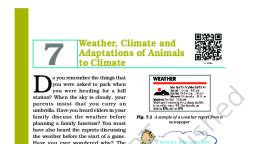
7, , Weather, Climate and, Adaptations of Animals, to Climate, , D, , o you remember the things that, you were asked to pack when, you were heading for a hill, station? When the sky is cloudy, your, parents insist that you carry an, umbrella. Have you heard elders in your, family discuss the weather before, planning a family function? You must, have also heard the experts discussing, the weather before the start of a game., Have you ever wondered why? The, weather may have a profound effect on, the game. It has a profound effect on, our lives. Many of our daily activities are, planned based on the weather predicted, for that day. There are daily reports of, the weather on the television and, radio and in the newspapers. But do you, know what this weather really is?, In this chapter, we will study about, the weather and climate. We will also, see how different forms of life are, adapted to the climate of their habitat., , 7.1 WEATHER, In Fig. 7.1 a sample of weather report, from a newspaper is given., We find that the daily weather report, carries information about the, temperature, humidity and rainfall, during the past 24 hours. It also, predicts the weather for the day., Humidity, as you might know, is a, measure of the moisture in air., , Fig. 7.1 A sample of a weather report from a, newspaper, , I wonder who prepares, these reports!, The weather reports are prepared by, the Meteorological Department of the, Government. This department collects, data on temperature, wind, etc., and, makes the weather prediction., , Activity 7.1, Cut out the weather reports of the last, week from any newspaper. If you do not, get a newspaper at home borrow from, your neighbours or friends and copy, these reports in your notebook. You can, also collect weather reports from a, library. Paste all the cut-outs on a white, sheet or on a chart paper., Now record the information from the, weather reports collected by you in, Table 7.1. The first row is just a sample., Fill all the columns according to the data, in the chart that you have prepared., , 68, , SCIENCE, , 2020-21
Page 2 :
Table 7.1, Weather data of a week, Date, 23-08-06, , Max., temp. (°C), , Min., temp. (°C), , Min., humidity (%), , Max., humidity(%), , 36.2, , 27.8, , 54, , 82, , Rainfall*, (mm), , *(Rainfall may not be recorded for all the days since it may not rain everyday. Leave, the space for rainfall blank if the data is not available.), , Rainfall is measured by an, instrument called the rain gauge. It, is basically a measuring cylinder with, a funnel on top to collect rainwater., Do all the seven days have the same, maximum and minimum temperatures,, humidity and rainfall? The maximum, and minimum temperatures recorded, may be the same for some of the days., However, all the parameters are not the, same on any two days. Over a week there, may be considerable variation. The dayto-day condition of the atmosphere, at a place with respect to the, temperature, humidity, rainfall, windspeed, etc., is called the weather at that, place. The temperature, humidity, and, other factors are called the elements of, the weather. The weather of a place, changes day after day and week after, week. That is why we often say, “today’s, , weather is too humid”, or “the weather, was warm last week”., The weather is such a complex, phenomenon that it can vary over very, short periods of time. It can happen, sometimes that it is sunny in the, morning, but suddenly clouds appear, from nowhere and it starts raining, heavily. Or, a heavy rain may vanish in, a matter of minutes and give way to, bright sunshine. You must have had, several such experiences. Try to recall, any such experience and share it with, your friends. Since weather is such a, complex phenomenon, it is not easy to, predict., Look at the graph given below which, shows the maximum temperature, recorded during 03 August 2006 to 09, August 2006 at Shillong, Meghalaya, (Fig. 7.2)., , WEATHER, CLIMATE AND ADAPTATIONS OF ANIMALS TO CLIMATE, , 2020-21, , 69
Page 3 :
Date, , Maximum, temperature, , 03-08-06, , 26.0°C, , 04-08-06, , 23.5°C, , 05-08-06, , 25.0°C, , 06-08-06, , 22.0°C, , 07-08-06, , 25.5°C, , 08-08-06, , 23.3°C, , 09-08-06, , 24.4°C, , Fig. 7.2 Graph showing the variation of maximum temperature during 03 to 09 August 2006, , As it is clear from any weather report,, the, maximum, and, minimum, temperatures are recorded every day. Do, you know how these temperatures are, recorded. In Chapter 4 you have learnt, , I wonder why weather, changes so frequently!, What is the source of weather, in the first place?, , that there are special thermometers for, this purpose, called maximum and, minimum thermometers. Can you, guess when during the day we have the, maximum temperature and when the, minimum?, The maximum temperature of the day, occurs generally in the afternoon while, the minimum temperature occurs, generally in the early morning. Can you, now understand why in summers we feel, so miserable in the afternoon and, comparatively comfortable early in the, morning?, , All changes in the weather are caused by the sun. The sun is a huge sphere of, hot gases at a very high temperature. The distance of the sun from us is very, large. Even then the energy sent out by the sun is so huge that it is the source of, all heat and light on the earth. So, the sun is the primary source of energy that, causes changes in the weather. Energy absorbed and reflected by the earth’s, surface, oceans and the atmosphere play important roles in determining the, weather at any place. If you live near the sea, you would have realised that the, weather at your place is different from that of a place in a desert, or near a mountain., 70, , SCIENCE, , 2020-21
Page 4 :
What about the times of sunrise and, sunset? You know that in winters it, becomes dark early and you do not get, much time to play. Are the days shorter, in winter than in summer? Try to find, it out yourself by completing the project, given at the end of the chapter., , 7.2 CLIMATE, Meteorologists record the weather every, day. The records of the weather have, been preserved for the past several, decades. These help us to determine the, weather pattern at a place. The average, weather pattern taken over a long, time, say 25 years, is called the, climate of the place. If we find that, the temperature at a place is high most, , of the time, then we say that the climate, of that place is hot. If there is also heavy, rainfall on most of the days in the same, place, then we can say that the climate, of that place is hot and wet., In Table 7.2 and 7.3, we have given, the climatic condition at two places in, India. The mean temperature for a given, month is found in two steps. First we, find the average of the temperatures, recorded during the month. Second, we, calculate the average of such average, temperatures over many years. That, gives the mean temperature. The two, places are: Srinagar in Jammu and, Kashmir, and Thiruvananthapuram in, Kerala., , Table 7.3 Thiruvananthapuram, (Kerala), , Table 7.2 Srinagar (Jammu &, Kashmir), , Information about climate, Month Mean temperature, Mean, o, C, total, Daily, Daily, rainfall, minimum maximum (mm), Jan, 22.2, 31.5, 23, Feb, 22.8, 31.9, 24, 32.6, 40, Mar, 24.1, Apr, 24.9, 32.6, 117, May, 24.7, 31.6, 230, Jun, 23.5, 29.7, 321, July, 23.1, 29.2, 227, Aug, 23.2, 29.4, 138, Sep, 23.3, 30.0, 175, Oct, 23.3, 29.9, 282, Nov, 23.1, 30.3, 185, Dec, 22.6, 31.0, 66, , Information about climate, Month Mean temperature, Mean, o, C, total, Daily, Daily, rainfall, minimum maximum (mm), Jan, -2.3, 4.7, 57, Feb, -0.6, 7.8, 65, Mar, 3.8, 13.6, 99, Apr, 7.7, 19.4, 88, May, 10.7, 23.8, 72, Jun, 14.7, 29.2, 37, July, 8.2, 30.0, 49, Aug, 17.5, 29.7, 70, 27.8, 33, Sep, 12.9, Oct, 6.1, 21.9, 36, Nov, 0.9, 14.7, 27, Dec, -1.6, 8.2, 43, , (Note: The numbers for the mean total rainfall have been rounded off), WEATHER, CLIMATE AND ADAPTATIONS OF ANIMALS TO CLIMATE, , 2020-21, , 71
Page 5 :
By looking at Tables 7.2 and 7.3 we, can easily see the difference in the, climate of Jammu & Kashmir and, Kerala. We can see that Kerala is very, hot and wet in comparison to Jammu, & Kashmir, which has a moderately hot, and wet climate for a part of the year., Similar data for the western region, of India, for example Rajasthan, will, show that the temperature is high, during most part of the year. But during, winter, which lasts only for a few, months, the temperature is quite low., This region receives very little, rainfall. This is the typical desert, climate. It is hot and dry. The northeastern India receives rain for a major, part of the year. Therefore, we can say, that the climate of the north-east is wet., , 7.3 CLIMATE AND ADAPTATION, Climate has a profound effect on all, living organisms., Animals are adapted to survive in the, conditions in which they live. Animals, living in very cold and hot climate must, possess special features to protect, themselves against the extreme cold or, heat. Recall from Chapter 9 of your, Class VI science book the definition of, adaptation. Features and habits that, help animals to adapt to their, surroundings are a result of the process, of evolution., In Chapter 9 you will learn about the, effect of weather and climate on soil. Here, we will study the effect of climate on, animals only. In Class VI, you have read, about adaptations of animals to certain, , habitats. As examples of adaptation of, animals to climatic conditions, we, discuss only animals living in polar, regions and tropical rainforests., As the name suggests, the polar, regions are situated near the poles, i.e.,, north pole and south pole., Some well-known countries that, belong to the polar regions are Canada,, Greenland, Iceland, Norway, Sweden,, Finland, Alaska in U.S.A. and Siberian, region of Russia., Examples of some countries where, the tropical rainforests are found are, India, Malaysia, Indonesia, Brazil,, Republic of Congo, Kenya, Uganda, and, Nigeria., , Activity 7.2, Take an outline map of the world. Mark, the polar regions in blue. Similarly,, mark the tropical regions in red., , (i) The polar regions, The polar regions present an extreme, climate. These regions are covered with, snow and it is very cold for most part of, the year. For six months the sun does, not set at the poles while for the other, six months the sun does not rise. In, winters, the temperature can be as low, as –37°C. Animals living there have, adapted to these severe conditions. Let, us see how they are adapted by, considering the examples of polar bears, and penguins., Polar bears have white fur so that, they are not easily visible in the snowy, white background. It protects them from, , 72, , SCIENCE, , 2020-21
Page 6 :
their predators. It also helps them in, catching their prey. To protect them, from extreme cold, they have two thick, layers of fur. They also have a layer of, fat under their skin. In fact, they are so, well-insulated that they have to move, slowly and rest often to avoid getting, overheated., Physical activities on warm days, necessitate cooling. So, the polar bear, goes for swimming. It is a good, swimmer. Its paws are wide and large,, which help it not only to swim well but, also walk with ease in the snow. While, swimming under water, it can close its, nostrils and can remain under water for, long durations. It has a strong sense of, smell so that it can catch its prey, for food. We can understand the, adaptations of polar bears with the help, of the flow chart shown in Fig. 7.3., , Another well-known animal living in, the polar regions is the penguin, (Fig. 7.4). It is also white and merges, well with the white background. It also, has a thick skin and a lot of fat to protect, it from cold. You may have seen pictures, of penguins huddled together. This they, do to keep warm. Recall how warm you, feel when you are in a hall full of people., , Fig. 7.4 Penguins huddled together, , The white fur is not, easily visible in the snowy, white background, , Fig. 7.3 Adaptations of polar bear, WEATHER, CLIMATE AND ADAPTATIONS OF ANIMALS TO CLIMATE, , 2020-21, , 73
Page 7 :
Fig. 7.5 Feet of penguin, , Like polar bears, penguins are also good, swimmers. Their bodies are streamlined, and their feet have webs, making them, good swimmers (Fig. 7.5)., Other animals living in the polar, regions are many types of fishes, musk, oxen, reindeers, foxes, seals, whales,, and birds. It is to be noted that while, fish can remain under cold water for, , long, birds must remain warm to, survive. They migrate to warmer regions, when winter sets in. They come back, after the winter is over. You know, probably that India is one of the, destinations of many of these birds. You, must have seen or heard about the, Siberian crane that comes from Siberia, to places like Bharatpur in Rajasthan, and Sultanpur in Haryana, and some, , Do fishes and butterflies, also migrate like birds?, , Fig. 7.6 Migratory birds, in their habitat/ Migratory, birds in flight, , Did you know?, Some migratory birds travel as much as 15000 km to escape the extreme climatic, conditions at home. Generally they fly high where the wind flow is helpful and, the cold conditions allow them to disperse the heat generated by their flight, muscles. But how these birds travel to the same place year after year is still a, mystery. It seems that these birds have a built–in sense of direction and know in, which direction to travel. Some birds probably use landmarks to guide them. Many, birds may be guided by the sun during the day and stars at night. There is some, evidence that birds may use the magnetic field of the earth to find direction. And, it is not only birds that migrate; mammals, many types of fish and insects are, also known to migrate seasonally in search of more hospitable climates., 74, , SCIENCE, , 2020-21
Page 8 :
wetlands of north east and some other, parts of India (Fig. 7.6)., , (ii) The tropical rainforests, The tropical region has generally a hot, climate because of its location around, the equator. Even in the coldest month, the temperature is generally higher than, about 15°C. During hot summers, the, temperature may cross 40°C. Days and, nights are almost equal in length, throughout the year. These regions get, plenty of rainfall. An important feature, of this region is the tropical rainforests., Tropical rainforests are found in, Western Ghats and Assam in India,, Southeast Asia, Central America and, Central Africa. Because of continuous, warmth and rain, this region supports, wide variety of plants and animals. The, major types of animals living in the, rainforests are monkeys, apes, gorillas,, tigers, elephants, leopards, lizards,, snakes, birds and insects., Let us read about the adaptations of, these animals to a hot, humid climate., The climatic conditions in rainforests, are highly suitable for supporting an, enormous number and a variety of, animals., Since the numbers are large, there, is intense competition for food and, shelter. Many animals are adapted to, living on the trees. Red-eyed frog, (Fig. 7.7) has developed sticky pads on, its feet to help it climb trees on which it, lives. To help them live on the trees,, monkeys (Fig. 7.8) have long tails for, grasping branches. Their hands and feet, , Fig. 7.7 Red-eyed frog, , Fig. 7.8 A new world monkey, , are such that they can easily hold on to, the branches., As there is competition for food, some, animals are adapted to get food not, easily reachable. A striking example is, that of the bird Toucan (Fig. 7.9), which, possesses a long, large beak. This helps, a toucan to reach the fruits on branches, which are otherwise too weak to support, its weight., Many tropical animals have sensitive, hearing, sharp eyesight, thick skin and, a skin colour which helps them to, camouflage by blending with the, surroundings. This is to protect them, from predators. For example, big cats, , WEATHER, CLIMATE AND ADAPTATIONS OF ANIMALS TO CLIMATE, , 2020-21, , 75
Page 9 :
Fig. 7.9 Toucan, , Fig. 7.10 Lion-tailed, macaque, , (lions and tigers) have thick skins and, sensitive hearing., The lion-tailed macaque (also called, Beard ape) lives in the rainforests of, Western Ghats (Fig. 7.10). Its most, outstanding feature is the silver-white, mane, which surrounds the head from, the cheeks down to its chin. It is a good, climber and spends a major part of its, life on the tree. It feeds mainly on fruits., It also eats seeds, young leaves, stems,, flowers and buds. This beard ape also, searches for insects under the bark of, the trees. Since it is able to get sufficient, food on the trees, it rarely comes down, on the ground., Another well-known animal of Indian, tropical rainforest is the elephant, , (Fig. 7.11). It has adapted to the, conditions of rainforests in many, remarkable ways. Look at its trunk. It, uses it as a nose because of which it, has a strong sense of smell. The trunk, is also used by it for picking up food., Moreover, its tusks are modified teeth., These can tear the bark of trees that, elephant loves to eat. So, the elephant, is able to handle the competition for food, rather well. Large ears of the elephant, help it to hear even very soft sounds., They also help the elephant to keep cool, in the hot and humid climate of the, rainforest., , Fig. 7.11 An Indian elephant, , Keywords, Adaptation, , Maximum temperature, , Tropical rainforest, , Climate, , Migration, , Tropical region, , Elements of weather Minimum temperature, Humidity, , Weather, , Polar region, , 76, , SCIENCE, , 2020-21
Page 10 :
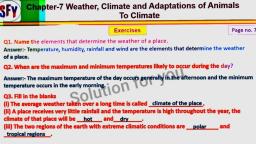
What you have learnt, n, , The day-to-day condition of the atmosphere at a place with respect to, the temperature, humidity, rainfall, wind-speed, etc., is called the, weather at that place., , n, , The weather is generally not the same on any two days and week after, week., , n, , The maximum temperature of the day occurs generally in the afternoon, while the minimum temperature occurs in the early morning., , n, , The times of sunrise and sunset also change during the year., , n, , All the changes in the weather are driven by the sun., , n, , The average weather pattern taken over a long time, say 25 years, is, called the climate of the place., , n, , The tropical and the polar regions are the two regions of the earth,, which have severe climatic conditions., , n, , Animals are adapted to the conditions in which they live., , n, , The polar regions are very cold throughout the year. The sun does not, set for six months in a year and in the other six months it does not rise., , n, , Animals in the polar region are adapted to the extremely cold climate by, having some special characteristics such as white fur, strong sense of, smell, a layer of fat under the skin, wide and large paws for swimming, and walking, etc., , n, , Migration is another means to escape the harsh, cold conditions., , n, , Because of the hospitable climatic conditions huge populations of plants, and animals are found in the tropical rainforests., , n, , Animals in the tropical rainforests are adapted such that they eat, different kinds of food to overcome the competition for food and shelter., , n, , Some adaptations of animals living in the tropical rainforests include, living on the trees, development of strong tails, long and large beaks,, bright colours, sharp patterns, loud voice, diet of fruits, sensitive hearing,, sharp eyesight, thick skin, ability to camouflage in order to protect, themselves from predators, etc., , Exercises, 1. Name the elements that determine the weather of a place., 2. When are the maximum and minimum temperatures likely to occur, during the day?, 3. Fill in the blanks:, (i), , The average weather taken over a long time is called ___________., , WEATHER, CLIMATE AND ADAPTATIONS OF ANIMALS TO CLIMATE, , 2020-21, , 77
Page 11 :
(ii), , (iii), , A place receives very little rainfall and the temperature is, high throughout the year, the climate of that place will be, ___________ and ___________ ., The two regions of the earth with extreme climatic conditions are, ___________ and __________., , 4. Indicate the type of climate of the following areas:, (a), , Jammu and Kashmir: _________________________________, , (b), , Kerala:, , (c), , Rajasthan:, , (d), , North-east India: _____________________________________, , ____________________________________________, __________________________________________, , 5. Which of the two changes frequently, weather or climate?, 6. Following are some of the characteristics of animals:, (i), (iii), (v), , Diets heavy on fruits, , (ii), , White fur, , Need to migrate, , (iv), , Loud voice, , Sticky pads on feet, , (vi), , Layer of fat under skin, , (vii), , Wide and large paws, , (ix), , Strong tails, , (viii), (x), , Bright colours, Long and large beak, , For each characteristic indicate whether it is adaptation for tropical, rainforests or polar regions. Do you think that some of these, characteristics can be adapted for both regions?, 7. The tropical rainforest has a large population of animals. Explain why, it is so., 8. Explain, with examples, why we find animals of certain kind living in, particular climatic conditions., 9. How do elephant living in the tropical rainforest adapt itself?, Choose the correct option which answers the following question:, 10. A carnivore with stripes on its body moves very fast while catching its, prey. It is likely to be found in, (i), (iii), , polar regions, , (ii), , deserts, , oceans, , (iv), , tropical rainforests, , 11. Which features adapt polar bears to live in extremely cold climate?, (i), , A white fur, fat below skin, keen sense of smell., , (ii), , Thin skin, large eyes, a white fur., , (iii), , A long tail, strong claws, white large paws., , (iv), , White body, paws for swimming, gills for respiration., , 78, , SCIENCE, , 2020-21
Page 12 :
12. Which option best describes a tropical region?, (i), , hot and humid, , (ii), , moderate temperature, heavy rainfall, , (iii), , cold and humid, , (iv), , hot and dry, , Extended Learning — Projects and Activities, 1. Collect weather reports of seven successive days in the winter months, (preferably December). Collect similar reports for the summer months, (preferably June). Now prepare a table for sunrise and sunset times as, shown:, Table, June, December, Date, , Sunrise, , Sunset, , Date, , Sunrise, , Sunset, , Try to answer the following questions:, (i), , Is there any difference in the time of sunrise during summer and, winter?, , (ii), , When do you find that the sun rises earlier?, , (iii), , Do you also find any difference in the time of sunset during the, month of June and December?, , (iv), , When are the days longer?, , (v), , When are the nights longer?, , (vi), , Why are the days sometimes longer and sometimes shorter?, , (vii), , Plot the length of the day against the days chosen in June and, December., , (Instructions for plotting graphs are given in Chapter 13.), 2. Collect information about the Indian Meteorological Department. If, possible visit its website: http//www.imd.gov.in., Write a brief report about the things this department does., , Did you know?, Rainforests cover about 6% of the earth’s surface, but they have more, than half of the animal life and about two-thirds of the flowering plants, of the planet. However, much of this life is still unknown to us., WEATHER, CLIMATE AND ADAPTATIONS OF ANIMALS TO CLIMATE, , 2020-21, , 79