Page 1 :
2, , Nutrition in Animals, , Y, , ou have learnt in Chapter 1 that, plants can prepare their own food, by the process of photosynthesis, but animals cannot. Animals get their, food from plants, either directly by, eating plants or indirectly by eating, animals that eat plants. Some animals, eat both plants and animals. Recall that, all organisms including humans require, food for growth, repair and functioning, of the body. Animal nutrition includes, nutrient requirement, mode of intake, of food and its utilisation in the body., You have studied in Class VI that food, consists of many components. Try to, recall and list them below:, 1. ______________________, 2. ______________________, 3. ______________________, 5. ______________________, 6. ______________________, The components of food such as, carbohydrates are complex substances., These complex substances cannot be, utilised as such. So they are broken, down into simpler substances. The, breakdown of complex components of, , Simpler substances, , 2.1 DIFFERENT WAYS OF TAKING FOOD, The mode of taking food into the body, varies in different organisms. Bees and, humming-birds suck the nectar of, plants, infants of human and many, other animals feed on mother’s milk., Snakes like the python swallow the, animals they prey upon. Some aquatic, animals filter tiny food particles floating, nearby and feed upon them., , Activity 2.1, What is the type of food and mode of, feeding of the following animals? Write, down your observations in the given, Table. You may find the list of modes of, feeding given below the Table helpful., Table 2.1 Various modes of feeding, , 4. ______________________, , Complex substance, , food into simpler substances is called, digestion., , Name of, Kind of, Mode of, animal, food, feeding, Snail, Ant, Eagle, Humming-bird, Lice, Mosquito, Butterfly, House fly, (Scraping, chewing, siphoning, capturing, and swallowing, sponging, sucking etc.), , 2020-21
Page 2 :
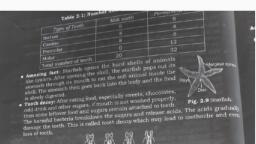
Amazing fact, Starfish feeds on animals covered by, hard shells of calcium carbonate., After opening the shell, the starfish, pops out its stomach through its, mouth to eat the soft animal inside, the shell. The stomach then goes back, into the body and the food is slowly, digested., , of the stomach and the small intestine,, and the various glands associated with the, canal such as salivary glands, the liver, and the pancreas secrete digestive juices., The digestive juices convert complex, , Buccal cavity, Salivary gland, Oesophagus, , Liver, , Fig. 2.1 Starfish, , 2.2 DIGESTION, , IN, , Gall bladder, , HUMANS, , Stomach, , Pancreas, , We take in food through the mouth,, digest and utilise it. The unused parts, of the food are defecated. Have you ever, wondered what happens to the food, inside the body? The food passes, through a continuous canal (Fig. 2.2), which begins at the buccal cavity and, ends at the anus. The canal can be, divided into various compartments:, (1) the buccal cavity, (2) foodpipe or, oesophagus, (3) stomach, (4) small, intestine, (5) large intestine ending in, the rectum and (6) the anus. Is it not a, very long path? These parts together, form the alimentary canal (digestive, tract). The food components gradually, get digested as food travels through the, various compartments. The inner walls, , Small, intestine, Large, intestine, Rectum, Anus, , Fig. 2.2 Human digestive system, , substances of food into simpler ones. The, digestive tract and the associated glands, together constitute the digestive system., Now, let us know what happens to, the food in different parts of the digestive, tract., , The mouth and buccal cavity, Food is taken into the body through the, mouth. The process of taking food into, , 12, , SCIENCE, , 2020-21
Page 3 :
Milk teeth and permanent teeth, Do you remember about falling of your teeth some years ago? The first set of, teeth grows during infancy and they fall off at the age between six to eight, years. These are termed milk teeth. The second set that replaces them are the, permanent teeth. The permanent teeth may last throughout life or fall off, during old age or due to some dental disease., , Molar, , Boojho is fascinated by the, highly coiled small intestine seen, in Fig. 2.2. He wants to know its, length. Would you like to make a, wild guess? We have given its, approximate length on page 16., Just imagine how such a long, structure is accommodated in a, small space within our body!, , Premolar, , Canine, , Incisor, , the body is called ingestion. We chew, the food with the teeth and break it, down mechanically into small pieces., Each tooth is rooted in a separate socket, in the gums (Fig. 2.3). Our teeth vary in, appearance and perform different, functions. Accordingly they are given, different names (Fig. 2.3)., , Fig. 2.3 Arrangement of teeth and different, type of teeth, , which ones for piercing and tearing?, Also find out the ones that are used for, chewing and grinding?, Record your observations in Table 2.2, , Activity 2.2, , Type of teeth, , Wash your hands. Look into the, mirror and count your teeth. Use, your index finger to feel the teeth., How many kinds of teeth could you, find? Take a piece of an apple or, bread and eat it. Which teeth do, you use for biting and cutting, and, , Cutting and, biting teeth, Piercing and, tearing teeth, Chewing and, grinding teeth, , NUTRITION IN ANIMALS, , Table 2.2, Number of teeth, Total, Lower jaw Upper jaw, , 13, , 2020-21
Page 4 :
Our mouth has the salivary glands, which secrete saliva. Do you know the, action of saliva on food? Let us find out., , Activity 2.3, Take two test tubes. Label them ‘A’ and, ‘B’. In test tube ‘A’ put one teaspoonful, , Iodine solution, , Water, Boiled rice, , A, , Boiled and chewed rice, , B, , Fig. 2.4 Effect of saliva on starch, , of boiled rice; in test tube ‘B’ keep one, teaspoonful of boiled rice after chewing, it for 3 to 5 minutes. Add 3–4 mL of, water in both the test tubes (Fig. 2.4)., Now pour 2–3 drops of iodine solution, in each test tube and observe. Why is, there a change in colour in the test, tubes? Discuss the results with your, classmates and your teacher. The saliva, breaks down the starch into sugars., The tongue is a fleshy muscular, organ attached at the back to the floor, of the buccal cavity. It is free at the front, and can be moved in all directions. Do, you know the functions of the tongue?, We use our tongue for talking. Besides,, it mixes saliva with the food during, chewing and helps in swallowing food., We also taste food with our tongue. It, has taste buds that detect different, tastes of food. We can find out the, , Sweets and tooth decay, Normally bacteria are present in our mouth but they are not harmful, to us. However, if we do not clean our teeth and mouth after eating,, many harmful bacteria also begin to live and grow in it. These bacteria, break down the sugars present from the leftover food and release, acids (see Chapter 5 to know what an acid is). The acids gradually, damage the teeth (Fig. 2.5). This is called tooth decay. If it is not, treated in time, it causes severe toothache and in extreme cases, results in tooth loss. Chocolates, sweets, soft drinks and other sugar, products are the major culprits of tooth decay., Therefore, one should clean the teeth with a brush or datun and, dental floss (a special strong thread which is moved between two, teeth to take out trapped food particles) at least twice a day and, rinse the mouth after every meal. Also, one should not put dirty, fingers or any unwashed object in the mouth., , (a), , (b), , (c), , (d), , Fig. 2.5 Gradual decay of tooth, 14, , SCIENCE, , 2020-21
Page 5 :
Sometimes when you eat in a hurry, talk or laugh while eating, you may cough,, get hiccups or a choking sensation. This happens when food particles enter the, windpipe. The windpipe carries air from the nostrils to the lungs. It runs adjacent, to the foodpipe. But inside the throat, air and food share a common passage., Then how is food prevented from entering the windpipe? During the act of, swallowing a flap-like valve closes the passage of the windpipe and guides the, food into the foodpipe. If, by chance, food particles enter the windpipe, we feel, choked, get hiccups or cough., , 5. Now write down your observations, and label Fig. 2.6., Repeat this activity with other, classmates., , The foodpipe/oesophagus, , Fig. 2.6 Regions of the, tongue for different tastes, , The swallowed food passes into the, foodpipe or oesophagus. Look at Fig. 2.2., The foodpipe runs along the neck, , position of taste buds by the following, activity., , Paheli wants to know how, food moves in the opposite, direction during vomiting., , Activity 2.4, 1. Prepare a separate sample each of, (i) sugar solution, (ii) common salt, solution, (iii) lemon juice and (iv) juice, of crushed neem leaf or bitter gourd., 2. Blindfold one of your classmates and, ask her/him to take out the tongue, and keep it in straight and flat position., 3. Use a clean toothpick to put the, above samples one by one on, different areas of the tongue as, shown in Fig. 2.6. Use a new, toothpick for each sample., 4. Ask the classmate which areas of the, tongue could detect the sweet, salty,, sour and bitter substances., , Food, , Oesophagus, , Stomach, , Fig. 2.7 Movement of the, food in the oesophagus, of the alimentary canal, , NUTRITION IN ANIMALS, , 15, , 2020-21
Page 6 :
and the chest. Food is pushed down by, movement of the wall of the foodpipe., Actually this movement takes place, throughout the alimentary canal and, pushes the food downwards (Fig. 2.7)., At times the food is not accepted by our, stomach and is vomited out. Recall the, instances when you vomited after eating, and think of the reason for it. Discuss, with your parents and teacher., , The stomach, The stomach is a thick-walled bag. Its, shape is like a flattened J and it is the, widest part of the alimentary canal. It, receives food from the food pipe at one, end and opens into the small intestine, at the other., The inner lining of the stomach, secretes mucous, hydrochloric acid and, digestive juices. The mucous protects, the lining of the stomach. The acid kills, many bacteria that enter along with the, , food and makes the medium in the, stomach acidic and helps the digestive, juices to act. The digestive juices break, down the proteins into simpler, substances., , The small intestine, The small intestine is highly coiled and, is about 7.5 metres long. It receives, secretions from the liver and the pancreas., Besides, its wall also secretes juices., The liver is a reddish brown gland, situated in the upper part of the, abdomen on the right side. It is the, largest gland in the body. It secretes bile, juice that is stored in a sac called the, gall bladder (Fig. 2.2). The bile plays, an important role in the digestion of fats., The pancreas is a large cream, coloured gland located just below the, stomach (Fig. 2.2). The pancreatic juice, acts on carbohydrates, fats and proteins, and changes them into simpler forms., , The working of the stomach was discovered by a, strange accident. In 1822, a man named Alexis St., Martin was badly hit by a shot gun. The bullet had, seriously damaged the chest wall and made a hole, in his stomach. He was brought to an American, army doctor William Beaumont. The doctor saved, the patient but he could not close the hole properly, and left it bandaged (Fig. 2.8). Beaumont took it as, a great opportunity to see the inside of the stomach, through the hole. He made some wonderful, observations., Beaumont found that the stomach was churning Fig. 2.8 Alexis St. Martin’s, shotgun wound, food. Its wall secreted a fluid which could digest, the food. He also observed that the end of the stomach opens into the intestine, only after the digestion of the food inside the stomach is completed., 16, , SCIENCE, , 2020-21
Page 7 :
The partly digested food now reaches the, lower part of the small intestine where, the intestinal juice completes the, digestion of all components of the food., The carbohydrates get broken into, simple sugars such as glucose, fats into, fatty acids and glycerol, and proteins, into amino acids., , proteins required by the body. This is, called assimilation. In the cells, glucose, breaks down with the help of oxygen, into carbon dioxide and water, and, energy is released. The food that, remains undigested and unabsorbed, enters into the large intestine., , Absorption in the small, intestine, , The large intestine is wider and shorter, than small intestine. It is about 1.5 metre, in length. Its function is to absorb water, and some salts from the undigested food, material. The remaining waste passes, into the rectum and remains there as, semi-solid faeces. The faecal matter is, removed through the anus from, time-to-time. This is called egestion., , The digested food can now pass into the, blood vessels in the wall of the intestine., This process is called absorption. The, inner walls of the small intestine have, thousands of finger-like outgrowths., These are called villi (singular villus)., Can you guess what the role of villi could, be in the intestine? The villi increase, the surface area for absorption of the, digested food. Each villus has a network, of thin and small blood vessels close to, its surface. The surface of the villi, absorbs the digested food materials. The, absorbed substances are transported, via the blood vessels to different organs, of the body where they are used to build, complex substances such as the, , Large intestine, , 2.3 DIGESTION IN GRASS-EATING, ANIMALS, Have you observed cows, buffaloes, and other grass-eating animals, chewing continuously even when, they are not eating? Actually, they, quickly swallow the grass and store, it in a part of the stomach called, rumen (Fig. 2.9). Here the food gets, , Diarrhoea, Sometime you may have experienced the need to pass watery stool frequently., This condition is known as diarrhoea. It may be caused by an infection, food, poisoning or indigestion. It is very common in India, particularly among children., Under severe conditions it can be fatal. This is because of the excessive loss of, water and salts from the body. Diarrhoea should not be neglected. Even before a, doctor is consulted the patient should be given plenty of boiled and cooled water, with a pinch of salt and sugar dissolved in it. This is called Oral Rehydration, Solution (ORS)., NUTRITION IN ANIMALS, , 17, , 2020-21
Page 8 :
Paheli wants to know why, these animals cannot chew, food properly at the time they, take it in?, , Boojho wants to know why, we cannot digest cellulose, like the cattle do., , partially digested and is called cud., But later the cud returns to the mouth, in small lumps and the animal chews, it. This process is called rumination and, these animals are called ruminants., The grass is rich in cellulose, a type, of carbohydrate. In ruminants like cattle,, deer, etc., bacteria present in rumen, Oesophagus, , Small Intestine, Rumen, , helps in digestion of cellulose. Many, animals, including humans, cannot, digest cellulose., Animals like horses, rabbit, etc., have, a large sac-like structure called Caecum, between the oesophagus and the small, intestine (Fig. 2.9). The cellulose of the, food is digested here by the action of, certain bacteria which are not present in, humans., So far you have learnt about animals, which possess the digestive system. But, there are many small organisms which do, not have a mouth and a digestive system., Then, how do they acquire and digest, food? In the section below you will learn, another interesting way of food intake., , 2.4 FEEDING AND DIGESTION, AMOEBA, , IN, , Amoeba is a microscopic single-celled, organism found in pond water. Amoeba, has a cell membrane, a rounded, dense, nucleus and many small bubble-like, vacuoles (Fig. 2.10) in its cytoplasm., Amoeba constantly changes its shape, and position. It pushes out one, or, more finger-like projections, called, pseudopodia or false feet for movement, and capture of food., Nucleus, Pseudopodium, Food particle, (ingestion), , Food vacuole, Stomach, , Large Intestine, , Caecum, , Egested waste, , Fig. 2.10 Amoeba, , Fig. 2.9 Digestive system of ruminant, 18, , SCIENCE, , 2020-21
Page 9 :
Amoeba feeds on some microscopic, organisms. When it senses food, it, pushes out pseudopodia around the, food particle and engulfs it. The food, becomes trapped in a food vacuole, [Fig. 2.10)., Digestive juices are secreted into the, food vacuole. They act on the food and, break it down into simpler substances., Gradually the digested food is absorbed., , The absorbed substances are used for, growth, maintenance and multiplication., The undigested residue of the food is, expelled outside by the vacuole., The basic process of digestion of, food and release of energy is the same, in all animals. In a later chapter you, will learn about the transport of food, absorbed by the intestine to the various, parts of the body., , Keywords, Absorption, Amino acid, Amoeba, Assimilation, Bile, Buccal cavity, Canine, Cellulose, Digestion, Egestion, , Fatty acid, Food vacuole, Gall bladder, Glycerol, Incisor, Ingestion, Liver, Milk teeth, Molar, Permanent teeth, , Oesophagus, Pancreas, Premolar, Pseudopodia, Rumen, Ruminant, Rumination, Salivary glands, Villi, Saliva, , What you have learnt, n, , Animal nutrition includes nutrient requirement, mode of intake of food, and its utilisation in the body., , n, , The human digestive system consists of the alimentary canal and, secretory glands. It consists of the (i) buccal cavity, (ii) oesophagus,, (iii) stomach, (iv) small intestine, (v) large intestine ending in rectum, and (vi) anus. The main digestive glands which secrete digestive juices, are (i) the salivary glands, (ii) the liver and (iii) the pancreas. The stomach, wall and the wall of the small intestine also secrete digestive juices., , n, , The modes of feeding vary in different organisms., , n, , Nutrition is a complex process involving: (i) ingestion, (ii) digestion,, (iii) absorption, (iv) assimilation and (v) egestion., , NUTRITION IN ANIMALS, , 19, , 2020-21
Page 10 :
n, , Digestion of carbohydrates, like starch, begins in the buccal cavity. The, digestion of protein starts in the stomach. The bile secreted from the, liver, the pancreatic juice from the pancreas and the digestive juice, from the intestinal wall complete the digestion of all components of food, in the small intestine. The digested food is absorbed in the blood vessels, from the small intestine., , n, , The absorbed substances are transported to different parts of the body., Water and some salts are absorbed from the undigested food in the, large intestine., , n, , The undigested and unabsorbed residues are expelled out of the body, as faeces through the anus., , n, , The grazing animals like cows, buffaloes and deer are known as, ruminants. They quickly ingest, swallow their leafy food and store it in, the rumen. Later, the food returns to the mouth and the animal chews it, peacefully., , n, , Amoeba ingests its food with the help of its false feet or pseudopodia., The food is digested in the food vacuole., , Exercises, 1. Fill in the blanks:, (a) The main steps of nutrition in humans are __________, __________,, __________, _________ and __________., (b) The largest gland in the human body is __________., (c) The stomach releases hydrochloric acid and ___________ juices which, act on food., (d) The inner wall of the small intestine has many finger-like outgrowths, called _________., (e) Amoeba digests its food in the ____________ ., 2. Mark ‘T’ if the statement is true and ‘F’ if it is false:, (a) Digestion of starch starts in the stomach. (T/F), (b) The tongue helps in mixing food with saliva. (T/F), (c) The gall bladder temporarily stores bile. (T/F), (d) The ruminants bring back swallowed grass into their mouth, and chew it for some time. (T/F), 3. Tick (ü) mark the correct answer in each of the following:, (a) Fat is completely digested in the, (i) stomach (ii) mouth (iii) small intestine (iv) large intestine, 20, , SCIENCE, , 2020-21
Page 11 :
(b) Water from the undigested food is absorbed mainly in the, (i) stomach (ii) foodpipe (iii) small intestine (iv) large intestine, 4. Match the items of Column I with those given in Column II:, Column I, , Column II, , Food components, , Product(s) of digestion, , Carbohydrates, , Fatty acids and glycerol, , Proteins, , Sugar, , Fats, , Amino acids, , 5. What are villi? What is their location and function?, 6. Where is the bile produced? Which component of the food does it help to, digest?, 7. Name the type of carbohydrate that can be digested by ruminants but, not by humans. Give the reason also., 8. Why do we get instant energy from glucose?, 9. Which part of the digestive canal is involved in:, (i), , absorption of food ________________., , (ii), , chewing of food ________________., , (iii), , killing of bacteria ________________., , (iv), , complete digestion of food ________________., , (v), , formation of faeces ________________., , 10. Write one similarity and one difference between the nutrition in amoeba, and human beings., 11. Match the items of Column I with suitable items in Column II, Column I, (a) Salivary gland, , Column II, (i), , Bile juice secretion, , (b) Stomach, , (ii), , Storage of undigested food, , (c), , (iii), , Saliva secretion, , (d) Rectum, , (iv), , Acid release, , (e), , Small intestine, , (v), , Digestion is completed, , (f ), , Large intestine, , (vi), , Absorption of water, , Liver, , (vii), , Release of faeces, , NUTRITION IN ANIMALS, , 21, , 2020-21
Page 12 :
12. Label Fig. 2.11 of the digestive system., , Fig. 2.11 A part of human digestive system, 13. Can we survive only on raw, leafy vegetables/grass? Discuss., , Extended Learning — Activities and Project, 1. Visit a doctor and find out:, (i), , Under what conditions does a patient need to be on a drip of, glucose?, , (ii), , Till when does a patient need to be given glucose?, , (iii), , How does glucose help the patient recover?, , Write the answers in your notebook., 2. Find out what vitamins are and get the following information., (i), , Why are vitamins necessary in the diet?, , (ii), , Which fruits or vegetables should be eaten regularly to get, vitamins?, , Write a one-page note on the information collected by you. You may take, help of a doctor, a dietician, your teacher or any other person, or from, any other source., , 22, , SCIENCE, , 2020-21
Page 13 :
3., , Collect data from your friends, neighbours and classmates to know more, about “milk teeth”., Tabulate your data. One way of doing it is given below:, , S. No. Age at which, first tooth fell, , Age at which, last tooth fell, , No. of teeth, lost, , No. of teeth, replaced, , 1., 2., 3., 4., 5., Find out from at least twenty children and find the average age at which, children lose the milk teeth. You may take help of your friends., , Did you know?, Fats in goat’s milk are much simpler than those in cow’s milk. Therefore,, the goat’s milk is much easier to digest than the cow’s milk., , NUTRITION IN ANIMALS, , 23, , 2020-21