Page 1 :
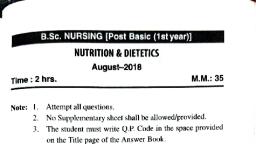
B.Sc., , NURSING [Post Basic, , (1styear)], NUTRITION &DIETETICS, August-2014, , Time:2hrs., , M.M.: 35, , Note:, , Attempt all questions., , Q.1., , Define the following:, , (1x5-5), , (a) Nutrients, , b) RDA of proteins, (c) Under nutrition, , (d) Carbohydrates, Essential Amino acids, Dietary management of any two of the following:, , (e), , Q.2., , (a) Heart disease, (b) Peptic ulcer, (c) Marasmus, , Q.3., , (3% x2-7), , (d) Premature infants, Explain any two of the following:, , (3% x 2, , 7, , in India, Ma) National nutritional programme, , Needs of community nutrition programme, diet, (c) Importance of balanced, (3%, Describe briefly any two of the following:, , (b), , 9.4., , x, , 2 7), , mother, , Q.5., , a ) Nutritional needs of lactating, nutritional foods, 6 ) Selection of cheap and, e ) Problems in feeding, following:, Write short, , (a), , Rich, , notes on, , sources, , ofthe, , of proteins, , b)Weaning effects, (c), , any three, , Macronutrients, , on, , and, , mother and child, micronutrients, , human body, minerals in the, of, Role, (d), e ) Preparation of soups, , 249, , (3x3 9 )
Page 2 :
SES Post Basic B.Sc., , 250, , Nursing (1st, , Ya, Yean, , SOLVED PAPER, , QUESTION-1, , Define the following, (a) Nutrients, (b) RDA of proteins, (c) Under nutrition, , (d) Carbohydrates, (e) Essential Amino acids, , ANSWER-1(a), Nutrients: Nutrients are organic and inorganic compounds found in, diet. These are also called constituents of food. These are divided into, two types:, , 1., , Macronutrients: These are the bulk of food and are the main, sources of energy. Proteins, fats and carbohydrates are kept in, , 2., , this category., Micronutrients: These required in small quantities. This cat, egory includes minerals and vitamins., , ANSWER1(b), », RDA of Proteins: The recommended dietary allowance of proteins, has, determined by body weight. Indian Council of Medical Research, , recommended and allowance of one gram protein per kg for auu, , based on the body weight. The requirement of protein is greater, infants, pregnant and lactating women, adolescent boys and girs, , ANSWER 1 (), utti, , Under Nutrition: This is the condition which results when insu, cient food is eaten over an extended period of time. In extreme ca, , c a s e s, , it is called starvation., , ANSWER 1 (d), and, , Carbohydrates: Carbohydrates composed of Carbon, Hydrog, , the major, , Oxygen (CHO) and it is the main component of diet. It is tne, , source of energy in the diet.
Page 3 :
Nutrition, , and Dietetics, , 251, , (August-2014), , ANSWER-1 (e), Essential Amino Acids: Proteins are made up of smaller units, called, amino acids and some amino acids are needed by the human body., Essential amino acids are those which cannot synthesize in the body., , EEA are Leucine, Isoleucine, Lysine, Methionine, Phenylalanine,, Threonine, Valine, Trypto-phan and Histidine., , QUESTION-2, Dietary management of any two of the following:, (a) Heart disease, (b) Peptic ulcer, (c) Marasmus, (d) Premature infants, , ANSWER-2(a), Dietary Management of Heart Disease, deCongestive heart failure is a form of chronic heart disease, may, heart muscle is unable, velop over time. The progressively weakened, sustain normal blood circuto maintain an adequate cardiac output to, , lation. The resulting fluid imbalance cause edema, especially pulmo, , makes, nary edema. This condition, , breathing difficult and paces more, , stress on the labouring heart., is to control the fluid, The basic objective of dietary management, imbalance that results in, , Dietary, , pulmonary edema., , heart disease includes the folmanagement of chronic, , lowing:, , No salt is served with, 1.Sodium restriction (2-3 g per day only):, the diet, role in tissue fluid balance,, meals. Because of sodium's, restricts sodium intake. The main, used to treat pulmonary edema, salt or sodium chlocommon table, Source of dietary sodium is, is 3.4 g/day. Other than the salt, sodium, intake, of, adult, ride. Daily, sources of sodium include, in food processing. Remaining, mineral in certain foods. So,, as a naturally occuring, found, such as, nat, , Sed, , resh, , foods, , herbs., , are, , encouraged with, , Salty processed foods, , are, , sodium-free, , avoided, eg, , flavouring, pickles, olives, ba-
Page 4 :
SES Post Basic B.SC. Nursing (1st Yean, , Year), , 252, con,, , ham,, , corn, , low sodium, , 2., 3., , are, , chips, potato chips., , Some, , processed foods, , wi, , available in food intake., , when indicated., Fluid restriction: Limited to 1500 ml/day, better if eating is un., Texture: Patients may tolerate soft foods, comfortable., , 4., , 4., , Small meals: Frequent small meals 5-6 per day are better suited, , than large meals., 5., , Alcohol: Intake is limited or avoided if it contributes to heart, , disease., , ANSWER 2 (b), Dietary Management in Peptic, , Ulcer:, , An ulcer is a crater 1like lesion in the wall of the stomach or duodenum, that erodes the mucosal layers., In the past, a highly restrictive, bland diet was used in the care of, patients with peptic ulcer disease. A bland diet has long since proved, to be ineffective and lacking in adequate nutrition support for the heal-, , ing process. Such a restrictive diet in unnecessary today because, newer and better drugs are available to control acid secretions and, , assist healing. Thus, current diet therapy is based on a liberal individual approach, guided by individual responses to food. In this positive nutrition support for medical management, two basic goals guide, food habits:, 1., , Eating a well-balanced, healthy diet: Supply a well-balanced,, , regular healthy diet to aid tissue healing and maintenance., 2., , Avoiding, , acid stimulation: Avoid, , stimulating, , excess, , gastric, , acid secretion, which irritates gastric mucosa. Only a few foodrelated habits have been shown to affect acid, as fol, , secretion,, , lows:, a., Food, , b., , 1o, , quantity: To avoid stomach distention, do not eat lar, quantities at meals. Avoid eating right before going to, o, food intake stimulates acid, output., Milk intake: Avoid, mu, drinking, it, milk, high-fat, because, stu, lates significant acid, d, fering, has only transient, secretion,, buio, effect, and its, animal fat content is, , undesirable.
Page 5 :
Dietefics, , Nutrition and, , (August-2014), , 253, , Seasoning: Individual tolerance is the rule, but hot chilli,, black pepper have shown variable results and perhaps should, be limited., , Dietary fibre: No evidence exists for restricting dietary fi, , bre. Some fibres, especially soluble forms are beneficial., Coffee: It also stimulates acid secretion and may cause indigestion., f., , ., , Citric acid juices: These juices may cause discomfort in, persons with existing esophagitis., Alcohol: Avoid alcohol because it also stimulate gastric acid., Smoking: Complete smoking cessation is best because, smoking hinders ulcer healing. It affects gastric acid secre-, , tion and hinders the effectiveness of drug therapy., , i., , Food environment: Finally we consider the food environ, ment. Eat slowly and savor the food in a calm environment., individual responses or tolerances to specific foods., , Respect, , Remember that the same food may bring different responses, at, , different times, , depending on stress., ANSWER-2(c), , Dietary Management, Marasmus is the, common clinical, in, , of Marasmus, undermourished child. This is a, malnutrition, to severe protein-calorie, , severely wasted,, , syndrome due, , young children. There is, , a severe, , deficiencies of protein and caloand should contain, , in the diet. The diet should be easily digestible, The nutritional, nutritive value, e.g. milk proteins., proteins of, , Ties, , high, , quirements, , are, , briefly discussed, , re-, , below:, , norbe about 1'% times than, should, intake, calorie, Calories: The, for rapid recovery., mal requirements, i.e. 140 kcal/kg, the normal, should be about twice, Froteins: The protein intake, body weight., requirements, i.e. 4-5 g/kg, and magnesium, 33, chloride (2-4 8), Potassium, Electrolytes:, for a period of 2 weeks., to the diet, added, daily, be, 1de . 5 g should, vitamins should be added, all, of, requirements, The, daily, administration, lamins:, is present, oral, O the diet. If vitamin A deficiency, soluble vilamin A should be, of a Single dose of S0,000 IU fat, O, , Cin, , chlo, , of
Page 6 :
SES Post Besic B. Sc. Nursing (1st Yaas, , Yeer), , 254, 5000 units., given immediately followed by, toms, , 5., , will be cured in about 2 weeks., , The, , deficiency syymp-, , Iron: For the treatment of anemia, ferrous Ammonia citrate (0, , in the form of a syrup in three divided, doses for a period of one month. Folic acid I mg should be given, , g), , should be, , given daily, , daily for a week followed by 100 microgram daily afterwards, , ANSWER-2(d), Dietary Management of Premature Infants: Special, , care, , is crucial, , for tiny, pre-mature babies who are categorized into two primary, , groups defined by weight or gestational age. Defined by birth weight,, low birth weight infants are those who weigh less than 2500 g, very, low birth weight infants are those weighing less than 1500 g. ex, tremely low birth weight babies whose weight is less than 990 gm. De, fined by gestational age, premature infants are born preterm less than, 270 days of gestation and their weight less than 2500 g., , Immature infants are subject to problems with growth and nutrition. Because their bodies are not fully formed, they differ from tem, , infants of normal weight in the following ways:, 1., , 3., , 5., 6, , More body water, less protein and fewer minerals., Little subcutaneous fat to maintain body temperature., Poorly calcified bones., Incomplete nerve and muscle development, making their sucking, reflexes weak., , Limited ability for digestion, absorption and renal function., An immature liver lacking developed metabolic, enzyme system o, adequate iron stores. To survive, these tiny babies require specia, , feeding, Types, , of Milk: For, , formulas, 1., , 2., , are, , premature infants both breast milk and speca, , needed for their growth., , Standard milk, , Types of formulas, , are:, , based-formulas: These formulas are made with, cow's milk protein. Lactose and, minerals from the cow's m as, well as vegetable oils,, minerals, vitamins are also in the formnula., Almost all babies and infants do, well on, Soy-based formulas: These are made these formulas. But, by using soy protein, have not been, proven to help with milk, allergies or colic.
Page 7 :
Nutrition and.Dietetics (August-2014), , 256, , Hypoallergic formulas: These types of formula may be helpful, , for infants who have true allergies to milk protein and for those, , with skin rashes or wheezing caused by allergies., Lactose free formulas: These formulas are used for, , galac-, , tosemia, congenital lactose deficiency and primzry lactose defi-, , ciency. An infant who has an illness with diarrhea usually will not, need lactose free formula., 5. Some special formulas are used only under doctor's, supervision:, , a. Reflx formula: These are pre-thickened with rice., b. Formulas having extra calories and minerals., c., Special formulas for infants with heart disease, malabsorption, syndromes and problems digesting fat or processing certain, amino acids., , QUESTION3, Explain any two of the following:, , (a) National nutritional programme in India, (b) Needs of community nutrition programme, (c) Importance of balanced diet, , ANSWER-3 (a), National Nutritional Programme in India, , In 1993, the govt. of India adopted a National Nutrition Policy (NNP), , which aims at the eradication of malnutrition and to achieve high stanadard, in the community through, The food and nutrition board was formed in 1964 under the minagriculture to bring variety in the dietary habits with the dual, o, and to make the, ojectives of reducing the demand of food grains, nutrition board:, diet more nutritious. Activities of food and, , ofnutrition, , multi-sectoral policy., , dual, , Education and training in nutrition:, a., , Nutrition demonstration programmes, and vegetables., Training in domestic preservation of truits, ntegrated nutrition education., and world food, d. 0, 1, , observe nutrition weeks 1-7 September, , day 16, , October,, , week 1-7 august., world breastfeeding
Page 8 :
SES Post Basic B.Sc., , 256, 2., , Development and, , a., , b., , enhancement, , Nursing (1st Yean, , of nutritive foods:, , Assessment of regularity and quality of supplementary fo, , food, , in anganwadi., , To encourage production of nutritious foods, foods inin, , the, , community., 3., , Fortification of food:, a., , b., , fortify milk with vitamin, To fortify salt with iodine., To, , 4., , Food analysis., , 5., , Research and development., , 6., , National nutrition policy and its, , A., , implementation., , nutrition programme, Some of community, , 1., , Applied nutrition programme., , 2., 3., 4., , Vitamin A, , Prevention of nutritional anemia., Mid-day meals programme., , 5., , Balwadi nutrition programmne., , 6., , Tamilnadu integrated nutrition programme., Special nutrition programme., , 7., , 8, , are as, , under:, , prophylaxis programme., , Integrated Child Development, , Service, , (ICDS)., , ANSWER-3 (b), Needs of Community Nutrition Programme, and wrong notions, . To avoid bad habits, prejudices, idiosyncrasies, regarding diet., and the community abo, 2. To educate the individual, the family, cooN, food articles and their nutritive value, balanced diet, proper, , ing methods and requirement of energy., 3., , To explain the, , technique ofbalanced diet, based on the availab, , ity and the income limits., , 4. To inform about food substitutes changes and modificationin the, 4., methods on, 5. To educate about the effects of various cooking, nutrients., , 6., , res, , To tell about the symptoms of deficiency diseases and measu, of prevention., , up, , 7. To underline the nutritional requirements of the vulnerable gro, i.e. children, pregnancy, lactation and old age.
Page 9 :
Nutrition and, 8., , Dietetics, , (August-2014), , 257, , To describe about the methods of storage and preservation of, , food., a, , To, , underline, , the, , importance, , of food, , hygiene., , ANSWER-3 (¢), Importance of Balanced Diet, 1. Growth and development: A well balanced, healthy diet helps, children to grow and lean. It also prevents obesity. It support, , growth and development for children includes five servings of, fruits and vegetable daily, proteins such as lean meats, nuts and, , eggs, whoie grains for fiber and milk for calcium and protein., 2. Weight control: Balanced diet helps to control weight. Calorie, needs depend on age, activity level and weight goals. Diet contains, low calorie, nutrient dense foods such as fruits, vegetables, whole, and lean proteins. These foods satisfy hunger while meet-, , grains, , ing nutrient needs in fewer calories to maintain a healthy weight., , 3., , Improved energy: Calories, , are, , the, , of energy stored in, amount of energy while, , amount, , food. Balanced diet provides the right, consumed provide energy,, maximizing nutrient intake. The food, and, with vitamins and minerals, for the body's cells, organs, , along, , muscle tissue., , 4., , foods reduce the risk for, Reduced risk for illness: The right, foods are at an increased, chronic disease. People who eat fatty, diabetes and cancer. A balanced, risk for developing heart disease,, potassium, fiber and essential, and, , E,, includes vitamins A, C, chronic disease., against, to, protect, will, acids, help, 1aty, whole, diet rich in fruits, vegetables,, A, depression:, Decreasing, help to prevent depresmeats and fish may, diet, , erains and high quality, sion and anxiety., , enhance imdiet helps to, well balanced, A, n h a n c e immunity:, minerals they help to, vitamins and, munity. Diet rich in proteins,, , maintain, , our, , immune, , system, , also,, , QUESTION-4, , a, , escribe briely any, , (a) Nutritional, , following:, two of the, , needs, , of lactating, , mother
Page 10 :
258, , SES Post Basic B.Sc., , Nursing (1st, , Yaa., , Year, , (b) Selection of cheap and nutritional foods, ()Problems in feeding, , ANSWER4(a), Nutritional Needs of Lactating Mother, The basic diet followed during pregnancy, as well as the prenatal nue, trient supplement used, should be continued through the lactation, riod. In general, attention to three areas of lactation support is needed:, , pe, , 1., , Diet:, a., , Energy and nutrients: Milk production requires energy for, both the process and product. Some of thiS energy may be, , met by extra fat stored during pregnancy. The recomme, ndation is 330 kcal/day in first 6 months and 400 kcal/day in, the second 6 months of lactation more than a woman's, , normal need of approximately 220 kcal. The need for protein, during lactation is 25 glday more than a woman's average, The core food plan for meeting lactation, need of 46, , g/day., , needs includes three servings of milk products, six to eight, , ounces, , servings of dark green or, to three servings of other vegetables,, , of protein foods,, , one, , to two, , yellow vegetables, two, fruits and juices, 6-9 ounces, , of whole, , breads and cereals and moderate, , grain, , amounts, , or, , enriched, , of butter, , or, , fortified margraines., b., , amount of tlu, Fluids: Breastfeeding mothers need adequate, such, sources of fluid, ids for milk production. Water and other, milk and soup contribute to, , juices,, produce milk. Beverages containing, , as, , the fluid necessary, , to, , alcohol and caffeine, , should be limited., , 2., , ad, the increased diet and, Rest, exer, mothers require rest, moderate, breastfeeding, fluids,, equate, and Relaxation:, , In addition, , to, , cise and rest., , ANSWER 4 (b), Nutritional Foods, Selection of Cheap and, in the budget of most of the families, Food is the largest single item, nutritional foods, following thing, For the selection of cheap and, , should kept in mind:
Page 11 :
Nutrition and, , Dietetics, , (August-2014), , 259, , The quality and characteristics for specific foods must be under, , etood. If wise selection are to be made, some planned purchase, can made appreciable savings., , st, , 2, , Plan meals for several days at one time. Use four food groups as, the basis for menu planning to assure good nutrition., , 3. Use market list. Be prepared to make substitutions when other, foods of equal nutritive value are cheaper., 4. Purchase foods that the family likes., 5. Read labels on packages and cans and compare weights and costs, of various brands., , 6. Buy large size packages only if the price per unit is less., 7. Provide storage conditions that maintain the wholesomeness and, nutritive value of food., , 8. Eat meals at home instead of eating at restaurants., 9. Only buying seasonal foods, this can cut the extra expenses and, , economize the food cost and provide adequate supply., , 10. Some of the product like cakes, pizza, pickles can prepared at, home hygienically and at low cost., 11. One should avoid impulse buying which can waste a lot of, , money., , 12. For economical benefit in selection of fats, margraines are consid, ered less costly than eggs. Out of hydrogenated fats and oils,, , corn and cotton seed oil possess the advantage of having high, and, acid and are inexpensive than sunflower oil, content, , oflinoleic, , sesame oil., , ANSWER-4 (¢), for, Problems in Feeding: Ordinarily, meal is a pleasant experience, mechanism, diseased condition, the digestion, under, But, person., every, or may end. He has, IS affected. The patient's hunger may be reduced, from eating or refusal to eat is a, Interest towards meals. Absence, , illness. Refusal to eat be-, , behavior of the patients during, the nurse to know the, necessary for, is, it, a, Hence,, omes problem., refuses to eat. The factors which, the, patient, which, under, aCtors, Create problems in feeding are as follows:, , common, , ,Environmental factors:, a., , or unsuitable dining, , Change in the place ofmeals, of the patient., according to the liking, , place or not
Page 12 :
SES Post Basic B.Sc. Nursing (1st Ye, , Year), , 260, presence of undesirable, , environment,, b. Dirty dining, unpleasant environment., are scene,, , c., C., , d., , Lack, , art:, , articles, , unattractive or, , of ventilation, , and, , lighting., , noise, disorder, confusion, crying,, Shouting, excessive, , eto, , during meals., e., , Inappropriate temperature, , and excessive, , meals., , Bad dress of the, , f., 2., , patient and, , of those, , humidity durino, , serving, , food., , Cultural factors:, , b., , unfamiliar with their usage., Unsuitable utensils or to be, table or floor for sit., of, Change in style of eating (use dining, , c., , Abstinence, , a., a., , ting)., , by vegetarians from, , meat, eggs, etc. and fearing, , its mixing with their food., , modified diet., , vegetarians disliking about vegetarian, with religious beliefs, e.g. Jains, Timing of meals not suitable, do not eat during night or irregular timings., desired persons as per religious, Not getting food cooked by, or, , Non, , d., e., , f., , belief., , meals, opportunity to pray before, some religious practices., Not getting an, , 33., , or, , to follow, , Psychological factors:, , according to, , the taste of the, , a., , Meals not, , b., , exhaustion., Physical and mental, , C., , meals., Unattractive flavor and color of, , d., , Feeding fear,, , e., , Personal, , worries while, , patient., , eating or serving food., , while eating, , experience of the patient not favorable,, meals, or those serving, Unfavorable behavior of doctor, nurse, , f., , with the patient., Unclean, , g., 4., A, , serving utensils., , Other factors:, , Physical weakness of patient., Full rejection of diet by patient., , a., , b., In this, , manner,, , ing for, , various, , the, , problems in acceptance of feeu, Sometimes it becomes difficult to find tha, doubt or event the patient not accepting, , patient can, , reasons., , due to what unknown, , fear,, , create
Page 13 :
Nutrition and, , Dietetics, , 261, , (August-2014), , feed. Hence, the nurse, based on her knowledge or skillfully motivate, and encourage the patient for accepting food, by removing all the, hurdles., , QUESTION-5, Write short notes on any three of the following:, (a) Rich sources of proteins, , (b)Weaning effects, , on, , mother and child, , Macronutrients and micronutrients, d) Role of minerals in the human body, , (c), , (e) Preparation of soups, , ANSWER-5 (a), Rich Sources of Proteins, Proteins are very necessary for human nutrition and biological reac-, , tions. Body contains about 20% protein. Proteins are derived mainly, from two types of food sources. These are:, 1., , Animal sources: Proteins of animal origin are found in meat,, Animal proteins contain all, eggs, fish and fowl, milk and cheese., the essential amino acids in adequate amount. It is called first class, , protein. Egg proteins are considered to be best among food pro, teins because of their high biological value and digestibility., 2. Vegetable source: Vegetable proteins are found in pulses, beans,, p0or in essential amino, acids. In India, cereals and pulses are the main sources of dietary, available and consumed in, protein because they are cheap, easily, , nuts, oil-seed cakes, cereals, etc. They, , are, , bulk., Pulses: Red gram dal, Bengal gram dal,, the richest source, Soyabeans.. Soyabeans are, , 3, , Black gram dal,, of protein and is, , also called poor men's meat., ., , Nuts:, , Peanuts, cereals, wheat, parboiled, , rice., , ANSWER-5 (b), Child, , Weaning Effects on Mother and, is the cessation of the, Weaning Effects on Mother: Weaning, mother or can be child led. A, oreastfeeding. It can, , be initiated, , by the
Page 14 :
SES Post Basic B.Sc., , 262, , Nursing (1st, , sar), , mother may decide to wean her baby earlier than this for a variety of, , reasons, including an emotional need to have her body back, work, schedules or going on a medication that may be contraindicated while, , the mother or child ini., tiates the weaning process, breast-feeding mothers may experience, , nursing. Regardless of the, , reason, whether, , side effects related to the weaning process:, 1., , Feelings of fullness: When breastfeeding comes to an end, it, , will take a period oftime for the milk to subside. During this time, mothers may feel an uncomfortable feeling of füllness, especially, , if weaning occurs abruptly., 2., , Plugged ducts and mastitis: When weaning occurs, it is pos-, , sible that very painful side effects such as plugged ducts can, occur. Mother is experiencing a localized point of tenderness on, the breast. Massage, heat and milk expression are needed to rem-, , edy a plugged duct. If it is left untreated,, , a, , serious breast infec-, , tion known as mastitis include severe pain in the breast, redness,, fever and warmth to touch. Mastitis is treated by using heat, milk, , expression and with antibiotics. Gradual weaning can also de, , 3., , crease the risks of developing these side effects of weaning., Depression: As the milk production decreases, hormone levels, , begin to fluctuate., , Prolactin is the hormone responsible, , largely for, , lactation. It can also impart feeling of calmness and happiness to, , the mother. When this hormone decreases, feelings of sadness, may occur. The time of weaning can also elicit feelings of sadness, when the mother realizes her baby is growing up and this part or, , relationship is over. Mothers with a history of depression may be, more likely to experience weaning-induced depression., 4., , Physical symptoms: Sometimes weaning process can cause, mother to experience other physical symptoms unrelated to the, , breasts. Nausea, mood swings and headaches are all side effects, that may occur with the weaning process, most likely due to, , hormonal fluctuations. These symptoms can mimic early preg, nancy symptoms, so some mothers may think that a new preg, , nancy has occurred when in reality it is hormonal changes from, , weaning., Weaning Efects on Child: Weaning is not sudden withdrawl of chilo, from the breast. It is a gradual process, starting around the age of 5
Page 15 :
Nutrition, 6, , and, , Dietetics, , 263, , (August-2014), , months. These are usually cow's milk, soft cooked rice, mashed po, , cooked vegetables, because usually after about 6 months, tatoes, soft, milk is no longer sufficient to sustain growth. So,, of age, mothers, If, supplementation with cereals, pulses, milk and eggs are essential., and, weaning is delayed or not done, children do not grow properly, , protein energy malnutrition develops., , ANSWER-5(c), Macronutrients and Micronutrients, , Nutrients, , are, , organic, , and, , inorganic complexes, , contained in food., , about 50 different nutrients which are normally supplied, has specific functions in the, through the foods we eat. Each nutrient, nutrient. These may, Most natural foods contain more than one, These, , are, , body., , be divided into:, ., , Macro Nutrients, , 2., , Micro nutrients, , Macronutrients:, , called, , which are often, proteins, fats and carbohydrates, form the main bulk of food in the, because, they, proximate principles", These, , are, , Indian dietary. They contribute to, , ing proportions:, 1., , the total energy intake in the, , follow, , 7 to 15%, , Protein, , 2. Fats, 3. Carbohydrates-, , 10 to 30%, , 65 to 80%, , Micronutrients:, , called micro nutrients, minerals. They are, and, vitamins, This includes, from a, amount which may vary, small, in, Decause they are required, , Iraction of a, , milligram to several grams., , ANSWER-5 (d), Body, Role of Minerals in the Human, , Vneral are inorganic, , ual for many vital, S, OE, , which are essenSome of the essential mineral, , micro quantities, compounds in, , functions of the, , body., , calcium, Iron and lodine., phosphate,, potassium,, are sodium,, described below:, human body are, of each mineral in the
Page 16 :
SES Post Basic B.Sc. Nursing, ng (1st, (1st vYea, , 264, 1., , Sodium: It is essential for many body activities. It is an extracel, , lular cation. It helps in the transmission of nerve impulses, co, , traction of muscles and maintenance of electrolyte balance in the, 2., , body., , Potassium: It is an intracellular cation and is involved in vario, , biochemical activities in the cells. It helps in transmission of nerve, impulses, maintenance of electrolyte balance and contraction of, , 3., , muscles., Phosphate: It works synergistically with calcium in the forma-, , tion of bones and enamel of teeth. It is important component of, adenosine triphosphate and adenosine diphosphate which are encells., ergy stores for the body, 4. Calcium: It is important component in bones and enamel of, teeth. It is also essential for muscle contraction and blood coagu-, , lation. It helps in synthesis of vitamin D in the body., 5. Iodine: It is essential for the synthesis of thyroid hormones, ie., indirect, T3 (Triiodothyronine) and T4 (Thyroxine). Hence, play, role in maintaining metabolic rate., blood, 6. Iron: It plays vital role in formation of hemoglobin, a red, and, cells pigment. It is necessary for oxidation of carbohydrates, in synthesis of some neurotransmitters and hormones., , ANSWER-5 (e), Preparation of Soups, , Soups are used as full liquid diet., , Some, , preparation of soups are de, , scribed below:, 1., , which, Bone soups: The base of this soup is stock or meat water, Bones are, is prepared by warming bones and meat for a long time., , broken into small pieces and meat is grinded and they are warmeu, is boiled, in water. Salt is added after foam appears. The mixture, , for 2-3 hours. From time to time, the foam is removed. After tnis, the mixture is strained through, solids. Soup is served hot., 2., , a, , fine strainer to, , remove, , fat and, , Non-vegetarian soup: Vegetable pieces are heated with butteri, , a sauce, , water, pan. For taste, salt, chiliies and boiled meat and, , mixed and the vegetable pieces are boiled till they become sol, This can be used after straining.
Page 17 :
Nutrition and Dietetics (August-2014), , 265, , Vegetable soup: Vegetables can be cooked over steam or by, hoiling in water till they become soft. The soup can be used after, straining and mixing salt, sugar or light spices. Tomato soup is, , prepared by boiling tomatoes along with the skin. Then, the skin, is removed and the bulk is nicely squeezed in boiled water. With, , the help of strainer the soup is separated which can be made tasty, by adding salt, spices, etc. Vegetable cream soup can also be pre, pared. One or more vegetable can be used in preparing soup., , 5., , Pulses soup: 40-50 g of finely grounded pulses is mixed with, about 300 ml of water and boiled for 20-30 minutes. The mixture, can be used as liquid diet by mixing salt or directly after straining.