Page 3 :
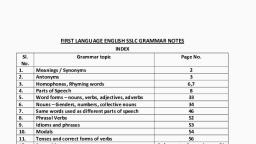
Contents, UNIT 1: PARTS OF SPEECH..................................................................................................................... 3, UNIT 2. SENTENCE STRUCTURE ........................................................................................................ 13, UNIT 3: TENSES, VERBS, AUXILIARIES ............................................................................................ 20, UNIT 4: ARTICLES AND PREPOSITIONS ........................................................................................... 37, UNIT 5 CHANGE OF VOICE ................................................................................................................... 50, UNIT 6: DIRECT AND INDIRECT SPEECH .......................................................................................... 56, UNIT 7: TRANSFORMATION OF SENTENCES .................................................................................. 66, UNIT 8 PUNCTUATION AND CAPITAL LETTERS ............................................................................. 78, UNIT 9: EXPRESSIONS AND CONVERSATIONS ................................................................................ 87, UNIT 10 HOW TO MAKE SPEECHES .................................................................................................. 101, UNIT 11: VOCABULARY BUILDING .................................................................................................. 112, UNIT 12: COMPREHENSION AND COMPOSITION .......................................................................... 142, , C3E/GEN101: ENGLISH, , Page 2
Page 4 :
UNIT 1 : PARTS OF SPEECH, Index, 1.0, , Introduction, , 1.1, , Unit Objectives, , 1.2, , Nouns, , 1.3, , Pronouns, , 1.4, , Adjective, , 1.5, , Verb, , 1.6, , Adverb, , 1.7, , Preposition and Conjunction, 1.7.1 Preposition, 1.7.2 Conjunction, , 1.8, , Interjection, , 1.9, , Summary, , 1.10 Questions and Exercises, 1.11 Further Reading, , C3E/GEN101: ENGLISH, , Page 3
Page 5 :
1.0 Introduction, The sentences or speeches are formed of words. The words which form sentence or speech are of different, classes of words. There are eight different classes of words which form sentences and are called as parts, of speech. The parts of speech are 1.Noun .2. Pronoun 3. Adjective 4. Verb 5. Adverb 6. Preposition, 7.Conjunction 8. Interjection. All words in a sentence must belong to one of these parts of speech., Though all the word in a sentence belongs to parts of speech doesn’t necessarily belong to same class of, words. Depending upon how the word, , perform the job or it has been used in the sentence decides its, , class of words. For example, My work is difficult. Work here is a Noun., I work in Nashik . Work in this sentence is a Verb., Like this different words depending upon what kind of job they are performing can be classified as parts, of speech. The word “but” can be used as a conjunction and a preposition;, The simple technique to analysis the part of speech is to ask the question yourself: “what kind of job this, word is doing in this sentence?” And answer to this question will certainly help to classify the word in the, particular class of word., , 1.1 Unit Objectives, After studying this unit, you will be able to learn:, •, , Noun and its types, , •, , Pronouns and its types, , •, , Adjectives and its types, , •, , Verbs and its types, , •, , Use of Preposition, conjunction s and interjections, , 1.2 Noun, Noun: A Noun is a word that names persons, places and things . e.g., Names of persons like Madhuri,, Saona , Sarita, Pooja, Akshay, Rahul, Pratik etc. Names of Places like Mumbai, Nashik, London, Pune,, Nagpur, Kolhapur etc. Name of things like mobile, computer, car, pen , calculator etc,, , Types of Nouns, There are different types of nouns :, Proper Noun, Common Noun, Collective Noun, 1. Material Noun, 2. Abstract Noun, C3E/GEN101: ENGLISH, , Page 4
Page 6 :
3. Countable Noun, 4. Uncountable Noun, , 1. Proper Noun:, A proper noun is the name of particular person , thing or place . A proper noun always begins with a, Capital Letters. Examples: Mahatma Gandhi, August, Friday, Canada, Taj Mahal etc. Each of these, nouns refer to a particular person, thing or place., , 2. Common Noun:, Common Noun is the general name of person, thing or place. . A proper noun always begins with a, small Letters. Its first letter will be Capital only when sentence begins with common name. Examples:, boy, girl, pen, car, garden etc. Each of these nouns refer to a general person , thing or place., , 3. Collective Noun:, It is the name given to a group or class. Examples: family, crowd, committee, nation, people etc., , 4. Material Noun:, It is the name of substance or materials. Examples: sand, cement, brick, water etc., , 5. Abstract Noun:, It is the name of qualities, ideas, feelings, emotions, actions and conditions. There are names of things, that cannot be seen, touched, heard, smelled or tested. Examples: Love, ability, honesty, kindness,, judgment, poverty, laughter etc., , 6. Countable Nouns:, Countable nouns are the nouns that can be counted. Examples: cat, student, pen, book etc., 7. Uncountable Nouns:, Uncountable nouns are the nouns that cannot be counted. Examples: water, milk, honesty, swimming, etc., , 1.3 Pronoun, A pronoun is a word used in place of a noun or noun expressions. Examples: Karisma is Indian Actress., She is beautiful. In this sentence Karisma is noun and the word she is pronoun. The word she is used in, place of Karisma., , Types of Pronouns:, There are different types of pronouns, 1. Personal Pronoun, 2. Possessive Pronoun, 3. Reflexive Pronoun, 4. Demonstrative Pronoun, 5. Relative Pronoun, C3E/GEN101: ENGLISH, , Page 5
Page 7 :
6. Interrogative Pronoun, 7. Indefinite Pronoun, 8. Distributive Pronoun, , 1. Personal Pronoun:, Personal Pronoun replace nouns that refer to things or people. Example: Meera had visited America, before she went to London., Here the Meera has been replaced by personal pronoun ‘she’., , The table below lists the different forms of Personal Pronouns, Singular, , Plural, , Singular, , Plural, , 1st Person, , I, , we, , Me, , Us, , 2 nd Person, , You, , you, , You, , You, , 3 rd Person, , He/she/it, , they, , Him/her, , Them, , 2. Possessive Pronoun, Possessive Pronoun indicates close possession or ownership or relationship of thing /person to, another thing or person. They include mine, ours, yours, his, hers, its , theirs., Example:, , a. This book is mine., b. The idea of my wife was excellent, , 3. Reflexive Pronouns, A reflexive pronoun is usually used when the object of a sentence is the same of the subject. They, include myself, yourself and ourselves. Example: you should try to do your work yourself. The, table below lists the Personal Pronoun and Reflexive Pronoun., , 4., , Personal Pronoun, , Reflexive Pronoun, , I, , Myself, , We, , Ourselves, , you(singular), , Yourself, , You(plural), , Yourselves, , He, , Himself, , She, , Herself, , It, , Itself, , They, , Themselves, , Demonstrative Pronoun, Demonstrative Pronoun points out to a person, place or thing. The words such as this, that, these, and those are used as demonstrative pronouns. When these words stands for noun are called as, Demonstrative Pronoun., Example:, , a. That refers to Roma’s dress., b. I went to see movie, but that was not possible., , C3E/GEN101: ENGLISH, , Page 6
Page 8 :
5., , Relative Pronoun, Pronouns that joins relative clause and relative sentence. It does the work of a pronoun and also the, work of a conjunction. They inclue who, which, what whom, whose and that. It refers to the noun, which comes before them., Example. a. The book which I bought yesterday is lost., b. This is the woman who saved lives of many orphans., , 6., , Interrogative Pronoun, The words which starts from “wh” i.e. what, who, where, which and whose are used to ask the, questions are called as Interrogative Pronouns., Example:, , a. What is your name ?, b. What do you know about UPSC Examination?, , 7., , Indefinite Pronoun, Indefinite pronouns refers to persons or things in general. They include nobody, everybody,, somebody, many ,all etc., Example: a. Everybody should respect the elders., b. Nobody supported him during his bad patch., , 8., , Distributive Pronoun, Distributive Pronouns are used to indicate all the members of the representative group. They, include everyone, each, either, neither., Example: Each of the member got the prize., , 1.4 Adjectives, Words that are used to describe a noun or pronoun are called adjectives. e.g. Amitabh is an intelligent, actor. Here intelligent is an adjective., Types of Adjectives: There are different types of adjectives which are listed below., Adjective of Quality, It gives information about quality, , of noun such as honesty, pretty, amazing, marvelous etc., , 1. Adjective of quantity, It gives information about quantity of noun such as few, little, enough, much etc., 2., , Adjective of number, It gives information about quantity of countable nouns such as one, two, three, four etc., , 3., , Interrogative adjectives, Words such as what, which and whose which are used with nouns to ask questions are called, Interrogative adjectives., , C3E/GEN101: ENGLISH, , Page 7
Page 9 :
4., , Demonstrative adjectives, Words such as this, that, these ,those, such ,certain, yonder which point out to nouns are called, as demonstrative adjectives., , 6., , Possessive adjectives, The words like my, your, his, her,its used with nouns to denote possession are called as, possessive adjectives ., , 1.4 Verbs, The Word that tells about the action, possession or a state of being in the sentence is known as a verb., Example, , a. She speaks very slow. Here speak is action verb., b. The boy wrote a letter. Here wrote is a action verb., , The following verbs are important from the subject point of view., 1. Transitive verbs:, The verbs that take an object or objects to complete their meanings are called as transitive verb., Example. Sangita wrote a letter. The verb wrote take an object Sangita.If no object used then the, sentence give incomplete meaning. The name Sangita make it more meaningful., 2. Intransitive verbs:, The verbs that do not take an object to complete the sentence. Example. She is laughing. Here, laughing is action verb which give complete meaning., 3. Main Verb: Main verbs are the verbs that describe the main meaning of the sentence. Example: I, do not know him. Here know is main verb., 4. Auxiliary Verbs, Auxiliary verbs are helping verbs that help the main verbs in sentence. Example: I do not know., Here main verb is know which is assisted by auxiliary verb ‘ do not’., 5. Modal Verbs, Can, may and should are a special type of auxiliary verbs .They are called the modal auxiliary, verbs or simply the modals. Modals are verbs used to seek or give permissions, make suggestions,, make polite request , give advice, give invitation etc. The most commonly used modals are, Can, , could, , may, , might, , Will, , would, , shall, , should, , Must, , ought to, , need, , dare, , C3E/GEN101: ENGLISH, , Page 8
Page 10 :
1.6 Adverbs, An adverb is a word that modifies a verb, adjective, another adverb, determiner, noun phrase, clause,, or sentence. Adverbs typically express manner, place, time, frequency, degree, level of certainty, etc., Examples: She sang loudly., I worked yesterday., , 1.7 Prepositions, Prepositions are the words that tells us about where peoples, objects or things are i.e. their position. It, also shows the direction of, , movement and time of something happening or will be happening., , Preposition always come before noun or pronoun., Examples of use of preposition:, On or uponMy calculator is on the table., In, Urmila is living in Mumbai., Over, The clock is over Icchita’s head., Into, The dog jumped into the river, Near, Our house is near the railway Station, Some of commonly used prepositions are listed below, Above, , across, , after, , among, , before, , out of, , for, , down, , by, , against, Behind, , Under towards, inside, , to, , Round, , in front of, , Ago, , from, , beside, , 1.8 Conjunctions, Conjunctions are the joining words which joins two sentences or parts of sentence., Example: Seeta and Geeta went to Simla, There are mainly two types of conjunctions 1. Coordinating Conjunction, , and, , 2. Subordinate, , Conjunction, 1. Coordinating Conjunction, Coordinating Conjunctions are used to join two clauses of equal rank where both the actions, are of equal importance., Example: Do not talk over mobile while you are driving ., Some commonly used coordinating conjunctions are still, hence, besides, either, therefore etc., C3E/GEN101: ENGLISH, , Page 9
Page 11 :
2. Subordinate Conjunction, Subordinate Conjunction join subordinate clause with main clause ., Example. I shall cook because I love cooking., Some commonly used subordinate conjunctions are if, once, before, till, although,since, than, etc., , 1.8 Interjections, The words which express sudden feelings or emotions are called as interjections. The interjection words, are usually followed by an exclamation mark (!)., Examples., , a. Ah! That is well done., b. Oh! The rain ruined everything., , Some commonly used interjections are bravo, hurray, alas, oh, hello etc., , 1.9 Summary, •, , •, , Parts of speech: There are eight different classes of words which form sentences and are called, as parts of speech. The parts of speech are 1.Nouns .2. Pronouns 3. Adjectives 4. Verbs 5., Adverbs 6. Prepositions 7.Conjunctions 8.Interjections., Noun: A Noun is a word that names persons, places and things . The different types of nouns are, Proper Noun, Common Noun, Collective Noun, Material Noun, Abstract Noun, Countable Noun,, Uncountable Noun, , •, , Pronoun: A pronoun is a word used in place of a noun or noun expressions. The different types, of pronouns are Personal Pronoun, Possessive Pronoun, Reflexive Pronoun, Demonstrative, Pronoun, Relative Pronoun, Interrogative Pronoun, Indefinite Pronoun, Distributive Pronoun, , •, , Adjectives: Words that are used to describe a noun or pronoun are called adjectives. The various, types of adjectives are Adjective of Quality, Adjective of quantity, Adjective of number,, Interrogative adjectives, Demonstrative adjectives, Possessive adjectives, , •, , •, , Verbs: The Word that tells about the action, possession or a state of being in the sentence is, known as a verb. The types of verbs are Transitive verbs, Intransitive verbs, Main Verb,, Auxiliary Verbs, Modal verbs., Adverb: An adverb is a word that modifies a verb, adjective, another adverb, determiner, noun, phrase, clause, or sentence. Adverbs typically express manner, place, time, frequency, degree,, level of certainty, etc., , •, , Prepositions : Prepositions are the words that tells us about where peoples, objects or things are, i.e. their position, Conjunctions: Conjunctions are the joining words which joins two sentences or parts of, sentence. The types of conjunctions are Coordinating Conjunction and Subordinate Conjunction., , •, , Interjections: The words which expresses sudden feelings or emotions are called as interjections., The interjection words are usually followed by an exclamation mark (!)., , C3E/GEN101: ENGLISH, , Page 10
Page 12 :
1.10 Questions and Exercises, 1. What are different parts of speech? Define any one of it., 2. Identify the collective nouns from the following list ., a.Class, b.Girls, c.Army, d.Children, e.Audience, 3. What are different types of noun? Explain in detail Collective noun., 4. Explain in short the following types of adjectives., a. Adjective of Quality, b.Adjective of Quantity, 5. Identify the verb in following sentences., a. She speaks very slow., b. The boy wrote a letter., c. She sang a song., d. The boy played tennis., 6. Choose the correct preposition., a. Her house is somewhere………..the river.(by, around, in), b. Sridevi is living ……………. Chennai.(at,in, over), c. The clock is ………….. Icchita’s head.(under, above, over), d. The dog jumped …………..the river.(into, over, under), e. Our house is ……… the railway Station(near, close, below), 7. Fill in the blanks with suitable interjection., a. ……..! That is well, b. ……..! The rain ruined everything., c….…..! I stood first in my class., d….…..! How come you are late ?, e…….! His uncle is no more., 5. Make the sentences using following conjunctions., a. Still, b. Hence, c. Besides, d., , Either, , e. Therefore, 6. What is adverb? Write any four sentences with suitable adverb clauses of place or reason., 7. What do you mean by modals ? Mention any four modals that are commonly used., , C3E/GEN101: ENGLISH, , Page 11
Page 13 :
1.11 Further Reading, 1. Wren, P.C. and H. Martin 2007. High School English Grammar and Composition. New Delhi: S., Chand and Company., 2., , Rajendra, , Pal, , and, , Prem, , Lata, , Suri, , 2004., , English, , Grammar, , and, , Composition., , New Delhi: Sultan Chand and Sons., , C3E/GEN101: ENGLISH, , Page 12
Page 14 :
UNIT 2 : SENTENCE STRUCTURE, Index, 2.0, , Introduction, , 2.1, , Unit Objectives, , 2.2, , Kinds of sentences, , 2.3, , Subject and predicate, , 2.4, , Phrases, 2.4.1 Adjective phrases, 2.4.2 Adverb phrases, 2.4.3 Noun phrases, , 2.5, , Use of question words, , 2.6, , Use of there and it as subject of the sentence, , 2.7, , Summary, , 2.8, , Questions and Exercises, , 2.9, , Further Reading, , C3E/GEN101: ENGLISH, , Page 13
Page 15 :
2.0, , Introduction, , The words form sentence. There are various kind of sentences like Declarative or Assertive, Imperative,, Interrogative and Exclamatory. This unit gives you comprehensive description of the sentence structure, and the combination of sentences., , 2.1 Unit Objectives, After studying this unit, you will be able to:, • Identify the kinds of sentences., • Classify a sentence into the subject and the Predicate., • Understand phrases and clauses., • Observe simple, compound and complex sentences., , 2.2 Kinds of sentences, Sentences are of four kinds: Declarative or Assertive, Imperative, Interrogative and Exclamatory., i), , Declarative or Assertive Sentence: A sentence that makes a statement or assertion is called a, Declarative or Assertive Sentence; e.g., Humpty Dumpty sat on a wall., , ii), , Imperative sentence: A sentence that expresses a command or a request is called an, Imperative sentence; e.g., Have mercy upon us., Be quite., , iii), , Interrogative sentence: A sentence that asks a question is called an interrogative sentence; e.g., Where do you live?, , iv), , Exclamatory sentence: A sentence that expresses strong feeling is called an exclamatory, sentence; e.g., How cold the night is!, What a shame!, , 2.3 Subject and Predicate, When we make a sentence, we name a person or a thing and we say something about that person or thing., The part which names the person or thing we are speaking about is the subject. The part which tells us, something about the person or thing is called the predicate., Example,, The boy stood on the staircase., The boy, , is the subject, and, , Stood on the staircase, , is the predicate., , C3E/GEN101: ENGLISH, , Page 14
Page 16 :
Example, Look at the following sentences:, The sun rises in the east., My elder brother is a doctor., I think we may sell the house., The flames spread everywhere., , No, 1, 2, 3, 4, , Subject, The sun, My elder, I, The flames, , Predicate, rises in the east., is a doctor., think we may sell the house., spread every where., , The subject of the sentence usually comes first but sometimes may come after the predicate., A barking sound the shepherd hears., In an imperative sentence, the subject is you but it is not mentioned, it is understood., 1. Sit down., 2. Get the book., , 2.4 Phrases, 2.4.1 Adjective Phrases, Def: An adjective phrase is a group of words that does the work of an adjective., Adjectives, A golden crown., A purple cloak., A jungle track., A blank page., A heavy load., , 2.4.2, , Adjective Phrases, A crown made of gold., A cloak of purple color., A track through the jungle., A page with no writing on it., A load of great weight., , Adverb Phrases, Def: An adverb phrase is a group of words that dose the work of an adverb., Adverb, Swiftly, Soon, Bravely, Unwisely, Formerly, , 2.4.3, , Adverb Phrases, In a swift manner, or without wisdom., Before very long, or at an early date., In a brave manner, or with bravery., In a unwise manner, or without wisdom., In former times, or once upon a time., , Noun Phrases, Def: A noun phrase is a group of words that does the work of a noun., , C3E/GEN101: ENGLISH, , Page 15
Page 17 :
Examples,, 1), 2), 3), 4), 5), , To win a prize is my ambition., I tried to get the sum right., He hopes to win the first prize., Did you enjoy reading this book?, He loves to issue harsh orders., , 2.5 Use of Question Words, Certain words are used for asking questions. They belong to the wh. Category., They are who, whom, which, whose, where and how., Who, whose and whom are used only for persons., Who spoke? Who is there at door?, Whose pen is this?, Whom do you want?, Which is used for both persons and things., Which are your books? Which boy did you speak to?, Which finger did you break?, What is used for things., What book do you want?, What sport do you play?, Sometimes what and which are interchangeable., What day/ which day is your evening class?, What train / which train will you catch?, What part / which part of India are you from?, We can use which with one or ones or with of, but we cannot use who or what before it., Which one would you like? Which ones of these would you like?, But we do not say,” What one would you like?”, Which of the girls do you want to meet?, But we do not say, “Who of the girls do you want to meet?”, Where is used to ask questions about place., Where do you live?, Where are you going?, How is another word used to ask questions., How are you?, How is the weather today?, To frame questions in the Simple Present tense, we must use do/does along with the question words., I live in Mumbai. Where do you live?, He walks to work every morning. How does he go to work every morning?, C3E/GEN101: ENGLISH, , Page 16
Page 18 :
Do you live in Mumbai? Yes I do., Does she live in Mumbai? Yes, she does., To frame questions in the simple past tense, the verb does not change its form., She lived in Mumbai in 1975. Where did she live (and not lived) in 1975?, He wrote a letter yesterday. What did she do (not did) yesterday?, She bought a dress. What did she buy (not bought)?, 2.6 Use of ‘there’ and ‘it’ as subject of the sentence., Look at the following sentences:, 1. A girl is in the garden., 2. There is a girl in the garden., Both sentences 1 and 2 mean the same, but sentence 2 begins with ‘There’. The word ‘There” has, no special meaning; it is just another way of beginning a sentence. The number ( singular or, plural) of the noun will decide whether it will be followed by is or are:, There is a bag on the table., There are bags on the table., , The question form will be:, Is there a bag on the table?, Are there bags on the table?, , The negative form will be:, There isn’t any bag n the table., There aren’t any bags on the table., We use “there” when we talk of something for the first time., Ex., There is a restaurant in King Street., There was a lot of traffic., We use “it” when we refer to a particular thing, place, fact, situation etc., We went to the new restaurant today. It is very good., We use “it” to talk about distance, time, and weather:, 1), 2), 3), 4), 5), , The weather is cold today. It is cold today., It’s a long way from here to the airport., It is 5.50 p.m. now., What day is it today?, Is there a laundry here?, , C3E/GEN101: ENGLISH, , Page 17
Page 19 :
Yes there is. There is one opposite the chemist’s., No there isn’t, but there is one in town., 6) Are there any shops around here?, Yes, there are. There are some shops here., No, there aren’t, but there are some in the city., , 2.7 Summary, Sentences are of four kinds: Declarative or Assertive, Imperative, Interrogative and Exclamatory., When we make a sentence, we name a person or a thing and we say something about that person or thing., The part which names the person or thing we are speaking about is the subject., The part which tells us something about the person or thing is called the predicate., An adjective phrase is a group of words that does the work of an adjective., An adverb phrase is a group of words that dose the work of an adverb., A noun phrase is a group of words that does the work of a noun., Certain words are used for asking questions. They belong to the wh. Category., They are who, whom, which, whose, where and how., , 2.8 Questions and Exercises, In the following sentences separate the subject and the predicate., 1. On the top of the hill lives a hermit., 2. The early bird catches the worm., 3. All mater is indestructible., 4. A guilty conscience needs no excuse., 5. A sick room should be well aired., 6. Bad habits grow unconsciously., 7. The earth revolves round the sun., 8. Islamabad is the capital of Pakistan., 9. All roads lead to Rome., 10. Miss Kitty was rude at the table one day., 2. Pick out the Adjective Phrases in the following:, 1. A bird in the hand is worth two in the bush., 2. He is a person very considerable renown., 3. Gardens with cool shady trees surround the village., 4. He was a lad of great promise., 5. A stitch in time saves nine., 3. Pick out the Adverb phrases in the following sentences., 1. Three fishers went sailing over the sea., 2. In her ear he whispered gaily., 3. On your conscience this will lie., 4. Make yourself at home., 5. He lives by his pen., C3E/GEN101: ENGLISH, , Page 18
Page 20 :
4. Pick out noun phrases in the following sentences., 1. Thinking good thoughts precedes good actions., 2. Promise to come again., 3. He dislikes having to punish his servants., 4. I should hate to do such a thing., 5. Have you ever tried climbing a coconut palm?, , 2.9 Further Reading, 1. Wren, P.C. and H. Martin 2007. High School English Grammar and Composition. New Delhi: S., Chand and Company., 2. Rajendra, , Pal, , and, , Prem, , Lata, , Suri, , 2004., , English, , Grammar, , and, , Composition., , New Delhi: Sultan Chand and Sons., , C3E/GEN101: ENGLISH, , Page 19
Page 21 :
UNIT 3 : TENSES, VERBS, AUXILIARIES, Index, 3.0, , Introduction, , 3.1, , Unit Objectives, , 3.2, , Tenses, 3.2.1 Present Tense, 3.2.1.1 Simple Present Tense, 3.2.1.2 Present Continuous Tense, 3.2.1.3 Present Perfect Tense, 3.2.1.4 Present Perfect Continuous Tense, 3.2.2 Past Tense, 3.2.2.1 Simple Past Tense, 3.2.2.2 Past Continuous Tense, 3.2.2.3 Past Perfect Tense, 3.2.2.4 Past Perfect Continuous Tense, 3.2.3 Future Tense, 3.2.3.1 Simple Future Tense, 3.2.3.2 Future Continuous Tense, 3.2.3.3 Future Perfect Tense, 3.2.3.4 Future Perfect Continuous Tense, , 3.3, , Verbs (types and Forms), , 3.4, , Auxiliaries Verbs, 3.4.1 Primary Auxiliary, 3.4.2 Modal Auxiliary, , 3.5, , Summary, , 3.6, , Questions and Exercises, , 3.7, , Further Reading, , C3E/GEN101: ENGLISH, , Page 20
Page 22 :
3.0 Introduction, The tenses are important to explain the status of time during which things are happened or going to, happen. There are basically three main tenses: Past tense, Present tense and Future tense. Each of these, tenses have divided into four different parts. This unit explains description of tenses, verbs and, auxiliaries., , 3.1 Unit Objectives, After going through this unit, you should be able to:, •, •, •, •, , Identify the forms and uses of tenses: present, past, future., Classify a verb and how it is used in different forms in a sentence., Understand what the auxiliaries are., Use the primary auxiliaries and modal auxiliaries., , 3.2 Tenses, The tense of a verb shows the time of an action or event. There are three main tenses:, •, •, •, , Present Tense, Past Tense, Future Tense, , All the three tenses are further divided into four parts:, •, , Present Tense, a) Simple Present Tense, b) Present Continuous Tense, c) Present Perfect Tense, d) Present Perfect Continuous Tense, , •, , Past Tense, a) Simple Past Tense, b) Past Progressive Tense, c) Past Perfect Tense, d) Past Perfect Continuous Tense, , •, , Future Tense, a) Simple Future Tense, b) Future Continuous Tense, c) Future Perfect Tense, d) Future Perfect Continuous Tense, , C3E/GEN101: ENGLISH, , Page 21
Page 23 :
3.2.1, , Present Tense, 3.2.1.1 Simple Present Tense, , Form:, 1) We normally use the root form of the verb in the simple tense. But with the subject like he/she/it, and other third person singular subjects, we add ’s’ or ‘es’ with the root form of the verb; as,, I like Mangoes., He likes Mangoes., 2) In the negative sentences, the pattern is:, He/she/it+ does not (or doesn’t) +root form of the verb., I/we/you/they + do not (or don’t) + root form of the verb., Shanaya does not write a poem., We do not go Mumbai., 3) In the interrogative sentences, do/does is placed first or before the subject., Does he write a poem?, Do we go Mumbai?, Does he not write a poem?, Do we not go Mumbai?, Uses:, 1) To express a future event that is part of a fixed timetable or fixed programme,, The next flight is at 8.00 tomorrow morning., 2) In vivid narrative, as substitute for the simple past;, Immediately the King hurries to his capital., 3) In exclamatory sentences beginning with here and there to express what is actually taking place in, the present;, Here comes the train!, 4) To express general truth;, Honey is sweet., 5) To express the habitual action;, I get up every day at six o’clock., , 3.2.1.2 Present Continuous Tense, Form:, We use is/am/are+ ing form of verb in the affirmative sentences is/am/are+ not+ ing form of verb, in negative sentences and is/am/are+ subject +ing form of verb in interrogative sentences., She is writing a book., The birds are flying., I am drinking tea., Samira is not singing., Are they playing football?, Am I not going Mumbai?, C3E/GEN101: ENGLISH, , Page 22
Page 24 :
Uses:, 1) For an action going on at the time of speaking; as,, Samira is singing (now)., 2) For a temporary action which may not be actually happening at the time of speaking; as;, I am reading ‘Harry Potter’ (but I am not reading at this moment)., 3) For an action that has already been arranged to take place in the near future; as,, I am going to the movie tonight., , 3.2.1.3 Present Perfect Tense:, Form:, In this tense the sentence pattern is: subject + has/have + Past Participle of verb., I have finished your work., She has not written a poem., Has she gone out?, They have not done my work., Uses:, 1) To indicate completed activities in the immediate past; as,, She has just gone out., 2) To express past actions whose time is not given and not defined; as,, Mr. Smith has been to Japan., 3) To describe past events when we think more of their effect in the present than of the action, itself; as,, Donatella has eaten all the chocolates., 4) To denote an action beginning at some time in the past and counting up to the present, moment; as,, We have lived here for 20 years., , 3.2.1.4.1 Present Perfect Continuous Tense:, Form:, In this tense the sentence pattern is: subject + has/have + been +ing form of verb., Uses:, 1) The present perfect continuous is used for an action which began at some time in the past and, is still continuing; as,, They have been playing since 5 O’clock., 2) This tense is also sometimes used for an action already finished. In such cases the continuity, of the activity is emphasized as an explanation of something., ‘Why is your dress so wet?’ – ‘I have been watering the plants.’, C3E/GEN101: ENGLISH, , Page 23
Page 25 :
3.2.2 Past Tense, 3.2.2.1 Simple Past Tense, Form:, In simple past tense, the sentence pattern is:, Subject + II form of verb. In negative sentence, we use ‘did not’ with the first form of, verb; as,, We went to USA., We did not go to college., Did we go to trip?, Uses:, 1) The simple past is used to indicate an action completed in the past. It often occurs, with adverbs or adverb phrases of past time., I received his parcel a week ago., 2) Sometimes this tense is used without an adverb of time. In such cases the time may, be either implied or indicate by the context., I learnt German in Mumbai., 3) The simple past tense is used for past habits; as,, Stella studied many hours every day., , 3.2.2.2. Past Progressive Tense, Form:, Subject + was/were + ing form of verb in affirmative sentences. . In negative sentences,, ‘not’ is used between was/were and ing form of verb., She was writing a poem., They were not going to market., I was not playing football yesterday., Uses:, 1) The past progressive is used to denote an action going on at some time in the past., The time of the action may or may not be indicated., It was getting darker., 2) This tense is also used with always, continually, etc. for persistence habits in the past., She was always grumbling., 3.2.2.3 Past Perfect Tense, Form:, In this tense the sentence pattern is:, Subject + had + past participle of verb. In negative sentence, we use ‘not’ between had, and past participle form of verb., She had written the poem., Had she cooked noodles?, Had they gone garden?, C3E/GEN101: ENGLISH, , Page 24
Page 26 :
Uses:, 1) The past perfect describes an action completed before a certain moment in the past;, as,, I met her in Mumbai in 2010. I had seen her last six years before., 2) If two actions happened in the past, it may be necessary to show which action, happened earlier than the other. The past perfect is mainly used in such situations., The simple past is used in one clause and the past perfect in the other; as,, I had written the poem before he arrived., , 3.2.2.3.1 Past Perfect Continuous Tense, Form:, We use this tense to express an action that began before a definite time in the past, had, continued up that time was still in progress at the time of speaking or had very recently, finished., She was breathless when I met her as she had been running for 15 minutes., In this tense the sentence pattern is:, Subject + had in negative sentences, the pattern is, Subject + had + ing form of verb., Uses:, 1) The past perfect continuous is used for an action that before a certain point in the past, and continued up to that time: as,, At the time he had been writing a book for three months., , 3.2.2 Future Tense, 3.2.3.1 Simple Future Tense, Form:, The simple future tense is used for an action that will take place in future over which the, speaker does not have any control:, I shall see her tomorrow., When there is a drought, the crop will die., In this tense, the sentence pattern is:, Subject + will/shall + root from of verb; as,, He will come here tomorrow., I shall do my homework., In negative sentence, the pattern is:, Subject + will/shall + not + root form of verb., I shall not go Mumbai., You will learn your lesson., In interrogative sentence, the pattern is,, C3E/GEN101: ENGLISH, , Page 25
Page 27 :
Will/shall + subject + root form of verb; as,, Shall I go USA?, Will they help you?, Uses:, 1) The simple future tense is used to talk about things which we cannot control. It expresses, the future as fact., I shall be twenty two next Saturday., 2) We use this tense to talk about what we think or believe will happen in the future., I think India will win the match., 3) We can use this tense when we decide to do something at the time of speaking., It is raining. I will take my raincoat., , 3.2.3.2 Future Continuous Tense, Form:, We use this tense to denote an action that will be in progress at a given moment in the future., This tense is also used to denote an action that is fairly certain to take or happen in the future., At 5 pm I shall be watching my favorite T.V. serial., In this tense, the sentence pattern is:, Subject + will be/ shall be + ing form of verb., She will be doing this work., They will not be having their dinner at 8 pm., Will you be playing football?, Uses:, 1) We use Future Continuous Tense to talk about actions which will progress at a time in the, future., I suppose it will be raining when we out., 2) We also use this tense to talk about actions in the future which are already planned or, which are expected to happen in the normal course of time., I will be staying here still Wednesday., , 3.2.3.3 Future Perfect Tense, Form:, We use the future perfect tense to denote an action that will be completed before a given, moment in the future., She will have done her homework by 8 o’clock, Will they have decided about his job by tomorrow?, We normally use adverbial expression like by, by then, by that time, by next month, by fifth, of this month, etc. with tense., Subject + will have /shall have + past participle form of verb., C3E/GEN101: ENGLISH, , Page 26
Page 28 :
Uses:, 1) We use Future perfect Tense to talk about actions that will be completed by a certain, future time., By the end of this month I will have worked here for 4 years., , 3.2.3.4, Form:, , Future Perfect Continuous Tense, , We use this tense to denote an action that will begin before a definite moment in the future,, will continue up to that moment and will be in progress even at that moment., By 7 pm she will have been reading for two hours., In this sentence, a definite moment in the future is indicated. The action of reading will begin, two hours before 7 pm, it will continue up to 7 pm and will be in progress even at 7 pm., , In this tense, sentence pattern is:, Subject + will/shall + have been + ing form of verb., She will have been playing for one hour., Will she have not been preparing lunch?, Uses:, 1) The future continuous tense is used for actions which will be in progress over a period of, time that will end in the future., By next march we shall have been living here for 5 years., , 3.3 VERBS, Kinds of verbs:, a) Transitive verbs, b) Intransitive verbs, c) Incomplete verbs or complements, a) Transitive Verbs:, Some verbs require an object to complete their meaning. These verbs are called transitive, verbs., For example: She writes a poem., Here, a poem is the object of the verb writes and this object is necessary, , to complete the meaning of ‘She writes'., Direct / indirect object, Sometimes transitive verbs take two objects after them., One object is name of a thing called direct object., The other object is a name of a person called indirect object., C3E/GEN101: ENGLISH, , Page 27
Page 29 :
For example;, Jenny teaches us English., Here English is the direct object and us is the indirect object., Other examples are;, 1. The principal presented her a price., 2. He gave me a pen., 3. My sister asked me a question., b) Intransitive verbs, Some verbs do not require an object to complete its meaning. They have completed meaning, by themselves. Such verbs are called intransitive verbs., The aero planes fly., Here the verb fly does not need an object to complete its meaning., c) Incomplete verbs, Some verbs require ‘some word/ words’ to complete their sense. These verbs are called, incomplete verb or verbs of incomplete predication. They are also called complements., The crow seems thirsty., He became happy., The word thirsty or happy so added is called the complement., , Irregular Verbs, Verbs can be regular or irregular., Regular verbs form their past tense and past participles by adding ‘ed’, Base form, Laugh, Walk, Paint, , Past tense, Laughed, Walked, Painted, , Past participle, Laughed, Walked, Painted, , Irregular verbs form their past tense and past participle in different way from adding ‘ed’., Base form, Sit, Cut, Come, Ring, , Past Tense, Sat, Cut, Came, Rang, , Past participle, Sat, Cut, Come, Rung, , We distinguish three types of irregular verbs:, 1) Verbs in which all three form are the same., 2) Verbs in which two of the three forms are the same., 3) Verbs in which all three form are different., Below is list of irregular verbs divided into the three types mentioned above. Some of, them can also be regular. In such cases the regular forms are also given., C3E/GEN101: ENGLISH, , Page 28
Page 30 :
1) All three form are the same; as,, Base form, Cut, Bet, Hurt, Cost, Hit, Let, Read, Shut, Spread, Burst, Split, , Past tense, Cut, Bet, Hurt, Cost, Hit, Let, Read, Shut, Spread, Burst, Split, , 2) Two of the three forms are the same, Base, Past Tense, Wind, Wound, Buy, Bought, Win, Won, Catch, Caught, Understand, Understood, Come, Came, Think, Thought, Creep, Crept, Tell, Told, Deal, Dealt, Teach, Taught, Dig, Dug, Swing, Swung, Dream, Dreamt, Sweep, Swept, Feed, Fed, Strike, Struck, Feel, Felt, Sting, Stung, Fight, Fought, Stick, Stuck, Get, Got, Stand, Stood, Hang, Hung, Spoil, Spoiled, Have, Had, Spit, Spat, Hear, Heard, Spell, Spelled, Hold, Held, Speed, Sped, Keep, Kept, Spill, Spilled, Lay, Laid, Spell, Spent, C3E/GEN101: ENGLISH, , Past participle, Cut, Bet, Hurt, Cost, Hit, Let, Read, Shut, Spread, Burst, Split, , Past participle, Wound, Bought, Won, Caught, Understood, Come, Thought, Crept, Told, Dealt, Taught, Dug, Swung, Dreamt, Swept, Fed, Struck, Felt, Stung, Fought, Stuck, Got, Stood, Hung, Spoiled, Had, Spat, Heard, Spelled, Held, Sped, Kept, Spilled, Laid, Spent, Page 29
Page 31 :
Lead, Lean, Smell, Learn, Sleep, Lose, Make, Sit, Mean, Shoot, Meet, Shine, Pay, Send, Run, Sell, Say, Burn, Beat, Build, Become, Bring, Breed, Bend, Bleed, , Led, Leaned, Smelled, Learned, Slept, Lost, Made, Sat, Meant, Shot, Met, Shone, Paid, Sent, Ran, Sold, Said, Burned, Beat, Built, Became, Brought, Bred, Bent, Bled, , 3) All three forms are different; as,, Base Form, Past Tense, Wake, Woke, Write, Wrote, Wear, Wore, Tear, Tore, Throw, Threw, Take, Took, Swim, Swam, Swear, Swore, Stink, Stank, Steal, Stole, Spring, Sprang, Speak, Spoke, Sink, Sank, Shrink, Shrank, Show, Showed, Shake, Shook, Sew, Sewed, See, Saw, Rise, Rose, Ring, Rang, Ride, Rode, Mistake, Mistook, Lie, Lay, Know, Knew, C3E/GEN101: ENGLISH, , Led, Leaned, Smelled, Learned, Slept, lost, Made, Sat, Meant, Shot, Met, Shone, Paid, Sent, Ran, Sold, Said, Burned, Beaten, Built, Become, Brought, Bred, Bent, Bled, , Past participle, Woken, Written, Worn, Torn, Thrown, Taken, Swum, Sworn, Stunk, Stolen, Sprung, Spoken, Sunk, Shrunk, Shown, Shaken, Sewn, Seen, Risen, Rung, Ridden, Mistaken, Lain, Known, Page 30
Page 32 :
Hide, Grow, Go, Give, Freeze, Forgive, Forget, Forbid, Fly, Eat, Drive, Be, Begin, Bite, Blow, Do, Break, , Hid, Grew, Went, Gave, Froze, Forgave, Forgot, Forbade, Flew, Ate, Drove, Was, Began, Bit, Blew, Did, Broke, , Hidden, Grown, Gone, Given, Frozen, Forgiven, Forgotten, Forbidden, Flown, Eaten, Driven, Been, Begun, Bitten, Blown, done, Broken, , The following verbs have an alternative past participle form, which can only be used, adjectivally., Verb, Strike, Sink, Shrink, Drink, Melt, Shave, Prove, Shear, , Usual past participle, Struck, Sunk, Shrunk, Drunk, Melted, Shaved, Proved, Sheared, , Adjectival past participle, Stricken, Sunken, Shrunken, Drunken, Molten, Shaven, Proven, Shorn, , 3.4 Auxiliary Verbs, An auxiliary verb is a “helping verb” used to support or make the form of another verb., Auxiliary verbs can be divided into two main basics groups:, •, •, , Primary Auxiliary, Modal Auxiliary, , 3.4.1 Primary Auxiliary, These helping verbs are the verbs be, do and have., The auxiliary ‘be’ is used, 1. In the formation of the continuous tenses like, She is working., I was reading., 2. In the formation of the passive like, The gate was closed., C3E/GEN101: ENGLISH, , Page 31
Page 33 :
3. To denote a command, as,, You are to go to the market at once., Thus is, am, are, were, was the forms of ‘be’., The auxiliary ‘have’ is used, 1. In the formation of the perfect tenses, He has worked hard., He has been working., 2. With the infinitive to indicate obligation, I have to be there by 6 o’clock., He has to go to work tomorrow., The auxiliary ‘do’ is used, 1. To form the negative and interrogative of the present simple and past simple tense., He doesn’t work. He didn’t talk., Does he work hard? Did he go to Puna?, 2. To avoid repetition of a previous ordinary verb; as,, Do you know him? Yes, I do., You met her, didn’t you?, 3. To emphasize the affirmative or make a request or invitation more persuasive., You do look pale., Oh, do be quiet., , 3.4.2 Modal Auxiliaries, Can, The auxiliary can usually expresses or capacity; as,, I can swim across the river., Can you lift this box?, , Could, Could is used as the past equivalent of can;, I could swim across the river when I was young., He said I could go., , May, May is used:, 1) To express permission., You may go now., C3E/GEN101: ENGLISH, , Page 32
Page 34 :
2) To express possibility in affirmative sentences., It may rain tomorrow., 3) To express a wish., May you live happily and long!, Might, Might is used to express a degree of dissatisfaction or reproach., You might pay a little more attention to your appearance., , Shall, should, will, would, 1) Shall is used in the first person and will in all persons to express pure future. Today i/ we shall, common than i/we will; as, I shall/ will be twenty next birthday., When shall we see you again?, You will see that I am right., 2) Shall is sometimes used in the second and third persons to express a command a promise, or, threat;, He shall not enter my house again., You shall be punished for this., , 3.5, , Summary, Simple present tense: We normally use the root form of the verb in the simple tense. But with, the subject like he/she/it and other third person singular subjects, we add ’s’ or ‘es’ with the root, form of the verb., , Present continuous tense: We use is/am/are+ ing form of verb in the affirmative sentences, is/am/are+ not+ ing form of verb in negative sentences and is/am/are+ subject +ing form of verb, in interrogative sentences., Present Perfect Tense: In this tense the sentence pattern is: subject + has/have + Past Participle, of verb., , Present Perfect Continuous Tense: In this tense the sentence pattern is:, , subject + has/have +, , been +ing form of verb., , Simple past tense, the sentence pattern is:, Subject + II form of verb. In negative sentence, we use ‘did not’ with the first form of verb., C3E/GEN101: ENGLISH, , Page 33
Page 35 :
Past Progressive Tense, Subject + was/were + ing form of verb in affirmative sentences. In negative sentences, ‘not’ is, used between was/were and ing form of verb., , Past Perfect Tense, In this tense the sentence pattern is:, Subject + had + past participle of verb. In negative sentence, we use ‘not’ between had and past, participle form of verb., , Past Perfect Continuous Tense, We use this tense to express an action that began before a definite time in the past, had continued, up that time was still in progress at the time of speaking or had very recently finished., Simple Future Tense The simple future tense is used for an action that will take place in future, over which the speaker does not have any control., , Future Continuous Tense, We use this tense to denote an action that will be in progress at a given moment in the future., This tense is also used to denote an action that is fairly certain to take or happen in the future., , Future Perfect Tense, We use the future perfect tense to denote an action that will be completed before a given moment, in the future., , Future Perfect Continuous Tense, We use this tense to denote an action that will begin before a definite moment in the future, will, continue up to that moment and will be in progress even at that moment., , Verbs:, a) Transitive verbs, b) Intransitive verbs, c) Incomplete verbs or complements, d), Auxiliary Verbs: An auxiliary verb is a “helping verb” used to support or make the form of, another verb., , C3E/GEN101: ENGLISH, , Page 34
Page 36 :
3.6 Questions and Exercises, 1., , Choose the correct verb form from those in brackets., 1., 2., 3., 4., 5., 6., 7., 8., 9., 10., , 2., , The earth ___ round the sun. (moves, move, moved), My friends ___ the Prime Minister yesterday. (see, have seen, saw), I ___ him only one letter up to now. (sent, have sent, send), He ___ a mill in this town. (have, has, is having), She ___ worried about something. (looks, looking, is looking), It started to rain while we ___ tennis. (are playing, were playing, had played), He ___ fast when the accident happened. (is driving, was driving, drove), He ___ asleep while he was driving. (falls, fell, has fallen), He ___ here for last five years. (worked, is working, has been working), He thanked me for what I ___. (have done, had done, have been doing), , Choose the correct or more suitable forms of the verbs to fill the blanks., 1., 2., 3., 4., 5., 6., 7., 8., 9., 10., , The plane ____ at 3.30. ( arrives, will arrive), I will phone you when he ____ back. (comes, will come), When I get home, my dog ____ at the gate waiting for me. (sets, will be sitting), I ____ the Joshis this evening. (visit, am visiting), Look at those black clouds. It ____. (will rain, is going to rain), I ____ home next Sunday. (go, am going), I ____ you one of these days. I expect. (see, will be seeing), Help! I ____ fall. (will, am going to), Oh dear! I ____. (will sneeze, am going to sneeze), I’m sure she ____ the exam. (passes, will pass), , 3. In the following sentences change the verbs to the Past Tense., 1., 2., 3., 4., 5., 6., 7., 8., 9., 10., , His voice shakes with emotion., The old women sit in the sun., Abdul swims very well indeed., He feels sorry for his faults., They all tell the same story., He saws the seeds of dissension., He gets along fairly well., I forgot his name., I do it of my own free will., He lies in order to escape punishment., , 4. Choose the correct alternatives., 1., 2., 3., 4., 5., 6., , I don’t think I (shall, should, can) be able to go., He (will, can, might) come, but I should be surprised., (Shall, Will, Would) I carry the box into the house for you?, I wish he (should, will would) not play his wireless so loudly., (Shall, Will, Would) I assist you?, (Shall, Should, Would) you please help me with this?, , C3E/GEN101: ENGLISH, , Page 35
Page 37 :
7., 8., 9., 10., , He said I (can, might, should) use his telephone at any time., If you (shall, should, would) see him, give him my regards., The Prime Minister (would, need, is to) make a statement tomorrow., To save my life, I run fast, and (would, could, was able to) reach safely, , 3.7 Further Reading, 1. Wren, P.C. and H. Martin 2007. High School English Grammar and Composition. New Delhi: S., Chand and Company., 2. Rajendra, , Pal, , and, , Prem, , Lata, , Suri, , 2004., , English, , Grammar, , and, , Composition., , New Delhi: Sultan Chand and Sons., , C3E/GEN101: ENGLISH, , Page 36
Page 38 :
UNIT 4 : ARTICLES AND PREPOSITIONS, Index, 4.0, , Introduction, , 4.1, , Unit Objectives, , 4.2, , Articles, 4.2.1, , Indefinite Articles, , 4.2.2 Definite Articles, 4.2.3 Omission of Articles, 4.2.4 Repetition of Articles, 4.3, , Prepositions, 4.3.1 Types of prepositions, 4.3.2, , Use of prepositions, , 4.2.3, , Prepositions of location, , 4.4 Summary, 4.5, 4.6, , Questions and Exercises, Further Reading, , C3E/GEN101: ENGLISH, , Page 37
Page 39 :
4.0 Introduction, A preposition is a word that links a noun, pronoun, or noun phrase to some other part of the sentence. An, article is a word that combines with a noun .This unit is to give you practice in understanding the articles, and the prepositions and their uses., , 4.1 Unit Objectives, After going through this unit, you should be able to:, •, •, •, •, , Use definite and indefinite articles properly., Identify areas where articles are not used., Comprehend the importance of prepositions in writing., Understand the proper use of prepositions., , 4.2 Articles, Articles are mainly of two kinds:, Indefinite articles, Definite articles, A or An is indefinite article and The is indefinite articles, , 4.2.1 Indefinite articles : A/An, ‘A’ is used before a word beginning with a consonant sound and ‘an’ is used with a word beginning with, vowel sound; as, A room, a university, a European, a one-rupee note, an eagle, an hour, an M.P., A/an is used before nouns in singular number. It is used:, 1. with the meaning ‘one’, ‘any’, it does not matter which; as;, I have a sister and two cousins., A square has four sides., 2. In certain expression of measurement (i.e. speed, price, ratio, etc.), For example, he drove the car at 85km an hour., She earns Rs. 6000/- a week., 3. Before dozen, hundred, thousand , million; as;, I bought a dozen oranges., A thousand persons went to the circus., C3E/GEN101: ENGLISH, , Page 38
Page 40 :
4. In exclamations before singular countable noun; as;, What a lovely garden!, Such a pity!, , 5., , Before proper nouns to express special meanings; as;, This money lender is a shylock (The heartlessness character), We see a Tagore in this young poet. (Poems as of Tagore’s), , 6. In a number of phrases; as;, As rule, all of sudden, to take a pride in, to have a headache, etc., , 4.2.2 Definite Article: The, The definite article ‘the’ is used:, 1. Before noun of which there is only one or which are considered as one; as the earth, the sun, the, sky, the North pole, etc., 2. With superlatives; as,, I am the oldest in my family., 3. Before the singular noun representing the whole class; as;, The donkey is the beast of burden., , 4. Before adjectives used as nouns denoting a whole class; as;, The rich should be helping the poor., 5. Before proper, Material and Abstract nouns used common noun; as;, He is the Newton of India. (Great scientist), The honesty of Indians is well known., The gold of Africa is quite pure., 6. Before ordinals in titles; as;, The Queen Elizabeth the second., 7. Before group of islands; as;, The West Indies, The Behamas, , 8. Before the names of country that is a union of smaller entities or that is plural in form; as;, The United Kingdom, The United States of America, The Netherlands, The Philippines., , C3E/GEN101: ENGLISH, , Page 39
Page 41 :
9. Before the name of musical instruments; as;, The flute, the piano, the harmonium, etc., 10. Before the names of ships, trains, aero planes, hotels, shops, institutes; as;, The State Bank of India, the Army and Navy stores, the Rajdhani express, etc., 11. Before the names of nationals and communities; as;, The Hindu, the Sikhs, the Japanese, etc., 12. Before the names of rare books, newspaper, magazines; as;, The Mahabharata, the Ramayana, the Bible, the Times of India, etc., , 4.2.3 Omission of Articles, A/an is not used;, 1. Before plural nouns; a cow- cows, 2. Before uncountable nouns; glass, wood, wine, coffee, tea, iron, stone, paper, cloth, etc., We write on paper, but I have got a paper (a newspaper), Iron is a metal but we use an iron (electric iron), Articles ‘the’ is omitted before;, 1. Proper noun; as;, Delhi, Mumbai, India, John, Sunday, January, 2. Names of materials; as;, Gold, Silver, wood, 3. Plural nouns used in general sense; as;, Books are my best friends., But ‘the’ is used before such nouns when they are particularized or specified; as;, The books that are in the shelf are mine., 4. Names of festivals and holidays; as;, Christmas falls on 25th of December., We spent Diwali at my grandparent’s house, 5. Phrases like go to school go to church, go to bed, be in hospital, put in prison. In these the words, school, church, bed, hospital, prison are used on connection with their purpose, namely studying,, taking part in the service, sleeping, taking treatment, etc. but when we refer these words as places,, we use the definite article. For example;, I went to the school to meet the principal., I visited the church to look at its architecture., I went to the hospital to see my friend., , C3E/GEN101: ENGLISH, , Page 40
Page 42 :
4.2.4 Repetition of the Article, 1. If I say –, I have a black and white dog., I mean a dog that is partly black and partly white., But if I sayI have a black and a white dog,, I mean two dogs, one black and one white., Hence two or more adjectives qualify the same noun, the article is used before the first adjective, only but when qualify different nouns, expressed or understood, the articles is normally used, before each adjective., , 2. Compare, 1) The secretary and treasurer is absent., 2) The secretary and the treasurer are absent., The first sentence clearly indicates that the posts of secretary and treasurer are held by one, person. The repetition of the article in the second sentence indicates that the two posts are held by, two different persons., Hence we see that when two or more nouns refer the same person or thing the article is ordinarily, used before the first only; but when two or more connected nouns refer to different persons or, things, the articles is used before each., 3. We may either say, The third and the fourth chapter, Or, The third and forth chapters., 4. In expressing a compassion, if two nouns refer to the same person or thing, the article is used, before the first noun only; as;, He is a better mechanic than clerk., He is a better poet than novelist., He would make a better engineer than lawyer., But if they refer to different persons or thing, the articles must be used with each noun; as;, He is a better mechanic than a clerk., , C3E/GEN101: ENGLISH, , Page 41
Page 43 :
4.3 Prepositions, A preposition is a word placed a noun or a pronoun to show in what relation the person or thing denoted, by it stands in regard to something else., , 4.3.1 Types of Prepositions, 1. Simple prepositions, At, by, from, in, on, off, out, through, till, to up, with, for, of., 2. Compound preposition, Which are generally formed by prefixing a preposition (usually a=no or be=by) to noun, an, adjective or an adverb., About, above, across, along, among, amongst, around, before, behind, below, beneath, beside,, between, beyond, inside, outside, underneath, within, without., 3. Phrase preposition, Groups of words used with force of single preposition, , Agreeably to, , In favor of, , Along with, , In front of, , Away from, , In lieu of, , Because of, , In order to, , By dint of, , In place of, , By means of, , In reference to, , By reason of, , In regard to, , By virtue of, , In spite of, , By way of, , Instead of, , Conformably to, , In the event of, , For the sake of, , On an account of, , In accordance to, , Owing to, , In addition to, , With a view to, , In (on) behalf of, , With an eye to, , In case of, , With reference to, , In comparison to, , With regards to, , In consequence of, , C3E/GEN101: ENGLISH, , Page 42
Page 44 :
Use of prepositions at, on and in, 1) At - for the time of the day, For example,, At 5 o’clock, at 11.45, at midnight, at lunchtime., , 2) On - for days and dates, For example,, On Friday, on 12 March 1991, On my birthday., 3) In - for longer periods, (months/years/seasons), , 4.3.2, , Use of prepositions, , 1. By, with, a) By is used after verb in the passive voice to express the agent or order of the action; with is, used with the instruments with which the action is done., The tiger was killed by him with a gun., The farmer cut the grass with a reaper., b) By also denotes ‘nearness’ in place of time and ‘manner’ in which an action is done., Will you stand by her?, We caught the rat by tail., 2. On, upon, On is used in speaking of things at rest; upon is used in speaking of things in motion., The cat sprang upon the mouse., The boys sat on the ground., 3. In ,into, In implies a state of rest inside anything; into denotes motion towards the inside of anything., She jumped into the river., The ducks are swimming in the pond., 4. In, after, In is used to denote at the end of a period of time in future; after is used to denote at the end of a, period of time in the past., She will come in a month., She came after a month., 5. In, at, a) At is used with the names of small towns and villages. In is used with names of big cities,, provinces and countries., C3E/GEN101: ENGLISH, , Page 43
Page 45 :
We live in USA., My brother lives at Mumbai in Maharashtra State., Her uncle lives in London., b) At is used for a point of time; in for period of time, i.e. before the names of months and years., She called me at 6 pm yesterday., He came to see him at day-break., I was born in January 1994., c) At is used to show the rates of prices; as;, Milk is being sold at Rs. 20/- per liter., 6. In, within, In implies ‘at the end of some future period; within means ‘before the end of’., I shall return in a week. (At the close of the week), She will return within a week. (In less than), 7. Since, for, from, a) Since is used to denote a point of time in the past; for is used to denote a period of time in, the present, past, future., He has been reading since 6 o’ clock., He has been reading from the past 3 hours., b) From denotes a point of time but is preceded by verb in any tense., It rained from morning till afternoon., Our school will remain closed from tomorrow for 5 days., 8. Till, by, Till means up to or not earlier than; by means not later than., I shall wait for her till 5 pm (up to 5 pm), If you don’t turn up by 5 pm, I shall leave the place. (Not later than 5 pm), 9. Between ,among, Between is used for two persons or things; among is used for more than two persons or things., Distributes these books between Nancy and Jonny., Distribute these books among all students., The boys are quarreling among themselves., 10. Beside, besides, Beside means ‘by the side of’; besides means’ in addition to’., She sat beside her brother., Besides being fined, he was imprisoned., C3E/GEN101: ENGLISH, , Page 44
Page 46 :
4.3.3 Prepositions of Location: At, In, On and prepositions of direction to, into, onto, At, , Located at a specific place:, Lara studied at the library all day., She left her homework at home., He arrived at the party early., , In, , Located within boundaries, The fans are in the stadium., There are sparrows in that field!, She lives in California., We were in the house when it happened., This also applies to metaphorical, boundaries:, He works in the field of engineering., , On, , Located on a surface, I left my homework on the table., Football players practice on the field., Cowboys live out on the range., `, , To, , Moving toward a specific place:, We are moving to London next month., Jenny flew from Los Angeles to Mexico, City., She walks to college., , Into, , Moving to the inside of an, , “In” and “into” can be used, interchangeably with some verbs, and, still keep the meaning of the sentence the, same:, The horse jumped into the pond., The horse jumped in the pond., Otherwise, “in” and “into” have distinct, meanings:, Rosa poured the water into the jar., (action ), There is water in the cup. (position), He hurried in to buy, (preposition with infinitive), , C3E/GEN101: ENGLISH, , the, , milk., , Page 45
Page 47 :
Onto, , Moving toward a surface:, , “On” and “onto” can often be used, interchangeably and still keep, the meaning of the sentence the same:, The notebook fell onto the floor., The notebook fell on the floor., He tossed the papers onto the coffee table., (action), The papers are on the coffee table., (position), He turned the TV on to watch the show., (w/ infinitive), , 4.4 Summary, In this unit, you have leant about the use of articles a ,an, the. These are really Demonstrative, Adjectives. There are two articles: definite and indefinite’ A’ or ‘an’ are called the indefinite, articles because they do not point out or speak of any particular or definite person or thing., ‘The’ is called the definite article because it is used when we speak of a definite particular person,, animal or thing., I bought a pen yesterday. The pen has been stolen just now., In this unit, you have also learnt about the preposition and their uses., A preposition is a word placed before a noun or a pronoun to show in what relation the person or, thing denoted by it stands in regard to something else., Some prepositions are: on, in, at, from, with, upon, into, within, beside, among, between, in front, of, etc., , 4.5 Questions and Exercises, Complete the following sentences by filling in a, an, the as may be suitable., 1., 2., 3., 4., 5., 6., 7., 8., 9., 10., 11., 12., 13., 14., 15., , He is _______ honor to this profession., Copper is ______ useful metal., He looks as stupid as _____ owl., _______ able man has not always a distinguish look., India is one of _______ most industrial countries in Asia., ________ reindeer is a native of Norway., Man, thou art ______ wonderful animal., Honest men speak ______, John got ______ best present., Rustum is ____ young Parsee., Let us discuss ____ matter seriously., Do you see ____ blue sky?, Sri Lanka is _______island., Varanasi is ______ holy city., The guide knows ____ way., , C3E/GEN101: ENGLISH, , Page 46
Page 48 :
16., 17., 18., 19., 20., 21., 22., 23., 24., 25., 26., 27., 28., 29., , Aladdin had _____ wonderful lamp., English is _____ language of _____people of England., The world is _____ happy place., If you see him, give him ____ message., He returned after _____ hour., The children found ____egg in the nest., I first met him ____ year ago., Ronny has come without _______ umbrella., ______ Ganga is ____ sacred river., Yesterday ______ European called at my office., French is _____ easy language., Who is ______ girl sitting there?, You are _____ fool to say that., Sanskrit is _____ difficult language., 30. Which is ____ longest river in India?, , Insert articles where necessary., 1. We started late bin afternoon., 2. May we have pleasure of your company?, 3. Apennines are in Italy., 4. Wild animals suffer when kept in capture., 5. He started school when he was six years old., 6. March is third months of year., 7. What kind of bird is that?, 8. Scheme failed for what of support., 9. Dr. Arnold was headmaster of rugby., 10. Man cannot live by bread alone., 11. My favorite flower is rose., 12. How blue sky looks!, 13. I like to live in open air., 14. Set back clock; it is hour too fast., 15. Sun rises in east., 16. Draw map of India., 17. Tagore was great poet., 18. Where did you buy umbrella?, , Fill in the blanks with suitable prepositions., 1., 2., 3., 4., 5., 6., 7., 8., 9., 10., , I am tired _____ walking., This is a matter ____little importance., They live ____ the same room., He died ____ his country., The dog ran ____ the road., I am fond _____ music., God is good ____ me., Do not cry ____ split milk., You, boys, must settle it _____ yourself., He goes ____ Sunday ____ church., , C3E/GEN101: ENGLISH, , Page 47
Page 49 :
11., 12., 13., 14., 15., 16., 17., 18., 19., 20., , He is afraid _____ the dog., O God! Keep me ____ sin., There is nothing new _____ the sun., We suffered ____ your neglect., “Will you walk ______ my parlor?”, I bought it _____ seventy rupees., The village was destroyed ____ fire., He spoke ___ me ____ Urdu., It cannot be done ______offence., The moon does not shine _____ its own light., , Fill in the blanks with appropriate prepositions., 1. I think you should apologize ……………………………….. him., a) To, b) At, c) For, 2. Do you believe ……………………………….. life after death?, a) In, b) At, c) On, 3. When did you arrive ……………………………….. India?, a) In, b) On, c) To, 4. Those notebooks belong ……………………………….. the top shelf., a) In, b) On, c) Both answers are correct, 5. When did your interest ……………………………….. poetry begin?, a) In, b) At, c) On, 6. We had a long discussion ……………………………….. fashion., a) About, b) At, c) For, 7. He might go camping – it depends ……………………………….. the weather., a) On, b) With, c) From, 8. My mother never showed if she was disappointed ……………………………….. me., a) At, b) With, c) About, , C3E/GEN101: ENGLISH, , Page 48
Page 50 :
9. People have always been very kind ………………………………..him., a) To, b) With, c) For, 10. Could you explain this rule ……………………………….. him?, a) To, b) With, c) At, , 4.6 Further Reading, 1. Wren, P.C. and H. Martin 2007. High School English Grammar and Composition. New Delhi: S., Chand and Company., 2. Rajendra, , Pal, , and, , Prem, , Lata, , Suri, , 2004., , English, , Grammar, , and, , Composition., , New Delhi: Sultan Chand and Sons., , C3E/GEN101: ENGLISH, , Page 49
Page 51 :
UNIT 5 : CHANGE OF VOICE, , Index, 5.0, , Introduction, , 5.1, , Unit Objectives, , 5.2, , Active and Passive Voice, 5.2.1 Formation of Passive Voice, 5.2.2 Rules for Changing from Active to Passive, , 5.3, , Summary, , 5.4, , Questions and Exercises, , 5.5, , Further Reading, , C3E/GEN101: ENGLISH, , Page 50
Page 52 :
5.0 Introduction, Voice is the form of verb that indicates the action of subject whether it is active or passive. This unit will, explain the types of voice. This unit will also explain the formation of passive voice and the rules for, changing active voice into passive voice., , 5.1 Unit Objectives, After learning this unit you will be able to :, •, , Learn Active and passive voice, , •, , Learn formation of passive voice, , •, , Learn what are rules for changing active voice to passive voice, , 5.2 Active and Passive Voice, Voice is the form of verb that indicates the action of subject whether it is active or passive. Depending, upon the action of the subject in the sentence voice is of two kinds i. Active Voice and ii. Passive Voice, Active Voice: In active voice the subject of verb actively performing the action that means the action is, directly done by active subject. Consider the following example, , Rashmi writes a letter., Here the subject Rashmi is active subject or doer who performs the action and letter is the object on, whom the effect of that action is directed. Sometimes in active voice the effect of the action may or may, not fall on an object, that is, the verb may or may not have an object., Example. The boy cries. In this sentence the subject boy who performs the action of cring but its effect is, not directed to any other object., See one more example of active voice sentence having subject and object. Anushka cleaned the car In, this sentence Anushka is subject and Car is an object., Passive Voice: In a passive sentence, the subject is not doing the action but is instead the recipient of the, action. The object of the active sentence becomes the subject of the passive sentence. We use a passive, verb to say what happens to the subject. The focus of the sentence is on the subject that receives the, action., Example: The car was cleaned by Rashmi, In this sentence Car is object and Rashmi is an object. If you carefully observed the active voice, and passive voice sentences then you can see object of active sentence becomes object of passive, sentence., Few more examples of passive voice are :, C3E/GEN101: ENGLISH, , Page 51
Page 53 :
A letter was written by Vishakha., A letter was written by me., How to recognize the sentences written are active or passive voice sentences?. The simple way is, to ask the question yourself : Is the subject of the sentence performing the action/verb?. If your, answer is yes then it is active voice and if answer is no then it is passive voice., Examples: a. They are building a house, In this sentence the subject is They. Ask the question does the subject performing the, action/Verb?. The answer is yes and therefore it is the type of Active voice., b. A house is being built., In this sentence the subject is House . Ask the question does the subject performing the, action/Verb?. The answer is No and therefore it is the type of Passive voice., , 5.2.1, , Formation of Passive Voice, , The active form is used more often than the passive voice. It shows clearly who does the action. The, active sentences are normally used in writing the books like novels, stories etc. The passive voice is used, when the agent performing action is not known and you focus more on the object than the subject., Example : A kite was flown by me., In order to form a passive sentence it must contain a subject, the verb to be and a past participle. The, structure for forming passive sentence for transitive verbs is as follows:, Subject +finite form of to be + the past participle and adding the by-agent after the main verb., The forms of verb to be (are, were,have been, being ….), Past participle means the third form of the verb e.g. see, saw, seen.Here the first form is the base form of, the verb (see), the second form is the simple past form(saw) and the third form is the past participle, (seen)., Example: A laptop was bought by Vinita., Following points to be noted while converting active sentence into passive sentence, a. the object of the active sentence becomes the subject of the passive sentence, b.the finite form of the verb is changed (to be + past participle), c. the subject of the active sentence becomes the object of the passive sentence (or is dropped), , Intransitive verbs means verbs that have a subject but don’t have an object .Stative verbs means verbs, that show description, quality or state of the object., Intransitive and stative verbs cannot be used in the passive forms., Example : I love driving . (NOT driving is loved by me), , C3E/GEN101: ENGLISH, , Page 52
Page 54 :
The table 5.1 showing Active Voice and Passive Voice in different Tenses, , Active, , Passive, , Present Simple, , am/are/is + past participle, , past simple, , was/were + past participle, , present continuous, , am/are/is + being + past participle, , past continuous, , was/were + being + past participle, , present perfect, , have/has + been + past participle, , past perfect, , had + been + past participle, , future (will), , will + been + past participle, , future (going to), , am/are/is going to + be + past participle, , Formation of the passive form, Active Voice, , ( Use form of to be ), , Passive Voice, , Present simple, , (am/are/is + past participle), , The homework is done (by her), , (was/were + past participle), , The homework was done (by, , She does the homework, Past simple, He did the homework, , him)., , Present continuous, , (am/are/is + being + past The homework is being done (by, , She is doing the homework, , participle), , Past continuous, , (was/were + being + past The homework was being done, , He was doing the homework., , participle), , Present perfect, , (have/has, , She has done the homework., , participle), , her)., , Past perfect, , (had + been + past participle), , The homework had been done (by, , He had done the homework., , C3E/GEN101: ENGLISH, , her)., , (by him)., +, , been, , +, , past The homework has been done (by, , him)., , Page 53
Page 55 :
(will + been + past participle), , Future (will), , her)., , She will do the homework., , (am/are/is going to + be + past The homework is going to be, , Future (going to), He, , is, , going, , The homework will be done (by, , to, , do, , the participle), , done (by him)., , homework., , (to be + past participle), , Infinitive, She wants to do the homework., , done (by her)., (modal + be + past participle), , Modal, He can do the homework, Gerund, , She wants the homework to be, , The homework can be done (by, him)., , (being + past participle), , The house is being built., , (get +past participle), , When I have time, the filing gets, , They are building the house., Present Conditional, When I have time, I do the, , done, , filing., , 5.2.2, , Rules for changing from active to passive voice., (i), , Change the subject of the active voice into object., , (ii) Change the object of the active voice into subject., (iii) Change the form of main verb to its past participle form ., (iv) Use the auxiliary verbs such as is,am,are,was, were in accordance with the subject verb, agreement., (v), , Add the by agent after the main verb., , (vi) For verbs with double object, two different sentences can be made in passive voice., , 5.3 Summary, •, , Voice: Voice is the form of verb that indicates the action of subject whether it is active or, passive., , •, , Active Voice: In active voice the subject of verb actively performing the action that means the, action is directly done by active subject., , •, , Passive Voice: In a passive sentence, the subject is not doing the action but is instead the, recipient of the action., , C3E/GEN101: ENGLISH, , Page 54
Page 56 :
5.4 Questions and Exercises, 1. Convert the following sentences into passive voice, a. She has mailed the letters., b. Honey is made by bees., c. I know her, d. Bela sang a lovely song., 2. Change the following sentences into active voice., a. Rama is loved by Hanuman., b. By whom was this done ?, c. The Stadium was inaugurated by Dhoni., d. The homework had been done by him., e. The homework is going to be done by him., , 3. State Rules for changing from active to passive voice., 4. Convert the following sentences into passive voice, a. She does the homework., b. He did the homework, c. She is doing the homework, d. They were eating mangos, , 5.5 Further Reading, 1. Wren, P.C. and H. Martin 2007. High School English Grammar and Composition. New Delhi: S., Chand and Company., 2. Rajendra, , Pal, , and, , Prem, , Lata, , Suri, , 2004., , English, , Grammar, , and, , Composition., , New Delhi: Sultan Chand and Sons., , C3E/GEN101: ENGLISH, , Page 55
Page 57 :
UNIT 6 : DIRECT AND INDIRECT SPEECH, Index, 6.0 Introduction, 6.1 Unit Objectives, 6.2 Direct speech, 6.3 Indirect speech, 6.4 How to change direct speech into indirect speech, 6.4.1 Tenses, 6.4.2 Personal Pronouns, 6.4.3 Questions, 6.4.4 Commands and request, 6.4.5 Exclamations and wishes, 6.4.6 Exceptions, 6.5 Summary, 6.6 Questions and Exercises, 6.7 Further Reading, , C3E/GEN101: ENGLISH, , Page 56
Page 58 :
6.0 Introduction, Direct or Indirect speech is related to reporting whenever you are narrating or reporting speech of any, person to other. There are two types of reporting Direct or Indirect. This unit explains the types, , of speech and its conversion from direct to indirect and vice versa., , 6.1 Unit Objectives, After going through this unit, you should be able to:, •, •, •, , Identify the direct and the indirect speech, Change the sentence from direct to indirect speech and vice versa, Understanding the proper use of narrations in writing., , 6.2 Direct Speech, Direct speech repeats, or quotes, the exact words spoken. When we use direct speech in writing, we place, the words spoken between quotation marks (" ") and there is no change in these words. We may be, reporting something that's being said now (for example a telephone conversation), or telling someone, later about a previous conversation., Examples, , John says, “What time will you be college?”, Ruby said,” What time will you be college?”And I said, “I don’t know!”, “There is a fly in my coffee!”Screamed Sofia., Jenny said,”There is a dog outside the house.”, Peter said,”I will cook for today.”, , 6.3 Indirect Speech, Reported or indirect speech is usually used to talk about the past, so we normally change the tense of the, words spoken. We use reporting verbs like 'say', 'tell', 'ask', and we may use the word 'that' to introduce, the reported words. Inverted commas are not used., , Example, 1), , Rita asked me to wait there till she returned., , 2), , Bonita said that she will call me the next day., , 3), , Barbara said that she will do homework regularly., , C3E/GEN101: ENGLISH, , Page 57
Page 59 :
4), , Akin asked me why I was studying Hindi., , 5), , The stranger asked where the MG Road was., , 6.4 How to change direct speech into indirect speech., 6.4.1 Tenses, 6.4.2 Personal Pronouns, 6.4.3 Questions, 6.4.4 Commands and request, 6.4.5 Exclamations and wishes, 6.4.6 Exceptions, , 6.4.1 Tenses, Direct Speech, , Indirect Speech, , Simple present, , Simple past, , Present continuous, , Past continuous, , Present perfect, , Past perfect, , Present perfect continuous, , Past perfect continuous, , Simple past, , Past perfect, , Past continuous, , Past perfect continuous, , Past perfect, , Past perfect, , Past perfect continuous, , Past perfect continuous, , C3E/GEN101: ENGLISH, , Page 58
Page 60 :
Direct Speech, , Indirect Speech, , Simple present, , Simple past, , Raj said, “Its cold.”, , Raj said it was cold., , Present continuous, , Past continuous, , Sofia said, “I am learning German online”., , Sofia said she was learning German online., , Present perfect continuous, , Past perfect continuous, , Akin said, “I have been teaching German for 5 Akin said she had been teaching German for 5, years.”, years., Simple past, , Past perfect, , Dora said, “I taught her yesterday.”, , Dora said she had taught her yesterday., , Past continuous, , Past perfect continuous, , Richa said, “I was singing earlier.”, , Richa said she had been singing earlier., , Past perfect, , Past perfect, , She said, “Lunch had already started when he She said lunch had already started when he, arrived.”, arrived., , Verb Change, Is/am/are, , Was/were, , Was/were, , Had been, , Had been, , Had been, , Has/have, , Had, , C3E/GEN101: ENGLISH, , Page 59
Page 61 :
Had, , Had, , Simple present(do), , Simple past (did), , Simple past (did), , Past perfect(had done), , Past perfect(had done), , No change(had done), , Will/shall, , Would/should, , Can/may, , Could/might, , Would/ could/should/might, , No change, , Must, , Had to, , Ought to/ used to, , No change, , 6.4.2, , Personal pronouns, , 1. Pronoun of the first person is changed into the person of the subject of the reporting verb:, 1) Direct speech, He said, “I am guilty.”, Indirect speech, He said that he was guilty., 2) Direct speech, Gita said,”I shall do my study.”, Indirect speech, Gita said that she would do her study., 2. Pronoun of the Second Person is changed into the person of the object of the Reporting Verb:, 1) Direct speech, John said to me, “you are wrong.”, Indirect speech, John told me that I was wrong., 2) Direct speech, Anne said to her, “She looks very pretty.”, Indirect speech, Anne told her that she looked very pretty., C3E/GEN101: ENGLISH, , Page 60
Page 62 :
3. If there is no object of the reporting verb the pronoun of the second person is usually changed into, the Third person., 1) Direct speech, They said,” You are doing wrong.”, Indirect speech, They said that he was doing wrong., , Change of Words, Direct Speech, , Indirect Speech, , Now, , Then, , Here, , There, , Today, , That day, , Tomorrow, , The next day, , Yesterday, , The previous day, , Last week, , The previous week, , This, , That, , These, , Those, , Ago, , Before, , Next day, , The following day, , 6.4.3, , Questions, While reporting questions the indirect speech is introduces by the verbs asked or enquired., If the reporting speech beings with -WH question word, the same word is used to connect the, reporting verb and reported speech., 1) Direct speech, Sham said to Rahul, “Where are you going?”, Indirect speech, Sham asked Rahul where he was going., , C3E/GEN101: ENGLISH, , Page 61
Page 63 :
2) Direct speech, She said, “Why were you absent yesterday.”, Indirect speech, She enquired why he had been absent on that day., Yes/ No answer type questions:, When the reported speech is given in interrogative form expressing answers ‘Yes/No’ or when the, question is not introduced by an interrogative word, the Reporting verb is followed by whether or if., 1) Direct speech, Sonia said to me, “Will you do it?”, Indirect speech, Sonia asked me if I might do it., 2) Direct speech, Harry said, “Will you read this article?”, Indirect speech, Harry asked whether he would read that article., 3) Direct speech, Rita said to Bosco, “Are you a teacher?”, Indirect speech, Rita asked Bosco if he was a teacher., , 6.4.4, , Commands and Requests, While reporting commands and requests, the indirect speech is introduced by some verb, expressing command or request and the imperative mood is changed into infinitive., 1) Direct speech, She said to him, “Stand up immediately.”, Indirect speech, She ordered him to stand up immediately., 2) Direct speech, Pony said to Diana, “Please talk to me.”, Indirect speech, Pony requested Diana to talk to her., , 6.4.5, , Exclamations and Wishes, While reporting Exclamations and Wishes the Indirect speech is introduces by some verb, expressing exclamation or wish., 1) Direct speech, Elli said, “How bad! We have lost the match.”, Indirect speech, Elli exclaimed sadly that they had lost the match., , C3E/GEN101: ENGLISH, , Page 62
Page 64 :
2) Direct speech, Senorita said, “Oh! What a pleasant surprise.”, Indirect speech, Senorita exclaimed happily what a pleasant surprise it was., , 6.4.6, , Exceptions, If the reported speech contains universal truth or numerical truth or habitual fact or proverbial, truth or some characteristics then tense in the reported speech is not changed., Examples, 1) Direct speech, The teacher said, “The earth is round.”, Indirect speech, The teacher said that the earth is round., 2) Direct speech, My sister said, “Ten and ten make twenty.”, Indirect speech, My sister said that ten and ten makes twenty., 3) Direct speech, Heena said,” Honesty is the best policy.”, Indirect speech, Heena said that honesty is the best policy., 4) Direct speech, Karvina said “Iron is a metal.”, Indirect speech, Karvina said that iron is metal., , 6.5 Summary, In this unit, you have been given practice in understanding the direct and indirect speech., Now, you understand that the words of a speaker may be reported in two ways: direct and indirect., When we quote the actual words, it is called the direct speech; as, He said, “I am unwell now.”, And when we report what the speaker has said without quoting the exact words of the speaker, it is, speaker, it is called Indirect speech; as,, He said that he was unwell then., Whenever the exact words of the speaker are reproduced, his entire speech is put within inverted, commas. And his speech is known as reported speech. The verb said which introduced the reported, speech is known as reporting verb., C3E/GEN101: ENGLISH, , Page 63
Page 65 :
6.6 Questions and Exercises, 1., , Change into indirect form of narration, 1), Ronny says every day, “This climate will not suit you.”, 2), Loretta said, “I am doing hard work these days.”, 3), Nora said, “Aisha may not come to college.”, 4), Teacher said, “Vicky will not pass.”, 5), Kavita said, “I walk daily in the morning.”, 6), Father said, “Anita has been studying since night.”, 7), Madam said, “No one should absent tomorrow.”, 8), Sheila said, “I had seen Paris.”, 9), Bobby said, “Shania can speak English.”, 10) Radhika said, “She has finished her dinner.”, , 2., , Convert the sentence into indirect speech, 1), I said to her,” The night is very cold.”, 2), Dorra said to me, “I shall go to college tomorrow.”, 3), The patient said to doctor,” I am suffering with cold.”, 4), Nisha said to John,” My brother went to Paris yesterday.”, 5), She said to him, “you must be there.”, 6), Keshav said to her, “I shall write your homework.”, 7), Peter said,” You should buy these Apples.”, 8), Lena said, “Our friends will come tomorrow.”, 9), Bhumi said, “You did not keep your promise.”, 10) She said to me, “You are looking beautiful.”, , 3., , Change the following into indirect speech, 1), “What do you do?” Jenny said to him., 2), “Start!” teacher said to students., 3), Dolly asked him, “Are you coming with me?”, 4), Vani said to the boy,” Bring me ice-cream.”, 5), He said, “How funny you are!”, 6), Madam Promised Riana, “If you come before lecture tomorrow, I will explain the poem.”, 7), Jimmy said, ”I am so happy to be here.”, 8), She said,” We all are tourist.”, 9), Umesh said,” How cool I am!”, 10) “Are you crazy?” said Isha., , 4., , Change the narration, 1), Sunny said to Julia, “Go away from here.”, 2), They said to me, “Please wait here for 10 minutes.”, 3), “Call 5 people,” said Rajiv., 4), Barbie shouted,” Oh my god, cockroach!”, 5), Boss said,” Answer my question.”, 6), Hansika said, “Sun sets in the west.”, , C3E/GEN101: ENGLISH, , Page 64
Page 66 :
6.7 Further Reading, 1. Wren, P.C. and H. Martin 2007. High School English Grammar and Composition. New Delhi: S., Chand and Company., 2. Rajendra, , Pal, , and, , Prem, , Lata, , Suri, , 2004., , English, , Grammar, , and, , Composition., , New Delhi: Sultan Chand and Sons., , C3E/GEN101: ENGLISH, , Page 65
Page 67 :
UNIT 7 : TRANSFORMATION OF SENTENCES, , Index, 7.0 Introduction, 7.1 Unit Objectives, 7.2 Transformation of sentences, 7.3 Methods of transformation, 7.4 Types of sentences, 7.5 Summary, 7.6 Questions and Exercises, 7.7 Further Reading, , C3E/GEN101: ENGLISH, , Page 66
Page 68 :
7.0 Introduction, Transformation is changing the form of a sentence without changing its meaning. This unit give you, practice in understanding the sentence of various nature and how they are transformed without changing, their meaning., , 7.1 Unit Objectives, After going through this unit, you should be able to:, •, , Identify the sentences of various nature, , •, , Transform the sentence without changing their meaning, , •, , Use different methods of transformation, , •, , Understand how to convert sentence into question where its meaning will change, , 7.2 Transformation of sentences, The changing of the form of a sentence without changing its meaning is called its transformation., , 7.3 Methods of Transformation, 1. Replacing “too” with “so that”, 2. Using the conjunctions “if”, “unless”, “as”, 3. As soon as and no sooner…than, 4. Using the conjunction “although”, “in spite of”, “despite”, 5. Change the voice, 6. Negations, 7. Questions interrogative, 8. Exclamations, 9. Command/ imperative, 10. Simple complex and compound, , 7.4 Types of sentences, In English, there are mainly three types of sentences, Simple sentence, Compound sentence, Complex sentence, A simple sentence has just one clause., C3E/GEN101: ENGLISH, , Page 67
Page 69 :
A complex sentence has one main clause and one or more subordinate clauses., A compound sentence has more than one main clause., We can change a simple sentence into a compound sentence a complex sentence., This is usually done by expanding a word or phrase into a clause., In the same way we can change a complex or compound sentence into simple sentence., This is done by reducing a clause into a word or phrase., “It is too late to start a new lesson”, As you can see this sentence has just one clause and therefore it is a simple sentence. The number of, clauses in a sentence is equal to the number of finite verbs in it. Note that to infinitives and- ing forms are, not finite verbs., The structure too…to can be replaced by the structural so…that., It is so late that we cannot start a new lesson., As you can see, this sentence has two clauses: one main clause and one subordinate clause. We have, already learnt that a sentence containing one main clause and one or more subordinate clauses is called a, complex sentence., He worked hard that he might pass the examination., The above sentence is an example of a complex sentence. It has one main clause and one subordinate, clause of purpose. Subordinate clauses of purpose can be reduced to to-infinitives., He worked hard to pass the examination to pass the examination., He ordered that the traitor be jailed., This sentence too, can be converted into simple sentence with help of to-infinitive., He ordered them to jail the traitor., Transformation of sentence can be done in various ways., The nature of the sentence can be changed without changing the meaning of the sentence., 1., , Replacing “too” with “so that”, My friend is too rich to be my consort., You can see how the transformation of sentence containing the adverb “too” takes place without, changing the meaning of the sentence., My friend is so rich that he cannot be my consort., Examples:, It is too late to start a new chapter., It is so late that we cannot start a new chapter., , My friend is too lazy to be my partner., My friend is so lazy that he cannot be my partner., , C3E/GEN101: ENGLISH, , Page 68
Page 70 :
The story is too good to be true., The story is so good that it cannot be true., Jack drove too fast for the police to catch., Jack drove so fast that the police couldn’t catch him., , Loren is too proud to beg., Loren is so proud that she will not beg., This skirt is too small for me., This skirt is so small that it is not suitable for me., Danish speaks too fast to be understood., Danish speaks so fast that he cannot be understood., , Nancy is too ignorant for the post of a Manager., Nancy is so ignorant that she is not suitable for the post of a Manager., Bella was too tired to walk., Bella was too tired that she could not walk., The tea was too hot to drink., The tea was so hot that we couldn’t drink it., , 2., , Using the conjunctions “if”, “unless”, “as”, Often when we are talking about present situations, we use unless instead of if...not., Unless means except if or simply it means if...not., Both of these examples have the same meaning and refer to the present time., "You can't go on summer vacations unless you save some money.", "If you don't save some money, you can't go on summer vacation.", "You will feel cold if you don't wear a sweater.", "You will feel cold unless you wear a sweater.", Unless is good to use when it highlights an exception to what is generally true. In this example I, only have one reason why I may be late: traffic (vehicles on the road):, "I'll arrive at 11am unless there is traffic.", "I'll arrive at 11am if there isn't traffic.", , C3E/GEN101: ENGLISH, , Page 69
Page 71 :
This next example shows us that sometimes the context can change and unless is not exactly, interchangeable with if...not., "I'll, , be, , annoyed if I, , do not arrive, , at, , 11am." -, , Being, , late, , will, , annoy, , me., , "I'll be annoyed unless I arrive at 11am." - The only thing that can stop me from being annoyed is, arriving at 11am., , Examples, Should I go out in the sun, I will get tan., If I go out in the sun, I will get tan., If you do not shout, Tina will not hear you., Unless you shout, Tina will not hear you., Should it rain, you shall stay at home., If it rains, you shall stay at home., , 3., , As soon as and no sooner…than, Transformation of sentence containing no sooner…than can be transformed using as soon as, scarcely/hardly had…when., As soon as Terence is well, he will go to work., No sooner is Terence well, than he will go to work., As soon as Aditya reaches Paris, he will call us up., No sooner Aditya reaches Paris, than he will call us up., No sooner had he reached the station than the train arrived., As soon as he reached the station, the train arrived., , 4., , Using the conjunction “although”, “in spite of”, “despite”, If we are asked to join two sentences using above then we should write them before the position, and status., , Example, It rained a lot, but Maria enjoyed her holiday., Although it rained a lot, Maria enjoyed her holiday., , C3E/GEN101: ENGLISH, , Page 70
Page 72 :
He is poor. He is honest., Though he is poor, he is honest., But when we rewrite the above sentence using “in spite of” ,we can write in two ways:, Example, In spite of being rich, he is humble., In spite of his richness, he is humble., That is either we can write “in spite of+ being” or “in spite + noun form of the adjective., Example, Carol killed a man. She was not arrested., In spite of Carol’s killing a man, she was not arrested., , 5., , Change the voice, The passive transformation: it shows how to change sentences that contain transitive verbs., The active voice focuses the sentence is on the subject, the person or thing performing the action., When we use a passive sentence we emphasize by showing what happens to something rather than, who or what does something., Active Voice: Betty ate the piece of cheese., Passive voice: The piece of cheese was eaten by Betty., , 6., , Negations, The affirmative sentence can be changed into negative sentence by using ‘not’., Example;, Affirmative: I was doubtful whether it was Sammy., Negative: I was not sure that it was Sammy., Affirmative: Everyone was present., Negative: No one was absent., , Affirmative: All cheered., Negative: There was no one present who did not cheered., , C3E/GEN101: ENGLISH, , Page 71
Page 73 :
Negative: God will not forget the cry of the humble., Affirmative: God will heed the cry of the humble., Negative: No one could deny that Lora is beautiful., Affirmative: Everyone accepts that Lora is beautiful., , Affirmative: Always speak truth., Negative: Never speak lie., Affirmative: I shall remember you., Negative: I shall not forget you., Affirmative: Both Nancy and Loretta can dance well., Negative: Not only Nancy but also Loretta can dance well., , Affirmative: I attend the class in time., Negative: I can’t but attend the class in time., Affirmative: Only Priya can do this., Negative: None but Priya can do this., As seen above the transformation of sentence can be made ways without changing the meaning of, the sentence., , 7., , Questions interrogative, Any statement can be changed into a question by moving first auxiliary in the verb phrases to a, position in front of the subject., Example, Diana is helping Merry with her assignment now., Is Diana helping Merry with her assignment now?, The group of students will be there to join reach out activity., Will the group of students be there to join the reach out activity?, Randeep and his friends are baking a cake for Vince right this minute., Are Randeep and his friends baking a cake for Vince right this minute?, , C3E/GEN101: ENGLISH, , Page 72
Page 74 :
Our college guides students to become the best fashion designer that they can be., Does our college guide students to become the best fashion designer that they can be?, Elli reads book., Doesn’t Elli read book?, , Jonny completed his assignment., Didn’t Jonny complete his assignment?, She has not done what she is., Has she done what she is?, , WH-question, , Yes/no question, , Ask for missing information, , Simple, , Begin with an interrogative word., , information., , conformation, , or, , denial, , of, , Who, whom, what, when, where, why, how,, which, whose., , WH- question transformation:, Move first auxiliary or the main verb if there is no auxiliary to the front., Substitute the appropriate WH –word., Move the WH- word to the front., Example, Dannie has gone somewhere., Where has Dannie gone?, Barbie wore someone’s coat., Whose coat did Barbie wear?, Everybody wants money., Who doesn’t want money?, , C3E/GEN101: ENGLISH, , Page 73
Page 75 :
8., , Exclamations, Exclamatory, , Assertive, , What a nice student you are!, , You are a very nice student., , What a pity!, , It is a great pity., , How tall the tower is!, , The tower is very tall., , Yahoo/ hurrah! We won the match, , It is a matter of joy that we won the match., , Had I the wings of bird/ if I had the wings of a I wish I had the wings of bird., bird!, , I wish I could be famous., , Would that I could be famous!, , 9., , Command/ imperative, Imperative sentences: Give commands and issue orders in a blunt way., Example, Finish your work!, Sit down!, , To transform declarative sentence into imperative:, Delete the subject you, You walk faster- walk faster!, You are here- Are here!, You are quite- Are quite!, Check if the verb is in its uninflected base form, Be here! Be quite!, , 10., , Simple complex and compound, Simple sentence contains only one main verb, Complex sentence contains one subordinate clause and one coordinate clause., Compound sentence contains two principle clauses., *Complex sentence contains following words:, Though/although /even if/ even though, Since/ as/ when, That/ which/ where/ who/ whom, So that/ in order that, *Compound sentence contains following words:, And, or, but, yet, still, , C3E/GEN101: ENGLISH, , Page 74
Page 76 :
Example:, Complex, 1), , Simple, , Compound, , Though Rocky had earned In spite of Rocky having Rocky has earned lots of money, lots of money. He had no earned lots of money he but had no peace of mind., peace of mind., , 2), , 3), , Jovial was so smart that she Jovial was smart enough to Jovial was very smart and, managed to accomplish the accomplish the assignment., , managed, , assignment., , assignment., , that heavy load., , the, , lift that heavy load., , walk that for., , she could not walk that for., , Mona is studying hard so Mona is studying hard to Mona is studying hard and can, that she can get admitted in get admitted in reputed get, reputed university., , 6), , accomplish, , Kareena was so tired that she Kareena was too tired to Kareena was very tired and so, could not walk that for., , 5), , to, , The girl is so weak that she The girl is too weak to lift The girl is very weak and can’t, can’t lift that heavy load., , 4), , had no peace of mind., , university., , admitted, , in, , reputed, , university., , If you worked hard. You By working hard you would Work hard and you would not, would not have to suffer not have to suffer now., , have to suffer then, , now., 7), , 8), , She knows the place he She knows his address., , He lives in place and she knows, , lives., , that., , Virat who is a cricketer is Virat a cricketer is my Virat is a cricketer and is my, my friend., , 9), , friend., , As it was very cold outside, It’s being cold outside, we It was very cold outside and we, we could not go to market., , 10), , friend., , could not go to market., , Joy wants that Kajol will Joy, continue her study., , wants, , to, , could not go to market., , continue Kajol will continue her study, , Kajol’s study., , and Joy wants that, , 7.5 Summary, In this lesson, you have been given practice of transformation of sentences. The changing of the form of a, sentence without changing its meaning is called its transformation., Transformation of sentences from one grammatical form to another without changing the meaning is done, in varieties of ways which have already been discussed in the lesson., For example,, As soon as Gauri is well, she will go to work., No sooner is Gauri well, than she will go to work., , C3E/GEN101: ENGLISH, , Page 75
Page 77 :
Methods of Transformation:, Replacing “too” with “so that”, Using the conjunctions “if”, “unless”, “as”, As soon as and no sooner…than, Using the conjunction “although”, “in spite of”, “despite”, Change the voice, Negations, Questions interrogative, Exclamations, Command/ imperative, Simple complex and compound, In English, there are mainly three types of sentences, Simple sentence, Compound sentence, Complex sentence, , 7.6 Questions and Exercises, 1., , Change affirmative to negative without changing the meaning, All the students liked the program., Chennai is hotter than Pune., The scorpion is shyer than other wall inhabitants., The farmer was too weak to walk., He is always on time., James runs faster than Seema., The water is too cold for me to use., James can write faster than me., Everyone found the book interesting., This medicine is cheap., Iron is a heavy metal., Rahul is the tallest boy in the class., , 2., , Change simple sentences into compound sentences, She came here to see me., In spite of his hard work, the boy didn’t succeed., The teacher praised the boy for his diligence., Having finished their work for the day, the workers went home., In spite of his popularity, he cannot be considered as a great author., , C3E/GEN101: ENGLISH, , Page 76
Page 78 :
3., , Change simple sentences into complex sentence, He confessed his crime., He bought his uncle’s factory., He worked hard to pass the test., Only Hindus can enter this temple., In his childhood, Lincoln did not go to school., On seeing the lion, the hunter climbed up a tree., In spite of the inflation, the standard of living has gone up., , 4., , Sentences are given in the active voice. Change them into the passive voice., I have finished the job., They built this house in 1990., He has bought a new car., I wrote a letter., They sent the parcel on Monday., , 5., , Change the following sentences as directed., The bag is too heavy to be raised., , (remove ‘too’), , She gave me a pen., , (passive voice), , I am stronger than her, , (positive degree), , Although Jack is poor, he is honest., , (use ‘in spite of’), , Kate’s hairs are long., , (use negative), , Tell him who you are., , (simple sentence), , John is too weak to walk., , (remove too), , As soon as Lara reached there, he went out., , (no sooner…than), , Why should I be praised by him?, , (active voice), , Kelvin is handsome boy., , (use negative and antonym), , The news is too good to be true., , (remove ‘too’), , Man is mortal., , (change into negative), , This coffee is too cold for me., , (remove ‘too’), , Asoka was the greatest emperor., , (change into positive), , 7.7 Further Reading, 1., , Wren, P.C. and H. Martin 2007. High School English Grammar and Composition. New Delhi: S., Chand and Company., , 2., , Rajendra, , Pal, , and, , Prem, , Lata, , Suri, , 2004., , English, , Grammar, , and, , Composition., , New Delhi: Sultan Chand and Sons., C3E/GEN101: ENGLISH, , Page 77
Page 79 :
UNIT 8 : PUNCTUATION AND CAPITAL LETTERS, , Index, 8.0, , Introduction, , 8.1, , Unit Objectives, , 8.2, , Use of Punctuation Marks, 8.2.1 Capitalization, 8.2.2 Full Stop, 8.2.3 Comma, 8.2.4 Semicolon, 8.2.5 Colon, 8.2.6 The Interrogation Mark/ Question Mark, 8.2.7 The Exclamation Mark, 8.2.8 The Apostrophe, 8.2.9 Dash, 8.2.10 Hyphen, 8.2.11 Inverted Commas or quotation marks, 8.2.12 Parentheses and Brackets, , 8.3, , Summary, , 8.4, , Questions and Exercises, , 8.5, , Further Reading, , C3E/GEN101: ENGLISH, , Page 78
Page 80 :
8.0 Introduction, The punctuation marks such as full stop, comma, colon, capital letters , inverted commas etc. are used in, the written passages. Consider a very long sentences without having any kind of punctuation marks., What will happen if you read such sentences?. This kind of sentences are difficult to read and understand, a passage. Punctuations marks used in written passage help us to read and understand passage easily and, clearly. In this unit we will be focusing on the principal punctuation marks and its usage, , in written, , passage., , 8.1 Unit Objectives, After studying this unit you will be able to, • Learn the importance of Punctuation marks, • Learn to use punctuation marks in written passage, , 8.2 Use of Punctuation Marks, The punctuations marks, When do we use punctuation marks? The answer to the question is that we use punctuation marks, whenever we would like to convey written passage in a more exact, clear and meaningful way., Punctuations are important in written passages to convey our message what exactly we would like to, convey to the reader.In case of oral communication or speaking we use facial and body language to, convey our message to listener. In speaking depending on the tone, volume of speech, facial expression, and body language of speaker we come to know what kind of sentence it is. Whether it is exclamatory or, interrogative sentences etc. In written communication or passage there is no direct dialogue between, listener and speaker .The speaker or writer have to convey the message in a more clear and meaningful, way .The writer tries to express his feelings may be happy or unhappy by using words alongwith, different punctuation marks in the sentences at the proper places . The use of proper punctuation marks at, proper places serves the purpose of conveying exact message to readers. Punctuation marks serve four, general purposes (i) to introduce, (ii) to separate, (iii) to enclose and (iv) to terminate., Example: We use Capital Letter at the beginning of any sentence. e.g. Who is the chief architect of, Indian Constitution?., We use comma to separate the words e.g. one, two, three etc. We use full stop to end any kind of, sentence., , Space Between words, Space between words is most important punctuation and can not be ignored. The right words at right, places and use of punctuation marks at right places convey the idea .Consider any sentence, (iwillgotobombaytomorrow) having no space would convey the idea of writer to the reader? Obviously, C3E/GEN101: ENGLISH, , Page 79
Page 81 :
answer is ‘No’ as there is no space between the words means a very long and lengthy sentence will be, formed which will create confusion in the minds of reader and they would not understand anything and, the writer will fail to convey his/her idea. Though the idea may be very innovative and good but no use, of it presenting in a non fruitful way. Therefore the importance of space between the words is very, important to convey the right message. In the beginning of 21st century people use to write very long, sentences in their written passage but today people prefer to use short and simple sentences. Normally, when you use computers to write the passages use single space between the words and use double space, when you start the next sentence., , 8.2.1 Capitalization, The use of capital letter in the beginning of sentence is a common practice and it is mostly followed in all, kinds of writing. Generally Capital letters are used at the beginning of sentences and for proper nouns., The capital letters are also used in some other context as well. Let us see where capital letters are used., •, , The first word of every sentence begins with capital letters., Example: Many foreigners visit our country to see beauty of our country., , •, , When words are used to refer God are written with capital letters., Example: God is the creator of Universe and He takes care of all happenings in the world., , •, , The first letter of every poem or prose begins with capital letters., Example: The woods are lovely, dark, and deep., , •, , The letter of every word of names of month and days begins with capital letter, Example: Monday, Tuesday, January, March etc., , •, , The first word of the reported speech in direct speech begins with a capital letter., Example: Aishwarya said, ‘My parents are focused.’, , •, , The pronoun in the first person singular , I,is always written as capital letter., Example: My father and I are moving to see Circus., , •, , Words , other than prepositions, conjunctions and articles in the names of government departments, are written with capital letters., Example: Public Works Department of Maharashtra Government., , •, , Words , other than prepositions, conjunctions and articles in the names of official designations are, written with capital letters., Example: Queen of Zasi, , •, , Words , other than prepositions, conjunctions and articles in the titles of book are written with, capital letters., Example: Against All Odds, The Discovery of India., , C3E/GEN101: ENGLISH, , Page 80
Page 82 :
8.2.2 Full Stop (.), The full stop is used to end the sentence that may be a statement, a command, a request or an instruction., It is used to represent longest pause or period. Whenever full stop appears in the written passages means, reader has to pause little bit more for a longer period before start of next sentence or statement., When to use full stop?, •, , The full stop is used at the end of an assertive or an imperative sentence., , •, , The full stop is used between numbers to denote a decimal fraction., Example: 77.07,10.09,.. etc., , •, , The full stop is used after abbreviations and initials., Example: Mrs.,Mr.,B.Com., etc., In case the sentences end with the final letter of the full word such as Dr, Mr, Mrs then full, stop is not used but it is omitted., , 8.2.3 Comma (,), The comma is used to represent shortest pause or period., When to use Comma?, •, , The comma is used to separate three or more words of the same part of speech., Example: Ganesh wanted to have peace, harmony, integrity and prosperity in every house., Remember no comma to be palced at the end of last word i.e. prosperity in this example., , •, , The comma is used to separate a question tag from the main sentence., Example: They are running charitable hospital, aren’t they?, , •, , The comma is used to separate different parts of an address, Example: Yashwantrao Chavan Maharashtra Open University, Dnyangangotri, Gangapur Road,, Nashik-22, , •, , The comma is used to separate different parts of a date, Example: August 15, 1947, , •, , The comma is used after the salutation and the complimentary close in a letter writing, Example: Dear Pooja,, Yours truly,, , •, , The comma is used to separate a subordinate clause that comes before the principal clause., Example: If we wins, they have to play with us., , 8.2.4 The Semicolon (;), The semicolon indicates a pause , longer than a comma but shorter than a full stop., When to use Semicolon?, • The Semicolon is used to separate the clause of a compound sentence , when they contain a, comma., C3E/GEN101: ENGLISH, , Page 81
Page 83 :
Example: The enchanting, eloquent speech came to an end, and there was absolute silence for a, few moments., , 8.2.5 The Colon (:), The colon indicates a pause , longer than the one indicated by a semicolon., , •, , When to use Colon?, The Colon is used to introduce an example, a list, a quotation, an explanation, a statement or, , •, , a proposition., Example: These are the things we must take with us in examination hall: pen, hall ticket,, pencil, scale and eraser., The explanation he gave was: he had not understood the pattern of UPSC examination., , 8.2.6, , The Interrogation Mark/ Question Mark( ?), Whenever we use direct question then The question mark is used after a direct question., When to use Question Mark?, Whenever we ask a direct question then after question use the interrogation or question mark., However it is to be remembered that if no direct question is asked then don’t use question mark, after such question., Example: How are you?, He enquired me about your health., , 8.2.7, , The Exclamation Mark (!), The exclamation mark is used after we express our strong feelings or emotions., Example: Wow! What a beautiful place., Great!, , 8.2.8, , The Apostrophe (’), Apostrophe show possession and indicate where a letter has been omitted to form a contraction., When Apostrophe is used ?, •, , The apostrophe is used to show possession, by adding apostrophe followed by s to a, singular noun., Example: Vishakha’s book, Vishakha’s bag., , •, , The apostrophe is used for plural possessive nouns ending in s to show possession., Example: My parents’ hostel, , •, , Apostrophe also used in contractions, two words which have been combined into one to, mark where the missing letter or letters would be ., Example: I’d (I would), , C3E/GEN101: ENGLISH, , Page 82
Page 84 :
We’ll (we will), Remember the use of apostrophe at right palces convey the right message., Example: Use of (’) in word at different places convey different meanings., e.g. we’ll and well’, , 8.2.9 Dash ( –), Dashes are used two separate words in the middle or at the ends of a sentence., Example: Lunch hours are 1:00-2:00 p.m., I knew the situation perfectly – until end of the day., , 8.2.10 Hyphen (-), Hyphens (-) are used to form compound words or join word units., Example: Forty -five actors, ex-mayor, non-Indian etc., , 8.2.11 Inverted Commas or quotation marks, Inverted Commas or quotation marks are used to denote the exact words of a speaker through direct, speech. You can use a single or a double quotation mark., Example: “ Practice, practice and practice,” said mathematics teacher., Mathematics teacher said, ‘Practice, practice and practice. ’, , 8.2.12 Parentheses and Brackets, Parentheses ( ):, A parenthesis (plural parentheses) is a type of bracket used for punctuation., Example: A dog (not a cat) is an animal that barks., The phrase not a cat is a parenthesis., My umbrella (which is somewhat broken) can still shield the two of us from the rain., The phrase which is somewhat broken is a parenthesis., Brackets:, A bracket is a tall punctuation mark typically used in matched pairs within text, to set apart or interject, other text., Brackets include round brackets/parentheses, square brackets, curly brackets, angle brackets, and various, other pairs of symbols., Round brackets: ( ), square brackets: [ ], Curly brackets or braces : { }, Angle brackets or chevrons:, C3E/GEN101: ENGLISH, , 〈〉, Page 83
Page 85 :
Brackets and its uses:, Braces ("curly braces"), , [], , Braces, are, used, to, group statements and declarations., The contents of a class or interface are enclosed in braces., Method bodies and constructor bodies are enclosed in braces., Braces are used to group the statements in an if statement, a loop, or, other control structures., Brackets ("square brackets"), , (), , Brackets are used to index into an array., Parentheses, , {}, , Parentheses are used for two purposes: (1) to control the order of, operations in an expression, and (2) to supply parameters to, a constructor or method., , 8.3 Summary, •, , Punctuation Marks: Punctuation marks serve four general purposes (i) to introduce, (ii) to, separate, (iii) to enclose and (iv) to terminate., , •, , Capitalization:The first word of every sentence begins with capital letters., , •, , When words are used to refer God are written with capital letters., , •, , The first letter of every poem or prose begins with capital letters., , •, , The letter of every word of names of month and days begins with capital letter, , •, , The first word of the reported speech in direct speech begins with a capital letter., , •, , Full Stop: The full stop is used to end the sentence that may be a statement, a command, a, request or an instruction., , •, , Comma: The comma is used to separate three or more words of the same part of speech., , •, , The comma is used to separate a question tag from the main sentence., , •, , The comma is used to separate different parts of an address., , •, , The Semicolon is used to separate the clause of a compound sentence , when they contain a, comma., , •, , The Colon is used to introduce an example, a list, a quotation, an explanation, a statement or a, proposition., , •, , Question Mark:Whenever we ask a direct question then after question use the interrogation or, question mark., , •, , The Exclamation Mark :The exclamation mark is used after we express our strong feelings or, emotions., , C3E/GEN101: ENGLISH, , Page 84
Page 86 :
•, , The Apostrophe : The apostrophe is used to show possession, by adding apostrophe followed, by s to a singular noun., , •, , The apostrophe is used for plural possessive nouns ending in s to show possession., , •, , Dash :Dashes are used two separate words in the middle or at the ends of a sentence., , •, , Hyphens : Hyphens are used to form compound words or join word units., , •, , Inverted Commas or quotation marks:Inverted Commas or quotation marks are used to, denote the exact words of a speaker through direct speech., , •, , Parentheses and Brackets:Come in pairs and are used to enclose words, phrases and sentences, within them., , •, , Parenthesis: Parenthesis is a type of bracket used for punctuation., , •, , Brackets: A bracket is a tall punctuation mark typically used in matched pairs within text, to, set apart or interject other text. It include round brackets/parentheses, square brackets, curly, brackets, angle brackets, and various other pairs of symbols., , 8.4 Questions and Exercises, 1., , Punctuate the following sentences using capital letters., a. many foreigners visit our country to see beauty of our country., b. god is the creator of universe and he takes care of all happenings in the world., c. the woods are lovely, dark, and deep., d. monday, tuesday, january, march etc., e. aishwarya said, ‘my parents are focused.’, f. My father and I are moving to see Circus., , 2., , Punctuate the following ., Yashwantrao Chavan Maharashtra Open University Dnyangangotri Gangapur Road Nashik-22, , 3., , Punctuate the following date., August 15 1947, , 4., , Punctutae the following., a. my brother ramesh lives in Aurangabad, b. sangitas brother is actor, c. he left to god to take care of his career, e. she is student of ycmou, , 5., , Use Hyphens to form compound words given below., Forty five actors, exmayor, nonIndian, , 6., , Punctuate the following speech., history changed on october 4 1957 when the soviet union successfully launched the sputnik, sputniks launch changed everything as a technical achievement sputnik caught the worlds attention, , C3E/GEN101: ENGLISH, , Page 85
Page 87 :
and the american public offguard that launch ushered in new political military technological and, scientific developments the sputnik shock shook the US and UK science establishment several new, initiatives were taken to make science teaching more interesting the nuffield science programme in, the uk in the early 60’s based itself on the discovery approach science through activities became the, buzzword, , 8.5 Further Reading, 1. Wren, P.C. and H. Martin 2007. High School English Grammar and Composition., New Delhi: S. Chand and Company., 2. Rajendra, , Pal, , and, , Prem, , Lata, , Suri, , 2004., , English, , Grammar, , and, , Composition., , New Delhi: Sultan Chand and Sons., , C3E/GEN101: ENGLISH, , Page 86
Page 88 :
UNIT 9 : EXPRESSIONS AND CONVERSATIONS, Index, 9.0, , Introduction, , 9.1, , Unit Objectives, , 9.2, , Expressions, 9.2 .1 Request, 9.2 .2 Expressing Annoyance, 9.2 .3 Spontaneous reaction, 9.2 .4 Asking for help, 9.2 .5 Asking for Permission, 9.2 .6 Greetings, 9.2 .7 Farewells, 9.2 .8 Expressing Gratitude, 9.2 .9 Expressing Sympathy, 9.2.10 Expressing Apologies, , 9.3, , Indianism, , 9.4, , Conversations, 9.4.1. At the Restaurant, 9.4.2. Conversation between 3 people ordering food in a restaurant, 9.4.3. Banking - Opening an account, 9.4.4. Buying clothes, 9.4.5. Finding an Apartment, 9.4.6. Telephone English, 9.4.7. Making a Complaint - a faulty TV, 9.4.8. A bad holiday, 9.4.9. Making Plans, 9.4.10. Making Excuses, , 9.5, , Summary, , 9.6, , Questions and Exercises, , 9.7, , Further Reading, , C3E/GEN101: ENGLISH, , Page 87
Page 89 :
9.0 Introduction, Expression and conversations are important part of life. Whenever we wish to get message or send, message to others we use to speak or write. In speaking the expression and conversations styles are very, much important to leave our impact on the listeners. This unit explains effective ways of communication, and different expressions in written and spoken English., , 9.1 Unit Objectives, After going through this unit, you should be able to:, •, •, , Communicate with the people effectively., Use different expressions in your written and spoken English., , 9.2 Expressions, 9.2.1 Request, Could you please____?, Will you/ would you please_____?, Could you do me a favors_____?, Would you mind______?, Could I ask you to____?, , 9.2.2 Expressing annoyance, Don’t you think that____?, I am not so sure that you are right____., I hate to disagree with____., I don’t agree with____., Oh! Come on!, You are mistaken., , 9.2.3 Spontaneous reactions, Bless you, Congratulations, Do you have a cold?, Do you feel well?, Sorry (apology), Sorry?, Thank you, You are welcome, , C3E/GEN101: ENGLISH, , Page 88
Page 90 :
9.2.4 Asking for help, I don't get it, can you repeat, please?, I need help, I need more time, Is it ok?, Is it right?, May I ask?, Say it again?, Tell me the difference between A and B, What does conductor mean?, What's the meaning of conductor?, , 9.2.5 Asking for permission, May I borrow a pen?, May I go to the toilet?, May I sharpen, please?, May I use a dictionary?, May you lend me your eraser?, , 9.2.6 Greetings:, The normal greeting when you meet someone you know is:, “Hi!”, “Hello! How are you?”, The usual reply is:, “Hello, I am fine. Thanks!” or “Hello, not bad! And how about you?”, In formal situation when you meet someone for the first time you say, “How do you do?”, The reply could be the same, “How do you do?” or “Pleased to meet you.”, , C3E/GEN101: ENGLISH, , Page 89
Page 91 :
9.2.7 Farewells, In formal situation, when you say goodbye to someone you have just met for first time you say:, “Nice to meet you”, If you plan to see someone later the same day or you know will see him or her again but don’t know when, you say:, “Bye, see you later/ See you soon.”, When you bid Goodbye to someone late night, or you are going to bed you say., “Good night”, , Accepting or refusing Invitations, How would you like_____?, Would you like to_____?, I would love to____?, That sounds great!, I would glad to___?, I would love to but I can’t., Sorry, but I won’t be able to___., Bye, have a nice day, , 9.2.8 Expressing Gratitude, Thanks/ thank you very much., I am very grateful to you_____, I want to express my gratitude to____, Reply to the above expressions:, Don’t mention at all., It was my pleasure., Glad to be of help., , 9.2.9 Expressing Sympathy, That’s awful!, It’s a pity!, What a shame!, That’s terrible!, Replies to the above expression:, I am very sorry to hear that., I am so sorry., , C3E/GEN101: ENGLISH, , Page 90
Page 92 :
9.2.10 Expressing Apologies, I am sorry., I apologize for____, Forgive me for____, Please accept my apologies., Replies to the above expressing could be., It’s okay/ it’s all right., No problem, Not to worry., , 9.3 Indianism, There are certain incorrect expression or word groups that are particularly used by Indians., Incorrect, , Correct, , Myself Girija, , I am Girija., , I am having two brothers, , I have two brothers., , Call the Heena here., , Call Heena here., , I am going to the Nasik., , I am going to Nasik., , I wasn’t knowing it., , I didn’t know it., , I am looking at job., , I am looking for job., , I shall return back with in a week., , I shall return within a week., , She is taller than her brother., , She looks taller than her brother., , What is your good name?, , What is your name?, , He returned it back to me., , He returned it to me., , My brother and I., , My brother and me., , I am understanding it., , I understand it., , What uh?, , Pardon me., , When I was small., , When I was young., , Open the light., , Turn on the light., , My house is at the backside of the CCD., , My house is behind CCD., , My all friend congratulated me., , All my friends congratulated me., , C3E/GEN101: ENGLISH, , Page 91
Page 93 :
9.4 Conversations, 9.4.1 At the Restaurant, Waitress: Good evening , welcome to Stanley House, can I help you?, Jackie: Can we have a table for two please., Waitress: Please come this way please., Ordering food, Waitress: Are you both ready to order now?, Jackie: Yes, we are. Can we have Mix vegetable, roti and Chicken please?, Waitress: Would you like anything to drink with your meal?, Jackie: 2 cold drinks please., After the Meal, Waitress: Would you like to see the dessert menu, Jackie: No thanks, can we have the bill please., , 9.4.2. Conversation between 3 people ordering food in a restaurant, Waitress: Hello, Can I get you both any drinks?, Kareem: Yes. I would like an iced coffee, please., Joy: And I will have the same please., Waitress: OK 2 iced coffees, here you are. Are you now ready to order, or would you like a few more, minutes?, Kareem: I think we are ready to order. I will have the chicken soup to start, and the steak with fries and, the mixed vegetables., Waitress: How do you want the steak cooked rare, medium, or well done?, Kareem: I would like it well done, please., Joy: I do not want a starter. I would like to have the fried chicken with fries and a side salad please., , C3E/GEN101: ENGLISH, , Page 92
Page 94 :
Waitress: Your meals will be here shortly., Waitress: Here are your meals. If you need anything else just ask. Have a nice meal., , 9.4.3. Banking - Opening an account, Bank Employee: Good morning, can I help you?, Lora: Yes, I'd like to open an account., Bank Employee: Certainly Sir. Would you like a saving or a current account?, Lora: Savings Account, Bank Employee: okay, Lora: What are the formalities for account opening and charges?, Bank Employee: We'll need two proofs of ID; telephone bill, driver's license and Rs. 1000 as deposit to, open an account., Lora: I’m sorry; I don't have any of those with me. I'll come back tomorrow., , 9.4.4. Buying clothes, Seller: May I help you?, Carol: Yes, I'm looking for a pair of trousers., Seller: What color would you like?, Carol: Black., Seller: And what size are you?, Carol: I’m not sure. Can you measure me?, Seller: [measures customer] you’re a 34 inch waist. How about these?, Carol: What material are they?, Seller: Wool., Carol: Do you have anything in cotton?, Seller: Yes, these., Carol: Can I try them on?, Seller: Of course. The fitting room's over there., Carol: [tries trousers] they’re a little long. Do you have anything shorter?, Seller: These are shorter., Carol: I’ll take them., , C3E/GEN101: ENGLISH, , Page 93
Page 95 :
9.4.5 Finding an Apartment, Mr. Steen: Hi, what can I do for you?, Mr. Dowell: I’m interested in the apartment in Marine Drive. What can you tell me about it?, Mr. Steen: It’s a conversion on the second floor of a beautiful, four-storey building. It has two bedrooms, and a large living room overlooking the sea. The kitchen and bathroom have recently been re-fitted., Mr. Dowell: Is it centrally heated?, Mr. Steen: Yes, it's centrally heated throughout, and double-glazed too., Mr. Dowell: Does it have a parking space?, Mr. Steen: No, but there's plenty of unrestricted parking in Marine Drive and nearby., Mr. Dowell: How much is it?, Mr. Steen: its $139,995, but I believe the owner would be willing to accept an offer., Mr. Dowell: How long is the lease?, Mr. Steen: There’s no lease, it's a condominium., , 9.4.6. Telephone English, Stella: Good afternoon, Fowler's, May I help you?, Fowler: Extension 237 please., Stella: I’m sorry, the lines are busy, and will you hold?, Fowler: Yes, I'll hold..............., Stella: I’m putting you through., Harry Webb: Marketing, Harry Webb speaking., Fowler: Could I speak to Maurice Cain please?, Harry Webb: I’m sorry; he's in a meeting at the moment., Fowler: Do you know when he'll be back?, Harry Webb: He should be back around four. Can I take a message?, Fowler: Yes, please ask him to call David Jones on 629 3478, Harry Webb: 629 3478, right?, Fowler: That’s right., Harry Webb: OK, I'll see he gets your message, C3E/GEN101: ENGLISH, , Page 94
Page 96 :
9.4.7. Making a Complaint - a faulty TV, Mr. James: Good afternoon, can I help you?, Mr. Brown: I hope so. I bought this television here about three months ago, but the sound and picture, quality is awful. The picture is always flickering and there's a dark line down the left-hand side of the, screen. And there's an annoying hissing sound in the background., Mr. James: Do you have an outdoor antenna?, Mr. Brown: Yes, I do., Mr. James: Have you tried adjusting the antenna?, Mr. Brown: Several times., Mr. James: Hmmmmm. I'll get our engineers to have a look at it., Mr. Brown: A friend of mine bought the same model here and had exactly the same problems. I want a, refund., Mr. James: I'm afraid it isn't our policy to give refunds, sir., Mr. Brown: I want to see the manager., Mr. James: Sure Sir, we will call you back on this issue by tomorrow, Thank you., Mr. Brown: Okay, , 9.4.8. A bad holiday, Mr. Muller: Good morning, can I help you?, Mrs. Brown: I'd like to make a complaint about my holiday in Hawaii last week., Mr. Muller: I'm sorry to hear that. What exactly was the problem?, Mrs. Brown: First of all the bus taking us to the hotel broke down and we had to wait for over two hours, in the sweltering heat before a replacement arrived. Then when we got to the hotel we found our room, hadn't been cleaned., Mr. Muller: Ohhhh, did you complain to the hotel staff?, Mrs. Brown: Of course, but we were told all the chambermaids were off duty. Anyway, that's not all. The, people in the room above sounded like they were having all-night parties, every night. I demanded, another room but the receptionist told me the hotel was full., Mr. Muller: Oh, I see., Mrs. Brown: And to cap it all the food in the hotel restaurant was awful. It was so bad we had to eat out, all the time despite having paid for meals in the price of our holiday., , C3E/GEN101: ENGLISH, , Page 95
Page 97 :
Mr. Muller: I do apologize. I'd like to offer you a 20% discount on the price of one of our autumn breaks, as a gesture of goodwill., Mrs. Brown: A 20% discount, you must be joking. I want to see the manager., , 9.4.9. Making Plans, Elena: Let's go to a movie together., Loren: I'd love to. When shall we go?, Elena: How about next Friday evening?, Loren: Let me see..... Oh, I am sorry; I'm having dinner with a friend., Elena: How about the following Tuesday?, Loren: That'd be great. What shall we see?, Elena: Star Wars?, Loren: No, that's boring. How about Austin Powers?, Elena: Sounds good to me. When shall we meet?, Loren: Seven? In the CCM?, Elena: Great, see you there., , 9.4.10. Making Excuses, Tom: Would you like to come to a movie with me?, Aaron: When do you want to go?, Tom: How about next Friday evening?, Aaron: I'm sorry, I can't. I'm having dinner with a friend., Tom: How about the following Tuesday?, Aaron: I go to evening class on Tuesdays., Tom: Oh, maybe some other time?, Aaron: Yeah, I'll give you a call., , C3E/GEN101: ENGLISH, , Page 96
Page 98 :
9.5 Summary, This unit enables you to express the several techniques while conversation in different situations., You may be familiar with many of these expressions but may not be sure exactly how they are, used. Now you have been given sufficient practice of introducing yourself and expressing gratitude,, sympathy, apology, accepting and refusing invitations, etc., In this unit, you have been given practice of making conversation with the people of different, positions and different fields and also at the different locations., This lesson enables the learners to converse confidently making use of new words. They have also, been given sufficient practice of how to use words and phrases in the daily routine, how to describe, a person appearance, character and his pleasant and unpleasant feelings, etc., , 9.6 Questions and Exercises, 1. Graduation, Situation: Rimy met Diana after she had purchased a graduation gift for her sister Veronica. Both of, them are talking about the graduation ceremony and Veronica’s plan of action after finishing four years, of studies., Diana: That is a very lovely bouquet of flowers. Who is it for?, Rimy: These flowers are for my sister Veronica. Today is her graduation day., Diana: It must have cost you a fortune., Rimy: I paid sixty dollars for it., Diana: That is expensive., Rimy: Yes, but it is worth it. My sister worked very hard for her degree over the last four years., Today is a very important day for her, and I want it to be special., Diana: That is very nice of you. I wish it is our graduation day also., Rimy: Another three years and we will be done also. Three years seems to be a long time. Yet, it is not, too bad., Diana: Where are they going to hold the graduation ceremony?, Rimy: The ceremony will be held on upper campus near the library at 3:00PM., Diana: I believe the school of Business and the school of Engineering hold the same graduation, ceremony., Rimy: That will be a big ceremony. Imagine all the graduating students from both schools along with, their relatives and acquaintances., Diana: You better show up early; otherwise, there will not be a seat left for you., Rimy: I better get a seat close to the stage if I want to get good pictures of my sister., Diana: I think all the seats up front are reserved for the graduating students. If you want to be close to the, stage, you probably will have to stand close by., C3E/GEN101: ENGLISH, , Page 97
Page 99 :
Rimy: That will be good enough for me. I can snatch pictures of her when she walks by., Diana: The University always has at least two professional photographers to take pictures of the students, when they go upstage for their diploma., Rimy: Yes, I heard that the photographers usually take a couple of pictures of each student— ordinarily,, when the students receive their diploma and when the school’s President shakes their hands in, congratulation., Diana: That will take care of the whole thing then. All the important moments will be captured on film., Rimy: And after the ceremony, there will be plenty of time to take pictures of my sister with our family, and her friends., Diana: The university store usually does not require the students to return their graduating gowns and, caps right after the ceremony., Rimy: Yes, Veronica has the option of returning them the next day., Diana: She will be wearing a black gown and cap with a gold tassel, right?, Rimy: Yes. I wonder how she will feel. She will probably be very excited, very happy, and also very, relieved to be done with her studies for now., Diana: What do you mean by “for now”? Is she planning to pursue graduate studies?, Rimy: Yes, but she plans to find a job first, and then she will go back to school for her Masters degree., Diana: You mean she will work for a while and then quit to go back to school full-time?, Rimy: No, she needs to work to support herself. She will work full-time and go to school part-time at, night., Diana: It will be hard to hold a full-time job while going to school., Rimy: I know it will not be easy; however, lots of people have done it. So, she can too., Diana: I am sure she will be able to do that. She is such a smart person, and hard-working too., Rimy: I wish I am as disciplined as she is., Diana: Have fun, Rimy. Tell your sister that I send my best wishes., Rimy: Thanks. Bye, Diana., Diana: Bye, Rimy., , Comprehension test, a) Why did Rimy buy the bouquet of flowers?, b) Why did Rimy buy the bouquet of flowers even though it costs so much?, c) When will Diana and Rimy graduate from college?, d) Where do they hold the graduation ceremony?, e) Why is it going to be a big graduation ceremony?, f) What should Rimy do to get good pictures of her sister?, g) What kinds of arrangement did the school make as far as graduation pictures?, h) When will the photographers take pictures of the graduates?, C3E/GEN101: ENGLISH, , Page 98
Page 100 :
i) Why does Rimy’s sister have plenty of time for pictures after the graduation ceremony?, j) What kind of graduation garment do the students wear?, k) What will Rimy’s sister do after she finds a job?, , 2. Steven Spielberg, The stars are usually actors and actresses. Most people do not even look at the name of the director or, producer, except one – Steven Spielberg. When he was a little boy, his father showed him how to use a, camera. Later he got his own camera and started to film things like model train crashes, stories about, monsters and horrible murders. His three younger sisters were always the victims. Later he made his first, film at home at the age of twelve. It was a cowboy film three and half minutes long, and it cost $10 to, make. When he was sixteen, he made a science –fiction film more than two hours long. Making films was, his great hobby- much more fascinating for him than school. Of course, Steven wanted to go to film, school. But his high school grades were not goof enough! So he just went along to Universal Studio and, asked for a job. Spielberg sometimes uses a lot of complicated effects- in the Indiana Jones films, for, examples. But, like in Duel, he can create a fantastic atmosphere even without special effects. E.T. is a, success because of the feelings and reaction of the children. In 1994 he won the most important film, prize, the Oscar, for Schindler’s List., The secret of Spielberg success is that the stories in many of his films somehow look as if they could, happen to ordinary people like you and me., (Adapted from: “The world of English), , Comprehension test, a), , His marks at school were too bad to go to film school., True, False, , b), , His first film was no longer than 3 ½ minutes., True, False, , c), , Steven Spielberg started filming at the age of 16., True, False, , d), , In some films, for example Duel, there are no special effects., True, False, , e), , E.T. was such a great success that he got the film prize, the Oscar, for it., True, False, , C3E/GEN101: ENGLISH, , Page 99
Page 101 :
9.7 Further Reading, 1., , Wren, P.C. and H. Martin 2007. High School English Grammar and Composition. New Delhi: S., Chand and Company., , 2., , Rajendra, , Pal, , and, , Prem, , Lata, , Suri, , 2004., , English, , Grammar, , and, , Composition., , New Delhi: Sultan Chand and Sons., , C3E/GEN101: ENGLISH, , Page 100
Page 102 :
UNIT 10 : HOW TO MAKE SPEECHES, , Index, 10.0 Introduction, 10.1 Unit Objectives, 10.2 How to Make Speeches, 10.2.1 Dos and Don’ts for Making Speeches, 10.2.2 Topics for Speeches, 10.3 Group Discussion, 10.4 Summary, 10.5 Questions and Exercises, 10.6 Further Reading, , C3E/GEN101: ENGLISH, , Page 101
Page 103 :
10.0 Introduction:, The fear of making public speech and less knowledge about how to make public speech are the, main obstacles to give public speech. This kind of obstacles often give anxiety to the speaker who, is going to give his/her first public speech. This unit will focus on how to make speech and what, to do and what not to do while delivering the speech. This unit will also focusing on the, importance of group discussion and group discussion techniques., , 10.1 Unit Objectives, After learning this topic , you will be able to :, •, , Learn the basics required for making speech, , •, , Know Do’s & Don’ts while making speech, , •, , Learn Purpose and significance of Group Discussion, , •, , Know How to conduct Group Discussion, , •, , Learn Group discussion techniques, , 10.2 How to Make Speeches, The words combined together and arranged in a systematic pattern makes sentences. These, sentences or words, , when pronounced by tongue make speech. There are formal and informal, , ways of speaking. The formal and the informal style of communication is the dialogue between a, person who speaks i.e. speaker and the listener. The listener may be single person or a group of, person or many groups of person. We use to talk in group of friends or family in an informal way., In an informal communication or speech we do not stick to any particular format of speech and, keep on talking in a free style of communication. When we have to deliver formal speech in front, of a group for conveying particular message then that speech is termed as public speaking. This, group of listeners may be of students, stakeholders, peoples, industrialists, workers etc. The, formal style of communication or public speaking need to be delivered in a particular format or, in a systematic way to make it more effective and achieve the objectives of the speech., We always listen to many experts who deliver speech in a very influential way and attract the, audience. The attraction of audience mind does half of the work to convey the purpose of, speaker’s speech. The public speaking or speech seems to be very simple for the listeners but it, takes lot of effort behind delivering it. Though the public speaking is not easy but anyone who, wish to make speech that is too good speech needs to learn basics of speech and understand what, is to do and what is not to do while delivering the actual speech . There are basically three P’s, , C3E/GEN101: ENGLISH, , Page 102
Page 104 :
required to make the speech more simple, effective, , and meaningful. These 3 P’s means, , preparation, practice and performance., , 1. Preparation, Preparation of the written draft before actual delivering the speech is the first step in, speech making. Many experts do not write the draft of speech what is to be delivered, after acquiring the mastery over the subject. But it is always advisable for fresher or any, who would like to make speech more effectively to write its draft of what is to be spoken., This kind of written draft of speech gives confidence and removes anxiety while making, the speech. The following points should be taken into consideration while making the, draft of the speech., a. Title, There should be a title given to the speech. The title would be of five to six words, and should be attractive and catchy. It should reflect the relevance of the content to, be delivered. The title is very much important as depending upon it the public decides, whether to go to attend or listen to the speaker., b. Content, Normally the content should comprise Beginning, Middle and End. The content of, the speech should be more clear, concise and complete. The content flow should be, from simple to complex. The content may also use various conventional phrases ,, quotes and stories to make it more effective and meaningful. The language used in, speech should be easy and simple. Normally the language of the speaker should be, the language of the large audience., c. Purpose, The purpose of the speech should be clear and according to it the draft of the speech, be prepared. The purpose should be social , educational, financial , etc. Sometimes, speeches may also be prepared to address various issues like water, energy crisis etc., d. Target Audience, The target audience to whom speech is to be given is very much important and, keeping in mind the targetted audience the speech should be prepared. The targetted, audience decides the depth of the speech . The depth of speech on same subject must, be different for school student and the college students. Also the depth of speech, must be different for literate and illiterate people. Sometimes the targetted audience is, mix of literate, illiterate, workers, experts in various fields, scientists, doctors,, lawyers, engineers etc. The speech should be prepared accordingly and at least, touches the interest of all sections of the audience. The political speeches addressed, C3E/GEN101: ENGLISH, , Page 103
Page 105 :
during election campaign are of this kind which include almost all sections of the, society., , 2. Practice, The practice makes man perfect. Practice, practice and practice is the only solution, to achieve excellence in any kind of field . The written speeches should be read and, recorded before delivering actually infront of audience. This kind of practice is, needed at least for the beginners .This practice boost up confidence in the speaker, and also provides an opportunity to polish the speech. The polishing of speech means, adding few more details required to express the thoughts more effectively and, removing unnecessary or irrelevant part of the speech. The correction of mistakes is, the first step towards the success. Hence making practice is must. Practice of, delivering speech also removes fear and anxiety of the speaker., , 3. Performance, The actual presentation of speech infront of the audience is the performance This, performance depends on the prepration of speech and practice., , 10.2.1, , Dos and Don’ts for Making Speeches, , The speaker has to consider the following Do’s and Don’ts for speeches., Do’s, i. Revision, Do revise your speech thoroughly for any loopholes or mistakes. These mistakes in, grammer, illogical structuring, repetitive words , unlawful statements should be, corrected .The speech should be simple and clear, correct , concise and complete., ii. Use of listener friendly language, Language is the important parameter to have good communication between listener, and speaker. Use the simple language and try to avoid the words which are not, unfamiliar and very complicated. The best way to communicate the audience is, using the same language the listener speaks or understands easily. Remember that, making speech should not be an attempt to show your command over the language, that you know but it should be medium to convey your purpose.Hence language, should be very simple and sentences should be short. The short sentences make good, impact over the audience ., , C3E/GEN101: ENGLISH, , Page 104
Page 106 :
iii., , Use of quotes and stories, In order to make impact on audience with less words use the famous quotes, in speech. You can also use short stories to support your speech. The short, stories told in between the speech make good impact over the audience., Remember that the stories or quotes used by you should not be irrelevant to, the topic on which you are delivering the speech., , iv., , Confidence and Enthusiasm, Be confident, warm and friendly while delivering speech. A pleasant smile,, firm voice and good body language indicates the confidence and enthusiasm, while delivering speech. The body language is as important as the content of, the speech. There should not be too much movement of the body but your, appearance should be calm and natural., , Don’ts, i., , Avoid unnecessary walking around the stage. The unnecessary walking, around the stage irritates the audience which gets disturbed and therefore, could not get you properly. The unnecessarily walking around the stage, reveals your nervousness, lack of confidence and anxiety, , ii., , Jumping straight into the speech, Do not be in hurry to directly jump into the speech without introducing, yourself and the title of the speech. Also tell the purpose of your speech so, that audience may get interest to listen to you. At the end you conclude your, speech summarizing the main points discussed during your speech., , iii., , Excessive use of technical terms and jargon, Avoid using high technical terms and jargons which the audience may not, be aware of them. The excessive use of technical terms and jargons confuse, the audience and could not concentrate on the speech., , iv., , Improper ending of the speech, Don’t end speech abruptly and without any proper conclusion. The, incomplete conclusion or no conclusion spoils the entire speech. Also don’t, end speech open ended. It is preferable to reach a conclusion rather than, leaving your speech open ended., , 10.2.2 Topics for speeches, The topic of speech would be anything. Normally the topic include on socio-economical, and political areas. There are no restrictions to select the topic for speech but the interest, C3E/GEN101: ENGLISH, , Page 105
Page 107 :
and purpose of speech matters to select the particular kind of speech. There is tremendous, demand and scope for thinkers in political, social, economical fields. The thinkers have, spent many years on particular field and have researched to make remarkable, contribution in their field. Such thinkers give excellent speech on the topic of their, interest. Some of the topics for making speeches are as follows:, (i), , Population Explosion, , (ii), , Liberalization, Privatization and Globalization(LPG), , (iii), , Digital India, , (iv), , Literacy, , (v), , Time Management, , (vi), , Dowry system in India, , (vii), , Right of Education, , (viii) Civilization and society, (ix), , Science is boon or curse etc., , Now let us look at a sample speech Delivered by Bhratratna Dr.A.P.J.Abdul Kalam which is, taken from the website www.abdulkalam.com., I am delighted to address and interact with the students of Devi Ahilya Vishwavidyalaya here, at Indore. My greetings to all of you. Friends, today, before coming to here, in the morning, I, have inaugurated a Planetarium at Ujjain. Government of Madhya Pradesh has established, this unique dynamic facility for astronomical observation and research. This planetarium is, being created to provide hands-on training to students in astronomy and space-science and, also kindle the urge for research in young minds. I am sure, all youth of this University will, visit Ujjain observatory and see the marvels of our Galaxy Milky Way. Dear young friends,, today when I am with you, I would like to share some views and thoughts on the topic, “Youth dynamics and the nation”. Dear friends, when I am in front of over thousands of, youth, I am thinking what thoughts I can share with you. I hope will provide a bridge for the, innovative ideas of the youth with the mature experience of the experienced for the Page 2 of, 17 prosperity of this region. I realize how the contributions of the youth in the past have, continuously enriched the world of today in many fields. When I am with you, I would like to, recall the inspiring advice to you by Swami Vivekananda, "how has all the knowledge in the, world been gained but by the concentration of the power of the mind? The world is ready to, give up its secret if we only know, how to knock, how to give it the necessary glow. The, strength and force of the glow come through concentration. There is no limit to the power of, the human mind. The more concentrated it is, the more power is brought to bear on one point,, that is the secret”. Dear friends, this thought has indeed influenced my conscience and I, would suggest that the education system must develop this faith among our youth and the, youth to practice this faith in all their actions, C3E/GEN101: ENGLISH, , Page 106
Page 108 :
10.3 Group Discussion (GD), The group discussion is an art. Group discussion is not only useful in selection process but also, useful in professional and personal life. The group discussion means discussing on a subject, among the group formed for that purpose. There are two types of Group discussion (i) GD Based, on Topic (ii) GD based on Case Study. We are more interested to know about topic based group, discussion from subject point of view. The group consists of eight to ten peoples who seat, together in circular path or semicircular path and discuss the topic given to them. A group of six, people can also be formed but it gives less variety of decision. The group discussion is less, formal way of meeting as compared to public speech. The question may arise in the mind why, group discussion is so important. We will see now why group discussion is so important. What, would you do to invest money in life insurance or in any other investment plans ?. What would, you do to take decision to send your child to the school?. What would you do to decide who will, be bride or bridegroom for your child? …The answer to all these questions would be to seat all, family members together and ask everyone to share their ideas or decision . It is called as group, discussion. The objectives of the group discussion are, •, , Sharing of ideas, , •, , Exploring the ideas, , •, , Negotiating or modifying ideas, , •, , Navigating through sensitive turns, , •, , Testing ideas through getting group opinions, , Group discussion doesn’t mean debate .In group discussion few peoples say 3-4 out of eight are, in the opinion of the subject and remaining are in opposite side of subject. Nevertheless, this, kind of situation should not stop discussion but it is a good sign that discussion is going in right, track. The right track opinion people and opposite track opinion peoples should have equal, opportunities to put forward their opinions. The logic and exploring ideas in more fruitful way, take the discussion to some concrete decision. Thus group discussion is an platform to set, , the group and discuss on the topic., Tenets of Group discussion:, In order to know how the group discussion functions, the following tenets of GD are important from the, subject point of view., •, , Team Play, , •, , Initiative, , •, , Leadership, , •, , Listening, , •, , Creativity, , C3E/GEN101: ENGLISH, , Page 107
Page 109 :
•, , Flexibility, , •, , Assertiveness, , •, , Reasoning Ability, , •, , Sensitivity to group opinion, , •, , Awareness of micro and macro view, , •, , Team Play : Formation of group of eight to ten peoples and taking their own stands in the group, discussion is important.The group of six people can also be formed and have group discussion., , •, , Initiative: Be the initiator of the team. If it is the selection process then initiator will get an, additional point for being initiated the discussion and for placing his strong or firm opinion on, side or on opposite of the subject. How to become a good initiater in the group? . Explain the, topic in brief to all other team members and then place your firm opinion on the subject. Don’t, abrupt while explaining to the team. Do Support the other members who could be of the same, opinion of yours ., , •, , Leadership, Leadership in the Group discussion depend on how a person think and contribute in the, discussion. It does not mean the initiator will only be leader as he/she has initiated the speech., Sometimes it is possible that the initiator could not introduced topic properly and there was no, clear vision to lead the group. In this case next person or any other person can take lead and, introduce the topic clearly and explain it in more proper way and contribute in discussion during, the entire discussion., , •, , Listening, Listening to other is very important aspect in group discussion. The listener will observe the, ideas floated by others and he will continue the discussion by strengthening the ideas or adding, new more ideas as discussion must be continued for 20 to 30 minutes as the time allotted to the, group., , •, , Creativity, Group discussion gives scope to individuals creativity by linking it with the ideas floated. If you, feel that the individual’s creativity is leading the discussion on right track and moving the, discussion ahead then use creativity in the group discussion., , •, , Flexibility, Group discussion is not debate and therefore one can shift his stand taken initially to other stand., This kind of flexibility in discussion provides to come with best of discussion., , C3E/GEN101: ENGLISH, , Page 108
Page 110 :
•, , Assertiveness, The assertiveness of Slight increasing loud of speech to convey your thought firmly get the, other team members listen to you and may get agree to your opinion., , •, , Reasoning Ability, Reasoning ability provides logical thinking which takes little time to float the idea and initialize, the speech . The lack of reasoning ability may take more time to initialize the speech and in that, case you may miss great opportunity to contribute in discussion., , •, , Sensitivity to group opinion, Do not make personal attack. You have to be sensitive. You are discussing the topic and not the, members. Give respect to the ideas of others.Eventhough you are not agreed opinions of other, and would like to tell them the same then use polite language to convey your opinion., , •, , Awareness of micro and macro view, The situation in group discussion must be studied taking both approach i.e. micro and macro, view. This micro and macro view of approach gives knowledge of subject in more detail and can, be used while discussing the ideas or convincing your opinion in more meaningful way., Basic Evaluation Components in Group discussion:, The students who are looking for a good job and involved in the selection process always, interested to know what are the basic evaluation components in the group discussion. The, following are four basic evaluation components which are important in group discussion., , •, , Knowledge, The group discussion panel observes the number of ideas one put forward while discussion.the, panel also observes te depth of analysis, time sharing and orderly conduct, how one negotiates, and acceded the point., , •, , Communication skills, The panel observes the communication skills how you present your ideas. The active, participation in the discussion is important and if you are not heard then the you may loose your, marks. In the situation when everybody is aggressive in putting their ideas and you would like to, hear by others then raise your hand and speak slightly loud so that others may permit or listen to, you., , •, , Group behavior, The common rules of group to be followed in discussion. Here everyone is for discussing the, topic and therefore each must have given an opportunity to speak and put forward his ideas. The, personal attack or annoyance should be avoided. Respect others opinion though you may be, disagreed with their opinions., , C3E/GEN101: ENGLISH, , Page 109
Page 111 :
•, , Leadership, Leardership skills and qualities of leader are important in group discussion. You can become, leader by encouraging three to four members in a group by generating the idea and seeking their, support. Also encouraging them to speak and float their ideas. The clear, correct and concise, ideas of leader make it happened to follow the leader. .The leader must have ability to deal with, hostility and tense situation., , 10.4 Summary, •, , 3P for Effective speech:To make speech effective 3 P’s means preparation, practice and, performance are important., , •, , Do’s and Don’ts :The speaker has to consider the Do’s and Don’ts for speeches before making, speech in front of audience., , •, , Group Discussion:The group discussion means discussing on a subject among the group, formed for that purpose., , •, , Types of GD:There are two types of Group discussion (i) GD Based on Topic (ii) GD based on, Case Study., , •, , Tenets of Group discussion: The tenets of GD important for functioning of GD are Team Play,, Initiative, Leadership, Listening, Creativity, Flexibility, Assertiveness, Reasoning Ability,, Sensitivity to group opinion, Awareness of micro and macro view., , 10.5 Questions and Exercises, 1. What are 3P’s in making speech simple and effective? Explain any one P is short., 2. What points should be taken into consideration while making the draft of the speech?., 3. Mention any three things that should be avoided while making speech., 4. Write speeches on following topic., a. Global warming., b. Youth & Social Media, c. Industrial Revolution in India, d. History of Open and Distance Learning in India., e. Leadership Skills, 5. What do you mean by Group Discussion? What are types of Group Discussion., 6. What are objectives of Group Discussion ?, 7. What are Tenets of Group discussion ?, 8. Explain any two tenets of Group discussion in details., 9. What are Basic Evaluation Components in Group discussion? Explain any one in detail., , C3E/GEN101: ENGLISH, , Page 110
Page 112 :
10. Write short notes on any two of following ., a. Group Behavior, b. Leadership, c. Communication Skills, 10. In your opinion what are the important What are, , 10.6 Further Reading, 1., , Wren, P.C. and H. Martin 2007. High School English Grammar and Composition. New Delhi: S., Chand and Company., , 2., , Rajendra, , Pal, , and, , Prem, , Lata, , Suri, , 2004., , English, , Grammar, , and, , Composition., , New Delhi: Sultan Chand and Sons., , C3E/GEN101: ENGLISH, , Page 111
Page 113 :
UNIT 11 : VOCABULARY BUILDING, , Index, 11.0 Introduction, 11.1 Unit Objectives, 11.2 Antonyms and synonyms, 11.3 Idioms, 11.4 Phrasal verbs, 11.5 One word substitution, 11.6 Prefixes and suffixes, 11.7 Summary, 11.8 Questions and Exercises, 11.9 Further Reading, , C3E/GEN101: ENGLISH, , Page 112
Page 114 :
11.0 Introduction, Vocabulary building is one of the most important aspects of learning a language. A rich vocabulary gives, one good command over the language. In this unit, we aim to give you practice in improving vocabulary., , 11.1 Unit Objectives, After studying this unit, learner should be able to:, •, •, •, , Use antonyms and synonyms, Use Idioms and phrasal verbs, Understanding and use one word for a definition or a statement, , Learn and use prefixes and suffixes, , 11.2 Antonyms and Synonyms, Antonyms: Antonyms are the words totally opposites or contrast in meaning at first sight. They, seem to mean totally the opposite, but a closer examination reveals important difference in the, exact opposite meaning., Synonyms: Synonyms are sets of words conveying almost the same idea or thought. Each word, in any set means nearly, but not exactly the same thing. We have to distinguish and choose that, specific word which exactly expresses that we wish to convey., Word, , Synonym, , Antonym, , Alleviate, , abate, relieve, , aggravate, enhance, , Allure, , entice, fascinate, , repulse, repel, , Amplify, , enlarge, extend, , lessen, contract, , Antipathy, , hostility, aversion, , admiration, fascination, , Apathy, , unconcern, indifference, , concern, care, , Arraign, , charge, blame, , exculpate, pardon, , Audacity, , boldness, arrogance, , mildness, cowardice, , C3E/GEN101: ENGLISH, , Page 113
Page 115 :
Authentic, , genuine, reliable, , fictitious, unreal, , Awkward, , clumsy, rough, , clever, apt, , Axiom, , maxim, truth, , absurdity, blunder, , Baffle, , frustrate, perplex, , compose, facilitate, , Barbarous, , uncivilized, savage, , cultured, humane, , Benevolence, , humanity, generosity, , malevolence, inhumanity, , Bewitching, , magical, fascinating, , repulsive, repugnant, , Bleak, , dismal, gloomy, , bright pleasant, , Brittle, , delicate, fragile, , tough, enduring, , Bustle, , haste, flurry, , slowness, quiet, , Calamity, , adversity, misfortune, , happiness, fortune, , Callous, , obdurate, unfeeling, , compassionate, tender, , Calumny, , defamation, aspersion, , commendation, praise, , Capable, , competent, able, , incompetent, inept, , Captivate, , charm, fascinate, , disillusion, offend, , Captivity, , imprisonment, confinement, , freedom, liberty, , Cavity, , depth, depression, , elevation, projection, , Cease, , terminate, desist, , begin, originate, , Chaste, , virtuous, pure, , sullied, lustful, , Chastise, , punish, admonish, , cheer, encourage, , C3E/GEN101: ENGLISH, , Page 114
Page 116 :
Comprise, , include, contain, , reject, lack, , Consolidate, , solidify, strengthen, , separate, weaken, , Conspicuous, , prominent, obvious, , concealed, hidden, , Contempt, , scorn, disregard, , regard, praise, , Contradict, , deny, oppose, , approve, confirm, , Contrary, , dissimilar, conflicting, , similar, alike, , Dainty, , elegant, delicate, , clumsy, coarse, , Decay, , collapse, decompose, , flourish, progress, , Deceit, , deception, artifice, , veracity, sincerity, , Decipher, , interpret, reveal, , misinterpret, distort, , Dedicate, , devote, consecrate, , refuse, negate, , Defer, , prolong, suspend, , accelerate, expedite, , Defile, , contaminate, pollute, , purify, sanctity, , Defray, , spend, pay, , disclaim, repudiate, , Deliberate, , cautious, intentional, , rash, sudden, , Delicious, , palatable, tasteful, , Distasteful, , Eccentric, , strange, abnormal, , natural, conventional, , Ecstasy, , delight, exultation, , despair, calamity, depression, , Efface, , destroy, obliterate, , retain, maintain, , Elevate, , dignify, heighten, , deprecate, denounce, , C3E/GEN101: ENGLISH, , Page 115
Page 117 :
Eliminate, , expel, oust, , restore, accept, , Eloquence, , expression, fluency, , halting, stammering, , Encumbrance, , hindrance, obstacle, , incentive, stimulant, , Endeavour, , undertake, aspire, , cease, quit, , Enormous, , colossal, mammoth, , diminutive, negligible, , Epitome, , precise, example, , increment, expansion, , Evident, , obvious, apparent, , obscure, concealed, , Fabricate, , construct, produce, , destroy, dismantle, , Fallacy, , delusion, mistake, , veracity, truth, , Falter, , stumble, demur, , persist, endure, , Fanatical, , narrow-minded, biased, , liberal, tolerant, , Fantastic, , fanciful, uncommon, , ordinary, normal, , Feeble, , weak, frail, , strong, robust, , Ferocious, , cruel, fierce, , gentle, sympathetic, , Feud, , strife, quarrel, , fraternity, harmony, , Fleeting, , transient, temporary, , enduring, eternal, , Flimsy, , trifling, transparent, , firm, tenacious, , Gloom, , obscurity, darkness, , delight, mirth, , Glut, , stuff, satiate, , starve, abstain, , C3E/GEN101: ENGLISH, , Page 116
Page 118 :
magnificent,, Gorgeous, , Gracious, , dazzling, , dull, unpretentious, , courteous,, , rude,, , unforgiving, , beneficent, disgusting,, , Grisly, , atrocious, , pleasing, attractive, , Grudge, , hatred, aversion, , benevolence, affection, , Guile, , cunning, deceit, , honesty, frankness, , Hamper, , retard, prevent, , promote, facilitate, , Haphazard, , random, unsorted, , considered, arranged, , unfortunate,, Hapless, , ill-fated, , fortunate, lucky, , Harass, , irritate, molest, , assist, comfort, , Haughty, , arrogant, pompous, , humble, submissive, , Hazard, , Peril, danger, , conviction, security, , non-conformist,, Heretic, , secularist, , conformable, religious, , frightful,, Hideous, , shocking, , attractive, alluring, , deception,, Hypocrisy, , affectation, , sincerity, honesty, , unsullied,, Immaculate, , C3E/GEN101: ENGLISH, , spotless, , defiled, tarnished, , Page 117
Page 119 :
Immense, , huge, enormous, , puny, insignificant, , Immerse, , submerge, involve, , emerge, uncover, , Imminent, , impending, brewing, , distant, receding, , prerogative,, Immunity, , privilege, , blame, censure, , diminish,, Impair, , deteriorate, , restore, revive, , Impartial, , just, unbiased, , prejudiced, biased, , hurdle,, Impediment, , obstruction, , assistance, concurrence, , irreligious,, Impious, , unholy, , pious, devout, , Impute, , attribute, ascribe, , exculpate, support, , inefficient,, Incompetent, , unskilled, , dexterous, skilled, , inappropriate,, Incongruous, , absurd, , compatible, harmonious, , unavoidable,, Inevitable, , ascertained, , unlikely, doubtful, , irresistible,, Irrepressible, , unconfined, , composed, hesitant, , Jaded, , tired, exhausted, , renewed, recreated, , Jejune, , dull, boring, , interesting, exciting, , C3E/GEN101: ENGLISH, , Page 118
Page 120 :
frolicsome,, Jovial, , cheerful, , solemn, morose, , rejoicing,, Jubilant, , triumphant, , melancholy, depressing, , thoughtful,, Judicious, , prudent, , irrational, foolish, , Just, , honest, impartial, , unequal, unfair, , Justify, , defend, exculpate, , impute, arraign, , Juvenile, , young, tender, , dotage, antiquated, , Keen, , sharp, poignant, , vapid, insipid, , Kindred, , relation, species, , unrelated, dissimilar, , dishonest,, Knave, , scoundrel, death, , Knell, , paragon, innocent, knell,, , blow, , last, reconstruction, rediscovery, , complicated, Knotty, , difficult, , simple, manageable, , abundant,, Lavish, , excessive, , scarce, deficient, , Lax, , slack, careless, , firm, reliable, , compassionate,, Lenient, , merciful, , cruel, severe, , Liable, , accountable, bound, , unaccountable, apt to, , C3E/GEN101: ENGLISH, , Page 119
Page 121 :
magnanimous,, Liberal, , generous, , stingy, malicious, , Linger, , loiter, prolong, , hasten, quicken, , indifferent,, Listless, , inattentive, , brisk, attentive, , Lucid, , sound, rational, , obscure, hidden, , Lunacy, , delusion, insanity, , normalcy, sanity, , Lure, , attract, entice, , repel, dissuade, , palatable,, Luscious, , delicious, , unsavory, tart, , Luxuriant, , profuse, abundant, , scanty, meager, , diminutive,, Minute, , miniature, , large, colossal, , marvelous,, Miraculous, , extraordinary, , ordinary, trivial, , Mitigate, , alleviate, relieve, , augment, enhance, , Modest, , humble, courteous, , arrogant, pompous, , Molest, , harass, tease, , console, soothe, , Mollify, , appease, assuage, , irritate, infuriate, , Momentous, , notable, eventful, , trivial, insignificant, , Monotonous, , irksome, tedious, , varied, pleasant, , liberal,, Munificent, C3E/GEN101: ENGLISH, , hospitable, , frugal, penurious, Page 120
Page 122 :
Murky, , dusky, dreary, , bright shining, , recalcitrant,, Mutinous, , insurgent, , submissive, faithful, , Mutual, , joint, identical, , separate, distinct, , inattentive,, Negligent, , careless, , vigilant, careful, , Niggardly, , miser, covetous, , generous, profuse, , Nimble, , prompt, brisk, , sluggish, languid, , indifferent,, Nonchalant, , negligent, , attentive, considerate, , Novice, , tyro, beginner, , veteran, ingenious, , Noxious, , baneful, injurious, , healing, profitable, , Nullify, , cancel, annual, , confirm, uphold, , Numerous, , profuse, various, , scarce, deficient, , Obstruct, , impede, prevent, , hasten, encourage, , Obvious, , evident, apparent, , obscure, ambiguous, , Occult, , latent, ambiguous, , intelligible, transparent, , malevolent,, Odious, , obnoxious, , engaging, fascinating, , abhorrent,, Offensive, , arrogant, , docile, compliant, , descendant,, Offspring, C3E/GEN101: ENGLISH, , sibling, , ancestor, forefather, Page 121
Page 123 :
Opaque, , obscure, shady, , transparent, bright, , Oracular, , cryptic, vague, , lucid, distinct, , Ordain, , order, impose, , revoke, abolish, , decorative,, Ornamental, , adorned, , unseemly, plain, , eruption,, Outbreak, , insurrection, , compliance, subjection, , offence,, Outrage, , maltreatment, , praise, favor, , Overwhelm, , triumph, subjugate, , flounder, falter, , Pamper, , flatter, indulge, , deny, disparage, , Paramount, , foremost, eminent, , trivial, inferior, , matchless,, Peerless, , unrivalled, , mediocre, commonplace, suave,, , Peevish, , amiable, , perverse, sullen, flippancy,, , Pertness, , impudence, , modesty, diffidence, , petulant,, Perverse, , obstinate, , complacent, docile, , Placid, , tranquil, calm, , turbulent, hostile, , Pompous, , haughty, arrogant, , unpretentious, humble, , Protract, , prolong, delay, , abbreviate, curtail, , C3E/GEN101: ENGLISH, , Page 122
Page 124 :
Provoke, , inflame, incite, , pacify, comfort, , Prudent, , cautious, discreet, , impetuous, unwise, , Quack, , impostor, deceiver, , upright, unfeigned, , Quaint, , queer, strange, , familiar, usual, , Quarantine, , seclude, screen, , befriend, socialize, , Quell, , subdue, reduce, , exacerbate, agitate, , dubious,, Questionable, , disputable, , reliable, authentic, , equivocate,, Quibble, , prevaricate, , Plain, , Ratify, , consent, approve, , deny, dissent, , Ravage, , destroy, ruin, , reconstruct, renovate, , Redeem, , recover, liberate, , conserve, lose, , Remnant, , residue, piece, , entire, whole, , Remonstrate, , censure, protest, , agree, laud, , Remorse, , regret, penitence, , ruthlessness, obduracy, , inaccessible,, Remote, , farther, , adjoining, adjacent, , Rescind, , annul, abrogate, , delegate, permit, , Resentment, , displeasure, wrath, , content, cheer, , Sarcastic, , ironical, derisive, , courteous, gracious, , C3E/GEN101: ENGLISH, , Page 123
Page 125 :
Saucy, , impudent, insolent, , modest, humble, , scarce,, Scanty, , insufficient, , lavish, multitude, , miserable,, Shabby, , impoverished, , prosperous, thriving, , Shrewd, , cunning, crafty, , simple, imbecile, , Slander, , defame, malign, , applaud, approve, , Sneer, , mock, scorn, , flatter, praise, , Solicit, , entreat, implore, , protest, oppose, , intermittent,, Sporadic, , scattered, , incessant, frequent, , Squalid, , dirty, filthy, , tidy, attractive, , Stain, , blemish, tarnish, , honor, purify, , lethargy,, Stupor, , unconsciousness, , sensibility, consciousness, , consequent,, Subsequent, , following, , Preceding, Previous, , considerable,, Substantial, , solid, , tenuous, fragile, , Taboo, , prohibit, ban, , permit, consent, , Taciturn, , reserved, silent, , talkative, extrovert, , Tedious, , wearisome, irksome, , exhilarating, lively, , Temperate, , cool, moderate, , boisterous, violent, , C3E/GEN101: ENGLISH, , Page 124
Page 126 :
Throng, , assembly, crowd, , Dispersion, , Timid, , diffident, coward, , bold, intrepid, , Tranquil, , peaceful, composed, , violent, furious, , temporal,, Transient, , transitory, , lasting, enduring, , assertive,, Trenchant, , forceful, , feeble, ambiguous, , trifling,, Trivial, , insignificant, , significant veteran, , Tumultuous, , violent, riotous, , peaceful, harmonious, , Tyro, , beginner, learner, , proficient, veteran, , resentment,, Umbrage, , bitterness, , sympathy, goodwill, , awkward,, Uncouth, , ungraceful, , elegant, graceful, , Usurp, , seize, wrest, , restore, compensate, , completely,, Utterly, , entirely, , deficiently, incompletely, , Vagrant, , wanderer, roaming, , steady, settled, , Valid, , genuine, authentic, , fallacious, deceptive, , conceit,, Vanity, , pretension, , modesty, humility, , Venerable, , esteemed, honored, , unworthy, immature, , C3E/GEN101: ENGLISH, , Page 125
Page 127 :
poison,, Venom, , malevolence, , antidote, benevolent, , ingenious,, Veteran, , experienced, , novice, tyro, , Vicious, , corrupt, obnoxious, , noble, virtuous, , Vigilant, , cautious, alert, , careless, negligent, , Volatile, , light, changing, , heavy, ponderous, , Vouch, , confirm, consent, , repudiate, prohibit, , inelegant,, Vulgar, , offensive, , elegant, civil, , Waive, , relinquish, remove, , impose, clamp, , Wan, , pale, faded, , bright, healthy, , Wane, , decline, dwindle, , ameliorate, rise, , cautious,, Wary, , circumspect, , heedless, negligent, , Wed, , marry, combine, , divorce, separate, , Wicked, , vicious, immoral, , virtuous, noble, , Wield, , use, employ, , forgo, avoid, , Wilt, , wither, perish, , revive, bloom, , Yearn, , languish, crave, , content, satisfy, , Yell, , shout, shriek, , whisper, muted, , Yield, , surrender,, , resist, protest, , C3E/GEN101: ENGLISH, , Page 126
Page 128 :
abdicate, Yoke, , connect, harness, , liberate, release, , Zeal, , eagerness, , apathy, lethargy, , Zenith, , summit, apex, , nadir, base, , delight,, Zest, , enthusiasm, , disgust, passive, , Zigzag, , oblique, wayward, , straight, unbent, , 11.3 Idioms:, An idiom is a group of words with meaning that is different from the individual words and often difficult, to understand from the individual words., Here is a list of idiomatic expressions., Break up with, (To break up with someone is to cut off all relations with them.), Though she has cheated on him, he does not want to break up with her., In turn, (In turn means ‘as a consequence’ or ‘in return’.), The CEO reprimanded the manager who in turn reprimanded his subordinates., Make someone’s day, (If something makes your day, it makes you very happy.), The news of my son’s appointment as the District Collector made my day., Heave a sigh of relief, (Take a long breath to express relief), Students heaved a sigh of relief when the examination was over., Be accustomed to, (If you are accustomed to something you are used to it.), Shanaya is accustomed to listen to loud music., Somebody’s heart sinks, (When your heart sinks, you lose all hope.), My heart sank when I heard that I had failed the test., Be badly shaken, (When you are badly shaken, you are very upset.), She was badly shaken when she heard that her mother was suffering from cancer., C3E/GEN101: ENGLISH, , Page 127
Page 129 :
Trail along behind, (To trail along behind is to walk very slowly.), The old woman was trailing along behind the others., In a pickle, (When you are in a pickle you are in difficulty.)You will land yourself in a pickle if you don’t change, your bad habits., Once in a blue moon, (Rarely), Raj comes here once in a blue moon., Safe and sound, (Safely), He reached Mumbai quite safe and sound., To and fro, (Move forward and backward), Flowers are moving to and fro in the wind., To burn the candles at both ends, (To spend carelessly), Johny is burning the candle at both ends after his father’s death., Wear and tear, (Depreciation), You must provide the wear and tear of your machinery., Under your nose, (Directly in front/ in plain view), The book is right under your nose. Why couldn’t you see it?, Odds and ends, (Miscellaneous articles), She is dealer in odds and ends., Null and void, (Invalid), His election was declared null and void by court., Red letter day, (A special day), The day she won a lottery was a red letter day for her., Up-to-date, (Completely, as on now), The account of our office is now up-to-date., Ups and downs, (Changes of fortune), She does not think over the ups and downs of life., , C3E/GEN101: ENGLISH, , Page 128
Page 130 :
In full swing, (At its best), The Ganesh fair is in full swing these days., All in all, (Most powerful), Our principle is all in all in the college., At the eleventh hour, (At the last moment), Bob send his application to college at the eleventh hour., By dint of, (By force), He passed the IPS main by dint of his hard work., Back street driver, (Someone who criticized from the sidelines), Stop being back seat driver and do some work., , Child’s play, (An easy work), Mountaineering is not child’s play., , 11.4 Phrasal verbs:, A phrasal verb is verb combined with an adverb or preposition., Here is a list of phrasal verbs., Come across, To come across someone or something is to find them by chance., I came across some old photos of my mother while cleaning up the cabinets., He came across as a stupid who didn’t know what he was doing., Come forward, When you come forward, you present yourself., The winners should come forward to receive the prizes., Count on, To count on someone is to depend on them for help., I don’t think we can count on him., Cut down on, To cut down on something is to reduce it in size or number., If you want to lose weight, you need to cut down on the amount of sweets you eat., Cut out, To cut something out is to remove it using scissors., She cut out some photos from the newspaper., Cut out can also mean remove or eliminate., I have cut out all junk food from my diet., , C3E/GEN101: ENGLISH, , Page 129
Page 131 :
Deal with, To deal with something is to handle it., You must learn to deal with stress and tension., Die down, When something dies down, it becomes less strong., They returned to their homes when the storm died down., Do without, To do without something is to manage without it., We cannot do without water., Drag on, If something drags on, it lasts longer than expected., The trial dragged on for several years., Draw up, To draw up a contract is to write it., He refused to sign the contract we had drawn up., Work out, To solve, The boy worked out the problem in few minutes., Turn down, To reject, He turned my proposal down and disappointed me., Take off, Put off, She took off her jewelry., Run out, To come to an end, The existing supply of coal is sure to run out the end of this century itself., Look at, To examine carefully, He looked at the diamond carefully., Give up, To stop trying or lose heart, You know there is enough competition, but do not give up., Call for, To deserved, The growing crimes call for stern action., Call at, To pay a short visit, The prime Minister called at Rashtrapati Bhavan yesterday., Carry out, To put in action, He did not carry out my advice care, C3E/GEN101: ENGLISH, , Page 130
Page 132 :
11.5 One word substitution:, Every language has its own special words. Each one of these words does the work of several, words. In a composition, it is necessary that one should convey one’s thought or ideas in as little, words as possible. Regular practice in ‘One word substitution’ enables us to improve our, vocabulary., Audience – a number of people listening to a lecture, Altruist – one, who considers the happiness and well-being of others first, Atheist – a person who does not believe in God, Anthropologist – one, who studies the evolution of mankind, Autocracy – government by one person, Autobiography – the life history of a person written by himself, Amputate – to cut off a part of a person's body which is infected, Arsenal – a place for ammunition and weapons, Archives – a place where government or public records are kept, Aristocracy – government by the nobles, Aquatic – animals/plants ere which live in water, Amphibian – animals which live both on land and sea, Alimony – allowance paid to wife on legal separation, Anthology – a collection of poems, Abdication – voluntary giving up of throne in favor of someone, Arbitrator – a person, appointed by two parties to solve a dispute, Astronomer – a person, who studies stars, planets and other heavenly bodies, Astrologer – a person who studies the influence of heavenly bodies on human beings, Anthology –a collection of poems, Axiom – a statement which is accepted as true without proof, Agenda – a list of headings of the business to be transacted at a meeting, Anarchist – one, who is out to destroy all governance, law and order, Almanac – an annual calendar with positions of stars, Bibliophile – a lover and collector of books, Bouquet – a collection of flowers, Bureaucracy – government by the officials, Belligerent – a person, nation that is involved in war, Cosmopolitan – a person who regards whole world as his country, Chauffeur – one, who is employed to drive a motor car, Curator – a person in charge of a museum, Carnivorous – one, who lives on flesh, Contemporaries – belonging to or living at the same time, C3E/GEN101: ENGLISH, , Page 131
Page 133 :
Cloak room – a place for luggage at railway station, Connoisseur – a critical judge of any art and craft, Crusade – a religious war, Choreographer – one, who teaches dancing, Convalescent – one, who is recovering health, Cardiologist – a person, who is specialist in heart diseases, Dormitory – the sleeping rooms with several beds especially in a college or institution, Drawn – a game that results neither in victory nor in defeat, Elegy – a poem of lamentation, Epitaph – words which are inscribed on the grave or the tomb in the memory of the buried, Ephemeral – lasting one day, Emigrant – a person who leaves his own country and goes to live in another, Edible – fit to be eaten, Encyclopedia – a book that contains information on various subjects, Epicure – one, who is devoted to the pleasure of eating and drinking, Florist – one, who deals-in flowers, Fastidious – one, who is very -selective in one's taste, Fanatic or Bigot – one, who is filled with excessive and mistaken enthusiasm in religious matters, Fatal – causing death, Fatalist – one, who believes in fate, Facsimile – an exact copy of handwriting, printing etc, Fauna – the animals of a certain region, Flora – the plants of a particular region, Fugitive – one, who runs away from justice or the law, Fragile – easily broken, Feminist – one, who works for the welfare of the women, Granary – a place for grains, Gregarious – animals which live in flocks, Hangar – a place for housing airplanes, Hive – a place for bees, Horticulture – the art of cultivating and managing gardens, Horizon – a line at which the earth and the sky seem to meet, Honorary – holding office without any remuneration, Heretic – one, who acts against religion, Herbivorous – one, who lives on herbs, Insolvent/Bankrupt – a person who is unable to pay his debts, Inaudible – a sound that cannot be heard, C3E/GEN101: ENGLISH, , Page 132
Page 134 :
Inaccessible – that cannot be easily approached, Incorrigible – incapable of being corrected, Irreparable – incapable of being repaired, Inevitable – incapable of being avoided, Impracticable – incapable of being practiced, Immigrant – a person who comes to one country from another in order to settle there, Invincible – one, too strong to be overcome, Indelible – that cannot be erased, Incognito – travelling under another name than one's own, Indefatigable – one, who does not tire easily, Infallible – one, who is free from all mistakes and failures, Invigilator – one, who supervises in the examination hall, Itinerant – one, who journeys from place to place, Infirmary – a home or room used for ill or injured people, Infantry – soldiers, who fight on foot, Inflammable – liable to catch fire easily, Interregnum – a period of interval between two reigns or governments, Lexicographer – one, who compiles a dictionary, Loquacious – one, who talks continuously, Linguist – one, who is skilled in foreign languages, Mortuary – a place, where dead bodies are kept for post mortem, Martyr – one, who dies for a noble cause, Maiden speech – the first speech delivered by a person, Mint – a place where coins are made, Morgue – a place, where dead bodies are kept for identification, Mammals – animals which give milk, Missionary – a person, who is sent to propagate religion, Numismatics – the study of coins, Namesake – a person having same name as another, Nostalgia – a strong desire to return home, home sickness, Novice or Tyro – one, new to anything, inexperienced, Narcotic – a medicine for producing sleep, Optimist – a person who looks at the brighter side of things, Orphan – one, who has lost parents, Omnipresent – one, who is present everywhere, Omnipotent – one, who is all powerful, Omniscient – one, who knows everything, C3E/GEN101: ENGLISH, , Page 133
Page 135 :
Opaque – that which cannot be seen through, Obituary – an account in the newspaper of the funeral of the one deceased, Orphanage – a home for orphans, Omnivorous – one, who eats everything, Pessimist – a person who looks at the darker side of things, Post mortem – an examination of dead body, Philanthropist – a lover of mankind, Philatelist – one, who collects stamps, Plagiarism – literary theft or passing off an author's original work as one's own, Plebiscite – (a decision made by) votes of all qualified citizens, Philistine – one who does not care for art and literature, Plutocracy – government by the rich, Posthumous – a child born after the death of his father or the book published after the death of, the writer, Panacea – a remedy for all diseases, Pediatrician – a person, who is specialist in child diseases, Platitude – ordinary remarks often repeated, Pedant – one, who makes a vain display of his knowledge, Polyglot – one, who speaks many languages, Paleography – the study of ancient writing, Parole – pledge given by a prisoner for temporary release, not to escape, Pedestrian – one, who goes on foot, Portable – that can be carried easily, Quarantine – an act of separation from other persons to avoid infection, Rhetoric – the art of elegant speech or writing, Sacrilege – violating or profaning religious things/places, Sculptor – one, who cuts in stones, Stable – a place for horses, Souvenir – a thing kept as a reminder of a person, place or event, Sinecure – a job with high salary but little responsibility, Sanatorium – a place for the sick to recover health, Triennial – an event which happens once in three years, Truant – a person/student who absents himself from class or duty without permission, Transparent – that which can be seen through, Theocracy – government by religious principles, Verbatim – repetition of speech or writing word for word, Volunteer – one, who offers one's services, C3E/GEN101: ENGLISH, , Page 134
Page 136 :
Versatile – interested in and clever at many different things, Veteran – one, who has a long experience of any occupation, Wardrobe – a place for clothes, , 11.6 Prefixes and Suffixes, Prefixes:, Prefix, a, ab, abs, , Meaning, away from, , ad, a, ac, af, ag, an, ar, to, toward, at, as, , anti, , Example words and meanings, absent, abscond, , not to be present,, away, abscond – to run away, , adapt, adhere, annex, attract, , to fit into, to stick to, to add or join, to draw near, , antifreeze, , a substance to prevent, freezing, refers to someone, who’s not social, , against, antisocial, , bi, bis, , circum, cir, , com, con, co, col, , two, bicycle, biannual, biennial, , two wheeled cycle, twice each year, every two years, , circumscribe, circle, , to draw around, a figure that goes all, around, , around, , with, together, combin, e, contact, collect, coworker, , de, , C3E/GEN101: ENGLISH, , away from, down, the, opposite of, , to bring together, to touch together, to bring together, co-worker, , to go away from, to turn down, , Page 135
Page 137 :
dis, dif, di, , apart, , epi, , dislike, dishon, est, distant, , not to like, not honest, away, , epitaph, , writing, upon, a, tombstone, speech at the end, on, top of the rest, , upon, on top of, epilogu, e, , equ, equi, , equal, , ex, e, ef, , equalize, equitable, , to make equal, fair, equal, , exit, eject, exhale, , to go out, to throw out, to breathe out, , inject, impose, , to put into, to force into, , inactive, ignoble, irreversible, irritate, , not active, not noble, not reversible, to put into discomfort, , out, from, , in, il, ir, im, en, , in, into, , in, il, ig, ir, im, , not, , inter, , between, among, international, interpose, , mal, male, , bad, ill, wrong, malpractice, malfunction, , mis, , bad practice, fail to function, bad, function, , wrong, badly, mistreat, mistake, misplace, , C3E/GEN101: ENGLISH, , among nations, to put between, , to treat badly, to get wrong, to put in wrong place, Page 136
Page 138 :
mono, , one, alone, single, monopoly, monotone, monologue, , one ownership, one note, speech by one person, one syllable, , monosyllable, non, , ob, , not, the reverse of, , in front, against, in, front of, in the way of, , nonsense, nonprofit, , not making sense, not making a profit, , obstacle, , something that stands, in the way of, right in front of,, apparent, to do away with, make, unnecessary, , obvious, obviate, per, , poly, , post, , pre, , through, pervade, perceive, , to pass through, to, spread through, to become aware, through sight, , polysyllable, polygon, , many syllables, figure with many sides, , postpone, postmortem, , to do after, after death, , many, , after, , before, earlier than, preview, prehistoric, preface, , pro, , forward, going ahead, of, supporting, , proceed, prewar, promote, , re, , se, , C3E/GEN101: ENGLISH, , a viewing earlier than, another, before written history, a statement before an, article or book, , to go forward, supporting the war, to raise or move, forward, , again, back, retell, recall, recede, , to tell again, to call back, to go back, , secede, , to withdraw, become, apart, , apart, , Page 137
Page 139 :
seclude, , sub, , under, less than, submarine, subway, subliminal, , super, , under water, a path or way to move, under ground, below the level of, consciousness, , over, above, greater, superstar, superimpose, , trans, , to stay apart from, others, , a start greater than, other stars, to put over something, else, , across, transcontinental, , across the continent, to lie or go across, , transverse, un, uni, , one, Unidirectional, unanimous, unilateral, , having one direction, sharing one view, having one side, , Suffix:, Suffix, able, ible, ble, , acious, cous, al, , ance, ancy, , Meaning, able to, , like, having the quality, of, , the act of, a state of, being, , Example words & meanings, Edible, Salable, , Able to be eaten, Able to be sold, , Nocturnal, Vivacious, , Of the night, Having the quality of, being lively, , Performance, , The act of performing, The act of being truant, , Truancy, , ant, ent, er, or, , one who, Occupant, Respondent, Teacher, Creator, , ar, ary, C3E/GEN101: ENGLISH, , One who occupies, One who responds or, answers, One who teaches, One who creates, , connected with, related, Page 138
Page 140 :
to, , ful, , ic, ac, il, ile, , Ocular, Beneficiary, , Related to the eye, Connected with one, who receives benefits, , Fearful, , Full of fear, , Cardiac, , Pertaining to the heart, Pertaining to citizens, Pertaining to infants, Like acid, , full of, , of, like, pertaining to, Civil, Infantile, Acidic, , ion, , ism, , ist, , the act or condition of, , the practice of, support, of, , Correction, , The act of correcting, , Patriotism, , Support, country, , One who creates art, , the state of, character of, Unity, Shifty, Showy, , ive, , ness, , ory, , C3E/GEN101: ENGLISH, , Having the nature of, acting or moving, , the study of, Biology, , ment, , The state of being one, State, of, shifting, around, State, of, always, showing oneself, , having the nature of, Active, , logy, , one’s, , one who makes, does, Artist, , ity, ty, y, , of, , The study, processes, , of, , life, , the act of, the state of, Retirement, , State of being retired, , Eagerness, , The quality of being, eager, , the quality of, , having the nature of, a, place or thing for, , Laboratory, , A place where work is, done, , Page 139
Page 141 :
11.7 Summary, Vocabulary building is one of the most important aspects of learning a language. A rich vocabulary gives, one a good command over the language., We have given you much practice of several idioms and phrasal verbs, antonyms and synonyms, prefixes, and suffixes etc. in this lesson. Regular practice in ‘one word substitution’ also enables you to improve, your vocabulary., , 11.8 Questions and Exercises, 1. Write down Antonym of the following, 1) Contradict, 2) Nimble, 3) Barbarous, 4) Awkward, 5) Evident, 2. Write down Antonym of the following, 1) Encumbrance, 2) Fantastic, 3) Flimsy, 4) Gloom, 5) Harass, 3., , Name the following (one word substitution), 1) a place for ammunition and weapons, 2) voluntary giving up of throne in favor of someone, 3) a collection of flowers, 4) nursery where children are cared for while their parents are at work, 5) the plants of a particular region, 4. Choose the appropriate ‘pair phrase’ to complete the sentence., Prim and proper, Tooth and nail, Length and breadth, To and fro, By and large, Safe and sound, Odds and ends, Pros and cons, Hard and fast, Down and out, Ins and outs, Up and about, , C3E/GEN101: ENGLISH, , Page 140
Page 142 :
Collar and tie, Bits and bobs, Cloak and dagger, Ups and downs, Pins and needles, Spick and span, Song and dance, Sick and tired, 1) I am sitting on ______ about this job interview next week. I am so nervous., 2) Of course all marriages have their______, but they are worth the effort., 3) I love reading suspenseful____novels., 4) When I called the computer company all I got was a_______. The problem wasn’t resolved., 5) She‘s ______of her boss. I think she is looking for new job., 6) As soon as you learn the______of the business, you will be very successful., 7) I keep all the _____ in that drawer over there., 8) Don’t worry, you will be _____ within 10 days., 9) It’s a formal dinner, very much a _____ affair., 10) He likes to keep his house____, 11) Now you will have to fight ______ to win this game., 12) I am afraid these rules are _____. We can’t make any exceptions., 13) She believes that, ______. There is nothing we can do to change anything., 14) You can find quality beers throughout the ______ of Ireland., 15) She is very _____ about everything. Make sure you don’t use any swear words around her!, 16) We just had _______ for dinner., 17) I am afraid that John is _______. I saw him begging the other day., 18) Their parents were relieved when they arrived _____ from their hiking trip., 19) I have been running _______ all day long. I am exhausted!, 20) You need to consider the _______ before you make a decision., , 11.9 Further Reading, 1., , Wren, P.C. and H. Martin 2007. High School English Grammar and Composition. New Delhi: S., Chand and Company., , 2., , Rajendra, , Pal, , and, , Prem, , Lata, , Suri, , 2004., , English, , Grammar, , and, , Composition., , New Delhi: Sultan Chand and Sons., , C3E/GEN101: ENGLISH, , Page 141
Page 143 :
UNIT 12 : COMPREHENSION AND COMPOSITION, , Index, 12.0, , Introduction, , 12.1, , Unit Objectives, , 12.2, , Letter Writing, , 12.3, , Dialogue Writing, , 12.4, , Story Writing, , 12.5, , Paragraph Writing, , 12.6, , Notice Writing, , 12.7, , Comprehension, , 12.8, , Summary, , 12.9, , Questions and Exercises, , 12.10 Further Reading, , C3E/GEN101: ENGLISH, , Page 142
Page 144 :
12.0 Introduction, Writing a letter, notice, story, and paragraph etc. becoming integral part of the business communication., Also understanding comprehension and answering questions given at the end need to have knowledge, about how to read it wisely and answer the questions. Reading and writing are two sides of a coin and this, unit focuses on t, , 12.1 Unit Objectives, Unit Objectives, After going through this unit, you should be able to:, •, , Read English effectively, , •, , Write letters, paragraphs, stories, etc, , 12.2 Letter writing, 1. Write an application to the class teacher of your class requesting him to grant you sick, leave., The class teacher, M.V.P School, Sambhaji nagar, Pune-02, October 25, 2015, Respected sir,, I wish to state that I am a student of class X-A of your school. I have been confined to bed with, jaundice for the last 10 days. The doctor has advised me further rest for another 10 days., I therefore request you to grant me leave i.e. from 25th to 4th November 2015., Thanking you, Nilesh Patil, Class X-A, Signature of parent, Enclosure: Medical Certificate, , C3E/GEN101: ENGLISH, , Page 143
Page 145 :
2. Write a letter to your father requesting him to send you some money., 22/8, East Shridhar Nagar, Nashik, 19th June 2015, Dear Papa, You will be glad to know that I have passed the 11th class. I have to buy books and exercise, books. I have to pay my college fees also. Please send me Rs 10000/- soon by money order., Love to mom and Sona., , Yours lovingly, Hrishi, , 3. Write a letter to the editor of daily newspaper complaining about the frequent break down, of electricity in your locality., 51, Jarvi Apartments, M.G. road, Delhi-110 005, August 28, 2016, The Editor,, Times of India, L.G. Marg, New Delhi, , Respected sir,, Allow me to highlight, through the columns of your esteemed newspaper, the frequent load, shedding restored to, by the Delhi Vidyut Board., , C3E/GEN101: ENGLISH, , Page 144
Page 146 :
Erratic power supply has caused immense discomfort to the residents of the locality particularly, to the school-going children. Electricity is not available for 8 hours to 10 hours daily. Students, like me, who are appearing for their final Board examinations, are the worst sufferers. Every time, the electricity goes off, they are badly hit., May we request the Vidyut Board authorities to look into the matter and save the residents of this, locality., Yours faithfully, Shrikant Khanna, , 4. Write a letter to the post master complaining against the postman of your locality., 16, G.T, Road, Mumbai, August 4, 2016, To, The postmaster, General Post Office, Mumbai, , Respected Sir,, I am very sorry to complain against Mr. Ravi Kumar, the postman of sector no 2. He is very, careless. He never comes in time. He delivers the letters to the wrong persons. He never puts the, letters into the letter box. Rather he throws them inside through the windows. He is very careless, in his duties. He has been requested often but to no result., Kindly look into the matter and instruct him to be careful in future., Thanking you, Yours faithfully, N. L. Pagare, , C3E/GEN101: ENGLISH, , Page 145
Page 147 :
5. Write a letter to your friend thanking him for the present he has sent you on your birthday., 3, Sanve Apt., Godse nagar,, Thane, , December 3, 2015, Dear Viraj,, Thanks for the gift you have sent me on my birthday. A golden watch is really a nice gift. It will, ever remind me of your love. My family has liked it so much. I really needed it. It will make me, punctual. Now I shall be never late for college. I am thankful to you for such a nice gift., , Yours lovingly, Jack, , 12.3 Dialogue writing, A dialogue literally means “talk between two people”. Dialogue writing is a useful Form of composition, especially for the Indian student who is trying to gain a command of spoken English. A written dialogue, should be so composed that it appears to be spontaneous or impromptu. The reader of it should not feel, that it is premeditated, stilted and dull., 1. An imaginary conversation between a bookish student and an athletic student on the comparative, merits of mental and physical culture., Steve: Hello, Sam! Exercising as usual. Come out, man; shut up your old books, and come and have a, game of tennis., Sam: I am sorry I cannot do that, Steve. The examination is drawing near, and I want every hour I, can get for study., Steve: Oh! Hang all examination! I do not worry about mine. What is the use of them, anyway?, Sam: Well, you can’t get a degree if you don’t pass the examination; and I have set my heart on being, a B.com, , C3E/GEN101: ENGLISH, , Page 146
Page 148 :
Steve: And pray what good will B.com do you? You may get a clerkship in a government office; but, that’s all. And there are hundreds of fellows who have got their degrees, and are no nearer getting, jobs of any sort., Sam: that may be so; but I am not studying so much to pass my examination and obtain my degree,, as to store my mind with knowledge and develop my intellectual faculties., Steve: My word! How fine you “highbrows” can talk. Develop my intellectual faculties; I tell you,, all a man wants to get on in the world is some brains, plain common sense, and plenty of push. And, you can’t learn these things from books. And while you are “developing your intellectual faculties”,, you are spoiling your health. You will soon be thin, white, narrow- chested, half- blind weakling if, you stick to your beloved books like this. Look at my broad chest and feel my biceps! Anyway, I am, developing my physical powers with my games and athletics., Sam: Well, if I have to choose, I would rather have a learned and cultivated mind than a strong and, well-developed body. For the mind is far more important than the body., Steve: Oh! I see! You mean to say that a man, who plays football and hockey and is a strong as horse,, cannot have any brains?, Sam: I did not say that; but you may remember what Kipling said about “Muddied oafs and, flannelled fools.”, Steve: Well, I must say you are very complimentary! Kipling must have been an ass if he said that., Anyway I would rather be “a muddied oaf” than a white-faced, spectacled book-worm, as blind as an, owl., Teacher: I see. Well you are both right and both wrong. Sam, a little more physical exercise will do, you good and will not interfere with your mental culture; and Steve, a little more study will not in any, way spoil your physical strength. So, go and have a game of tennis, Sam; and afterwards you, Steve,, settle down to few hours study., 2. A dialogue between two boys discussing their hobbies., Bob: I am in luck, William. My uncle has just sent me a letter from Japan, where he is on business,, with some Japanese stamps. He knows I collect them and often sends me foreign stamps from the, places he visits., William: They look rather nice. Are you going to paste them in your album?, Bob: Yes, here it is. I have got quite a nice collection now., William: What a lot! French, Italian, Dutch, German, American, Turkish. You seem to have some, from almost every country., , C3E/GEN101: ENGLISH, , Page 147
Page 149 :
Bob: Oh! There are a lot I have not got yet. And some rare ones are very expensive, and cost pounds, of money., William: But what is the use of collecting stamps?, Bob: Oh! Well it’s a hobby. And it teaches you some geography; and sometimes it brings money., William: How is that?, Bob: Why a really good collection sometimes sells for hundreds of pounds. Why don’t you go in for, stamp collecting?, William: I like something more active. My hobby is collecting ferns and wild flowers. And to get this, you have to go long country walks, and explore the woods, and climb the hills. It is quite an, adventure when you find a rare plant or fern in some wild place., Bob: But what do you do with them when you get them?, William: I press them and mount it neatly on the shit of paper, and name them. I have got quite nice, collection., Bob: How do you press them?, William: I lay the ferns or plant between sheets of bloating paper, and put them in a press, or under a, board with heavy weights. You have to change the bloating paper every day. And in week a plant dry, and will last like that for years., Bob: And what is the good of your hobby?, William: Well it teaches me a lot of botany. It does me good physically, because it means exercise in, the open air., 3. A dialogue between a master and pupil on public speaking., Master: Well Kim, I hear you are taking part in speaking competition., Kim: Yes sir and I came to ask you about the hints on public speaking., Master: With pleasure Kim, have you prepared your speech., Kim: Yes sir, and now I am learning it by heart., Master: Oh! But that is great mistake. Always prepare what you want to say, but never by heart it., Kim: But why, Sir?, Master: Because when you are speaking you should make eye contact with audience, nut not, remembering you’re by hearted speech., Kim: But it seems so much to learn it., Master: It is not so in the end. Memorizing is a great strain. Also, if you forget one sentence you, may break down altogether., C3E/GEN101: ENGLISH, , Page 148
Page 150 :
Kim: Well I could manage if I have my notes with me., Master: At first you may take short note of outline, or main points of your speech, lest you should, forget. When you get used speaking in public, it is best to do without notes., Kim: Ok, Sir., Master: Any other query do you have?, Kim: No Sir, I will try it, surely., Master: Yes, go ahead. And all the best for your competition. Do well!, Kim: Thank you so much Sir., , 12.4 Story Writing, 1. Outlines: A thirsty crow…finds and earthen pot…..water, it….drops….pebbles…water rises…..drinks water…..flies away., A Thirsty Crow, , low…..cannot, , reach, , It was the month of June. It was very hot. A crow felt very thirsty. He flew from place-to-place in, search of water, but he found no water. As he was flying over a house, he saw an earthen pot of, water. He felt very happy. He flew to it. He tried to drink the water. But the water in the pot was, very low. His beak could not reach the water. He became sad. He was a cleaver crow. He thought, of a plan. He saw some pebbles lying here and there on the roof. He put them one-by-one into the, pot. He water rose up. He felt happy. He drank the water and flew away. His hard work and, patience led him to success., Moral: Have patience and do hard work., , 2. A fox sees a crow with a piece of cheese… wishes to have it…..Praises the crow…asks to, sing….piece falls down…runs away with it. Moral., The fox and the crow, Once a crow was looking for something to eat. Suddenly he saw a piece of cheese. He lifted the, piece in his beak. He flew to a tree nearby. A fox was also in search of food. While wandering he, came under that tree. He saw the crow and his piece of cheese. His mouth watered. He wanted to, have it. He was very cunning. He hit upon a plan to trick the crow. He said to the crow.”You are a, fine bird. Your wings are very pretty. Your voice must be very sweet. Would you not sing me a, song?” The foolish crow was taken in. He opened his beak to sing. The piece of cheese fell down., The fox ate it up and ran away., Moral: Beware of flatterers., , C3E/GEN101: ENGLISH, , Page 149
Page 151 :
3. Outlines: A lion asleep …..a little mouse gets on his body….lion forgives it…..lion caught in a, rope-net….mouse bites the ropes…lion….freed…both happy. Moral., The Lion and the Mouse, It was a hot summer day. A lion was talking rest under a shady tree. A mouse lived in a hole, nearby. It came out to play. By chance it jumped upon the body of lion. He lion woke up. He, caught the mouse in his paw. He was about to kill it. The mouse cried for mercy. It said, “O King, of the forest, have pity. Spare my life. I may help you adversity. “The lion laughed. However, he, let it go., Many days passed. The lion was caught in a rope-net. He tried to free himself but in vain. He, began to roar. He same little mouse heard roar of the lion. It soon came there. It gnawed the ropes, with its sharp teeth. The lion became free. He thanked his little friend., Moral: Do good, find good. Or one good turn deserves another., 4. Fox very hungry….sees grapes hanging over…a garden wall….jumps but falls short….makes, several attempts…cries in disappointments…”grapes are sour”, Grapes are Sour, One day a fox was hungry. He had nothing to eat. He went here and there in search of food. He, wandered about the whole day long, but could get nothing to eat. At last he came to a garden., There he saw grapes hanging from a vine. The grapes were ripe and nice. His mouth watered to, see the grapes. He wanted to eat them. The grapes were high up. He jumped again-and-again to, get at the grapes, but in vain. They were too high for him. At last he was tired. He gave up trying., He went away saying. “These grapes are sour, If I eat them, I shall fall ill.”, Moral: Those who cannot get a thing, often say that they do not want it., 5. A fox invited a stork for dinner….puts soup in a flat dish…stork remains hungry…invites, fox…puts rice in the jar…fox felt ashamed. Moral., Tit for Tat, A fox and a stork were fast friends. The fox was very cunning. One day he thought of a mischief., He invited the stork to dinner. He served soup in a flat dish. The stork had long legs, a long neck, and a long beak. She could not eat anything. The fox lapped it up. The fox said,, not eating the soup? Don’t you like it?, only rice., , The stork said., , Why are you, , The soup does not agree with me. I eat, , He came back to his place., , A few days later, the stork invited the fox to dinner. He served boiled rice in a long and narrownecked jar. The fox could not eat anything. The stork enjoyed a hearty meal. The fox felt small., He promised not to play such a trick again., Moral: Tit for tat., C3E/GEN101: ENGLISH, , Page 150
Page 152 :
12.5 Paragraph Writing, Paragraph writing is a distinct piece of writing in which the sentences deal with the sentences deal with, the same one topic. Its characteristic is unity of thought. The sentences deal with one topic arranged in a, logical order, each sentence leading up to that which follows. A paragraph is thus an essay in miniature,, the only difference being that an essay deals with a number of ideas, each idea being expresses in a single, paragraph while a paragraph deals with only one idea., , 1., , The world of yesterday, , The world of yesterday was in a bad shape because man was at the mercy of remorseless nature. He had, no control over the elements- air, water and fire. He was open to attack by disease, natural calamities and, wild animals. Man’s ignorance bred superstition and kept him backward. He felt extremely weak and, helpless during all the three seasons- summer, winter and monsoon. Most of the people in the world till, the 18th century were savages. They used to organize raids on pockets of civilization and destroy it. There, were no metalled roads, no hospitals, no electricity, no rule of law. It is doubtful if our ancestors were, really happy. Life was simple and mans needs was limited. But he was certainly not free from tension and, fear. The world of today has its own problems and dangers. Still it is much better than so called ‘good old, days.’, , 2., , A Holiday, , We had a holiday last week on account of Baisakhi. My friend and I went to the river. There was already, a crowd of people-men, women and children on the bank. They had come there for a dip in the holy water, of the river. There was large number of sightseers also. We took a boat and went up the stream. We had, not gone far when we felt tired and hungry. We made our boat fast on the other bank and took out our, lunch packets. How we realized it! It is well said that hunger is the best sauce. We got into holiday mood,, the mood of rejoicing. We sang and danced and rolled on the lawns. It is a pity indeed to waste a holiday, within the four walls of the house., , 3., , Volcanoes, , Have you ever thought about what makes a volcano erupt or what happens afterward? The book Danger!, Volcanoes by Seymour Simon describes many cause-and-effect relationship. When the temperature rises, deep under the earth’s crust, it becomes not enough to melt rock and turn into magma. Sometimes this, melted rock blasts through the earth surface, which causes rock, ash, and deadly gases to fly into the air., The lava that flows out of the volcano can knock down trees and destroy houses and even whole towns., Although volcanoes can cause lots of destruction the volcano eruption also creates new land. Many times, this new land forms an island in the ocean. You might even live on land created by volcano!, , C3E/GEN101: ENGLISH, , Page 151
Page 153 :
4., , The scene at sunset, , How beautiful is the scene at sunset! The sky is bathed in rosy color. The light of the setting sun fills the, sky with glow. Everything looks golden. Even the small floating clouds look golden. Soon however the, glow lessens. The shades of evening deepen. The sun already deep down in the west seems to be diving, down. By degrees the color dies out. Darkness thickness. People went their way home. Houses are lit with, electric light and smoke arises from the kitchen fires. The sunset scene is a charming sight for the poets, and painters, in cities the setting of the sun hardly makes much difference. Life keeps moving at a fast, pace till the zero hour., , 5., , A Friendly Clown, , On one corner of my dresser sits a smiling toy clown on a tiny unicycle a gift. I received last Christmas, from a close friend. The clown’s short yellow hair, made of yarn, covers its ears but is parted above the, eyes. The blue eyes are outlined in black with thin, dark lashes flowing from the brows. It has cherry-red, cheeks, nose, and lips, and its broad grin disappears into the wide, white ruffle around its neck. The clown, wears a fluffy, two-tone nylon costume. The left side of the outfits is light blue, and the right side is red., The two colors merge in dark line that runs down the outfits is light blue, and the right side is red., Surrounding its ankles and disguising its long back shoes are big pink bows. The white spokes on the, wheels somewhat resembles the inner half of a grapefruit. The clown and unicycle together stand about a, foot high. As a cherished gift from my good friend train, this colorful figure greets me with a smile every, time I enter my room., , 12.6 Notice Writing, In the present modern age, a notice or a circular forms the part and parcel of society. It is a method to, convey a message or information in brief to all the concerned persons. The notice should be exact, precise, and simple so as to reach the understanding of all. It should consist of the following steps:, 1. Write the place and date of issuing in the beginning., 2. Try to make the object as clear as possible., 3. Specify the date, time, place, and instruction very precisely., 4. At the end of the notice, put the signature along with the designation., 5. Pay due attention to the format and style of drafting a proper notice., , C3E/GEN101: ENGLISH, , Page 152
Page 154 :
1. You have lost your ‘Oxford English Dictionary” in the school premises during tea-break., Write a notice in not more than 30 words for the school notice board., , Army Public School, NOTICE, September 1, 2015, I, the undersigned have lost my ‘Oxford English Dictionary, 5th, Edition’ in the school premises during tea-break today. If anyone, finds the Dictionary, please hand it over to me., , Dora, Class-X (A), , C3E/GEN101: ENGLISH, , Page 153
Page 155 :
2. Write a notice in about 50 words for the school notice board about the Annual sports meet to, be held in the coming week., , Bandra Public school, Bandra, NOTICE, , Annual Sports Meet, The Annual sports meet of the school is scheduled to be held on, 14th and 15th January, 2015. Students who wish to take part in, various sports events should give their names to the undersigned, by the 10th instant; and be present at the ground at 9 am. On the, 14th., , Sd/--------Sports Secretary, 7th January, 2015, , C3E/GEN101: ENGLISH, , Page 154
Page 156 :
3. Write a notice in about 50 words for the school notice board inviting volunteers for a one-day, Blood Donation Camp to be organized in your school. You are the Head Boy, Modern Public, School, Mumbai., , Modern Public School, Mumbai, , NOTICE, October 12, 2015, Blood Donation Camp, A Blood Donation Camp will be organized in our school, premises on October 20, 2015. It’s a golden opportunity to, make a small sacrifice that may save the life of a fellow-being., The volunteers may give their names to the undersigned; and, be present at 9 am. on the said date in the School Science lab., Sd/--------Head Boy, , C3E/GEN101: ENGLISH, , Page 155
Page 157 :
4. Your school is going to conduct a Debate Competition. You are the overall in charge of the, elocution. Write a NOTICE in about 40 words inviting the students who wish to participate in, the competition., , -----------School,------city, NOTICE, Elocution Competition, September 30, 2015, Our school is going to organize a Elocution Competition on, October 30, 2015. The students who wish to take part in the, competition are required to give their names to the, undersigned by October 1, 2015. The topic for the elocution, will be announced two days prior to the event., Jack, In-charge, , Summary, A précis restates the main ideas or points found in a speech or a piece of writing. It presents them in a, shortened form. When someone asks you to make précis of a speech or an essay or passage, he wants you, to write a summary of giving all the main points in your own words., A précis is a clear, compact logical summary of a passage. It preserves only the essential or important, ideas of the original. It is a kind of shorthand in your study of history., 1. General Washington saw some soldiers trying to lift a heavy beam on to a bank. There was an, officer with them giving orders. The beam was very heavy and the soldiers could not lift it. They, wanted one man more to help them. But the officer did not want to help them as thought himself a, very great man. Seeing this Washington help soldiers lifted it on to the bank. At the time of, , C3E/GEN101: ENGLISH, , Page 156
Page 158 :
departure he said,” Gentleman, when you have hard work to do and not enough men, send for me., I am your General Washington.”, General Washington saw some soldiers trying to lift a heavy beam on to a bank. There was an, officer with them giving orders. The soldiers could not lift it. Officer was also not helping, them. Seeing this Washington help soldiers lifted it on to the bank. At the time of departure, he said,” Gentleman, when you have hard work to do and not enough men, send for me. I am, your General Washington.”, 2. Kashmir has been called the ‘Switzerland of India’. It is a curious country, shut in all side by, Rocky Mountains. The scenery is so beautiful that visitors from all parts of the world are attracted, by it. Through the heart of its valleys flows the Jhelum. This valley is so charmingly beautiful, that it has long had a world-wide fame. The Great Moghal Emperors used it as their summer, residence and called it the ’Garden of Eternal Spring’. The air of the valley is sweet with the, perfume of many miles of rose grown for making attar of roses, the most costly perfume of the, world. On the windswept pasture of the higher are reared the Kashmir goats from the hair of, which are woven the costly Kashmir shawls. The forests are unexhausted. Fruit trees are bent, down under their burden of juicy fruit., The scenery of Kashmir, the ‘Switzerland of India’ attracts the visitors. The core of valleys has, got worldwide fame. This ‘Garden of Eternal Spring’ was summer residence of the Great, Moghals. The valley is rich in rosy perfumes. Manufacturing Kashmiri shawls and also a treasure, of varieties of fruits., 3. India is the country of festivals. Most commonly, we the Indians celebrate two types of festivalssocial and National festivals. 15th august is a red letter day in the history of India. It is our, independence day. India became free on this day in 1947. It is celebrated as national festival., On August 1947 the nation celebrated this day at the Red Fort. Our beloved Prime Minister, Jawaharlal Nehru hoisted the National flag and took the salute. He delivered a message to the, nation., Since then it celebrated every year at Red Fort with great pomp and show. The Prime Minister, hoists the flag. He delivers a message to the nation., Our school also celebrates this day every year. The school building is tastefully decorated., National flag is hoisted. Then our principal delivers a speech on this occasion., At night, the parliament house, the Red Fort and the Rashtapati Bhawan are illuminated with, electric bulbs. The city has a new look., Among our social and national festivals, 15th August, our independence day is celebrated as a, national festival. India became free on this day in 1947 and our Prime Minister Jawaharlal Nehru, hoisted flag. The prime minster hoists the flag and delivered speech to the nation every year at, Red Fort. Our principal hoists the flag in our school and delivers a speech on this occasion. At, night, the illumination of the national buildings gives the city a new look., C3E/GEN101: ENGLISH, , Page 157
Page 159 :
12.7 COMPREHENSION, A comprehension exercise consists of a passage, upon which questions are set to test the student’s, ability to understand the content of the given text and to infer information and meanings from it., Guidelines for answering questions:, 1. Read the paragraph twice or thrice so that you understand the theme of the passage., 2. Read the questions carefully and then underline those portion of the given passage which, in your, opinion, from the most suitable answers., 3. Do not copy the out the relevant line which from the answer to the questions but write the, answers in your own language as far as possible. The answers must be put in simple, brief and in, grammatically correct language., 4. Write out each answer separately. It should be numbered and its number should correspond to, that of the question., 5. The answer should be in the same tense in which the question has been put, , ., , 6. The heading should not be in the form of sentence. Generally the heading is in the beginning or at, the end of the passage. Write all the important words of the heading in capital letters. Remember, that the heading should represent the central idea of the passage., 1) The next ingredient is very remarkable one: Good Temper. “Love is not easily provoked”., Nothing could be more striking than to find this here. We are inclined to look upon bad temper as, very harmless weakness. We speak of it as a mere infirmity of nature, a family failing, a matter of, temperament, not a thing to take into very serious account in estimating a man’s character. And, yet here, right in heart of this analysis of love, it finds a place; and the Bible again and again, return to condemn it as one of the most destructive elements in human nature. The peculiarity of, ill temper is that it is the voice of the virtuous. It is often the one blot on an otherwise noble, character. You know men who are all but perfect, and women who would be entirely perfect, but, for all easily ruffled quick-tempered or “touchy” disposition. This compatibility of ill temper with, high moral character is one of the strongest and saddest problems of the ethics. The truth is there, are two great classes of sins-sins of the Body, and sins of Disposition. The Prodigal son may be, taken as a type of the first, the Elder Brother of the second. Now society has no doubt whatever as, to which of these is the worse. Its brand falls, without a challenge, upon the Prodigal. But are we, right? We have no balance to weigh one another’s sins, and coarser and finer are but human, words; but faults in higher nature may be less venial than those in the lower, and to the eye of, Him who is Love, a sin against love may seem a hundred times baser. No form of vice, not, worldliness, not greed of gold, not drunkenness itself does more to UN-Christianise society than, evil temper. For embittering life, for breaking up communities, for destroying the most sacred, relationships, for devastating homes, for withering up men and women, for taking the bloom off, childhood; in short for sheer gratuitous misery-producing power, this influence stand alone., C3E/GEN101: ENGLISH, , Page 158
Page 160 :
Jealousy, anger, pride, uncharted, cruelty; self-righteousness, touchiness, doggedness, sullennessin varying proportions these are the ingredients of all ill temper. Judge if such sins of the, disposition are not worse to live in, and for other to live with than sins of the body. There is really, no place in Heaven for a disposition like this. A man with such a mood could only make Heaven, miserable for all the people in it., -Henry Drummond, , Questions, , 1., 2., 3., 4., 5., 6., , What is the popular notion about “bad temper”?, How is bad temper “the vice of the virtuous”?, Which class of sins is worse, and why – sins of the body, sins of the disposition?, Mention some evils of bad temper., Why, according to the author, will there be no place in Heaven for bad-tempered folk?, Find words from the passage which mean breaking up: running: scandalising: souring:, easily or quickly offended., , 2) Long years ago we made a tryst with destiny, and now the time comes when we shall, redeem our pledge, not wholly or in full measure, but very substantially, At the stroke of, the midnight hour, when the world sleeps, India will awake to life and freedom. A, moment comes, which comes but rarely in history, when we step out from the old to new,, when an age ends, and when the soul of nation, long suppressed, finds utterance. It is, fitting that at this solemn moment we take the pledge of dedication to the service of India, and her people and to the still larger cause of humanity., At the dawn of history India started on her unending quest, and trackless centuries are filled with, her striving and the grandeur of he success and her failures. Though good and ill fortune alike she, has never lost sight of that quest or forgotten the ideals which gave her strength. We end today a, period of ill fortune and India discovers herself again. The achievement we celebrate today is but, a step, an opening of opportunity, to the greater and achievements that await us. Are we brave, enough and wise enough to grasp this opportunity and accept the challenge of the future?, Freedom and power bring responsibility. That responsibility rests upon this assembly, a sovereign, body representing the sovereign people of India. Before the birth of freedom we have endured all, the pains of labour and our hearts are heavy with the memory of this sorrow. Some of those pains, continue even now. Nevertheless, the past is over and it is the future that beckons to us now. That, future is not of ease or resting but of incessant striving so that we may fulfil the pledge we have, so often taken and the one we shall take today. The service of India means the service of millions, who suffer. It means the ending of poverty and ignorance and disease and inequality of, C3E/GEN101: ENGLISH, , Page 159
Page 161 :
opportunity. The ambition of the greatest man of our generation has been to wipe every tear from, every eye. That may be beyond us, but as long as there are tears and suffering, so long our work, will not be over., -Jawaharlal Nehru, , Questions, 1. Express in your own words : (a) we made a tryst with destiny; (b) at the stroke of the, midnight hour; (c) when the world sleep; (d) when we step out from old to new; (e) we, take the pledge of dedication; (f) at the dawn of history; (g) India discovers herself again;, (h) with the memory of sorrow., 2. In what does the “service of India” consist, according to the author?, 3. What are the ideals which India has never forgotten?, 4. Mention some of the responsibilities of freedom and power., 5. This speech is concerned with the living as well as the dead. In what way does Nehru, appeal to his listener? What motive urges Nehru to rouse the India of today to action?, , 3), , Unquestionably a literacy life is for the most part an unhappy life; because if you have, genius, you must duffer the penalty of genius; and if you have only talent, there are so many, cares and worries incidental to the circumstances of men of letters, as to make life, exceedingly miserable. Besides the pangs of composition and the continues disappointments, which a true artists feels at his inability to reveal himself there is the ever recurring difficulty, of ganging the public ear. Young writers are buoyed up by the hope and the belief that they, only to throw that poem at the worlds feet to get back in return the laurel crown. That they, author that the editors of margins and the publishers of books are practically of books are, practical body men, who are by no means frantically anxious about placing the best, literature before the public. Nay that for the most part they are mere brokers, who conduct, their business on the hardest lines of profit and loss account. But supposing your book fairly, launches its perils are only beginning you have to run the gaunter of critics. To young, again, this seems to be terrible an ordeal as passing down the files of Sioux or Comanche Indian, each one of whom is thirsty for your scalp. When you are a little older, you will find that, criticism is not much more serious than to bye-play of clown in a circus, when they beat, around the ring the victim with bladders slung at the end of long poles. A time comes in the, life of every author when he regards critics as comical rather than formidable and goes his, way unheeding. Silence is the only safeguard as the only dignified protest against insult and, offence., -P.A. Sheehan, , C3E/GEN101: ENGLISH, , Page 160
Page 162 :
Questions, 1. Why is the literacy life mostly an unhappy one?, 2. What are the ambitions of a young author?, 3. Are editors and publishers sympathetic to young authors?, 4. What are some of the ordeals awaiting the young authors from the critics?, 5. What an attitude should an author adopt in the face of bitter critics?, , 12.8 Summary, In writing you have been given immense practice of letter and application writing. You also know how to, write short stories. Stories are source of great interest. Paragraph writing is a distinct piece of writing in, which the sentence deal with the same one topic. Its characteristic is in unity of thought. A précis restates, the main ideas or points found in a speech or a piece of writing. It presents them in a shortened form., When someone asks you to make précis of a speech or an essay or passage, he wants you to write a, summary of giving all the main points in your own words. In the present modern age, a notice or a, circular forms the part and parcel of society. It is a method to convey a message or information in brief to, all the concerned persons. The notice should be exact, precise and simple so as to reach the understanding, of all. A dialogue literally means “talk between two people”., , 12.9 Questions and Exercises, 1. Letter Writing, i., , Write a letter to your friend congratulating him on the occasion of his marriage, anniversary., , ii., , Write a letter to your sister telling her about your visit to a historical place., , iii., , Write a letter to your father informing him your brilliant success in your Board, examinations., , iv., , Write a letter to Railway Company, complaining that your furniture has been, damaged in transit and calming damages., , v., , Write a letter to the secretary of a joint stock company of which you are, shareholder, notifying your change of address., , 2. Dialogue Writing, i., , The use and abuses of advertisement., , ii., , The pleasure and disadvantages of life in a school hostel., , iii., , The advantages and disadvantages of the life in a great city., , C3E/GEN101: ENGLISH, , Page 161
Page 163 :
iv., , The influence of the cinema., , v., , The influence of the television channels., , 3. Story writing, i., , A young man setting out on a journey…accompanied part way by an old man…they part, under a papal tree…young man asks old man to keeps Rs.100 for him till he returns…old, man agrees and takes money…old man says he never gave him any to keep…young man, takes him before judge…judge sends young man to summon tree to court…a long time, away…judge asks old man, “Why?”…old man says tree is long way off…judge sees that, the old man knows which tree it is…when young man returns, judge gives verdict in his, favor., , ii., , A king distress…his people lazy..to teach them a lesson…he had a big stone put in the, middle of the road one night…next day merchants pass and go round it…an officer, driving in his carriage did the same…a young soldier came riding, did the same…all, cursed the stone and blamed the government for not removing it…then the king had the, stone removed…under it was an iron box, marked, “for the man who moves away the, stone”…inside a purse full of money…the people were ashamed., , iii., , A son is born to Rajah…the mother dies in childbirth…a young mother with a baby is, chosen as nurse…she nurses both babies together…enemies of Rajah plot to kill his, son….they bribe the guards and get into the palace…the nurse is warned just in, time…quickly changes the children’s dresses…leaves her own child dressed as prince, and flies with real prince…murdered entered room killed the child left behind…so rajah, offered nurse reward…she refuses it and kill herself…Rajah grieved…erects splendid, tomb for the faithful nurse., , iv., , An old lady becomes blind…calls in a doctor…agrees to pay large fee if cured, but, nothing if not…doctor calls daily…covets ladies furniture….delays the cure…every day, takes off her furniture….at last cures her…demands his fees…lady refuses to, pay…saying cure is not complete…doctor brings a court case…judge asks her why she, did not pay…she said sight was not properly restored…she cannot see all her, furniture…judge gives verdict in her favor..Moral., , v., , Rich nobleman gives a grand feast…many guest…his steward tells him a fisherman has, brought a fine fish…nobleman tells him to pay him his price…steward says his price is, hundred lashes…nobleman thinks this a merry jest…sends for fisherman…fisherman, conforms, , steward, , report…nobleman, , agrees…fisherman, , quietly, , receives, , fifty, , lashes…then stops…says, he has a partner to whom he promised half the price…. ”Who, is he?”….nobleman’s porter… “Why?” … porter refuses to let him in he did not, C3E/GEN101: ENGLISH, , Page 162
Page 164 :
agree…porter brought in and given the other fifty lashes…guests enjoy joke…nobleman, rewards fisherman, , 4. Paragraph Writing, i. Humanity, ii. The cobra, iii. The cow, iv. Examinations, v. Anger, vi. A picnic, vii. A fire, viii. A flood, ix. Trees, x. The Astronaut, , 5. Notice Writing, i. Write a notice to be circulated among all the students of your college inviting, names of those who would like to go on an excursion to south India. Invent all, necessary details, ii. Write a notice for football tournament. Inviting names of those who would like, to participate in the proposed Football Tournament., iii. You are Anny McCartney, head girl of School. Write a notice on behalf at your, school inviting all the grandparents of the students at your school to celebrate, ‘Worlds Elders Day’., , 6. Summary Writing, i., , There are hundreds of superstitions which survive in various parts of the country, and the, story of them is rather amusing. We are told, for example that it is unlucky to point to the, new moon or to look at it through glass, but if we bow nine times it we shall have a lucky, month., Now suppose you tell a scientist that you believe a certain superstition let us say, that the, howling of a dog is assign of death, the scientist will immediately require evidence before, he can accept your belief. He will want figures to prove it. It will be useless to quote two, or three cases; he will want hundreds. He will want to also know if ever happens that the, howling of dogs is not followed by death, if ever a person’s death is predicted by the, howling of dog. The answer of the former question is in the affirmative and letter in the, negative. Your superstition will not bear investigation. It may impress an ignorant person;, , C3E/GEN101: ENGLISH, , Page 163
Page 165 :
but it cannot face the light of facts. Your case would not carry conviction in a court of, low., ii., , Over eating is one of the most wonderful practices among those who think that they can, afford it. In fact authorities say that nearly all who can get as much as they desire, over, eat to their disadvantage. This class of people could save a great more food than they can, save by missing one meal per week and at the same time they could improve their health., A heavy meal at night, the so called “dinner”, is the fashion with many and often it is, taken shortly before retiring. It is unnecessary and could be forgone, not only once a, week but daily without loss strength. From three to five hours are needed to digest food., While sleeping this food not being required to give energy work, is in many cases, converted into excess fat, giving rise to over weight. The evening meal should be light,, taken three or four hours before retiring. This prevents over eating, conserves energy and, reduces the cost of food., , iii., , The man who is perpetually hesitating which of the two things he will do first, will do, neither. The man who resolves, but suffers his resolution to be changed by the first, counter suggestion of a friend who fluctuates from opinion to opinion, from plan to plan, and veers like weather cock to every point of the compass with every breath of caprice, that blows can never accomplish anything great or useful. Instead of being progressive in, anything, he will be at best stationary, and more probably retrograde in all. It is only, those petty difficulties which daunt a weaker spirit that can advance to eminence in any, line. Take your course wisely, but firmly; and having taken it, hold upon it with heroic, resolution and the Alps and Pyrenees will sink before you., , iv., , Tress give shade for the benefit of others and while they themselves and in the sun and, endure scoring heat, they produce the fruit by which others profit. The character of good, men is like that trees. What is the use of this perishable body, if no use of it’s made for, the benefit of mankind? Sandalwood the more it is rubbed the more scent does it yield,, sugarcane the more it peeled and cut into pieces, the more juice does it produce. Gold the, more it burnt, the more brightly does shine. The men who are noble or heart do not lose, these qualities even in losing their lives. What does it matter whether men praise them or, not? What difference does it make whether riches abide with them or not? What does is, signify whether they die at this moment or whether their lives are prolongs? Happen what, may, those who tread in the right path will not set foot in any other. Life itself is, unprofitable to a man who does not live for others. To live the mere sake of living ones, life is to live the life of dogs and cows. Those who lay down their lives for the sake of, friend, or even for the sake of stranger will assuredly dwell forever in a world of bliss., , C3E/GEN101: ENGLISH, , Page 164
Page 166 :
v., , Nature seems to have taken a particular care to disseminate her blessings among the, different region of the world with an eye to this mutual intercourse and traffic among, mankind, that the natives of the several parts of the globe might have a kind of, dependence upon one another and be united together by their common interest. Almost, every degree produces something peculiar to it. The food often grows in one country and, the sauce in another. The fruits of Portugal are corrected by the products of Barbados and, the infusion of the china sweetened by the pith of an Indian cane. The Philippines Island, gives a flavor to our European bowls. The single dress of women of quality often the, product of a hundred climates. The muff and the fan came together by the different ends, of the earth. The brocade petticoat rises out of the mines of Peru, and the diamond, necklace out of the bowels of Indostan., , 7. Comprehension, i., , A young man, who makes dowry a condition of marriage, discredits his, education and his country and dishonours womanhood. There are many youth, movement in the country. I wish that this movement would deal with questions of, this character. Such association often become self adulation societies, instead of, becoming, as they should be, bodies representing solid reform from within. Good, as the work of these bodies at times in helping public movements, it should be, remembered that the youth of the country have their reward in the public, appreciation they get. Such work, if it is not backed by internal reform, is likely, to demoralize the youth by creating in them a sense of unwarranted selfsatisfaction. A strong public- opinion should be created in condemnation of the, degrading practice of dowry, and young man, who soils their fingers with such, ill-gotten gold, should be ex-communicated from society. Parents of girls should, cease to be dazzled by English degrees and should not hesitate to travel outside, their little castes and provinces to secure true gallant young men for their, daughters., , Read the above passage and answer the following question:, 1. Who discredits his education and his country?, 2. How can parents help to solve the problem of dowry?, 3. Explain the italicized portion., 4. Give a summary of the passage., 5. Suggest a suitable heading for the passage., , C3E/GEN101: ENGLISH, , Page 165
Page 167 :
ii., , Do not study for too late at once. So long as the mind acts with ease, it may be, allowed to continue working, but if we find that it moves slowly and extra trouble, is needed to keep the attention fixed, it is far better to break off and take a walk, or some other reaction than go plodding on until one feels wholly exhausted. To, continue forcing the mind to work is likely to lead to injurious results and may, end in a nervous breakdown. Violent exercise which causes bodily weariness is, not what is wanted; for with a tired body, little mental piece is possible. Useful, exercise as a change for study should give energy, not exhaust it., , Read the above passage and answer the following question:, 1. When is physical exercise necessary?, 2. What danger is there in working with a tired man?, 3. What kind of exercise is needed?, 4. What principle should be followed while studying?, 5. Suggest a suitable heading for the passage., iii., , Travelling in a over-crowed bus is a tiring experience. One has to wait for long, on the bus-stop before one is able to get into a bus. But one’s real ordeal begins, after getting into the bus. Since the bus is packed to the full, there is no question, of getting seat. One has to rely on one’s feet and bear with the jostling and, elbowing of the other passengers. When the bus is about to reach one’s, destination, one has to make one’s way, inch by inch, towards the front door. The, driver would not stop the bus unless he is informed in time. Then one has to, hurry while getting down. ONE never know when the conductor would blow the, whistle and the bus would move on., , Read the above passage and answer the following question:, (a) What sort of experience has been described in the passage?, (b) Where has one to wait and why?, (c) What is the reason of not getting a seat in the bus?, (d) Why would the driver not stop the bus?, (e) Pick out the words from the passage which are similar in meaning to the words given below:, (a) Tribulation, , C3E/GEN101: ENGLISH, , (b), , crowded, , (c), , pushing, , around, , (d), , dismount, , Page 166