Page 1 :
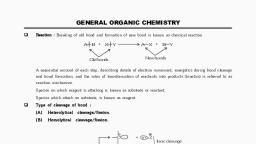
3, , 3.0, , 3.1, , bed, &, , f [PIV 00002 \R 0 A ARETE NENG WHOOKE D103 COC NOI THEERY RSS, , REACTION MECHANISM : PART-I, Reaction : Breaking of old bond and formation of new bond is known as chemical reaction, , A+B + X+4Y, , A—X + B-Y, , , , Old bonds New bonds, , A sequential account of each step, describing details of electron movement, energetics during bond cleavage, and bond formation, and the rates of transformation of reactants into products (kinetics) is referred to as, reaction mechanism. Reactants are of two types substrate and reagent., , Substrate is that reactant which supplies carbon to the new bond and the other reactant is called reagent. If, both reactants supply carbon to the new bond then choice is arbitrary and in that case the molecule on which, attention is focused is called substrate., , CONCEPTS TO UNDERSTAND REACTION MECHANISM :, , (1) Bond cleavage (2) Attacking reagent (3) Reaction intermediate (4) Electronic effect, TYPE OF BOND CLEAVAGE :, , (a) Heterolytical cleavage/fission : Cleavage in which unequal distribution of electrons takes place, during the bond cleavage is known as heterolytical cleavage. Due to unequal distribution of electrons, ions are, formed. That's why it is also known as ionic cleavage or heterolytical cleavage., , (b) Homolytical cleavage/fission : Cleavage in which equal distribution of e°s takes place during the, chemical reaction is known as homolytical cleavage, , Due to equal distribution of electrons, without charge unpaired electrons species is formed, which is, known as free radical and cleavage is known as unionic cleavage/homolytical fission., , Is °, ——> —-CCD + @Z, | | lonic cleavage, or, , bes 7—_ 5 > leap rf etl Heterolytic fission, | |, , , , Un ionic cleavage, , |, Se +ez or, , . Homolytic fission, Reaction, , intermediate, , TYPES OF ATTACKING REAGENTS, These are of two types :, (a) Electrophilic reagent or electrophiles:, Electrophilic (electro + philic), (electron + loving), The reagent which attacks on the negative part of the molecule or loves electrons are called electrophiles., Electrophiles may be positively charged or neutral., (i) Positively charged electrophiles :, , @ ® @ ® ® @ @, H.SOQ,H NO. NO, XR R—C. CH, —Ne, , (ii) Neutral electrophiles :- central atom e deficient, (a) All Lewis acids as :, BF,, AICI,, SO,, ZnCl,, BeCl,, FeCl,, SnCl,, CO,, SnCl,., (b) Free radicals, carbenes and nitrenes act as electrophiles., , —_———_e 55, Scanned with CamS«c
Page 2 :
“SABES, (b) Nucleophilic reagent or nucleophiles, Which attacks on the positive site of the substrate or loves, Nucleophilic (Nucleo + philes), v, (Nucleus + loving), Nucleophiles may be negatively charged ions or posses, (i) Negatively charged nucleophiles, , , , nucleus, , a lone pair of electron or ne, , H.OH-OR.CN .X.R.R-COO.NH2, SH, (ji) All Lewis base which contains lone pairs or ne, , H,0,R-OH,R-O-R, NH,, R-NH,, R,N, CH,<CH,, CH CH, , (ii) _R - Mg - X, LiAIH,, NaBH,, , The star (*) indicates the atom which, Ambident nucleophile :- Nucleophiles which have two s, more atoms bear a lone pair of electrons., , n donates electrons to the substrate, , ites of electron rich centre or in which two o, , , , Examples :- K®%9-—N=O, NI 1-0, , 3.3. REACTION INTERMEDIATE, a Carbocation :, Cation in which positive charge is present on carbon atom is called carbocation, , o Due to electron deficiency it acts as an electrophile and always attack on electron richer site, o It is incomplete octet species because it has six electron in outer most shell., e All electrons are paired., , a Carbanions : Anion in which negative charge is present on carbon atom is called carbanion., , o It has eight electron in outermost shell so it is complete octet species., o It is an electron richer species because it has extra electron, o Due to presence of non bonding electrons it acts as a nucleophile., , Qs Free Radical :, Electrically neutral species in which unpaired electron is present on carbon atom is known as carbon, , , , o, free radical., ° It has seven electron or odd electron in outermost shell., o It is incomplete octet species so it is also electron deficient speci, , Q Carbenes (CH,,;:) :, Carbenes are neutral carbon species in which the carbon atom is bonded to two monovalent atoms or groups i, , and carries two nonbonded electrons., , , , «It behaves as an electrophile. . 6 e in outermost shell., e = It is neutral. . 4 @ are bonded and two are nonbonded e. +, Q_sNitrenes (-N :) i, Nitrenes are neutral nitrogen species in which the nitrogen is bonded to one monovalent atom or grouP i, and carries four non-bonded electrons. !, ¢ It is monovalent radical. . 6 e@ in outermost shell. \, ¢ It is neutral. ° Two are bonded and four are nonbonded electrons. i, b, 56, a .), , OCAINICU WILIT Udll
Page 3 :
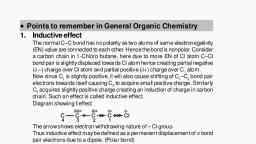
3.4, , Which of the following species is not electrophilic in nature :, @, @, (1) BHs (2) H,o° (3) NO, (4) cl, , CH3CH,-Cl undergoes homolytic fission to produce :, () CH;CH, and } (2) CH,CH, and Cl®, , e, (3) CH;CH, and Cl® (4) CH, CH, and cl?, , Which of the following intermediate has complete octet :(1) Carbocation (2) Carbanion (3) Free radical (4) Carbene, ELECTRONIC EFFECTS :, , There are four effects which affect the chemical reaction due to transfer of electron, (1) Inductive effect (2) Mesomeric effect, , (3) Hyperconjugation (4) Electromeric effect, , 3.4.1INDUCTIVE EFFECT (I-EFFECT) :, , , , ry Polarity induced in non polar o bond due presence of adjacent polar bond is known as inductive effect., , GOLDEN KEY POINTS, , In Leffect there is partial displacement of e®., , , , After 3 or 4 C-atom I-effect is considered to be zero., , Inductive effect decreases on increasing distance., 1, distance, , Feffect of hydrogen is considered as zero., , So Magnitude of I effect «, , groups :, , O sp sp", ® ® - > -C=N > mae, “OR > NR, > NH > NES d oe, —X> -OH > —NH, > —GHs, +I groups :, , CH,, 6 —CH,—CH, > —CD, > —CH,, ~8 > ~coo® > —cncH, > —cH —CH, > CH, 5, , CH, CH,, , Scanned with CamSi
Page 4 :
er eareeitaraerree tei et, EE ll, APPLICATION OF I-EFFECT m—, , (1) Stability of carbocation :, , Energy « charge « 1, stability, , , , Stability of carbocation « +leffect, -| effect, . Hy © ® ®, Example : Stability order : (1) cH? > 2) CHeeH > 3) CHa CH > @) CH,, CH, Hy ,, 3° 2° 1, , Reason: More no. of +1 group., more stable carbocation., , so stability order 1 > 2 > 3>4., , (2) Stability of carbanion :, , as - -| effect, Stability of Carbanion « FTeffect, , CH,, I Q 9, Example: (1) cH-C (2) CH-CH, (3) CH;-CH, (4) CH,, , CH, CH;, , 3° 2° 1°, More No. of +I group., Less stable carbanion., So stability order 4>3>2>1, , ° 9, Example : (1) Cap Sele Se (2) CH CH CH —CH, (3) CH;—-CH-CH;-CHrF, , F F, , Minimum distance of -F., Maximum -I of -F., , Minimum negative charge., Maximum stable., , So stability order 1>2>3, , @ °, Example (1) cH—cH*F (2) CH-cHOH CB) Scan ans, , Maximum -I of F., , Negative charge will be minimum., Maximum stable., , So stability order 1>2>3, , OCdIINICU WILIT Udl 11S
Page 5 :
BEGINNER’, , Most stable carbocation is :, oO, cu en, (2) Br—CH,—CH,, , a a, (3) Cl-—-CH,--CH (4) F—CH,—CH,, , Most stable carbanion is ;, , a a, (1) CH CH —NO (2) @4—cH—cn, , e ‘, (3) CH —cH.—COOH (4) GH,—CH, —CH,— CH, —F, , , , , , (3) Acidic and basic strength :, , °, , , , Acidic strength :, , , , ——— H’ donar, , Acid, , , , +——- €_ acceptor, , , , , , , , Acidic strength « Stability of conjugate base (anion) « zl effect, , , , , , +I effect, Example :, () | CH—-CH.—COOH < C1—CH ,— COOH “ F—CH,— COOH, Hw H -H", 9 9 8, CH,—CH ,— COO CI—CH,—COO F—CH,—COO, +1 of -CH Maximum -I of -F, anion is leas stable Maximum stable anion, , Corresponding acid is maximum acidic., (ii) CCI,—COOH > CBr,—COOH > Cl,—COOH, maximum -I of Cl, so maximum acidic., , (iii) CH,—CH, -CH—COOH > CH,~-CH-~-CH, ~ COOH > GH, ~ CH, ~ CH, = COOH, ACH,, , Minimum distance of F from -COOH, Maximum -I of F,, , So maximum acidic., , i, , Qe 59, , Scanned with CamSx