Page 1 :
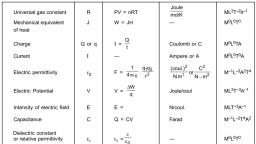
SPARK ACADEMY, Unit, Dimension and Measurement, Class-Sheet, S. N., , Quantity, , (1), , Velocity or speed (v), , m/s, , [M0L1T –1], , (2), , Acceleration (a), , m/s2, , [M0LT –2], , (3), , Momentum (P), , kg-m/s, , [M1L1T –1], , (4), , Impulse (I), , Newton-sec or kg-m/s, , [M1L1T –1], , (5), , Force (F), , Newton, , [M1L1T –2], , (6), , Pressure (P), , Pascal, , [M1L–1T –2], , (7), , Kinetic energy (EK), , Joule, , [M1L2T –2], , (8), , Power (P), , Watt or Joule/s, , [M1L2T –3], , (9), , Density (d), , kg/m3, , [M1L– 3T 0], , (10), , Angular displacement (), , Radian (rad.), , [M0L0T 0], , (11), , Angular velocity (), , Radian/sec, , [M0L0T – 1], , (12), , Angular acceleration (), , Radian/sec2, , [M0L0T – 2], , (13), , Moment of inertia (I), , kg-m2, , [M1L2T0], , (14), , Torque (), , Newton-meter, , [M1L2T –2], , (15), , Angular momentum (L), , Joule-sec, , [M1L2T –1], , (16), , Force constant or spring constant (k), , Newton/m, , [M1L0T –2], , (17), , Gravitational constant (G), , N-m2/kg2, , [M–1L3T – 2], , (18), , Intensity of gravitational field (Eg), , N/kg, , [M0L1T – 2], , (19), , Gravitational potential (Vg), , Joule/kg, , [M0L2T – 2], , (20), , Surface tension (T), , N/m or Joule/m2, , [M1L0T – 2], , (21), , Velocity gradient (Vg), , Second–1, , [M0L0T – 1], , (22), , Coefficient of viscosity (), , kg/m-s, , [M1L– 1T – 1], , (23), , Stress, , N/m2, , [M1L– 1T – 2], , (24), , Strain, , No unit, , (25), , Modulus of elasticity (E), , N/m2, , (26), , Poisson Ratio (), , No unit, , [M0L0T 0], , (27), , Time period (T), , Second, , [M0L0T1], , (28), , Frequency (n), , Hz, , [M0L0T –1], , Unit, , Dimension, , [M0L0T 0], [M1L– 1T – 2], , S. N., , Quantity, , (1), , Temperature (T), , Kelvin, , [M0L0T0 1], , (2), , Heat (Q), , Joule, , [ML2T– 2], , (3), , Specific Heat (c), , Joule/kg-K, , [M0L2T– 2 –1], , (4), , Thermal capacity, , Joule/K, , [M1L2T – 2 –1], , (5), , Latent heat (L), , Joule/kg, , [M0L2T – 2], , (6), , Gas constant (R), , Joule/mol-K, , [M1L2T– 2 – 1], , Mo: 9300015048; Dr. Neelesh Channawar, , Unit, , Dimension
Page 2 :
S. N., , Quantity, , Dimension, , Unit, , (7), , Boltzmann constant (k), , Joule/K, , [M1L2T– 2 – 1], , (8), , Coefficient of thermal conductivity (K), , Joule/m-s-K, , [M1L1T– 3 – 1], , (9), , Stefan's constant (), , Watt/m2-K4, , [M1L0T– 3 – 4], , (10), , Wien's constant (b), , Meter-K, , [M0L1To1], , (11), , Planck's constant (h), , Joule-s, , [M1L2T–1], , (12), , Coefficient of Linear Expansion (), , Kelvin–1, , [M0L0T0 –1], , (13), , Mechanical eq. of Heat (J), , Joule/Calorie, , [M0L0T0], , (14), , Vander wall’s constant (a), , Newton-m4, , [ML5T– 2], , (15), , Vander wall’s constant (b), , m3, , [M0L3T0], , S. N., , Quantity, , (1), , Electric charge (q), , Coulomb, , [M0L0T1A1], , (2), , Electric current (I), , Ampere, , [M0L0T0A1], , (3), , Capacitance (C), , Coulomb/volt or Farad, , [M–1L– 2T4A2], , (4), , Electric potential (V), , Joule/coulomb, , M1L2T–3A–1, , Unit, , Coulomb, , Dimension, , 2, , (5), , Permittivity of free space (0), , Newton - meter 2, , [M–1L–3T4A2], , (6), , Dielectric constant (K), , Unitless, , [M0L0T0], , (7), , Resistance (R), , Volt/Ampere or ohm, , [M1L2T– 3A– 2], , (8), , Resistivity or Specific resistance (), , Ohm-meter, , [M1L3T– 3A– 2], , (9), , Coefficient of Self-induction (L), , volt − second, or henery or ohm-second, ampere, , [M1L2T– 2A– 2], , (10), , Magnetic flux (), , Volt-second or weber, , [M1L2T–2A–1], , (11), , Magnetic induction (B), , newton, Joule, ampere − meter ampere − meter, volt − second, meter, , (12), (13), , Magnetic Intensity (H), Magnetic Dipole Moment (M), , 2, , [M1L0T– 2A– 1], , or Tesla, , 2, , [M0L– 1T0A1], , Ampere/meter, Ampere-meter, , 2, , Newton, ampere, , 2, , or, , [M0L2T0A1], Joule, , ampere, , 2, , − meter, , or, , (14), , Permeability of Free Space (0), , (15), , Surface charge density (), , Coulomb metre −2, , [M0L–2T1A1], , (16), , Electric dipole moment (p), , Coulomb − meter, , [M0L1T1A1], , (17), , Conductance (G) (1/R), , ohm −1, , [M–1L–2T3A2], , (18), , Conductivity () (1/), , ohm −1 meter, , (19), , Current density (J), , Ampere/m2, , M0L–2T0A1, , (20), , Intensity of electric field (E), , Volt/meter, Newton/coulomb, , M1L1T –3A–1, , (21), , Rydberg constant (R), , m–1, , M0L–1T0, , S. N., , Dimension, , Quantity, , Mo: 9300015048; Dr. Neelesh Channawar, , Ohm − sec ond, henery, Volt − second, or, or, ampere − meter, meter, meter, , −1, , [M1L1T–2A–2], , [M–1L–3T3A2]
Page 3 :
S. N., , [M0L0T–1], , Frequency, angular frequency, angular velocity, velocity gradient and decay constant, , (2), , [M1L2T–2], , Work, internal energy, potential energy, kinetic energy, torque, moment of force, , (3), , [M1L–1T–2], , Pressure, stress, Young’s modulus, bulk modulus, modulus of rigidity, energy density, , (4), , [M1L1T–1], , Momentum, impulse, , (5), , [M0L1T–2], , Acceleration due to gravity, gravitational field intensity, , (6), , [M1L1T–2], , Thrust, force, weight, energy gradient, , (7), , [M1L2T–1], , Angular momentum and Planck’s constant, , (8), , [M1L0T–2], , Surface tension, Surface energy (energy per unit area), , (9), , [M0L0T0], , Strain, refractive index, relative density, angle, solid angle, distance gradient, relative, permittivity (dielectric constant), relative permeability etc., , (10), , [M0L2T–2], , Latent heat and gravitational potential, , (11), , [M0L2T–2 –1], , (12), , [M0L0T1], , (13), , [M0L0T1], , L/R,, , [ML2T–2], , V2, q2, t, VIt, qV , LI 2 ,, , CV 2 where I = current, t = time, q = charge,, R, C, L = inductance, C = capacitance, R = resistance, , , , Thermal capacity, gas constant, Boltzmann constant and entropy, l g , m k , R g , where l = length, , g = acceleration due to gravity, m = mass, k = spring constant, , LC , RC where L = inductance, R = resistance, C = capacitance, , I 2 Rt ,, , a , , The equation P + 2 (V − b ) = constant. The units of a is, V , , , (a), 2., , Dimension, , Unit, , (1), , (14), , 1., , Quantity, , Dyne cm 5, , (b) Dyne cm 4, , (c) Dyne / cm 3, , (d) Dyne / cm 2, , If x = at + bt 2 , where x is the distance travelled by the body in kilometre while t the time in seconds, then the, units of b are, , 3., 4., , (a) km/s, (b) km-s, The unit of absolute permittivity is, (a) Farad - meter, (b) Farad / meter, , (c) km/s2, , (d) km-s2, , (c) Farad/meter 2, , (d) Farad, , (c) Jm −2, , (d) Js, , (c) Dyne/cm, , (d) Newton/m2, , Unit of Stefan's constant is, , (a) Js −1, , (b) Jm −2 s −1 K −4, , 5. The unit of surface tension in SI system is, (a) Dyne / cm 2, 6., , (b) Newton/m, , A suitable unit for gravitational constant is, (a) kg metre sec −1, , 7., , (d) kg metre sec −1, , The SI unit of universal gas constant (R) is, (a) Watt K −1 mol, , 8., , (b) Newton metre −1 sec (c) Newton metre 2 kg −2, , X = 3YZ, , 2, , −1, , (b) Newton K −1 mol, , −1, , (c) Joule K −1 mol, , −1, , (d) Erg K −1 mol −1, , find dimension of Y in (MKSA) system, if X and Z are the dimension of capacity and magnetic, , field respectively, (a) M −3 L−2 T −4 A −1, (b) ML −2, (c) M −3 L−2 T 4 A 4, 1, , where symbols have their usual meaning, are, 9. Dimensions of, 0 0, (a) [LT −1 ], , (b) [L−1 T ], , (c) [L−2 T 2 ], , (d) M −3 L−2 T 8 A 4, , (d) [L2 T −2 ], , 10. If L, C and R denote the inductance, capacitance and resistance respectively, the dimensional formula for C 2 LR is, , Mo: 9300015048; Dr. Neelesh Channawar
Page 4 :
(a) [ML −2 T −1 I 0 ], , (c) [M −1 L−2 T 6 I 2 ], , (b) [M 0 L0 T 3 I 0 ], , (d) [M 0 L0 T 2 I 0 ], , 11. A force F is given by F = at + bt 2 , where t is time. What are the dimensions of a and b, (a) MLT, , −3, , and ML 2 T −4 (b) MLT, , −3, , and MLT, , −4, , (c) MLT, , −1, , and MLT, , (d) MLT, , 0, , −4, , and MLT 1, , v , 12. The position of a particle at time t is given by the relation x (t) = 0 (1 − c − t ), where v 0 is a constant and 0 ., , , The dimensions of v 0 and are respectively, (a) M 0 L1 T −1 and T −1, , (b) M 0 L1 T 0 and T −1, , (c) M 0 L1 T −1 and LT −2, , 13. The dimensions of physical quantity X in the equation Force =, (a) M 1 L4 T −2, , (b) M 2 L−2 T −1, , 14. Number of particles is given by n = − D, , (d) M 0 L1 T −1 and T, , X, is given by, Density, , (c) M 2 L−2 T −2, , (d) M 1 L−2 T −1, , n 2 − n1, crossing a unit area perpendicular to X- axis in unit time, where n1, x 2 − x1, , and n 2 are number of particles per unit volume for the value of x meant to x 2 and x 1 . Find dimensions of D called, as diffusion constant, (a) M 0 LT 2, (b) M 0 L2 T −4, (c) M 0 LT −3, (d) M 0 L2 T −1, 15. E, m, l and G denote energy, mass, angular momentum and gravitational constant respectively, then the dimension, of, , El 2, m 5 G2, , are, , (a) Angle, , (b) Length, , (c) Mass, , (d) Time, , x, , 16. The equation of a wave is given by Y = A sin − k where is the angular velocity and v is the linear velocity., v, , The dimension of k is, , (a) LT, , (b) T, , (c) T −1, , 17. The potential energy of a particle varies with distance x from a fixed origin as U =, , (d) T 2, A x, x2 + B, , , where A and B are, , dimensional constants then dimensional formula for AB is, (a) ML7/2T −2, , (b) ML11 / 2 T −2, , (c) M 2 L9 / 2 T −2, , (d) ML13 / 2 T −3, , 1, 0 E 2 ( 0 = permittivity of free space ; E = electric field ) is, 2, , 18. The dimensions of, , (a) MLT −1, (b) ML 2 T −2, (c) ML −1 T −2, (d) ML2 T −1, 19. You may not know integration. But using dimensional analysis you can check on some results. In the integral, dx, x, , = an sin −1 − 1 the value of n is, a, (2 ax − x 2 )1 / 2, , , , , , (a) 1, , (b) – 1, , 20. A physical quantity P =, (a) MLT, , −3, , (c) 0, , (d), , 1, 2, , B 2l 2, where B= magnetic induction, l= length and m = mass. The dimension of P is, m, , (b) ML2 T −4 I–2, , (c) M 2 L2 T −4 I, , (d) MLT, , −2 −2, , I, , 2ct , 2x , 21. The equation of the stationary wave is y= 2 a sin , cos , , which of the following statements is wrong, , , , (a) The unit of ct is same as that of , (c) The unit of 2c / is same as that of 2x /t, , (b) The unit of x is same as that of , (d) The unit of c/ is same as that of x / , , 22. A physical quantity is measured and its value is found to be nu where n = numerical value and u = unit., Then which of the following relations is true, (a) n u 2, , (b) n u, , Mo: 9300015048; Dr. Neelesh Channawar, , (c) n u, , (d) n , , 1, u
Page 5 :
23. In C.G.S. system the magnitude of the force is 100 dynes. In another system where the fundamental physical, quantities are kilogram, metre and minute, the magnitude of the force is, (a) 0.036, , (b) 0.36, , (c) 3.6, , (d) 36, , 24. The temperature of a body on Kelvin scale is found to be X K. When it is measured by a Fahrenheit, thermometer, it is found to be X F. Then X is, (a) 301.25, , (b) 574.25, , (c) 313, , (d) 40, , 25. Which relation is wrong, (a) 1 Calorie = 4.18 Joules, , 1Å =10–10 m, , (b), , (c) 1 MeV = 1.6 × 10⁻¹³ Joules (d), , 1 Newton =10–5 Dynes, , 26. To determine the Young's modulus of a wire, the formula is Y =, , F L, . ; where L= length, A= area of crossA l, , section of the wire, L = Change in length of the wire when stretched with a force F. The conversion factor to, change it from CGS to MKS system is, (a) 1, , (b) 10, , (c) 0.1, , (d) 0.01, , 27. Conversion of 1 MW power on a new system having basic units of mass, length and time as 10kg, 1dm and, 1 minute respectively is, (a) 2 . 16 10 12 unit, , (b) 1 . 26 10 12 unit, , (c) 2 . 16 10 10 unit, , (d) 2 10 14 unit, , 28. In two systems of relations among velocity, acceleration and force are respectively v 2 =, F2 =, , F1, , , , 2, v1 , a2 = a1 and, , , . If and are constants then relations among mass, length and time in two systems are, , (a) M 2 =, , , 2, 3 T1, M1 , L2 = 2 L1 , T2 =, , , , , (b) M 2 =, , (c) M 2 =, , 3, 2, , M, ,, L, =, L , T = T1, 1, 2, 3, 2 1 2, , , , , (d) M 2 =, , 1, , M 1 , L2 =, , 2 2, , 3, , L , T = T1 2, 3 1 2, , , , 2, , 3, M, ,, L, =, L, ,, T, =, T1, 1, 2, 1, 2, 2, 2, 3, , 29. If the present units of length, time and mass (m, s, kg) are changed to 100m, 100s, and, , 1, kg then, 10, , (a) The new unit of velocity is increased 10 times (b) The new unit of force is decreased, , 1, times, 1000, , (c) The new unit of energy is increased 10 times (d) The new unit of pressure is increased 1000, times, 30. Suppose we employ a system in which the unit of mass equals 100 kg, the unit of length equals 1 km and the, unit of time 100 s and call the unit of energy eluoj (joule written in reverse order), then, (a) 1 eluoj = 104 joule, , (b) 1 eluoj = 10-3 joule (c) 1 eluoj = 10-4 joule, , (d) 1 joule = 103 eluoj, , 31. If 1gm cms–1 = x Ns, then number x is equivalent to, (a) 1 10 −1, , (b) 3 10 −2, , (c) 6 10 −4, , (d) 1 10 −5, , 32. From the dimensional consideration, which of the following equation is correct, (a) T = 2, , R3, GM, , (b) T = 2, , GM, R, , 3, , (c) T = 2, , GM, R, , 2, , [CPMT 1983], , (d) T = 2, , R2, GM, , 33. A highly rigid cubical block A of small mass M and side L is fixed rigidly onto another cubical block B of the, same dimensions and of low modulus of rigidity such that the lower face of A completely covers the upper, face of B. The lower face of B is rigidly held on a horizontal surface. A small force F is applied perpendicular to, one of the side faces of A. After the force is withdrawn block A executes small oscillations. The time period of, which is given by, , Mo: 9300015048; Dr. Neelesh Channawar
Page 6 :
M, L, , (a) 2, , (b) 2, , L, M, , (c) 2, , ML, , , , (d) 2, , M, , L, , 34. A small steel ball of radius r is allowed to fall under gravity through a column of a viscous liquid of coefficient, of viscosity. After some time the velocity of the ball attains a constant value known as terminal velocity v T ., The terminal velocity depends on (i) the mass of the ball. (ii) (iii) r and (iv) acceleration due to gravity g., which of the following relations is dimensionally correct, (a) v T , , mg, r, , (b) v T , , r, mg, , (c) vT rmg, , (d) v T , , mgr, , , , 35. A dimensionally consistent relation for the volume V of a liquid of coefficient of viscosity flowing per second, through a tube of radius r and length l and having a pressure difference p across its end, is, (a) V =, , pr 4, 8l, , (b) V =, , l, 8 pr, , 4, , 36. With the usual notations, the following equation S t = u +, , (c) V =, , 8 p l, , r, , 4, , (d) V =, , p , 8lr 4, , 1, a(2 t − 1) is, 2, , (a) Only numerically correct, , (b) Only dimensionally correct, , (c) Both numerically and dimensionally correct, , (d) Neither numerically nor dimensionally correct, , 37. If velocity v, acceleration A and force F are chosen as fundamental quantities, then the dimensional formula, of angular momentum in terms of v, A and F would be, (a) FA −1 v, , (b) Fv 3 A −2, , (c) Fv 2 A −1, , (d) F 2 v 2 A −1, , 38. The largest mass (m) that can be moved by a flowing river depends on velocity (v), density ( ) of river water, and acceleration due to gravity (g). The correct relation is, (a) m , , 2v 4, g2, , (b) m , , v 6, g2, , (c) m , , v 4, g3, , (d) m , , v 6, g3, , 39. If the velocity of light (c), gravitational constant (G) and Planck's constant (h) are chosen as fundamental units,, then the dimensions of mass in new system is, (a), , c 1 / 2 G 1 / 2 h1 / 2, , (b), , c 1 / 2 G 1 / 2 h −1 / 2, , (c), , c 1 / 2 G −1 / 2 h 1 / 2, , (d), , c −1 / 2 G 1 / 2 h 1 / 2, , 40. If the time period (T) of vibration of a liquid drop depends on surface tension (S), radius (r) of the drop and, density ( ) of the liquid, then the expression of T is, (a) T = K r 3 / S, , (b) T = K 1 / 2 r 3 / S, , (c) T = K r 3 / S 1 / 2, , (d) None of these, , 41. If P represents radiation pressure, C represents speed of light and Q represents radiation energy striking a unit, area per second, then non-zero integers x, y and z such that P x Q y C z is dimensionless, are, (a) x = 1, y = 1, z = −1, , (b) x = 1, y = −1, z = 1, , (c) x = −1, y = 1, z = 1, , (d) x = 1, y = 1, z = 1, , 42. The volume V of water passing through a point of a uniform tube during t seconds is related to the cross-sectional, area A of the tube and velocity u of water by the relation V A u t , which one of the following will be true, (a) = = , , (b) = , , (c) = , , (d) , , 43. If velocity (V), force (F) and energy (E) are taken as fundamental units, then dimensional formula for mass will be, (a) V −2 F 0 E, , (b) V 0 FE 2, , (c) VF −2 E 0, , 44. Given that the amplitude A of scattered light is :, (i) Directly proportional to the amplitude (A0) of incident light., (ii) Directly proportional to the volume (V) of the scattering particle, (iii) Inversely proportional to the distance (r) from the scattered particle, (iv) Depend upon the wavelength ( ) of the scattered light. then:, , Mo: 9300015048; Dr. Neelesh Channawar, , (d) V −2 F 0 E
Page 7 :
(a) A , , 1, , , , (b) A , , Mo: 9300015048; Dr. Neelesh Channawar, , 1, , , , 2, , (c) A , , 1, , , , 3, , (d) A , , 1, , 4