Notes of NEET,JENPUS &ETC BATCH, Biology The living world.pdf - Study Material
Page 1 :
Science : The term science is derived from Latin word scientia, which means knowledge. So, the term ‘science’ is used for, knowledge gained by actual observation, found correct on, verification and put in a systematic manner or science provides us, information based on facts. There are several branches of science,, each dealing with a specific subject., , Biology : It is the combination of two Greek words bios and, logos. Bios means life and logos means study. Thus, biology is the, branch of science which deals with the study of life, The first major, biological observations were made by ancient Greek naturalist, Aristotle (384-322 B.C.). Aristotle has been designated as Father of, biology. The term biology was given by French naturalist Lamarck, and Gottfried Treviramus of Germany (1744-1829), Biology has, been further classified into., , (1) Botany (2) Zoology., , The science of plants is called Botany. The word botany has, been derived from Greek word botane which means pasture or, plants. Technically, botany is called Phytology (Gk. phyto = plants;, Jogos = study). Theophrastus (370-287 B.C.) is known as Father, of botany. Zoology is the study of animals (Gk. zoon = animals;, logos = study). Aristotle is called Father of zoology. Being, broad-based and with mulfi-disciplinary approach, the term, biology has been replaced by Life Sciences or Biological Sciences., , Microbiology : It is the branch of biology which deals with, different aspects of microorganisms. Leeuwenhoek (1632-1723), is called Father of microbiology,, , , , The Living World, , 1.1 Nature and Scope of Biology, , Some Branches of Biology, , ‘Anatomy = Study of intemal structures of plants and animals, alter dissection,, , Biochemistry : Study of chemistry of living matter (ie.,, chemical composition, nature, mode of formation, functioning) in, relation to life activities., , Cytology : Study of the structure and functions of cells and, their organelles, , Ecology : Study of relationship between organisms and, environment., , Embryology : Study of developmental stages of organisms, upto hatching or birth,, , Endocrinology : Study of endocrine glands and hormones, action in animals., , Evolution : Study of the origin of life and the gradual, differentiation or descent of species., , Histology : Study of tissues by microscopy., Immunology : Siudy of resistance of organisms to infection,, , Limnobiology : Study of fresh water lakes, ponds and, streams,, , Morphology : Study of form and structure of animals., Palaeozoology : Study of fossil animals., , Physiology : Study of functions of various parts within the, organisms., , Radiobiology : Study of effects of radioactivity on life., , Taxonomy : Study of classification of organisms and their, evolutionary relationships with other organisms.
Page 2 :
2 The Living World, , , , Zoogeography : Study of the distribution of animals over, the earth,, , Zoopathology : Study of diseases of animals,, , Specified Branches of Biology, , ‘Acarology : Study of mites and ticks., , Agriculture : Science of farming, raising crops and animal, husbandary., , Angiology : Study of blood vascular system including veins, and arteries,, , Anthology : Study of flowers, , Bacteriology : Study of bacteria, , Bryology : Study of mosses and liverworts,, , Cardiology : Study of heart., , Dermatology : Study of skin covering the body., , Epidemiology : Study of infection of parasites or epidemic, diseases., , Ethnology : Study of different races of mankind., , Etiology : Study of cause of disease., , Gerontology : Study of growing old., , Gynaecology : Study of female reproductive organs., , Haematology : Study of blood,, , Hepatology : Study of liver., , Kalology : Study of human beauty., , Leprology : Study of leprosy., , Molecular biology : Study of life sciences on molecular level, (e.g, nudleic acids ie., RNA & DNA and proteins),, , Myrmecology : Study of ants and anteaters., , Nematology : Study of nematodes., , Nephrology : Study of kidney., , Neurology : Study of nervous system including brain., , Oncology : Study of tumours,, , ology : Study of eggs of birds., , Ornithology : Study of birds,, , Osteology : Study of bones., , Palaeontology : Study of fossils and their distribution., , Pomology : Study of fru., , Rhinology : Study of nose and olfactory organs., , ‘Serology : Study of serum, Study of antigen-antibody reactions,, , Serpentology : Study of snakes., , Termitology : Study of termites., , Toxicology : Study of toxic effects of drugs and harmful, compounds,, , ‘Therapeutics : Science of healing,, , Trophology : Study of nutri, , Virology : Study of viruses, , ‘Zoophytology : Study of drifting organisms such as diatoms., , Zymology : Study of fermentation processes., , , , , , , , , , , , , , Fathers of Various Sciences, , Father of Zoology and Biology and Founder of Embryology, Aristotle, , Father of Botany : Theophrastus, , Father of Genetics : GJ. Mendel, , Father of Evolutionary ideas : Empedocles, , Father of Eugenics : Francis Galion, , Father of Mutation : Hugo de Vries, , Father of Modem Embryology : Karl Ernst Von Baer, Father of Palaeontology : Leonardo da vinci, , Father of Taxonomy : Carolus Linnaeus, , Father of Special Creation Theory : Father Saurez, Father of Blood groups : K.Landsteiner, , Father of Blood circutz, Father of Comparative Anatomy : G. Cuvier, Father of Modem Genetics : W.Bateson, Father of human genetics : Archibald Garrod, Father of Medicine : Hippocrates, , , , in: William Harvey, , Father of Microbiology : Leeuwen hock, Father of Immunology : Edward Jenner, , Biology in Ancient india, , ‘About 740 plants and 250 animals have been mentioned in, Vedic literature. Few significant references in old literature are,, , (1) Chandyogya Upanishad : Here the animals have been, classified into three categories , {i) Jivaja (Viviparous) e.g, mammals,, , (i) Andaja (Oviparous) e.g, birds, reptiles, insects and worms., , (iil) Udbbhija (Vegetal origin) e.g. small animals., , (2) Susruta Samhita (600 B.C.) : Here organisms were, classified into,, , () Sthavara in which immobile organisms like plants, were kept,, , (i) dangama in which mobile organisms like animals were, placed., , Medical Science in Ancient India, , Two Ashwini Kumars has been said to be practising medicine, during Vedic times, Dhanvantari has been called as 'God of, medicine’, Susruta has been called as ‘Father of surgery’Few, important references are, , (1) Sustuta studied human anatomy on dead bodies,, , (2) Susruta carried plastic surgery on human nose (rhinoplasty, , (3) Ophthalmic surgery : Susruta carried an eye surgery like, extraction of cataracts., , (4) Clotting of blood : Susruta used non-poisonous live, leeches for checking clotting of blood in post operative conditions., Now its clearly established that hirudin is released along saliva of, leeches to produce this kind of effect., , (5) Charaka Samhita (100 B.C.) : It is said to be primarily, written by Agnivesa under the guidance of Atreya (600 B.C)., Charaka was first to discuss the concepts of digestion, Metabolism, and immunity.
Page 3 :
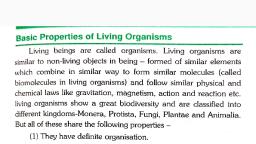
The Living World 3, , , , , , ‘Scope of Biology, , Biology creates an awareness of vast array of forms of life, which normally goes unseen. Biology offers a large scope and, provides a large field for study., , (1) Helps us to understand ourselves better : It unfolds, different queries of life alongwith its cultural, social, philosophical, and economical aspects. So it helps in understanding the life, better., , (2) Biology and inter-relationship of living beings :, Study of biology helps us in understanding the wonderful, phenomenon and laws of nature which finally tell us to predict the, ‘behaviour of different living beings under changed conditions., , 3) Biology and resources : Biology helps us to know how, to trap and conserve the resources available to us e.g. fishes, birds,, forests etc, , (4) Biology and literature : Knowledge of Natural Biology, has greatly enriched the literature with their references in stories, and poems etc. Poets and other authors have been inspired by the, beautiful and interesting plants and animals and frequently figure, them in stories, poems and dramas., , (5) Study of nature is a rewarding experience : Many, plants like Narcissus, Dahlia, Gloriosa, Roses, Marigold, Aster, etc., are used for ornamental purposes. The variety available in animals, is widely enjoyed in zoological parks., , 1.2 Understanding Life, , Basic Properties of Living Organisms, , Living beings are called organisms. Living organisms are, similar to non-living objects in being — formed of similar elements, which combine in similar way to form similar molecules (called, biomolecules in living organisms) and follow similar physical and, chemical laws like gravitation, magnetism, action and reaction etc., living organisms show a great biodiversity and are classified into, different kingdoms-Monera, Protista, Fung, Plantae and Animalia,, But all of these share the following properties —, , (1) They have definite organisation,, , (2) They always have cellular nature so are either, unicellular (eg. Amoeba, Paramecium etc.) or multicellular, (e.g., Hydra, man etc.)., , (3) They show co-ordination between different parts of body, to maintain homeostasis (constant internal environment) inside the, body., , (4) They have the ability of movements and locomotion., , (5) They show metabolic functions in the presence of energy., , (6) These have the ability of intussusceptional_ (intemal), growth and development., , (7) These have specific receptors (e.g,, sense organs to receive, external and intemal stimuli) and specific effectors (eg., muscles, and glands to give specific response}., , (8) These have regulatory mechanisms (eg, nerves and, hormonal in animals, and only hormonal in plants) to maintain, homeostasis inside the body., , (9) These show adaptations to their environment to increase, their chances of survival., , , , (6) Solving problems : Biology makes us to understand the, present day problems such as population growth, pollution,, conservation of wildlife and survival of man etc. The future, directions of biotechnology, conservation of biodiversity,, maintenance of environment and human welfare remain in the, hands of biologists, , (7) Biology-Medicinal aspect : Several plants like Atropa, belladona, Cinchona are sources of atropine, quinine etc. Many, members of fungi such as Penicillium and Streptomyces give rise, to antibiotics like penicillin and streptomycin, Plants are the major, source of vitamins, Drugs are first tested on animals before being, used for treating man. Animals provide scientific hints for the, production and use of medicines. Many diseases like malaria are, caused and transmitted by animals., , (8) Solving approach of biology : Knowledge for, eradication of diseases like malaria, small pox, etc. have been, achieved by scientists basically due to desire and determination to, solve the problem., , (9) Ecosystem and living organisms : Biology helps us in, understanding the various ecosystems. The living community and, non-living environment interact with each other and exchange of, material in them takes place., , (10) Biotechnology : Biotechnologists have produced many, genetically modified (GM) crops. Plenty of studies are being made, by geneticists, evolutionists and cytologists to fudge the efficacy of, biotechnology, , , , , , (10)These show variations which help in speciation and, evolution., , (11) These have reproductive powers for continuity of, their race,, Levels of Biological Organization, , (1) Levels of Organization common in both living and nonliving, , {) Atomic level : The lowest level of organization in both, living and non-living is the atom, All living organisms are basically, made up of four chemical elements carbon (C), hydrogen (H),, oxygen (O) and nitrogen (N) with only about 1% other elements., ‘The non-living matter may possess other elements (such as silica,, calcium, iron, etc.) in variable composition., , (il) Molecular level : Atoms combine to form molecules,, ‘which undergo chemical reactions to form organelles., , , , Atoms + Molecules -> Inorganic compounds + Simple, organic compounds —» Complex organic compound ->, Protoplasm — Cell,, , (2) Levels of Organization found only in living organisms, , (i) Cellular level : All multicellular organisms are made up of, cells, The cell is considered as basic unit of life and constitutes the, smallest level of organisation of the living organisms,, , (i) Tissue level : In multicellular organisms similar or, dissimilar cells, having a common origin and a common function,, combine to form a tissue. Each tissue performs a specific role (eg.,, xylem conducts water and minerals in plants)., , (ii) Organ level : Different tissue are organised to form, distinet organs. For example, xylem, phloem chlorenchyma,, parenchyma get organised to form a leaf.
Page 4 :
4 The Living World, , , , , , (iv) Organs System level : A group of organs that, coordinates to performs a major function forms the organs system., For example, the brain works with the spinal cord and a network of, nerves to form the nervous system., , (v} Individual or Organismic level : A multicellular, individual, having many organ systems, forms an organismic level, of organisation, , Cell + Tissue -+ Organ + Organ system — Individual, , (3) Levels of organization beyond the individual, organism, , (}) Population level : All the individuals of a species in a, particular area, where they interact with each other, belong to a, population. For example, there is a population of Oak trees in a, temperate deciduous forest., , (ii) Community level : The populations of different species, of plants and animals present in a particular area make up biotic, community,, , (ii) Ecosystem level : Populations of different plants and, animals interact among themselves and with the non-living, components of the area form as ecosystem., , (iv) Biosphere level : The different ecosystems (small or big), of all the geographical regions of the world form the biosphere or, the entire livable part of the earth,, , Building blocks of life and their function, , Living organism is formed of many types of inorganic as well, ‘as organic biomolecules. Inorganic compounds include water,, minerals etc. and are always micro-biomolecules (small sized, low, molecular weight, readily soluble in water and diffusible) while, organic molecules may be micro (e.g. monosugars, amino acids, etc.) or macro-biomolecules {large sized, high molecular weight,, insoluble or slightly soluble and non-diffusible e.g,, proteins, fats,, nucleic acids, etc.). These both types of biomolecules play, important roles in metabolism :, , (1) Role of Water : Water forms 70-90% of the cellular pool., , It forms 65% (about two-thirds) of human body. It is formed of H, and O in the ratio of 2:1, 95% of water is found in free state and, 5% in combined form in the cell. Water helps in sustaining the life, processes. So water is called elixir or cradle of lip as life is not, possible in the absence of water., (2) Role of Oxygen : Oxygen is mainly utilized in aerobic, cell respiration of the nutrients inside the mitochondria to produce, energy-rich ATP molecules so is essential for life, In the absence of, ‘oxygen, only 5% of energy available is released., , (3) Role of Sodium chloride (common salt-NaCl) :, Sodium chloride plays important roles in metabolic functions of, body especially when in ionic form., , (4) Role of Carbohydrates : Carbohydrates are organic, compounds formed of C, H and O generally in the ratio of 1:2:1., These are commonly called saccharides (Gk. saccharon = sugar), Carbohydrates are the main storage molecules and most organisms, use carbohydrates as an important fuel, breaking these bonds and, releasing energy to sustain life., , , , (5) Role of Proteins : Proteins are polymeric compounds, formed by interlinking of amino acids (monomers) by peptide, , bonds. Out of about 100 types of amino acids, only 20 types of, amino acids are of biological importance, so are called Magic-20,, Proteins play a vital role in the formation of structures in living, organisms, Like carbohydrate and fat, protein can be broken down, with the release of energy. Protein is not stored as such in the body, and it is normally only used as a substantial source of energy in, conditions of starvation., , (6) Role of lipids : Lipids comprise a major group of, insoluble hydrocarbons having many functions. These are, polymers of alcohols (e.g. glycerol) and fatty acids interlinked by, esterbonds,, , (7) Role of Nucleic Acid : These are polymers of, nucleotides interlinked by phosphodiester bonds, so called, polynucleotides. Each nucleotide is formed of 3 components : a, pentose sugar (e.g. ribose in RNA and deoxyribose in DNA), a, phosphate group and an inorganic nitrogen-base (a purine or a, pyrimidine)., , Matter and Energy, , Technically speaking, matter and energy are interchange, able as expressed by Albert Einstein's famous equation E =mc?:, energy equals mass times the square of the speed of light (c?)., , For the chemical reactions that occur within living, organisms, however, we can treat matter and energy as quite, distinct from one another. Matter is the physical material of the, universe; energy isthe capacity to do work,, , Close and Open system : A system is a portion of the, universe that is selected within a definite boundary, The part other, than the system is called surrounding., , As system is said to be closed if it can exchange energy but, nnot matter, and in this energy can be gained or lost (through, stainless walls) but not matter. A system said to be open if it can, exchange matter and energy with surroundings. All living systems, fare open systems because they are continuously exchanging, matter and energy with their surroundings., , Kinetic and Potential energy, , Kinetic energy is the energy of movement and this include not, only movement of large objects but also movements such as, electrical energy (movement of electrons) and heat (movement of, atoms and molecules)., , Potential energy is stored energy that can be released as, kinetic energy under right conditions,, , ‘The food which you eat has chemical potential energy, some, of which is converted into kinetic energy., , Laws of Thermodynamics, , The laws of thermodynamics describe the basic properties, of energy. All interactions among pieces of matter are governed, by the two laws of thermodynamics. The laws of, thermodynamics deal with “isolated systems” which are any, parts of the universe that cannot exchange either matter or, energy with any other parts., , First Law of Thermodynamics : The first law of, thermodynamics states that energy can neither be created nor, destroyed; but energy can change from one form to another., , In other words, within an isolated system the total quantity of, energy remains constant. The first law is therefore often called the, Jaw of conservation of energy.
Page 5 :
Second law of Thermodynamics : The second law of, thermodynamics states that the amount of useful energy always, decreases when energy is converted from one form to another., , In other words, every transfer or transformation of energy, makes the universe disordered; no physical process or chemical, reaction is 100 per cent efficient., , Entropy is a measure of the disorder or randomness within a, system,, , Energy flow, , (1) Energy Transformation : It is the phenomenon in which, one form of energy is changed into another form of energy, e.g. in, photosynthesis (anabolism), radiant (Kinetic) energy of sunlight is, changed into chemical (potential) energy of glucose, All the living, organisms depend upon this transformation,, , (2) Energy Transfer : It involves the movement of energy, from one source or area or substance to another in the same form,, €.g. in cell respiration (catabolism), oxidative break down of ghicose, occurs inside the mitochondria of aerobic plants and animals., , The glucose is enzymatically catabolised by stepped, breakdown into water and CO, and about 686 kcal of energy is, released per mole of glucose. A part of released energy is stored as, chemical energy in high energy bonds of ATP (adenosine, triphosphate) formed by phosphorylation of ADP., , , , , , , , , , , , , , , , , , , , ___Eneray Transfer __Energy Transformation, Electical Eneray for Nerve, Glucose, Impulse a, CiHlaOu+60> ee, ‘Chemical Fey, 6H,0+6C0; ‘Mechanical Energy for, Respitaton ATP. Muscle Contraction, Table : 11-1 Some examples of Energy transformation., "Type of Energy Transformation | Example, ‘Chemical to electical Nenve cell, Light fo electrical Retina af eve, Chemical to osmotic Kidney, (Chemical te mechanical Muscles and ella, Sound to electrical Ear, Chemical t light Bioluminescence, Chernical to heat Homeothenny, Homeostasis, , , , Homeostasis (Gk, homolos = same; stasis = standing) is the, maintenance of a constant intemal environment or steady state, (blood plasma, haemolymph, extracellular fluid, etc.). The French, physiologist Claude Bernard (1857) realized the importance of, stability in the intemal environment (milieu interieur), The term, ‘homeostasis! was first coined by the American physiologist Walter, Bradford Cannon in 1929. Homeostasis is a fundamental property, of life and is considered a good sign of life., , Thermoregulation, , Regulation of body heat in response to the intemal and, external environment of the body is called thermoregulation,, , The Living World 5, , , , As far as temperature regulation is concerned, animals can be, divided into two groups: poikilothermous and homeothermous,, , Poikilothermic means ‘having a variable temperature’, Poikilothermic animals are described as ‘cold-blooded’, their body, temperature changing with fluctuation in the environmental, temperature. Homeothermic means ‘having the same temperature’,, Homeothermic animals (mammals, birds and a few fishes lke tuna fish, and sword fish) are popularly described as ‘warm-blooded’; their, body temperature is independent of environmental temperature., Growth, , Growth is one of the most important characteristics of living, organisms. Growth is defined as a permanent increase in size or, weight or volume of an organism or its body parts e.g, kittens grow, into cats, puppies grow into dogs and a human baby grows to, become adult., , At the molecular level, the growth involves,, , , , , , (1) Increase in the size of cells due to synthesis of protoplasmic, substances like cytoplasm and nucleus, , (2) Addition of non-living aprotoplasmic materials like, intercellular matrix, fibres of connective tissue, etc. These are, secreted by the cells., , (3) Increase in the number of cells by cell division. It occurs, through cell cycle which is formed of interphase and M-phase, , (4) Growth is the result of greater anabolic (synthetic), processes over the catabolic (destructive) processes in an organism., , The process in which reserve food material is utlized and, exhibited negative growth is called degrowth., , , , Development, , (1) In general, growth involves three processes or strategies, namely cell proliferation, cell enlargement and secretion of large, amount of extra cellular matrix., , (2) Growth is an important part of development, continuing, throughout life., , (3) Early embryonic developmental, prefunctional state of life., , (4) The biological process of growth and differentiation, ‘enables the animal to enter the functional state of life,, , (5) Morphogenesis refers to generation of form and structure, during development of an individual organism., , (6) Morphogenesis produces new forms by involving cell, movements., , (7)Morphogenetic movements of large number of cells, during development is particularly noticed during gastrulation., , (8) Differentiation results in increasing diversity of cells., Reproduction, , (2) Reproduction is one of the most important life functions,, , (2) Reproduction is the only way that living things can, perpetuate themselves., , (3) There are a number of different ways that various kinds of, organisms reproduce and compensate for the loss of life due to death., , (4) Some reproductive processes known as sexual, reproduction involve two organisms and their sex cells., , (5) Asexual reproduction occurs when organisms make, identical copies of themselves., , stages constitute



 Learn better on this topic