Page 2 :
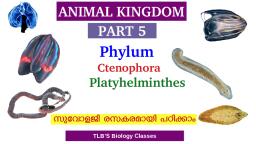
Common Names, Ctenophores are often called “comb jellies,” “sea, gooseberries,” “sea walnuts,” or “Venus’s girdles.”
Page 4 :
I.Basic Characteristics, • Ctenophores have two digestive openings, but rarely use the, •, •, •, •, , anus for defecation, Digestive system consists of mouth, pharynx, and stomach, with a canal system, Have no CNS or brain, but a nerve net, Use an aboral sense organ with a statocyst to maintain, balance, All Ctenophores have a distinct larval form before, adulthood
Page 5 :
I.Basic Characteristics, , ⚫ Voracious feeders on copepods, fish eggs, crab larvae,, , shrimp larvae and other, ⚫ Can double in size in 1 day!, ⚫ Important secondary consumers, Long Island estuaries, , meroplankton, in
Page 6 :
I.Basic Characteristics, , E. Reproduction, 1. Monoecious, 2. Parent dies after releasing gametes
Page 7 :
Morphology, , Most ctenophores are round or, spherical in body shape. They, generally have two large tentacles, and eight rows of comb plates., Their tentacles have the adhesive, colloblasts to capture prey and they, have a stomach, mouth, pharynx,, and anal pores. They have a nerve, network that is rather complex and, an apical sense organ. All, ctentophores are hermaphrodites, and most reproduce sexually. They, generally range in size from .6 cm, to 30.5 cm.
Page 9 :
Ctenophore Structure, ⚫ Body surface has eight rows, , of comb-like paddles, ⚫ Comb paddle has thousands, of cilia used to swim, , 9, , Phylulm Ctenophora
Page 11 :
Colloblasts, ⚫ Sticky retractile tentacle, , used to catch prey, ⚫ Colloblast discharge an, , adhesive thread which is, sticky to the touch, , ⚫ Some spp. lack tentacles, , and the body is studded, with colloblasts, , 11, , Phylulm Ctenophora
Page 12 :
Colloblasts, Colloblasts are microscopic,, sticky structures used to, adhere to the prey of a, ctenophore. Usually the, classes Cydippida and, Lobata have colloblasts on, their tentacles. After a prey, is caught by a colloblast, the, tentacle is contracted and, the prey is brought by the, predator’s mouth. There, the prey is released and
Page 13 :
Digestion, ⚫ Feed on plankton,, , other ctenophores and, other Cnidarian jellies, ⚫ Gut extends through, the entire body; mouth, is at the oral end, ⚫ Anal pore is at the, aboral end, , 13, , Phylulm Ctenophora
Page 14 :
Reproduction, ⚫ Can rapidly regenerate, , lost or damaged parts, ⚫ Usually hermaphrodites, ⚫ Developmental stage, ⚫, , 14, , Cydippid larva, this, develops into an adult, , Phylulm Ctenophora
Page 15 :
Compare, to, Coelenterates, A. Differences, 1., 2., 3., 4., 5., 6., 7., , Only 2 tentacles, One statocyst, No nematocysts, Colloblasts – sticky, adhesive cells, on tentacles for feeding, No polymorphism, Never colonial, Has an anal opening
Page 16 :
Compare to Coelenterates, B. Similarities, , 1. Nerve net, 2. Same 2 body layers, , epidermis, gastrodermis, mesoglea (have muscle)
Page 17 :
Embryology, , When the egg is fertilized, development of the embryo begins., Cleavage occurs completely but unequally, first producing two, cells, then four, then eight, and so on until the embryo is full, developed. The embryo forms within the egg cover. It, develops double rows of cilia, a pair of lateral tentacles, and a, large, apical sense-organ. The ectodermal layer of the, gastrovascular system undergoes Epiauxesis. Epiauxesis, involves the flattening and extension of the ectoderm germ, layer in the gastrovascular system. Soon, the cilia begin to, function and the developed larva breaks the egg shell and, enters the water. The following pages are detailed steps to the, process of initial cleavage and development.
Page 18 :
Development (Embryology)
Page 19 :
Development (Embryology)
Page 20 :
Ctenophore diversity, ⚫ Most species live in the open ocean and are not well, , studied, ⚫, , New studies use submersibles and divers to collect specimens,, eliminating specimen destruction by fast towed nets, , ⚫ Phylum Ctenophora, ⚫, , Order Lobata, ⚫ Order Beroida, , Phylulm Ctenophora, , 20
Page 22 :
Lobata (Morphology), , • Order also called Lobates, • Have pair of muscular lobes extending, from mouth, • Tentacles in grooves on lobes, have, auricles between lobes and mouth, • Auricles have cilia to create current and, flush prey into the mouth, • Two comb rows on each lobe and two on, each side between lobes, • Comb movement dependent on nerves, rather than water movement, • Some can clap combs to push water, rapidly and move opposite, • Generally prey on plankton
Page 24 :
Beroids (Morphology), • Order also known as Nuda, • No feeding appendages, but, pharynxes have macrocilia, • Macrocilia are large bundles of cilia, that work to bite off pieces of, whatever is being consumed, • Prey on other ctenophores, • When not eating, a ridge shuts the, mouth by connecting with the, other part of the ridge