Notes of NEET,JENPUS &ETC BATCH, Biology Monera prokaryotes.pdf - Study Material
Page 1 :
Monera (Prokaryotes), , , , Characteristics of Monera, , Monera (Monos — single) includes prokaryotes and shows the, following characters, , (1) They are typically uniceltular organisms (but one group is, mycelial)., , (2) The genetic material is naked circular DNA, not enclosed, by nuclear envelope., , (3) Ribosomes and simple chromatophores are the only, subcellular organelles in the cytoplasm. The ribosomes are 70 S., Mitochondria, plastids, golgi apparatus, lysosomes, endoplasmic, reticulum, centrosome, etc., are lacking,, , (4) Sap vacuoles do not occur. Instead, gas vacuole may be, present., , (5) The predominant mode of nutrition is absorptive but some, groups are photosynthetic (holophytic) and chemosynthetic., , (6) The organisms are non-matile or move by beating of, simple flagella or by gliding., , (7) Flagella, if present, are composed of many intertwined, of a protein flagellin. They are not enclosed by any, membrane and grow at the tip., , , , dl, , (8) Moneran cells are microscopic (1 to few microns in length)., (9) Most organisms bear a rigid cell wall (Peptidoglycan),, , (10) Reproduction is primarily asexual by binary fission or, budding. Mitotic apparatus is not formed during cell division., , (11) The kingdom Monera includes true bacteria,, mycoplasma, rickettsias, actinomycetes (ray fungi) etc., Microbiologists also include blue green algae (ie., Cyanobacteria), under the group of bacteria because of the presence of prokaryotic, cell structure. Studies have established that the members of, archaebacteria group are the most primitive and have separated, from eubacteria group very early in the process of evolution., , Bacteria, , Study of bacteria is called bacteriology. Linnaeus placed, them under genus vermes. Nageli classified bacteria under, schizomycetes. Bacteria are unicellular, microscopic and, cosmopolitan organisms. The branch of science, which deals, with the study of microorganism and their process is called, as microbiology. Antony Van Leeuwenhoek is known as, father of bacteriology and father of modern microbiology Is, Robert Koch., , ‘These are the smallest cell wall having prokaryotic cell. The, bacteria constitute a highly specialised group of one celled plants., They differ from animals in having a rigid cell wall and being, capable to synthesize vitamins, Bacteria were first seen by a Dutch, lens maker, Antony Van Leeuwenhoek (1683) who named them, animalcules. Louis Pasteur (1822-95) made a detailed study of, bacteria and proposed germ theory of disease. Ehrenberg (1829), was the first to use the term bacterium. Robert Koch (1881), found that some diseases like tuberculosis, cholera in man, and, anthrax in cattle is caused by bacteria. Lister introduced antiseptic, surgery, He used carbolic acid for sterilization of surgical, instrument, Pasteurization theary was proposed by Louis Pasteur,, , , , (1) Size : They are 3 to 5 microns (11 = 1/1000 millimetre or, about 1/25,000 inch) in length. A few species of bacteria are, , approximately 15in diameter., , , , Smallest known bacterium, (0.15-0.34), , , , Dialister pneumonsintes, , Largest known bacterium is a recently discovered, bacterium thiomargarita namibiensis (earlier Bacillus buschili in, cockroach and Spirillum volutans were considered to be the largest, bacteria).
Page 2 :
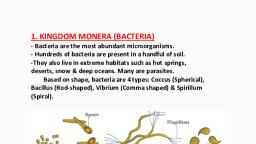
Monera (Prokaryotes) 27, , , , , , (2) Shape : The bacteria possess the follawing forms =, , Cocci (Gk. Kokkos = Berry) : They are oval or spherical, in shape. They are called micrococcus when occur singly as in, Micrococcus, diplococcus when found in pairs as in Diplococcus, pneumoniae, tetracoccus in fours, streptococcus when found in, chains as in Streptococcus lactis, staphylococcus when occurting in, grape like clusters as in Staphylococcus aureus and Sarcine, when, found in cubical packets of 8 or 64 as in Sarcina, , Bacilli ; They are rod-shaped bacteria with or without, flagella. They may occur sinaly (bacillus), in pairs (diplobacillus) or, in chain (streptobacillus)., , Vibrios : These are small and ‘comma or kidney’ like. They, have a flagellum at one end and are motile, vibrio bacteria has, ‘curve in its cell e.g., Vibrio cholerae., , Spirillum (Spira = Coil) : They are spiral or coiled like a, cork-screw. The spirillar forms are usually rigid and bear two or more, flagella at one or both the ends e.g., Spirillum, Spirochaetes etc,, , Filament : The body of bacterium is filamentous like a fungal, mycelia. The filaments are very small e.g., Beggiota, Thiothrix etc., , Stalked : The body of bacterium possesses a stalk eg,, Caulobacter., , Budded : The body of bacterium is swollen at places e.g,, Rhodomicrobium., , (3) Flagellation : Depending upon the presence or absence, of flagella, the bacteria are of following types, , Atrichous : When the flagellum is absent it is called, atrichous. e.g., Pasteurella pestis, Lactobacillus., , Monotrichous : Only one flagellum is found at one end. e.g.,, Vibrio cholerae., , Lophotrichous : When a group of flagella is present at one, end e.g., Spirillum volutans,, , Amphitrichous : When single or group of flagella is present, at both the end e.g,, Nitrosomonas., , Peritrichous : A number of flagella are present all over the, body. e.g, E. coli, Clostridium tetani., , Staining of bacteria, , (1) Simple staining : The coloration of bacteria by applying, single solution of stain to a fixed smear is termed simple staining, The cells usually stain uniformly,, , (2) Gram staining ; This technique was introduced by Hans, Christian Gram in 1884. It is a specific technique which is used to, classify bacteria into two groups Gram +ve and Gram -ve, The, bacteria are stained with weakly alkaline solution of crystal violet., The stained slide of bacteria is then treated with 0.5 percent iodine, , , , solution. This is followed by washing with water or acetone or 95%, au alcohol. The ae Which retain the purple stain are called, , m 1085 become decolourised are called as, cae ee eter fe Wal ol Giada bacleta ae simpler, nature as compared to Gram -ve bacteria. E.coli is a Gram —ve, bacterium. Gram negative bacterium can be seen with other stain, safranin,, , , , Plasma Membrane, , , , Periplasm, , Mesosome, Peptidoglyean, , — Lipopolysaccharide, ‘membrane, Teichoic acid + lipéfeichoic acid, , Gram-Negative Gram-Positive, , Fig ; 1.2-1 Difference between cell walls of, Gram-negative and Gram- positive bacteria, , Gram positive bacteria : ¢.9., soccus, Streptococcus,, Staphylococcus, Bacilus, Clostridium, he Streptomyces., , , , Gram negative bacteria : eg, Salmonella, Pseudomonas,, Escherichia, Haemophilus, Helicobacter, Vibrio, Rhizobium,, Table : 1.2-1, Gram + Positive, Gall wall thick (250-300 A)., Cell wall homogenous:, , Gram —Negative, (Cea wall thin (100— 150 A), Cail wall helerogenous., , , , , , , , , , , , , , , , , , , , , , Cell wall single layered Cell wall 3-layered,, , Cell wall more rigid Cell wall less rigid, , Cell wall made up of Cell wall made up of, , mucopeptide (80%), lipoprotein, mucopentide and, lipopolysaccharide., , Teichoie acid (5—10%) present. | Teichoic acid absent, , , , , , ‘Spore producing forms included | No spore producing form., , , , , , , , , , , , , , , , , , , , , , , , Polar flagellum usually absent | Polar lagelur usually present, , Contain Mg-ribonuleste Mg-ribonicleate absent., , May produce exotonins, May produce endotoxins,, , ‘Sensitive to penicilin Not senslive to peniilin., , Lisin present in pepiide Diamino palmilic acid present in, peptide., , (antigen absent O-antigen present, , , , , , , , Structure of bacteria, , , , (1) Capsule : In a large number of bacteria, a slimy capsule is, present outside the cell wall. It is composed of polysaccharides and, the nitrogenous substances (amino acids) are also present in, addition. This slime layer becomes thick, called capsule. The, bacteria, which form a capsule, are called capsulated or virulent, bacteria. The capsule is usually found in parasitic forms eg,, Bacillus anthracis, Diplococcus pneumoniae, Mycobacterium, tuberculosis
Page 3 :
28 Monera (Prokaryotes), , , , (2) Cell wall : All bacterial cells are covered by a strong, rigid, cell wall. Therefore, they are classified under plants, Inner to the, capsule cell wall is present. It is made up of polysaccharides,, proteins and lipids., , In the cell wall of bacteria there are two important sugar, derivatives are found Le, NAG and NAM (N-acetyl glucosamine, and N-acetyl muramic acid) and besides L or D - alanine, Dglutamic acid and diaminopimelic acid are also found., , One of the unique components of cell wall of bacteria is, , peptidoglycan or mucopeptide or murein (made of, mucopolysaccharide + polypeptide)., Prosma —_Respatry, Cell wall membrane ao, , , , Nudeoid DNA jpembrane, Fig : 1.2-2 Electron microscope structure af a bacterium cell, , (3) Plasma membrane : Each bacterial cell has plasma, membrane situated just internal to the cell wall. It is a thin, elastic, and differentially or selectively permeable membrane. It is, composed of large amounts of phospholipids, proteins and some, amounts of polysaccharides but lacks sterols, It is characterised by, possessing respiratory enzymes., , Mesosome : On the plasma membrane generally at mid, point, there are present some circular coiled bodies called, mesosomes. So mesosomes are simply infoldings of plasma, membrane. Mesosomes contain respiratory enzymes like oxidases, and dehydrogenases and hence they help in respiration. Hence, mesosomes are also known as "mitochondria of bacterial cell” or, chondrioides. Mesosomes are more prominent in Gram +ve, bacteria., , Q_Itreceive DNA during conjugation and DNA replication, enzyme., , — Mesosome participate in the formation of septa during, cell division., , (4) Cytoplasm and Cytoplasmic inclusions : The, cytoplasm is a complex aqueous fluid or semifluid ground substance, (matrix) consisting of carbohydrates, soluble proteins, enzymes, coenzymes, vitamins, lipids, mineral salts and nucleic acids. The, organic matier is in the colloidal state., , The cytoplasm is granular due to presence of a large number, of ribosomes. Ribosomes (70S) in bacteria are found in the form of, polyribosome. Membranous organelles such as mitochondria,, endoplasmic reticulum, golgi bodies, lysosomes and vacuoles are, absent., , Volutin granules : They were first reported in Spirillum, volutans bacteria. These are also known as metachromatic, granules, which are composed of polyphosphate. Volutin serves as, a reserve source of phasphate., , Poly-#hydroxy butyric acid granules (PHB) : These are, polymer of lipid like material and chloroform soluble which are, oflen found in aerobic bacteria especially under high carbon low, nitrogen culture conditions. Granules can serve as a reserve carbon, and energy source,, , Glycogen and Sulphur granules : Glycogen are also, known as polysaccharide granules. It can be stained brown with, iodine. By electron microscopy they appear as datk granules., , (5) Nucleoid : It is also known as genophore, naked nucleus,, incipient nucleus, There is present nuclear material DNA which is, double helical and circular. Itis surrounded by some typical protein, (polyamine) but not histone proteins, , (6) Plasmid : In addition to the normal DNA chromosomes, many bacteria (eg, E.coli) have extra chromosomal genetic, elements or DNA. These elements are called plasmids. Plasmids, are small circular double stranded DNA molecules. The plasmid, DNA replicates independently maintains independent identity and, may carry some important genes. Plasmid term was given by, Lederberg (1952). Some plasmids are jitegrating into the bacterial, DNA chromosome called episomes., , ‘Types of plasmid, , (i) Ffactor or Fertility factor : Which is responsible for, transfer of genetic material, , (ii) Refactor or resistance factor : It provides resistance, against drugs., , (iii) Colicinogenic factor : Which produces 'Colicines', which kill other bacteria (other than which produce these, colicines), , (7) Flagella : These are fine, thread-like, protoplasmic, appendages which extend through the cell wall and the slime layer, of the flagellated bacterial cells. These help in bacteria to swim, about in the liquid medium., , ‘The diameter of each subunit is about 40-50A, These subunits, are arranged around a hollow axis. A flagellum is usually 4.54 long, and 120-1854 in diameter. Flagellum is attached to cell membrane, by a special terminal hook, which is attached to the basal body, called (blepharoplast). A bacterial flagellum can be divided into, three parts — (Basal granule, Hook and Filament)., , (8) Pili or Fimbriae : Besides flagella, some tiny or small hairlike outgrowths are present on bacterial cell surface. These are called, pili and are made up of pilin protein. They measure about 0.5-2um, in length and 3-Spm in diameter. These are of 8 types I, Il, I, IV, V,, Vi, VIl, and F types. Ito F are called sex pil, These are present all, most all gram -ve bacteria and few gram +ve bacteria. Fimbriae, take part in attachment lixe holding the bacteria to solid surfaces., Reproduction in bacteria, , Vegetative reproduction, , (1) By budding : According to Bisset and Hale, reproduction, bby budding takes place in Bigidi bacterium bifidus., , (2) By binary fission : This type of reproduction is most, common in all kinds of bacteria. Under favourable conditions, bacterial cell expands. Cytoplasm divides into two parts due to, constriction and formation of a transverse septum in the centre of, the cell, Later on, these two parts separate from each other and, ive rise to two cells.
Page 4 :
E_, , Asexual reproduction, , (1) By endospores : Endospores are formed in all species of, the genera Bacillus and Clostridium. In each cell only one, endospore is formed. Endospore is highly resistant to very high, and very low temperature., , Endospore is found either in the centve or near the cell wall., Under unfavourable conditions cytoplasm shrinks and gets, rounded and around it a hard protective three layer is formed., Each endospore may be either circular, ellipsoidal or semicircular., When favourable conditions come, outer layers rupture and active, ‘bacterial cell comes out. So this is a method of perennation (i.e,, to, tide over unfavourable condition) and some people say it, “reproduction without multiplication”., , (2) By conidia : Some filamentous bacteria eg,, Streptomyces reproduce by means of conidia. The conidia are, spore like in structure and are formed in chains, Each conidium, gives rise to a new bacterium., , (3) By zoospores : In rare cases bacterial cell forms some, motile spores which give rise to new cells. This process has been, rarely seen. e.g., Rhizobium, , Sexual reproduction (Genetic recombination), , ‘Sometimes it was believed that sexual reproduction does not, take place in bacteria, Lederberg and Tatum (1946) proved that, sexual reproduction takes place in bacteria, On the basis of this, discovery they were awarded Nobel Prize,, , According to the present view, three types of sexual, reproduction are found in bacteria :, , (1) Transformation : In this process one kind of bacterium is, transformed into another kind, It takes place by transfering DNA, from capsulated to non-capsulated bacterium. For the first time, Griffith (1928) reported transformation in mice. Later on, Avery,, McLeod and McCarty (1944) studied transformation in, Diplococcus pneumoniae., , (2) Transduction : In this process DNA of a bacterial cell is, transferred into another bacterial cell through bacteriophage - a, Kind of virus which is parasitic upon bacteria. Bacteriophage, consists of DNA. It has been now accepted that DNA of a bacterial, cell is transferred through bacteriophage to another bacterium., Transduction was first of all reported by N.D. Zinder and, Lederberg (1952) in bacteria Salmonella typhimurium., , (3) Conjugation : In this process genetic material from one, strain of bacterium which is known as male is transferred into another, strain of bacterium which is known as female. On the experimental, basis it is believed that genetic material of male enters into female, bacterium in the form of a straight line. Lederberg and Tatum first of, all reported conjugation in bact.Qerial strain of E.coli called Ky, (1946)., In 1966, Wollman and dacob described itn detail., , In gram negative bacteria, there are two strains, F> (with, fertlty factor and sex pili) and F- (without fertility factor and sex, pili). These two can come together. Sex pilus of donor cell extrudes, a protein that helps it in attaching to the recipient cell. Latter on,, sex pilus is converted into conjugation tube between the two, The, donor or F* can transfer ils fertility factor or plasmid to recipient, cell or F- and convert it into donor as well. Sometimes the F*, plasmid attaches to nucleoid, becomes episome and converts the, , , , , , , , Monera (Prokaryotes) 29, , , , donor into HFr (high frequency of recombination 1 : 100). There is, a transfer of few genes of nucleoid from HFr to F-. HFr quality can., also be transferred occasionally (HFr x F- = F> plus a few genes, and a few HFi), The transferred segment is called exogenote which, ‘similar’ segment of the recipient bacterium is known as endogenote., ‘The recipient bacterium is called merozygote or partial zygote., ‘Some of the donor genes integrate into recipient genome., , In gram positive bacteria sex pili do not develop. Donor, calls produce a protein adhesion over their surface for bringing, recipient cells in contact with them. In Strepiococcus faecalis, the, recipient cells excrete a small peptide (sex hormone) for inducing, lumping. Wall dissolves in the region of contact. Transfer of DNA, segment occurs from donor to recipient cell., , Respiration in bacteria, , , , With respect to oxygen requirement and mode of cellular, respiration, bacteria distinctly belong to two broad categories :, , (1) Aerobic respiration, , Obligate aerobes : These bacteria grow exclusively in, presence of molecular oxygen and fail to survive in its absence, eg,, Bacillus subtilis, Azotobactor, Arthrobactor, Mycobacterium etc., , Facultative anaerobes : The aerobic bacteria which can, also survive in absence of oxygen, e.g., Aerobacter, Kiebsiella,, Pseudomonas, etc., , (2) Anaerobic respiration, , Obligate anaerobes : These bacteria grow and multiply in, the absence of free oxygen. They fail to survive under aerobic, conditions, e.g., Clostridium botulinum,, , Facultative aerobes : The anaerobic bacteria which can, also survive in presence of oxygen, e.g., Chlorobium limicola,, , Mode ofnutrition in bacteria, , On the basis of mode of nutrition, bacteria are grouped into, two broad categories. First is autotrophic and second is, heterotrophic bacteria., , Autotrophic bacteria : These bacteria are able to synthesize, their own food from inorganic substances, as green plants do. Theit, carbon is derived from carbon dioxide. These are divided into two, categories., , (1) Photoautotrophic bacteria : These bacteria are mostly, anaerobic bacteria. They use sunlight as source of eneray to, synthesize food., , ‘They possess a pigment called bacteriochlorophyll which is, different from the chlorophyll pigment found in higher plants. This, is known as anoxygenic photosynthesis. eg, Green sulphur, (Thiothrix) and purple sulphur (Chromatium) bacteria, , Green sulphur bacteria : They are autotrophic. The, hydrogen donor is HS and the pigment involved in the process is, chlorobium chlorophyll (Bacterioviridin) e.g,, Chlorobium,, , 6CO, +12H,S CHO; +6H,0-+125, , , , , , , , Cerca crop, Purple sulphur bacteria : They are also autotrophic. The, , hydrogen donor is thiosulphate and the pigment involved in, , photosynthesis is bacteriochlorophyll e.9., Chromatium., , 6C0; +15H,0+ 3N09S,0, >, , CHO, + 6H,0 +6NoHSO, .
Page 5 :
30 Monera (Prokaryotes), , , , , , , , Purple non-sulphur bacteria : They are heterotroy, utilizing succinate or malate ot alcohol. e.g., Rhodospirillum,, Rhodopseudomonas., , 6CO, +12CH,CHOHCH, —+, , CcHyz0, +12CH,COCH, +6H,0 ., , (2) Chemoautotrophic bacteria: Some bacteria, manufacture organic matter from inorganic raw materials (such as, carbon dioxide) and utilize energy liberated by oxidation of, inorganic substances present in the extemal medium such as, ammonia, ferrous ion, nitrates, nitrites, molecular hydrogen, etc., , Sulphur bacteria : These bacteria derive energy by, oxidizing hydrogen sulphide or molecular sulphur. Beggiatoa, a, colourless sulphur bacterium oxidises hydrogen sulphide (H,S) to, water and sulphur. The energy released is used up and the sulphur, granules are deposited inside or outside the body of bacterial cell., , 2H,S+ 0) —>2H,0 +28 + Energy., , Iron bacteria : They take energy from the oxidation of, ferrous salts into ferric salts e,g,, Ferrobacillus, Leptothrix., , AFeCO, +O, +6H,O—-noinixorchos _,, sextote, , Frou, , , , , , Fe(OH), +4CO, +Energy(81k-cal)., , FenicHyioate, Hydrogen bacteria : These bacteria utilize free molecular, hydrogen and oxidize to hydrogen into water with the help of, either oxygen or oxidize salts ¢¢., Hydrogenomonas., 2H, + Oz —> 2H,0 + Energy (56 kcal), , Ammonifying bacteria : They oxidise protein and amino, acid into NH, (ammonia). e.g, Proteus vulgaris, Bacillus mycoids., Nitrifying bacteria : They oxidise ammonia to nitites and, then into nitrates., Neroorenas, , NH, +0, N22" 5 NO, +H,0+ Energy and, , 2NO, +O, —=™2"_s 2NO, + Energy, , Denitrifying bacteria : They change nitrogen compound, into molecular nitrogen. So that they reduce fertility of soil e.g,, Micrococcus denitrificans, Pseudomonas denitrificans., , Methane bacteria : The bacterium Methanomonas utilizes, methane as source of carbon and energy., , CH, +20, —>CO, +2H,0 + Energy, , Methane producing bacteria : These are spherical or rod, shaped bacteria which produce methane (CH) from hydrogen, gas and carbon dioxide e.g,, Methanobacterium., , CO, + 4H, —+CH, +2H,0, , Methane (swamp gas) is produced under anaerobic conditions, and can be used as a “biogas”, otherwise it is a pollutant that, contributes to the green house effect and global warming., , Carbon bacteria : These bacteria oxidize carbon monoxide, into carbon dioxide and use the liberated energy, e.g., Bacillus, ollgocarbophilus., , 2CO+0, —+2CO, +Energy ., , (3) Heterotrophic bacteria : Most of the bacteria can not, synthesize their own organic food. They are dependent on external, , organic materials and require atleast one organic compound as a, source of carbon of their growth and energy. Such bacteria are, , , , , , called heterotrophic bacteria. Heterotrophic bacteria are of three, types ~ Parasites, Saprotrophs and Symbionts., , (i) Parasites : They obtain their organic food or special, organic compounds required for their growth from living cells of, plants and animals. Some paresitic bacteria are relatively harmless, ‘and nonpathogenic, ie., da not produce disease in hosts., , Table : 1.2-2 Human diseases, , , , , , , , , , , , Disease Casual organism, , Paratyphoid Salmonella paratyphi, , Gastroenteritis Salmonella sp. and Escherichia coll, , Dyseniery ‘Shigella dysenirioe, sonnel, S opail, , Tularaemia Francisella tularensis:, , pmiees [:Haerieph ii ijitensae SST, , Table : 1.2-3 Plant diseases, Disease Casual organism, , Black chaff of wheat Xanthomonas trenslucens, enthomonas stewart, “Xenthomenas esculorum, Peeudomonos rubies, Corynebacterium, Corynebacterium michiganense, , Leaf spot of Lady's finger Xanthomonas esculent!, , Hairy rot of apple Agrobacterium rhizogenes, , Black knot of grapes. Pseudomonas tumefaciens, , , , , , (il) Saprotrophie bacteria : These bacteria obtain their, nutritional requirements from dead organic matter (such as animal, excreta, corpses, fallen leaves, bread, fruits, vegetables, jams,, Jellies, ete.), These bacteria breakdown the complex organic matter, into simple soluble forms by secreting exogenous digestive, enzymes. Then they absorb the simple nutrient molecules and, assimilate them. Aerobic break down of organic matter is called, decomposition or decay. e.g., Pseudomonas,, , (iti) Symbiotic bacteria : Symbiosis is the phenomenon in, which the two organisms live in close association in such a way, that both the partners get mutual benefit from this association. For, example, a very well known nitrogen fixing bacteria - Rhizobium, forms a symbiotic association with roots of leguminous plants, , (soyabean, clover, alfalfa, ete.) and producing root nodules., Spirochaetes, , These are free inhabitants of mud and water, and are, chemoheterotrophic unicellular bacteria. These are spiral or helicoid, in shape, covered by flexible cell wall and swim actively with flagella, Present at both pole or ends. Many diseases are caused by them as, Treponema pallidum causes syphilis, Leptospira causes infectious, jaundice and Borrelia causes relapsing fever. Besides some, spirochaetes are found in teeth,, , Archaebacteria, , ‘They are present in rumen (first part of storach) of cattles., This is simplest and most primitive group of bacteria, The cell wall, of these bacteria is made of polysaccharides and proteins, (peptidoatycans and muramic acid are absent in cell wall), Archaebacteria are considered to be the ‘oldest of lving fossils., ‘Three main groups of archaebacteria are following., , (1) Methanogens : These are strict anaerobic bacteria and, mainly occur in muddy areas and also in stomach of cattle, where, cellulose Is fermented by microbes. These are responsible for



 Learn better on this topic