Notes of NEET,JENPUS &ETC BATCH, Biology Fungi.pdf - Study Material
Page 1 :
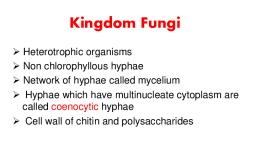
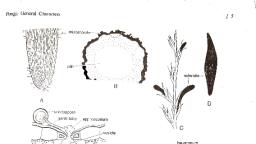
The terms ‘fungus’ has been derived from the Latin, word which means mushroom. The science dealing with the, study of fungi is called as mycology. Clausius (1601) may be, regarded as one of the earliest writers to describe fungi, The, term ‘Fungus’ was coined by Gaspard and Bauhin. Bauhin, (1623) also included the account of known fungal forms in his, book Pinax Theatric Botanica. Kingdom fungi has been called, mycota by Von Arx (1981) and mycetae by Alexopoulos. Anton, de Bary is known as ‘Father of Modem Mycology and plant, pathology’, , Famous Indian Mycologists : Dastur, Mundkar, Prof. K.C., Mehta (associated with study of annual recurrence of wheat rust in, India), Thind, Srinivasan, KG. Mukherj, Chaudhary and, Sadasivan are other famous mycologist of India, , Thallus organization, , , , The plant body of true fungi (Eumycota) is thallus. It may be, non-mycelial or mycelial. The non-mycelial forms are unicellular,, however, they may form a pseudomycelium by budding, In, mycelial forms, the plant body is made up of thread like structures, called hyphae (sing. hypha). The mycelium may be aseptate, (non-seplate) or septate. When non-septate and multinucleate,, the mycelium is described as coenocytle. In lower fungi the, mycelium is non-septate e.g. Phycomycetes. In higher forms it is, septate e.g., Ascomycetes, Bi iomycetes and Deuteromycetes. In, some forms the plant body is unicelled at one stage and mycelial at, the other. Their organization is sometimes described as, dimorphic., , , , When the entire mycelium is converted into reproductive, structure, the thallus is described as holacarpic. However, if only, a part of it becomes reproductive, the thallus is called as eucarpic., , Fungi (Multicellular decomposers), , Specialised formation, , , , In higher forms the mycelium gels organised into loosely or, compactly woven structure which looks like a tissue called, plectenchyma. It is of two types, , Prosenchyma : It comprises loosely woven hyphae lying, almost parallel to each other., , Pseudoparenchyma : If the hyphae are closely interwoven,, looking like parenchyma in a cross-section, it is called as, , pseudoparenchyma., , , , In addition to above, the fungal mycelium may form some, specialized structures as under :, , Rhizomorphs : It is a ‘root or string-like’ elongated structure, of closely packed and interwoven hyphae. The rhizomorphs may, have a compact growing point., , , , , , Sclerotia : Here the hyphae gels interwoven forming, pseudoparenchyma with external hyphae becoming thickened to, save the inner ones from desiccation. They persist for several years., , , , Stroma : It is thick mattress of compact hyphae associated, with the fruiting bodies., , Cell organization, , , , The cell wall of fungi is mainly made up of chitin, (CaHisN,On)) and cellulose. While chitin is a polymer of N-acetyl, glucosamine, the cellulose is polymer of d-glucose. Precisely, the, cell wall may be made up of cellulose-glucan (oomycetes), chitinchitosan (Zygomycetes), mannan-glucan (Ascomycetes), chitinmannan (Basidiomycetes) and chitin-glucan (some Ascomycetes,, Basidiomycetes and Deuteromycetes). Besides, the cell wall may, be made up of cellulose-glycogen, cellulose-chitin or, polygalactosamine-galactan.
Page 2 :
Fungi (Multicellular decomposers) 79, , , , , , The cel wall is closely associated with the inner layer, the plasma, membrane. In fungi, plasma membrane bears coiled membranes, ‘outgrowth called lomasomes (Moore and McAlear, 1961)., , Fungi cells are eukaryotic. They possess all eukaryotic, organelles such as mitochondria, E.R., ribosomes, microbodies,, lysosomes, vacuoles and reserve food particles (glycogen, lipid, etc.). Golgi body or dictyosome are also not typical. In many cases, they are unicisternal. The cells lack chloroplast. However, a, reddish pigment, neocercesporin has been isolated from the, fungus Cercospora kikuchii, The vacuoles are bound by tonoplast., ‘The genetic material is DNA., , Fungi possess true nucleus having definite nuclear envelope., ‘The nuclear envelope persists during nuclear division. It has called, karyochorisis by Moore (1965). The nuclear spindle is formed, within the nuclear envelope in both mitosis and meiosis. The, spindle poles either contain centrioles or spindle pole bodies (SPB), but lack microtubular organization,, , , , The fungi are achlorophyllous organisms and hence they can, not prepare their food. They live as heterotrophs i.e., as parasites, and saprophytes. Some forms live symbiotically with other green, forms., , Parasites : They obtain their food from a living host. A, parasite may be obligate or facultative. The obligate parasites, thrive on a living host throughout their life. The facultative, parasites are infact saprophytes which have secondarily become, parasitic., , Saprophytes : They derive their food from dead and, decaying organic matter. The saprophytes may be obligate or, facultative. An obligate saprophyte saprophytic, throughout its life. On the other hand, facultative saprophyte is, infect a parasite which has secondarily become saprophytic., , Symbionts : Some fungal forms grow in symbiotic, association with the green or blue-green algae and constitute the, lichen. A few fungal forms grow in association with the roots of, higher plants. This association is called as mycorrhiza,, , Reproduction, , remains, , , , (1) Vegetative reproduction, Fragmentation : Some forms belonging to Ascomycotina, and Basidiomycotina multiply by breakage of the mycelium., Budding : Some unicelled forms multiply by budding. A bud, atises as a papilla on the parent cell and then after ils enlargement, separates into a completely independent entity., Fission : A few unicelled forms like yeasts and slime moulds, multiply by this process, , (2) Asexual reproduction, , Oidia : In some mycelial forms the thallus breaks into its, component cells. Each cell then rounds up into a structure called, cidium (pl. oidia). They may germinate immediately to form the, new mycelium, e.g., Rhizopus., , Chlamydospores : Some fungi produce chlamydospores, which are thick walled cells, They are intercalary in position. They, are capable of forming a new plant on approach of favourable, conditions, e.g, Rhizopus, Saprolengnia, Ustilago., , Sporangiospores : These are thin-walled, non-motile spores, formed in a sporangium. They may be uni-or multinucleate. On, account of their structure, they are also called as aplanospores., e.g, Rhizopus, Mucor., , Zoospores : They are thin-walled flagellate spores which occur in, ‘aqualic fungi. These spores are formed in a zoosporangium. The, zoospores are of several types :, , OF Uniflageliate with whiplash type flagellum e.g., Allomyces., , , , O Uniflageliate with tinsel type flagellum e.g., Rhizidiomyces., , O Biflagellate with a tinsel type and a whiplash type flagella, e.,, Saprolegnia., , O Biflagellate with, Plasmodiophora,, , Conidia : In some fungi the spores are not formed inside a, sporangium. They are bom freely on the tips of special branches, called conidiophores. The spores thus formed are called as, conidia. e.g,, Penicillium., , (3) Sexual reproduction : With the exception of, Deuteromycetes (fungi imperfecti), the sexual reproduction is, found in all groups of fungi, During sexual reproduction the, compatible nuclei show a specific behaviour which is responsible, for the onset of three distinct mycelial phases. The three phases of, nuclear behaviour are as under :, , two whiplash type flagella eg.,, , Plasmogamy : Fusion of two protoplasts., Karyogamy : Fusion of two nuclei, , Melosis : The reduction division., , , , These three events are responsible for the arival of the, following three mycelial phases :, , Haplophase : As a result of meiosis the haploid (n) or, haplophase mycelium is formed., , Dikaryatic phase : The plasmogamy results in the formation, of dikaryotic mycelium (n + n)., , Diplophase : As a result of karyogamy the diplophase, mycelium (2n) is formed., , The fungi reproduce sexually by the following methods, , O Planogametic copulation : In this type of copulation, fusion occur between flagellate gamete. It is of three types :, , (i) Isoplanogametic copulation : Both the fusion gametes, are similar and flagellate. e.g., Synchytrium., , {) Anisoplanogametic copulation : The fusing gametes,, , are flagellate, similar in structure but different in size. In which one, is small and other one is large. eg, Allomyces,



 Learn better on this topic