Page 1 :
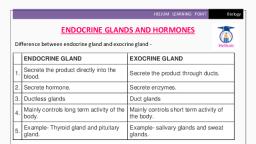
Chapter, , out, , _Chemical Co-ordination and Integration, , , , Endocrine system is formed of all endocrine glands of body., Though different endocrine glands are different in embryonic, origin and are isolated from one another but these interact with, one another so collectively form an endocrine system. Endocrine, system along with nervous system, controls and coordinates the, body functions and maintains a homeostasis. So both collectively, form neuro-endocrine system. The study of these two systems is, called neuro-endocrinology., , Glands of body : Animals have three types of glands., , (i) Exocrine gland (Gr., ex = out + krinein = to, secrete) : These glands have ducts for discharging their secretions., Therefore, they are called as duct glands. ex — Liver, Sweat gland,, Sebaceous gland, Gastric glands and some intestinal glands., , (ii) Endocrine glands (Gr., endo = within + krinein =, to secrete) : These glands lack ducts and pass secretions into the, surrounding blood directly. Therefore they are called as ductless, glands. ex — Thyroid, parathyroid, adrenal, pituitary, pineal body, and thymus,, , (iii) Heterocrine glands : These glands consist of both, exocrine and endocrine tissue. The exocrine discharge its secretion, by a duct and the endocrine tissue discharges its secretion into the, blood. Pancreas and gonads are heterocrine glands. These are also, called mixed glands., , Hormones and their mechanism, , , , Hormones are informational molecules secreted by the, endocrine cells in one part of the body and carried by blood to, another part where they stimulate or inhibit specific physiological, process., , Discovery : First hormone discovered was secretin. It was, discovered by two English physiologists : William M Bayliss and, Emest H. Starling in 1903., , Term hormone was coined by Starling (1905) from Greek, word Homone means to excite. It is a misnomer because a number, of hormones are known to have inhibitory effect (eg., Somatostatin)., , General function of hormones, , (1) Some hormones contro! Basal Metabolic Rate (BMR) e.g.,, thyroxine of thyroid gland., , (2) Some hormones control the secretion of other endocrine, , glands, e.g., Tropic hormones of Anterior pituitary control Thyroid,, Adrenal cortex, gonads, etc., , (3) Some hormone control blood pressure e.g., Aldosterone,, Atrial Natriuretic Hormone (ANH) of heart, Vasopressin or ADH’,, oxytocin and Renin of kidney., , (4) Increase production of RBC e.g., erythropoietin of kidney., Properties of hormones, , (1) These are secreted by endocrine gland (biogenic in origin)., , (2) Their secretions is released directly into blood (except local, hormones e.g., gastrin)., , (3) These are carried to distantly located specific organs,, called target organ., , (4) These have specific physiological action (excitatory or, inhibitory). These co-ordinate different physical, mental and, metabolic activities and maintain homeostasis., , (5) The hormones have low molecular weight e.g., ADH has a, molecular weight of 600-2000 daltons., , (6) These act in very low concentration e.g., around 107°, molar., , (7) Hormones are non antigenic., , (8) These are mostly short-lived. So have a no cumulative, effect., , (9) Some hormones are quick acting e.g. adrenalin, while, some acting slowly e.g., oestrogen of ovary., , (10) Some hormones secreted in inactive form called, Prohormone e.g., Pro-insulin., , (11) Hormones are specific. They are carriers of specific, information to their specific target organ. Only those target cell, respond to a particular hormone for which they have receptors.
Page 2 :
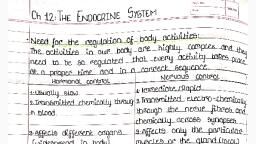
Chemical Co-ordination and Integration 1005, , , , (12) Hormones after their action are destroyed in liver and, kidney., , Classification of hormones, , (1) On the basis of chemical nature : On the basis of, chemical composition hormones are classified into three categories., , (i) Amine hormones : These are derived from tyrosine, amino acid and have amino (-NH,) group e.g., Thyroxine,, Epinephrine, Nor-epinephrine., , (ii) Steroids : These are fat soluble and have sterol group., These are derived from cholesterol e.g., hormones of adrenal, cortex (cortisol, cortisone, corticosterone, aldosterone) testes, (testosterone) and ovaries (oestrone, oestradiol, progesterone etc.), , (iii) Proteinaceous and peptide hormones : These are, formed of 3 — 200 amino acids interlinked by peptide bonds and, are water soluble e.g.,, , (a) Proteinaceous hormones like STH, TSH, FSH, LH etc. Out, of these FSH and LH are glycoproteins., , (b) Long peptide hormones like insulin and glucagon, ACTH,, Paratharmone., , (c) Short peptide hormones like oxytocin, ADH, MSH, These, hormones formed of a few amino acids., , (2) On the basis of mode of action, , (i) Quick acting hormones : These hormones initiate, immediate response from their target cells. There receptor is always, located on the outer surface of plasma membrane of target cell, because these are large sized. Hormone receptor complex activates, a membrane enzyme adenyl cyclase which hydrolyse ATP into, cyclic AMP. Which acts as secondary messenger, c-AMP activates, an inactive enzyme system by cascade effect. So their mode of, action is called second messenger hypothesis. e.g., These includes, proteinaceous, peptide and amine hormones., , (ii) Delayed acting hormones : These hormones initiate, response after some time. These are small sized so are diffusable, through the plasma membrane of their target cell. These bind their, proteinaceous receptor present in the cytosol. These always, operate through de-novo synthesis of m-RNA by activation of, certain genes. So their mechanism of action is called m-RNA, hypothesis. These include steroid hormones of testes, ovary and, adrenal cortex., , Table : 5.7-1 Difference between hormone and enzymes, , , , , , , , , , , , S.No, Characters Enzymes Hormones, 1. | Chemistry Always proteinaceous May be proteinaceous, or amine or steroids., 2. | Molecular weight Macromolecules with high molecular weights. Have low molecular weights., 3__| Diffusibility Non-diffusible through cell membrane. Diffusible through cell membrane,, , 4, _ | Site of action Either act intracellularly or carried by some duct | Generally carried by blood to a target organ,, , to another site., , , , 5. Mode of action, , Always act as biocatalysts and increase the rate, , May be excitatory or inhibitatory in their physiological action,, , , , , , , , , , , , , , , , , , , , , , , , , , , , , , , , , , , , of metabolic physiological process., 6. Reversibility These catalyze reversible reactions. Hormone controlled reactions are not reversible., i Effect of concentration | Reaction rate increase with increase in their | Deficiency or excess of hormone causes metabolic disorders, concentration upto a limit. and diseases,, 8. Speed Act quickly Some are quick acting, while some are slow acting with a lag, period., 9. | Consumption Not used in metabolic functions. Used up in metabolic functions,, Table : 5.7-2 Difference between hormone and vitamin, S.No. | Characters Hormones Vitamins, 1, Source Synthesized in the endocrine cells of body. Taken along with food from outside,, 2 Chemistry Steroids or proteinous or amino acid derivatives. Simple organic compounds like amines, esters, organic acids etc,, 3. Action Either excitatory or inhibatory. Do not act as co-enzymes. | These generally act as co-enzymes for enzyme activity., 4. Cause of | Both excess as well as deficiency of hormones. Generally avitaminosis (deficiency of vitamins) leads to deficiency, disorders diseases,, Table : 5.7-3 Difference between Nervous and hormonal control, S.No. Characters Nervous control Hormones control, , , , T_| Speed of action Always quick acting., , May be quick acting or acting with a long period., , , , Mode of transmission | As electrochemical nerve impulses., , of informations, , As chemical messengers,, , , , , , , , , , , , , , , , 3___| Path of transmission | Through nerve fibres. Through blood, , 4 | Direction of the | Towards a specific direction (effector organ or CNS). | Released in general blood circulation from where taken by, informations specific receptor., , 5_| Suitability For quick reactions like reflexes. For long-term changes eg, maintenance of pregnancy., , 6. | Durability Short time effect Long lasting., , , , Release of hormones : Hormones are released from, endocrine glands by three types of stimuli., , (1) Specific metabolites : The presence of a specific, metabolite in the blood elicits the hormone to deal with it.
Page 3 :
1006 Chemical Co-ordination and Integration, , , , , , For instance excess of glucose in the blood causes the release, of insulin from the pancreas and decrease of glucose in blood, causes the release of glucagon from pancreas., , (2) Other hormone : The presence of a specific hormone in, the blood induces the release of another hormone. For example, TSH stimulate thyroid gland to release thyroxine hormone and, ACTH stimulate Adrenal cortex to release their hormc es., , (3) Neuronal impulse : Neurons of autonomic system, stimulate hormone release from some glands. For example, adrenaline and nor-adrenaline are released from adrenal medulla, on the arrival of nerve impulses during anxiety, stress and danger., , Mechanism of hormone action : The hormones act in two, ‘ways —, , (1) On cell surface : The molecules of hormones that are, amino acid derivatives, peptides or proteins are large and insoluble, in lipid, and can not enter the target cell. Therefore they act at the, cell surface. They bind to specific receptor molecules located on, the surface of cell membrane. The hormone receptor complex may, acts in one of the two ways —, , (i) Formation of cAMP : Mechanism of formation of cAMP, was discovered by E.W. Sutherland in 1950. The hormone, receptor complex causes the release of an enzyme adenylcyclase, from the receptor site. This enzyme hydrolyse the ATP into c-AMP., The c-AMP activates the existing enzyme system of the cell. This, accelerates the metabolic reactions in cell. The hormone is called, first messenger and the c-AMP is termed the second messenger., e.g., Adrenaline causes the secretion of glucose from the liver cell, from this mechanism., , Vv > Hormone, A A érstmessenger), Transmembrane, , (WR receptor protein, , , , , , , , Degraded by, (second messenger) phosphodiesterase, T oo, Activated, i | protein kinases, , , , , , , , CAN, , Alter activities of metabolic enaymes, Alter plasma membrane permeability, Cause muscle contraction and relaxation, Stimulate protein-synthesis and lipolysis, Alter secretion rate, , Pee, , , , , , , , Fig : 5.7-1 Mechanism of Hormone action on cell surface, , (i) Change in membrane permeability : The receptor, proteins of some hormones are large transmembrane intrinsic, protein acting as ion channels for facilitated diffusion of Na*, K*,, Ca®* etc. On binding with specific hormone these receptor proteins, undergo conformational changes, so that the membrane, permeability for ions is altered, resulting into important changes in, metabolism., , For example, insulin promotes the entry of glucose from blood, into the muscle cells by increasing the permeability of sarcolemma, to glucose., , (2) Within a cell : The steroid hormones act within the cell., Their small, lipid soluble molecules pass through the cell membrane, and bind to specific receptor molecules present in the cytoplasm. The, teceptor molecules carry them into the nucleus. Here, the receptor, hormone complex binds to a specific receptor site on the chromosome, and activates certain genes that were previously repressed. The, activated gene transcribe m-RNA which directs the synthesis of enzyme, (protein molecule) in the cytoplasm. The enzyme molecule promote, the metabolic reactions in the cell., , , , Nucleus, DNA, , DNA Proteins, , , , , , IPRE mRNA\, , , , , , , , Cytoplasm, , mRNA, , 1, , Protein-synthesis upon, , @ ribosomes, , t, t, , , , , , , , Rass, a, Steroid = Thyroid, , hormones hormones, Fig : 5.7-2 Mechanism of cell surface within a cell, , Feedback control of hormone secretion : The secretion, of hormones depends on age, daily routine, health of body,, physiological conditions of body etc. Besides the above factors, hormone secretion also depends on its own amount circulating in, the blood. Decrease and increase in the circulating amount of a, hormone has a directly inverse effect on the secretion of hormone., This is known as the “pull and push" or "feed-back control", mechanism of hormonal secretion., , , , , , , , , , , Hypothalamus},, , , , Low {| High, ; [RH, , , , , , , , , , , , , , , , , | Low blood level, of thyroxine, , Fig : 5.7-3 Feed-back control of hormone secretion
Page 4 :
f Z Chemical Co-ordination and Integration 1007, , , , (1) Negative feedback control, , Direct feedback control : Thyroid stimulating hormone, (T.S.H.) stimulates the thyroid gland to secrete thyroxine hormone., A high amount of thyroxine in the blood exerts an inhibitory effect, on pituitary to secrete less T.S.H.. This eventually results in, decrease in thyroxine. This is called "Direct feedback control"., , (2) Positive feedback control : Oxytocin released by, posterior pituitary gland stimulate contraction of uterus during child, birth. As the contraction of uterus progresses, more and more of, oxytocin is released. This is called positive feed back control., , Table : 5.7-4 Origin of different endocrine glands, , , , , , , , , , , , , , , , , , , , , , , , Endocrine glands Weight Origin, Pituitary 0.5. 9m Ectoderm, Pineal 5.0 mg Ectoderm, ‘Thymus (upto 12 yrs.) 20.0 am Endoderm, Thyroid, 25.0 gm Endoderm, Parathyroid 20.0 mg Endoderm, Adrenal cortex 4.0 gm Mesoderm, Adrenal medulla 1.0gm Ectoderm, Testes = Mesoderm, Ovary - Mesoderm, Pancreas 60,0 gm Endoderm, , , , , , , , Table : 5.7-5 Number of hormones secreted by, different endocrine glands, , , , Endocrine-glands, Pituitary — Anterior c, Hypothalamus Pineal body Thymus Thyroid ~, Parathyroid od, Islets of Langerhans S, Adrenal cortex =, Adrenal medulla Testes =, Ovary Placenta a, Kidneys =, Stomach >, Duodenum =, , Teum =, , Number of secreted hormones, , , , , , , , , , , , , , , , , , , , , , , , , , , , , , , , , , Nl a}el mlm) ale) me) ele} e| me) elm) me] a, , , , , , , , , , Fig : 5.7-4 Location of many endocrine glands, , Discovery & Terms, (1) Term ‘endocrine’ was first used by Claude Bernard,, (2) Thomas Addison is called as father of endocrinology., , (3) Walter canon stated that the hormones maintain, homeostasis in the body., , (4) Von Euler coined the term 'prostaglandin', (5) Kendall for the first time prepared the crystals of thyroxine., , (6) Harrington and Barger studied the molecular structure of, thyroxine., , (7) Term 'thyroxine' was coined by Whartson., (8) Sutherland discovered cAMP., , (9) Parathormone was first isolated by Collip., (10) Potts discovered the structure of PTH., , (11) Axelord studied the structure of epinephrin and norepinephrin., , (12) Endocrine structures of the pancreas were discovered by, langerhans., , (13) Structure of insulin was studied by Sanger. He was given, Nobel prize in 1958. He was rewarded Nobel prize in 1980 for, gene structure., , (14) Human insulin was synthesized by Tsan., , (15) Glucagon was discovered by Kimball and Murlin., (16) Term ' Secretin' was coined by Beylis and Starling., (17) Adrenal gland was discovered by Eustachian,
Page 5 :
1008 Chemical Co-ordination and Integration, , Pituitary Gland (Hypophysis), , , , Pituitary is known as hypophysis cerebri, its name pituitary, was given by Vesalius. Muller's gland of amphioxus and subneural, gland of hardmania is homologous to pituitary of vertebrates., Weight of pituitary is 0.5 gm. Removal of pituiury is known as, hypophysectomy., , Position and origin : Pituitary gland is the smallest (about 1, to 1% cm in diameter) endocrine gland of the body. It is peashaped, ovoid, reddish brown gland situated at the base of the, brain in a cavity, hypophyseal fossa of the sella turcica of sphenoid, bone. It is connected by a short stalk called Infundibulum, to the, ventral wall (Hypothalamus) of diencephalon. That is why it is also, called hypophysis cerebri. It weight about 0.5 to 1 gm. It control, most of the endocrine glands. Hence, it is also called leader of, endocrine orchestra or master gland. Pituitary gland is closely, related with hypothalamus, hence, it is also called hypothalamohypophyseal gland, pituitary is ectodermal in origin., , Parts and component, , Adenohypophysis, , (1) Pars distalis, , (2) Pars tuberalis, , (3) Pars intermedia, , Neurohypophysis, , (1) Pars nervosa, , (2) Infundibulum, , Anterior lobe 75%, , Posterior lobe 25%, , Hypothalamus, Anterior pituitary, Posterior pituitary, , , , Fig : 5.7-5 Location of pituitary gland, , Structure of pituitary gland : Pituitary gland is comprised, of two main lobes - Adenohypophysis and Neurohypophysis., Adenohypophysis arises as hypophyseal or Rathke's pouch from, dorsal wall of embyronic stomodeum. It is the anterior lobe of, pituitary. The neurohypophysis (Pars nervosa or Posterior lobe), form as an outgrowth from the infundibulum of the floor of, hypothalamus., , , , , Median eminence:, , Pars tuberalis, Pars intermedia, , Infundibular stem, , Pars nervosa, Pars distalis, , Posterior lobe Anterior lobe, Fig : 5.7-6 Structure of pituitary gland, , In pituitary following types of cells are found :, , (1) Chromophobes cells : Found in adenohypophysis of, pituitary. These are not stained by acid and base dye. Pigment, granules are absent. These are colourless may change into, chromophils., , (2) Chromophil cells : Found in adenohypophysis of, pituitary. These are stained by acid and base dye. Pigment, granules are filled in these cells. These may be two types :, , (i) Acidophils : It is also known as a-cells synthesize and, secretes growth hormone and prolactin., , (ii) Basophils : It is also known as cyanophils or i-cells, synthesize and secretes TSH, ACTH, FSH, LH and MSH, hormones., , (3) Pituicyte cells : These cells found in neurohypophysis of, pituitary. These are supporting neuroglea cells and gives support to, herring bodies., , (4) Herring bodies : Herring bodies are dilated terminal, , portion of Neurosecretory axon constituting hypothalamohypophyseal, tract. They are hormone precursors for oxytocin and vasopressin., , Neurosecretory cells, of hypothalamus, , , , , , , , Capillary bed, , Hypothalamohypophyseal, portal veins, , Superior, hypophyseal artery //, , Intermediate, , | Anterior lobe, lobe Vein, , Neurohypophysis, , Adenohypophysis, , Fig : 5.7-7 Blood supply to pituitary, , Blood supply to pituitary or Hypophyseal portal, system : A pair of posterior hypophyseal arteries and a pair of, anterior hypophyseal arteries provide blood to the pituitary, gland. Posterior arteries supply blood to the pars nervosa, and, anterior arteries supply blood to the hypothalamus and pars, distalis. Adenohypophysis has dual blood supply by means of a, "circle of willis". The anterior hypophyseal artery which bring, blood into this circle big ureates into two branches outside the, lobe. One branch supplies the adenohypophysis and other, supplies the hypothalamus. The veins that drain the blood from, hypothalamus. Then run into the pars distalis through pars, tuberalis and divide into capillaries. Those veins are therefore,, called portal hypophyseal veins. These constitute a hypothalamo, hypophyseal portal system. Hypothalamic hormone reached, anterior pituitary by portal system.