Notes of NEET,JENPUS &ETC BATCH, Biology Cell cycle and cell - Study Material
Page 1 :
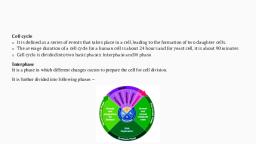
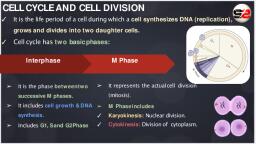
Cell Cycle and Cell Division, , , , , , Cell division / Cell reproduction / Cell cycle, , It is the process by which a mature cell divides and forms, two nearly equal daughter cells which resemble the parental cell in, a number of characters., , In unicellular organisms, cell division is the means of, reproduction by which the mother cell produces two or more new, cells. In multicellular organism also, new individual develop from a, single cell, Cell division is central to life ofall cell and is essential for, the perpetuation of the species, , Discovery : Prevost and Dumans (1824) first to study cell, division during the deavage of zygote of frog. Nageli (1846) first to, propose that new cells are formed by the division of pre-existing cells,, , Rudolf Virchow (1859) proposed “omnis cellula ¢ celhula” and, “cell lineage theory”,, , A cell divides when it has grown fo a certain maximum size, which disturb the karyoplasmic index (KI)(Nucleoplasmic ratio, (NP)(Kernplasm connection,, , Cell eycle : Howard and Pefe (1953) frst time described it,, ‘The sequence of events which occur during cell growth and cell, division are collectively called cell cycle. Cell cycle completes in, two steps:, , (1) Interphase, (2) M-phase/Dividing phase, , (2) Interphase : It is the period between the end of one cell, division to the beginning of next cell division. It is also called, resting phase or not dividing phase, But, it is actually highly, metabolically active phase, in which cell prepares itself for next cel, division, In case of human beings it will take approx 25 hours,, Interphase is completed into three successive stages., , G, phase/Post mitotic/Pre-DNA synthetic phase/gap I"', + In which following events take place,, intensive cellular synthesis., , (ii) Synthesis of RNA, mRNA ribosomes and proteins, , (ii) Metabolic rate is high., , (iv) Cells become differentiated., , (v) Synthesis of enzymes and ATP storage., , (vi) Cell size increases,, , (vii) Decision for a division in a cell occurs, , (citi) Substances of G stimulates the onset of next S— phase., , , , , , , , (ix) Synthesis of NHC protein, carbohydrates, proteins, lipids., , (x) Synthesis of enzyme, amino acids, nucleotides etc. but, there is no change in DNA amount., , S-phase/Synthetic phase, DNA replicates and its amount becomes double (2C - 4C)., i) Synthesis of histone proteins and NHC {non-histone, chromosomal proteins)., , (ii) Euchromatin replicates earlier than heterochromatin., , G,-phase/Pre mitotic/Post synthetic phase/gap-II™, , ) Mitotic spindle protein (tubulin) synthesis begins., , (ii) Chromosome condensation factor appears., , (ii) Synthesis of 3 types of RNA, NHC proteins, and ATP, molecule., , (iv) Duplication of mitochondria, plastids and other cellular, ‘macromolecular complements., , (v) Damaged DNA repair occur., , (2) M-phase/Dividing phase/Mitotic phase : It is divided, into two phases, karyokinesis and cytokinesis., , , , , , , , , , , Fig: 3.3-1 Different stages of cell cycle (Mitotic cycle)
Page 2 :
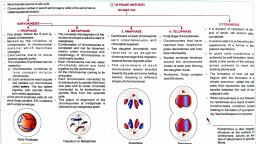
562 Cell Cycle and Cell Division, , , , , , Duration of cell cycle : Time period for G, , 8, Gz and Mphase is species specific under specific environmental conditions., €..,20 minutes for bacterial cell, 8-10 hours for intestinal epithelial, cell, and onion root tip cells may take 20 hours., , Gy ~ phase (Lajtha, 1963) : The cells, which are not to, divide further, do not proceed beyond the G, phase and start, undergoing differentiation into specific type. Such cells are said to, be in G, phase., , , , ‘Types of cell division : It is of three types, Amitosis, Mitosis, , and Meiosis., Amitosis, , Amitosis (Gk. Amitos = without thread; osis = state). It is also, called as direct cell division. It was discovered by Remak (1855) in, RBC of chick embryo. In this division there is no differentiation of, chromosomes and spindle. The nuclear envelope does not, degenerate. The nucleus elongates and constricts in the middle to, form two daughter nuclei. This is followed by a centripetal, constriction of the cytoplasm to form two daughter cells. It is, primitive type of division occuring in prokaryotes, protozoans,, yeasts, foetal membrane of mammals, cartilage of mammals etc., , ‘Nucleus, , , , \, Plasma, membrane, , Fig : 3.3-2 Amitos!, , Daughter, Cells, , , , division, , Mitosis, , Mitosis (Gk. Mitos = thread; osis = state). It is also called, indirect cell division or somatic cell division or equational division., In this, mature somatic cell divides in such a way that, chromosomes number is kept constant in daughter cells equal to, those in parent cell. So itis called equational di, , , , , , Qn, Discovery : Mitosis was first observed by Strasburger (1875), , in plant cell and in animal cell by Wflemming (1879). Term mitosis, was given by Flemming (1882)., , , , Occurrence : Mitosis is the common method of cell division, It takes place in the somatic cells in the animals and plants. Hence,, it is also known as the somatic division. In plants mitosis occurs in, the meristematic cells eg., root apex and shoot apex., , Process of mitosis : Mitosis is completed in two steps,, , Karyokinesis : (Gk. Karyon = nucleus; kinesis = movement), Division of nucleus. Term given by Schneider (1887). Karyokinesis it, takes 5-10% (shortest phase) time of whole division. It comprises, four phases 1, Prophase, Metaphase, Anaphase, Telophase., , , , (1) Prophase : It is longest phase of karyokinesis., , (i) Chromatin fibres thicken and shorten to form chromosomes, which may overlap each other and appears like a ball of wool, ie,, Spireme stage,, , (ii) Each chromosome divides longitudinally into 2 chromatids, which remain attached to centromere., , (il) Nuclear membrane starts disintegrating except in, dinoflagellates., , (iv) Nucleolus starts disintegrating, , (v) Cells become viscous, refractive and oval in outline., , (vi) Spindle formation begins., , (vil) Cell cytoskeleton, golgi complex, ER, etc. disappear., (vili) In animal cells, centrioles move towards opposite sides., (ix) Lampbrush chromosomes can be studied well, , (x) Small globular structure (beaded) on the chromosome are, called chromomeres., , (xi) Spindle is formed from centriole (in animal cells) or, MTOC (microtubule organising centre) in plant cells successively, called astral and anastral spindle., , (2) Metaphase, , (i) Chromosomes become maximally distinct i.e., size can be, measured., , (ii) A colourless, fibrous, bipolar spindle appears., , (iil) Spindle fibre are made up of 97% tubulin protein and, 3% RNA., , (iv) Chromosomes move towards equatorial plane of spindles, called congression and become arranged with their arms directed, towards pole and centromere towards equator., , (v) Spindle fibres attach to kinetochores., , (vi) Metaphase is the best stage for studying chromosome, morphology (structure, size, number)., , (vii) Spindle has two type of fibres, (a) Continous fibre (run from pole to pole)., , (b) Discontinous fibre (between pole to centromeres)., (3) Anaphase, , (i) Centromere splits from the middle and two chromatids gets, separated,, , (il) Both the chromatids move towards opposite poles due to, repulsive force called anaphasic movement., , (iil) Anaphasic movement is brought about by the, repolymerisation of continuous fibres and depolymerisation of, chromosomal fibres. Formation and expansion of interzonal fibres.
Page 3 :
Cell Cycle and Cell Division 563., , , , (iv) Different shape of chromosomes (V, J, I or L shapes), become evident during chromosome movement viz. metacentric, acrocenttic etc., , {v) The centromere faces towards equator., , (vi) The chromatids are moved towards the pole at a speed of, 1 fm/minute, About 30 ATP molecules are used to move one, chromosome from equator to pole,, , (vii) Shape of chromosome is best studied at anaphase., (4) Telophase, , (i) Chromosomes reached on poles by the spindle fibers and, form two groups., , (i) Chromosomes begin to uncoil and form chromatin net., (i) The nuclear membrane and nucleolus reappear., , {iv) Two daughter nuclei are formed,, , (v) Golgi complex and ER ete, reform., , (vi) This phase is also known as reverse prophase., , Fig: 3.3-8 Various, , , , Cytokinesis : (Gk -kitos = cell; kinesis = movement), Division of cytoplasm, Term given by Whiteman (1887). Division, of cytoplasm into 2 equal parts., , Cytokinesis is by 2 methods, , (1) Cell furrow method : This is characteristic of animal, cells, Due to absence of rigid cell wall here, the more flexible, plasmamembrane forms the outer layer of cell. A circular, constriction or invagination appears at centre or equator, which, deepens gradually and finally two daughter cells are separated., , (2) Cell plate method ; This is characteristic of plant cells., Here, vesicles provided by Golgi apparatus unite to form, phragmoplasts, which join to form cell plate. Cell plate is first laid, down in centre and then proceeds towards periphery (ie,, centrifugal plate-formation). Cell wall materials are now laid down, on bath sides of cell plate and thus forming two daughter cells, , , , Significance of mitosis, , (1) It keeps the chromosome number constant and genetic, stability in daughter cells, so the linear heredity of an organism is, maintained. All the cells are with similar genetic constituents,, , , , (2) It provides new cells for repair and regeneration of lost, parts and healing of the wounds., , (3) It helps in asexual reproduction by fragmentation,, budding, stem cutting, etc,, , (4) Somatic variations when maintained by vegetative, Propagation can play important role in speciation., Types of Mitosis, , (1) Intranuclear or Promitasis : In this nuclear membrane, is not lost and spindle is formed inside the nuclear membrane e.g.,, , Protozoans (Amoeba) and yeast. It is so as centriole is present, within the nucleus., , (2) Extranuclear or Eumitosis : In this nuclear membrane, is lost and spindle is formed outside nuclear membrane e.g,, in, plants and animals,, , (3) Endomitosis : Chromosomes and their DNA duplicate, but fail to separate which lead to polyploidy e.g,, in liver of man,, both diploid (2N) and polyploid cells (4N) have been reported. It is, also called endoduplication and endopolyploidy., , , , (4) Dinomitosis : in which nuclear envelope persists and, microtubular spindle is not formed. During movement the, chromosomes are attached with nuclear membrane., , Mitotic poision : The agents which inhibit cell division,, (1) Azides and Cyanides : Inhibit prophase., , (2) Colchicine : Inhibits spindle formation at metaphase., (3) Mustard gas : Agglutinates the chromosomes., , (4) Chalones : These were first reported by Laurence and, Bullough (1960). They are peptides and glycoproteins secreted by, extracellular fluid of healthy cells and inhibit celular division,, , Karyochoriosis : A type of mitosis in fungi in which is, intranuclear nucleus divides by furrow formation., , Table : 3.3-1, , Difference between animal and plant cells (Mitosis), , , , , , Animal cells, , Cenitioles present at spindle, poles,, , ‘Asters are formed (amphiastral)., , Cyiokinesis_by furowing of, cytoplasm., Funow extends centipetally, , Plant cells,, Cenitioles lacking at spindle poles,, , , , , , , , , , ‘No asters are formed (anastral), , , , , , Cytokinesis mostly by cell plate, formation., , , , , , Cell plate grows centrifugally.
Page 4 :
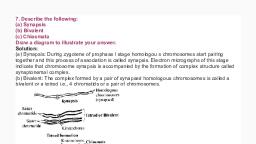
| 564 Cell Cycle and Cell Division, , Microfilament ting brings about, lavage, , (Occurs nealy in al tisues., , Call becomes rounded and its, , cytoplasm more viscous at the, time of mitosis., , , , , , Midbody is formed at the, , , , ‘equator of the spindle., Intercolilar spaces appear, ‘between the daughter cells., , , , Animal mitosis is controlled by, certain mitogens., , , , , , , , Microfilamenis have no Tole in, cytokinesis., , ‘Occurs mainly at meristems., , Cell does not change form or, nature atthe time of mitosis,, , , , , , , , Equator ofthe spindle changes into, phragmoplast., , Daughter cells remain adhered, together by middle lamella, , Plant mitosis is usually controlled, bya hormone cytokinin., , , , Meiosis, , Meiosis (Gr. meio ~ to lest, , sen, osis — state). Meiosis is a much, , slower process than mitosis. It is a double division that occurs in a, ‘mature diploid reproductive cell (2x) in which nucleus divides twice, but chromosome (DNA) replicates only once to form four haploid, calls, each having the half the number of chromosomes present in, the parent cell. As it causes reduction in the number of, chromosomes, it is known as reduction division. Meiosis in a cell, occurs only once. The so formed haploid cells do not further, , undergo meiosis because there, , haploid genome., , is no synaptinemal complex in, , Discovery : It was first demonstrated by Van Beneden (1887), but was described by Winiwarter (1900). Term “meiosis” was given by, Farmer and Moore (1905). Gregoire used the term meiosis | and IL, , ‘Occurrence : Itis found in, , special types and at specific period. It, , is reported in diploid germ cells of sex organs (eg, primary, spermatocytes of testes to form male gametes called spermotozoa and, primary oocytes to form female gametes called ova in animals) and in, pollen mother cells (microsporocytes) of anther and megasporocute of, ‘ovule of ovary of flowers in plant to form the haploid spores. The study, of meiosis in plants can be done in young flower buds., , Process of meiosis : Meiosis is completed in two steps,, , meiosis | and meiosis Il, , Melosis-l : In which the, , 1@ actual chromosome number is, , reduced to half, Therefore, meiosis | is also known as reductional, , division or heterotypic division., haploid cells from one diploid, karyokinesis I and cytokinesis 1, , , , Karyokinesi, , It results in the formation of two, cell, It is divided into two parts,, , + It involves division of nucleus. It is divided, , into four phases i.e., prophase, metaphase, anaphase, telophase., , (1) Prophase-I : It is of longest phase of karyokinesis of, , m, , , , It is again divisible into five subphases i.e., leptotene,, , zygotene, pachytene, diplotene and diakinesis., , (i) Leptotene/Leptonema, {a) Chromosomes are long thread like with chromameres on it., , (b) Volume of nucleus increases., , (©) Chromatin network has half chromosomes from male and, half from female parent., , (4) Chromosome with similar structure are known as, homologous chromosomes., , (e) Leptonemal chromosomes have a definite polarization and, forms loops whose ends are attached to the nuclear envelope at, points near the centrioles, contained within an aster. Such peculiar, arrangement is termed as bouquet stage (in animals) and syndet, knot (in plants)., , (g) Lampbrush chromosome found in oocyte of amphibians is, seen in leptotene., , (ii) Zygotene/Zygonema, (a) Pairing or “symapsis” of homologous chromosomes takes, place in this stage., , {b) Paired chromosomes are called bivalents, which by furthur, ‘molecular packing and spiralization becomes shorter and thicker., , , , {c) Pairing of homologous chromosomes in a zipper-fashion,, Number of bivalents (paired homologous chromosomes) is half to, total number of chromosomes in a diploid cell. Each bivalent is, formed of one paternal and one matemal chromosome (i.e, one, chromosome derived from each parent), , (d) Under EM, a filamentous ladder like nucleoproteinous, complex, called synaptinemal. Synaptinemal complex is seen, between the homologous chromosomes which was discovered by, “Moses” (1956)., , (ii) Pachytene/Pachynema, , , , {a) In the tetrad, two similar chromatids of the same, chromosome are called sister chromatids and those of two, homologous chromosomes are termed non-sister chromatids, , (b) Crossing over i.e., exchange of segments between nonsister chromatids of homologous chromosome occurs at this stage., , It takes place by breakage and reunion of chromatis segments, Breakage called nicking, is assisted by an enzyme endonuclease, and reunion termed annealing is added by an enzyme ligase., Breakage and reunion hypothesis proposed by Darlington (1937)., , (c) Chromatids of pachytene chromosome are attached with, centromere., , (d) A tetrad consists of two sets of homologous chromosomes, each with two chromatids. Each tetrad has four kinetochore (two, sister and two homologous).
Page 5 :
Cell Cycle and Cell Division 565, , , , (e} A number of electron dense bodies about 100 nm in, diameter are seen at imegular intervals within the centre of the, synaptonemal complex, known as recombination nodules,, , Chromatid Centromere, , , , Chiasma, , Fig : 3.3-4 Crossing over during meiosis, (f) DIA polymerase is responsible for the repair synthesis,, (iv) Diplotene/Diplonema, , (a) At this stage the paired chromosomes begin to separate, (desynapsis). Terminalisation starts., , (b) Cross is formed at the place of crossing over between, non-sister chromatids, , {c) Homologous chromosomes move apart they remain, attached to one another at specific points called chiasmata., , (d) At least one chiasma is formed in each bivalent., , {e) Chromosomes are attached only at the place of, chiasmata., , () Chromatin bridges are formed in place of synaptonemal, complex on chiasmata., , (g)_ This stage remains as such for long time., , (v) Diakinesis, , (a) Terminalization completes., , (b) Nuclear membrane and nucleolus degenerates,, , (€) Chromosome recondense and tetrad moves to the, metaphase plate, , {d) Formation of spindle,, , (ec) Bivalents are iregularly and freely scattered in the, nucleocytoplasmic matrix., , When the diakinesis of prophase is completed than cell, enters into the metaphase-1, , , , Nuclear Disappearing, mernbrane Nudeolus nuclear membrane, ‘A bivalent, (A) Leplotene ——_(B)Zygotene (0 Pachytene, , Soe) //)\\, , , , 1 @, , QQEM i Sas, , (© Diakioesie, , (8) Metaphate (G) Anaphase 1 (i) Telophase 1 (1 Interphase, Reappearance of, , ‘nucealas and, clear membrane, , @ a => 86, Sim wen eat bee, Fig ; 3.3-5 Different stages of meiotic cell division (meiosis), (2) Metaphase-1, {i) Chromosome come on the equator,, , (ii) Bivalents arange themselves in two parallel equatorial or, metaphase plates. Each equatorial plate has one genome., , , , , , , , (ii) Centromeres of homologous chromosomes lie equidistant, from equator and are directed towards the poles while arms, generally lie horizontally on the equator,, , (iv) Each homologous chromosome has two kinetochores and, both the kinetochores of a chromosome are joined to the, chromosomal or tractile fibre of same side,, , (3) Anaphase-1, , (i) It involves separartion of homologous chromosomes which, start moving opposite poles so each tetrad is divided into two, daughter dyads. So anaphase-I involves the reduction of, chromosome number, this is called disjunction., , , , (ii) The shape of separating chromosomes may be rod or J or, ‘V-shape depending upon the position of centromere., , , , ) Segregation of Mendelian factors or independent, assortment of chromosomes take place. In which the patemal and, ‘maternal chromosomes of each homologous pai segregate during, anaphase-I which introduces genetic variability, , (4) Telophase-1, , (i) Two daughter nuclet are formed but the chromosome, number is half than the chromosome number of mother cell., , (ii) Nuclear membrane reappears., , (iil) After telophase I cytokinesis may or may not occur.



 Learn better on this topic