Notes of MU- HRDC ( AMSU) COACHING, Sociology INTRODUCTION TO SOCIOLOGY.pdf - Study Material
Page 2 :
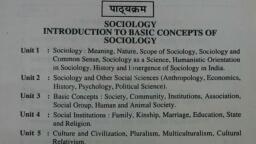
INTRODUCTION TO SOCIOLOGY, , , Unit 1 :, , Nature and Scope of Sociology: Meaning of Sociology and Definition;, Nature and Scope of Sociology,, , , Unit II:, , Basic Concepts: Society, Community, Institution, Association, Group, and, Culture., UNIT III, Social Institutions: Family, Marriage, Religion, Education, Polity and, Economy
Page 3 :
Unit 1 :, Nature and Scope of Sociology: Meaning of Sociology and Definition;, Nature and Scope of Sociology,, , Sociology is a science based on the study of humans and their culture. It is a combination, of the organized study of the growth, architecture, relationships and attitudes of systematic, groups of human beings. Sociology paves the way for scientists, social thinkers and, activists in understanding the society. It also helps them in improving the quality of life of, the people living in the society., The basic principles of sociology are as follows:, • The behaviour of individuals in social groups is different than that when they, are independent., • Individuals who are part of a social group follow the rules of that social group., • These rules are created and implemented socially., • Some people have more authority in the creation of rules than others., • Those who follow the rules are awarded and those who break them are, penalized.
Page 4 :
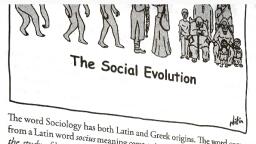
• Sociology is one of the first social sciences to be acknowledged. The word ‘sociology’owes its origin to the Latin word, socius (companion) and the Greek word logy (study of). Sociology incorporates the study of social phenomena, social, life, groups, institutions,associations and societies ., French philosopher and sociologist Auguste Comte invented the term ‘sociology’, in the year 1838. He advocated for sociology to be used as a positive methodas in natural sciences. He, further believed that social evolution went hand in hand withprogress, in accordance with the law of, three stages. These three stages are:, , The, theological-military,, the, metaphysical-legalistic, According to Comte’s hierarchy of sciences, sociology occupies the summit., , and, , the, , positive-industrial, , French sociologist Emile Durkheim was a pioneer in demonstrating scientific methodology in sociology. In his most acclaimed work,, Rules of Sociological Method (1897), he emphasized on the methodology that he has described in his study, Suicide(1897)., , laws.
Page 5 :
Popular definitions of Sociology, , Sociology is the science of social phenomena ‘subject to natural and invariable laws, the, discovery of which is the object of investigation’., , —Auguste Comte, ‘, Sociology… is a science which attempts the interpretative understanding of social, action in order thereby to arrive at a causal explanation of its course and effects.’, , —Max Weber, ‘, In the broadest sense, sociology is the study of human interactions and, interrelations, their conditions and consequences.’, , —Morris Ginsberg, ‘, Sociology is the study of man and his human environment in their relations to, each other.’, , —Henry Fairchild
Page 6 :
Sociology as a branch of knowledge has its own unique characteristics. It is different, from other sciences in certain respects. An analysis of internal logical characteristics, helps one to understand its main characteristics, which are discussed as, follows:, (i) Sociology is an independent science: It is not treated and studied as a branch o, any other science. As an independent science, it has its own field of study, boundary, and method., , (ii) Sociology is a social science and not a physical science: As a social science, it, focuses its attention on man, his social behaviour, social activities and social life. It is, related to other social sciences such as history, political science, economics, and so, on.
Page 7 :
Scope of Sociology, According to the British sociologist Morris Ginsberg, the scope of sociology includes a broad study of, human interactions, their conditions and consequences., Sociology involves a systematic and objective study of human society. Sociologists study, individuals’ social actions. Social relationships, for instance, those between a husband and, a wife, a teacher and a student, a buyer and a seller, and social processes,, namely,cooperation, competition, conflict and organizations, communities and nations,, and social structures (family, class and state), give rise to sociological queries., Explanations that are derived from norms and values result in the formation of social, institutions., Thus, sociology can be defined as the study of social life. Sociology comprises a varietyof, apprehensions and interests. It is aimed at providing classified forms of relationship within, societies, institutions and associations
Page 8 :
• Politicology:, It is an alternative term offered for political science which argues that politics is more of a cultural aesthetic than a, science., • Positivism:, It is a philosophical system recognizing only that which can be scientifically verified or which is capable of logical, or mathematical proof, and,therefore, rejecting metaphysics and theism., • Historical materialism:, It is a methodological approach to the study of human, societies and their development over time first articulated by Karl Marx (1818–, 1883) as the materialist conception of history.
Page 9 :
Law of Three stage – August Comte, “During the religious stage, searching for the nature of the world (creation) or the premiere and end reasons, of the happenings of natural reasons (production and objective) man, in trying to understand them, accepts, that all events are the results of the present activities of divine, other wordly beings.”, “Metaphysical stage is a mere ammendment of the first stage. Man’s mind now believes that not divine, powers, but abstract, unseen mischievous which exist in every living creature are active behind every, event.”, , “In the last stage, the mind of man, abandous the futile search for unbiased beliefs, world and evil forces, and their objectives as reasons for all wordly events”, but the rules behind the events are studied. In other, words he observes and studies their repititions, similarities and ponders them. The main basis for this, knowledge is observation and reasoning applied holistically to the given data
Page 10 :
UNIT 2 BASIC CONCEPTS, , CONCEPT OF SOCIETY, The term ‘society’ is not easy to define. In general, it refers to people and their community., Man is a social animal who relies on others around him for his basic needs., British sociologist Morris Ginsberg has defined society, thus:, ‘A society is a collection of individuals united by certain relations or mode of behaviours, which mark them off from others who do not enter into these relations or who differ, from them in behaviour.’, Well-known sociologist R. M. MacIver has defined society as, ‘Society is a web of social relationships’
Page 11 :
Society has been differently defined by different sociologists. Here are a few definitions:, American sociologist Gerhard Lenski defined society as is a form of organization involving:, (1) Relatively sustained ties of interaction among its members., (2) Relatively high degree of interdependence among its members., (3) A high degree of autonomy, , A. L. Kroeber (1948) Anthropology. New York: Harcourt, Brace, A society is a collection of people who are linked to one another, either directly or, indirectly, through social interaction...The term society can be applied to the total human, community, encompassing all of humanity., B. Michael Howard and Patrick McKim (1983) Contemporary Cultural Anthropology, For convenience of study, aggregates of individuals in their relational aspects are arbitrarily, isolated as social units. Where these show a number of common features in distinction, from other such units, they are conveniently termed societies.
Page 12 :
Social Contract Theory, The social contract theory is unique, giving importance to individuals as architects ofsociety. This theory was propounded, by three eminent philosophers: Thomas Hobbes,John Locke and J. J. Rousseau. According to this theory, all men were born, free and equal, and individuals made a mutual agreement and created a society., J. J. Rosseau, in his book, Contract Social, gave a classical opinion about the social contract theory .
Page 13 :
COMMUNITY, Human society is a group of people related to each other through peristent relations., Societies are characterized by patterns of relationships between individuals sharing a distinctive culture and, institutions., Community is also an important concept in social and political life. The social life led by people is affected and, influenced by the kind of community in which they live., The word ‘community’ is derived from Latin, where the prefix ‘com’ signifies ‘together’, and the noun munia, munium means ‘duty’. Thus, community refers to fulfilling duties, together., It implies that the ‘community’ is an organization of human beings framed for the purpose of serving together., According to a widely quoted definition, ‘a community is a local grouping within which people carry out a full round, of life activities.
Page 14 :
Other definitions of community, ‘Community is ‘any circle of people who live together and belong together in such a way that they do not share this or that, particular interest only, but a whole set of interests’., –Karl Mannheim, Community is ‘a group of social beings living a common life including all the infinite variety and complexity of relations, which result from that common life which constitutes it’., –Morris Ginsberg, , Community is ‘the smallest territorial group that can embrace all aspects of social life’., –Kingsley Davis
Page 15 :
MacIver’s conception of community, , R. M. MacIver has given one of the most salient definitions and analyses of community., According to him, ‘Wherever the members of any group, small or large, live together in, such a way that they share, not this or that particular interest, but the basic conditions of, a common life, we call that group a community., As MacIver has stated, ‘Communities exist within greater communities: the town within a region, the region, within a nation, and the nation within the world community, which, perhaps, is in the process of development ‘.
Page 16 :
Community and Association, , MacIver has distinguished community from association. An association is a group of people organized for the pursuit of a, specific purpose or a limited number of purposes., , An association is not a community but an organization within a community. A community is more than any specific, organizations that arise within it. It is a permanent social group embracing a totality of ends or purposes. As the association is, organized for particular purposes for the pursuit of specific interests, one belongs to it only by virtue of these interests., Membership in an association has a limited significance. A community, on the other hand, is a permanent social group embracing, a totality of ends or purposes.
Page 17 :
Institutions, An institution is a structure of social order and cooperation, governing the behaviour of a set of individuals within a human, community. Institutions are generally identified with a social purpose and permanence., Institutions have been defined by MacIver as ‘established forms or conditions of procedure characteristic of group activity’., So, it can be said that social institutions are the social structures and machinery, through which the society organizes,directs, and executes multiple activities that are required to fulfil human needs., An institution is an organized system of social relationships which embodies certain common values and procedures and, meets certain basic needs of the society.
Page 18 :
Association, An association is an assembly of people planned for a particular purpose or a limited number of purposes., To constitute an association, there must be, firstly, a group of people; secondly, these people must be organized, i.e., there, must be certain rules for their conduct in the groups, and thirdly, they must have a common purpose of a specific nature to, pursue., According to Maclver, ‘An organization deliberately formed for the collective pursuit of some interest or set of interest,, which the members of it share, is termed as association.’, Ginsberg writes, ‘An association is a group of social beings related to one another, by the fact that they possess or have instituted in common an organization with a view to, securing specific end or specific ends.
Page 19 :
Group, A social group comprises two or more people who interact with each other and identify themselves as a well-defined, social unit ., Primary groups, A small group in a society who share a close relationship is termed as a primary group.There is a concern for each other, among the members of this group and they share acommon culture. Herein, the groups usually comprise family members,, close friends orhighly influential social groups. This concept of primary group was first coined by asociologist from, the Chicago School of Sociology, Charles Cooley in his book Social Organization: A Study of the Larger Mind’., Secondary groups, Secondary groups comprises people who interact with each other on a less personal manner and the interaction formed is, not that long-lasting. The relationship between the members of the group is also not long-lasting. These groups are usually, formed to carry out a certain task or a function and, hence, the roles played by the members of the group are more, interchangeable.
Page 20 :
CULTURE, Sir Edward Tylor (1871) defined culture in a classical and sociological manner., According to him, ‘Culture is that complex entirety which includes knowledge, belief,art, morals, law, customs and other, capabilities and habits, that are acquired by man, as a member of society.’, According to notable sociologist David Bidney, culture is the product of agro, facts (product of civilization), artifacts (product of industry), sociofacts (social, organization) and mentifacts (language, religion, art, and so on). According to Marett,, culture is communicable intelligence.
Page 21 :
Folkways, Willam Graham Sumner, in his book, Folkways (1906), defined folkways as the usual, established, routine and ], regular way in which a group performs its activities.These activities can range from shaking hands, eating with knives and, forks, driving inthe left side of streets, and so on., , Diffusion, Diffusion means adopting the characteristics of culture from other societies, irrespective of their means of, emergence in the source society.
Page 22 :
Custom, , A habit, once formed, becomes a normal way of life. Customs usually comprise mutual give and take, accompanied by, compulsive responsibilities. Additionally, customs also abide by the law, in the absence of which they would be, worthless., According to Maclver and Page, custom sets up its own kind of social order which curbs the disagreements, that rise between custom and law., Ethnocentrism, Ethnocentrism is interrelated with cultural relativity. The word ethno is derived from a Greek terminology which, means, people, country and cultural bonding;centric is derived from a Latin word, which means centre. Thus,, ethnocentrism means the inclination ofevery society to place its own culture patterns at the centre of things
Page 23 :
Acculturation, Acculturationis an expression that explains the manner in which different cultures interact, with each other. It also defines the customs of such interactions. These interactive processes between cultures, may either be socially interactive in a direct way or through media, or other forms of communication. As a result, of these interactions, the identity and culture of the interacting groups change. In some cases, hostility between, both the cultures may result in the emergence of a new form of culture. This new culture may adopt the, characteristics of both the cultures., Cultural Lag, Culture lag is the duration or gap of time that exists between the emergence of a new material invention and the, process of adapting it to the corresponding non-material culture., , This duration is usually long, for instance, the period between the invention of, the typewriter and its practical use in offices was fifty years.
Page 24 :
Social Institutions, A social institution is an organized collection of statuses, roles, values and norms that are designed to fulfil one or many, basic needs of the society. Social institutions vary from region to region., Social institutions are established or standardized patterns of rule-governed behaviour. They include the family, education,, religion, and economic and political institutions., , FAMILY, The institution of a family is the basic and fundamental institution in the life of an individual.It is the primary group and, an important agency of socialization. Historically, the institutionof a family has undergone many changes. The term, ‘family’ has been defined by manysociologists and anthropologists. American anthropologist George Murdock (in 1949),, after studying about 250 multi-cultural societies, defined ‘family as a social group that is characterized by common, residence, economic cooperation and reproduction’.
Page 25 :
Forms of Families, Various sociologists have studied different forms of families. They have taken into consideration different factors for the, classification of families. The following are the different types of families:, • Marriage classifies families into monogamous and polygamous categories., • Based on the location of their residence, families are categorized into two main, types: family of matrilocal residence and family of patrilocal residence., • On the basis of ancestry or descent, families are classified into matrilineal and, patrilineal types., • According to the type of authority, families may be identified as matriarchal and, patriarchal types., • In terms of size or structure, there may be two types of families: nuclear or joint., • Families can be divided into conjugal and consanguineous types, based on the relations between the members. In a, conjugal family, relations between the husband and the wife are private and their ties with the extended family are, voluntarily. A consanguine family consists of close relatives other than parents and children.
Page 26 :
conjugal and consanguineous types
Page 27 :
Basis of Categorization, , Types, , Marriage, , 1. Monogamous family, 2. Polygamous family, , Location of residence, , 1. Family of matrilocal residence, 2. Family of patrilocal residence, , Ancestry/Descent, , 1. Matrilineal family, 2. Patrilineal family, , Type of authority, , 1. Matriarchal family, 2. Patriarchal family, , Size/structure, , 1. Nuclear, 2. Joint, , Relations between members, , 1. Conjugal family, 2. Consanguineous family
Page 28 :
MARRIAGE, Marriage is a social institution under which a man and a woman establish their decision to live as husband and wife by, law, often through religious commitments and ceremonies. It is a secure association between a man and a woman who, are permitted by the society to have children, without affecting their reputation in the society, , ., , Forms of Marriage, On the basis of the number of mates, marriage is classified into two types: monogamy and, polygamy. Monogamy is the marriage between single partners (i.e., a husband having one wife or, a wife having one husband)., Polygamy is the practice of having more than one partner in marriage. Polygamy may be of two types: polygyny and, polyandry. When one man has two or more wives at a time, the practice is known as polygyny. When two or more, sisters share one husband,the practice is known as sororal polygyny.
Page 29 :
When one woman gets married to more than one man simultaneously, the practice is known as polyandry. Polyandry, may be of two types: fraternal or adelphic polyandry and non-fraternal polyandry. When one woman marries several, brothers at the same time, the practice is known as fraternal polyandry. This practice is prevalent among the Toda, community in India. When a woman has several husbands, none of whom are necessarily brothers, the practice is, known as non-fraternal polyandry.
Page 30 :
Marriage of a man with the childless widow of his deceased brother is known as levirate, marriage. When a levirate marriage prevails, on the death of a husband, it is the duty of one of his brothers to, marry his widow and any children that are born as a result of this union are counted as progeny of the deceased, man., When a sororate marriage prevails, the husband of a childless woman marries, her sister and at least some of the children that are born as a result of this union are, counted as children of the childless wife., , The term ‘sororate’ is also used with reference to the custom whereby, upon the death of a wife, her kin provide, her sister as wife to the widower. However, any children that are born as a result of this union are recognized as, her own., Levirate and sororate customs emphasize the acceptance of inter-familial, obligations and recognition of marriage as a tie between two families and not simply, between two individuals.



 Learn better on this topic