Page 1 :
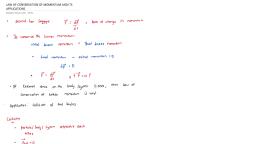
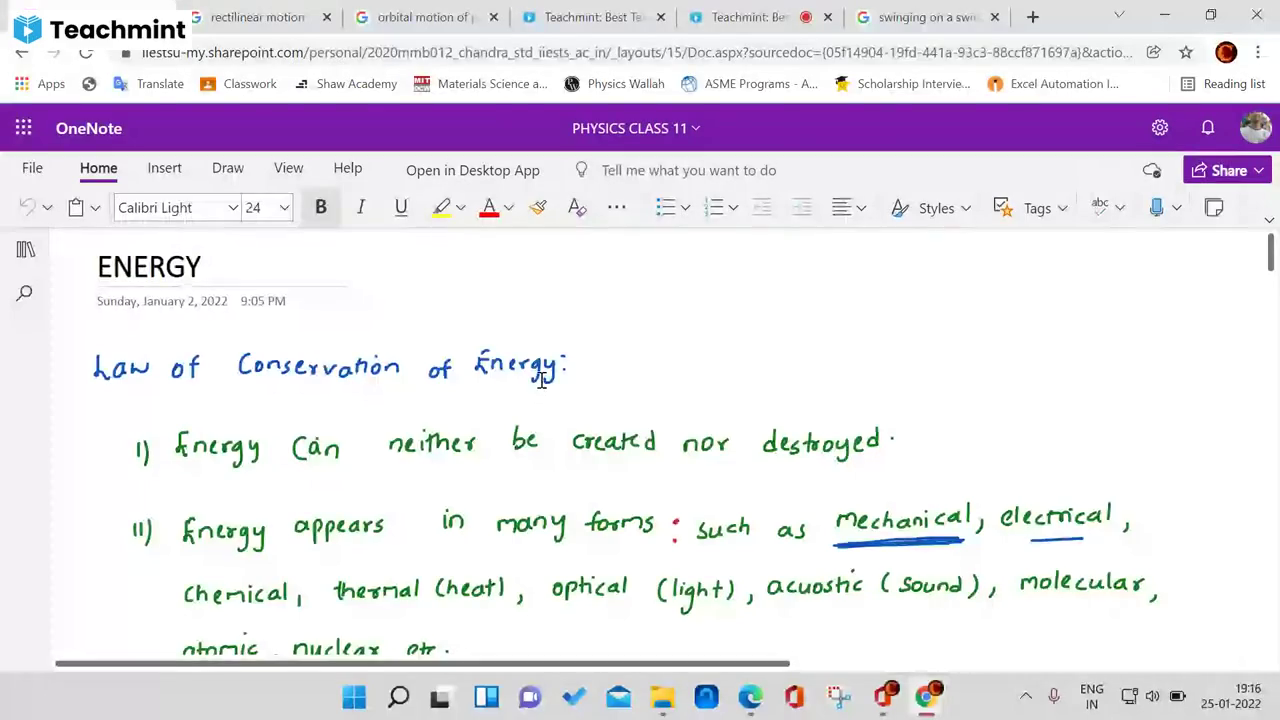
10/8/21, 12:51 AM, , OneNote, , NATURE OF PHYSICAL LAWS, Thursday, October 7, 2021 2:52 PM, , WHAT DO YOU MEAN BY LAW OF PHYSICS?, A law of physics is a statement that summarizes the results of experiments and, observations for a certain range of physical phenomena., NOTE:- a law cannot be proved. It can be verified, or disproved by experiments and/or, observations., LAW OF NATURE DO NOT CHANGE WITH TIME., , Question:- what is conserved quantities?, Ans- the physical quantities that remain unchanged in a process are called conserved, quantities., Example:-energy, linear momentum , angular momentum, charge., These are conserved quantities of nature thus exists:, 1. Law of conservation of energy, 2. Law of conservation of linear momentum, 3. Law of conservation of angular momentum, 4. Law of conservation of charge, These laws are hypothesis, based on observations and experiments., QUESTION:- ARE CONSERVATION OF MASS AND CONSERVATION OF MECHANICAL ENERGY FUNDAMENTAL, LAWS OF NATURE?, Ans:- no, mass is conserved in a chemical reaction but in a nuclear reaction, it is converted to energy or viceversa . Law of conservation of mechanical energy is restricted to conservative forces only . it fails if other, forces do work on the system., , https://iiestsu-my.sharepoint.com/personal/2020mmb012_chandra_std_iiests_ac_in/_layouts/15/Doc.aspx?sourcedoc={05f14904-19fd-441a-93c3…, , 1/1