Page 2 :
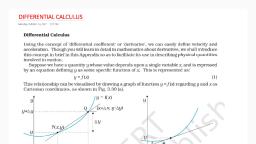
store Foe Til aval cay: Can Re daaived per general eq” ot Shige, OTE, , Jing: attbyt c= where degree ss aie Se., However, Gf degree of variable: 2, We ger a parabola., , QurtbrtC =O , Degve = 2, , Following graphs and their corresponding equations are frequently used in Physics., , (i) y=, represents a straight line passing through origin. Here, m= tan @ is also called the slope of, line, where @ is the angle which the line makes with positive x-axis, when drawn in anticlockwise, direction from the positive x-axis towards the line., , y yx, Sp: ——, 0 ww, , Fig. 1.2, , The two possible cases are shown in Fig. 1.1. In Fig. 1.1 (i), @<90°. Therefore, tan @ or, slope of line is positive. In Fig. 1.1 (ii), 90°<@ <180°. Therefore, tan 6 or slope of line is, negative., Note That y = mxor y « x also means that value of y becomes 2 times ifx is doubled. Or it will remain * th if, x becomes + times., ‘ i origin. Here, m is the slope of tine ax, (ii) y= mx+ c, represents a straight line not passing through, discussed above and c the intercept on y-axis., , y ¥, y, cae cawe . o x, = cue, ry ® *
Page 3 :
Fig. 1.2, In figure (i) : slope and intercept both are positive., In figure (ii) : slope is negative but intercept is positive and, In figure (iii) : slope is positive but intercept is negative., Note That in y = mx + ¢,y does not become two times if x is doubled., Git) yo4 or y=2 ete, represents a rectangular hyperbola in first and third quadrants. The shape of, x, , retangile bypetok kos Py. 1.3(i)., , Se, > (—, , ¥, , Fig. 1.3, , From the figure and from the graph we can see that y —» Oas x» or x» Oas y—» x., Similarly, y =~ represents a rectangular hyperbola in second and fourth quadrants as shown in, Fig. 1.3(ii)., , Note That in case of rectangular hyperbola if x is doubled y will become half., , (iv) yox? or y= 2x", etc, represents a parabola passing through lela tie ia Fig, , - y, e @, , Note That in the parabola y = 2x' or y « x*, if x is doubled, y will become four times., , Graph x oy? or x=4y* is again a parabola passing through origin as shown in Fig 1.4 (ii). In this, case if y is doubled, x will become four times., , (vy) y=x? +4orx= y* ~ 6will represent a parabola but not passing through origin. In the first equation, (y=x" +4),ifx is doubled, y will not become four times., , (vi) y= Ae"; represents exponentially decreasing graph. Value of y decreases exponentially from A, to 0. The graph is shown in Fig. 1.5., , re
Page 4 :
Fig. 15, , From the graph and the equation, we can sec that y= A at x=Oand y—> Oas x—> 0,, (vil) y=aQl-e™), fepresents an exponentially increasing graph. Value of y increases exponentially, from 0 to A. The graph is shown in Fig, 1.6., , , , x, , Fig. 1.6, From the graph and the equation we can see that y= Oat x=Oand y > Aas x—> a.