Page 1 :
GASEOUS STATE, , Assignment, Contents, Topic, , Page No., , Theory, , 02-09, , Exercise -1, , 10-32, , Exercise -2, , 33-44, , Exercise -3, , 45-48, , Exercise -4, , 49-50, , Answer Key, , 51-55, , Syllabus, Gaseous state : Absolute scale of temperature , ideal gas equation; Deviation from ideality,, Vander Waal’s equation; Kinetic theory of gases, average, root mean square and most, probable velocities and their relation with temperature; Law of partial pressure; Vapour, pressure; diffusion of gases., , Name : _____________, , Batch : __________, , Abhyaas Tutorial, Venue : 1. Near M.I. T. Exchange Gate, Muzaffarpur, 2. Infront of HP Petrol Pump, Rewa Road Bhagwanpur, Mob. 7654129419, 8863852869, 9709799480
Page 2 :
GASEOUS STATE, 1., , Measurable properties of gaseous :, Mass : The gases do possess mass. The mass of gas is generally used in the form of, number of moles which is related as :, , 2., , Volume : Volume of gas is nothing but volume of the container in which it is present., Relation between different units of volume, 1, =, =, litre =, =, ml =, ., , 3., , Temperature : Degree of hotness or coldness of a body is measured by temperature, C – Celcius scale,, K – Kelvin scale,, F – Fahrenheit scale, Note : In all the problems of gaseous sate (i.e. in all gas law equations), temperature, must be expressed in Kelvin scale. i.e.,, t 0C + 273 = K, , 4., , Pressure : Force acting per unit area., P=, Units :, CGS, :, dyne/cm, MKS :, Newton/m, Relation:, 1 N/m = 10 dyne/cm, Units of pressure :, 1 atm = 76 cm of Hg, = 760 mm of Hg, = 760 torr, = 1.01325×10⁵ N/m, = 101.325 kPa, = 1.01325 bar, = 14.7 Ib/In (Psi), = 10.33 metres of H O, , Absolute density, (mass per unit volume), , DENSITY OF GASES, Relative density, (Relative to hydrogen turned as vapour density), , d=, , VD =, , Boyle’s law and measurement of pressure :, Statement :, For a fixed amount of gas at constant temperature, the volume occupied by the gas is, inversely proportional to the pressure applied on the gas or pressure of the gas., V∝, Hence PV = constant, this constant will be dependent on the amount of the gas and temperature of the gas., PV, PV, , Abhyaas Tutorial, Venue : 1. Near M.I. T. Exchange Gate, Muzaffarpur, 2. Infront of HP Petrol Pump, Rewa Road Bhagwanpur, Mob. 7654129419, 8863852869, 9709799480, , 2
Page 3 :
Gaseous State, , MEASUREMENT OF PRESSURE :, Barometer : A barometer is an instrument that is used for the measurement of pressure., The construction of the barometer is as follows, , Cross sectional view of the capillary column, (‘h’ is the height to which mercury has risen in the capillary), or, P = ρgh, Normal atmospheric pressure which we call 1 atmosphere (1 atm), is defined as the, pressure exerted by the atmosphere at mean sea level. It comes out to be 760 mm of, Hg = 76 cm of Hg. (at mean sea level the reading shown by the barometer is 76 cm of, Hg), 1 atm = (13.6 ×, ) ×9.8 ×0.76 =1.013 ×, Pascal., 1 torr = 1 mm of Hg., 1 bar =, N/m (Pa), Charle’s Law : It relates the volume and temperature of a given mass of a gas at constant, pressure., For each degree change of temperature, the volume of a sample of a gas changes by the, fraction, of its volume at 0 0C., or, , = constant, if pressure is kept constant, , Calculation of pay load : Pay load is defined as the maximum weight that can be lifted by, a gas filled balloon., , For maximum weight that can be lifted, applying force balance, , Abhyaas Tutorial, Venue : 1. Near M.I. T. Exchange Gate, Muzaffarpur, 2. Infront of HP Petrol Pump, Rewa Road Bhagwanpur, Mob. 7654129419, 8863852869, 9709799480, , 3
Page 4 :
Gaseous State, , Fbuoyancy = Mballoon × g + Mpay load × g, ⇒, ρ v.g. = ρ v.g. + Mg + mg., mass of balloon = m, net force on, volume of balloon = v, balloon = 0, density of air = ρ, (at equilibrium / when balloon is incoming, density of the gas inside the with constant speed), balloon = ρ, Gay-Iussac’s law : For a fixed amount of gas at constant volume, pressure of the gas is, directly proportional to temperature of the gas on absolute scale of temperature., P∝T, constant, dependent on amount and volume of gas, temperature on absolute scale originally, the law was developed on, the centigrade scale, where it was found that pressure is a linear function of, temperature P = P, bt where ‘b’ is a constant and P is pressure at zero degree, centigrade., , Avogadro’s Hypothesis : For similar values of pressure & temperature equal number of, molecules of different gases will occupy equal volume., N, V, (volume of N molecules at P & T of one gas ), N, V, (volume of N molecules at P & T of second gas), ⇒ Molar volume & volume occupied by one mole of each and every gas under similar, conditions will be equal., One mole of any gas or a combination of gases occupies 22.413996 L of volume at STP., The previous standard is still often used, and applies to all chemistry data more than, decade old, in this definition Standard Temperature and Pressure STP denotes the same, temperature of C(273015K), but a slightly higher pressure of 1 atm (101.325kPa)., Standard Ambient Temperature and Pressure (SATP), conditions are also used in some, specific works. SATP conditions means 298.15 K and 1 bar (i.e. exactly, Pa) At SATP, (1 bar and 298.15 K), the molar volume of an ideal gas is 24.789 L mol, Ideal Gas Equation : Combining all these gas laws, a simple equation can be derived at,, which relates P, V, n and T for a gas, PV = nRT, (for n moles of gas), ⇒, (combined gas law), Relation between Molecular Mass and Gas Densities :, (A) Actual density : For an ideal gas PV = nRT or PV =, , where w = mass of the gas, in gms and M = Molecular wt. in gms., ∴, PM =, or, PM = ρRT, (where ρ is the density of the gas, ), ∴, , d=, , Abhyaas Tutorial, Venue : 1. Near M.I. T. Exchange Gate, Muzaffarpur, 2. Infront of HP Petrol Pump, Rewa Road Bhagwanpur, Mob. 7654129419, 8863852869, 9709799480, , 4
Page 5 :
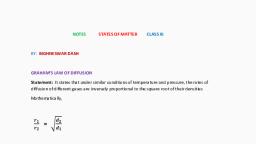
Gaseous State, Dalton’s Law of Partial Pressures : The total pressure of a mixture of non reacting gases, is equal to the sum of their partial pressures., By Dalton’s Law, , P, , P, , P, , …………, , Graham’s Law of Diffusion /Effusion :, Diffusion : Net spontaneous flow of gaseous molecules from region of high, concentration (higher partial pressure) to the region of lower concentration or lower, partial pressure, Graham’s Law : “Under similar conditions of pressure (partial pressure) the rate of, diffusion of different gases is inversely proportional to square root of the density of, different gases.”, , rate of diffusion r ∝, d = density of gas, √, , , , √, , √, , √, , √, , √, , ., , V.D is vapour density, , ., , The general form of the grahams law of diffusion can be stated as follows,, when one or all of the parameters are varied., rate ∝, , √, , A, , P – Pressure, A – area of hole, T – Temp. , M – mol. wt., , , If partial pressure of gases are not equal., , √, , Kinetic Theory of Gases :, Derivation :, m = mass of one molecule, PV = mN U Kinetic equation of gases, where U is mean square speed, N = number of molecule, root mean square speed = U, , = √U, , √(, , ), , Kinetic Energy of gas sample :, (i), , Average kinetic energy of a single molecule =, K = boltzman constant =1.38 ×, J/deg, , (ii), , Total Kinetic Energy for one mole of gas =, , (iii), , Kinetic Energy for n mol of gas = n × RT, , ., , .T, , KT, , RT, , Abhyaas Tutorial, Venue : 1. Near M.I. T. Exchange Gate, Muzaffarpur, 2. Infront of HP Petrol Pump, Rewa Road Bhagwanpur, Mob. 7654129419, 8863852869, 9709799480, , 5
Page 6 :
Gaseous State, Average Velocity : As per kinetic theory of gases, each molecule is moving with altogether, different velocity. Let ‘n” molecules be present in a given mass of gas, each one moving with, velocity u , u . u ,……..u . The average velocity or U = average of all such velocity terms., , Average velocity =, , ⇒, , U, , =√, , Root Mean Square Velocity : Maxwell proposed the term U, means of square of all such velocities., , as the square root of, , U, Also, , U, , =√, , Most probable velocity : It is the velocity possessed by maximum no. of molecules., =√, , Further more U, , :U, , :U, , :: √, , :√, , :√, , = √ : √ : √ = 1 : 1.128 : 1.224, , Real Gases :, , Real gases do not obey the ideal gas laws exactly under all conditions of, temperature and pressure, , Real gases derivates from ideal behavior because, o, Real gas molecules have a finite volume., {since on liquefaction real gases occupy a finite volume}, o, Inter molecular attractive forces between real gas molecules is not, zero., {Real gases can be converted into liquid where as ideal gases cant be}, , Deviation of real gases from ideal behavior can be measured by using, compressibility factor : (Z), Z=, Z=, , (, , ), , (, , ), , PV, , =, , (PV), , RT, , nRT, , , V is volume of one mole of gas or molar volume., , Vander Waal Equations of real gases :, The ideal gas equation does not consider the effect of attractive forces and molecular, volume., Vander Waal’s corrected the ideal gas equation by taking the effect of, (a) Molecular volume, (b) Molecular attraction, Excluded volume per molecule = ,, , ( r) - = 4,, , = excluded volume per mole of gas (b) =N ,, molecule for n moles, excluded volume = nb, V V nb, volume correction, , r r - = 4 × N ×Volume of individual, , Abhyaas Tutorial, Venue : 1. Near M.I. T. Exchange Gate, Muzaffarpur, 2. Infront of HP Petrol Pump, Rewa Road Bhagwanpur, Mob. 7654129419, 8863852869, 9709799480, , 6
Page 7 :
Gaseous State, , , Pressure correction or effect of molecular attraction forces :, ‘a’ is constant of proportionality, And this is dependent on force of attraction, Stronger the force of attraction greater will be ‘a’ (Constant), , P, , P, , Vander Waal s equation is (P, , an, v, , ) (v, , nb) = nRT, , VERIFICATION OF VANDER WAAL’S EQUATIONS :, , ) (V, , (P, , , b) = RT, , AT LOWER PRESSURE (at separate temp.), At low pressure V will be high., , Z=1–, , Z<1, , Real gas is easily compressible as compared to an ideal gas., , , AT HIGH PRESSURE (moderate temp.), Z=, (Z > 1), If Z > 1, then gas is more difficult to compress as compared to an ideal, gas., , , , For H or He a ≃ 0 because molecules are similar in size or Vander Waal’s, forces will be very weak, these are non polar so no dipole-dipole interactions, are present in the actions., P(V, b) RT, so, Z= 1+, , , , ‘a’ factor depends on inter molecular attractive forces., o, ‘a’ factor for polar molecule > ‘a’ factor for non polar molecule., Virial Equation of state : It is a generalized equation of gaseous state. All other, equations can be written in the form of virial equation of state., , Z=1+, , ………………., , B – second virial coefficient, C – third virial coefficient, D – fourth virial coefficient, Vander Waal’s equation in virial form :, , Z=(, , )–, B=b–, , =1+, , (b, , )+, , ………….., , , C = b , D = b at low pressure : V will be larger, , Abhyaas Tutorial, Venue : 1. Near M.I. T. Exchange Gate, Muzaffarpur, 2. Infront of HP Petrol Pump, Rewa Road Bhagwanpur, Mob. 7654129419, 8863852869, 9709799480, , 7
Page 8 :
Gaseous State, So, at T =, , ,gas will behave as an ideal gas (or follows Boyles law), , But at constant temperature, ideal gas equation is obeying Boyles law as T =, , so the temperature is called Boyles’ temp., T =, Critical constant of a gas :, or critical temp : Temperature above which a gas can not be liquefied, or critical pressure : Minimum pressure which must be applied at critical, temperature to convert the gas into liquid., or critical volume : Volume occupied by one mole of gas at T & P, V = 3b, , P =, , (, , ), , =, , T =, Reduced Equation of state :, Reduced Temp: Temperature in any state of gas with respect to critical temp, of the gas, T, Reduced pressure :, , P, , Reduced volume :, , V, , (P, , )(, , V, , )=8T, , (Reduced equation of state), , Above equation is independent from a, b and R, so will be followed by each, and every gas, independent of its nature., Vapour pressure of a liquid (aqueous Tension of water) :, , this h denotes vapour pressure of liquid = pressure exerted by vapours, of liquid, Vapour pressure of liquid = pressureexerted by vapours of liquid., , Abhyaas Tutorial, Venue : 1. Near M.I. T. Exchange Gate, Muzaffarpur, 2. Infront of HP Petrol Pump, Rewa Road Bhagwanpur, Mob. 7654129419, 8863852869, 9709799480, , 8
Page 9 :
Gaseous State, Vapour pressure is independent of amount of liquid & surface area of liquid., Vapour pressure of the liquid is independent of pressure of any gas in the, container,, P, P, P, Eudiometry : The analysis of gaseous mixtures is called eudiometry. The gsaes, are identified by absorbing them in specified and specific reagents., Some Common Facts :, , , , Liquids and solutions can absorb gases., , , , If a hydrogen is burnt, gases liberated will be CO & H O. [ H O is seperated, out by cooling the mixture & CO by absorption by aqueous KOH], , , , If organic compounds contains S or P, then these are converted into SO &, P O by burning the organic compound., , , , If nitrogen is present, then it is converted into N ., [ The only exception :if organic compound contions – NO group then NO, liberated ], , is, , , , If mixture contains N gas & this is exploded with O gas, do not assume any, oxide formation unless specified., , , , Ozone is absorbed in turpentine oil and oxygen in alkaline pyragallol., , Abhyaas Tutorial, Venue : 1. Near M.I. T. Exchange Gate, Muzaffarpur, 2. Infront of HP Petrol Pump, Rewa Road Bhagwanpur, Mob. 7654129419, 8863852869, 9709799480, , 9
Page 10 :
Gaseous State, , PART – I : OBJECTIVE QUESTIONS, Section A : Gas Laws, A-1. At constant temperature, in a given mass of an ideal gas(a) The ratio of pressure and volume always remains constant, (b) Volume always remains constant, (c) Pressure always remains constant, (d) The product of pressure and volume always remains constant, A-2. Three flasks of equal volume contain CH , CO , and Cl gases respectively. They will, contain equal number of molecules if(a) the mass of all the gases is same, (b) the moles of all the gases is same but temperature is different, (c) temperature and pressure of all the flasks are same, (d) temperature, pressure and masses same in the flasks, A-3. A certain mass of a gas occupies a volume of 2 litres at STP. Keeping the pressure, constant at what temperature would the gas occupy a volume of 4 litres(a), C, (b), C, (c), C, (d), C, A-4. At, C a gas has 1 atm. pressure and 10 L volume. Its volume at NTP would be(a) 10 litres, (b) less than 10 litres, (c) more than 10 litres, (d) none, A-5. If, ml of a gas ‘A’ at, torr and, container, the final pressure will be(a) 100 torr, (b) 650 torr, , ml of gas B at 8, (c) 1800 torr, , torr are placed in a L, (d) 2400 torr, , A-6. Two flasks A and B of 500 ml each are respectively filled with O and SO at 300 k and 1, atm. pressure. The flasks will contain(a) The same number of atoms, (b) The same number of molecules, (c) More number of moles in flasks A as compared to flasks B, (d) The same amount of gases, A-7. In the gas equation PV = nRT, the value of universal gas constant would depend only, on(a) The nature of the gas, (b) The pressure of the gas, (c) The temperature of the gas, (d) The units of measurement, A-8. 8.2 L of an ideal gas weight 9.0 gm at 300 K and 1 atm pressure. The molecular mass of, gas is(a) 9, (b) 27, (c) 54, (d) 81, A-9. Energy in an ideal gas is-, , Abhyaas Tutorial, Venue : 1. Near M.I. T. Exchange Gate, Muzaffarpur, 2. Infront of HP Petrol Pump, Rewa Road Bhagwanpur, Mob. 7654129419, 8863852869, 9709799480, , 10
Page 11 :
Gaseous State, (a) Completely kinetic, (b) Completely potential, (c) KE + PE, (d) All the above, A-10. A 0.5 dm flasks contains gas ‘A’ and, dm flasks contains gas ‘B’ at the same, temperature. If density of A = 3.0 gm dm and that of B = 1.5 gm dm and the molar, mass of A = ⁄ of B, then the ratio of pressure exterted by gases is(a) P ⁄P = 2, (b) P ⁄P = 1, (c) P ⁄P = 4, (d) P ⁄P = 3, A-11. One litre of an unknown gas weight 1.25 gm at N.T.P. which of the following gas, pertains to the above data(a) CO, (b) NO, (c) N, (d) O, A-12. If the density of a gas A is 1.5 times that of B then the molecular mass of A is M. The, molecular mass of B will be(a) 1.5 M, (b) M⁄ ., (c) 3M, (d) M⁄, A-13. When the pressure of 5L of N is doubled and its temperature is raised from 300K to, 600K, the final volume of the gas would be(a) 10 L, (b) 5 L, (c) 15 L, (d) 20 L, A-14. The value of gas constant per mole is approximately(a) 1 cal, (b) 2 cal, (c) 3 cal, , (d) 4 ca, , A-15. A gas is found to have a formula CO . If its vapour density is 70 the value of x is(a) 2.5, (b) 3.0, (c) 5.0, (d) 6.0, A-16. If the pressure of a gas contained in a closed vessel is increased by 0.4 % when heated, by C its initial temperature must be(a) 250 K, (b), C, (c), C, (d) 25 K, A-17. A thin balloon filled with air at, C has a volume of 3 litre. If on placing it in a cooled, room its volume becomes 2.7 litre, the temperature of room is :, (a), C, (b), C, (c), C, (d), C, A-18. If a mixture containing 3 moles of hydrogen and 1 mole of nitrogen is converted, completely into ammonia, the ratio of initial and final volume under the same, temperature and pressure would be(a) 3 : 1, (b) 1 : 3, (c) 2 : 1, (d) 1 : 2, A-19. Two flasks of equal volume are connected by a narrow tube (of negligible volume) all at, C and contain 0.35 mole of H each at 0.5 atm. One of the flasks is then immersed, , Abhyaas Tutorial, Venue : 1. Near M.I. T. Exchange Gate, Muzaffarpur, 2. Infront of HP Petrol Pump, Rewa Road Bhagwanpur, Mob. 7654129419, 8863852869, 9709799480, , 11
Page 12 :
Gaseous State, into a bath kept at, C, while the other remains at, flask is(a) Final pressure= 0.5714 atm, (b) Final pressure= 1.5714 atm, (c) Final pressure= 0.5824 atm, (d) None of these, , C. The final pressure in each, , A-20. Two flasks of equal volume are connected by a narrow tube (of negligible volume) all at, C and contain 0.70 moles of H at 0.5 atm. One of the flasks is then immersed into a, bath kept at, C, while the other remains at, C. The number of moles of H in flask, 1 and flask 2 are :(a) Moles in flasks 1 = 0.4, moles in flask 2 = 0.3, (b) Moles in flasks 1 = 0.2, moles in flask 2 = 0.3, (c) Moles in flasks 1 = 0.3, moles in flask 2 = 0.2, (d) Moles in flasks 1 = 0.4, moles in flask 2 = 0.2, A-21. A gas is heated from C to, C at 1.0 atm pressure. If the initial volume of the gas is, 10.0 ℓ, its final volume would be(a) 7.32 ℓ, (b) 10.00 ℓ, (c) 13.66 ℓ, (d) 20.00 ℓ, A-22. Under what conditions will a pure sample of an ideal gas not only exhibit a pressure of, 1 atm but also a concentration of 1 mol litre . [R = 0.082 litre atm mol K ], (a) At S.T.P., (b) when v= 22.42 L, (c) When T = 12 K, (d) impossible under any condition, A-23. A and B are two identical vessels. A contains 15 g ethane at 1 atm and 298 K. The vessel, B contains 75 g of a gas X at same temperature and pressure . The vapour density of X, is :, (a) 75, (b) 150, (c) 37.5, (d) 45, A-24. The density of neon will be highest at(a) STP, (b) C ,2 atm, , (c), , C. 1 atm, , (d), , C. 2 atm, , A-25. A 0.5 dm flask contains gas A and 1 dm flask contains gas B at the same temperature., If density of A = 3 g/dm and that of B = 1.5 g/dm and the molar mass of A = 1/2 of B,, the ratio of pressure exerted by gases is :, (a), (b), (c), (d), A-26. Which expression among the following represents Boyle’s law ?, (a) (dP/dV) = K/V, (b) (dP/dV) = –K/V, (c) (dP/dV) = –K/V, (d) (dP/dV) = K, A-27. For a fixed a mass of a gas at constant pressure, which of the following is correct –, (a) Plot of volume versus Celsius temperature is linear with intercept zero, (b) Plot of volume versus kelvin temperature is linear with a nonzero intercept, (c) Plot of V/T versus T is linear with a positive slope, , Abhyaas Tutorial, Venue : 1. Near M.I. T. Exchange Gate, Muzaffarpur, 2. Infront of HP Petrol Pump, Rewa Road Bhagwanpur, Mob. 7654129419, 8863852869, 9709799480, , 12
Page 13 :
Gaseous State, (d) Plot of V/T versus T is linear with a zero slope, A-28. The density of carbon monoxide at STP is –, (a) 0.625 g L, (b) 1025 g L, (c) 2.5 g L, , (d) 1.875 g L, , A-29. At a given temperature ρ(X), ρ(y) and M(y) = 3 M(X), where ρ and M stand, respectively for density and molar mass of the gases X and Y, then the ratio of their, pressures will be –, (a) p(X) / p(Y) = ¼ (b) p(X) / p(Y) = 4 (c) p(X) / p(Y) = 6 (d) p(X) / p(Y) = 1/6, A-30. Which of the following expression gives the variation of density of ideal gas with, changes in temperature?, (a), (b) d, (c), (d) d, A-31. The volume of ammonia obtained by the combination of 10 ml of N and 30 ml H is –, (a) 20 ml, (b) 40 ml, (c) 30 ml, (d) 10 ml, A-32. Hydrogen and Argon are kept in two separate but identical vessels at constant, temperature and pressure –, (a) Both contain same number of atoms., (b) The number of atoms of argon is half that of hydrogen., (c) The number of atoms of argon is double that of hydrogen., (d) None of these, A-33. Which of the following represents the Avogadro number –, (a) Number of molecules present in 1 L of gas at N.T.P., (b) Number of molecules present in 22.4 ml of gas at N.T.P., (c) Number of molecules present in 22.4 L of gas at 298K and 1 atm. pressure, (d) Number of molecules present in one mole of gas at any temp. and pressure., A-34. 26 c.c. of CO are passed over red hot coke. The volume of CO evolved is –, (a) 15 c.c., (b) 10 c.c., (c) 32 c.c., (d) 52 c.c, A-35. 10 gm of a gas at NTP occupies 5 litres. The temp. at which the volume becomes double, for the same mass of gas at the same pressure is –, (a) 273 K, (b) –, C, (c), C, (d), C, A-36. An ideal gas is at a pressure (P) and temperature (T) in a box, which is kept in vaccum, within a large container. The wall of the box is punctured. What happens as the gas, escape through the hole ?, (a) the temperature falls, (b) its temperature rises, (c) its temperature remains the same, (d) unpredictable, A-37. V versus T curves at constant pressure P and P for an ideal gas are shown in figure., Which is correct –, , Abhyaas Tutorial, Venue : 1. Near M.I. T. Exchange Gate, Muzaffarpur, 2. Infront of HP Petrol Pump, Rewa Road Bhagwanpur, Mob. 7654129419, 8863852869, 9709799480, , 13
Page 14 :
Gaseous State, , (a) P > P, , (b) P < P, , (c) P = P, , (d) All, , A-38. If pressure of a gas contained in a closed vessel is increased by 0.4% when heated by, C its initial temperature must be –, (a) 250 K, (b) 25 C, (c) 2500 K, (d), C, A-39. At a constant pressure, what should be the percentage increase in the temperature in, kelvin for a 10% increase in volume –, (a) 10%, (b) 20%, (c) 5%, (d) 50%, A-40. There is 10 litre of a gas at STP. Which of the following changes keeps the volume, constant –, (a) 273 K and 2 atm, (b) 27 C and 2 atm, (c), C and 0.5 atm, (d) C and 0 atm, A-41. The density of oxygen gas at, C is 1.458 mg/litre at one atmosphere. At what, pressure will oxygen have the density twice the value –, (a) 0.5 atm/, C, (b) 2 atm/, C, (c) 4 atm/, C, (d) None, A-42. A flask of methane (CH ) was weighed. Methane was then pushed out and the flask, again weighed when filled with oxygen at the same temperature and pressure. The, mass of oxygen would be –, (a) The same as the methane, (b) Half of the methane, (c) Double of that of methane, (d) Negligible in comparison to that of metane, A-43. A balloon filled with methane (CH ) is pricked with a sharp point and quickly plunged, into a tank of hydrogen at the same pressure. after sometime, the balloon will have –, (a) Enlarged, (b) Shrinked, (c) Remain unchanged in size, (d) Ethylene (C H ) inside it, A-44. Containers X, Y and Z of equal volume contain oxygen, neon and methane respectively, at the same temperature and pressure. The correct increasing order of their masses is, –, (a) X < Y < Z, (b) Y< Z < X, (c) Z < X < Y, (d) Z < Y < X, A-45. Two flasks X and Y have capacity 1L and 2L respectively and each of them contains 1, mole of a gas. The temperature of the flask are so adjusted that average speed of, molecules in X is twice as those in Y. The pressure in flask X would be –, (a) Same as that in Y, (b) Half of that in Y, (c) Twice of that in Y, (d) 8 times of that in Y, , Abhyaas Tutorial, Venue : 1. Near M.I. T. Exchange Gate, Muzaffarpur, 2. Infront of HP Petrol Pump, Rewa Road Bhagwanpur, Mob. 7654129419, 8863852869, 9709799480, , 14
Page 15 :
Gaseous State, A-46. A gas can be liquefied by –, (a) Cooling, (b) Compressing, , (c) Both, , (d) None of these., , Section B: Daltons Law of Partial Pressures, B-1, A cylinder is filled with a gaseous mixture containing equal masses of CO and N . The, ratio of their partial pressure is(a) P = P, (b) P = 0.875 P, (c) P = 2 P, (d) P = P, B-2, , The total pressure of a mixture of two gases is(a) The sum of partial pressure of each gas, (b) The difference in partial pressures, (c) The product of partial pressures, (d) The ratio of partial pressures, , B-3, , Equal masses of SO , CH and O are mixed in empty container at 298 K, when total, pressure is 2.1 atm. The partial pressures of CH in the mixture is(a) 0.5 atm, (b) 0.75 atm, (c) 1.2 atm, (d) 0.6 atm, , B-4, , Air contains 79% N and 21% O by volume. If the pressure is 750 mm of Hg, the, partial pressure of O is(a) 157.5 mm of Hg (b) 175.5 mm of Hg (c) 315.0 mm of Hg (d) 257.5 mm of Hg, , B-5, , Equal weights of ethane & hydrogen are mixed in an empty container at, fraction of the total pressure exerted by hydrogen is(a) 1 : 2, (b) 1 : 1, (c) 1 : 16, (d) 15 : 16, , B-6, , A mixture of hydrogen and oxygen at one bar pressure contains 20% by weight of, hydrogen. Partial pressure of hydrogen will be(a) 0.2 bar, (b) 0.4 bar, (c) 0.6 bar, (d) 0.8 bar, , B-7, , A compound exists in the gaseous phase both as monomer (A) and (A ). The atomic, mass of A is 48 and molecular mass of A is 96. In an experiment 96 g of the compound, was confined in a vessel of volume 33.6 litre and heated to, C. The pressure, developed if the compound exists as dimer to the extent of 50% by weight under these, conditions will be(a) 1 atm, (b) 2 atm, (c) 1.5 atm, (d) 4 atm, , B-8, , In the below experiment, the value of P is1 mol gas A, 250 mm, , 2 mol gas B, →, 250 mm, removed, , C, the, , Pressure = P, , same temp, rature, , (a) 250 mm, B-9, , (b) 500 mm, , (c) 300 mm, , (d) 400 mm, , A closed vessel contains equal number of oxygen and hydrogen molecules at a total, pressure of 740 mm. if oxygen is removed from the system, the pressure(a) Becomes half of 740 mm, , Abhyaas Tutorial, Venue : 1. Near M.I. T. Exchange Gate, Muzaffarpur, 2. Infront of HP Petrol Pump, Rewa Road Bhagwanpur, Mob. 7654129419, 8863852869, 9709799480, , 15
Page 16 :
Gaseous State, (b) remains unchanged, (c) becomes ⁄ th of 740 mm, (d) becomes double of 740 mm, B-10 At constant temperature 200 cm of N at 720 mm and 400 cm of O at 750 mm, pressure are put together in a ore litre flask. The final pressure of mixture is –, (a) 111 mm, (b) 222 mm, (c) 333 mm, (d) 444 mm, B-11 A box of 1L capacity is divided into two equal compartments by a thin partition which, are filled with 2g H and 16gm CH respectively. The pressure in each compartment is, recorded as P atm. The total pressure when partition is removed will be –, (a) P, (b) 2P, (c) P⁄, (d) P⁄, B-12 The partial pressure of hydrogen in a flask containing 2gm of H & 32 gm of SO is _, (a) of total pressure, (b) of total pressure, (c) of total pressure, (d) of total pressure, B-13 The mass of CO that be mixed with 20 g of oxygen such that 27 ml of a sample of the, resulting mixture contains equal number of molecules of each gas(a) 13.75 g, (b) 27.5 g, (c) 41.25 g, (d) 55 g, B-14 A mixture of hydrogen and oxygen (45 ml) is sparked to form liquid water. The, component not in excess reacts completely and 15 ml is left over. ( All measurement, are made at the same temperature and pressure). The composition by volume in the, original mixture of H :O is(a) 4 : 5, (b) 7 : 2, (c) either 4 : 5 nor 7 : 2, (d) 2 : 1, B-15 In a gaseous mixture at, C the partial pressure of the components are,: H : 150 torr,, CO : 200 torr, CH : 300 torr, C H : 100 torr, volume percent of H is(a) 26.67, (b) 73.33, (c) 80.00, (d) 20, , B-16 At STP, a container has mole of Ar, 2 moles of CO , 3 moles of O and 4 moles of N ., without changing the total pressure if one mole of O is removed, the partial pressure, of O (a) is changed by about 26%, (b) is halved, (c) is unchanged, (d) changed by 33%, B-17 Which of the following gases will have the same rate of diffusion under identical, conditions?, (i), CO,, (ii) CO ,, (iii) N O,, (iv) N ,, (v) C H, (vi) C H, , Abhyaas Tutorial, Venue : 1. Near M.I. T. Exchange Gate, Muzaffarpur, 2. Infront of HP Petrol Pump, Rewa Road Bhagwanpur, Mob. 7654129419, 8863852869, 9709799480, , 16
Page 17 :
Gaseous State, (a) CO, CO , C H, , (b) CO , C H , N O (c) C H , N O, CO, , (d) CO, N , C H , C H, , Section C : Graham’s Law of Diffusion., C-1. The rates of diffusion of SO , CO , PCl and SO are in the following order(a) PCl > SO , > SO > CO ,, (b) CO > SO > PCl > SO, (c) SO > SO > PCl > CO, (d) CO > SO > SO > PCl, C-2., , ℓ of SO diffuses through a porous partition in 60 seconds. Volume of O diffuse, under similar conditions in 30 seconds will be(a) 12.14 ℓ, (b) 14.14 ℓ, (c) 18.14 ℓ, (d) 28.14 ℓ, , C-3., , See the figure -1 :, , The values of X and Y are opened simultaneously. The white fumes of NH Cl will first, form at(a) A, (b) B, (c) C, (d) A,B and C simultaneously, C-4., , X ml of H gas effuses through a hole in a container in 5 sec. The time taken for the, effusion of the same volume of the gas specified below under identical conditions is(a) 10 sec. He, (b) 20 sec. O, (c) 25 sec. CO, (d) 55 sec. CO, , C-5., , The rate of diffusion of gases ‘A’ and ‘B’ are in the ratio : . If the ratio of their, masses present in the mixture is 2 : 3. Then, (a) The ratio of their molar masses is 16 : 1, (b) The ratio of their molar masses is 1 : 4, (c) The ratio of their moles present inside the container is 1 : 24, (d) The ratio of their moles present inside the container is 8 : 3, , C-6., , A gas ‘A’ having molecular weight, weight of gas B is, (a) 36, (b) 12, , diffuses thrice as fast as the gas B. the molecular, (c) 18, , (d) 24, , C-7., , The increasing order of effusion among the gases, H , O , NH and CO is(a) H , CO , NH , O, (b) H , NH , O , CO, (c) H , O , NH , CO, (d) CO , O , NH , H, , C-8., , The rate of diffusion of methane at a given temperature is twice that of a gas X. The, molecular weight of X is(a) 64, (b) 32, (c) 4, (d) 8, , Abhyaas Tutorial, Venue : 1. Near M.I. T. Exchange Gate, Muzaffarpur, 2. Infront of HP Petrol Pump, Rewa Road Bhagwanpur, Mob. 7654129419, 8863852869, 9709799480, , 17
Page 18 :
Gaseous State, C-9., , A gas X diffuses three times faster than another gas Y the ratio of their densities i.e., D, : D is(a), , (b), , (c), , (d), , C-10. In which of the following pairs the gaseous species diffuse through a porous plug the, same rate of diffusion(a) NO, CO, (b) NO, CO, (c) NH , PH, (d) NO, C H, C-11. A balloon filled with ethylene is pricked with a sharp pointed needle and quickly, placed in a tank full of hydrogen at the same pressure. After a while the balloon would, have(a) Shrunk, (b) enlarged, (c) completely collapsed, (d) remain unchanged in size, C-12. A certain gas is diffused from two different vessel A and B. The vessel A has a circular, orifice while vessel B has square orifice of length equal to the radius of the orifice of, vessel A. The ratio of the rates of diffusion of the gas form vessel A to that of in vessel B, assuming same T & P is(a), (b) ⁄, (c) 1 : 1, (d) 2 : 1, C-13. The vapour densities of CH and O are in the ratio 1 : 2. The ratio of rates of diffusions, of O and CH at same P and T is(a) 1 : 2, (b) 2 : 1, ( c) 1 : 1.41, ( d) 1 : 4.14, C-14. A balloon is filled with a l gm of He and had a radius of 10 cm. after some time 0.27 gm, of He the effused out from the balloon. If pressure & temp. remains constant what, would be the radius of balloon now(a) 9.5, (b) 9.0, (c) 8.0, (d) 6.5, Section D : Kinetic Theory of Gases., D-1. Which is not correct in terms of kinetic theory of gases –, (a) Gases are made up of small particles called molecules, (b) The molecules are in random motion, (c) When molecules collide , they lose energy, (d) When the gas is heated , the molecules moves faster, D-2., , D-3., , The kinetic energy of 1 mole of gas is equal to(a) RT, (b) KT, (c), , Which of the following expression does not give root mean square velocity(a) (, , D-4., , (d), , ), , (b) (, , ), , (c) ( ), , (d) (, , ), , Which one of the following gases would have the highest R.M.S. velocity at 25 0C-, , Abhyaas Tutorial, Venue : 1. Near M.I. T. Exchange Gate, Muzaffarpur, 2. Infront of HP Petrol Pump, Rewa Road Bhagwanpur, Mob. 7654129419, 8863852869, 9709799480, , 18
Page 19 :
Gaseous State, (a) Oxygen, , (b) carbon dioxide, , (c) sulphur dioxide (d) carbon monoxide, , D-5., , If the r.m.s. velocity of nitrogen molecules is 5.15 ms at 298 K, then a velocity of, 10.30 ms will be possessed at a temperature(a) 149 K, (b) 172.6 K, (c) 596 K, (d) 1192 K, , D-6., , The RMS velocity at NTP of the species can be calculated from the expression(a)√( ), , (b) √(, , ), , (c) √(, , ), , (d) all are correct, , D-7., , Among the following gases which one has the lowest root mean square velocity at 25, 0C(a) SO, (b) N, (c) O, (d)Cl, , D-8., , By how many folds the temp of a gas would increase when the r.m.s velocity of gas, molecules in a closed container of fixed volume is increased from 5 ×, cm s to, 10×, cm s, (a) 0.5 times (b) 2 times, (c) 4 times, (d) 16 times, , D-9., , At S.T.P. the order of mean square velocity of molecules H , N , O and HBr is –, (a) H > N > O > HBr, (b) HBr > O > N > H, (c) HBr > H > O > N, (d) N > O > H > HBr, , D-10. Most probable speed, average speed and RMS speed are related as –, (a) 1 : 1.128 : 1.224, (b) 1 : 1.128 : 1.424, (c) 1 : 2.128 : 1.224, (d) 1 : 1.428 : 1.442, D-11. The root mean square velocity of an ideal gas in a closed container of fixed volume is, increased from 5 ×, cm. s to 10 ×, cm. s . Which of the following statements, might correctly explain how the change accomplished –, (a) By heating the gas, the temperature is doubled, (b) By heating the gas, the pressure is made four times, (c) By heating the gas, the volume is tripled, (d) By heating the gas, the pressure is doubled, D-12. Temperature at which r.m.s. speed of O is equal to that of neon at 300 K is :, (a) 280 K, (b) 480 K, (c) 680 K, (d) 180 K, D-13. The R.M.S. speed of the molecules of a gas of density 4 kg m, m is :, (a) 120 m s, (b) 300 m s, (c) 600 m s, , and pressure 1.2 ×, , N, , (d) 900 m s, , D-14. The mass of molecule A is twice that of molecule of B. The root mean square velocity of, molecule A is twice that of molecule B. If two containers of equal volume have same, number of molecules, the ratio of pressure P /P will be :, (a) 8 : 1, (b) 1 : 8, (c) 4 : 1, (d) 1 : 4, , Abhyaas Tutorial, Venue : 1. Near M.I. T. Exchange Gate, Muzaffarpur, 2. Infront of HP Petrol Pump, Rewa Road Bhagwanpur, Mob. 7654129419, 8863852869, 9709799480, , 19
Page 20 :
Gaseous State, D-15. The average kinetic energy (in joules of ) molecules in 8.0 g of methane at 27 0C is :, (a) 6.21 ×, J/molecule, (b) 6.21 ×, J/molecule, (c) 6.21 ×, J/molecule, (d) 3.1 ×, J/molecule, D-16. According to kinetic theory of gases, for a diatomic molecule :, (a) The pressure exerted by the gas is proportional to the mean velocity of the, molecule., (b) The pressure exerted by the gas is proportional to the r.m.s velocity of the, molecule., (c) The r.m.s. velocity of the molecule is inversely proportional to the temperature., (d) The mean translational K.E. of the molecule is proportional to the absolute, temperature., D-17. The temperature of an ideal gas is increased from 120 K to 480 K. If at 120 K the rootmean-square velocity of the gas molecules is v, at 480 K it becomes :, (a) 4v, (b) 2v, (c) v/2, (d) v/4, D-18. The ratio between the r.m.s. velocity of H at 50 K and that of O at 800 K is :, (a) 4, (b) 2, (c) 1, (d) 1/4, D-19. If a gas is allowed to expand at constant temperature then which of the following does, not hold true :, (a) the kinetic energy of the gas molecules decreases, (b) the kinetic energy of the gas molecules increases, (c) the kinetic energy of the gas molecules remains the same, (d) Can not be predicted, D-20. The total kinetic energy of 0.6 mol of an ideal gas at 27 0C is –, (a) 1122 J, (b) 1681 J, (c) 2245 J, , (d) 2806 J, , D-21. Which of the following molecule has the lowest average speed at 273 K ?, (a) CO, (b) CH, (c) CO, (d) C H, D-22. Which of the following is true –, (a) u, ., (b) u, , ., , (c) u, , ., , (d) u, , ., , D-23. At what temperature will be total kinetic energy (KE) of 0.30 mole of He be the same, as the total KE of 0.40 mole of Ar at 400 K –, (a) 400K, (b) 373 K, (c) 533 K, (d) 300 K, D-24. Four particles have speed 2, 3, 4 and 5 cm/s respectively. Their rms speed is –, (a) 3.5 cm/s, (b) (27/2) cm/s, (c) √ cm/s, (d) (√ / ) cm/s, D-25. The RMS velocity of an ideal gas at 27 0C is 0.3 m sec . Its RMS velocity at, (a) 0.6 m sec, (b) 0.9 m sec, (c) 2.4 m sec, (d) 3.0 m sec, D-26. Average velocity is equal to –, (a) 0.9213 RMS velocity, , 0C, , is-, , (b) 0.9 RMS velocity, , Abhyaas Tutorial, Venue : 1. Near M.I. T. Exchange Gate, Muzaffarpur, 2. Infront of HP Petrol Pump, Rewa Road Bhagwanpur, Mob. 7654129419, 8863852869, 9709799480, , 20
Page 21 :
Gaseous State, (c) 0.9602 RMS velocity, , (d) 0.9813 RMS velocity, , D-27. The velocity possessed by most of the gaseous molecules is –, (a) Average velocity, (b) Most probable velocity, (c) R.M.S. velocity, (d) None of these, D-28. A 2.24L cyclinder of oxygen at N.T.P. is found to develop a leakage. When the leakage, was plugged the pressure dropped to 570 mm of Hg. The number of moles of gas that, escaped will be –, (a) 0.025, (b) 0.050, (c) 0.075, (d) 0.09, D-29. Helium atom is twice times heavier than a hydrogen molecule. At, C the average, K.E. of helium atom is –, (a) Twice that of hydrogen, (b) Same as that of hydrogen, (c) Four times that of hydrogen, (d) Half that of hydrogen, D-30. If a gas is expanded at constant temperature –, (a) Number of molecules of the gas decreases, (b) The kinetic energy of the molecules decreases, (c) The kinetic energy of the molecules remains the same, (d) The kinetic energy of the molecules increases, D-31. Three gases of densities A (0.82), B(0.25), C(0.51) are enclosed in a vessel of 4L, capacity. Pick up the correct statement :, I., Gas A will tend to lie at the bottom, II., The number of atoms of various gases A,B, C are same, III., The gases will diffuse to form homogeneous mixture., IV., The average kinetic energy of each gas is same., (a) I , IV, (b) only III, (c) III, IV, (d) II, III, D-32. Which of the following statements is not true ?, (a) The ratio of the mean speed to the rms speed is independent of the temperature., (b) The square of the mean speed of the molecules is equal to the mean squared speed, at a certain temperature., (c) Mean kinetic energy of the gas molecules at any given temperature is independent, of the mean speed., (d) None of these, D-33. The temperature of an ideal gas is increased from 140 K to 560 K. If at 140 K the rootmean square velocity of the gas molecules is V, at 560 K it becomes :, (a) 5 V, (b) 2 V, (c) V/2, (d) V/4, D-34. If for two gases of molecular weights M and M at temperature T and T ,, T M, T M , then which property has the same magnitude for both the gases :, (a) density, (b) pressure, (c) K.E. per mole, (d) r.m.s. speed, , Abhyaas Tutorial, Venue : 1. Near M.I. T. Exchange Gate, Muzaffarpur, 2. Infront of HP Petrol Pump, Rewa Road Bhagwanpur, Mob. 7654129419, 8863852869, 9709799480, , 21
Page 22 :
Gaseous State, D-35. At what temperature will the total K.E. of 0.30 mol of He be the same as the total K.E. of, 0.40 mol of Ar at 400 K ?, (a) 533 K, (b) 400 K, (c) 346 K, (d) 300 K, D-36. A mixture of methane an ethane in the mole ratio X : Y has a mean molecular weight =, 20. What would be the mean molecular weight if the same gases are mixed in the ratio, Y:X, (a) 22, (b) 24, (c) 20.8, (d) 19, D-37. For two gases, A and B with molecular weights M and M it is observed that at a, certain temperature, T, the mean velocity of A is equal to the root mean squared, velocity of B. Thus the mean velocity of A can be made equal to the mean velocity of B,, if –, (a) A is at temperature, T, and B at T , T > T, (b) A is lowered to a temperature T, while B is at T, (c) Both A and B are raised to a higher temperature, (d) Both A and B are lowered in temperature, Section E : Real Gases, E-1. The Vander Waals’ equation explains the behaviour of –, (a) Ideal gases, (b) Real gases, (c) Vapours, (d) Non-real gases, E-2., , The correct expression for the Vander Waal’s equation of state is –, (a) (p + a/n V ) (V – nb) = nRT (b) (p + an / V ) (V – nb) ∆nRT, (c) (p + an / V ) (V – b) = nRT (d) (p + an / V ) (V – nb) = nRT, , E-3., , The tem that accounts for intermolecular force in Vander Waal’s equation for non ideal, gas is –, (a) RT, (b) V – b, (c) (P + a / V ), (d) RT, , E-4., , The critical temperature of a substance is –, (a) The temperature above which the substance undergoes decomposition, (b) The temperature above which a substance can exist only as a gas, (c) Boiling point of the substance, (d) All are wrong, , E-5., , Critical temperature of the gas is the temperature –, (a) Below which it cannot be liquified, (b) Above which it cannot be liquified, (c) At which it occupies 22.4 L of volume, (d) At which one mole of it occupies volume of 22.4 L, , E-6., , The units of the Vander Waal’s constant ‘a’ are –, (a) atm L mol, (b) atm L mol, (c) atm L mol, , E-7., , (d) atm mol L, , The units of the Vander Waal’s constant ‘b’ are –, , Abhyaas Tutorial, Venue : 1. Near M.I. T. Exchange Gate, Muzaffarpur, 2. Infront of HP Petrol Pump, Rewa Road Bhagwanpur, Mob. 7654129419, 8863852869, 9709799480, , 22
Page 23 :
Gaseous State, (a) atmosphere, E-8., , E-9., , (b) joules, , (c) L mol, , (d) mol L, , The Vander Waal’s parameters for gases W, X, Y, and Z are –, Gas, a(atm L mol ) b(L mol ), W, 4.0, 0.027, X, 8.0, 0.030, Y, 6.0, 0.032, Z, 12.0, 0.027, Which one of these gases has the highest critical temperature ?, (a) W, (b) X, (c) Y, , (d) Z, , If the Vander Waal’s constants of a gas A are given as –, a(atm L mol ) = 6.5, b(L mol ) 0.056, than critical pressure of A is, (a) 56.24 atm, (b) 76.77 atm, (c) 42.44 atm, , (d) 36.42 atm, , E-10. A real gas obeying Vander Waal’s equation will resemble ideal gas, if the :, (a) constants a & b are small, (b) a is large & b is small, (c) a is small & b is large, (d) constant a & b are large, E-11. For the non-zero values of force of attraction between gas molecules, gas equation will, be :, (a) PV = nRT –, , (b) PV = nRT + nbP (c) PV = nRT, , E-12. Compressibility factor for H behaving as real gas is :, (a) 1, (b) (, ), (c) (, , ), , (d) P =, , (d) (, , E-13. At low pressure (For mole), the Vander Waal’s equation is written as *p, The compressibility f actor is then equal to :, (a) (, ), (b) (, ), (c) (, ), (d) (, E-14. Calculate the radius of He atoms if its Vander Waal’s constant ‘b’ is, (Note ml = cubic centimeter), (a) 1.355 Å, (b) 1.314 Å, (c) 1.255 Å, , ), , +V, , RT, ), , ml mol ., (d) 0.355 Å, , E-15. In Vander Waal’s equation of state for a non ideal gas the term that accounts for, intermolecular forces is :, (a) nb, (b) nRT, (c) n a/V, (d) (nRT), E-16. The values of Vander Waal’s constant “a” for the gases O , N , NH & CH are 1.36,, 1.39 ,4.17, 2.253 L atm mole respectively. The gas which can most easily be, liquefied is :, (a) O, (b) N, (c) NH, (d) CH, , Abhyaas Tutorial, Venue : 1. Near M.I. T. Exchange Gate, Muzaffarpur, 2. Infront of HP Petrol Pump, Rewa Road Bhagwanpur, Mob. 7654129419, 8863852869, 9709799480, , 23
Page 24 :
Gaseous State, E-17. The correct order of normal boiling points of O , N , NH & CH , for whom the values, of Vander Waal’s constant ‘a’ are 1.360, 1.390, 4.170 and 2.253 L . atm. mol, respectively , is :, (a) O, N, NH, CH, (b) O, N, CH, NH, (c) NH, CH, N, O, (d) NH, CH, O, N, E-18. NH gas is liquefied more easily than N . Hence :, (a) Vander Waal’s constants ‘a’ and ‘b’ of NH > that of N, (b) Vander Waal’s constants ‘a’ and ‘b’ of NH < that of N, (c) a (NH ) > a (N ) but b (NH ) < b (N ), (d) a (NH ) < a (N ) but b (NH ) > b (N ), E-19. The Vander Waal gas constant ‘a’ is given by, (a) V, , (b) 3P V, , (c), , (d), , E-20. At low temperature the Vander Waals equation is reduced to, (a) Z = 1 –, (c) pV, , b, , (b) Z =, RT, , (d) Z =, , E-21. Consider the equation Z = Which of the following statements is correct ?, (a) When Z.1, real gases are easier to compress than the ideal gas., (b) When Z = 1, real gases get compressed easily., (c) When Z > 1, real gases are difficult to compress., (d) When Z = 1, real gases are difficult to compress., E-22. A mixture of C H and CH exerts a pressure of 320 mm Hg at temperature TK in aV, litre flask. On complete combustion, gaseous contains CO , only and exerts a pressure, of 448 mm Hg under identical conditions. Hence, mole fraction of C H in the mixture, is :, (a) 0.2, (b) 0.8, (c) 0.25, (d) 0.75, E-23. Let the most probable velocity of hydrogen molecules at a temperature 10C is V ., Suppose all the molecules dissociate into atoms when temperature is raised to, ( t, )0C then the new rms velocity is :, (a) √ V, , (b) √ (, , )l/V (c) 2/ √ V, , (d) √ V, , E-24. The P of real gases is less than the P of an ideal gas because of –, (a) Increase in number of collisions, (c) Finite size of molecules, (c) Increase in KE of molecules, (d) Intermolecular forces, E-25. Average K.E. of CO at 270C is E. The average kinetic energy of N at the same, temperature will be –, (a) E, (b) 22E, (c) E/22, (d) E/√, , Abhyaas Tutorial, Venue : 1. Near M.I. T. Exchange Gate, Muzaffarpur, 2. Infront of HP Petrol Pump, Rewa Road Bhagwanpur, Mob. 7654129419, 8863852869, 9709799480, , 24
Page 25 :
Gaseous State, E-26. The rate of diffusion of of hydrogen is about –, (a) One half that of He, (b) 1.4 times that of He, (c) Twice that of He, (d) Four times that of He, E-27. A gas is said to behave like an ideal gas when the reaction PV/T = constant , holds., When do you expect a real gas to behave like an ideal gas –, (a) When temperature and pressure are low, (b) When temperature and pressure are high, (c) When temperature is low and pressure is high, (d) When temperature is high and pressure is very low., E-28. If temperature and volume are same, the pressure of a gas obeying Vander Waal’s, equation is –, (a) Smaller than that of an ideal gas, (b) Larger than that of an ideal gas, (c) Same as than that of an ideal gas, (d) None of these, E-29. In case of hydrogen and helium the Vander Waal’s forces are –, (a) Strong, (b) Very strong, (c) weak, (d) Very weak, E-30. Which of the following can be most readily liquefied ? Given value of ‘a’ for NH, CO, 3.59, SO = 6.71, Cl = 6.49, (a) NH, (b) Cl, (c) SO, (d) CO, , 4.17,, , E-31. The density of a gas at 270C and atm pressure is ρ. Pressure remaining constant, the, temperature at which its density is . ρ is –, (a) 200 K, (b) 400 K, (c) 600 K, (d) 800 K, E-32. A real gas is excepted to exhibit maximum deviations from ideal gas laws at –, (a) Low T and High P, (b) Low T and Low P, (c) High T and High P, (d) High T and Low P, E-33. Which of the following expressions of compression factor Z (= pV /RT ) of a real gas, is applicable at high pressure –, (a) Z = 1 –a / V /RT, (b) Z = 1 + a /V /RT, (c) Z = 1 + pb /RT, (d) Z = 1 – pb/RT, E-34. Which of the following expressions of compression factor Z (= pV /RT ) of a real gas, is applicable at low pressure –, (b) Z = 1 –a / V /RT, (b) Z = 1 + a /V /RT, (c) Z = 1 + pb /RT, (d) Z = 1 – pb/RT, E-35. Which of the following expressions between the Vander Waal’s constant b and the, radius r of spherical molecules is correct –, (a) b = ( r ) N, (b) b = ( r ), (c) b = 2 ( r ) N (d) b = 4( r ) N, , Abhyaas Tutorial, Venue : 1. Near M.I. T. Exchange Gate, Muzaffarpur, 2. Infront of HP Petrol Pump, Rewa Road Bhagwanpur, Mob. 7654129419, 8863852869, 9709799480, , 25
Page 26 :
Gaseous State, E-36. The value of compression factor at the critical state of a Vander Waals gas is –, (a) 3/8, (b) 8/3, (c) 1, (d) 5/8, E-37. A gas with formula C H, diffuses through the porous plug at a rate one sixth of the, rate of diffusion of hydrogen gas under similar conditions. The formula of gas is –, (a) C H, (b) C H, (c) C H, (d) C H, E-38. The values of critical temperature (T ) and critical pressure (P ) for some gases are, given below. Which of the gases can not be liquefied at 100 K and 50 atm ?, Gases, (i), (ii), (iii), (iv), P (atm), 2.2, 14, 35, 45, T (K), 5.1, 33, 127, 140, (a) (iv) only, (b) (i) only, (c) (i) and (ii), (d) (iii) and (iv), E-39. Let f and f be the fractions of molecules in the range c and c + dc for SO at 2T and, O and T, respectively which of the following expressions is correct –, (a) f > f, (b) f < f, (c) f = f, (d) f and f cannot be correlated, PART – II : MISCELLANEOUS QUESTIONS, COMPREHENSION, Read the following passage carefully and answer the questions., Comprehension #1, One of the important approach to the study of real gases involves the analysis of a, parameter Z called the compressibility factor Z =, where P is pressure, V is molar, volume, T is absolute temperature and R is the universal gas constant. Such a relation, can, also, be, expressed, as, Z, =, (, ), (where V, and V, are the molar volume for ideal and real gas respectively )., Gas corresponding Z > 1 have repulsive tendencies among constituent particles due to, their size factor, whereas those corresponding to Z < 1 have attractive forces among, constituent particles. As the pressure is lowered or temperature is increased the value, of Z approaches 1. (reaching the ideal behaviour), 1., , Choose the conclusions which are appropriate for the observation stated., I., Z=1, I . The gas need not be showing the ideal behavior, II., Z>1, II. On applying pressure the gas will respond by, increasing its volume, III., Z<1, III. The gas has the ability to be liquefied., IV., Z, for low P, IV. The gas is approaching the ideal behavior., (a) All conclusions are true, (b) Conclusions I, II & IV are true, (c) Conclusions I, III & IV are true, (d) Conclusions III & IV are true, , 2., , For a real gas ‘G’ Z, , 1at STP then for ‘G’ :, , Abhyaas Tutorial, Venue : 1. Near M.I. T. Exchange Gate, Muzaffarpur, 2. Infront of HP Petrol Pump, Rewa Road Bhagwanpur, Mob. 7654129419, 8863852869, 9709799480, , 26
Page 27 :
Gaseous State, Which of the following is true :, (a) 1 mole of the gas occupies 22.4 L at NTP, (b) 1 mole of the gas occupies 22.4 L at pressure higher than that at STP (keeping, temperature constant), (c) 1 mole of the gas occupies 22.4 L at pressure lower than at STP (keeping, temperature constant), (d) None of the above, 3., , Following graph represents a pressure (P) volume (V) relationship at affixed, temperature (T) for n moles of a real gas. The graph has two regions marked (I) and, (II). Which of the following options is true., , (a) Z < 1 in the region (II), (b) Z = 1 in the region (II) b, (c) Z = 1 for the curve, (d) Z approaches 1 as we move from region (ii) to region (I), Comprehension 2., Real gases deviates from ideal behavior because of the following two faulty assumptions, of kinetic theory :, (i), The actual volume occupied by molecules is negligible as compared to the total, volume of the gas., (ii), The forces of attraction and repulsion between molecules of the gas are, negligible. The extent of deviation of a real gas from ideal behavior is expressed, in terms of compressibility factor (Z), Hence suitable corrections were applied to the ideal gas equation. So that it can, also explain the behavior of real gases. The equation obtained by applying the, two corrections to the usual gas equation is known as Vander Waal equation., 1., Volume correction :, Corrected (ideal) volume = (V – nb), where b is the effective volume of the molecules., 2., Pressure correction (Intermolecular attraction correction ), Corrected (ideal) pressure (P + P’), However P’ =, ∴ The Vander Waal’s equation becomes, (P, ) (V– nb) = nRT, on the basis of the above passage, answer the following questions., 4., , 0.5 value of compressibility factor (Z) indicates that the gas –, , Abhyaas Tutorial, Venue : 1. Near M.I. T. Exchange Gate, Muzaffarpur, 2. Infront of HP Petrol Pump, Rewa Road Bhagwanpur, Mob. 7654129419, 8863852869, 9709799480, , 27
Page 28 :
Gaseous State, (a) shows positive deviation from ideal behavior, (b) negative deviation from the ideal gas, (c) either of the two, (d) the factor is insufficient, 5., , Vander Waal equation is obeyed by the real gases –, (a) over a wide range of temperature and pressure, (b) over all temperatures, (c) over all pressures, (d) at high temperature, , 6., , At low pressure, The Vander Waal’s equation for mole gas is –, (a) PV = RT +, (b) PV = RT –, (c) PV = RT +, (d) PV = RT –, , 7., , Identify the wrong statement related to the above graph :, , (a) Between 50 K and 150 K temperature and pressure ranging from 10 atm to 20 atm, matter may have liquid state., (b) Zero is the maximum value of the slope of P-V Curve, (c) If Vander Waal equation of state is applicable above critical temperature then cubic, equation of V will have one real and two imaginary roots., (d) At 100 K and pressure below 20 atm it has liquid state only, MATCH THE COLUMN, 8., , 9., , Match the following, List I, (A), /, (B), /, (C), /, (a) (A) –(iii), (B) –(ii), (C) –(i), (c) (A) –(iii), (B) –(i), (C) –(ii), , List II, (i) 1.22, (ii) 1.13, (iii) 1.08, (b) (A) –(i), (B) –(ii), (C) –(iii), (d) (A) –(ii), (B) –(iii), (C) –(i), , Vander Waal’s equation for, List – I, (A) High pressure, (B) Low pressure, (C) Force of attraction is negligible, (D)Volume of molecules is negligible, (a) (A) –(i), (B) –(ii), (C) –(i), (D)-(ii), (c) (A) –(iv), (B) –(iii), (C) –(ii), (D)- (i), , List -II, (i) PV = RT + Pb, (ii) PV = RT – a /v, (iii) PV = RT + a/v, (iv) (P, ) (V– b) =RT, (b) (A) –(i), (B) –(ii), (C) –(iii), (D)-(iv), (d) (A) –(iv), (B) –(ii), (C) –(iii), (D)-(i), , Abhyaas Tutorial, Venue : 1. Near M.I. T. Exchange Gate, Muzaffarpur, 2. Infront of HP Petrol Pump, Rewa Road Bhagwanpur, Mob. 7654129419, 8863852869, 9709799480, , 28
Page 29 :
Gaseous State, 10., , 11., , 12., , Match the column, Column I, (i), Boyle’s Law, (ii), Charles law, (iii) Gaylussac’s law, (iv) Avogadro’s law, (a) (i) A,C; (ii) A,D; (iii) A,B; (iv) B,C, (c) (i) A,D; (ii) D,C; (iii) A,C; (iv) A,C, , Column II, (A) Mass = constant, (B) Pressure = constant, (C) temperature = constant, (D) Volume = constant, (b) (i) B,D; (ii) A.C; (iii) A,C; (iv) A,B,C,D, (d) (i) B,C; (ii) C,D; (iii) D,C; (iv) A,D, , Match the column, Column I, , Column II, , (a) (i) –CD; (ii) – CD; (iii) – D; (iv) – B, (c) (i) –AC; (ii) – CD; (iii) – A; (iv) – D, , (b) (i) –AD; (ii) – BC; (iii) – A; (iv) – B, (d) (i) –A; (ii) – D; (iii) – A,C; (iv) – B, , Match the column, Column I, (i), Z<, , Column II, (A) Positive deviation, , (ii), (iii), (iv), , (B) negative deviation, (C) small size of atom, (D) molecular attraction, , Z>, H , He, N , CO, , Abhyaas Tutorial, Venue : 1. Near M.I. T. Exchange Gate, Muzaffarpur, 2. Infront of HP Petrol Pump, Rewa Road Bhagwanpur, Mob. 7654129419, 8863852869, 9709799480, , 29
Page 30 :
Gaseous State, (a) (i) – A, D ; (ii) C, D ; (iii) – A, B ; (iv) – B, C, (b) (i) – B, D ; (ii) D, C ; (iii) – A, C ; (iv) – A, B, C, D, (c) (i) – A, D ; (ii) D, C ; (iii) – A, C ; (iv) – A, C, (d) (i) – B, C ; (ii) C, D ; (iii) – D, C ; (iv) – A, D, 13., , For a fixed amount of the gas match the two column :, (a), (p) T, T, , T, , (b), , (q) P, , P, , P, , (r) V, , V, , V, , (s) d, , d, , d, , (c), , (d), , ASSERTION /REASONING, DIRECTIONS :, Each question has 5 choices (A), (B), (C), (D) and (E)out of which ONLY ONE is correct., (A) Statement -1 is True, Statement -2 is True ; Statement -2 is a correct explanation, for statement-1., (B) Statement -1 is True, Statement -2 is True ; Statement -2 is NOT a correct, explanation for Statement -1., (C) Statement -1 is True, Statement -2 is False., (D)Statement -1 is False, Statement -2 is True., (E) Statement -1 and Statement -2 both are False., 14., , Statement-1 : Plot of P Vs. 1/V is a straight line for constant temperature and fixed, amount of ideal gas., Statement-2 : Pressure is directly proportional to volume., , 15., , Statement-1 : Absolute zero is a theoretically possible temperature at which the, volume of the gas becomes zero., Statement-2 : The total kinetic energy of the molecules is zero at this temperature., Abhyaas Tutorial, 30, Venue : 1. Near M.I. T. Exchange Gate, Muzaffarpur, 2. Infront of HP Petrol Pump, Rewa Road Bhagwanpur, Mob. 7654129419, 8863852869, 9709799480
Page 31 :
Gaseous State, 16., , Statement-1 : In a container containing gas ‘A’ at temp, K, some more gas A at temp., 300 K is introduced. The pressure of the system increases., Statement-2 : Increases in gaseous particles increases the number of collisions among, the molecules., , 17., , Statement-1 : Gas with lower molar mass will effuse or diffuse faster., Statement-2 : Total kinetic Energy of any gas depends upon its molar mass., , 18., , Statement-1 : Pressure exerted by a mixture of gases is equal to the sum of their partial, pressures., Statement-2 : Reacting gases react to form a new gas having pressure equal to the sum, of both., , 19., , Statement-1 : CH , CO has value of Z (compressibility factor) less than one, generally., Statement-2 : Z < 1 is due to repulsive forces among the molecules., , 20., , Statement-1 : Critical temperature of the gas is the temperature at which it occupies, 22.4 L of volume., Statement-2 : Molar volume of every gas at NTP is 22.4 L., , 21., , Statement-1 : Excluded volume or co-volume equals to (v – nb) for n moles gas., Statement-2 : Co-volume depends on the effective size of gas molecules., , 22., , Statement-1 : Gases like N , O behave as ideal gases at high temperature and low, pressure., Statement-2 : Molecular interaction diminishes at high temperature and low pressure., , 23., , Statement-1 : Most probable velocity is the velocity possessed by maximum fraction of, molecules at the same temperature., Statement-2 : On collision, more and more molecules acquire higher speed at the same, temperature., , 24., , Statement-1 : Noble gases can be liquefied., Statement-2 : Attractive forces can exist between non-polar molecules., , 25., , Statement-1 : The diffusion rate of oxygen is smaller than that of nitrogen under same, conditions of T and P., Statement-2 : Molecular mass of nitrogen is smaller than that of oxygen., TRUE / FALSE, 26., , The volume of a gas always increases when the temperature is increased., , 27., , Equal volumes of helium and neon contain equal number of atoms., , 28., , The times of diffusion of equal volumes of two gases, under similar conditions of, temperature and pressure, are inversely proportional to their densities., , Abhyaas Tutorial, Venue : 1. Near M.I. T. Exchange Gate, Muzaffarpur, 2. Infront of HP Petrol Pump, Rewa Road Bhagwanpur, Mob. 7654129419, 8863852869, 9709799480, , 31
Page 32 :
Gaseous State, 29., , A gas cannot be liquefied above its critical temperature., , 30., , Kinetic energy of a molecule is zero at 00C., , 31., , The volume occupied by 32 g of oxygen is greater than that occupied by 16 g of, methane, both being at the same T and P. (assume ideal behaviour), , 32., , A real gas can be liquefied if its temperature is greater than its critical temperature., , 33., , The increase in volume per degree rise in Celsius temperature at constant pressure is, V/, . , where V is the volume of gas at 0 K., , 34., , The rate of diffusion is directly proportional to the square root of its Kelvin, temperature and also inversely proportional to the square root of its molar mass., , 35., , The volume of a fixed mass of gas at constant pressure varies nonlinearly with, temperature expressed in Celsius whereas it varies linearly when expressed in Kelvin., , 36., , Kinetic energy of gaseous molecules is zero at 00C., , 37., , The term (V, b) in Vander Waal’s equation represents the available volume where, molecules of the gas can move., , Abhyaas Tutorial, Venue : 1. Near M.I. T. Exchange Gate, Muzaffarpur, 2. Infront of HP Petrol Pump, Rewa Road Bhagwanpur, Mob. 7654129419, 8863852869, 9709799480, , 32
Page 33 :
Gaseous State, , PART – I : MIXED OBJECTIVE, Single choice type, 1., I, II, III are three isotherms respectively at T , T and T as shown in graph., Temperature will be in order., , (a) T = T = T, 2., , (b) T < T < T, , (c) T > T > T, , (d) T > T = T, , Oxygen and cyclopropane at partial pressures of 570 torr and 170 torr respectively, are mixed in a gas cylinder. What is the ratio of the number of moles of cyclopropane, to the number of moles of oxygen?, (a), ., (b), /*, + = 0.19, (c), , ., , (d), , ., , 3., , A vessel of volume 5 litre contains 1.4 g of nitrogen at a temperature 1800 K. The, pressure of the gas if 30% of its molecules are dissociated into atoms at this, temperature is :, (a) 4.05 atm, (b) 2.025 atm, (c) 3.84 atm, (d) 1.92 atm, , 4., , One litre of a gaseous mixture of two gases effuses in 311 seconds while 2 litres of, oxygen takes 20 minutes. The vapour density of gaseous mixture containing CH and, H is, (a) 4, (b) 4.3, (c) 3.4, (d) 5, , 5., , Pure O diffuses through an aperture in 224 second, whereas mixture of O and and, another gas containing 80% O diffuses from the same in 234 seconds. The molecular, mass of gas will be, (a) 45.6, (b) 48.6, (c) 50, (d) 46.6, , 6., , Three footballs are respectively filled with nitrogen, hydrogen and helium. If the, leaking of the gas occurs with time from the filling hole, then the ratio of the crate of, leaking of gases (r, r, r ) from three footballs (in equal time interval) is, (a) ( : √ : √ ), (b) (√ : √ : √ ) (c) (√ : : √ ), (d) ( : √ : √ ), , 7., , A straight glass tube as shown, has 2 inlets X and Y at the two ends of 200 cm long, tube. HCl gas through inlet X and NH gas through inlet Y are allowed to enter in the, , Abhyaas Tutorial, Venue : 1. Near M.I. T. Exchange Gate, Muzaffarpur, 2. Infront of HP Petrol Pump, Rewa Road Bhagwanpur, Mob. 7654129419, 8863852869, 9709799480, , 33
Page 34 :
Gaseous State, tube at the same time and pressure at a point P inside the tube. The dfistance of point, P from X is :, (a) 118.9 cm, (b) 81.1 cm, (c) 91.1 cm, (d) 108.9 cm, 8., , A teacher enters a classroom from front door while a student from back door. There, are 13 equidistant rows of benches in the classroom. The teacher releases N O, the, laughing gas, from the first bench while the student releases the weeping gas, (C H OBr) from the last bench. At which row will the students starts laughing and, weeping simultaneously, (a) 7, (b) 10, (c) 9, (d) 8, , 9., , A sample of a gas was heated from 300C to 600C at constant pressure. Which of the, following statement (s) is/are true., (a) Kinetic energy of the gas is doubled, (b) Boyle’s law will apply, (c) Volume of the gas will be doubled, (d) None of the above, , 10., , An volume of 1.00 g of a gaseous compound of boron and hydrogen occupies 0.820, litre at 1.00 atm and at 30C . The compound is (R= 0.0820 litre atm mole K , at wt:, H= 1.0, B= 10.8), (a) BH, (b) B H, (c) B H, (d) B H, , 11., , A certain volume of argon gas (Mol. Wt.=40) requires 45 s to effuse through a hole at a, certain pressure and temperature. The same volume of another gas of unknown, molecular weight requires 60 s to pass through the same hole under the same, conditions of temperature and pressure. The molecular weight of the gas is:, (a) 53, (b) 35, (c) 71, (d) 120, , 12., , On the surface of the earth at 1 atm pressure, a balloon filled with H gas occupies 500, mL .This volume is ⁄ of its maximum capacity. The balloon is left in air. It starts, rising. The height above which the balloon will burst if temperature of the atmosphere, remains constant and the pressure decreases 1 mm for every 100 cm rise of height is(a) 120 m, (b) 136.67 m, (c) 126.67 m, (d) 100 m, , 13., , A chemist has synthesized a greenish yellow gaseous compound of chlorine and, oxygen and finds that its density is 7.71 g/L at 360C and 2.88 atm. Then the molecular, formula of the compound will be, (a) ClO, (b) ClO, (c) ClO, (d) Cl O, , 14., , Which of the following expression correctly represents the relationship between the, average kinetic energy of CO and N molecules at the same temperature., (a) (CO)>E(N ), (b) E(CO)< E(N ), (c) E(CO)= E(N ), (d) cannot be predicted unless volumes of the gases are given, , Abhyaas Tutorial, Venue : 1. Near M.I. T. Exchange Gate, Muzaffarpur, 2. Infront of HP Petrol Pump, Rewa Road Bhagwanpur, Mob. 7654129419, 8863852869, 9709799480, , 34
Page 35 :
Gaseous State, 15., , A 40 ml of mixture of H and O at 180C and 1 atm pressure was sparked so that the, formation of water was complete. The remaining pure gas had a volume of 10 ml at, 180C and 1 atm pressure. If the remaining gas was H , the mole fraction of H in the 40, ml mixture is :, (a) 0.75, (b) 0.5, (c) 0.65, (d) 0.85, , 16., , A real gas most closely approaches the behavior of an ideal gas at(a) 15 atm and 200 K (b) 1 atm and 273 K (c) 0.5 atm and 500 K (d) 15 atm and 500 k, , 17., , Calculate the compressibility factor for CO , if one mole it occupies 0.4 litre at 300 K, and 40 atm. Comment on the result., (a) 0.40, CO is more compressible than ideal gas, (b) 0.65, CO is more compressible than ideal gas, (c) 0.55, CO is more compressible than ideal gas, (d) 0.62, CO is more compressible than ideal gas, , 18., , Which of following statement (s) is true, I -Slope of isotherm at critical point is maximum., II -Larger is the value of T easier is the liquification of gas., III -Vander Waals equation of state is applicable below critical temperature at all, pressure., (a) Only I, (b) I & II, (c) II & III, (d) only II, , 19., , Consider the following statements:, The coefficient B in the virial equation of state, (i), is independent of temperature, (ii), is equal to zero at boyle temperature, , PV = RT(, , (iii) has the dimension of molar volume, Which of the above statements are correct., (a) i and ii, (b) I and iii, (c) ii and iii, , ….), , (d) i, ii and iii, , 20., , Consider the following statements: if the van der waal’s parameters of two gases are, given as, a(atm lit mol )b (lit mol ), Gas X: 6.5, 0.056, Gas Y: 8.0, 0.011, then (i) : V (X)< V (Y) (ii) P (X)< P (Y), (iii) T (X)< T (Y), Select correct alternate:, (a) (i)alone, (b) (i) and (ii), (c) (i),(ii)and (iii) (d) (ii) and (iii), , 21., , Select correct statement (s):, (a) We can condense vapours simply by applying pressure, (b) To liquefy a gas one must lower the temperature below T and also apply pressure, (c) At T , there is no distinction between liquid and vapour state, hence density of the, liquid is nearly equal to density of the vapour, (d) All the statements are correct statements, , Abhyaas Tutorial, Venue : 1. Near M.I. T. Exchange Gate, Muzaffarpur, 2. Infront of HP Petrol Pump, Rewa Road Bhagwanpur, Mob. 7654129419, 8863852869, 9709799480, , 35
Page 36 :
Gaseous State, , 22., , At Boyle’s temperature, the value of compressibility factor Z (PV /RT=V /V, ), has a value of 1, over a wide range of pressure. This is due to the fact that in the, Vander Waal’s equation, (a) the constant ‘a’ is negligible and not ‘b’, (b) the constant ‘b’ is negligible and not ‘a’, (c) both the constant ‘a’ and ‘b’ are negligible, (d) the effect produced due to the molecular attraction compensates the effect, produced due to the molecular volume, , 23., , The critical density of the gas CO is 0.44 g cm at a certain temperature. If r is the, radius of the molecule, r in cm is approximately. (N is Avogadro number), (a), (b), (c), (d), , 24., , The curve of pressure volume (PV) against pressure (p) of the gas at a particular, temperature is as shown, according to the graph which of the following is incorrect (in, the low pressure region) :, , (a) H and He shows +ve deviation from ideal gas equation, (b) CO, CH and O show negative deviation from ideal gas equation., (c) H and He show negative deviation while CO , CH and O show positive deviation., (d) H and He are less compressible than that of an ideal gas while CO , CH and O, more compressible that of ideal gas., 25., , For a real gas P-V curve was experimentally plotted and it had the following, appearance. With respect to liquefaction. Choose the correct statement., , (a) At T = 500 K, P = 40 atm, the state will be liquid., (b) At T = 300 K, P = 50 atm, the state will be gas., (c) At T < 300 K, P > 20 atm, the state will be gas., (d) At 300 K<T<500 K, P>50 atm, the state will be liquid., 26., , The ratio of the root mean square velocity of H at 50 K and that of O at 800 K is, , Abhyaas Tutorial, Venue : 1. Near M.I. T. Exchange Gate, Muzaffarpur, 2. Infront of HP Petrol Pump, Rewa Road Bhagwanpur, Mob. 7654129419, 8863852869, 9709799480, , 36
Page 37 :
Gaseous State, (a) 4, , (b)2, , (c) 1, , (d) ⁄, , 27., , If for two gases of molecular weights M and M at temperature T and T , T M =, T M , then which property has the same magnitude for both the gases., (a) Density, (b) pressure, (c) KE per mole, (d) U, , 28., , What percent of a sample of nitrogen must be allowed to escape if its temperature,, pressure and volume are to be changed from 2200C, 3 atm and 1.65 L to 1000C, 0.7 atm, and 1 L respectively?, (a) 41.4%, (b) 8.18%, (c)4.14%, (d) 81.8%, , 29., , Assuming that air is 79% by mole of N , 20% O and 1% Ar, the density of air at 250C, and 1 atm is(a) 1.18 g/lit, (b) 1.08 g/lit, (c) 1.28g/lit, (d) 1.0 g/lit, , 30., , 0.2 g of a gas X occupies a volume of 0.44 L at same pressure and temperature. Under, identical conditions of P and T, 0.1 g of CO gas occupies 0.32 L. Gas X can be:, (a) O, (b) SO, (c) NO, (d) C H, , 31., , A flask containing 12g of a gas of relative molecular mass 120 at a pressure of 100 atm, was evacuated by means of a pump until the pressure was 0.01 atm. Which of the, following is the best estimate of the number of molecules left in the flask, (N =6×, mol )., (a) 6×, (b) 6×, (c)6×, (d)6×, , 32., , The behavior of a real gas is usually depicted by plotting compressibility factor Z, versus P at a constant temperature. At high temperature and high pressure, Z is, usually more than one. This fact can be explained by van der waals equation when, (a) the constant ‘a’ is negligible and not ‘b’, (b) the constant ‘b’ is negligible and not ‘a’, (c) both constant ‘a’ and ‘b’ are negligible, (d) both the constant ‘a’ and ‘b’ are not negligible., , 33., , Under identical conditions of temperature , the density of a gas X is three times that of, gas Y while molecular mass of gas Y is twice that of X. The ratio of pressure of X and Y, will be:, (a) 6, (b) 1/6, (c) 2/3, (d) 3/2, , 34., , X ml of H gas effuse through a hole in a container in 5 seconds. The time taken for the, effusion of the same volume of the gas specified below under identical conditions is(a) 10 seconds : He (b) 20 seconds : O (c) 25 seconds : CO (d) 35 seconds : CO, , 35., , One mole of N O (g) at 300 K is kept in a closed container under one atmosphere, pressure. It is heated to 600 K when 20% by mass of N O (g) decomposes to NO (g)., The resultant pressure is:, (a) 1.2 atm (b) 2.4 atm, (c) 2 atm, (d) 1 atm, , Abhyaas Tutorial, Venue : 1. Near M.I. T. Exchange Gate, Muzaffarpur, 2. Infront of HP Petrol Pump, Rewa Road Bhagwanpur, Mob. 7654129419, 8863852869, 9709799480, , 37
Page 38 :
Gaseous State, 36., , A gas cylinder containing cooking gas can with stand a pressure of 14.9 atmosphere., The pressure guaze of cylinder indicates 12 atmosphere at 270C. Due to sudden fire in, the building temperature starts rising. The temperature at which cylinder explode is(a) 372.5 K (b) 99.50C, (c) 1990C, (d) 472.5 K, , More than one choice type, 37., , For the above, temperature. T, (a) If T >T , M, (b) If T >T , M, (c), , graph, drawn for two different samples of gases at two different, and T , which of the following statements is /are necessarilytrue., is necessarily greater than M, is necessarily greater than M, , (d) Nothing can be predicted, 38., , Which of the following statements are correct ?, (a) Helium diffused at a rate 8.65 times as much as CO does., (b) Helium escapes at a rate 2.65 times as fast as CO does., (c) Helium escapes at a rate 4 times as fast as CO does., (d) Helium escapes at a rate 4 times as fast as SO does., , 39., , In the above maxwellian plot at two different temperature which of the following, statements may be true, (a) Area under the two plots is the same, (b) Fraction of molecules with speed u at T > fraction of molecules having speed u, at T, (c) U > U and T > T, (d) U, at T < U, at T ; U, at T <U, at T, 40., , Which of the following are correct statements ?, (a) Vander Waal’s constant ‘a’ is a measure of attractive force., (b) Vander Waal’s constant ‘b’ is also called co-volume or excluded volume, (c) ‘b’ is expressed in L mol, (d) ‘a’ is expressed in atm L mol, , 41., , A gas can be easily liquefied, , Abhyaas Tutorial, Venue : 1. Near M.I. T. Exchange Gate, Muzaffarpur, 2. Infront of HP Petrol Pump, Rewa Road Bhagwanpur, Mob. 7654129419, 8863852869, 9709799480, , 38
Page 39 :
Gaseous State, (a) When its inversion temperature equals the Boyle temperature, (b) under reversible adiabatic expansion, (c) under pressure when it is cooled to below the critical temperature, (d) at low pressure and above the critical temperature., 42., , According to Charle’s Law :, (a) V ∝, (b) ( ), , K, , (c) ( ), , K, , (d) (, , ), , 43., , The temperature of ideal gas can be increased by, (a) decreasing the volume and pressure but keeping the amount constant, (b) increasing the pressure but keeping the volume and amount constant, (c) decreasing the amount but keeping the volume and pressure constant, (d) increasing the amount but keeping the volume and pressure constant, , 44., , For a gaseous system, the pressure can be increased by, (a) increasing the volume of container but keeping the amount and temperature, constant, (b) increasing the amount of gas at constant temperature and volume, (c) decreasing the volume of container but keeping the amount and temperature, constant, (d) decreasing temperature but keeping amount and volume constant, , 45., , Boyle’s law is represented by –, (a), (b), , (c), , (d), , 46., , The time taken for effusion of 32 ml of oxygen will be the same as the time taken for, effusion under identical conditions of –, (a) 64 ml of H, (b) 50 ml of N, (C) 27.3 ml of CO, (d) 22.62 ml of SO, , 47., , Which of the following expressions is correct on the basis of the ideal gas equation ?, (a) PV = RT, (b) PV =Nk T, (c) PV = RT, (d) PV =, , 48., , Which of the following statements are correct ?, (a) Helium diffuses at a rate 8.65 times as much as CO does., (b) Helium escapes at a rate 2.65 times as much as CO does., (c) Helium escapes at a rate 4 times as fast as CO does., (d) Helium escapes at a rate 4 times as fast as sO does., , 49., , Which of the following pair of gases will have same rate of diffusion under similar, condition, (a) H and He, (b) CO & N O, (c) CO & H, (d) NO & CO, , Abhyaas Tutorial, Venue : 1. Near M.I. T. Exchange Gate, Muzaffarpur, 2. Infront of HP Petrol Pump, Rewa Road Bhagwanpur, Mob. 7654129419, 8863852869, 9709799480, , 39
Page 40 :
Gaseous State, , 50., , Which of the following quantities is the similar for all ideal gases at the same, temperature?, (a) The kinetic energy of 1 mol, (b) The kinetic energy of 1 g, (c) The number of molecules in 1 mol, (d) The number of molecules in 1 g, , 51., , Four gas balloons A, B, C, D of equal volumes containing H , H O, CO, CO respectively, were pricked with needle and immersed in a tank containing CO . Which of them will, shrink after some time., (a) A, (b) C, (c) C, (d) Both A and D, , 52., , According to the kinetic theory of gases., (a) the pressure exerted by a gas is proportional to the mean square speed of the, molecules., (b) the pressure exerted by a gas is proportional to the root mean square speed of the, molecules., (c) the root mean square speed is inversely proportional to the temperature., (d) The mean translational kinetic energy of the molecule is directly proportional to, the absolute temperature., , 53., , Indicate the correct statement for equal volumes of N (g) and CO (g) at 298 K and 1, atm., (a) The average translational KE per molecule is the same for N and CO, (b) The rms speed remains constant for both N and CO ., (c) The density of N is less than that of CO ., (d) The total translational KE of both N and CO is the same., , 54., , Which of the following is correct for critical temperature?, (a) It is the highest temperature at which liquid and vapour can coexist., (b) Beyond this temperature, there is no distinction between the two phases and a gas, cannot be liquefied by compression., (c) At this temperature, the surface tension of the system is zero., (d) At this temperature, the gas and the liquid phases have different critical densities., , PART – II : SUBJECTIVE QUESTIONS, 1., , A gas is present at a pressure of 2 atm. What should be the increase in pressure so that, the volume of the gas can be decreased to 1/4th of the initial value if the temperature, is maintained constant., , 2., , A sample of gas occupies 10 litre under a pressure of 1 atmosphere. What will be its, volume if the pressure is increased to 2 atmospheres? Assume that the temperature of, the gas sample does not change., , 3., , The reading of a faulty barometer is 700mm of HG. When actual pressure is 750 mm of, Hg. The length of the air column trapped in this case is 10 cm. Find the actual value of, , Abhyaas Tutorial, Venue : 1. Near M.I. T. Exchange Gate, Muzaffarpur, 2. Infront of HP Petrol Pump, Rewa Road Bhagwanpur, Mob. 7654129419, 8863852869, 9709799480, , 40
Page 41 :
Gaseous State, the atmospheric pressure when reading of this barometer is 750 mm of Hg. Assume, that the length of the Barometer tube above mercury surface in the container remains, , constant., 4., , (a) In each of the following examples, find the pressure of the trapped gas., , (b), , (c), , P, , cos ., , 5., , 1 mole of an ideal gas at constant atmospheric pressure is heated to increase its, volume by 50% of initial volume. The change in temperature made was 300 K to T K., Than calculate final temperature., , 6., , A balloon of diameter 20 m weights 100 kg. Calculate its pay-load, if it is filled with He, at 1.0 atm and 270C. Density of air is 1.2 kg m . [R = 0.0082 dm atm K mol ], , 7., , The temperature of a certain mass of a gas is doubled. If the initially the gas is at 1 atm, pressure. Find the % increase in pressure?, , 8., , Pressure of gas contained in a closed vessel is increased by 0.4%, when heated by 10C., Calculate its final temperature. Assume ideal nature., , Abhyaas Tutorial, Venue : 1. Near M.I. T. Exchange Gate, Muzaffarpur, 2. Infront of HP Petrol Pump, Rewa Road Bhagwanpur, Mob. 7654129419, 8863852869, 9709799480, , 41
Page 42 :
Gaseous State, 9., , An open vessel at 270Cis heated until 3/5th of the air in it has been expelled. Assuming, that the volume of the vessel remains constant find, (a) the air escaped out if vessel is heated to 900K., (b) temperature at which half of the air escapes out., , 10., , 5g of ethane is confined in a bulb of one litre capacity. The bulb is so weak that it will, burst if the pressure exceeds 10 atm. At what temperature will the pressure of gas, reach the bursting value?, , 11., , The density of an unknown gas at 980C and 0.974 atm is 2.5×, mol wt. of gas?, , 12., , When 3.2 g of sulphur is vapourised at 4500C and 723 mm pressure, the vapours, occupy a volume of 780 ml. What is the molecular formula of sulphur vapours under, these conditions? Calculate the vapour density also., , 13., , Calculate the mean molar mass of a mixture of gases having 7 g of Nitrogen, 22 g of, CO and 5.6 litres of CO at STP., , 14., , A gaseous mixture contains 55% N , 20% O , and 25% CO by mass at a total, pressure of 760 mm. Calculate the partial pressure of each gas., , 15., , A mixture containing 1.6 g of O , 1.4 g of N and 0.4 g of He occupies a volume of 10, litre at 270C. Calculate the total pressure of the mixture and partial pressure of each, compound., , 16., , In a tube of length 5 m having 2 identical holes at the opposite ends. H & O are made, to effuse into the tube from opposite ends under identical conditions. Find the point, where gases will meet for the first time., , 17., , Assume that you have a sample of hydrogen gas containing H , HD and D that you, want to separate into pure components (H = 1H and D = 2H). What are the relative, rates of diffusion of the three molecules according to Graham’s law?, , 18., , In a container of capacity 1 litre there are, molecules each of mass, root mean square speed is, cm/sec then calculate pressure of the gas., , 19., , Arrange following in decreasing ‘a’ factor ; (H O, CO , Ar), , 20., , Arrange following gases according to ‘a’ ; He, Ar, Ne, Kr., , 21., , Arrange the following according to liquification pressure ; n-pentane; iso-pentane, neo, pentane., , g/ml. What is the, , gms. If, , Abhyaas Tutorial, Venue : 1. Near M.I. T. Exchange Gate, Muzaffarpur, 2. Infront of HP Petrol Pump, Rewa Road Bhagwanpur, Mob. 7654129419, 8863852869, 9709799480, , 42
Page 43 :
Gaseous State, 22., , Two Vander Waal’s gases have same value of b but different a values. Which nof these, would occupy grater volume under identical conditions?, , 23., , The Vander Waal’s constant for HCl are a = 371.843 KPa.dm mol, mol find the critical constant of this substance., , 24., , The Vander Waal’s constant for gases A, B and C are as follows :, Gas, a/dm KPa mol, b/dm mol, A, 405.3, 0.027, B, 1215.9, 0.030, C, 607.95, 0.032, Which gas has, (a) Highest critical temperature, (b) The largest molecular volume, (c) Most ideal behavior around STP?, , 25., , In a container of capacity 1 litre, air and some liquid water is present in equilibrium at, total pressure of 200 mm of Hg. This container is connected to another one litre, evacuated container. Find total pressure inside the container when equilibrium is, again stablised (aqueous tension or vapour pressure at this temp. 96 mm Hg)., , 26., , Carbon dioxide gas (CO ) measuring 1 litre is passed over heated coke the total, volume of the gases coming out becomes 1.6 litre. Find % conversion of CO into, carbon monoxide., , 27., , 100 mol of hydrocarbon is mixed with excess of oxygen and exploded. On cooling, the, mixture was reported to have ca contraction of 250 ml. The remaining gas when, passed through a solution of aqueous KOH, the mixture shows a further contraction of, 300 ml. Find molecular formula of the hydrocarbon., , 28., , 100 ml ml of an hydrocarbon is burnt in excess of oxygen in conditions so that water, formed gets condensed out the total contraction in volume of reaction mixture was, found to be 250 ml when the reaction mixture is further exposed to aqueous KOH a, further contraction of 300 ml is observed find molecular formula of hydrocarbon., , 29., , Calculate the total pressure in a 10 L cylinder which contains 0.4 g of helium , 1.6 g of, oxygen and 1.4 g of nitrogen at 27 0C. Also calculate the partial pressure of helium gas, in the cylinder. Assume ideal behavior for gases., , 30., , Assuming that N molecules is spherical and its radius is 2×, empty space in one mole of N gas at NTP., , 31., , Using Vander Waal’s equation calculate the pressure exerted by one mole of CO . Its, volume at 373 K is 0.05 dm . Given a = 3.592 atm L mol and b = 0.0426 L mol ., , 32., , Density of a mixture of CO and CO at 303 K and 73 cm of Hg is 1.5 gram/litre. What is, the mole percent of two gases in the mixture., , and b = 40.8 cm, , meter, calculate the, , Abhyaas Tutorial, Venue : 1. Near M.I. T. Exchange Gate, Muzaffarpur, 2. Infront of HP Petrol Pump, Rewa Road Bhagwanpur, Mob. 7654129419, 8863852869, 9709799480, , 43
Page 44 :
Gaseous State, 33., , Two grams of gas A are introduced in a evacuated flask at, C . The pressure of the, gas is 1 atm. Now 3g of another gas B is introduced in the same flask, the total pressure, becomes 1.5 atm. Calculate, (a) the ratio of molecular mass M and M, (b) volume of the vessel, if A is O ., , 34., , One litre O and one litre H are taken in a vessel of 2 litre at STP. These gases are, made to react to form water. Calculate, (a) moles and weight of water formed., (b) Amount of gas left in the vessel., (c) Total pressure of the gas at 1000C, , 35., , At 270C vapour density of the mixture of NO and N O is 38.3. Calculate the moles of, NO in 100 g mixture., , Abhyaas Tutorial, Venue : 1. Near M.I. T. Exchange Gate, Muzaffarpur, 2. Infront of HP Petrol Pump, Rewa Road Bhagwanpur, Mob. 7654129419, 8863852869, 9709799480, , 44
Page 45 :
Gaseous State, , PART – I : IIT-JEE PROBLEMS (PREVIOUS YEARS), Marked Questions are having more than one correct option., 1., The compressibility of a gas is less than unity at S.T.P. therefore,, (a) V >22.4 litres (b) V <22.4 litres (c) V =22.4 litres (d) V =44.8 litres, 2., , The rms velocity of hydrogen is √ times the rms velocity of nitrogen. If T is the, temperature of the gas, then, (a) T( ) = T( ), (b) T( ) > T( ), (c) T( ) < T( ) (d) T( ) =√ T( ), , 3., , At, C and 1 atm, if density of liquid water is 1.0 g cm and that of water vapour is, 0.0006 g cm , that the volume occupied by water molecules in 1 litre of steam at that, temperature is:, (a) 6 cm, (b) 60 cm, (c) 0.6 cm, (d) 0.06 cm, , 4., , The root mean square velocity of an ideal gas at constant pressure varies with density, (d) as :, (a) D2, (b) d, (c) √d, (d) ⁄√d, , 5., , The compression factor (compressibility factor ) for mole of a van waal’s gas at C, and 100 atmosphere pressure is found to be 0.5. Assuming that the volume of gas, molecule is negligible, calculate the van der waal’s constant a., , 6., , Which of the following volume (v)-temperature (T) plots represent the behavior of, one mole of an ideal gas at one atmospheric pressure., , 7., , (a), , (b), , (c), , (d), , The density of the vapours of a substance at 1 atm pressure and 500 K is 0.36 Kg m ., The vapour effuses through a small hole at a rate of 1.33 times faster than oxygen, under the same conditions., (a) Determine (i) molecular weight (ii) molar volume (iii) compression factor (z) of, the vapours and (iv) which forces among gas molecules are dominating , the, attractive or repulsive., , Abhyaas Tutorial, Venue : 1. Near M.I. T. Exchange Gate, Muzaffarpur, 2. Infront of HP Petrol Pump, Rewa Road Bhagwanpur, Mob. 7654129419, 8863852869, 9709799480, , 45
Page 46 :
Gaseous State, (b) If the vapours behave ideally at 1000 K determine the average translational kinetic, of a molecule., 8., , The average velocity of gas is 400m/sec calculate its r.m.s. velocity at the same, temperature., , 9., , For one mole of gas the average kinetic energy is given as E. the U, (a) √, , (b) √, , (c) √, , of gas is :, , (d) √, , 10., , Ratio of rates of diffusion of He and CH (under identical conditions)., (a), (b) 3, (c), d) 2, , 11., , Figure displays the plot of the compression factor Z verses p for a few gases, IV, , I, , III, , II, , Which of the following statements is/are correct for a van-der waals gas:, (a) The plot I is applicable provided the vander waals constant a is negligible, (b) The plot II is applicable provided the vander waals constant b is negligible, (c) The plot III is applicable provided the vander waals constants a and b are negligible, (d) The plot IV is applicable provided the temperature of the gas is much higher than, its critical temperature., 12., , Match gases under specified conditions listed in Column-I with their properties/law in, Column-II., Column –I, Column -II, (a) Hydrogen gas (P=200 atm,T=273K), (p) compressibility factor≠, (b) Hydrogen gas (P~0,=273K), (c) CO (P=1 atm,T=273K), (d) Real gas with very large molar volume, , (q) attractive forces are dominant, (r) PV=nRT, (s) P(V – nb)=nRT, , 13., , A gas describe by van der waals equation, (a) Behaves similar to an ideal gas in the limit of large molar volumes, (b) Behaves similar to an ideal gas in the limit of large pressure, (c) Is characterised by van der waals coefficients that are dependent on the identity of, the gas but are independent of the temperature, (d) Has the pressure that is lower than the pressure exerted by the same gas behaving, ideally, , 14., , The term that corrects for the attractive forces present in a real gas in the vander, waals equation is(a) nb, , (b), , (c) -, , (d) –nb, , Abhyaas Tutorial, Venue : 1. Near M.I. T. Exchange Gate, Muzaffarpur, 2. Infront of HP Petrol Pump, Rewa Road Bhagwanpur, Mob. 7654129419, 8863852869, 9709799480, , 46
Page 47 :
Gaseous State, 15., , At 400K, the root mean square (rms) speed of a gas X (molecular weight = 40) is equal, to the most probable speed of gas Y at 60 K. The molecular weight of the gas Y isParagraph for Question Nos. 16 to 17, A fixed mass ’m’ of a gas is subjected to transformation of states from K to L to M to N, and back to K as shown in the figure., K, L, Pressure, N, , M, volume, , 16., , The pair of isochoric processes among the transformation of states is(a) K to L and L to M, (b) L to M and N to K, (c) L to M and M to N, (d) M to N and N to K, , 17., , The succeeding operations that enable this transformation of states, are:, (a) Heating, cooling, heating, cooling, (b) cooling, heating, cooling, heating, (c) Heating, cooling, cooling, heating, (d) cooling, heating, heating, cooling, , PART – II : AIEEE PROBLEMS (PREVIOUS YEARS), 1., , 2., , Value of gas R is(a) 0.082 litre atm (b) 0.987 cal mol K, , (c) 8.3 Jmol K, , Kinetic theory of gases proves:, (a) Only Boyle’s law, (c) only Avogadro’s law, , (d) 83 erg mol K, , (b) only Charle’s law, (d) all of these, , 3., , For an ideal gas , number of moles per litre in terms of its pressure P, gas constant R, and temperature T is:, (a) PT⁄R, (b) PRT, (c) P⁄RT, (d)RT⁄P, , 4., , According to kinetic theory of gases in an ideal gas between two successive collision a, gas molecule travels(a) In a straight line path, (b) with an accelerated velocity, (c) in a circular path, (d) in a wavy path, , 5., , What volume of hydrogen gas, at 273 K and 1 atm pressure will be consumed in, obtaining 21.6g of elemental boron (atomic mass = 10.8) from the reduction of boron, trichloride by hydrogen?, (a) 89.6 L, (b) 67.2 L, (c) 44.8 L, (d) 22.4 L, , Abhyaas Tutorial, Venue : 1. Near M.I. T. Exchange Gate, Muzaffarpur, 2. Infront of HP Petrol Pump, Rewa Road Bhagwanpur, Mob. 7654129419, 8863852869, 9709799480, , 47
Page 48 :
Gaseous State, 6., , As the temperature is raised from, atoms changes by a factor:, (a) 2, , (b) √, , C to, , C , the average kinetic energy of neon, , (c), , (d), , 7., , In vander waal’s equation of state of the gas law, the constant ‘b’ is a measure of:, (a) Intermolecular collision per unit volume, (b) Intermolecular attractions, (c)Volume occupied by the molecules, (d) Intermolecular repulsions, , 8., , Which one of the following statements regarding helium is incorrect?, (a) It is used to fill gas balloons instead of hydrogen because it is lighter and noninflammable, (b) It is used as a cryogenic agent for carrying out experiments at low temperatures, (c) It is used to produce and sustain powerful superconducting magnets, (d) It is used in gas-cooled nuclear reactors, , 9., , For gaseous state, if most probable speed is denoted by C , average speed C and mean, square speed by C, then for a large number of molecules the ratio of these speeds are:, (a) C : C : C=1.225 : 1.128 : 1, (b) C : C : C=1.128 : 1.225 : 1, (c) C : C : C=1 : 1.128 : 1.225, , (d) C : C : C=1 : 1.225 : 1.1, , Abhyaas Tutorial, Venue : 1. Near M.I. T. Exchange Gate, Muzaffarpur, 2. Infront of HP Petrol Pump, Rewa Road Bhagwanpur, Mob. 7654129419, 8863852869, 9709799480, , 48
Page 49 :
Gaseous State, , NCERT QUESTIONS, 1., , What will be the minimum pressure required to compress 500 dm of air at 1 bar to, 200 dm at, C?, , 2., , A vessel of 120 ml capacity contains a certain amount of gas at, C and 1.2 bar, pressure. The gas is transferred to another vessel of volume 180 ml at, C. what, would be its pressure?, , 3., , Using the equation of state PV = nRT; show that at a given temperature density of a, gas is proportional to gas pressure P., , 4., , At C; the density of a gaseous oxide at 2 bar is same as that of nitrogen 5 bar. What is, the molecular mass of the oxide?, , 5., , Pressure of 1 g of an ideal gas A at, C is found to be 2 bar when 2 g of another ideal, gas B is introduced in the same flask at same temperature the pressure becomes 3 bar., Find a relationship between their molecular masses., , 6., , The drain cleaner, Drainex contains small bits of aluminium which react with caustic, soda to produce hydrogen. What volume of hydrogen of hydrogen at, C and one bar, will be realesed when 0.15 g of aluminium reacts?, , 7., , What will pressure exerted by a mixture of 3.2 g of methane and 4.4 g of carbon, dioxide contained in a 9 dm flask at, C?, , 8., , What will be the pressure of the gas mixture when 0.5 L of H at 0.8 bar and 2.0 L of, oxygen at 0.7 bar are introduced in at 1 L vessel at, C?, , 9., , Density of a gas is found to be 5.4 g/dm at, density at STP?, , 10., , 34.05 mL of phosphorus vapour weighs 0.0625 g at, is the molar mass of phosphorus?, , 11., , A student forgot to add the reaction mixture to the round bottomed flask at, C but, put it on the flame. After a lapse of time , he realized his mistake, using a pyrometer he, found the temperature of the flask was, C. what fraction of air would have been, expelled out?, , 12., , Calculate the temperature of 4.0 moles of a gas occupying 5 dm at 3.32 bar., , 13., , Calculate the total number of electrons present in 1.4 g of nitrogen gas., , C at 2 bar pressure. What will be its, , C and 0.1 bar pressure. What, , Abhyaas Tutorial, Venue : 1. Near M.I. T. Exchange Gate, Muzaffarpur, 2. Infront of HP Petrol Pump, Rewa Road Bhagwanpur, Mob. 7654129419, 8863852869, 9709799480, , 49
Page 50 :
Gaseous State, 14., 15., , How much time would it take to distribute one Avogadro number of wheat grains, if, grains are distributed each second?, Calculate the total pressure in a mixture of 8 g of oxygen and 4 g of hydrogen confined, in a vessel of 1 dm at, C. (R = 0.083 bar dm K mol )., , 16., , Pay load is defined as the difference between the mass of displaced air and the mass of, the balloon. Calculate the pay load when a balloon of radius 10m, mass 100Kg is filled, with helium at 1.66 bar at, C. (density of air = 1.2Kg m and R = 0.083 bar, dm k mol ), , 17., , Calculate the volume occupied by 8.8 g of CO at 31., , 18., , 2.9 g of gas at, C occupied the same volume as 0.184 g of hydrogen at, same pressure , what is the molar of the gas?, , 19., , Through the two ends of a glass tube length 200 cm hydrogen chloride gas and, ammonia are allowed to enter. At what distance ammonium chloride will first appear?, , 20., , For 10 minutes each, at, C , from two identical holes and an unknown gas are leaked, into a common vessel of 3 L capacity. The resulting pressure is 4.18 bar and the, mixture contains 0.4 mol of nitrogen. What is the molar mass of the unknown gas?, , 21., , Equal volumes of two gases A and B diffuse through a porous pot in 20 and 10 seconds, respectively. If the molar mass of A be 80, fine molar mass of B., , 22., , Calculate the average kinetic energy of 32 g methane molecules at, , 23., , A mixture of hydrogen and oxygen at one bar pressure contains 20% by weight of, hydrogen. Calculate the partial pressure of hydrogen., , 24., , What would be the SI unit for the quantity PV T ⁄n., , 25., , In terms of Charles’ law explain why -, , 26., , Explain the physical signification of van der waals parameters., , 27., , Critical temperature for carbon dioxide and methane are 31. C and –81., respectively. Which of these has stronger intermolecular forces and why?, , 28., , A manometer is connected to a gas containing bulb. Then open arm reads 43.7 cm, where as the arm connected to the bulb reads 15.6 cm. it the barometric pressure is, 743 mm mercury. What is the pressure of gas in bar., , C and 1 bar pressure., C , at the, , C., , C is the lowest possible temperature., , Abhyaas Tutorial, Venue : 1. Near M.I. T. Exchange Gate, Muzaffarpur, 2. Infront of HP Petrol Pump, Rewa Road Bhagwanpur, Mob. 7654129419, 8863852869, 9709799480, , C, , 50
Page 51 :
Gaseous State, , EXERCISE # 1, A-1., A-8., A-15., A-22., A-29., A-36., A-43., B-4., B-11., C-1., C-8., D-1., D-8., D-15., , (D), (B), (C), (C), (C), (C), (A), (A), (A), (D), (A), (C), (C), (B), , A-2., A-9., A-16., A-23., A-30., A-37., A-44., B-5., B-12., C-2., C-9., D-2., D-9., D-16., , (C), (A), (A), (A), (A), (B), (D), (D), (C), (B), (B), (A), (A), (D), , A-3., A-10., A-17., A-24., A-31., A-38., A-45., B-6., B-13., C-3., C-10., D-3., D-10., D-17., , (B), (C), (C), (B), (A), (A), (D), (D), (B), (C), (D), (B), (A), (B), , D-22., D-29., D-36., E-6., E-13., , (A), (B), (B), (A), (A), , D-23., D-30., D-37., E-7., E-14., , (C), (C), (B), (C), (A), , D-24., D-31., E-1., E-8., E-15., , (D), (C), (B), (D), (C), , E-20. (A), E-27. (D), E-34. (A), 1., 8., 13., 18., 25., 32., , E-21. (C), E-28. (A), E-35. (D), , E-22. (A), E-29. (D), E-36. (A), , (D) 2., (B), 3., (B), 9., (A), 10., (A) s ; (B) q, s ; (C) r ;(D)p, (C), 19., (C), 20., (A), 26., F, 27., F, 33., F, 34., , (D), (A), (E), T, F, , PART # I, A-4., A-11., A-18., A-25., A-32., A-39., A-46., B-7., B-14., C-4., C-11., D-4., D-11., D-18., , (B), (C), (C), (C), (B), (A), (C), (B), (C), (B), (B), (D), (B), (C), , A-5., A-12., A-19., A-26., A-33., A-40., B-1., B-8., B-15., C-5.*, C-12., D-5., D-12., D-19., , D-25., D-32., E-2., E-9., E-16., , (A), (B), (D), (B), (C), , D-26., D-33., E-3., E-10., E-17., , (B), (B), (A), (B), (D), (B), (A), (A), (D), (BD), (A), (D), (B), (ABD, ), (A), (B), (C), (A), (B), , A-6., A-13., A-20., A-27., A-34., A-41., B-2., B-9., B-16., C-6., C-13., D-6., D-13., D-20., , (B), (B), (A), (D), (D), (B), (A), (A), (A), (A), (C), (D), (B), (C), , A-7., A-14., A-21., A-28., A-35., A-42., B-3., B-10., B-17., C-7., C-14., D-7., D-14., D-21., , D-27., D-34., E-4., E-11., E-18., , (B), (D), (B), (A), (C), , D-28., D-35., E-5., E-12., E-19.*, , (D), (B), (C), (B), (C), (C), (C), (D), (C), (D), (B), (D), (A), (C), , (A), (A), (B), (C), (BD, ), E-26. (B), E-33. (C), , E-23. (D), E-30. (C), E-37. (C), , E-24. (D), E-31. (C), E-38. (C), , E-25. (A), E-32. (A), E-39. (C), , PART # II, 4., (B), 11., (D), 14., (C), 21., (D), 28., F, 35., F, , 5., 12., 15., 22., 29., 36., , (A), (B), (B), (A), T, F, , 6., , (B), , 7., , (D), , 16., 23., 30., 37., , (C), (C), F, T, , 17., 24., 31., , (C), (A), F, , 5., 12., 19., 26., 33., 40., 46., 53., , (D), (C), (C), (C), (A), , (A), (B), (D), (D), (B), (BC), (AB), (ABC), , 7., 14., 21., 28., 35., , (B), (C), (D), (D), (B), , 48., , (BD), , EXERCISE #2, 1., 8., 15., 22., 29., 36., 42., 49., , (C), (C), (A), (D), (A), (AB), , 2., 9., 16., 23., 30., 37., (BCD) 43., (BC) 50., , (D), (D), (C), (C), (B), (BC), (AC), (AC), , 3., 10., 17., 24., 31., 38., 44., 51., , PART # I, (D), 4., (B), (C), 11., (C), (B), 18., (B), (C), 25., (D), (B), 32., (A), (ABC), (BD) 39., (BC) 45., (BC), (ABC) 52., (BC), , 6., 13., 20., 27., 34., (ABCD) 41., (CD) 47., (ACD) 54., , PART # II, 1., 4., , 6 atm, 2., V, litre, (a) Total pressure of gas column = 75 + 10 = 85 cm of Hg., , 3., , 850 ρg, , Abhyaas Tutorial, Venue : 1. Near M.I. T. Exchange Gate, Muzaffarpur, 2. Infront of HP Petrol Pump, Rewa Road Bhagwanpur, Mob. 7654129419, 8863852869, 9709799480, , 51
Page 52 :
Gaseous State, (b) P, , cm of Hg., , (c) From the above problem, it can be generalised that, applying force balance every, single time is not necessary. If we are moving up in a fluid, then substract the vertical, length, and while moving down add the vertical length., 5., 9., , 450, 6., 424.67×, g, 7., 100, 8., 250 K, One should clearly note the fact that on hearing a gas in a vessel, there are the number, of moles of gas which go out, the volume of vessel remains constant., Let initial no. of moles of gas at, K be ‘n’. On heating 3/5 moles of air escape out at, temperature T., ∴, , Moles of air left at temperature T = (n, , n), , (a) On heating vessel to 900 K, let n moles be left,, n T, n T, ⇒, n, n, , ], ⇒, , n, , n, , (b) Let n/2 moles escape out at temperature T, then, n T, n T, ⇒, T n, , ⇒, , T = 600 K, , 10., 14., , 457.810C, 136.74 mm, , 127.99, x=4, , 18., , P=, , 20., , Polar, o, For non polar molecules :, Greater the size or surface area, greater will be Vander Waal’s force, so greater, will be ‘a’ constant., a, a, a, a, o, More ‘a’ factor means higher will be boiling point, o, Liquification pressure :, Is the pressure required to convert gas into liquid., for easily liquefaction a↑ and P↓, , ∴ moles escaped out = n – = n moles, , pascals, , When Z < 1, V, Z > 1, V, 21., , a, , 11., 15., , 78.18, 0.123, , 19., , H O, , V, V, , ,, , 13., 17., , 36, 1.41, , CO, , ⟹, ⟹, , ,, , a, , 12., 16., , easily liquefiable, more difficult to compress., , a, , Liquification pressure = LP, L, L, L, b is roughly related with size of the molecule. (Thumb rule), b=N, 22., , ,, , r -, , If two gases have same value of ‘b’ but different values of ‘a’ , then the gas having a, larger value of ‘a’ will occupy lesser volume. This is because the gas with a larger value, of ‘a’ will have larger force of attraction and hence lesser distance between its, molecules., , Abhyaas Tutorial, Venue : 1. Near M.I. T. Exchange Gate, Muzaffarpur, 2. Infront of HP Petrol Pump, Rewa Road Bhagwanpur, Mob. 7654129419, 8863852869, 9709799480, , 52
Page 53 :
Gaseous State, , , , , , , Z>1, Repulsive forces, Difficult to compress, Difficult to liquefy, , •Z, • Attractive forces, • Easy to compress, • Easy to liqify, , 23., , 122.4 cm, , 24., , T, Since, R is constant, higher the value of a/b, higher will be critical, temperature., V, b and V ∝ V (for a particular gas ) therefore higher the value of V , higher will, be molar volume of the gas., If the critical temperature is close to 273 K, gas will behave ideally around the STP. Let, us illustrate the result in a tabular form., Gas a/, b/, a/b, A, 405.3, 0.027, 534.97 K, 0.081 1.501×, B, 1215.9, 0.030, 1444.42 K, 0.09 4.053×, C, 607.95, 0.032, 677.07 K, 0.096 1.89×, (a) B gas has the largest critical temperature., (b) C gas has the largest molecular volume., (c) A gas has the most ideal behavior around STP, 148 mm, CO, C, CO, CO, CO, 1, 0, at time t, 1–x, 2x, Initial volume = 1 litre, final volume = 1.6 litre, Final volume = (1 + x) litres, 1 + x = 1.6, x =0 .6, x = 0.6, , 25., 26., , ., , 27., 29., , C H, n, , of CO will be converted into CO, . /, , ., , ,, , n, , 28., 6, = 1.6/32=0.05, n = 1.4/28 = 0.05, , Abhyaas Tutorial, Venue : 1. Near M.I. T. Exchange Gate, Muzaffarpur, 2. Infront of HP Petrol Pump, Rewa Road Bhagwanpur, Mob. 7654129419, 8863852869, 9709799480, , 53
Page 54 :
Gaseous State, , 30., , Total mass = 0.2, PV = nRT, ⇒, 99.9%, , P × 10 = 0.2 × 0.082 × 300, 31., 1620.95 atm, , 33., , (a), , (b) 1.53 litre, , 34., , 2H, 1, 0, , ⇒, , O = 2H O, 1, 0, 0.5, 1, P = 1 atm,, , Volume before reaction (L), Volume after reaction (L), (a) For H O : PV = nRT,, At STP, ∴, Moles of H O(n) = 4.46 ×, Weight of H O = 4.46 ×, × 18 = 0.803 gram, (b) Gas left in the vessel = 0.5 litre at STP, ∴ 22.4 litre O at STP weigh 32 g, ∴ 0.5 litre O at STP weigh 32 g =, , ., ., , NO, , ., , V = 1 litre,, , 0.714 gram, , (c) Moles of H O formed = 4.46 ×, O left = 0.5litre at STP = 2.23 ×, moles, Total moles in the vessel = 4.46 ×, + 2.23 ×, PV = nRT,, P = ? V = 2 litre, n = 6.69 ×, P × 2 = 6.69 ×, × 0.0821 × 373, ⇒, 35., , P = 0.492 atm, 32., 67.81, , = 6.69 ×, ,, T = 373 K, ∴ P = 1.02 atm, , ., , EXERCISE # 3, PART # I, 1., 6., 8., 12., 13., 14., , (b), 2., (c), 3., (c), 4., (d), 5., 1.253 Litre mole atm, (c), 7., (a) 18.1, 50.25 ×, , 1.225, (b) 2.07 ×, J, 434m/s, 9., (a), 10., (d), 11., (abc), (a) p, s; (b) r; (c) p, q; (d) r, (acd) Correct Answers : Jee Source iitg.ac .in, AC or ACD, (b), 15., M =4, 16., (b), 17., (c), , PART # II, 1., 7., , (c), (c), , 2., 8., , (d), (c), , 3., 9., , (c), (c), , 4., , (a), , 5., , (b), , 6., , (c), , EXERCISE # 4, 1., , 2.5 bar 2., , 7., , 8.314 × 10⁴ Pa, , 0.8 bar 4., 8., , 70g/mol, , 5., , 1.8 bar, , 9., , MB = 4MA, 3g/dm3, , 6., , 202.5 mL, , 10., , 1247.7g, , Abhyaas Tutorial, Venue : 1. Near M.I. T. Exchange Gate, Muzaffarpur, 2. Infront of HP Petrol Pump, Rewa Road Bhagwanpur, Mob. 7654129419, 8863852869, 9709799480, , 54
Page 55 :
Gaseous State, 11., , 3/5, , 12., , 50K, , 13., , 4.2154 Q, , 14., 18., , 1.90956 × 10⁶year, 40 g mol-1, 20 g mol-1, , 15., , 56.025bar, , 16., , 3811.1kg, , 19., , 81.12 cm from HCl end, 7482.6 J mol-1 23., , 21., , 22., , 0.8 bar, , electrons, 17., , 5.05L, , 20., , 417.4 g mol-1, 1.347 bar, , 28., , Abhyaas Tutorial, Venue : 1. Near M.I. T. Exchange Gate, Muzaffarpur, 2. Infront of HP Petrol Pump, Rewa Road Bhagwanpur, Mob. 7654129419, 8863852869, 9709799480, , 55