Page 1 :
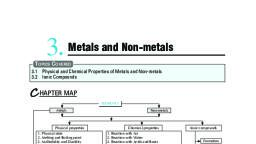
La Acàdemïa, Science Chapter 3, Metals,Non Metals and Properties, Notes, , Physical Properties of Metals:, Metals are:, ● hard to touch., ● lustrous i.e., freshly, ● Cut surfaces of metals have characteristic shining., ● Malleable- The property of metals by which they can, be beaten to make thin sheets is called malleability., , La A cà, , d e m ïa, , ● Ductile- the property of metal by which it can be, drawn into wires is called ductility., ● Sonorous , metals produce ringing sound when, struck on a hard surface., ● Good conductors of heat and electricity., Metals like sodium and potassium are soft and can be, cut with a knife., , Mercury is the only metal which is found in the liquid, state at room temperature., Physical Properties of Non-metals:, ● Non-metals are soft and dull (e.g., coal and sulphur)., 1
Page 2 :
● Non-metals are generally brittle, i.e., they break down, into a powdery mass on tapping with a hammer., ● They are not sonorous., ● They are poor conductors of heat and electricity., Chemical Properties of Metals and Non-metals:, ● Reaction with Oxygen: Both metals and non-metals, when burnt in oxygen from their oxides., , ● Oxides of metals are basic in nature while that of, non-metals are generally acidic in nature e.g.,, ● Reaction with Water: Some metals react with water to, produce metal hydroxide and hydrogen gas., Generally, non-metals do not react with water., , d e m ïa, , ● Reaction with Acids: Metals react with acids and, produce metal salt and hydrogen gas. Generally,, non-metals do not react with dil. acids., , La A cà, , ● Reaction with Bases: Metals react with bases to, produce hydrogen gas., Remember, Carbon in the form of graphite is non-metal which, conduct electricity., Iodine is non-metal which is lustrous having a shining, surface., Carbon in the form of diamond is a non-metal which is, extremely hard., , 2
Page 3 :
La A cà, , d e m ïa, , Diamond is a non-metal which has a very high melting, point and boiling point., , 3
Page 4 :
Uses of Metals and Non-metals, , La A cà, , d e m ïa, , ● Metals are used in making machinery automobiles,, aeroplanes. trains, satellites, industrial gadgets,, cooking utensils, water boilers etc., ● Non-metals are also used in day-to-day life., Some examples are:oxygen is essential for, life.nitrogen, phosphorus and potassium are used as, fertilizers,chlorine is used as a water purifier., , 4
Page 6 :
Atom: Atom is the smallest particle of matter which, cannot be divided further by any physical means. Atoms, are the basic units from which molecules and ions are, formed., Conductor: Substances which allow heat/electricity to, pass through them are called conductors of, heat/electricity, Ductility: The property of metals by which they can be, drawn into wires is called ductility, Elements: Substances whose molecules contain only one, type of atoms are known as elements., Hardness: Metals are hard, on the other hand,, non-metals are generally brittle., , La A cà, , d e m ïa, , Malleability: The property of metals by which they can be, beaten into thin sheets is called malleability., Metals: The materials which are generally hard, lustrous,, malleable, ductile, sonorous and good conductors of, heat and electricity are called metals, Metalloids: Elements which possess characters of both, metals and non-metals are called met.alloids., Non-metals: Materials which are soft, dull in appearance,, brittle, not sonorous and poor conductors of heat and, electricity are called non-metals., Sonorous: Metals are called sonorous because they, produce a specific ringing sound., 6