Page 1 :
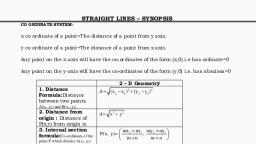
STRAIGHT LINES – SYNOPSIS, CO ORDINATE SYSTEM:, , x co ordinate of a point=The distance of a point from y axis;, y co ordinate of a point=The distance of a point from x axis., Any point on the x-axis will have the co-ordinates of the form (x,0) i.e has ordinate=0, Any point on the y-axis will have the co-ordinates of the form (y,0) i.e. has abscissa=0, 2 – D Geometry, 1. Distance, Formula:Distance, between two points, , d = (x 2 − x1 )2 + (y2 − y1 )2, , A(x1 ,y1) and B(x2 ,y2), , 2. Distance from, origin : Distance of, P(x,y) from origin is, 3. Internal section, formula:Co-ordinates of the, point P which divides A(x1 ,y1), and B(x2 ,y2) internally in the, ratio m:n is, , d = x 2 + y2, , mx 2 + nx1 my2 + ny1 , P(x, y) = , ,, , m+n , m+n, , 4. External section, mx 2 − nx1 my 2 − ny1 , formula: Co-ordinates of the P(x, y)= m − n , m − n , , , point P which divides AB, externally in the ratio m:n is, , 5. Midpoint, Formula:Co-ordinates of, the midpoint of the line joining, the points (x1 ,y1) and (x2 ,y2) is, given by, , 6. Centroid Formula:, Co-ordinate of centroid of the, triangle formed by the vertices, (x1 ,y1) (x2 ,y2) and (x3,y3) are, given by, , 2., , For a ABC :, 1., Centroid, , x + x 2 y1 + y 2 , P(x, y) = 1, ,, , 2 , 2, , x + x 2 + x 3 y1 + y 2 + y3 , G (x, y) = 1, ,, , 3, 3, , , , : Point of Intersection of Medians, , (The median is the line joining any vertex to midpoint of the opposite side.), 2., , Circumcenter: Point of Intersection of perpendicular bisectors., , (The perpendicular lines through the mid point of a side and perpendicular to it )., 3., , Orthocentre, , : Point of Intersection of Altitudes, , Altitude of a triangle is the line drawn through a vertex perpendicular to the, opposite side., 4., , Incentre, , : Point of Intersection of Angular bisectors., , (The angular bisector of the angle is the line which passes through the vertex, of the angle and divides into two equal angles)., , 1, By KH VASUDEVA
Page 2 :
If (x1 y1) (x2 y2) & (x3 y3) are vertices of ABC then, x + x 2 + x 3 y1 + y2 + y3 , 1) Centroid = G (x, y) = 1, ,, , 3, 3, , , ax + ax 2 + cx 3 ay1 + by2 + cy3 , 2) Incentre = I (x, y) = 1, ,, , a+b+c , a+b+c, Where a = BC, b = CA, c = AB, For a Right angled triangle, 1) Circumcentre is the Mid-point of Hypotenuse, 2) Orthocentre is the vertex at the right angle, For an equilateral triangle, Centroid, Circumcenter, Orthocenter, incenter coincide, For any triangle, The orthocenter (H) Centroid (a) and circumcenter (s) are collinear and G divides, HS internally in the ratio 2 : 1, 1 x1 − x 3 x 2 − x 3, 1, Area of the triangle = x1 (y 2 − y3 + x 2 (y3 − y1 ) + x 3 (y1 − y 2 ) =, 2, 2 y1 − y3 y2 − y3, , 3., , 4., 5., 6., , 7., , =, , 8., , Area of the quadrilateral ABCD where A = (x1 y1) B (x2 y2) C (x3 y3) D (x4 y4) is, 1 x1 − x 3 x 2 − x 4, A=, 2 y1 − y3 y 2 − y 4, , STRAIGHT LINE, The angle of inclination of a straight line is the angle, say θ, made by the line with, the x-axis measured in the counter clockwise (positive) direction., , The slope or gradient of a straight line is a number that measures its “direction and, steepness”.If a straight line makes an angle with the +ve direction of x-axis then tan, , is called its slope or gradient and it is usually denoted by m., When θ is the angle of inclination of the line with the x-axis measured in the counter, clockwise direction then the slope, , m = tanθ, Ex. i) If the inclination of a line is 450, then its slope is 1., ii) If the slope of a line is, , 3 , then its inclination is 600., , Result: The slope of a line joining points (x1, y1) and (x2, y2) is m=, , y2 − y1, x 2 − x1, , Note:, , ( = 0) ., ii) The slope of a horizontal line is 0 ( = 0 ) ., i) The slope of x - axis is 0, , 2, By KH VASUDEVA
Page 3 :
iii) The slope of y-axis is not defined, , (, , = 900 ) ., , iv) The slope of a vertical line is not defined., REMARK:, a. If tan θ >o then 0< θ <900 i.e slope of the line is +ve if inclination of line is, acute, b. If tan θ =0, then θ=00 , 1800 which means line is itself x axis or it is parallel to x, axis. ie slope of a line parallel to x axis is zero., c. If tan θ <0 then 900 < θ <1800 or 2700< θ 3600 i.e the slope of the line is -ve if, inclination of line is obtuse., Remarks, •, •, •, , Two (non-vertical) lines are parallel iff their slopes are equal., Two (non-vertical) lines are perpendicular iff the product of their slopes = -1., Slope of a perpendicular line is the negative reciprocal of the slope of the, 𝑎, given line. e.g: If slope of given line is − 𝑏 then slope of perpendicular line to given line, is, , •, , 𝑏, , 𝑎, , and vice versa, , If three points A, B, C are collinear then slope of AB =slope of BC =slope of AC, , 1., If, 1) is angle of Inclination, 2) (x1 y1) and (x2 y2) are two points on straight, line, 3) equation of the line is ax + by + c = 0, , then slope (m), m = tan , y −y, m= 2 1, x 2 − x1, , m=, , −a, b, , 2., , Three points A, B and C are collinear if, 1) Area of ABC = 0, 2) Slope of AB = slope of AC, 3) Sum of 2 lengths = third length, 4) Any one of the three points lies on the straight line joining the other two points, 5) Any one of the three points divides the straight line joining the other two points, in same ratio., , 3., , Equation of straight line:, COORDINATE AXES:, The equation of x – axis is y = 0., The equation of y – axis is x = 0., Any line parallel to x – axis (horizontal line) has the equation y = k, where k is a, constant., Any line parallel to y – axis (vertical line) has the equation x = h, where h is a, constant, , 3, By KH VASUDEVA
Page 4 :
4.VARIOUS FORMS OF STRAIGHT LINES, Given, Equation of a straight line, Slope = m y – intercept = c y = mx + c, Slope =m(straight line y=mx, passing through origin), Slope=m, x intercept=d, y=m(x-d), Slope = m point = (x1 y1), y – y1 = m (x – x1), Two points (x1 y1) (x2 y2), y −y, y − y1 = 2 1 (x − x1 ), x 2 − x1, x – intercept = a,, y –intercept = b, , p = ⊥ distance from origin x cos + y sin = p, = angle made by ⊥ with, x-axis, All above forms can be ax + by + c = 0, simplified to, , Form, Slope, Intercept, , slope – point, Two point, Intercept, , Normal, General, , 5. INTERCEPTS:, , If a straight line cuts the x – axis then the distance between the origin and the, point of intersection, with proper sign is called x – intercept., If a straight line cuts the y – axis then the distance between the origin and the, point of intersection, with proper sign is called y – intercept., They are usually denoted by a and b respectively., Note:, 1. If the x – intercept is ‘a’ the line passes through (a, 0), 2. If the y – intercept is ‘b’ the line passes through (0, b), 6. GENERAL FORM, Result: Any linear equation in x and y i.e. and equation of the form ax + by + c = 0, represents a straight line, Proof: Suppose b ≠ 0, then the equation ax + by + c = 0 can be written as, by= – ax – c, a c, i.e. y = − x + − , b b, a, c, This is of the form y = mx + c with “m” = − and "c" = −, b, b, Hence the given equation represents a straight line, Suppose b = 0, then ax + c = 0 x = −, , c, is a vertical line, a, , 4, By KH VASUDEVA
Page 6 :
3)If lines re perpendicular and slope of one of the line be m then slope of, 1, , the other line be − 𝑚, 4) The obtuse angle between the two given lines is − , , ANGLE BETWEEN TWO LINES WHOSE GENERAL EQUATIONS ARE GIVEN:, , Let θ be the angle between two lines L1 : a1x +b1y +c1 =0 L2 : a2x+b2y+c2 =0 ;, 𝑎, , then slope of line L1=− 𝑏1, 1, , 𝑎, , ; Slope of Line L2 = − 𝑏2, 2, , tan θ =, , 8. Conditions of parallelism and perpendicularity., Two lines with slopes m1 and m2 are, (i) parallel if and only if m1 = m2, (ii) perpendicular if and only if m1m2 = -1, 9.Equation of the line parallel and perpendicular to ax+by+c=0, •, •, , The equation of the line parallel to ax + by + c = 0 is ax + by + k = 0, The equation of the line perpendicular to ax + by + c = 0 is bx – ay + k = 0, , 10.CONDITONS FOR TWO GIVEN LINES TO BE PARALLEL AND, PERPENDICULAR:, The two lines a1x +b1y +c1 =0 , and a2x+b2y+c2 =0, i)are parallel, , if or a1b2 =b1a2, , ii) and coincident if, , iii)These lines will be perpendicular if a1a2 +b1b2 =0, i.e. product of the coefficients of x + product of coefficients of y=0., iv)Intersecting if a1b2 -a2b1#0 i.e., , 11. POINT OF INTERSECTION, Let a1x + b1y + c1 = 0 and a2x + b2y + c2 = 0 be two lines., The common solution (x1, y1) is the point of intersection., , 6, By KH VASUDEVA
Page 7 :
The point of intersection of two lines, a1x +b1y +c1 =0 , and a2x+b2y+c2 =0 is given by obtained by solving the two, equations(by method of cross multiplication), , 12. CONCURRENT STRIAGHT LINES:, Three or more lines are said to be concurrent if they pass through the same point., Three lines are said to be concurrent if the point of intersection of two of them lies on, the third., , 13. DISTANCE OF A POINT FROM A LINE, The perpendicular distance from P (x1 y1) to the line ax + by + c = 0 is, ax + by1 + c, d= 1, a 2 + b2, The distance between the parallel lines ax + by + c1 = 0 and ax + by + c2 = 0 is, c −c, d= 1 2, a 2 + b2, 14., , Family of Straight lines:, , Equation of the line through the intersection of L1=0 and L2=0 is of the form, L1 +kL2 =0, The equation of family of lines passing through the point of intersection of, a1x +b1y +c1 =0 , and a2x+b2y+c2 =0 is given by :, a1x +b1y +c1 +k( a2x+b2y+c2) =0 where k is arbitrary real number., For different values of K we get different straight lines passing through the point of, intersection of L1 and L2, 15. POSITION OF A POINT WITH RESPECT TO A LINE, Let ax + by + c = 0 be the equation of a line and (x1 , y1) be any point on the plane., 1. If ax1 +by1+c =0 then (x1 , y1) is on the line, 2. If ax1 +by1+c >0 then (x1 , y1) is above the line, 3. If ax1 +by1+c <0 then (x1 , y1) is below the line, , 7, By KH VASUDEVA