Page 1 :
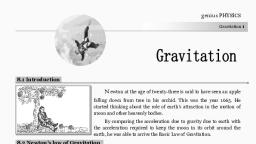
VIJAYSHREE PHYSICS BY VISHAL SIR, Gravitation 1, , 8.1 Introduction., , N ewton at the age of twenty-three is said to have seen an apple, falling down from tree in his orchid. This was the year 1665. He, started thinking about the role of earth's attraction in the motion of, moon and other heavenly bodies., By comparing the acceleration due to gravity due to earth with, the acceleration required to keep the moon in its orbit around the, earth, he was able to arrive the Basic Law of Gravitation., , 8.2 Newton's law of Gravitation, Newton's law of gravitation states that every body in this universe attracts every other body with a, force, which is directly proportional to the product of their masses and inversely proportional to the square, of the distance between their centres. The direction of the force is along the line joining the particles., Thus the magnitude of the gravitational force F that two particles of masses m1 and m 2 separated by a, m m, distance r exert on each other is given by F 1 2, r2, A, B, F, F, 12, 21, m1m 2, m1, m2, or, F=G, r2, r, Vector form : According to Newton's law of gravitation, →, − Gm 1m 2, − Gm 1m 2 →, − Gm 1m 2 →, rˆ 21 =, F12 =, r21 =, r21, →, r3, r2, 3, | r21 |, r̂12 = unit vector from A to B, →, , r̂, , = unit vector from B to A,, , Here negative sign indicates that the direction of F12 is opposite to that of r̂21 . →21, F12 =, gravitational, force, − Gm 1 m 2, − Gm 1m 2 →, − Gm 1m 2 →, Similarly →, rˆ =, F 21 =, 12, r12, exerted on body A by, →, r12 =, r2, 3, 3, body B, r, | r12 |, →, Gm 1 m 2, F21 =, gravitational, force, =, r̂21 [ r̂12 = −r̂21 ], 2, exerted, on, body, B, by, r, , , →, , →, , It is clear that F12 = – F 21 . Which is Newton's third law of motion., , Here G is constant of proportionality which is called 'Universal gravitational constant'., If m1 = m 2 and r = 1 then G = F, i.e. universal gravitational constant is equal to the force of attraction between two bodies each of unit, mass whose centres are placed unit distance apart., , Important points, (i) The value of G in the laboratory was first determined by Cavendish using the torsional balance., (ii) The value of G is 6.67×10⁻¹¹ N–m2 kg–2 in S.I. and 6.67×10⁻⁸ dyne- cm2-g–2 in C.G.S. system.
Page 2 :
VIJAYSHREE PHYSICS BY VISHAL SIR, 40 Gravitation, (iii) Dimensional formula [M −1 L3 T −2 ]., (iv) The value of G does not depend upon the nature and size of the bodies., (v) It also does not depend upon the nature of the medium between the two bodies., (vi) As G is very small hence gravitational forces are very small, unless one (or both) of the masses is, huge., , 8.3 Properties of Gravitational Force., (1) It is always attractive in nature while electric and magnetic force can be attractive or repulsive., (2) It is independent of the medium between the particles while electric and magnetic force depend on, the nature of the medium between the particles., (3) It holds good over a wide range of distances. It is found true for interplanetary to inter atomic, distances., (4) It is a central force i.e. acts along the line joining the centres of two interacting bodies., (5) It is a two-body interaction i.e. gravitational force between two particles is independent of the, presence or absence of other particles; so the principle of superposition is valid i.e. force on a particle due to, →, , →, , →, , →, , number of particles is the resultant of forces due to individual particles i.e. F = F1 + F2 + F3 +........, While nuclear force is many body interaction, (6) It is the weakest force in nature : As Fnuclear > F electromagnetic > F gravitational ., (7) The ratio of gravitational force to electrostatic force between two electrons is of the order of 10 −43 ., (8) It is a conservative force i.e. work done by it is path independent or work done in moving a particle, round a closed path under the action of gravitational force is zero., (9) It is an action reaction pair i.e. the force with which one body (say earth) attracts the second body, (say moon) is equal to the force with which moon attracts the earth. This is in accordance with Newton's third, law of motion., , Note : ❑, , The law of gravitation is stated for two point masses, therefore for any two arbitrary, , finite size bodies, as shown in the figure, It can not be applied as there is not unique value for, the separation., , m2, , m1, , m1, , m2, , r, r=?, , But if the two bodies are uniform spheres then the separation r may be taken as the distance, between their centres because a sphere of uniform mass behave as a point mass for any point, lying outside it., , Sample problems based on Newton’s law of gravitation, Problem 1., , The gravitational force between two objects does not depend on, (a) Sum of the masses, , (b) Product of the masses, , (c) Gravitational constant, , (d) Distance between the masses, , [RPET 2003]
Page 3 :
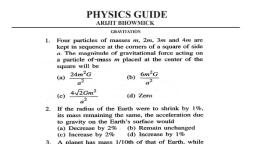
VIJAYSHREE PHYSICS BY VISHAL SIR, Gravitation 3, Solution : (a), , F=, , Gravitatio nal constant product of the masses, (Distance between the masses), , Problem 2., , 1, , (b), , 2, , 3, , Gravitational force F =, , Gm1m2, , For maximum value of force, , , d, dx, , (c) 1, , (d) 2, , 5, , GxM (1 − x)M GM 2, = 2 x(1 − x), r, r2, , =, , r2, , Problem 3., , ., , Mass M is divided into two parts xM and (1 – x)M. For a given separation, the value of x for which the, gravitational attraction between the two pieces becomes maximum is, [EAMCET 2001], (a), , Solution : (a), , 2, , dF, , d GM 2 x, , =, 0 , , dx, , , dx , , r2, , , (1 − x) = 0, , , (x − x 2 ) = 0 1 − 2x = 0 x = 1 / 2, , The mass of the moon is about 1.2% of the mass of the earth. Compared to the gravitational force the, earth exerts on the moon, the gravitational force the moon exerts on earth, [SCRA 1998], (a) Is the same, , (b) Is smaller, , (c) Is greater, , (d) Varies with its phase, , Solution : (a), , Earth and moon both exerts same force on each other., , Problem 4., , Three identical point masses, each of mass 1kg lie in the x-y plane at points (0, 0), (0, 0.2m) and, (0.2m, 0). The net gravitational force on the mass at the origin is, , Solution : (a), , (a) 1.67 10 −9 (ˆj + ˆj)N, , (b) 3.34 10−10 (ˆi + ˆj)N, , (c) 1.67 10−9(ˆi − ˆj)N, , (d) 3.34 10−10 (ˆi + ˆj)N, , Let particle A lies at origin, particle B and C on y and x -axis respectively, G m Am, FAC =2, , B, , r AB, , −11, 1 1 ˆ, −9 ˆ, ˆ = 6.67 10, i, i, =, 1.67, , 10, iN, (0.2)2, , Y, B (0, 0.2), FAB, , Similarly FAB = 1.67 10 −9 ˆj N, , (0, 0) A, FAC, , Net force on particle A F = F AC + F AB = 1.67 10 −9 (ˆi + ˆj) N, , Problem 5., , X, , Four particles of masses m, 2m, 3m and 4m are kept in sequence at the corners of a square of side a., The magnitude of gravitational force acting on a particle of mass m placed at the centre of the square, will be, (a), , Solution : (c), , (0.2, 0), C, , 24 m 2G, a2, , (b), , 6m 2G, a2, , 4 2Gm 2, a2, , (c), , If two particles of mass m are placed x distance apart then force of attraction, , (d) Zero, Gmm, = F (Let), x2, , Now according to problem particle of mass m is placed at the centre (P) of square. Then it will, experience four forces, FPA = force at point P due to particle A =, Similarly FPB =, , G2mm, , = 2F , F, , x2, , Hence the net force on P, , PC, , =, , G3mm, x2, , D 4m, , Gmm, =F, x2, , = 3F and F, PD, , Pm, , = G4mm = 4 F, x2, , Fnet = F PA + F PB + F PC + F PD = 2 2 F, , 3m C, , FPD, , FPC, , FPA, Am, , FPB, , 2m B
Page 4 :
Vijayshree Physics by Vishal Sir, 4 Gravitation, F net = 2 2 Gmm = 2 2, 2, , x, , =, , Gm 2, (a / 2 ), , [x=, , 2, , a, , = half of the diagonal of the square], , 2, , 4 2 Gm 2, ., a2, , 8.4 Acceleration Due to Gravity., The force of attraction exerted by the earth on a body is called gravitational pull or gravity., We know that when force acts on a body, it produces acceleration. Therefore, a body under the effect of, gravitational pull must accelerate., The acceleration produced in the motion of a body under the effect of gravity is called acceleration due, to gravity, it is denoted by g., Consider a body of mass m is lying on the surface of earth then gravitational force on the body is given, by, GMm, R2, , F=, , …..(i), , Where M = mass of the earth and R = radius of the earth., If g is the acceleration due to gravity, then the force on the body due to earth is given by, Force = mass acceleration, or, , F = mg, , From (i) and (ii) we have mg =, GM, R2, , , , g=, , , , g = G 4 R 3 , , , , , R23, 4, g = GR, 3, , m, , …..(ii), , mg R, , GMm, , Earth, , R2, …..(iii), , 4, [As mass (M) = volume ( R 3 ) × density ()], , , , 3, …..(iv), , Important points, GM = 4 GR, it is clear that its value depends upon the mass radius and, R2, 3, density of planet and it is independent of mass, shape and density of the body placed on the surface of the, planet. i.e. a given planet (reference body) produces same acceleration in a light as well as heavy body., (i) From the expression g =, , (ii) The greater the value of (M / R 2 ) or R, greater will be value of g for that planet., (iii) Acceleration due to gravity is a vector quantity and its direction is always towards the centre of the, planet., (iv) Dimension [g] = [LT–2], (v) it’s average value is taken to be 9.8 m/s2 or 981 cm/sec2 or 32 feet/sec2, on the surface of the earth, at mean sea level.
Page 5 :
VIJAYSHREE PHYSICS BY VISHAL SIR, Gravitation 5, , (vi) The value of acceleration due to gravity vary due to the following factors : (a) Shape of the, earth, (b) Height above the earth surface, (c) Depth below the earth surface and (d) Axial rotation of, the earth., , Sample problems based on acceleration due to gravity, Problem 6., , Solution : (a), , Problem 7., , Acceleration due to gravity on moon is 1/6 of the acceleration due to gravity on earth. If the ratio of, e 5, =, densities of earth (m ) and moon (e ) is , then radius of moon Rm in terms of Re will be [MP PMT 2, m 3, 5, 1, 3, 1, Re, Re, (a), (b), (c), (d), Re, R, e, 18, 18, 23, 6, g, R, 4, or m = m . m, Acceleration due to gravity g = GR g R, [As g m = 1 and e = 5, 3, m 3, ge, 6, ge, e Re, (given)], R m g m e 1 5, 5, , = , Rm, , =, =, Re, Re, g e m 6 3, 18, A spherical planet far out in space has a mass M0 and diameter D0 . A particle of mass m falling freely, near the surface of this planet will experience an acceleration due to gravity which is equal to, [MP PMT 1987; DPMT 2002], , (a) GM 0 /, Solution : (c), , (b) 4mGM 0 / D, , D 02, , We know g =, , GM, R2, , =, , GM, (D / 2)2, , =, , 2, , 0, , (c) 4 GM 0 / D 0, , (d) GmM 0 / D 02, , 2, , 4GM, D2, , If mass of the planet = M 0 and diameter of the planet = D0 . Then g =, , Problem 8., , 4 GM 0, D02, , ., , The moon's radius is 1/4 that of the earth and its mass is 1/80 times that of the earth. If g represents, the acceleration due to gravity on the surface of the earth, that on the surface of the moon is, [MP PMT 1997; RPET 2000; MP PET 2000, 2001], , (a), Solution : (b), , g, , (b), , 4, , Acceleration due to gravity g =, , g, 5, GM, , R2, =g, , g, moon, , Problem 9., , Solution : (c), , earth, , , , (c), , g, , (d), , 6, R2, moon = moon . earth = , 2, Mearth Rmoon, gearth, g, , M, , g, 8, , 1 4 2, , 80 1 , , 16 g, = ., 80 5, , If the radius of the earth were to shrink by 1% its mass remaining the same, the acceleration due to, gravity on the earth's surface would [IIT-JEE 1981; CPMT 1981; MP PMT 1996, 97; Roorkee 1992; MP PET 1999], (a) Decrease by 2%, (b) Remain unchanged (c)Increase by 2%, (d) Increase by 1%, 1, We know g , [As R decreases, g increases], R2, So % change in g = 2 (% change in R ) = 2 1% = 2%, acceleration due to gravity increases by 2%., , Problem 10. Mass of moon is 7.34 10 22 kg. If the acceleration due to gravity on the moon is 1.4m/s2, the radius of, the moon is (G = 6.667 10 −11 Nm 2 / kg 2 ), , Solution : (b), , (a) 0.56 104 m, GM, We know g =, R2, , (b) 1.87 10 6 m, R=, , GM =, g, , [AFMC 1998], , (c) 1.92 106 m, , (d) 1.01 108 m, , 6, 6.67 10 −11 7.34 10 22, = 1.87 10 m ., 1.4, , Problem 11. A planet has mass 1/10 of that of earth, while radius is 1/3 that of earth. If a person can throw a stone, on earth surface to a height of 90m, then he will be able to throw the stone on that planet to a height [RPMT 199, (a) 90m, (b) 40m, (c) 100m, (d) 45m
Page 6 :
Vijayshree Physics by Vishal Sir, 6 Gravitation, Solution : (c), , GM, R2, , Acceleration due to gravity g =, , , , 2, g, R, M, , planet , earth , =, gplanet, R, Mearth, earth =, planet, , , , 3 2, 1 =, 10 1 , , 9, 10, , , , If a stone is thrown with velocity u from the surface of the planet then maximum height H =, , u2, 2g, , Hplanet, Hearth, , =, , gearth, gplanet, , Hplanet, , =, , 10, , H, , 9, , earth, , =, , 10, , 90 = 100 metre., , 9, , Problem 12. The radii of two planets are respectively R1 and R2 and their densities are respectively 1 and 2 ., The ratio of the accelerations due to gravity at their surfaces is, (a) g1 : g 2 =, , 1, R 12, , :, , 2, , (b) g1 : g2 = R1R2 : 12, , R 22, , (c) g1 : g2 = R1 2 : R2 1, Solution : (d), , (d) g1 : g2 = R1 1 : R2 2, 4, , Acceleration due to gravity g = GR, 3, , g1 : g2 = R1, , 8.5 Variation in g Due to Shape of Earth., , 1, , : R2 2 ., , Earth is elliptical in shape. It is flattened at the poles and bulged out at the equator. The equatorial, GM, radius is about 21 km longer than polar radius, from g =, R2, GM, g e=, R e2, , At equator, At poles, , g p=, , From (i) and (ii), , ge, , GM, R p2, , gp, , ......(i), , Rp, Re, , .....(ii), , ge, , 2, = Rp, 2, gp, Re, , Since Requator Rpole, , gpole gequator and gp = ge + 0.018 ms −2, , Therefore the weight of body increases as it is taken from equator to the pole., , Sample problems based on variation in g due to shape of the earth, Problem 13. Where will it be profitable to purchase 1 kg sugar (by spring balance), (a) At poles, Solution : (b), , (b) At equator, , (c) At 45° latitude, , [RPET 1996], , (d) At 40°latitude, , At equator the value of g is minimum so it is profitable to purchase sugar at this position., , Problem 14. Force of gravity is least at, , [CPMT 1992], , (a) The equator, (c) A point in between equator and any pole, , (b) The poles, (d) None of these, , Solution : (a), g, , 8.6 Variation in g With Height., Acceleration due to gravity at the surface of the earth, g=, , GM, R2, , .....(i), , Acceleration due to gravity at height h from the surface of the earth, g' =, , GM, (R + h)2, , .....(ii), , h, r, , g, R, O
Page 7 :
VIJAYSHREE PHYSICS BY VISHAL SIR, Gravitation 7, 2, , g' = g R , , R+h, , From (i) and (ii), , 2, =g R, r2, , .....(iii), , .....(iv), , [As r = R + h], , Important points, (i) As we go above the surface of the earth, the value of g decreases because g , , 1, , ., r2, , (ii) If r = then g = 0 , i.e., at infinite distance from the earth, the value of g becomes zero., (iii) If h R i.e., height is negligible in comparison to the radius then from equation (iii) we get, 2, R , h −2, 2h , , , [As h R ], g = g R + h = g 1 + = g1 − , R, R, , , , , , , (iv) If h R then decrease in the value of g with height :, 2hg, Absolute decrease g = g − g =, R, Fractional decrease g = g − g = 2h, g, g, R, g, 2h, 100 % = 100 %, Percentage decrease, g, R, , Sample problems based on variation in g with height, Problem 15. The acceleration of a body due to the attraction of the earth (radius R) at a distance 2R from the, surface of the earth is (g = acceleration due to gravity at the surface of the earth), g, , (a), Solution : (a), , (b), , 9, , g, , (c), , 3, , R 2 R 2 1, =, =, =, g R+h, 9, R + 2R , , g, , g, , (d) g, , 4, g =, , , , g, , ., 9, , Problem 16. The height of the point vertically above the earth's surface, at which acceleration due to gravity, becomes 1% of its value at the surface is (Radius of the earth = R), (a) 8R, Solution : (b), , (b) 9R, , (c) 10 R, , Acceleration due to gravity at height h is given by g = g, , , , g, , =g, 100, , , , , , (d) 20R, , R 2, , , R, +, h, , , , R = 1 h = 9R ., 2, , , , R + h 10, R+h, , R, , Problem 17. At surface of earth weight of a person is 72 N then his weight at height R/2 from surface of earth is (R, = radius of earth), (a) 28N, , [CBSE PMT 2000; AIIMS 2000], , (b) 16N, , (c) 32N, , (d) 72N
Page 8 :
Vijayshree Physics by Vishal Sir, 8 Gravitation, , Solution : (c), , , 2, 4, 2 2 4, R 2, R, W = W , = W = W = 72 = 32 N., = W , R, , 9, 9, R+h, 3, R+ , 2, , , Weight of the body at height R,, , , , Problem 18. If the distance between centres of earth and moon is D and the mass of earth is 81 times the mass of, moon, then at what distance from centre of earth the gravitational force will be zero, (a) D/2, Solution : (d), , (b) 2D/3, , (c) 4D/3, , (d) 9D/10, , If P is the point where net gravitational force is zero then FPA = FPB, , d, , Gm1m Gm 2m, =, x2, (d − x)2, , P, , m1, , FPA, , A, , By solving x =, , m1 + m2, , =, , m 1D, m1 +, , m=, , = earth, m = moon and m = 81m, 1, , m1 D, , d–x, , B, , m1 + m 2, , For the given problem d = D , m, , So x =, , x, , m1 d, , m2, , FPB, , 2, , =, , m1, 81, , 1, , 2, , 2, , m1, 81, , D, , 9D, 1 = 10, 1+, 9, , 8.7 Variation in g With Depth., Acceleration due to gravity at the surface of the earth, g=, , GM = 4 GR, R2, 3, , …..(i), , g, d, , Acceleration due to gravity at depth d from the surface of the earth, 4, …..(ii), g = G(R − d), 3, d, , From (i) and (ii) g = g1 − , R, , R, r, , P, , g, , O, , Important poi nts, (i) The value of g decreases on going below the surface of the earth. From equation (ii) we get, g (R − d) ., So it is clear that if d increase, the value of g decreases., (ii) At the centre of earth, , d = R g = 0 , i.e., the acceleration due to gravity at the centre of earth, , becomes zero., (iii) Decrease in the value of g with depth, Absolute decrease g = g − g =, , dg, R, , Fractional decrease g = g − g = d, g, g, R
Page 9 :
VIJAYSHREE PHYSICS BY VISHAL SIR, Gravitation 9, , g, , d, 100 % = 100 %, g, R, , Percentage decrease, , (iv) The rate of decrease of gravity outside the earth ( if h R ) is double to that of inside the earth., , Sample problems based on variation in g with depth, Problem 19. Weight of a body of mass m decreases by 1% when it is raised to height h above the earth's surface. If, the body is taken to a depth h in a mine, change in its weight is, (a) 2% decrease, Solution : (b), , (b) 0.5% decrease, , [KCET 2003; MP PMT 2003], , (c) 1% increase, g, , Percentage change in g when the body is raised to height h ,, , (d) 0.5% increase, , 100% =, , 2h 100, , g, g, , Percentage change in g when the body is taken into depth d,, , 100% =, , g, d=h], Percentage decrease in weight =, , = 1%, , R, d, , h, 100% = 100%, R, R, , [As, , 1 2h, 1, 100 = (1%) = 0.5% ., 2 R, 2, , Problem 20. The depth at which the effective value of acceleration due to gravity is, , g, , is (R = radius of the earth), , 4, [MP PET 2003], , (a) R, Solution : (b), , (b), , 3R, , (c), , R, , (d), , 2, , 4, , R, 4, , d, g , d, 3R, , g = g1 − = g1 − d =, 4, R, R 4, , , , Problem 21. Assuming earth to be a sphere of a uniform density, what is the value of gravitational acceleration in a, mine 100 km below the earth's surface (Given R = 6400km), (a) 9.66m / s2, Solution : (a), , Acceleration, = 9.8 , , 63, , (b) 7.64m / s2, due, , to, , gravity, , at, , (c) 5.06m / s2, depth, , g =, , d,, , = 9.66m / s 2 ., , (d) 3.10m / s2, , d, 100 , −, =, −, =, 1, g 1, g, , R , 6400 , , 1, −, 9.8 1, 64 , , 64, , Problem 22. The depth d at which the value of acceleration due to gravity becomes, surface, is [R = radius of the earth], R, n −1, (b), (a), R, , n , n, Solution : (b), , (c), , R, n, , 2, , d, g, d, d, 1, , , n − 1 , g = g1 − = g1 − = 1 − d = , R, n, R, n, R, R, n, , , , 1, , times the value at the, , n, , (d), , R, , n, n + 1, ,
Page 10 :
Vijayshree Physics by Vishal Sir, 10 Gravitation, , 8.8 Variation in g Due to Rotation of Earth, As the earth rotates, a body placed on its surface moves along the circular path and hence experiences, centrifugal force, due to it, the apparent weight of the body decreases., , , Since the magnitude of centrifugal force varies with the latitude of the, place, therefore the apparent weight of the body varies with latitude due to, variation in the magnitude of centrifugal force on the body., , P, , r, , mg, , , , Fc, , mg, , If the body of mass m lying at point P, whose latitude is , then due to, rotation of earth its apparent weight can be given by mg = mg + Fc, or, , mg =, , (mg) 2+ (F c) +2 2mg F cos(180, − ), c, , , , mg =, , (mg)2 + (m 2 R cos)2 + 2mg m 2 R cos (−cos) [As Fc = m 2 r = m 2 R cos ], , By solving we get g = g − 2 R cos 2 , , Note : ❑, , The latitude at a point on the surface of the earth is defined as the angle, which the, , line joining that point to the centre of earth makes with equatorial plane. It is denoted by ., ❑ For the poles = 90 o and for equator = 0 o, , Important points, (i) Substituting = 90 o in the above expression we get g pole = g − 2 R cos 2 90 o, , , g pole = g, , …..(i), , i.e., there is no effect of rotational motion of the earth on the value of g at the poles., (ii) Substituting = 0 o in the above expression we get g eqator = g − 2 R cos 2 0 o, , , gequator = g − 2 R, , …..(ii), , i.e., the effect of rotation of earth on the value of g at the equator is maximum., From equation (i) and (ii) g pole − g equator = R 2 = 0.034 m / s 2, (iii) When a body of mass m is moved from the equator to the poles, its weight increases by an amount, m(g p− g ) e= m 2 R, , (iv) Weightlessness due to rotation of earth : As we know that apparent weight of the body decreases due to, rotation of earth. If is the angular velocity of rotation of earth for which a body at the equator will become, weightless, g = g − 2 R cos 2 , , , 0 = g − 2 R cos 2 0 o, , , , g −2R, , [As = 0 o for equator], , , =, , g, R
Page 11 :
VIJAYSHREE PHYSICS BY VISHAL SIR, Gravitation 11, , or time period of rotation of earth T =, , 2, , , , Substituting the value of R = 6400 10 3 m, , =, , 1, , = 1.25 10, , Note : ❑ This time is, , −3 rad, , sec, , 800, 1, , about, , R, g, , = 2, , and, , g = 10 m / s 2 we get, , and, , T = 5026 .5 sec = 1.40 hr., , times the present time period of earth. Therefore if earth starts, , 17, , rotating 17 times faster then all objects on equator will become weightless., ❑ If earth stops rotation about its own axis then at the equator the value of g increases by 2 R, and consequently the weight of body lying there increases by m 2 R ., ❑ After considering the effect of rotation and elliptical shape of the earth, acceleration due to, gravity at the poles and equator are related as, g p= g +e 0.034 + 0.018 m / s 2, , gp = g e+ 0.052 m / s 2, , Sample problems based on variation in g due to rotation of the earth, Problem 23. The angular velocity of the earth with which it has to rotate so that acceleration due to gravity on 60°, latitude becomes zero is (Radius of earth = 6400 km. At the poles g = 10 ms–2), (b) 5.0×10⁻¹rad/sec (c) 10 10 1 rad / sec, , (a) 2.5×10⁻³rad/sec, Solution : (a), , (d) 7.8 10 −2 rad / sec, , Effective acceleration due to gravity due to rotation of earth g = g − 2 R cos 2 , 2, 0 = g − 2R cos2 60o R = g =, 4, , =, , 1 = 2.5 10, 400, , −3, , rad, , 4 g = 2 g = 2 rad, R, R, 800 sec, , [As g = 0 and = 60 o ], , ., , sec, , Problem 24. If earth stands still what will be its effect on man's weight, (a) Increases, Solution : (a), , (b) Decreases, , (c) Remains same, , (d) None of these, , When earth stops suddenly, centrifugal force on the man becomes zero so its effective weight, increases., , Problem 25. If the angular speed of earth is increased so much that the objects start flying from the equator, then, the length of the day will be nearly, (a) 1.5 hours, Solution : (a), , (b) 8 hours, , Time period for the given condition T = 2, , (c) 18 hours, , (d) 24 hours, , R, = 1.40 hr 1.5 hr nearly., g, , 8.9 Mass and Density of Earth, Newton’s law of gravitation can be used to estimate the mass and density of the earth., As we know g =, , GM, , , so we have M =, , R2, 9.8 (6.4 10 6 )2, , , M=, , 6.67 10 −11, , gR 2, G, , = 5.98 10, , 24, , kg 10, , 25, , kg
Page 12 :
Vijayshree Physics by Vishal Sir, 12 Gravitation, 4, and as we know g = GR , so we have = 3g, 3, 4GR, , , =, , 3 9.8, = 5478 .4 kg / m 3, 4 3.14 6.67 10 −11 6.4 10 6, , 8.10 Inertial and Gravitational Masses., (1) Inertial mass : It is the mass of the material body, which measures its inertia., If an external force F acts on a body of mass mi, then according to Newton’s second law of motion, F = mia or mi =, , F, a, , Hence inertial mass of a body may be measured as the ratio of the magnitude of the external force, applied on it to the magnitude of acceleration produced in its motion., , Important points, (i) It is the measure of ability of the body to oppose the production of acceleration in its motion by an external, force., (ii) Gravity has no effect on inertial mass of the body., (iii) It is proportional to the quantity of matter contained in the body., (iv) It is independent of size, shape and state of body., (v) It does not depend on the temperature of body., (vi) It is conserved when two bodies combine physically or chemically., (vii) When a body moves with velocity v , its inertial mass is given by, m=, , m0, v2, 1− 2, c, , , where m0 = rest mass of body, c = velocity of light in vacuum,, , (2) Gravitational Mass : It is the mass of the material body, which determines the gravitational pull, acting upon it., If M is the mass of the earth and R is the radius, then gravitational pull on a body of mass m g is given, by, F=, , GMm g, F, F, =, or mg =, 2, 2, R, (GM / R ) E, , Here m g is the gravitational mass of the body, if E = 1 then m g = F, Thus the gravitational mass of a body is defined as the gravitational pull experienced by the body in a, gravitational field of unit intensity,, (3) Comparison between inertial and gravitational mass, (i) Both are measured in the same units., (ii) Both are scalars, (iii) Both do not depends on the shape and state of the body, (iv) Inertial mass is measured by applying Newton’s second law of motion where as gravitational mass, is measured by applying Newton’s law of gravitation., (v) Spring balance measure gravitational mass and inertial balance measure inertial mass.
Page 13 :
VIJAYSHREE PHYSICS BY VISHAL SIR, Gravitation 13, , (4) Comparison between mass and weight of the body, Mass (m), , Weight (W), , It is a quantity of matter contained in a body., , It is the attractive force exerted by earth on any body., , Its value does not change with g, , Its value changes with g., , Its value can never be zero for any material particle., , At infinity and at the centre of earth its value is zero., , Its unit is kilogram and its dimension is [M]., , Its unit is Newton or kg-wt and dimension are, [ MLT −2 ], , It is determined by a physical balance., , It is determined by a spring balance., , It is a scalar quantity., , It is a vector quantity., , Sample problems based on inertial and gravitational mass, Problem 26. Gravitational mass is proportional to gravitational, (a) Field, , (b) Force, , [AIIMS 1998], , (c) Intensity, , (d) All of these, , Solution : (d), , Problem 27. The ratio of the inertial mass to gravitational mass is equal to, (a) 1/2, , (b) 1, , [CPMT 1978], , (c) 2, , (d) No fixed number, , Solution : (b), , 8.11 Gravitational Field., The space surrounding a material body in which gravitational force of attraction can be experienced is, called its gravitational field., Gravitational field intensity : The intensity of the gravitational field of a material body at any, point in its field is defined as the force experienced by a unit mass (test mass) placed at that point, provided, the unit mass (test mass) itself does not produce any change in the field of the body., So if a test mass m at a point in a gravitational field experiences a force F then, I=, , F, m, , Important points, (i) It is a vector quantity and is always directed towards the centre of gravity of body whose gravitational field is, considered., (ii) Units : Newton/kg or m/s2, (iii) Dimension : [M0LT–2], (iv) If the field is produced by a point mass M and the test mass m is at a distance r from it then by, GMm, Newton’s law of gravitation F =, Test mass, r2, F, , GMm / r 2, then intensity of gravitational field I =, =, m, m, , , I=, , r, , m, , M, Source point, , GM, r2, , (v) As the distance (r) of test mass from the point mass (M ), increases, intensity of gravitational field, decreases
Page 14 :
Vijayshree Physics by Vishal Sir, 14 Gravitation, GM, 1, I=, ; I, 2, r, r2, , M2, I1, , M1, , (vi) Intensity of gravitational field I = 0 , when r = ., , I2, , I3, , (vii) Intensity at a given point (P) due to the combined effect of different, point masses can be calculated by vector sum of different intensities, , M3, , Inet = I1 + I2 + I3 + ........, , (viii) Point of zero intensity : If two bodies A and B of different masses m1 and m 2 are d distance, apart., Let P be the point of zero intensity i.e., the intensity at this point is, equal and apposite due to two bodies A and B and if any test mass placed at, this point it will not experience any force., For point P, , I1 + I2 = 0, , By solving, , x=, , , , d, A, , − Gm 1, Gm 2, +, =0, 2, x, (d − x) 2, , m1 d, , and (d − x) =, , m1 + m 2, , m1, , P, , x, I1, , GM, r, , and also g =, , 2, , GM, , , , m2, , I2, , m 2d, m1 + m 2, , (ix) Gravitational field line is a line, straight or curved such that a unit, mass placed in the field of another mass would always move along this line., Field lines for an isolated mass m are radially inwards., (x) As I =, , B, , d–x, , m, , I=g, , R2, , Thus the intensity of gravitational field at a point in the field is equal to acceleration of test mass, placed at that point., , Sample problems based on gravitational field, Problem 28. Knowing that mass of Moon is, , M, , where M is the mass of Earth, find the distance of the point where, , 81, , gravitational field due to Earth and Moon cancel each other, from the Moon. Given that distance, between Earth and Moon is 60 R. Where R is the radius of Earth, (a) 2 R, Solution : (c), , Point of zero intensity x =, , (b) 4 R, , (c) 6 R, , (d) 8 R, , m1 d, m1 + m 2, , d, , mass of the earth m1 = M , Mass of the moon m2 =, , M, , m1, , M 60 R, M +, , So distance from the moon = 60R − 54R = 6R ., , Moon, , 81, , and distance between earth & moon d = 60R, Point of zero intensity from the Earth x =, , P, , Earth, , M, 81, , =, , 9, , 60 R = 54 R, 10, , x, , m2
Page 16 :
Vijayshree Physics by Vishal Sir, 16 Gravitation, (a) I =, (b) I =, , G(M1 + M 2 ), r2, G(M1 + M 2 ), , for r r, 1, , (c) I = G, (d) I =, Solution : (d), , r2, , r2, M1, , 2, , r2, M2, , M2, , for r r, , r1, , r, , for r1 r r2, , m, , GM 1, for r1 r r2, r2, , Gravitational field on a mass m due to outer shell (radius r2 ) will be zero because the mass is placed, GM 1, inside this shell. But the inner shell (radius r ) behaves like point mass placed at the centre so I =, 1, r2, for r1 r r2, , Problem 33. A spherical shell is cut into two pieces along a chord as shown in the figure. P is a point on the plane of, and that due to the lower part is I2 ., , the chord. The gravitational field at P due to the upper part is I1, What is the relation between them, (a) I1 I2, , P, , (b) I1 I2, (c) I1 = I2, (d) No definite relation, Solution : (c), , Intensity at P due to upper part = I1 and Intensity at P due to lower part = I 2, Net Intensity at p due to spherical shell I1 + I2 = 0, I1 = −I2, , Problem 34. A uniform ring of mass m is lying at a distance 1.73 a from the centre of a sphere of mass M just over, the sphere where a is the small radius of the ring as well as that of the sphere. Then gravitational force, exerted is, (a), , (c), Solution : (d), , GMm, 8a, 3, , 2, , GMm, a2, , (b), , m, , GMm, (1.73 a)2, , (d) 1.73, , 1.73 a, , GMm, 8a, , a, , 2, , Intensity due to uniform circular ring at a point on its axis I =, , Force on sphere F =, , a, , GMmr, GMm 3a, =, 2, (a 2 + r 2 )3 / 2, (a + ( 3a)2 )3 / 2, , M, , Gmr, (a + r 2 ) 3 / 2, 2, , = GMm 3a =, (4 a 2 )3 / 2, , 3GMm, 8a 2, , [As r =, , 3a ], , 8.13 Gravitational Potential., At a point in a gravitational field potential V is defined as negative of work done per unit mass in, shifting a test mass from some reference point (usually at infinity) to the given point i.e.,
Page 17 :
VIJAYSHREE PHYSICS BY VISHAL SIR, Gravitation 17, , V =−, , , I=−, , W, , F.dr, = −, m, m, , , , = − I .dr, , [As, , F, , =I], , m, , dV, dr, , i.e., negative gradient of potential gives intensity of field or potential is a scalar function of position, whose space derivative gives intensity. Negative sign indicates that the direction of intensity is in the, direction where the potential decreases., , Important points, (i) It is a scalar quantity because it is defined as work done per unit mass., (ii) Unit : Joule/kg or m2/sec2, (iii) Dimension : [M0L2T–2], V=−, , (iv) If the field is produced by a point mass then, , , , GM, , V=−, , I dr = −, , , , +c, , , , − GM dr, , , r2, , [As I = −, , GM, r2, , [Here c = constant of integration], , r, Assuming reference point at and potential to be zero there we get, 0=−, , GM, , , Gravitational potential V = −, , , , +cc=0, , GM, r, , (v) Gravitational potential difference : It is defined as the work done to move a unit mass from one, point to the other in the gravitational field. The gravitational potential, VA, VB, difference in bringing unit test mass m from point A to point B under the, m, m, M, gravitational influence of source mass M is, A, B, rA, WA → B, 1, 1 , rB, = −GM r − r , V = VB − V A =, B, A , m, (vi) Potential due to large numbers of particle is given by scalar addition of all the potentials., V = V1 + V2 + V3 + .........., =−, , GM − GM − GM, r2, r3 ........, r1, M, , = −G , i=n, , i, , M, M1, r5, M, , r1 P, r4, , M, , r2, , r3, M, , i=1 ri, , (vii) Point of zero potential : It is that point in the gravitational field, if the, , A, m1, , B, , unit mass is shifted from infinity to that point then net work done will be eq ual to zero., Let m1 and m2 are two masses placed at d distance apart and P is the point, of zero potential in between the two masses., Net potential for point P = VA + VB = 0, , ], , m2, , P, , x, , d–x, d
Page 18 :
Vijayshree Physics by Vishal Sir, 18 Gravitation, , , −, , Gm 1, , −, , Gm 2, , =0, , By solving x =, , d−x, , x, , m1 d, m1 − m 2, , Sample problems based on gravitational potential, Problem 35. In some region, the gravitational field is zero. The gravitational potential in this region, (a) Must be variable, Solution : (b), , As I = −, , dV, , (b) Must be constant (c) Cannot be zero, , [BVP 2003], , (d) Must be zero, , , if I = 0 then V = constant., , dx, , Problem 36. The gravitational field due to a mass distribution is E = K / x 3 in the x - direction (K is a constant)., Taking the gravitational potential to be zero at infinity, its value at a distance x is, (b) K / 2x, , (a) K / x, Solution : (d), , V=−, , E dx = − x, , K, , dx, , 3, , (c) K / x 2, , (d) K / 2x 2, , K, = ., 2x 2, , Problem 37. The intensity of gravitational field at a point situated at a distance of 8000 km from the centre of the, earth is 6 N / kg . The gravitational potential at that point is – (in Joule / kg), (a) 8 10 6, Solution : (c), , (b) 2.4 10 3, , (c) 4.8 107, I=, , Gravitational intensity at point P,, V =−, , (d) 6.4 1014, , GM, r2, , and, , gravitational, , potential, , GM, r, , V = I r = 6 N / kg 8000 km = 4.8 107, , Joule, ., kg, , Problem 38. The gravitational potential due to the earth at infinite distance from it is zero. Let the gravitational, potential at a point P be −5 J / kg . Suppose, we arbitrarily assume the gravitational potential at infinity, to be + 10 J / kg , then the gravitational potential at P will be, (a) −5 J / kg, Solution : (b), , (b) +5 J / kg, , (c) −15 J / kg, , (d) +15 J / kg, , Potential increases by +10 J / kg every where so it will be +10 − 5 = +5J / kg at P, , Problem 39. An infinite number of point masses each equal to m are placed at x =1. x = 2, x = 4, x = 8 ……… What is, the total gravitational potential at x = 0, (a) − Gm, (b) −2Gm, Solution : (b), , (c), , Net potential at origin V = − Gm + Gm + Gm +, , r2, r3, r1, , 1, 1 1 1 1 , , = −Gm + + + = −Gm, 1, 1 2 4 8, 1 −, , , , , 2, , −, , , , , , = −2Gm, , , , , (d) − 8Gm, , 4Gm, , O, , m, , m, , m, , m, , 1m, 2m, 4m, 8m, , Problem 40. Two bodies of masses m and M are placed a distance d apart. The gravitational potential at the, position where the gravitational field due to them is zero is V, then, G, Gm, GM, (a) V = − (m + M), (b) V = −, (c) V = −, d, d, d, G, V = − ( m + M )2, d, Solution : (d), , If P is the point of zero intensity, then x =, , M, M+m, , .d, , and, , (d), , d− x =, , m, M+m, , d
Page 19 :
VIJAYSHREE PHYSICS BY VISHAL SIR, Gravitation 19, Now potential at point P, V = V1 + V2 = −, , GM, x, , −, d, −, x, , Substituting the value of x and d – x we get V = −, , G, , (, , d, , m +, , M, , )., 2, , 8.15 Gravitational Potential Energy., The gravitational potential energy of a body at a point is defined as the amount of work done in, bringing the body from infinity, to that point against, r GMm, 1 r the gravitational force., W=, dx = −GMm, , , , , , x2, , x , , , M, , GMm, W=−, r, This work done is stored inside the body as its gravitational potential energy, GMm, U=−, r, , r, , m, , Important points, (i) Potential energy is a scalar quantity., (ii) Unit : Joule, (iii) Dimension : [ML2T–2], (iv) Gravitational potential energy is always negative in the gravitational field because the force is, always attractive in nature., (v) As the distance r increases, the gravitational potential energy becomes less negative i.e., it, increases., (vi) If r = then it becomes zero (maximum), (vii) In case of discrete distribution of masses, , , Gravitational potential energy U = u = − Gm 1 m 2 + Gm 2 m 3 + ........, , i, , r23, r12, , , (viii) If the body of mass m is moved from a point at a distance r1 to a point at distance r2 (r1 r2 ) then, 1 1, 1 1, r, change in potential energy U = r 2 GMm, 2 dx = −GMm r − r or U = GMm r − r , 1 x, 2, 1 , 1, 2 , As r1 is greater than r2 , the change in potential energy of the body will be negative. It means that if a, body is brought closer to earth it's potential energy decreases., GMm, GM , (ix) Relation between gravitational potential energy and potential U = −, = m −, r , r, , , , , U = mV, , (x) Gravitational potential energy at the centre of earth relative to infinity., 3 GM , 3 GMm, U, = mV, = m−, =−, centre, centre, 2 R, 2 R , (xi) Gravitational potential energy of a body at height h from the earth surface is given by, h, R+, 2, GMm, h = − gR m, U =−
Page 20 :
Vijayshree Physics by Vishal Sir, R+h, 20 Gravitation, , =, −, m, g, R, 1, +, h, R
Page 21 :
VIJAYSHREE PHYSICS BY VISHAL SIR, Gravitation 21, , 8.16 Work Done Against Gravity., If the body of mess m is moved from the surface of earth to a point at distance h above the surface of, earth, then change in potential energy or work done against gravity will be, 1 1, W = U = GMm − , r r, 1, 2 , 1 , 1, [As r = R and r = R + h ], , W = GMm, −, 1, 2, R R + h , , , , , W=, , GM, [As R 2 = g ], , mghh, GMmh, h = 1+, 2, R 1 + R , R, , , , Important points, (i) When the distance h is not negligible and is comparable to radius of the earth, then we will use above, formula., n, , (ii) If h = nR then W = mgR , n +1, , , (iii) If h = R then W =, , 1, , mgR, 2, , (iv) If h is very small as compared to radius of the earth then term h / R can be neglected, W=, , From, , h, , , →0, As, , , R, , , mgh, = mgh, 1+ h/ R, , Sample problems based on potential Energy, Problem 41. Energy required to move a body of mass m from an orbit of radius 2R to 3R is, (a), Solution : (d), , GMm, 12R, , 2, , (b), , GMm, 3R, , 2, , Work done = Change in potential energy, , (c), , =U−U, 2, , =, , GMm, 8R, 1, , (d), , GMm, 6R, , GMm GMm , GMm, GMm, =−, +, = −, − −, , 3R, 2R, r2 , r1 , , , GMm, ., 6R, , Problem 42. A body of mass m kg. starts falling from a point 2R above the earth’s surface. Its kinetic energy when it, has fallen to a point ‘R’ above the earth’s surface [R-Radius of earth, M-Mass of earth, G-Gravitational, constant], [MP PMT 2002], , (a) 1 GMm, 2 R, Solution : (b), , (b) 1 GMm, 6 R, , (c) 2 GMm, 3 R, , (d) 1 GMm, 3 R, , When body starts falling toward earth’s surface its potential energy decreases so kinetic energy, increases., Increase in kinetic energy = Decrease in potential energy, Final kinetic energy – Initial kinetic energy = Initial potential energy – Final potential energy, GMm GMm , Final kinetic energy – 0 = −, r − − r , , 1, , 2,
Page 22 :
Vijayshree Physics by Vishal Sir, 22 Gravitation, , , Final, , kinetic, , = − GMm GMm , R + h − − R + h , , 1 , , 2, , energy, , , GMm, = − GMm GMm , GMm, 1 GMm, =−, − −, +, =, ., , , , 3, R, 2, R, 6, R, R, +, 2R, R, +, R, , , , , Problem 43. A body of mass m is taken from earth surface to the height h equal to radius of earth, the increase in, potential energy will be, , [CPMT 1971, 97; IIT-JEE 1983; CBSE PMT 1991;, Haryana CEE 1996; CEET Bihar 1995; MNR 1998; RPET 2000], , (a) mgR, Solution : (b), , Work done =, , 1, , (b), , mgR, , (c) 2mgR, , 2, , mgh, , If h = R then work done =, 1+h/ R, , (d), , 1, , mgR, , 4, , 1, mgR, = mgR ., 2, 1 + R /R, , Problem 44. If mass of earth is M, radius is R and gravitational constant is G, then work done to take 1 kg mass, from earth surface to infinity will be, (a), Solution : (b), , GM, 2R, , GM, , (b), −U, , Work done = U, final, , (c), , R, , =U−U, initial, , , , R, , 2GM, R, , GMm GMm, =, =0− −, , , R, R, , , , (d), , GM, 2R, , [As m = 1kg ], , Problem 45. Three particles each of mass 100 gm are brought from a very large distance to the vertices of an, equilateral triangle whose side is 20 cm in length. The work done will be, (a) 0.33 10 −11 Joule, Solution : (d), , (b) − 0.33 10 −11 Joule (c) 1.00 10 −11 Joule, , (d) − 1.00 10 −11 Joule, , Potential energy of three particles system, U=−, , m1, , Gm 1 m 2 Gm 2 m 3 Gm 1 m 3, − r, − r, 23, 13, r12, , r, , r, , Given m1 = m 2 = m 3 = 100 gm and r12 = r23 = r13 = 2cm, − 6.67 10 −11 (10 −1) (10 −1), −11, U = 3, Joule ., = −1.00 10, −2, 20 10, , , , m2, , r, , m3, , Problem 46. A boy can jump to a height h on ground level. What should be the radius of a sphere of density d such, that on jumping on it, he escapes out of the gravitational field of the sphere, 4 gh 1 / 2, (b) , 3 Gd , , 4 Gd 1 / 2, (a) , , 3 gh , Solution : (c), , 3 Gd 1 / 2, (d) , , 4 gh , , 3 gh 1 / 2, (c) , 4 Gd , , When a boy jumps from a ground level up to height h then its velocity of jumping v =, …..(i), and for the given condition this will become equal to escape velocity v, , escape, , =, , 2GM, =, R, , 2 gh, 2G 4, , 3, R .d , R3, , , …..(ii), Equating (i) and (ii), , 2gh = R, , 1/2, 3, gh , Gd R = , ., 3, 4 Gd , , 8, , 8.17 Escape Velocity., The minimum velocity with which a body must be projected up so as to enable it to just overcome the, gravitational pull, is known as escape velocity., The work done to displace, a body from the, surface of earth (r = R) to infinity ( r = ) is, GMm, 1 1, −, W=, dx = −GMm, , , , R, , x2, , , , R
Page 23 :
VIJAYSHREE PHYSICS BY VISHAL SIR, Gravitation 23, , , , W=, , GMm, R, , This work required to project the body so as to escape the gravitational pull is performed on the body, by providing an equal amount of kinetic energy to it at the surface of the earth., 1, mv 2, If v is the required escape velocity, then kinetic energy which should be given to the body is, e, e, 2, 1, GMm, mv e2 =, 2, R, , , , ve =, , or, , , , v=, e, , , , 4, 2 GR R , 3, , ve =, , ve = R, , 2GM, R, 2gR, , 8, 3, , G, , [As GM = gR ]2, 4, [As g = GR ], 3, , Important points, (i) Escape velocity is independent of the mass and direction of projection of the body., (ii) Escape velocity depends on the reference body. Greater the value of (M / R) or (gR) for a planet,, greater will be escape velocity., (iii) For the earth as g = 9.8m / s 2 and R = 6400 km, ve = 2 9.8 6.4 10 6 = 11 .2km / sec, , , 3RT , (iv) A planet will have atmosphere if the velocity of molecule in its atmosphere vrms =, is lesser, M , , than escape velocity. This is why earth has atmosphere (as at earth vrms ve ) while moon has no atmosphere, (as at moon vrms ve ), (v) If body projected with velocity lesser than escape velocity ( v v e ) it will reach a certain maximum, height and then may either move in an orbit around the planet or may fall down back to the planet., (vi) Maximum height attained by body : Let a projection velocity of body (mass m ) is v , so that is, attains a maximum height h . At maximum height, the velocity of particle is zero, so kinetic energy is zero., By the law of conservation of energy, Total energy at surface = Total energy at height h ., GMm 1, GMm, , −, + mv 2 = −, +0, R, 2, R +h, 2, v, 1 , GMh, 1, , =, GM −, =, 2, R R + h R(R + h), 2GM, R+h =1+R, , =, v2 R, h, h, , , h=, , v2 , R, R, =, =, R, 2, , 2GM − 1, 2, v e2, , v e − v , 1, −, , 2, , v R, v2, , (vii) If a body is project with velocity greater than escape velocity, energy., , [As v =, e, , 2GM, 2GM = v 2 ], , e, R, R, , (v ve ) then by conservation of
Page 24 :
Vijayshree Physics by Vishal Sir, 24 Gravitation, Total energy at surface = Total energy at infinite, 1, GMm 1, mv 2 −, = m(v)2 + 0, 2, R, 2, 2GM, (v)2 = v 2 −, v'2 = v 2 − v 2, i.e.,, e, R, , , v =, , v 2− v, , [As 2GM = v 2 ], e, R, , 2, e, , i. e, the body will move in interplanetary or inter stellar space with velocity, , v 2− v, , 2, e, , ., , (viii) Energy to be given to a stationary object on the surface of earth so that its total energy becomes, zero, is called escape energy., Total energy at the surface of the earth = KE + PE = 0 −, , GMm, R, , Escape energy =, , , , GMm, R, , (ix) If the escape velocity of a body is equal to the velocity of light then from such bodies nothing can, escape, not even light. Such bodies are called black holes., The radius of a black hole is given as, R=, , 2GM, C2, , 2GM, , where C is the velocity of light], R, , [As C =, , Sample problems based on escape velocity, Problem 47. For a satellite escape velocity is, , 11 km / s . If the satellite is launched at an angle of, , 60 o with the, , vertical, then escape velocity will be, (a) 11 km / s, , (b) 11 3 km / s, , (c), , 11, , km / s, , (d) 33 km / s, , 3, Solution : (a), , Escape velocity does not depend upon the angle of projection., , Problem 48. The escape velocity from the earth is about 11 km / s . The escape velocity from a planet having twice the radius, and the same mean density as the earth, is [MP PMT 1987; UPSEAT 1999; AIIMS 2001; MP PET 2001, 2003] (a) 22, km/s, (b) 11 km/s, (c) 5.5 km/s, (d) 15.5 km/s, Solution : (a), , 8, 2Gm, GR 2, =, ve R if = constant. Since the planet having double radius in, R, 3, comparison to earth therefore the escape velocity becomes twice i.e. 22 km/ s ., ve =, , Problem 49. A projectile is projected with velocity kv e in vertically upward direction from the ground into the, space. ( v e is escape velocity and k < 1). If air resistance is considered to be negligible then the, maximum height from the centre of earth to which it can go, will be (R = radius of earth) [Roorkee 1999; RPET 1, R, R, R, R, (b), (c), (a), (d), 2, 2, 2, k+1, k +1, k −1, 1−k, Solution : (c), , From the law of conservation of energy, Difference in potential energy between ground and maximum height = Kinetic energy at the point of, projection, 1, 1, mgh, 1, = m(kv )2 = mk 2 v 2 = m k 2 (, 2g R)2, [As v = 2 gR ], e, e, e, 2, 2, 1 + h/ R 2, Rk 2, By solving height from the surface of earth h =, 1−k2
Page 25 :
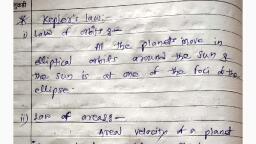
VIJAYSHREE PHYSICS BY VISHAL SIR, Gravitation 25, , So height from the centre of earth r = R + h = R +, , Rk 2 = R ., 1 − k2 1 − k 2, , Problem 50. If the radius of earth reduces by 4% and density remains same then escape velocity will, [MP PET 1991; MP PMT 1995], , (a) Reduce by 2%, Solution : (c), , (b) Increase by 2%, , (c) Reduce by 4%, , (d) Increase by 4%, , Escape velocity v e R and if density remains constant v e R, So if the radius reduces by 4% then escape velocity also reduces by 4%., , Problem 51. A rocket of mass M is launched vertically from the surface of the earth with an initial speed V., Assuming the radius of the earth to be R and negligible air resistance, the maximum height attained, by the rocket above the surface of the earth is, R, R, , , (b) gR − 1, (d) 2gR, (a), (c), R, R, −1, gR − 1, 2gR − 1, , , 2, , , , , , 2V 2, V, 2V 2, , V2, , Solution : (c) Kinetic energy given to rocket at the surface of earth = Change in potential energy of the rocket in, reaching from ground to highest point, 1, v2, g, , mv 2 = mgh , , =, 1 1, 2, 1+h/R, 2, +, h R, 2, 2, 1 1 2g, 1 2g 1, 1 2gR − v, v R, h=, =, + =, − =, h R v2, h v2 R, h, 2gR − v 2, v2R, R, h=, 2gR, , −1, 2, , v, Problem 52. A body of mass m is situated at a distance 4 Re above the earth’s surface, where Re is the radius of, earth. How much minimum energy be given to the body so that it may escape, mgRe, mgRe, (a) mgRe, (c), (d), (b) 2mgRe, 5, 16, Solution : (c), , Potential energy of the body at a distance 4 R e from the surface of earth, U=−, , mgR e, mgRe, mgRe, =−, =−, 1+4, 5, 1 + h / Re, , [As h = 4 Re (given)], , So minimum energy required to escape the body will be, , mgRe, 5, , ., , 8.18 Kepler’s Laws of Planetary Motion., Planets are large natural bodies rotating around a star in definite orbits. The planetary system of the, star sun called solar system consists of nine planets, viz., Mercury, Venus, Earth, Mars, Jupiter, Saturn,, Uranus, Neptune and Pluto. Out of these planets Mercury is the smallest, closest to the sun and so hottest., Jupiter is largest and has maximum moons (12). Venus is closest to Earth and brightest. Kepler after a life, time study work out three empirical laws which govern the motion of these planets and are known as, Kepler’s laws of planetary motion. These are,, (1) The law of Orbits : Every planet moves around the sun in an, elliptical orbit with sun at one of the foci., (2) The law of Area : The line joining the sun to the planet sweeps out, equal areas in equal interval of time. i.e. areal velocity is constant. According, to this law planet will move slowly when it is farthest from sun and more, rapidly when it is nearest to sun. It is similar to law of conservation of, angular momentum., , Sun, r, , dA, , v dt
Page 26 :
Vijayshree Physics by Vishal Sir, 26 Gravitation, Areal velocity =, , dA, , =, , dt, , 1 r(vdt) 1, = rv, 2 dt, 2, [As L = mvr ; rv =, , dA L, =, dt, 2m, , , , L, , ], m, , (3) The law of periods : The square of period of revolution (T), proportional to the cube of the semi-major axis of the orbit., 3, r +r , 2, 3, 2, T a or T 1 2 , 2 , Proof : From the figure AB = AF + FB, r1 + r2, 2a = r1 + r2 a =, where a = semi-major axis, 2, , of any planet around sun is directly, , E, Perigee, , A, , r1, , r1 = Shortest distance of planet from sun (perigee)., , Apogee, , r2, , Sun F, , a, , C, , D, , r2 = Largest distance of planet from sun (apogee)., Important data, Planet, , Semi-major axis, , Period, , T2/a3, , a (1010 meter), , T(year), , (10–34, year2/meter3), , Mercury, , 5.79, , 0.241, , 2.99, , Venus, , 10.8, , 0.615, , 3.00, , Earth, , 15.0, , 1.00, , 2.96, , Mars, , 22.8, , 1.88, , 2.98, , Jupiter, , 77.8, , 11.9, , 3.01, , Saturn, , 143, , 29.5, , 2.98, , Uranus, , 287, , 84.0, , 2.98, , Neptune, , 450, , 165, , 2.99, , Pluto, , 590, , 248, , 2.99, , Note:: ❑, , Solar System, , Kepler's laws are valid for satellites also., , 8.19 Velocity of a Planet in Terms of Eccentricity, Applying the law of conservation of angular momentum at perigee and apogee, mv p rp = mv ara, , , vp, va, , =, , ra, rp, , =, , a+c 1+e, =, a −c 1−e, , [As r = a − c,, p, , c, r = a + c and eccentricity e = ], a, a, , Applying the conservation of mechanical energy at perigee and apogee, 1, 1, 1, 2, 2, = 2GM, 1, 2 mv p 2 − GMm = mv 2 − GMm v − v, − , r, a, p, a, , 2, ra, p, rp ra , r 2 − r 2 , r − r , vr, p, aa, , v 2 a, = 2 GM a p , [As v =, , ], p, a, 2, r, r, r, r, , , p, , , a, p, , , p, , , B
Page 27 :
VIJAYSHREE PHYSICS BY VISHAL SIR, Gravitation 27, , , , rp , 2 GM a − c 2 GM 1 − e , 2 GM, 2, =, r + r va =, a a +c, a 1 + e , r, , , , , a, p a , , v a=, 2, , Thus the speeds of planet at apogee and perigee are, 2 GM 1 − e , a 1 + e ,, , , , va =, , 2 GM 1 + e , , , a 1 − e , , vp =, , Note:: ❑ The gravitational force is a central force so torque on planet relative to sun is always zero,, hence angular momentum of a planet or satellite is always constant irrespective of shape of, orbit., , 8.20 Some Properties of the Planet., Mercur, y, , Venus, , Earth, , Mars, , Jupiter, , Saturn, , Uranus, , Neptune, , Pluto, , Mean distacne from sun, 106, km, , 57.9, , 108, , 150, , 228, , 778, , 1430, , 2870, , 4500, , 5900, , Period of revolution, year, , 0.241, , 0.615, , 1.00, , 1.88, , 11.9, , 29.5, , 84.0, , 165, , 248, , Orbital speed, km/s, , 47.9, , 35.0, , 29.8, , 24.1, , 13.1, , 9.64, , 6.81, , 5.43, , 4.74, , Equatiorial diameter, km, , 4880, , 12100, , 12800, , 6790, , 143000, , 120000, , 51800, , 49500, , 2300, , 0.0558, , 0.815, , 1.000, , 0.107, , 318, , 95.1, , 14.5, , 17.2, , 0.002, , Density (Water =1), , 5.60, , 5.20, , 5.52, , 3.95, , 1.31, , 0.704, , 1.21, , 1.67, , 2.03, , Surface value of g, m/s2, , 3.78, , 8.60, , 9.78, , 3.72, , 22.9, , 9.05, , 7.77, , 11.0, , 0.5, , Escape velocity, km/s, , 4.3, , 10.3, , 11.2, , 5.0, , 59.5, , 35.6, , 21.2, , 23.6, , 1.1, , 0, , 0, , 1, , 2, , 16+ring, , 18+rings, , 17+rings, , 8+rings, , 1, , Mass (Earth =1), , Known satellites, , Sample problems based on Kepler’s law, Problem 53. The distance of a planet from the sun is 5 times the distance between the earth and the sun. The Time, period of the planet is, (a) 5, Solution : (a), , 3/2, , years, , [UPSEAT 2003], , (b) 5, , According to Kepler’s law T R 3 / 2, , 2/3, , (c) 5, , years, , T planet = (5), , 3/2, , 1/3, , (d) 5, , years, , 1/2, , years, , Tearth = 5 (3 / 2) 1 year = 5 3 / 2 years ., , (), , Problem 54. In planetary motion the areal velocity of position vector of a planet depends on angular velocity, , Solution : (c), , and the distance of the planet from sun (r). If so the correct relation for areal velocity is, dA, dA, dA, dA, r2, , r, 2r, (a), (b), (c), (d), dt, dt, dt, dt, dA L, mvr = 1 r2, =, =, [As Angular momentum L = mvr and v = r ], dt, 2m, 2m, 2, dA, r 2 ., , dt, , Problem 55. The planet is revolving around the sun as shown in elliptical path. The correct option is, , r, , [UPSEAT 2002], , B, , (a) The time taken in travelling DAB is less than that for BCD, (b) The time taken in travelling DAB is greater than that for BCD, , S, C, , A, , (c) The time taken in travelling CDA is less than that for ABC, (d) The time taken in travelling CDA is greater than that for ABC, Solution : (a), , D, , When the planet passes nearer to sun then it moves fast and vice-versa. Hence the time taken in, travelling DAB is less than that for BCD.
Page 28 :
Vijayshree Physics by Vishal Sir, 28 Gravitation, , Problem 56. The distance of Neptune and Saturn from sun are nearly 10 13 and 1012 meters respectively. Assuming, that they move in circular orbits, their periodic times will be in the ratio [NCERT 1975; CBSE PMT 1994; MP PET 2, (a), , Solution : (c), , (b) 100, (c) 10 10, 3/2, 3, /2, 1013 , T, R, , Kepler’s third law T 2 R 3 , Neptune, Neptune , = 10, ., = , = 12 , 10, , T, R, 10, Saturn, Saturn , , , , (d) 1 /, , 10, , 10, , Problem 57. The maximum and minimum distance of a comet from the sun are 8 10 12 m and 1.6 1012 m. If its, Solution : (a), , velocity when nearest to the sun is 60 m/s, what will be its velocity in m/s when it is farthest, (a) 12, (b) 60, (c) 112, (d) 6, According to conservation of angular momentum mv minrmax = mv maxrmin = constant, rmin, 1.6 1012 , = 12m / s, = 60 , vmin = vmax , rmax, 8 1012 , , Problem 58. A satellite A of mass m is at a distance of r from the centre of the earth. Another satellite B of mass 2m, is at distance of 2r from the earth’s centre. Their time periods are in the ratio of, Solution : (d), , (a) 1 : 2, (b) 1 : 16, (c) 1 : 32, (d) 1 : 2 2, Time period does not depend upon the mass of satellite, it only depends upon the orbital radius., 1, r 3/2 r 3 /2, T, 1, = , =, ., According to Kepler's law, = 1, T2, r, 2r, 22, , 2, , Problem 59. A planet moves around the sun. At a given point P, it is closed from the sun at a distance d 1 and has a, speed v1 . At another point Q. when it is farthest from the sun at a distance d 2 , its speed will be [MP PMT 1987], 2, , (a), , d v1 1, , (b), , 2, , d1, , d2, Solution : (c), , d 2 v1, , (c), , 2, , d1 v1, , (d), , d2, , d v2, , 1, , 2, , d1, , According to law of conservation of angular momentum mv d = mv d, 1 1, , 2, , v=, 2, , 2, , d1 v1, , ., , d2, , 8.21 Orbital Velocity of Satellite, Satellites are natural or artificial bodies describing orbit around a planet under its gravitational, attraction. Moon is a natural satellite while INSAT-1B is an artificial satellite of earth. Condition for, establishment of artificial satellite is that the centre of orbit of satellite must coincide with centre of earth or, satellite must move around great circle of earth., Orbital velocity of a satellite is the velocity required to put the satellite into its orbit around the earth., For revolution of satellite around the earth, the gravitational pull provides the required centripetal, force., mv 2 GMm, =, r2, r, , , v=, v=, , Satellite, h, r, , GM, r, 2, , gR, g, =R, R+h, R+h, , R, Earth, , v, , [As GM = gR 2 and r = R + h ], , Important points, (i) Orbital velocity is independent of the mass of the orbiting body and is always along the tangent of, the orbit i.e., satellites of deferent masses have same orbital velocity, if they are in the same orbit., (ii) Orbital velocity depends on the mass of central body and radius of orbit.
Page 29 :
VIJAYSHREE PHYSICS BY VISHAL SIR, Gravitation 29, , (iii) For a given planet, greater the radius of orbit, lesser will be the orbital velocity of the satellite, , (v 1 / r )., , (iv) Orbital velocity of the satellite when it revolves very close to the surface of the planet, GM, GM, GM, = gR, [As h = 0 and GM = gR 2 ], v=, =, v=, R, r, R+h, For the earth v =, , 9.8 6.4 10 6 = 7.9 k m / s 8 km / sec, v=, , (v) Close to the surface of planet, , , v=, , ve, , i.e., v escape =, , 2, , GM, R, , [As v e =, , 2 vorbital, , It means that if the speed of a satellite orbiting close to the earth is made, 41%) then it will escape from the gravitational field., , 2 times (or increased by, , (vi) If the gravitational force of attraction of the sun on the planet varies as F , velocity varies as v , , 1, r −1, n, , 2GM, ], R, , 1, rn, , then the orbital, , ., , Sample problems based on orbital velocity, Problem 60. Two satellites A and B go round a planet P in circular orbits having radii 4R and R respectively. If the, , Solution : (b), , speed of the satellite A is 3V, the speed of the satellite B will be, (a) 12 V, (b) 6 V, (c) 3/2 V, v, rA, GM, 1, B=, Orbital velocity of satellite v =, v, r, rB, vA, r, , (d) 3/2 V, , , vB, , =, 3V, , 4R, v B = 6V ., R, , Problem 61. A satellite is moving around the earth with speed v in a circular orbit of radius r. If the orbit radius is, , decreased by 1%, its speed will, (a) Increase by 1%, (b) Increase by 0.5% (c) Decrease by 1%, (d) Decrease by 0.5%, 1, Gm, v, [If r decreases then v increases], Solution : (b) Orbital velocity v =, r, r, 1, 1, Percentage change in v =, (Percentage change in r) =, (1%) = 0.5% orbital velocity increases by, 2, 2, 0.5%., Problem 62. If the gravitational force between two objects were proportional to 1/R; where R is separation between, them, then a particle in circular orbit under such a force would have its orbital speed v proportional to, , [CBSE PMT 1994; JIPMER 2001, 02], , Solution : (b), , (a) 1 / R 2, 1, If F , then v , Rn, , (b) R 0, 1, Rn −1, , ;, , here n = 1 v , , (c) R 1, 1, R, , 1−1, , (d) 1 / R, R0., , Problem 63. The distance between centre of the earth and moon is 384000 km. If the mass of the earth is, 6 10 24 kg and G = 6.67 10 −11 Nm 2 / kg 2 . The speed of the moon is nearly, (a) 1 km / sec, Solution : (a), , Orbital velocity v =, , (b) 4 km / sec, GM, =, r, , (c) 8 km / sec, , 6.67 10 −11 6 10 24, 38400 10 3, , 8.22 Time Period of Satellite., It is the time taken by satellite to go once around the earth., , , T=, , Circumfere nce of the orbit, orbital velocity, , [MH CET 2002], , (d) 11.2 km / sec, , v = 1.02 km / sec = 1km / sec (Approx.)
Page 30 :
Vijayshree Physics by Vishal Sir, 30 Gravitation, 2r, = 2r, v, , , , T=, , , , T = 2, , , , T = 2, , r, GM, , r3, = 2, GM, , (R + h)3, gR2, , [As v =, r3, gR 2, , = 2, , GM, ], r, , [As GM = gR 2 ], 3/2, R, h, 1 + , R, g, , [As r = R + h ], , Important points, (i) From T = 2, , r3, it is clear that time period is independent of the mass of orbiting body and, GM, , depends on the mass of central body and radius of the orbit, (ii), , T = 2, , , , T 2=, , r3, GM, , 4 2 3, r i.e., T 2 r 3, GM, , This is in accordance with Kepler’s third law of planetary motion r becomes a (semi major axis) if the orbit is, elliptic., (iii) Time period of nearby satellite,, From, , T = 2, , r3, = 2, GM, , R3, = 2, gR 2, , R, g, , [As h = 0 and GM = gR 2 ], , For earth R = 6400 km and g = 9.8m / s 2, T = 84.6 minute 1.4 hr, (iv) Time period of nearby satellite in terms of density of planet can be given as, 1/2, 2 (R 3 ), 3, 3, = 3, T = 2 r = 2 R =, 1 /2, 4, G., GM, GM, G, R3 , 3 , , , (v) If the gravitational force of attraction of the sun on the planet varies as F , , 1, rn, , then the time period varies as, , n+1, , Tr2, (vi) If there is a satellite in the equatorial plane rotating in the direction of earth’s rotation from west, to east, then for an observer, on the earth, angular velocity of satellite will be, (S − E ). The time interval, between the two consecutive appearances overhead will be, 2 , , As T =, 2, TS TE, T=, =, , s − E TE − TS, , If S = E , T = i.e. satellite will appear stationary relative to earth. Such satellites are called geostationary, satellites., , Sample problems based on time period
Page 31 :
VIJAYSHREE PHYSICS BY VISHAL SIR, Gravitation 31, , Problem 64. A satellite is launched into a circular orbit of radius ‘R’ around earth while a second satellite is, launched into an orbit of radius 1.02 R. The percentage difference in the time periods of the two, satellites is, [EAMCET 2003], (a) 0.7, Solution : (d), , (b) 1.0, , (c) 1.5, , (d) 3, , Orbital radius of second satellite is 2% more than first satellite, So from T (r)3 / 2 , Percentage increase in time period =, , 3, , (Percentage increase in orbital radius), , 2, , =, , 3, , (2%) = 3%., , 2, , Problem 65. Periodic time of a satellite revolving above Earth’s surface at a height equal to R, where R the radius of, Earth, is [g is acceleration due to gravity at Earth’s surface], , Solution : (b), , (a) 2, , 2R, g, , T = 2, , (R + h)3, GM, , R, g, , (b) 4 2, (R + R)3, , = 2, , gR, , 8R, = 4 2, g, , = 2, , 2, , R, g, , (c) 2, , (d) 8, , R, g, , R, g, , [As h = R (given)]., , Problem 66. An earth satellite S has an orbit radius which is 4 times that of a communication satellite C. The period, of revolution of S is, , [MP PMT 1994; DCE 1999], , (a) 4 days, Solution : (b), , (b) 8 days, , (c) 16 days, , (d) 32 days, , Orbital radius of satellite rs = 4rc (given), From Kepler’s law T r 3 / 2 , , r 3/2, = (4)3 / 2 Ts = 8Tc, = s, Tc, sc , T, , s, , = 8 1 day = 8 days., , Problem 67. One project after deviation from its path, starts moving round the earth in a circular path at radius, equal to nine times the radius at earth R, its time period will be, (a) 2, , Solution : (b), , T = 2, , R, g, , (b) 27 2, , r3, gR, , 2, , = 2, , (9R)3, gR, , 2, , = 2 (9) 3 / 2, , R, g, , (c) , , R, = 27 2, g, , R, g, , R, g, , (d) 8 2, , R, g, , [As r = 9R (given)]., , Problem 68. A satellite A of mass m is revolving round the earth at a height ‘r’ from the centre. Another satellite B, of mass 2m is revolving at a height 2r. The ratio of their time periods will be, (a) 1 : 2, Solution : (d), , (b) 1 : 16, , (c) 1 : 32, , Time period depends only upon the orbital radius, , T, , 1, , T2, , By squaring and rearranging both sides, 1/3, , , , T 2g R 2, h=, , 2, 4, , , −R, , r3, = 2, GM, , (d) 1 : 2 2, , r 3/2 r 3 /2, 1, = 1 , = , =, ., r, 2r, 2, 2, , 2, , 8.23 Height of Satellite., As we know, time period of satellite T = 2, , [CBSE PMT 1993], , (R + h)3, gR 2, , g R2T 2, 3, = (R + h ), 4 2
Page 32 :
Vijayshree Physics by Vishal Sir, 32 Gravitation, By knowing the value of time period we can calculate the height of satellite the surface of the earth., , Sample problems based on height, Problem 69. Given radius of earth ‘R’ and length of a day ‘T’ the height of a geostationary satellite is, [G – Gravitational constant, M – Mass of earth], 1/3, , 4 2GM , (a) , 2, , , T, , , [MP PMT 2002], , 4GM 1 / 3, (b) , −R, R2, , , , 1/3, , Solution : (c), , From the expression h = , , T 2 gR 2 , , 4 2 , , , , −R, , 1/3, , GMT 2 − R, (c) , 4 2 , , , 1/3, , 2 − R, h = GMT, 2, , 4, , , 1/3, , 2, , (d) GMT, +R, 4 2 , , , , [As gR 2 = GM ], , Problem 70. A satellite is revolving round the earth in circular orbit at some height above surface of earth. It takes, 5.26 10 3 seconds to complete a revolution while its centripetal acceleration is 9.92 m / s 2 . Height of, satellite above surface of earth is (Radius of earth 6.37 10 6 m ), (a) 70 km, Solution : (c), , (b) 120 km, v2, , Centripetal acceleration (ac ) =, From equation (i) and (ii) r =, , and T =, , r, ac T 2, 4, , 2, , (c) 170 km, , [MP PET 1993], , (d) 220 km, , 2r, v, , R+h=, , 9.32 (5.26 10 3 ) 2, 42, , h = 6.53 10 6 − R = 6.53 10 6 − 6.37 10 6 = 160 10 3 m = 160km 170km ., , 8.24 Geostationary Satellite., The satellite which appears stationary relative to earth is called geostationary or geosynchronous, satellite, communication satellite., A geostationary satellite always stays over the same place above the earth such a satellite is never at, rest. Such a satellite appears stationary due to its zero relative velocity w.r.t. that place on earth., The orbit of a geostationary satellite is known as the parking orbit., , Important points, (i) It should revolve in an orbit concentric and coplanar with the equatorial plane., (ii) It sense of rotation should be same as that of earth about its own axis i.e., in anti-clockwise, direction (from west to east)., (iii) Its period of revolution around the earth should be same as that of earth about its own axis., T = 24 hr = 86400 sec, , (iv) Height of geostationary satellite, As, , T = 2, , r3, GM, , , , 2, , (R + h)3, = 24 hr, GM, , Substituting the value of G and M we get R + h = r = 42000 km = 7 R, height of geostationary satellite from the surface of earh h = 6R = 36000 km
Page 33 :
VIJAYSHREE PHYSICS BY VISHAL SIR, Gravitation 33, , (v) Orbital velocity of geo stationary satellite can be calculated by v =, , GM, r, , Substituting the value of G and M we get v = 3.08 km / sec, , 8.25 Angular Momentum of Satellite., Angular momentum of satellite L = mvr, , , L=m, , , , L=, , GM, r, r, , GM, ], r, , [As v =, , m 2 GMr, , i.e., Angular momentum of satellite depend on both the mass of orbiting and central body as well as, the radius of orbit., , Important points, (i) In case of satellite motion, force is central so torque = 0 and hence angular momentum of satellite is, conserved i.e., L = constant, (ii) In case of satellite motion as areal velocity, dA 1 (r)(vdt) 1, =, = rv, dt 2 dt, 2, , Sun, r, , dA L, =, dt, 2m, , , , dA, , v dt, , [As L = mvr ], , But as L = constant, areal velocity (dA/dt) = constant which is Kepler’s II law, i.e., Kepler’s II law or constancy of areal velocity is a consequence of conservation of angular, momentum., , Sample problems based on angular momentum, Problem 71. The orbital angular momentum of a satellite revolving at a distance r from the centre is L. If the, distance is increased to 16r, then new angular momentum will be, L, (a) 16 L, (b) 64 L, (c), 4, Solution : (d), , Angular momentum L =, L2, L1, , =, , r2 =, r1, , m 2 GMr L , , (d) 4 L, , r, , 16r = 4, r, , L2 = 4 L1 = 4 L, , Problem 72. Angular momentum of a planet of mass m orbiting around sun is J, areal velocity of its radius vector, will be, 1, mJ, (a), 2, , (b), , J, 2m, , (c), , m, 2J, , (d), , 1, 2mJ, , Solution : (b), , 8.26 Energy of Satellite., When a satellite revolves around a planet in its orbit, it possesses both potential energy (due to its, position against gravitational pull of earth) and kinetic energy (due to orbital motion).
Page 34 :
Vijayshree Physics by Vishal Sir, 34 Gravitation, − GMm − L2, =, mr 2, r, GMm, 1, L2, 2, mv, =, =, (2) Kinetic energy : K = 2, 2r, 2 mr 2, (1) Potential energy : U = mV =, , (3) Total energy : E = U + K = −, , , , As V = − GM , L2 = m 2 GMr, , , r, , , , , GM, As v =, , r , , , GMm GMm − GMm − L2, + 2r =, =, r, 2r, 2mr 2, , Important points, (i) Kinetic energy, potential energy or total energy of a satellite depends on the mass of the satellite, and the central body and also on the radius of the orbit., (ii) From the above expressions we can say that, Kinetic energy (K) = – (Total energy), Potential energy (U) = 2 (Total energy), Potential energy (K) = – 2 (Kinetic energy), (iii) Energy graph for a satellite, , (iv) Energy distribution in elliptical orbit, , +, Satellite, , r, , Energy, , K, , Perigee, K.E. = max, P.E. = min, , O, E, , Focus, , a, Semi major, axis, , Apogee, K.E. = min, P.E. = max, , r, , U, , rmin, , rmax, , (B), , –, (A), , (v) If the orbit of a satellite is elliptic then, (a) Total energy (E) =, , − GMm, , = constant ; where a is semi-major axis ., , 2a, (b) Kinetic energy (K) will be maximum when the satellite is closest to the central body (at perigee), and maximum when it is farthest from the central body (at apogee), (c) Potential energy (U) will be minimum when kinetic energy = maximum i.e., the satellite is closest, to the central body (at perigee) and maximum when kinetic energy = minimum i.e., the satellite is farthest, from the central body (at apogee)., (vi) Binding Energy : Total energy of a satellite in its orbit is negative. Negative energy means that the, satellite is bound to the central body by an attractive force and energy must be supplied to remove it from the, orbit to infinity. The energy required to remove the satellite from its orbit to infinity is called Binding Energy, of the system, i.e.,, GMm, Binding Energy (B.E.) = −E =, 2r, , 8.Change in the orbit of Satelite, , When the satellite is transferred to a higher orbit (r2 r1 ) then variation in different quantities can be, shown by the following table, Quantities, Orbital velocity, , Variation, Decreases, , Relation with r, v, , 1, r, , Time period, , Increases, , T r 3/2
Page 35 :
VIJAYSHREE PHYSICS BY VISHAL SIR, Gravitation 35, Linear momentum, , Decreases, , P , , 1, r, , Angular momentum, , Increases, , L r, , Kinetic energy, , Decreases, , K , , 1, r, , Potential energy, , Increases, , 1, , U −, , r, , Total energy, , Increases, , E−, , 1, r, , Binding energy, , Decreases, , BE , , 1, r, , Note:: ❑, , Work done in changing the orbit W = E2 − E1, GMm GMm , W = − 2r − − 2r , , 2, , 1, , W=, , r2, , M, , r1 Earth, , , , GMm, 2 r1 − r1 , 1, 2 , , Sample problems based on Energy, Problem 73. Potential energy of a satellite having mass ‘m’ and rotating at a height of, , 6.4 106 m from the earth, , centre is, [AIIMS 2000; CBSE PMT 2001; BHU 2001], , (a) −0.5 mgRe, Solution : (a), , (b) −mgRe, , Potential energy = −, , GMm, r, , gR 2 m, , Potential energy = − e, , 2Re, , =−, , GMm, Re + h, , (c) −2 mgRe, =−, , (d) 4 mgRe, , [As h = R, , GMm, , e, , 2Re, , (given)], 2, , [As GM = gR ], , = −0.5mgRe, , Problem 74. In a satellite if the time of revolution is T, then kinetic energy is proportional to, (a), Solution : (d), , 1, , 1, , (b), , T3, , T2, , T, , 1, , (c), , (d) T −2 / 3, , 1, 1, Time period T r 3 / 2 r T 2 / 3 and Kinetic energy 2 / 3 T −2 / 3 ., r, T, , Problem 75. Two satellites are moving around the earth in circular orbits at height R and 3R respectively, R being, the radius of the earth, the ratio of their kinetic energies is, (a) 2, Solution : (a), , (b) 4, , (c) 8, , (d) 16, , r1 = R + h1 = R + R = 2R and r2 = R + h2 = R + 3R = 4 R, Kinetic energy , , 1, r, , , , (KE)1 r2, 4R 2, =, =, = ., 2R 1, (KE)2, r1, , 8.28 Weightlessness, The weight of a body is the force with which it is attracted towards the centre of earth. When a body is, stationary with respect to the earth, its weight equals the gravity. This weight of the body is known as its, static or true weight.
Page 36 :
Vijayshree Physics by Vishal Sir, 36 Gravitation, We become conscious of our weight, only when our weight (which is gravity) is opposed by some other, object. Actually, the secret of measuring the weight of a body with a weighing machine lies in the fact that as, we place the body on the machine, the weighing machine opposes the weight of the body. The reaction of, the weighing machine to the body gives the measure of the weight of the body., The state of weightlessness can be observed in the following situations., (1) When objects fall freely under gravity : For example, a lift falling freely, or an airship, showing a feat in which it falls freely for a few seconds during its flight, are in state of weightlessness., (2) When a satellite revolves in its orbit around the earth : Weightlessness poses many, serious problems to the astronauts. It becomes quite difficult for them to control their movements., Everything in the satellite has to be kept tied down. Creation of artificial gravity is the answer to this, problem., (3) When bodies are at null points in outer space : On a body projected up, the pull of the earth, goes on decreasing, but at the same time the gravitational pull of the moon on the body goes on increasing., At one particular position, the two gravitational pulls may be equal and opposite and the net pull on the, body becomes zero. This is zero gravity region or the null point and the body in question is said to appear, weightless., , 8.29 Weightlessness in a Satellite., A satellite, which does not produce its own gravity moves around the earth in a circular orbit under the, GM, action of gravity. The acceleration of satellite is 2 towards the centre of earth., r, If a body of mass m placed on a surface inside a satellite moving around the earth. Then force on the, body are, Satellit, (i) The gravitational pull of earth =, , GMm, r, , R, , (ii) The reaction by the surface = R, By Newton’s law, , GmM, R=m a, r2 −, GM , GmM R = m, −, 2 , r2, r , , h, , r, , 2, , Earth, , , , m, , ma, , GMm, r, , 2, , v, , R=0, , Thus the surface does not exert any force on the body and hence its apparent weight is zero., A body needs no support to stay at rest in the satellite and hence all position are equally comfortable., Such a state is called weightlessness., , Important points, (i) One will find it difficult to control his movement, without weight he will tend to float freely. To get, from one spot to the other he will have to push himself away from the walls or some other fixed objects., (ii) As everything is in free fall, so objects are at rest relative to each other, i.e., if a table is withdrawn, from below an object, the object will remain where it was without any support., (iii) If a glass of water is tilted and glass is pulled out, the liquid in the shape of container will float and, will not flow because of surface tension., (iv) If one tries to strike a match, the head will light but the stick will not burn. This is because in this, situation convection currents will not be set up which supply oxygen for combustion, (v) If one tries to perform simple pendulum experiment, the pendulum will not oscillate. It is because, there will not be any restoring torque and so T = 2 (L / g) = ., [As g = 0 ]
Page 37 :
VIJAYSHREE PHYSICS BY VISHAL SIR, Gravitation 37, , (vi) Condition of weightlessness can be experienced only when the mass of satellite is negligible so that, it does not produce it own gravity., e.g. Moon is a satellite of earth but due to its own weight it applies gravitational force of attraction on, the body placed on its surface and hence weight of the body will not be equal to zero at the surface of the, moon., , Sample problems based on weightlessness in satellite, Problem 76. The time period of a simple pendulum on a freely moving artificial satellite is, (a) Zero, Solution : (d), , T = 2, , (b) 2 sec, l, g, , = 2, , l, =, 0, , (c) 3 sec, , (d) Infinite, , [As g = 0 in the satellite], , Problem 77. The weight of an astronaut, in an artificial satellite revolving around the earth, is, (a) Zero, (c) More than that on the earth, , (b) Equal to that on the earth, (d) Less than that on the earth, , Solution : (a), , Problem 78. A ball is dropped from a spacecraft revolving around the earth at a height of 120 km. What will happen to, the ball, (a) It will continue to move with velocity v along the original orbit of spacecraft, (b) If will move with the same speed tangentially to the spacecraft, (c) It will fall down to the earth gradually, (d) It will go very far in the space, Solution : (a), , Because ball possess same initial tangential speed as that of space craft.. So it also feels the condition, of weightlessness., , Sample problems (Miscellaneous), Problem 79. Two particles of equal mass go round a circle of radius R under the action of their mutual gravitational, attraction. The speed of each particle is, (a) v =, , 1, 2R, , 1, Gm, , (b) v =, , Gm, 2R, , [CBSE PMT 1995], , (c) v =, , 1, 2, , Gm, R, , Solution : (c) Both the particles moves diametrically opposite position along the, circular path of radius R and the gravitational force provides, required centripetal force, mv 2, Gmm, 1, =, v=, R, 2, (2R)2, , Gm, R, , (d) v =, , m, , 4 Gm, R, , 2R, m, , Problem 80. Two types of balances, the beam balance and the spring balance are, commonly used for measuring weight in shops. If we are on the moon, we can continue to use, (a) Only the beam type balance without any change, (b) Only the spring balance without any change, (c) Both the balances without any change, (d) Neither of the two balances without making any change, Solution : (a) Because in beam type balance effect of less gravitation force works on both the Pans. So it is, neutralizes but in spring balance weight of the body decreases so apparent weight varies with actual, weight., , Problem 81. During a journey from earth to the moon and back, the greatest energy required from the space-ship, rockets is to overcome, (a) The earth’s gravity at take off, (b) The moon’s gravity at lunar landing, (c) The moon’s gravity at lunar take off, (d) The point where the pull of the earth and moon are equal but opposite, Solution : (a), , [CBSE PMT 1991]
Page 38 :
Vijayshree Physics by Vishal Sir, 38 Gravitation, , Problem 82. If the radius of earth contracts, , 1, , of its present value, the length of the day will be approximately, , n, , (a), Solution : (b), , 24, h, n, , (b), , 24, h, n2, , (c) 24 n h, , (d) 24 n 2 h, , 2, 2, Conservation of angular momentum L = I = = MR 2 , = constant T R 2, 5, T, same], 2, R , T, 1, R / n 2, 24, T =, =, hr, [As T = 24 hr ]., 2= 2 = , 2, 1, 2, 2, T1 R 1 , R, n, , , n, , [If M remains, , Problem 83. A body released from a height h takes time t to reach earth’s surface. The time taken by the same body, released from the same height to reach the moon’s surface is, , (a) t, Solution : (c), , (b) 6t, , (c), 2h, g, , If body falls from height h then time of descent t =, , (d), , 6t, , t, 6, , , , tmoon, =, tearth, , g earth, =, g moon, , 6 t moon =, , 6 t., , Problem 84. A satellite is revolving round the earth with orbital speed v 0 . If it stops suddenly, the speed with, which it will strike the surface of earth would be ( ve = escape velocity of a particle on earth’s surface), (a), Solution : (d), , v e2, , (b) v 0, , v0, , v e2 − v 02, , (c), , (d), , Applying conservation of mechanical energy between A and B point, 1, 1, GMm , ;, GMm = mv 2 + −, mv 2 GMm, GMm, −, =, −, , , R, r, r, 2, R 2, , 2Gm, 2Gm −, = v 2 − 2v 2 v =, v 2=, v2e − 2v20, e, 0, R, r, [As escape velocity v e =, , 2Gm, , orbital velocity v0 =, R, , v e2 − 2v 02, , u=0, , v, B, , A, r, , Gm, ], r, , Problem 85. The escape velocity for a planet is v e . A tunnel is dug along a diameter of the planet and a small body, is dropped into it at the surface. When the body reaches the centre of the planet, its speed will be, v, v, (c) e, (a) v e, (d) Zero, (b) e, 2, 2, Solution : (b), , Gravitational potential at the surface of the earth Vs = −, Gravitational potential at the centre of earth V c = −, , GM, R, , 3GM, 2R, , 1, 2, V ), By the conservation of energy 2 mv = m(V, − c, s, , v2=2, v=, , GM 3 − 1 = GM, , , R, R 2, , , 2, , = gR v= e, , [As v e =, , 2 gR ], , 2, , ve, 2, , Problem 86. A small body of superdense material, whose mass is twice the mass of the earth but whose size is very, small compared to the size of the earth, starts from rest at a height H R above the earth’s surface,, and reaches the earth’s surface in time t. Then t is equal to, (a), Solution : (c), , 2H / g, , (b), , H/g, , (c), , 2H / 3g, , As the masses of the body and the earth are comparable, they will, move towards their centre of mass, which remains stationary., , (d), M, , 4 H / 3g, , 2H, 3, , H, , C.M. 3, , 2M, , P, Body, , Earth, H
Page 39 :
VIJAYSHREE PHYSICS BY VISHAL SIR, Gravitation 39, Hence the body of mass 2m move through distance, , H, , ., , 3, , and time to reach the earth surface =, , 2h, =, g, , 2H / 3, =, g, , 2H, 3g, , Problems based on Newton’s law of gravitation, Basic level, 1., , The force of gravitation is, (a) Repulsive, , 2., , (b) Becomes four times, , (b) 1/2, , (d) Non - conservative, , (c) Is reduced to half, , [CPMT 1973; AMU (Med.) 2000], , (d) Is reduced to a quarter, , (c) 1/4, , (d) 1/5, , Three particles each of mass m are placed at the three corners of an equilateral triangle. The centre of the triangle is at a, distance x from either corner. If a mass M be placed at the centre, what will be the net gravitational force on it, (a) Zero, , 5., , (c) Conservative, , A mass M is split into two parts, m and M – m, which are then separated by a certain distance. What ratio of m/M maximizes, the gravitational force between the two parts, [AMU 2000], (a) 1/3, , 4., , (b) Electrostatic, , If the distance between two masses is doubled, the gravitational attraction between them, (a) Is doubled, , 3., , [AIIMS 2002], , (b) 3GMm / x 2, , (c), , 2GMm / x 2, , (d), , GMm / x 2, , Two identical spheres are placed in contact with each other. The force of gravitation between the sph eres will be, proportional to (R = radius of each sphere), (a) R, , (b) R2, , (c) R4, , (d) None of these, , Advance level, 6., , A solid sphere of uniform density and radius R applies a gravitational force of attraction equal to F1 on a particle placed at A,, distance 2 R from the centre of the sphere. A spherical cavity of radius R/2 is now made in the sphere as shown in the figure., The sphere with cavity now applies a gravitational force F2 on the same particle placed at A. The ratio F2 / F1 will be, (a) 1/2, (b) 3, (c) 7, , R, , R, , A, , (d) 7/9, , 7., , Three uniform spheres of mass M and radius R each are kept in such a way that each t ouches the other two. The magnitu de, of the gravitational force on any of the spheres due to the other two is, (a), , 3 GM 2, 4, , 8., , R2, , (b) 3 GM 2, 2R2, , (c), , 3GM 2, , (d), , 3 GM 2, 2, , R2, , R2, , A mass of 10kg is balanced on a sensitive physical balance. A 1000 kg mass is placed below 10 kg mass at a distance of 1m., How much additional mass will be required for balancing the physical balance, (a) 66 10 −15 kg, , (b) 6.7 10 −8 kg, , (c) 66 10 −12, kg, , (d), , Problems based on acceleration due to gravity, Basic level, , 6.7 10 −6 kg
Page 40 :
Vijayshree Physics by Vishal Sir, 40 Gravitation, 9., , If R is the radius of the earth and g the acceleration due to gravity on the earth's surface, the mean density of the earth is, [CPMT 1990; CBSE 1995; BHU 1998; MH CET (Med.) 1999; Kerala PMT 2002], , (a) 4G / 3gR, , 10., , (b) 3R / 4gG, , (b) m / 8, , Rg / 12G, , (c) m / 4, , (d) m, , The diameters of two planets are in the ratio 4 : 1 and their mean densities in the ratio 1: 2. The acceleration due to gravity on, the planets will be in ratio, [ISM Dhanbad 1994], (a) 1 : 2, , 12., , (d), , A mass 'm' is taken to a planet whose mass is equal to half that of earth and radius is four times that of earth. The mass of the, body on this planet will be, [RPMT 1989, 97], (a) m / 2, , 11., , (c) 3g / 4RG, , (b) 2 : 3, , (c) 2 : 1, , (d) 4 : 1, , The acceleration due to gravity on the moon is only one sixth that of earth. If the earth and moon are assumed to have the, same density, the ratio of the radii of moon and earth will be, 1, 1, 1, 1, (c), (b), (d), (a), 1/3, (6), 6, 36, (6)2. / 3, , Advance level, 13., , 14., , Let g be the acceleration due to gravity at earth's surface and K be the rotational kinetic energy of the earth. Suppose the, earth's radius decreases by 2% keeping all other quantities same, then, [BHU 1994; JIPMER 2000], (a) g decreases by 2% and K decreases by 4%, , (b) g decreases by 4% and K increases by 2%, , (c) g increases by 4% and K decreases by 4%, , (d) g decreases by 4% and K increase by 4%, , Clock A based on spring oscillations and a clock B based on oscillations of simple pendulum are synchronised on earth. Both, are taken to mars whose mass is 0.1 times the mass of earth and radius is half that of earth. Which of the following statement, is correct, (a) Both will show same time, (b) Time measured in clock A will be greater than that in clock B, (c) Time measured in clock B will be greater than that in clock A, (d), , Clock A will stop and clock B will show time as it shows on earth, , Problems based on variation in g with height, Basic level, 15., , A body weight W Newton at the surface of the earth. Its weight at a height equal to half the radius of the earth will be, [UPSEAT 2002], , (a), , 16., , W, , (b), , 2, , 2W, , (c), , 3, , 4W, 9, , (d), , 8W, 27, , The value of g on the earth's surface is 980 cm/sec2. Its value at a height of 64 km from the earth's surface is, (Radius of the earth R = 6400 Kilometers), (a) 960 .40cm, , 17., , / sec 2, , (b) 984 .90cm, , [MP PMT 1995], , / sec 2, , (c) 982 .45cm, , / sec 2, , (d), , 977 .55cm / sec 2, , (d), , R, 2hg, , The decrease in the value of g at height h from earth's surface is, (a), , 2h, R, , (b) (b), , 2h, g, R, , (c), , h, g, R, , Advance level, 18., , A simple pendulum has a time period T1 when on earth's surface and T2 when taken to a height R above the earth's surface,, where R is the radius of earth. The value of T2 / T1 is, [IIT-JEE (Screening) 2001], (a) 1, , 19., , 20., , (b), , 2, , (c) 4, , (d) 2, , A pendulum clock is set to give correct time at the sea level. This clock is moved to hill station at an altitude of 2500m above, the sea level. In order to keep correct time of the hill station, the length of the pendulum, [SCRA 1994], (a) Has to be reduced, , (b) Has to be increased, , (c) Needs no adjustment, , (d) Needs no adjustment but its mass has to be increased, , Which of the following correctly indicates the approximate effective values of g on various parts of a journey to the moon, (values are in metres/sec2), Before take off from earth, , One minute after lift – off, , In earth orbit, , on the moon
Page 41 :
VIJAYSHREE PHYSICS BY VISHAL SIR, Gravitation 41, , 21., , (a), , 9.80, , 9.80, , 0, , 1.6, , (b), , 9.80, , 0.98, , 0, , 1.6, , (c), , 9.80, , 0.00, , 0, , 9.8×6, , (d), , 9.80, , 7.00, , 0, , 1.6, , Two blocks of masses m each are hung from a balance. The scale pan A is at height H 1 whereas scale pan B is at height H 2 ., The error in weighing when H1 H 2 and R being the radius of earth is, 1 − 2H1 , , mg , R, , , H2, H1, (b), 2mg , −, , R, R , H, H, , (c) 2mg 2 − 1 , (a), , (d), , A, , m, m, , B, , H1, , R , R, H 2 H1, 2mg, H1 + H 2, , H2, , Problems based on variation in g with depth, Basic level, 22., , If the value of 'g' acceleration due to gravity, at earth surface is 10m / s 2 , its value in m / s 2 at the centre of the earth, which, is assumed to be a sphere of radius 'R' metre and uniform mass density is, [AIIMS 2002], (a) 5, , 23., , (b) 10/R, , (d) Zero, , The loss in weight of a body taken from earth's surface to a height h is 1%. The change in weight taken into a mine of depth h, will be, (a) 1% loss, , 24., , (c) 10/2R, , (b) 1% gain, , (c) 0.5% gain, , (d) 0.5% loss, , The weight of body at earth's surface is W. At a depth half way to the centre of the earth, it will be (assuming uniform density, in earth), (a) W, , (b) W/2, , (c) W/4, , (d) W/8, , Advance level, 25., , A particle would take a time t to move down a straight tunnel from the surface of earth (supposed to be a homogeneous, t, sphere) to its centre. If gravity were to remain constant this time would be t'. The ratio of will be, t', 2, , , , , (d), (c), (b), (a), 2, 3, 2 2, 3, , 26., , Suppose a vertical tunnel is dug along the diameter of earth assumed to be a sphere of uniform mass having density, body of mass m is thrown in this tunnel, its acceleration at a distance y from the centre is given by, (a), (c), , 27., , 4, , Gym, , 3, 4, , y, , 3, , (b), (d), , 3, , Gy, , 4, 4, , . If a, , m, y, , Gy, , 3, , A tunnel is dug along the diameter of the earth. If a particle of mass m is situated in the tunnel at a distance x from the centre, of earth then gravitational force acting on it, will be, (a), , GM em, x, R e3, , (b) GM em, R e2, , (c), , GM em, x2, , (d), , GM e m, (Re + x)2, , Problems based on variation in g due to shape of the earth, Basic level, 28., , The acceleration due to gravity at pole and equator can be related as, , [DPMT 2002]
Page 42 :
Vijayshree Physics by Vishal Sir, 42 Gravitation, (a) gp ge, , (b) gp = ge = g, , (c), , gp = ge g, , (d), , gp ge, , Weight of a body is maximum at, , 29., , (a) Moon, , 30., , [AFMC 2001], , (b) Poles of earth, , (c) Equator of earth, , (d) Centre of earth, , The value of 'g' at a particular point is 9.8m/s2. Suppose the earth suddenly shrinks uniformly to half its present size without, losing any mass. The value of 'g' at the same point (assuming that the distance of the point from the centre of earth does not, shrink) will now be, [NCERT 1984; DPMT 1999], (a) 4.9m / sec 2, , (b) 3.1m / sec 2, , (c) 9.8m / sec 2, , (d), , 19.6m / sec 2, , Advance level, 31., , The acceleration due to gravity increases by 0.5% when we go from the equator to the poles. What will be the time period of, the pendulum at the equator which beats seconds at the poles, (a) 1.950 s, , (b) 1.995 s, , (c) 2.050 s, , (d) 2.005 s, , Problems based on gravitational field, Basic level, 32., , There are two bodies of masses 100 kg and 10000 kg separated by a distance 1m. At what distance from the smaller body,, the intensity of gravitational field will be zero, [BHU 1997], (a), , 1, , (b), , m, , 9, , 33., , 1, 10, , m, , (d), , 11, , I, , (a), , 10, m, 11, , I, , (b), , I, , (c), , (d), , r =a, r =a, r =a, r =a, r, r, r, The curve depicting the dependence of intensity of gravitational field on the distance r from the centre of the earth is, I, , (a), O, , I, , I, , (b), , r=R, , r=R, , r, , r, , I, , (c), O, , r, , 35., , 1, , Which one of the following graphs represents correctly the variation of the gravitational field (F) with the distance (r) from, the centre of a spherical shell of mass M and radius a, I, , 34., , (c), , m, , (d), O, , r=R, , O, , r, , r=R, , r, , A thin spherical shell of mass M and radius R has a small hole. A particle of mass m is released at the mouth of the hole., Then, (a) The particle will execute simple harmonic motion inside the shell, , m, , (b) The particle will oscillate inside the small, but the oscillations are not simple harmonic, R, , (c) The particle will not oscillate, but the speed of the particle will go on increasing, (d), , M, , None of these, , Advance level, 36., , A solid sphere of uniform density and radius 4 units is located with its centre at the origin O of coordinates. Two spheres of, equal radii 1 unit with their centres at A(– 2, 0, 0) and B(2, 0, 0) respectively are taken out of the solid leaving behind, spherical cavities as shown in figure, (a) The gravitational force due to this object at the origin is zero, (b) The gravitational force at the point B (2, 0, 0) is zero, (c) The gravitational potential is the same at all points of the circle y 2 + z 2 = 36, , [IIT-JEE 1993], , y, A, , B, O, , z, , x
Page 43 :
VIJAYSHREE PHYSICS BY VISHAL SIR, Gravitation 43, (d), , 37., , The gravitational potential is the same at all points on the circle y 2 + z 2 = 4, y, , Gravitational field at the centre of a semicircle formed by a thin wire AB of mass m and length l is, Gm, Gm, along y axis, along x axis, (b), (a), l, l, , l, , A, , (c), , 38., , 2 Gm, along x axis, l2, , (d), , Two concentric shells of different masses m 1 and m, position A, B and C are, (a) 0, Gm 1 , G(m1 + m 2 )m, 2, 2, r1, r2, (c), , 39., , (b), , Gm 2, 2, , (d), , , 0,, , x, , 2, , r3, , G(m1 + m 2 )m Gm 1, , 2 ,0, r12, r2, , m2, m, , A r1, , A sphere of mass M and radius R2 has a concentric cavity of radius R1 as shown in figure. The force F exerted by the sphere, on a particle of mass m located at a distance r from the centre of sphere varies as (0 r ), , F, , R2, , F, , r, , (a), , F, , r, , (b), , F, , r, , (c), , r, , (d), , A spherical hole is made in a solid sphere of radius R. The mass of the sphere before hollowing was M. The gravitational field, at the centre of the hole due to the remaining mass is, (a) Zero, (c), , 41., , B, r2 C, , r1, , R1, , 40., , B, , are having a sliding particle of mass m. The forces on the particle at, , 2, , Gm 1, , r2, , G(m1 + m 2 )m Gm 2, ,, ,0, r12, r22, , O, , 2 Gm, along y axis, l2, , (b), , GM, 2R 2, , (d), , GM, 8R2, , R, , GM, R2, , A point P lies on the axis of a ring of mass M and radius a, at a distance a from its centre C. A small particle starts from P and, reaches C under gravitational attraction only. Its speed at C will be, 2GM, a, , (a), , (b), , 2GM , 1 , 1−, a , 2 , , 2GM, ( 2 − 1), a, , (c), , (d) Zero, , Problems based on gravitational potential, Basic level, 42., , If V is the gravitational potential on the surface of the earth, then what is its value at the centre of the earth, (a) 2V, , 43., , (c), , (b) 3V, , 3, , (d), , V, , 2, , 2, , V, , 3, , The diagram showing the variation of gravitational potential of earth with distance from the centre of earth is, , O, , V, , V, , V, r=R, r, , O, , r=R, r, , O, , V, r=R, r, , O, , r=R, r
Page 44 :
Vijayshree Physics by Vishal Sir, 44 Gravitation, (a), , 44., , (b), , (c), , By which curve will the variation of gravitational potential of a hollow sphere of radius R with distance be depicted, V, , V, , (a), , 45., , (d), , (b), , O, , r=R, , O, , (c), r, , r, , r=R, , V, , V, , (d), , r=R, , O, , Two concentric shells have mass M and m and their radii are R and r respectively, where, potential at their common centre, (c) − G M − m , R, r , , , (b) − Gm, r, , (a) − GM, R, , r=R, , O, , r, , r, , R r . What is the gravitational, (d) − G M + m , R, r , , , Advance level, 46., , A person brings a mass of 1 kg from infinity to a point A. Initially the mass was at rest but it moves with a speed of 2 m/s as it, reaches A. The work done by the person on the mass is – 3 J. The potential of A is, (a) – 3 J/kg, , 47., , (b) – 2 J/kg, , (c) – 5 J/kg, , (d) – 7 J/kg, , A thin rod of length L is bent to form a semicircle. The mass of the rod is M. What will be the gravitational potential at the, centre of the circle, (a) −, , GM, L, , (b) −, , GM, (c) − 2L, , GM, 2L, , (d) −, , GM, L, , Problems based on escape velocity, Basic level, 48., , The escape velocity of a planet having mass 6 times and radius 2 times as that of earth is, (a), , 49., , (d) m−1, , (c) m 0, , (b), , 2 times, , (c), , 2 times, , (d), , 3 times, , [RPMT 2000], , 4 times, , The orbital velocity of a satellite at a height h above the surface of earth is v. The value of escape velocity from the same, location is given by, [J&K CET 2000], (a), , 52., , (b) m, , m2, , [CPMT 1978; RPMT 1999; AIEEE 2002], , How many times is escape velocity (ve ) , of orbital velocity (v0 ) for a satellite revolving near earth, (a), , 51., , (d) 2Ve, , 2Ve, , The escape velocity of a particle of mass m varies as, (a), , 50., , (c), , (b) 3Ve, , 3 Ve, , [CPMT 1999; MP PET 2003], , How, , (b) v, , 2v, much, , energy, , will, , be, , v, , (c), necessary, , for, , making, , (d), , 2, , 2, , a, , v, , body, , of, , 500, , kg, , escape, , from, , the, , earth, , [g = 9.8 m / s , radius of earth = 6.4 10 m], 2, , 6, , [MP PET 1999], , (a) About 9.8 10, , 53., , 6J, , (b) About 6.4 10 J, 8, , (c) About, , 3.1 10 10, , J, , (d) About 27.4 10 12 J, , The escape velocity of a body on the surface of the earth is 11.2 km / s . If the earth’s mass increases to twice its present value, and the radius of the earth becomes half, the escape velocity would become, [CBSE PMT 1997], (a) 5.6 km / s, , (b) 11.2 km / s (remain unchanged)
Page 45 :
VIJAYSHREE PHYSICS BY VISHAL SIR, Gravitation 45, (c), , 54., , A rocket is launched with velocity 10 km/s. If radius of earth is R, then maximum height attained by it will be, (a) 2R, , 55., , (d) 44.8 km / s, , 22.4 km / s, (b) 3R, , (c) 4R, , [RPET 1997], , (d) 5R, , A missile is launched with a velocity less then the escape velocity. The sum of its kinetic and potential energy is, , [MP PET 1995], , (a) Positive, (b) Negative, (c) Zero, (d) May be positive or negative depending upon its initial velocity, , 56., , v e and v p denotes the escape velocity from the earth and another planet having twice the radius and the same mean density, as the earth. Then, [NCERT 1974; MP PMT 1994], (a) ve = v p, , 57., , (b) ve = vp / 2, , (c) ve = 2vp, , (d) ve = vp / 4, , The magnitude of the potential energy per unit mass of the object at the surface of earth is E. Then the escape velocity of the, object is, (a), , (b) 4 E 2, , 2E, , (c), , (d), , E, , E/2, , Advance level, 58., , A ball of mass m is fired vertically upwards from the surface of the earth with velocity nv e , where v e, and n < 1. Neglecting air resistance, to what height will the ball rise? (Take radius of the earth as R ), (b) R /(1 − n 2 ), , (a) R / n 2, , 59., , (c), , Rn 2 /(1 − n 2 ), , is the escape velocity, , (d) Rn 2, , The masses and radii of the earth and moon are M1 , R1 and M 2 , R2 respectively. Their centres are distance d apart. The, minimum velocity with which a particle of mass m should be projected from a point midway between their centres so that it, escape to infinity is, [MP PET 1997], , (a), , 60., , 2, , G, d, , (M 1+ M ) 2, , (b) 2, , 2G, (M1 + M 2), d, , (c), , 2, , Gm, (M 1 + M 2), d, , (d) 2, , Gm (M1 + M 2 ), d(R1 + R2 ), , A body is projected with a velocity 2ve, where ve is the escape velocity. Its velocity when it escapes the gravitational field of, the earth is, (a), , 7ve, , (b), , 5ve, , (c), , 3ve, , (d) v e, , Problems based on energy, Basic level, 61., , Escape velocity of a body of 1 kg mass on a planet is 100 m/sec. Gravitational potential energy of the body at the planet is, [MP PMT 2002], , (a) – 5000 J, , 62., , 63., , (b) – 1000 J, (c) – 2400 J, (d) 5000 J, R, A body of mass m rises to a height h =, from the earth’s surface where R is earth’s radius. If g is acceleration due to gravity, 5, at the earth’s surface, the increase in potential energy is, [CPMT 1989], 4, 6, mgh, mgh, (a) mgh, (b), (c) 5 mgh, (d), 5, 6, 7, The work done is bringing three particles each of mass 10 g from large distances to the vertices of an equilateral triangle of side, 10 cm., (a) 1 10 −13 J, , 64., , (b) 2 10 −13 J, , (c) 4 10 −11 J, , (d) 1 10 −11 J, , The potential energy due to gravitational field of earth will be maximum at, (a) Infinite distance, , (b) The poles of earth, , (c) The centre of earth, , (d) The equator of earth, , Advance level, 65., , The radius and mass of earth are increased by 0.5%. Which of the following statement is false at the surface of the earth, [Roorkee 2000]
Page 46 :
Vijayshree Physics by Vishal Sir, 46 Gravitation, , 66., , (a) g will increase, , (b) g will decrease, , (c) Escape velocity will remain unchanged, , (d) Potential energy will remain unchanged, , Two identical thin rings each of radius R are coaxially placed at a distance R. If the rings have a uniform mass distribution, and each has mass m 1 and m 2 respectively, then the work done in moving a mass m from centre of one ring to that of the, other is, (a) Zero, , (b), , Gm (m1 − m 2 )( 2 − 1), , (c), , 2R, , Gm 2(m1 − m 2 ), R, , (d), , Gm 1m 2 ( 2 + 1), m 2R, , Problems based on orbital velocity of satellite, Basic level, 67., , The orbital velocity of an artificial satellite in a circular orbit just above the earth’s surface is v. For a satellite orbiting at an, altitude of half of the earth’s radius, the orbital velocity is, [Kerala (Engg.) 2001], (a), , 3, , V, , 2, , 68., , 2, 3, , (c) V, , (d), , 2, , V, , 3, , (b) (a / b)v, , (c) ( a / b )v, , (d) ( b / a )v, , For the moon to cease to remain the earth’s satellite its orbital velocity has to increase by a factor of, (a) 2, , 70., , 3, 2, , The speed of a satellite is v while revolving in an elliptical orbit and is at nearest distance ‘a’ from earth. The speed of satellite, at farthest distance ‘b’ will be, [RPMT 1995], (a) (b / a)v, , 69., , (b) V, , (b), , 2, , Two artificial satellites A and B are at a distances rA and rB, ratio of their speeds will be, 2, 1/2, r+R, r+R, , , (a) B, (b) B, rA + R , rA + R , , (c) 1 /, , 2, , (d), , [MP PET 1994], , 3, , above the earth’s surface. If the radius of earth is R, then the, r, (c) B , rA , , 2, 1/2, , r, (d) B , rA , , Advance level, 71., , When a satellite going round earth in a circular orbit of radius r and speed v, losses some of its energy. Then r and v change, as, [EAMCET (Med.) 2000], , (a) r and v both will increase, (c) r will decrease and v will increase, , 72., , (b), , r and v both will decrease, , (d) r will increase and v will decrease, , A satellite is revolving around a planet of mass M in an elliptical orbit of semi-major axis a. The orbital velocity of the, satellite at a distance r from the focus will be, 1/2, , 2, , (a) GM − 1 , r a , , , 1/2, , 1, , (b) GM − 2 , r a , , , (c), , 1/2, , 2, 1 , GM 2 − 2 , a , r, , , 1/2, , 1, , (d) GM 2 − 22 , a , r, , , Problems based on time period of satellite, Basic level, 73., , A geo-stationary satellite is orbiting the earth at a height of 6 R above the surface of earth, R being the radius of earth. The, time period of another satellite at a height of 2.5 R from the surface of earth is, [UPSEAT 2002; AMU (Med.) 2002], (a) 10 hr, , 74., , (c) 6 hr, , (d) 6 2 hr, , Time period of revolution of a satellite around a planet of radius R is T. Period of revolution around another planet. Whose, radius is 3R but having same density is, [CPMT 1981], (a) T, , 75., , (b) (6 / 2 ) hr, , (b) 3T, , (c) 9T, , (d) 3 3 T, , A satellite is orbiting around the earth with a period T. If the earth suddenly shrinks to half its radius without change in, mass, the period of revolution of the satellite will be, (a), , T/ 2, , (b) T / 2, , (c) T, , (d) 2T
Page 47 :
VIJAYSHREE PHYSICS BY VISHAL SIR, Gravitation 47, 76., , A satellite is orbiting around the earth in the equitorial plane rotating from west to east as the earth does. If e, , be the, , angular speed of the earth and s be that of satellite, then the satellite will repeatedly appear at the some location after a, time t =, (a), , 77., , 2, s−c, , (b), , 2, s + c, , (c), , , s−c, , (d), , , s+c, , Suppose the gravitational force varies inversely as the nth power of distance. Then, the time period of a planet in circular, orbit of radius R around the sun will be proportional to, n+1, , (a) R n, , n+1, , (b)(b) R 2, , (c), , (d) R−n, , R2, , Advance level, 78., , A geostationary satellite orbits around the earth in a circular orbit of radius 36000 km. Then, the time period of a satellite, orbiting a few hundred kilometres above the earth’s surface (REarth = 6400 km ) will approximately be [IIT-JEE (Screening) 2002], (a) 1/2 h, , 79., , (b) 1 h, , (c) 2 h, , (d) 4 h, , If the distance between the earth and the sun becomes half its present value, the number of days in a year would have been, [IIT-JEE 1996; RPET 1996], , (a) 64.5, , 80., , (b) 129, , (c) 182.5, , (d) 730, , A satellite is launched into a circular orbit of radius R around the earth. A second satellite is launched into an orbit of radius, (1.01) R. The period of the second satellite is larger than that of the first one by approximately, [IIT-JEE 1995], (a) 0.5%, , (b) 1.0%, , (c) 1.5%, , (d) 3.0%, , 81., , A satellite moves eastwards very near the surface of the earth in the equatorial plane of the earth with speed v 0 . Another, satellite moves at the same height with the same speed in the equatorial plane but westwards. If R = radius of the earth about, its own axis, then the difference in the two time period as observed on the earth will be approximately equal to, 4Rv 0, 4Rv 0, 4Rv 0, 2Rv 0, (a), (b), (c), (d), 4, 2, 2, 2, 2, 2, 2, 2, 2, 2, R − v0, R − v0, R + v0, R 2 + v02, , 82., , A “double star” is a composite system of two stars rotating about their centre of mass under their mutual gravitational, attraction. Let us consider such a “double star” which has two stars of masses m and 2m at separation l. If T is the time, period of rotation about their centre of mass then,, (a) T = 2, , 83., , l3, mG, , (b) T = 2, , l3, 2mG, , (c) T = 2, , l3, 3mG, , (d) T = 2, , l3, 4mG, , A space probe projected from the earth moves round the moon in a circular orbit at a distance equal to its radius, R, Rmoon = where R = radius of the earth. Its rocket launcher moves in circular orbit around the earth at a distance equal to R, 4, from, its, surface., The ratio of the times taken, for one revolution by the probe and the rocket launcher is, M, , , M moon = , where M = mass of the earth , 80, , , (a), , 3:2, , (b), , 5 2, , (c) 1 : 1, , (d) 2 : 3, , Problems based on height of satellite, Basic level, 84., , The distance of a geo-stationary satellite from the centre of the earth (Radius R = 6400 km) is nearest to, (a) 5 R, , 85., , (b) 7 R, , (c) 10 R, , [AFMC 2001], , (d) 18 R, , An artificial satellite is moving in a circular orbit around the earth with a speed equal to half the escape speed from the earth., If R is the radius of the earth then the height of the satellite above the surface of the earth is, (a), , R, 2, , (b), , 2R, , (c), , R, , (d) 2R, , 3, , Advance level, 86., , If the angular velocity of a planet about its own axis is halved, the distance of geostationary satellite of this planet from the, centre of the planet will become, (a) (2)1 / 3 times, , (b) (2)3 / 2 times, , (c) (2)2 / 3 times, , Problems based on energy of satellite, , (d) 4 times
Page 48 :
Vijayshree Physics by Vishal Sir, 48 Gravitation, , Basic level, 87., , A satellite moves around the earth in a circular orbit with speed v. If m is the mass of the satellite, its total energy is [CBSE PMT 1991], 1, 1, 3, 1, 2, mv 2, mv 2, mv 2, (a) − mv, (b), (c), (d), 2, 2, 2, 4, , 88., , The minimum energy required to launch a satellite of mass m from the surface of earth of radius R in a circular orbit at an, altitude 2 R is (mass of earth is M), (a), , 89., , 5GmM, 6R, , (b), , 2GmM, 3R, , (c), 7.36 10 22 kg, , The masses of moon and earth are, , GmM, 2R, , GmM, 3R, , (d), , and 5.98 10 24 kg, , respectively and their mean separation is, , 3.82 10 km . The energy required to break the earth-moon system is, 5, , (a) 12.4 10 32 J, , 90., , (b) 3.84 10 28 J, , (d) 2.96 10 20 J, , A body placed at a distance R0 form the centre of earth, starts moving from rest. The velocity of the body on reaching at the, earth’s surface will be ( Re = radius of earth and M e = mass of earth), , , (a) GM e 1 − 1 , R0 , Re, , 91., , (c) 5.36 10 24 J, , , , (b) 2GM e 1 − 1 , R0 , Re, , (c) GM e, , 1, , 1, , −, , Re, , 1, 1, , 2GM e , −, R0 , Re, , (d), , R0, , If total energy of an earth satellite is zero, it means that, (a) The satellite is bound to earth, (b) The satellite may no longer be bound to earth’s field, (c) The satellite moves away from the orbit along a parabolic path, (d) The satellite escapes in a hyperbolic path, , Advance level, 92., , By what percent the energy of a satellite has to be increased to shift it from an orbit of radius r to, (a) 66.7%, , 93., , (b) 33.3%, , (c) 15%, , 3, , r, 2, , (d) 20.3%, , A mass m is raised from the surface of the earth to a point distant R( 1) from the centre of the earth and then put into a, circular orbit to make it an artificial satellite. The total work done to complete this job is, (a) mgR (2 − 1), , (b) mgR (2 + 1), , (c) mgR ( + 1), , (d) mgR, , 2 − 1, 2, , Problems based on angular momentum of satellite, Basic level, 94., , A satellite of mass m is circulating around the earth with constant angular velocity. If radius of the orbit is R0 and mass of, the earth M, the angular momentum about the centre of the earth is, [MP PMT 1996; RPMT 2000], (a) m GMR 0, , 95., , (b), , M GmR 0, , (c) m, , GM, R0, , (d) M, , GM, R0, , A planet of mass m is moving in an elliptical path about the sun. Its maximum and minimum distances from the sun are r1, and r2 respectively. If Ms is the mass of sun then the angular momentum of this planet about the center of sun will be, (a), , 2GM s, (r1 + r2 ), , (b) 2GM sm, , r1r2, (r1 + r2 ), , (c) m, , 2GM sr1r2, (r1 + r2 ), , (d) m, , 2GM sm(r1 + r2 ), r1r2, , Problems based on weightlessness in satellite, Basic level, 96., , 97., , Reaction of weightlessness in a satellite is, , [RPMT 2000], , (a) Zero gravity, , (b) Centre of mass, , (c) Zero reaction force by satellite surface, , (d) None of these, , A body suspended from a spring balance is placed in a satellite. Reading in balance is W1 when the satellite moves in an orbit, of radius R. Reading in balance is W2 when the satellite moves in an orbit of radius 2 R . Then, (a) W1 = W2, , (b) W1 W2, , (c) W1 W2, , (d) W1 = 2W2
Page 49 :
VIJAYSHREE PHYSICS BY VISHAL SIR, Gravitation 49, 98., , An astronaut feels weightlessness because, (a) Gravity is zero there, (b) Atmosphere is not there, (c) Energy is zero in the chamber of a rocket, (d) The fictitious force in rotating frame of reference cancels the effect or weight, , 99., , Inside a satellite orbiting very close to the earth’s surface, water does not fall out of a glass when it is inverted. Which of the, following is the best explanation for this, (a) The earth does not exert any force on the water, (b) The earth’s force of a attraction on the water is exactly balanced by the force created by the satellites motion, (c) The water and the glass have the same acceleration, equal to g, towards the centre of the earth, and hence there is no, relative motion between them, (d) The gravitational attraction between the glass and the water balances the earth’s attraction on the water, , 100. To overcome the effect of weightlessness in an artificial satellite, (a) The satellite is rotated its axis with compartment of astronaut at the centre of the satellite, (b) The satellite is shaped like a wheel, (c) The satellite is rotated around and around till weightlessness disappears, (d) The compartment of astronaut is kept on the periphery of rotating wheel like satellite, , Problems based on Kepler's laws, Basic level, 101. Which of the following astronomer first proposed that sun is static and earth rounds sun, (a) Copernicus, , (b) Kepler, , (c) Galilio, , [AFMC 2002], , (d) None, , 102. The period of a satellite in a circular orbit of radius R is T, the period of another satellite in a circular orbit of radius 4R is, [CPMT 1982; MP PET/PMT 1998; AIIMS 2000; CBSE 2002], , (a) 4 T, , (b) T / 4, , (c) 8 T, , (d) T / 8, , 103. Kepler’s second law is based on, , [AIIMS 2002], , (a) Newton’s first law, , (b) Newton’s second law, , (c) Special theory of relativity, , (d) Conservation of angular momentum, , 104. Two planets at mean distance d 1 and d 2 from the sun and their frequencies are n 1 and n 2 respectively then [Kerala (Med.) 2002], (a) n 2 d 2 = n d 2, 1, , 1, , (b) n 2 d 3 = n 2 d 3, , 2 2, , 2, , 2, , (c) n d 2 = n d 2, , 11, , 1, , 1, , (d) n 2 d = n 2 d, , 2 2, , 1, , 1, , 22, , 105. Earth needs one year to complete one revolution round the sun. If the distance between sun and earth is doubled then the, period of revolution of earth will become, (a), , 2 2 yrs, , (b) (b) 8 yrs, , [PM PMT 1997], , (c), , 1, , yrs, , 2, , (d), , 1 yrs, , 106. The eccentricity of earth’s orbit is 0.0167. The ratio of its maximum speed in its orbit to its minimum speed is, (a) 2.507, , (b) 1.033, , (c) 8.324, , [NCERT 1973], , (d) 1.000, , 107. For a planet around the sun in an elliptical orbit of semi – major and semi – minor axes a and b, respectively, and period T, (A) The torque acting on the planet about the sun is non – zero, (B) The angular momentum of the planet about the sun is constant, (C) The areal velocity is ab / T, (D) The planet moves with a constant speed around the sun, (a) A, B, , (b) B, C, , (c) C, D, , (d) D, A, , 108. A planet moves in an elliptical orbit around one of the foci. The ratio of maximum velocity v max and minimum velocity vmin, in terms of eccentricity e of the ellipse is given by, (a), , 1 −e, 1 +e, , (b) (b), , e−1, e+1, , (c), , 1 +e, 1 −e, , (d), , e, e−1
Page 50 :
Vijayshree Physics by Vishal Sir, 50 Gravitation, 109. The satellites S 1 and S 2 describe circular orbits of radii r and 2r respectively around a planet. If the orbital angular velocity, of S 1 is , that of S 2 is, (a), , , , (b) 2, , 2 2, , (c), , , , (d), , 2, 3, , 2, , Advance level, 110. Imagine a light planet revolving around a very massive star in a circular orbit of radius R with a period of revolution T. If the, gravitational force of attraction between planet and star is proportional to R−5 / 2 , then T 2 is proportional to, [IIT-JEE 1989; RPMT 1997], , (a), , (b), , R3, , (c), , R7 / 2, , (d), , R 5/2, , R 3/2, , 111. A binary star has stars of masses m and nm (where n is a numerical factor) having separation of their centres as r. If these, stars revolve because of gravitational force of each other, the period of revolution is given by, , (a), , 2r 3 / 2, Gnm 2 2, , (n + 1)m , , , , (b), , 1, , 2r1 / 2, G(n + 1)m , , , nm, , (c), , 1, 2, , 2r 3, 2, 3 GMn, , (d), , 2r 3 / 2, 2, GMn, , 3, , , 2/3, , Answers of Practice problems, 1., , 2., , 3., , 4., , 5., , 6., , 7., , 8., , 9., , 10., , c, , d, , b, , a, , c, , d, , a, , b, , c, , d, , 11., , 12., , 13., , 14., , 15., , 16., , 17., , 18., , 19., , 20., , c, , a, , c, , b, , c, , a, , b, , d, , a, , d, , 21., , 22., , 23., , 24., , 25., , 26., , 27., , 28., , 29., , 30., , b, , d, , d, , b, , a, , d, , a, , d, , b, , c, , 31., , 32., , 33., , 34., , 35., , 36., , 37., , 38., , 39., , 40., , d, , c, , d, , b, , d, , a, c, d, , d, , d, , b, , c, , 41., , 42., , 43., , 44., , 45., , 46., , 47., , 48., , 49., , 50., , b, , c, , c, , c, , d, , c, , d, , a, , c, , a, , 51., , 52., , 53., , 54., , 55., , 56., , 57., , 58., , 59., , 60., , b, , c, , c, , c, , b, , b, , a, , c, , a, , c, , 61., , 62., , 63., , 64., , 65., , 66., , 67., , 68., , 69., , 70., , a, , c, , b, , a, , a, , b, , c, , b, , b, , a, , 71., , 72., , 73., , 74., , 75., , 76., , 77., , 78., , 79., , 80., , c, , a, , d, , a, , c, , a, , b, , c, , b, , c, , 81., , 82., , 83., , 84., , 85., , 86., , 87., , 88., , 89., , 90., , b, , c, , b, , b, , c, , c, , a, , a, , b, , d, , 91., , 92., , 93., , 94., , 95., , 96., , 97., , 98., , 99., , 100., , c, , b, , d, , a, , c, , c, , a, , d, , c, , d, , 101., , 102., , 103., , 104., , 105., , 106., , 107., , 108., , 109., , 110., , a, , c, , d, , b, , a, , b, , b, , c, , a, , b, , 111., a