Page 1 :
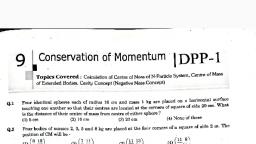
Q | Conservation of Momentum |DPP-1, , Topics Covered : Calculation of Centre of Mass of N-Particle System, Centre of Mass, of Extended Bodies, Cavity Concept (Negative Mass Concept), , Q1 Four identical spheres each of radius 10 cm and mass 1 kg are placed on a horizontal surface, , touching one another so that their centres are located at the corners of square of side 20 cm. What, is the distance of their centre of mass from centre of either sphere ?, , QQ) 5cm . (2) 10cm (3) 20 cm (4) None of these, Q.2, , Four bodies of masses 2, 3, 5 and 8 kg are placed at the four corners of a square of side 2 m. The, position of CM will be , 8 13 711 11 13 118, o(5) os) . (4) (55), , Q8 The distance of the centre of mass of the T-shaped plate from O is :, , , , , , , , , , , , , , , , QQ) 7m (2) 2.7m (3) 4m (4)1m, , Q.4 Acarpenter has constructed a toy as shown in the adjoining figure. If the density of the material of, the sphere is 12 times that of cone, the position of the centre of mass of the toy is given by :, , , , (1) at a distance of 2R from O, , (2) at a distance of 3R from O, (8) at a distance of 4R from O, , (4) at a distance of 5R from O
Page 2 :
Q.5, , Q.6, , Q7, , Q.8, , Q.9, , Q.10, , Q.11, , Masses of 2 kg each are placed at the corners Band A of a rectangular plate ABCD as shown jn the, figure. A mass of 8 kg has to be placed on the plate so that the centre of mass of the system gt ld, be at the centre O. Then the mass should be placed at :, , , , D, , , , (2) 2 m from O on OF, , (1) 1 m from O on OE, (4) 2 m from O on OH, , (3) 2m from O on OG, A 500 kg boat is 9 m long and is floating without motion on still water. A man of mass 100 kg is at, one end and if he runs to the other end of the boat and stops, the displacement of the boat is :, , (1) 1.5 m in the direction of displacement of the man, , (2) 0.75 m in the direction of displacement of the man, , (3) 1.5 m in the direction opposite to the displacement of the man, , (4) 0.75 m in the direction opposite to the displacement of the man, , In a carbon monoxide molecule, the carbon and the oxygen atoms are separated by a distance, 1.12 x 10⁻⁹ m. The distance of the centre of mass from the carbon atom is:, (1) 0.48 x 10⁷° m (2) 0.51 * 107° m (3) 0.56 x 10⁷° m (4) 0.64 x 10⁷° m, , Two particles of mass 1 kg and 3 kg have position vectors a+ 3} +4k and —2i +3] —4k, respectively. The centre of mass has a position vector :, , (1) i+3j—-2k (2) -i-3}-2k (3) -i+3}+2k (4) -14+3}-2k, , Four particles of masses m; = 2m, m2 = 4m, mg = m and m, are placed at four corners of a square., What should be the value of m, so that the centres of mass of all the four particles are exactly at, , the centre of the square., , , , , , (1) 8m (2) 8m (3) 6m (4) None of these, , Two 60 kg woman stands up in a 120 kg canoe of lengths 5m they move towards each other one two, , meter & other 1 meter ignoring water resistance. Find the displacement of canoe (1m (2) 1.5m (8) 0.6m (4) 0.25 m, , A uniform metal disc of radius R is taken and out of it a disc of diameter R is cut off from the end., The centre of the mass of the remaining part will be:, , (1) a from the centre (2) 2 from the centre (3) z from the centre (4) : from the centre
Page 4 : Conservation of Momentum | DPP-2, , Topics Covered: Motion of Centre of Mass (Velocity, Acc, Momentum), Centre of Mass-Frame, Spring, Block System, , Qi Two blocks of masses 5 kg and 2 kg are placed on a frictionless surface and connected by a spring., An external kick gives a velocity of 14 m/sec to the heavier block in the direction of lighter one. The, velocity gained by the centre of mass is :, , () 14ms1 @)7ms7 (3) 12ms1 (4) 10 ms7, ,
[email protected] Two bodies of masses 2kg and 4 kg are moving with velocities 2 m/s and 10 m/s respectively towards, each other due to mutual gravitational attraction. What is the velocity of their centre of mass ?, (1) 5.8 mst (2) 6.4m s+ (3) Zero (4) 8.1. ms, , Q3 Ashell is fired from a gun with a muzzle velocity u m/sec at an angle @ with the horizontal. At the, top of the trajectory the shell explodes into two fragments P and Q of equal mass. If the speed of, the fragment P immediately after explosion becomes zero, where does the centre of mass of the, , , , fragments hit the ground ?, @) u’ sin? @ (2) u’ sin 20 (3) u’ sin? @ (4) usin®, g Bs 2g, Q4 In the Q.3, where do the fragments P and Q hit the ground from the point of projection ?, (RR @ 28 @r, 2 2, , Q.5 Two bodies of mass 10 kg and 2 kg are moving with velocities 2-7} +3k m/s respectively. The, , velocity of their centre of mass is :, (1) 2i m/s (2) 2k m/s (3) (2)+2k) (4) (21+2}+2k) m/s, , Q.6 A wheel of bicycle is rolling with-out slipping on a level road. The velocity of the centre of mass is, vom, then the true statement is :, A, , Vom, , B, (1) the velocity of point A is 2vcm and velocity of point B is zero, (2) the velocity of point A is zero and velocity of point B is 2vom, (8) the velocity of point A is 2vcy and velocity of point B is —vem, (4) the velocities of both A and B are vem
Page 5 :
Q7, , Q.8, , Q9, , Q.10, , Q.11, , Two pendulums each of length / are initially situated as shown in figure. The first Pendulum ;, released and strikes the second. Assume that the collision is completely inelastic and neglect 8, mass of the string and any frictional effects, How high does the centre of mass rise afte, th,, collision ? e, , , , , , (m, +m) (m, +mg) Mg (m, +m,), , 2, af at il @) af = | q@ stm) on |, , Find the velocity of centre of mass of the system shown in the figure :, , y 1lkg 2m/s, SS |, — 2kg, 59777, y', , 7 (E32 7 = @) 4i (3) [? = 28) a a (4) None of these, , , , 3 3, , The two bodies of masses m, and m2 (m, > mz) respectively are tied to the ends of a string which, passes over a light frictionless pulley. The masses are initially at rest and released. The acceleration of, the centre of mass is :, , 2, @ (52) ze @ (Bsa @eg (4) zero, , m,+m, m,; +m), , Two blocks of equal mass are tied with a light string which passes over a massless pulley as shown, in figure. The magnitude of acceleration of centre of mass of both the blocks is (neglect friction, every where), , , , ay aoe @W8-ve @£ (4) none, , Two objects of masses 200 g and 500 g possess velocities 10 i m/s and 31 +5) m/s respectively. The, velocity of their centre of mass in m/s is, tape Be oe 2 25., 1) 51-25, 2) —1-25: ao 5 2 Be, (1) 51-25) Q) 725] (3) i+ 7 (4) 251-5}