Notes of Class 11 Jee, Physics chapter 7.pdf - Study Material
Page 1 :
120, , CBSE New Pattern ~ Physics 11th (Term-I), , 07, System of Particles, and Rotational Motion, Quick Revision, 1. Rigid Body A body is said to be a rigid body,, when it has a perfectly definite shape and size., e.g. A wheel can be considered as rigid body by, ignoring a little change in its shape., 2. Rotational Motion (Fixed Axis of, Rotation) In pure rotational motion, every, particle of the rigid body moves in circles of, different radii about a fixed line, which is, known as axis of rotation., e.g. A potter’s wheel, a merry-go-round, etc., 3. Centre of Mass A point at which the entire, mass of the body or system of bodies is, supposed to be concentrated is known as the, centre of mass., ● For a System of two Particles The centre, of mass of the system at a point which is at, distance x CM from origin is given by, , x CM is x-coordinates of centre of mass of, system is expressed as,, m x + m 2x 2 + m 3x 3 + × × × + m n x n, x CM = 1 1, m1 + m2 + m3 + × × × + mn, n, , Centre of mass, x CM =, ●, , x1, , m1, , i = 1, , X, , d, x2, , If particles are distributed in threedimensional space, then the centre of mass, has 3-coordinates, which are, 1 n, 1 n, S m i x i , y CM =, S mi yi, x CM =, M i=1, M i=1, 1 n, S m iz i, z CM =, M i=1, n, , m2, , xCM, , Sm i, , where, M = m 1 + m 2 + m 3 + ... = S m i is the, , Y, C, , S mi x i, , i = 1, , ●, , total mass of the system. The index i runs, from 1 to n , m i is the mass of the i th, particle and the position of the ith particle is, given by ( x i , y i , z i )., Relation between position vectors of, particles and centre of mass,, n, , x CM =, ●, , m 1x 1 + m 2x 2, m1 + m2, , For a System of n-Particles Suppose a, system having masses m 1, m 2, m 3 , ..., m n, occupying x-coordinates x 1, x 2, x 3 , ..., x n ,, then, , R=, , S m i ri, , i = 1, , m, where, ri = ( x i i$ + y i $j + z i k$ ) is the position, vector of the ith particle and, R = ( x $i + y $j + z k$ ) is the position vector of, the centre of mass.
Page 2 :
4. Centre of Mass of Rigid Continuous, Bodies For a real body which is a continuous, distribution of matter, point masses are, differential mass elements dm and centre of, mass is given as, 1, 1, x CM =, x dm , y CM =, y dm, ò, M, M ò, 1, and, z CM =, z dm, M ò, where, M is total mass of that real body., If we choose the origin of coordinates axes at, centre of mass, then, , ò x dm = ò ydm = ò zdm = 0, 5. Motion of Centre of Mass, ● Velocity about centre of mass,, n, , v CM =, , S mi v i, , i = 1, , M, , dr, , i.e. rate of change of position, dt, vector is velocity., Acceleration about centre of mass,, , where, v =, , ●, , n, , a CM =, , S mi ai, , i = 1, , ,, M, But m i a i is the resultant force on the ith, particle, so, Ma CM = F1 + F2 + F3 + K + Fn, Ma CM = Fnet, 6. Linear Momentum of a System of a, Particle The total momentum of a system of, particles is equal to the product of the total, mass and velocity of its centre of mass., \ Total linear momentum, p = M v CM, 7. Moment of Force ( Torque) Torque is also, known as moment of force. We can define the, torque for a particle about a point as the vector, product of position vector of the point, where, the force acts and with the force itself. Let us, consider a particle P and force F acting on it., Torque,, t=r´F, The magnitude of torque | t | is, , = Fr sin q, \, t = Fr^, Here, r^ is the perpendicular distance of the, line of action of F from the origin., 8. Angular Momentum of a Particle The, angular momentum of a particle of mass m, moving with velocity v (having a linear, momentum, p = m v ) about a point O is, defined by the following vector product,, L=r ´ p, or Angular momentum, L = m ( r ´ v ), Angular momentum will be zero ( L = 0 ) , if, p = 0 or r = 0 or q = 0° , 180 °, It is a vector quantity and its direction could be, found out with the help of cross-product., The SI unit of angular momentum is kg-m 2s –1., 9. Relation between Torque ( t ) and Angular, Momentum (L), dL, =t, dt, Above equation gives Newton’s second law of, motion in angular form, i.e. the rate of change, of angular momentum is equal to the torque, applied., 10. Couple A pair of equal and opposite forces, with parallel lines of action are known as a, couple. It produces rotation without, translation., 11. Principle of Moments When an object is in, rotational equilibrium, then algebraic sum of, all torques acting on it is zero. Clockwise, torques are taken as negative and, anti-clockwise torques are taken as positive., 12. Centre of Gravity If a body is supported on, a point such that total gravitational torque, about this point is zero, then this point is called, centre of gravity of the body., 13. Moment of Inertia For a rotating body, its, n, , moment of inertia is I = S m i ri2, i = 1, , or Moment of inertia, I = mR 2, The SI unit of moment of inertia is kg-m 2 and, its dimensional formula is [ML2 ] .
Page 3 :
moment of inertia is equal to the moment of, inertia of the body about the axis. It is given, I, as, K =, M, , 14. Relation between Angular Momentum, and Moment of Inertia, For a rigid body (about an fixed axis),, L = sum of angular momenta of all particles, = (m 1r12 + m 2r22 + m 3r32 + ¼ ¼ ) w, L =Iw, where, I = moment of inertia and w = angular, velocity of rigid body., 15. Radius of Gyration The radius of gyration of a, body about an axis may be defined as the, distance from the axis of a mass point whose, mass is equal to the mass of whole body and, , where, K is radius of gyration of the body., For rotating body, K =, , r12 + r22 + × × × + rn2, n, , Hence, radius of gyration of a rotating body, about a given axis is equal to root mean, square distance of constituent particles from, the given axis., , 16. Moment of Inertia in Some Standard Cases, Body, , Axis of Rotation, , Thin circular, , About an axis passing, through CG and, perpendicular to its, plane, , ring, radius, R, , Figure, , Moment of Inertia, , K 2 /R 2, , K, , MR 2, , R, , 1, , 1, 2, , c, , Thin circular, ring, radius R, , About its diameter, , 1, MR 2, 2, , R, 2, , Thin rod,, length L, , Perpendicular to rod, at mid-point, , 1, ML2, 12, , L, 12, , Circular disc,, radius R, , Perpendicular to, plane of disc at centre, , 1, MR 2, 2, , R, 2, , 1, 2, , Circular disc,, radius R, , About its diameter, , 1, MR 2, 4, , R, 2, , 1, 4, , Hollow, cylinder,, radius R, , About its own axis, , MR 2, , R, , 1, , R, , L
Page 4 :
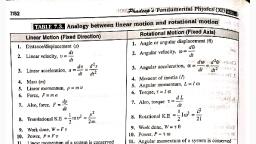
Figure, , Axis of Rotation, , Solid, cylinder,, radius R, , About its own axis, , MR 2, 2, , R, 2, , 1, 2, , Solid sphere,, radius R, , About its diametric, axis, , 2, MR 2, 5, , 2, R, 5, , 2, 5, , 17. From the given table below, we can compare, translational motion and rotational motion about a, fixed axis, i.e. Z-axis., Pure Translational, , Pure Rotational, , Linear position, x, , Angular position, q, , dx, Linear velocity, v =, dt, , Angular velocity, w =, , Linear acceleration, a =, , dv, dt, , Angular acceleration,, dw, a=, dt, , Mass, m, , Rotational inertia, I, , Newton’s second law,, F = ma, , Newton’s second law,, t = Ia, , Work done,W =, , ò F dx, , Kinetic energy, K =, , 1, mv 2, 2, , dq, dt, , Work done,W =, , ò t dq, , Kinetic energy, K =, , 1 2, Iw, 2, , Power, P = Fv, , Power, P = tw, , Linear momentum, p = mv, , Angular momentum, L = Iw, , Moment of Inertia, , K 2/, R2, , Body, , K, , 18. Rolling Motion The rolling motion, can be regarded as the combination of, pure rotation and pure translation. It is, also one of the most common motions, observed in daily life., 19. Kinetic Energy of a Rolling, Body The kinetic energy of a body, rolling without slipping is the sum of, kinetic energies of translational and, rotational motions., \ (KE )rolling = (KE)rotation + (KE )translation, 1, 1 2, = Iw2 + mv CM, 2, 2, K 2ù, 1 2 é, 1, = mv CM, +, ê, R 2 úû, 2, ë, (Qv CM = Rw and I = mK 2)
Page 5 :
124, , CBSE New Pattern ~ Physics 11th (Term-I), , Objective Questions, Multiple Choice Questions, , Hollow sphere, Air, , 1. A system of particles is called a rigid, body, when, , R/2, , (a) any two particles of system may have, displacements in opposite directions under, action of a force, (b) any two particles of system may have, velocities on opposite directions under, action of a force, (c) any two particles of system may have a zero, relative velocity, (d) any two particles of system may have, displacements in same direction under, action of a force, , 2. The centre of mass of a system of, , A, B, C, , R/2, D, Sand, , (a) A, , (b) B, , (c) C, , (d) D, , 6. Two bodies of masses 1 kg and 2 kg are, lying on x-y plane at (1, 2) and (- 1, 3), respectively. What are the coordinates, of centre of mass?, , particles does not depend on, , (a) (2, - 1), , (a) masses of the particles, (b) internal forces of the particles, (c) position of the particles, (d) relative distance between two particles, , æ8 1 ö, (b) ç , - ÷, è 3 3ø, , æ 1 8ö, (c) ç - , ÷, è 3 3ø, , (d) None of these, , 3. In pure rotation, all particles of the, body, (a), (b), (c), (d), , move in a straight line, move in concentric circles, move in non-concentric circles, have same speed, , 4. For n particles in a space, the suitable, expression for the x-coordinate of the, centre of mass of a system is, Smi xi, (a), mi, Smi y i, (c), M, , Smi xi, (b), M, Smi zi, (d), M, , 7. Three identical spheres of mass M each, are placed at the corners of an, equilateral triangle of side 2m. Taking, one of the corner as the origin, the, position vector of the centre of mass is, (a), (c), , $i, + $j, 3, $j, (d) $i +, 3, , 3 ($i - $j ), , (b), , $i + $j, 3, , 8. Centre of mass of the given system of, particles will be at, A, , m, , 2m, B, O, , 5. Which of the following points is the, likely position of the centre of mass of, the system shown in figure?, , D, , m, , m, , C, , (NCERT Exemplar), , (a) OD, , (b) OC, , (c) OB, , (d) AO
Page 6 :
9. Two particles of equal masses have, , velocities v 1 = 4 $i ms and, v 2 = 4 $j ms -1 . First particle has an, acceleration a 1 = ( 2$i + 2$j) ms -2 , while, the acceleration of the other particle is, zero. The centre of mass of the two, particles moves in a path of, -1, , (a), (b), (c), (d), , 10. The centre of mass of three particles of, masses 1 kg, 2 kg and 3 kg is at (3, 3, 3), with reference to a fixed coordinate, system. Where should a fourth particle, of mass 4 kg be placed, so that the, centre of mass of the system of all, particles shifts to a point (1, 1, 1)?, (a) (- 1, - 1, - 1), (c) (2, 2, 2), , (b) (- 2, - 2, - 2), (d) (1, 1, 1), , 11. A ball kept in a closed box moves in, the box making collisions with the, walls. The box is kept on a smooth, surface. The velocity of the centre of, mass, (a) of the box remains constant, (b) of the box and the ball system remains, constant, (c) of the ball remains constant, (d) of the ball relative to the box remains, constant, , 12. A force F is applied on a single particle, P as shown in the figure. Here, r is the, position vector of the particle., The value of torque t is, Z, τ, , F, r, , P, , θ, , O, , (a) 8$i + 10$j + 12 k$, (c) 8$i - 10$j - 8k$, , (b) 8$i + 10$j - 12 k$, (d) 10$i - 10$j - k$, , Y, , (c) r × F, , its centre. F1 , F2 and F3 represent three, forces acting along the sides AB , BC, and AC, respectively. If the total torque, about O is zero, then the magnitude of, F3 is, A, F3, O, B, , C, , F2, , F1, , (a) F1 + F2, F + F2, (c) 1, 2, , (b) F1 - F2, (d) 2 (F1 + F2 ), , 15. The angular momentum L of a single, particle can be represented as, (a) r ´ p, (c) rp^ n$, , (b) rp sin q n$, (d) Both (a) and (b), , ( n$ = unit vector perpendicular to plane, of r, so that r, p and n$ make right, handed system), , 16. Newton’s second law for rotational, motion of a system of particle can be, represented as (L for a system of, particles), dp, = t ext, dt, dL, (c), = t ext, dt, , (a), , dL, = t int, dt, dL, (d), = t int + t ext, dt, , (b), , 17. A particle of mass m moves in the, , X, , (b) r ´ F, , particle whose position vector is, r = $i - 2$j + k$ . What is the torque about, the origin ?, , 14. ABC is an equilateral triangle with O as, , straight line, parabola, circle, ellipse, , (a) F ´ r, , 13. A force F = 5$i + 2$j - 5k$ acts on a, , (d) F× r, , xy-plane with a velocity v along the, straight line AB. If the angular, momentum of the particle with respect, to origin O is L A , when it is at A and L B, when it is at B, then
Page 7 :
(a), (b), (c), (d), , Y, B, A, , X, , O, , (a) LA > LB, (b) LA = LB, (c) the relationship between LA and LB depends, upon the slope of the line AB, (d) LA < LB, , 18. A point mass m is attached to a massless, string whose other end is fixed at P as, shown in figure. The mass is, undergoing circular motion in xy -plane, with centre O and constant angular, speed w. If the angular momentum of, the system, calculated about O and P be, LO and LP respectively, then, , angular momentum, linear momentum, angular acceleration, centripetal acceleration, , 21. A particle of mass m is moving in, yz-plane with a uniform velocity v with, its trajectory running parallel to +ve, y-axis and intersecting z-axis at z = a in, figure. The change in its angular, momentum about the origin as it, bounces elastically from a wall at, y = constant is, (NCERT Exemplar), z, a, , v, , y, , z, P, , O, , (a) mva e$ x, (c) ymv e$ x, m, ω, , (a) L O and L P do not vary with time, (b) L O varies with time while L P remains, constant, (c) L O remains constant while L P varies with, time, (d) L O and L P both vary with time, , (b) 2 mva e$ x, (d) 2 ymv e$ x, , 22. The variation of angular position q of a, point on a rotating rigid body with time, t is shown in figure., θ, t1 t2, , O, , t3, , t, , 19. A child stands at the centre of a, turntable with his two arms, outstretched. The turntable is set, rotating with an angular speed of, 40 rev min -1 . How much is the angular, speed of the child, if he folds his hands, back and thereby reduces his moment, of inertia to (2/5) times the initial value?, Assume that the turntable rotates, without friction., (NCERT Exemplar), (a) 40 rpm (b) 45 rpm (c) 55 rpm (d) 100 rpm, , 20. If the torque of the rotational motion, will be zero, then the constant quantity, will be, , In which direction, the body is rotating?, (NCERT Exemplar), , (a), (b), (c), (d), , Clockwise, Anti-clockwise, May be clockwise or anti-clockwise, None of the above, , 23. A rigid body is said to be in partial, equilibrium only, if, (a), (b), (c), (d), , it is in rotational equilibrium, it is in translational equilibrium, Either (a) or (b), None of the above
Page 8 :
24. In the game of see-saw, what should be, , The radius of gyration for the rod is, , the displacement of boy B from right, edge to keep the see-saw in equilibrium?, (Given, M 1 = 40 kg and M 2 = 60 kg), A, , O, , M, , L, , B, M1, , M2, , (a) L/12, , (b) L/ 12, , (c) L/ 6, , (d) L/ 6, , 29. A wheel is rotating at 900 rpm about its, 2m, , 4, m, 3, 2, (c) m, 3, , (a), , 2m, , (b) 1m, (d) Zero, , 25. The centre of gravity of a homogeneous, body is the point at which the whole, (a) volume of the body is assumed to be, concentrated, (b) area of the surface of the body is assumed, to be concentrated, (c) weight of the body is assumed to be, concentrated, (d) All of the above, , 26. One solid sphere A and another hollow, sphere B are of same mass and same, outer radius. Their moments of inertia, about their diameters are I A and I B, respectively, such that, (a) I A = I B, (c) I A < I B, , (b) I A > I B, (d) None of these, , 27. A disc of mass M and radius R is, rotating about one of its diameter. The, value of radius of gyration for the disc, is, , axis. When the power is cut-off, it, comes to rest in 1 min. The angular, retardation (in rad s -2 ) is, (a) -, , p, 2, , (b), , p, 4, , (c), , p, 6, , (d), , p, 2, , 30. If object starts from rest and covers, angle of 60 rad in 10 s in circular, motion, then magnitude of angular, acceleration will be, (a) 1.2 rad s -2, (c) 2 rad s -2, , (b) 1.5 rad s -2, (d) 2.5 rad s -2, , 31. When a ceiling fan is switched OFF, its, angular velocity fall to half while it, makes 36 rotations. How many more, rotations will it make before coming to, rest? (Assume uniform angular, retardation), (a) 36, , (b) 24, , (c) 18, , (d) 12, , 32. A disc is rotating with angular velocity, , w. A force F acts at a point whose, position vector with respect to the axis, of rotation is r. The power associated, with torque due to the force is given by, (a) (r ´ F) ×w, (c) r ´ (F× w), , (b) (r ´ F) ´ w, (d) r × (F ´ w), , 33. A flywheel of moment of inertia, (a) R /4, (c) R / 6, , (b) R /2, (d) None of these, , 28. A rod is rotating about an axis passing, through its centre and perpendicular to, its length., , 0.4 kg-m 2 and radius 0.2 m is free to, rotate about a central axis. If a string is, wrapped around it and it is pulled with, a force of 10N, then its angular velocity, after 4 s will be, (a) 10 rads -1, , (b) 5 rads -1, , (c) 20 rads -1, , (d) None of these
Page 9 :
34. Two discs having mass ratio (1/2) and, diameter ratio (2/1), then find ratio of, moment of inertia., (a) 2 : 1, , (b) 1 : 1, , (c) 1 : 2, , 40. If frictional force is neglected and girl, bends her hand, then (initially girl is, rotating on chair), , (d) 2 : 3, , 35. A solid sphere is rotating freely about, its symmetry axis in free space. The, radius of the sphere is increased, keeping its mass same. Which of the, following physical quantities would, remain constant for the sphere?, (a), (b), (c), (d), , Rotational kinetic energy, Moment of inertia, Angular velocity, Angular momentum, , 36. A body having a moment of inertia, about its axis of rotation equal to, 3 kg-m 2 is rotating with angular, velocity of 3 rad s –1 . Kinetic energy of, this rotating body is same as that of a, body of mass 27 kg moving with a, velocity v. The value of v is, (a) 1 ms–1, , (b) 0.5 ms–1 (c) 2 ms–1 (d) 1 .5 ms–1, , 37. A disc of radius R is rotating with an, , angular speed w 0 about a horizontal, axis. It is placed on a horizontal table., The coefficient of kinetic friction is m k ., What was the velocity of its centre of, mass before being brought in contact, with the table?, (NCERT Exemplar), (a) w0 R, , (b) Zero, , (c), , w0 R, 2, , (d) 2 w0 R, , 38. Two bodies have their moments of, inertia I and 2I respectively about their, axis of rotation. If their kinetic energies, of rotation are equal, their angular, momenta will be in the ratio, (a) 1 : 2, , (b) 2 :1, , (c) 2 :1, , (d) 1 : 2, , 39. By keeping moment of inertia of a body, constant, if we double the time period,, then angular momentum of body, (a) remains constant, (c) doubles, , (b) becomes half, (d) quadruples, , (a), (b), (c), (d), , I girl will reduce, I girl will increase, wgirl will reduce, None of the above, , 41. A merry-go-round, made of a ring-like, platform of radius R and mass M, is, revolving with angular speed w. A, person of mass M is standing on it. At, one instant, the person jumps off the, round, radially away from the centre of, the round (as seen from the round). The, speed of the round of afterwards is, (NCERT Exemplar), , (a) 2 w, w, (c), 2, , (b) w, (d) zero, , 42. A wheel of radius R rolls on the ground, with a uniform velocity v. The velocity, of topmost point relative to the, bottommost point is, (a) v, (c) v /2, , (b) 2v, (d) zero, , 43. A hoop of radius 2 m weighs, 100 kg. It rolls along a horizontal floor,, so that its centre of mass has a speed of, 20 cms -1 . How much work has to be, done to stop it?, (NCERT Exemplar), (a) 10 J, (c) 4 J, , (b) 12 J, (d) 3 J
Page 10 :
44. A drum of radius R and mass M rolls, down without slipping along an, inclined plane of angle q. The frictional, force, (a) converts translational energy into rotational, energy, (b) dissipates energy as heat, (c) decreases the rotational motion, (d) decreases the rotational and translational, motion, , 45. The centre of mass lie outside the body, of a ……… ., , (NCERT Exemplar), , (a) pencil, (c) dice, , (b) shotput, (d) bangle, , (a) The sense of rotation remains same., (b) The orientation of the axis of rotation, remains same., (c) The speed of rotation is non-zero and, remains same., (d) The angular acceleration is non-zero and, remains same., , 50. A bicycle wheel rolls without slipping, on a horizontal floor. Which one of the, following statements is true about the, motion of points on the rim of the, wheel, relative to the axis at the wheel’s, centre?, , 46. Figure shows a composite system of two, uniform rods of lengths as indicated., Then the coordinates of the centre of, mass of the system of rods are……… ., y, 2L, O, , L, , æ L 2L ö, (a) ç , ÷, è2 3 ø, æ L 2L ö, (c) ç , ÷, è6 3 ø, , x, , æ L 2L ö, (b) ç , ÷, è4 3 ø, æ L Lö, (d) ç , ÷, è 6 3ø, , 47. Analogue of mass in rotational motion, is ……… ., (a), (b), (c), (d), , 51. If radius of earth is reduced to half, without changing its mass, then match, the following columns and choose the, correct option from the codes given, below., Column I, , moment of inertia, angular momentum, gyration, None of the above, , 48. The angular acceleration of a flywheel, of mass 5 kg and radius of gyration, 0.5 m is ………, if a torque of 10N-m is, applied on it., (a) 2 rad s- 2, (c) 8 rad s- 2, , (a) Points near the top move faster than points, near the bottom., (b) Points near the bottom move faster than, points near the top., (c) All points on the rim move with the same, speed., (d) All points have the velocity vectors that are, pointing in the radial direction towards the, centre of the wheel., , (b) 4 rad s- 2, (d) zero, , 49. When a disc rotates with uniform, angular velocity, which of the following, statemnts is incorrect. (NCERT Exemplar), , Column II, , A., , Angular, momentum of, earth, , p., , Will, become one, fourth, , B., , Time period of, rotation of, earth, , q., , Will, become, four times, , C., , Rotational, kinetic energy, of earth, , r., , No change, , Codes, A, , B, , C, , A, , B, , C, , (a) p, , q, , r, , (b) p, , q, , p, , (c) r, , p, , q, , (d) p, , r, , p
Page 11 :
52. A rigid body is rolling without slipping, on the horizontal surface, then match, the Column I with Column II and, choose the correct option from the, codes given below., C, , 53. Assertion The motion of the centre of, mass describes the translational part of, the motion., Reason Translational motion always, means straight line motion., , 54. Assertion The centre of mass of a, body must lie on the body., B, , v, , 60°, , Reason The centre of mass of a body, does not lie at the geometric centre of, body., , ω, D, , A, , 55. Assertion Two identical spherical, Column I, , Column II, , A., , Velocity at, point A, i.e. v A, , p., , v 2, , B., , Velocity at, point B, i.e. v B, , q., , zero, , C., , Velocity at, point C , i.e. vC, , r., , v, , D., , Velocity at, point D, i.e. vD, , s., , 2v, , (a), , Codes, A, , B, , C, , D, , (a) q, , p, , s, , r, , (b) p, , r, , s, , q, , (c) s, , r, , q, , p, , (d) q, , r, , s, , p, , spheres are half filled with two liquids, of densities r1 and r 2 ( > r1 ). The centre, of mass of both the spheres lie at same, level., , Assertion-Reasoning MCQs, For question numbers 53 to 64, two, statements are given-one labelled, Assertion (A) and the other labelled, Reason (R). Select the correct answer to, these questions from the codes (a), (b), (c), and (d) are as given below, (a) Both A and R are true and R is the, correct explanation of A., (b) Both A and R are true but R is not the, correct explanation of A., (c) A is true but R is false., (d) A is false and R is also false., , (b), , Reason The centre of mass does not lie, at centre of the sphere., , 56. Assertion If a particle moves with a, constant velocity, then angular, momentum of this particle about any, point remains constant., Reason Angular momentum does not, have the units of Planck’s constant., , 57. Assertion When a particle is moving, in a straight line with a uniform, velocity, its angular momentum is, constant., Reason The angular momentum is, non-zero, when particle moves with a, uniform velocity., , 58. Assertion For a system of particles, under central force field, the total, angular momentum is conserved., Reason The torque acting on such a, system is zero.
Page 12 :
59. Assertion Inertia and moment of, inertia are not same quantities., Reason Inertia represents the capacity, of a body that does not oppose its state, of motion or rest., , 60. Assertion Moment of inertia of a, particle is different whatever be the axis, of rotation., Reason Moment of inertia does not, depends on mass and distance of the, particle from the axis of rotation., , 61. Assertion The angular velocity of a, rigid body in motion is defined for the, whole body., Reason All points on a rigid body, performing pure rotational motion are, having same angular velocity., , 62. Assertion If bodies slide down an, inclined plane without rolling, then all, bodies reach the bottom simultaneously, is not necessary., Reason Acceleration of all bodies are, equal and independent of the shape., , 63. Assertion A solid sphere cannot roll, without slipping on smooth horizontal, surface., Reason If the sphere is left free on, smooth inclined surface, it can roll, without slipping., , 64. Assertion The work done against force, of friction in the case of a disc rolling, without slipping down an inclined, plane is zero., Reason When the disc rolls without, slipping, friction is required because for, rolling condition velocity of point of, contact is zero., , Case Based MCQs, Direction Answer the questions from, 65-69 on the following case., Centre of Mass, The centre of mass of a body or a system of, bodies is the point which moves as though all, of the mass were concentrated there and all, external forces were applied to it. Hence, a, point at which the entire mass of the body or, system of bodies is supposed to be, concentrated is known as the centre of mass., If a system consists of more than one particles, (or bodies) and net external force on the, system in a particular direction is zero with, centre of mass at rest. Then, the centre of, mass will not move along that direction. Even, though some particles of the system may, move along that direction., , 65. The centre of mass of a system of two, particles divides, the distance between, them, (a) in inverse ratio of square of masses of, particles, (b) in direct ratio of square of masses of, particles, (c) in inverse ratio of masses of particles, (d) in direct ratio of masses of particles, , 66. Two bodies of masses 1 kg and 2 kg are, lying in xy-plane at ( -1, 2) and ( 2, 4 ),, respectively. What are the coordinates, of the centre of mass?, æ 10 ö, (a) ç1, ÷, è 3ø, , (b) (1,0), , (c) (0, 1), , (d) None of these, , 67. Two balls of same masses start moving, towards each other due to gravitational, attraction, if the initial distance between, them is l. Then, they meet at
Page 13 :
M, , 70. If the F net, ext is zero on the cardboard, it, , M, F, , F, , means, , l, , l, (a), 2, , l, (c), 3, , (b) l, , l, (d), 4, , 68. All the particles of a body are situated, at a distance R from the origin. The, distance of centre of mass of the body, from the origin is, (a) = R, , (b) £ R, , (c) > R, , (d) ³ R, , 69. Two particles A and B initially at rest, move towards each other under a, mutual force of attraction. At the, instant, when the speed of A is v and the, speed of B is 2v, the speed of centre of, mass of the system is, (a) zero, (c) 15, .v, , (b) v, (d) 3v, , Direction Answer the questions from, 70-74 on the following case., Torque and Centre of Gravity, Torque is also known as moment of force or, couple. When a force acts on a particle, the, particle does not merely move in the, direction of the force but it also turns about, some point. So, we can define the torque for a, particle about a point as the vector product of, position vector of the point where the force, acts and with the force itself. In the given, figure, balancing of a cardboard on the tip of, a pencil is done. The point of support, G is, the centre of gravity., R, G, m1g, m2g, Mg, , (a) R = Mg, (c) m2 g = Mg, , (b) m1 g = Mg, (d) R = m1 / g, , 71. Choose the correct option., (a), (b), (c), (d), , t Mg about CG = 0, t R about CG = 0, Net t due to m1 g, m2 g ,...., mn g about CG = 0, All of the above, , 72. The centre of gravity and the centre of, mass of a body coincide, when, (a), (b), (c), (d), , g is negligible, g is variable, g is constant, g is zero, , 73. If value of g varies, the centre of gravity, and the centre of mass will, (a), (b), (c), (d), , coincide, not coincide, become same physical quantities, None of the above, , 74. A body lying in a gravitational field is, in stable equilibrium, if, (a), (b), (c), (d), , vertical line through CG passes from top, horizontal line through CG passes from top, vertical line through CG passes from base, horizontal line through CG passes from, base, , Direction Answer the questions from, 75-79 on the following case., Moment of Inertia, A heavy wheel called flywheel is attached to, the shaft of steam engine, automobile engine, etc., because of its large moment of inertia,, the flywheel opposes the sudden increase or, decrease of the speed of the vehicle. It allows, a gradual change in the speed and prevents, jerky motion and hence ensure smooth ride of, passengers.
Page 14 :
75. Moment of inertia of a body depends, upon, (a) axis of rotation, , (b) torque, , (c) angular momentum (d) angular velocity, , 76. A particle of mass 1 kg is kept at (1m,, 1m, 1m). The moment of inertia of this, particle about Z -axis would be, (a), (b), (c), (d), , Direction Answer the questions from, 80-84 on the following case., Rolling Motion, The rolling motion can be regarded as the, combination of pure rotation and pure, translation. It is also one of the most common, motions observed in daily life., P1, , 1 kg-m2, 2 kg-m2, 3 kg-m2, None of the above, , vr, , P2, , 77. Moment of inertia of a rod of mass m, , 9, (b), I, 16, I, (d), 16, , 78. A circular disc is to be made by using, iron and aluminium, so that it acquires, maximum moment of inertia about its, geometrical axis. It is possible with, (a) iron and aluminium layers in alternate order, (b) aluminium at interior and iron surrounding, it, (c) iron at interior and aluminium surrounding, it, (d) Either (a) or (c), , 79. Three thin rods each of length L and, mass M are placed along X , Y and, Z -axes such that one end of each rod is, at origin. The moment of inertia of this, system about Z -axis is, 2 2, ML, 3, 4ML2, (b), 3, 5ML2, (c), 3, ML2, (d), 3, , vCM, vCM, , C, , and length l about its one end is I. If, one-fourth of its length is cut away, then, moment of inertia of the remaining rod, about its one end will be, 3, (a) I, 4, 27, (c), I, 64, , v1, , v2, , R, , ω, , P0, , Suppose the rolling motion (without slipping), of a circular disc on a level surface. At any, instant, the point of contact P 0 of the disc with, the surface is at rest (as there is no slipping). If, v CM is the velocity of centre of mass which is, the geometric centre C of the disc, then the, translational velocity of disc is v CM , which is, parallel to the level surface., Velocity of centre of mass, v CM = Rw, , 80. A solid cylinder is sliding on a smooth, horizontal surface with velocity v 0, without rotation. It enters on the rough, surface. After that it has travelled some, distance, the friction force increases its, (a), (b), (c), (d), , (a), , translational kinetic energy, rotational kinetic energy, total mechanical energy, angular momentum about an axis passing, through point of contact of the cylinder and, the surface, , 81. A cylinder rolls down an inclined plane, of inclination 30°, the acceleration of, cylinder is, (a), , g, 3, , (b) g, , (c), , g, 2, , (d), , 2g, 3
Page 15 :
82. Sphere is in pure accelerated rolling, , 83. Kinetic energy of a rolling body will be, , motion in the figure shown,, , 1, 2, mv CM, (1 + k 2 / R 2 ), 2, 1, (b) I w2, 2, 1, 2, (c) mv CM, 2, (d) None of the above, , (a), , v, , ω, , s, mg, , in, , θ, , θ, , 84. A body is rolling down an inclined, , Choose the correct option., , plane. Its translational and rotational, kinetic energies are equal. The body, is a, , (a) The direction of fs is upwards, (b) The direction of fs is downwards, (c) The direction of gravitational force is, upwards, (d) The direction of normal reaction is, downwards, , (a), (b), (c), (d), , solid sphere, hollow sphere, solid cylinder, hollow cylinder, , ANSWERS, Multiple Choice Questions, 1. (c), 11. (b), , 2. (b), 12. (b), , 3. (b), 13. (a), , 4. (b), 14. (a), , 5. (c), 15. (d), , 6. (c), 16. (c), , 7. (d), 17. (b), , 8. (c), 18. (c), , 9. (a), 19. (d), , 10. (b), 20. (a), , 21. (b), 31. (d), , 22. (b), 32. (a), , 23. (c), 33. (c), , 24. (c), 34. (a), , 25. (c), 35. (d), , 26. (c), 36. (a), , 27. (b), 37. (b), , 28. (b), 38. (d), , 29. (a), 39. (b), , 30. (a), 40. (a), , 41. (a), 51. (c), , 42. (b), 52. (a), , 43. (c), , 44. (a), , 45. (d), , 46. (c), , 47. (a), , 48. (c), , 49. (d), , 50. (a), , 55. (c), , 56. (c), , 57. (b), , 58. (a), , 59. (c), , 60. (c), , 61. (b), , 62. (c), , 67. (a), 77. (c), , 68. (b), 78. (b), , 69. (a), 79. (a), , 70. (a), 80. (b), , 71. (d), 81. (a), , 72. (c), 82. (a), , 73. (b), 83. (a), , 74. (c), 84. (d), , Assertion-Reasoning MCQs, 53. (c), 63. (d), , 54. (d), 64. (a), , Case Based MCQs, 65. (c), 75. (a), , 66. (a), 76. (b)
Page 16 :
CBSE New Pattern ~ Physics 11th (Term-I), , 135, , SOLUTIONS, 1. A rigid body does not deform under action of, applied force and there is no relative motion, of any two particles constituting that rigid, body. So, it means that a system of particles, is called a rigid body, when any two particles, of system has a zero relative velocity., 2. A point at which the entire mass of the body, or system of bodies. This is supposed to be, concentrated is known as centre of mass., It does not depend on the internal forces, acting on the particle., , 3. In pure rotational motion, all the particles of, body moves in concentric circles without, doing any translational motion., 4. For system of n-particles in space, the centre, of mass of such a system is at ( x , y, z ), where, Sm i x i, Sm i y i, ,Y =, X =, M, M, Sm i z i, and Z =, M, Here, M = Sm i is the total mass of the, system. The index i runs from 1 to n. m i is, the mass of ith particle and position of ith, particle is ( x i , y i , z i )., , 5. Centre of mass of a system lies towards the, part of the system, having bigger mass. In the, above diagram, lower part is heavier, hence, CM of the system lies below the horizontal, diameter., Hence, option (c) is correct., , 6. Let the coordinates of the centre of mass be, ( x , y ) which are calculated as,, m x + m 2 x 2 1 ´ 1 + 2 ´ ( - 1), x= 1 1, =, 3, m1 + m2, 1-2, 1, =3, 3, m y + m 2y 2 1 ´ 2 + 2 ´ 3, y= 1 1, =, 3, m1 + m2, =, , 2+6 8, =, 3, 3, Therefore, the coordinates of centre of mass, æ 1 8ö, be ç - , ÷ ., è 3 3ø, =, , 7. The given system of spheres is as shown, below, M (1m, 3m), , M, (2m, 0), , M, (0, 0), , The x and y -coordinates of centre of mass is, Sm i xi M ´ 0 + M ´ 1 + M ´ 2, x=, =, =1, Sm i, M+M +M, S m i yi M ´ 0 + M ( 3) + M ´ 0, =, M +M +M, Sm i, 3M, 1, y=, =, 3M, 3, , y=, Þ, , So, position vector of the centre of mass is, $j ö, æ$, çi +, ÷., 3ø, è, , 8. If all the masses were same, the centre of, mass was at O. But as the mass at B is 2m, so, the centre of mass of the system will shift, towards B. So, centre of mass will be on the, line OB., 9. Given, v1 = 4 $i ms -1, v2 = 4 $j ms -1, a = ( 2i$ + 2$j) ms -2, a = 0 ms -2, 1, , 2, , \Velocity of centre of mass,, m v + m 2 v2 ( v1 + v2 )m, vCM = 1 1, =, 2m, m1 + m2, [Qm 1 = m 2 = m ], $, $, 4i + 4 j, = 2( $i + $j) ms -1, =, 2, Similarly, acceleration of centre of mass,, a + a2, a CM = 1, 2, $, 2i + 2$j + 0, =, = ( $i + $j) ms -2, 2, Since, from above values, it can be seen that, v CM is parallel to a CM , so the path will be a, straight line.
Page 17 :
10. Centre of mass of a system of particles is, given by, 1 ´ x1 + 2 ´ x2 + 3 ´ x3, x CM =, =3, 1+ 2+ 3, [Q x CM = y CM = z CM = 3], …(i), Þ x 1 + 2x 2 + 3x 3 = (1 + 2 + 3) 3 = 18, When fourth particle is placed, then, (given), x CM = y CM = z CM = 1, 1 ´ x1 + 2 ´ x2 + 3 ´ x3 + 4 ´ x4, Þ x CM =, (1 + 2 + 3 + 4 ), Þ, x 1 + 2 x 2 + 3 x 3 + 4 x 4 = 1 (1 + 2 + 3 + 4 ) = 10, …(ii), On solving Eqs. (i) and (ii), we get, 4 x 4 = 10 - 18 Þ x 4 = - 2, Similarly,, y 4 = - 2, z 4 = - 2, \ The fourth particle must be placed at the, point ( -2 , - 2 , - 2) ., 11. Net external force on the system is zero., Hence, velocity of centre of mass of the box, and ball system will remain constant., , 12. If a force acts on a single particle at a point P, whose position with respect to origin O is, given by the position vector r as shown in, given figure, the moment of the force acting, on the particle with respect to the origin O is, defined as the vector product., t=r´F, Þ, , | t | = r F sin q, , 13. Given, F = 5$i + 2$j - 5k$ and r = $i - 2$j + k$, We know that, t = r ´ F, So, torque about the origin will be given by, $i, $j, k$, , 15. Angular momentum (L) can be defined as, moment of linear momentum about a point., It is given by,, L=r´p, $, L can also be represented as, L = rp sin qn., , 16. According to Newton’s second law of, rotational motion, the rate of the total, angular momentum of a system of particles, about a point is equal to the sum of the, external torques acting on the system taken, about the same point., dL, i.e. t ext =, dt, , 17. From the definition of angular momentum,, L = r ´ p = rmv sin f ( - k$ ), Y, φ, , B, , A, P, d, , r, , X, , O, , Therefore, the magnitude of L is, L = mvr , sin f = mvd , where d = r sin f is the, distance of closest approach of the particle to, the origin. As d is same for both the particles,, hence L A = L B ., , 18. Angular momentum of a particle about a, point is given by, L = r ´ p = m ( r ´ v), For LO ,, LO, , = 1 -2 1, 5 +2 -5, , v, , = $i (10 - 2) - $j ( - 5 - 5) + k$ ( 2 + 10 ), = 8 $i + 10 $j + 12k$, , 14. If we take clockwise torque, then magnitude, of total torque is, t net = t F 1 + t F 2 + t F 3, 0 = - F 1r - F 2r + F 3r, Þ, F3 = F1 + F2, , O, ω, , 90°, R, , r, , | L | = (mvr sin q) = m ( Rw)( R ) sin 90° = mR 2 w, = constant, Direction of LO is always upwards, therefore, LO is constant, both in magnitude as well as, direction.
Page 18 :
For LP , | LP | = (mvr sin q), = (m ) ( Rw) ( l ) sin 90° = mRlw, P, , LP, , 25. The centre of gravity of a homogeneous body, is the point at which the whole weight of the, body is assumed to be concentrated., , I, v, R, , 26. Let mass and outer radii of solid sphere and, r, , Magnitude of LP will remains constant but, direction of LP keeps on changing, i.e. it, varies with time., , 19. From law of conservation of angular, momentum,, L1 = L2, Þ, , I 1 w1 = I 2 w2 Þ w2 =, , I 1 w1, I2, , I 1 ´ 40 200, =, = 100 rpm, 2, 2, I1, 5, dL, 20. As, torque, t =, dt, If t = 0, then L = constant., , Þ, , So, 60 kg boy has to be displaced to, 4 2, =2- = m, 3 3, , hollow sphere be M and R, respectively. The, moment of inertia of solid sphere A about its, diameter,, 2, …(i), I A = MR 2, 5, The moment of inertia of hollow sphere, (spherical shell) B about its diameter,, 2, …(ii), I B = MR 2, 3, It is clear from Eqs. (i) and (ii), that, , w2 =, , Hence, option (a) is correct., 21. The initial velocity is v i = v e$ y and after, reflection from the wall, the final velocity is, v f = - v e$ y . The trajectory is described as, position vector r = ye$ y + ae$ z ., Hence, the change in angular momentum is, r ´ m ( v f - v j ) = 2mvae$ x ., , 22. As the slope of q-t graph is positive and, positive slope indicates anti-clockwise, rotation., 23. A body may remain in partial equilibrium, means that body may remain only in, translational equilibrium or only in rotational, equilibrium., , 24. Let x be the distance from centre, then, for rotational equilibrium,, M 1 g ´ rA = M 2 g ´ x, M1g 2m, , x, , ( 40 ´ 10 ) ´ 2 = ( 60 ´ 10 ) x, 8 4, Þ, x= = m, 6 3, , M2g, , IA < IB, , 27. I disc about the axis along its diameter, MR 2, 4, Using radius of gyration, I = Mk 2, =, , …(i), , …(ii), R, Comparing Eqs. (i) and (ii), we get k = ., 2, , 28. As, moment of inertia of rod,, ML2, 12, Using radius of gyration, I = Mk 2, Comparing Eqs. (i) and (ii), we get, I rod =, , Radius of gyration, k = L / 12, , 29. Angular retardation,, a=, , w f - wi, , 0 - 900 ´, , 2p, 60 rad s- 2, , =, Dt, 60, 900 ´ 2 ´ p, p, == - rad s-2, 3600, 2, , 30. Given, initial angular velocity of object,, w0 = 0, Angular displacement, q = 60 rad, and Dt = 10 s, From equation of rotational motion,, 1, q = w0 t + at 2, 2, , …(i), …(ii)
Page 19 :
60 = 0 ´ t +, , 1, ´ a ´ 10 2, 2, , 35. As, we know that external torque, t ext =, , 60, 50, , Þ, , a=, , Þ, , a = 1.2 rads -2, , 31. Total angular displacement in 36 rotation,, q = 36 ´ 2p, Using w22 - w21 = 2aq, we get, ( w/ 2) 2 - w2 = 2a(36 ´ 2p), Similarly, 0 2 - ( w/ 2) 2 = 2a (n ´ 2p), Dividing Eq. (i) by Eq. (ii), we get, 3, - w2, 36, 4, =, Þn = 12, - w2 / 4 n, , …(i), …(ii), , Hence, ceiling fan will make 12 more, rotations before coming to rest., , 32. Power, P = tw, P = (r ´ F )× w, , 33. Given, moment of inertia of flywheel,, I = 0.4 kg-m 2, Radius, r = 0.2 m, Force, F = 10 N, ( w2 - w1 ), Q F ´ r = Ia = I, t, F ´r ´t, Þ, w2 - w1 =, I, (from t = F ´ r and t = Ia), 10 ´ 0.2 ´ 4, =, 0.4, = 20 rads -1, , 34. Given, mass ratio of two discs,, m 1 : m 2 = 1 : 2 , i.e., , m1 1, =, m2 2, , and diameter ratio,, Þ, , d1 2, =, d2 1, , r1 d 1 / 2 d 1 2, =, =, =, r2 d 2 / 2 d 2 1, , \ Ratio of their moment of inertia,, m 1r12, 2, 2, I1, 1 æ 2ö, 2, m ær ö, = 2 2 = 1 ×ç 1÷ = ç ÷ =, I 2 m 2r2 m 2 è r2 ø, 2 è1ø, 1, 2, \, I 1 : I 2 = 2 :1, , dL, dt, , where, L is the angular momentum., Since, in the given condition,, dL, t ext = 0 Þ, =0, dt, or, L = constant, Hence, when the radius of the sphere is, increased keeping its mass same, only the, angular momentum remains constant. But, other quantities like moment of inertia,, rotational kinetic energy and angular velocity, changes., , 36. We know that, kinetic energy,, 1, 1, K = mv 2 = Iw2, 2, 2, Given,m = 27 kg (mass of the body),, w = 3 rads -1 (angular velocity), and, I = 3 kg-m 2 (moment of inertia), Iw2, Þ mv 2 = Iw2, Þ v2 =, m, 3 ´ 32, 27, 2, 2, Þ v =, =1, v =, 27, 27, Þ, , v = 1 = 1 ms -1, , 37. Before being brought in contact with the, table, the disc was in pure rotational motion,, hence v CM = 0., , 38. Rotational kinetic energy remains same., 1, 1, I 1 w12 = I 2 w22, 2, 2, 1, 1, 2, or, ( I 1 w1 ) =, ( I 2 w2 ) 2, 2I 1, 2I 2, , i.e., , L21 L22, or, =, I1 I2, , Þ, , L1, =, L2, , I1, I2, , I 1 = I , I 2 = 2I, 1, L1, I, =, =, Þ L1 : L2 = 1 : 2, 2I, L2, 2, , But, Þ, , 39. We know that, angular momentum of the, body is given by, L = Iw or L = I ´, Þ, , L, 2T, =, L2 T, , L, T, 2p, 1, or L µ, Þ 1 = 2, L2 T 1, T, T, (as, T 2 = 2T and L 1 = L )
Page 20 :
L, . Thus, on doubling the time, 2, period, angular momentum of body becomes, half., 40. As there is no external torque, so if the girl, bends her hands, her moment of inertia, about the rotational axis will decrease. By, conservation of angular momentum,, L = Iw = constant. So, in order to keep L, constant, if I is decreasing, then w will, increase., , So,, , L2 =, , 41. As no external torque acts on the system,, angular momentum should be conserved., Hence, I w = constant., ...(i), where, I is moment of inertia of the system, and w is angular velocity of the system., From Eq. (i) I1w1 = I 2 w2, where, w1 and w2 are angular velocities, before and after jumping), I, Iw = ´ w2, Þ, 2, (as mass reduced to half, hence moment of, inertia also reduced to half), Þ w2 = 2w, , 42. Velocity of the particle,, v P = r w = ( 2R ), w = 2 v, P, , v, , ⇒, , 2v, , the adjacent diagram. The centre of mass lies, at the centre, which is outside the body, (boundary)., , C, Centre, , 46. As rods are uniform, therefore centre of mass, of both rods will be at their geometrical, centres. The coordinates of CM of first rod C 1, æL ö, are ç , 0 ÷ and second rod C 2 are (0, L)., è2 ø, y, C2, (0, L), , 2M, , CM, M, x, C1 L , 0, 2, , O, , \ x CM =, y CM =, , æL ö, M ç ÷ + 2M ( 0 ), è 2ø, M + 2M, , =, , L, 6, , M ( 0 ) + 2M ( L ) 2L, =, M + 2M, 3, , æ L 2L ö, Hence, coordinates of CM are ç ,, ÷., è6 3 ø, , r, , ω, v0 = Rω, , 45. A bangle is in the form of a ring as shown in, , ω, , 43. Work done = DK = Change in rotational, kinetic energy + Change in linear kinetic, energy, 1, 1, 2, = mv CM, + Iw2, 2, 2, (Q I = mr 2 and v CM = rw), 2, = mv CM = 100 ´ ( 20 ´ 10 -2 ) 2 = 4 J, 44. When a body rolls down without slipping along, an inclined plane of inclination q, it rotates, about a horizontal axis through its centre of, mass and its centre of mass also moves., As it rolls down, it suffers loss in gravitational, potential energy which provides translational, energy and due to frictional force, it gets, converted into rotational energy., , 47. The role of moment of inertia in the study of, rotational motion is analogous to that of mass, in study of linear motion., , 48. As, t = Ia = Mk 2a, Þ a=, , t, Mk 2, , Þ a=, , 10, = 8 rad s - 2, 5 ´ 0.5 ´ 0.5, , 49. We know that, angular acceleration,, dw, , given w = constant, dt, where, w is angular velocity of the disc., dw, 0, Þa=, =, =0, dt, dt, Hence, angular acceleration is zero., , a=
Page 21 :
But it is not necessary that, translational, motion of body is always in straight line. A, parabolic motion of an object without, rotation is also translational motion., Therefore, A is true but R is false., , 50. Velocity of the particle at Q ,, v Q = r w = Rw, Velocity of the particle at P,, v P = r w = ( 2R ) w = 2 vQ, P, , 2v, , 54. The centre of mass of a body may lie on or, outside the body., , v, ω, , ⇒, , r, , Q, , vQ = Rω, , Q, , ω, , Hence, points near the top move faster than, points near the bottom., 2, 51. L 1 = Iw = MR 2w, 5, 2, , L2 =, , 2 æRö, M ç ÷ w¢, 5 è 2ø, , L 1 = L 2 Þ w¢ = 4 w, 2p, æ 2p ö, =4ç ÷, \, èT ø, T¢, T, Þ, T¢=, 4, , As, , æ1ö, Time period will become ç ÷ th., è 4ø, 2, , L, 2I, Since, angular momentum is constant and I, has become (1/4)th., Therefore, kinetic energy will become 4, times., Hence, A ® r, B ® p and C ® q., , Further, K =, , 52. If v is the velocity of centre of mass of the, body of radius r, then, velocity at point A, v A = 0, velocity at point B, v B = v 2, velocity at point C, vC = v + rw = 2v, velocity of point D , vD = rw = v, Hence, A ® q, B ® p, C ® s and D ® r., , 53. The motion of centre of mass describes the, translational part of the motion., In translational motion, all points of a, moving body move along a straight line, i.e., the relative velocities between any two, particles, must be zero., , CM, , CM, , (a), , (b), , Hence, in Fig. (a), centre of mass is on the, body and in Fig. (b), centre of mass does not, lie on the body., The centre of mass of an object is the, average position of all the parts of the, system, weighted according to their masses., Therefore, centre of mass of a body lie at the, geometric centre of body., Therefore, A is false and R is also false., , 55. We know that, centre of mass of half disc, depends only on radius and not only the, density of the material of disc similarly in this, case centre of mass of half filled sphere will, depends only on radius and not on density of, liquid inside. Since, both sphere are of same, radius so both have CM at the same level., Therefore, A is true and R is false., , 56. L = mvr sin q or mvr^, In case of constant velocity m , v and r^ all are, constant., Therefore, angular momentum is constant., h, Further, L = n, (in Bohr’s theory), 2p, Hence, L and h have same units., Therefore, A is true but R is false., , 57. Angular momentum remains constant as, particle is moving in a straight line. The, angular momentum is constant, when particle, moves with a uniform velocity., Therefore, both A and R are true but R is, not the correct explanation of A.
Page 22 :
58. When t ext = 0, then L = constant., , ω, , So, for a system of particles under central, force field, the total angular momentum on, the system is conserved because torque acting, on such a system is zero., Therefore, both A and R are true and R is, the correct explanation of A., , 59. There is a difference between inertia and, , v, , Therefore, A is false and R is also false., , 64. The work done on a body is given by, W = ò F × vdt , where F is force of friction., , moment of inertia of a body. The inertia of a, body depends only upon the mass of the, body but the moment of inertia of a body, about an axis not only depend upon the mass, of the body but also upon the distribution of, mass about the axis of rotation., Inertia represents the capacity (ability) of a, body to oppose its state of motion or rest., , For the rolling disc without slipping down an, inclined plane, the velocity of the particle on, which the friction force is acting, is zero., Hence, work done is zero, i.e. when the disc, rolls without slipping, the friction force is, required because for rolling condition,, velocity of point of contact is zero., Therefore, both A and R are true and R is, the correct explanation of A., , Therefore, A is true but R is false., , 60. Moment of inertia changes with axis chosen., It is because moment of inertia of a particle, depends on its mass and its distance from, axis of rotation., , 65. Centre of mass of a system of two particles, is, Then, rCM =, , Therefore, A is true but R is false., , 61. Angular velocity for a rigid body can be, , If m 1 + m 2 = M = total mass of the particles,, m r + m 2r2, then, rCM = 1 1, M, \, rCM µ1/ M, So, the above relation clearly shows that the, centre of mass of a system of two particles, divide the distance between them in inverse, ratio of masses of particles., , described as the rate of change at which the, object rotates about an axis. It is defined for, the whole body., Angular velocity of particle of rigid body is, same in rotational motion., Therefore, both A and R are true but R is, not the correct explanation of A., , 62. Friction force between sliding body and, inclined plane depends upon the nature of, surfaces of both the body and inclined plane,, hence if bodies slide down an inclined plane, without rolling, then it is not necessary that, all bodies reach the bottom simultaneously., Acceleration of all bodies are also not equal, due to different values of friction between the, surfaces of body and inclined plane., Therefore, A is true but R is false., , 63. Sphere can roll without slipping on surface, if, v = r w on an inclined plane, it is friction, which creates rotation on sphere. So, smooth, surface cannot create rotation., , m 1r1 + m 2r2, m1 + m2, , 66. Let the coordinates of the centre of mass be, ( x , y )., \, , x=, , m 1x 1 + m 2x 2, m1 + m2, , 1 ´ (-1) + 2 ´ 2 -1 + 4, =, =1, 3, 3, m y + m 2y 2, y= 1 1, m1 + m2, =, , 1 ´ 2 + 2 ´ 4 2 + 8 10, =, =, 3, 3, 3, Therefore, the coordinates of centre of mass, æ 10 ö, be ç1, ÷ ., è 3ø, =
Page 23 :
67. As the balls were initially at rest and the, forces of attraction are internal, then their, centre of mass (CM) will always remain at, rest., So, v CM = 0, As CM is at rest, they will meet at CM., Hence, they will meet at l/2 from any initial, positions., , 68. For a single particle, distance of centre of, mass from origin is R. For more than one, particles, distance £ R., , 69. As per the question, two particles A and B, are initially at rest, move towards each other, under a mutual force of attraction. It means, that, no external force is applied on the, system. Therefore, F ext = 0., So, there is no acceleration of CM. This, means velocity of the CM remain constant., As, initial velocity of CM, v i = 0 and final, velocity of CM, v f = 0., So, the speed of centre of mass of the system, will be zero., , 70. The tip of the pencil provides a vertically, upward force due to which the cardboard is, in equilibrium. As shown in given figure, the, reaction of the tip is equal and opposite to, Mg, the total weight of the cardboard, i.e., R = Mg ., , 71. Net t due to all the forces of gravity, m 1 g , m 2 g , ×××, m n g about CG is zero., t of reaction R about CG is also zero as it is, at CG., Point G is the centre of gravity of the, cardboard and it is so located that the total, torque on it due to forces m 1 g, m 2 g, .., m n g is, zero., It means, t g = S t i, = S ri ´ m i g = 0., , 72. As, t g = Sri ´ m i g, (t g = total gravitational torque), S ri ´ m i g = 0, If g is constant,, ( Sm i ri ) ´ g = g S m i ri, As g ¹ 0, so S m i ri = 0, , It is the condition where the centre of mass, (CM) of the body lies at origin and here origin, is considered at centre of gravity (CG), when g, is constant., , 73. If the value of g varies, then CM and CG, will not coincide. Keep in mind that, CG and, CM both are two different concepts. CM has, nothing to do with CG., , 74. A body in a gravitational field will be in, stable equilibrium, if the vertical line through, CG passes from the base of the body., , 75. Moment of inertia of a body depends on, position and orientation of the axis of, rotation with respect to the body., , 76. Perpendicular distance from Z -axis would be, (1) 2 + (1) 2 = 2 m, \ I = Mr 2 = (1) ( 2 ) 2 = 2 kg -m2, , 77. Initial moment of inertia, I =, , ml 2, 3, , New moment of inertia,, I¢=, , ( 3m / 4 ) ( 3l / 4 ) 2 27 æml 2 ö 27, I, =, ç, ÷=, 64 è 3 ø 64, 3, , 78. A circular disc is made up of larger number, of circular rings., Moment of inertia of a circular ring in given, by, I = MR 2, Þ, I µM, Since, mass is proportional to the density of, material. The density of iron is more than, that of aluminium. Hence to get maximum, value of I , the less dense material should be, used at interior and denser at the, surrounding., Therefore, using aluminium at the interior, and iron at its surrounding will maximise the, moment of inertia., , 79. Moment of inertia of the rod lying along, Z -axis will be zero. Moment of inertia of the, ML 2, rods along X and Y -axes will be, each., 3, 2, Hence, total moment of inertia is ML 2 ., 3
Page 24 :
80. The frictional force will reduce v 0 , hence, translational KE will also decrease., It will increases w, which increases its, rotational kinetic energy., There is no torque about the line of contact,, angular momentum will remain constant. The, frictional force will decrease the mechanical, energy., g sin q g sin 30°, g /2, 81. a =, =, Þ a =, = g /3, 1, k2, 3/ 2, 1, +, 1+ 2, 2, R, , 82. As we know that,, ω, v, , m, , gs, , in, , fs, , θ, , The direction of f s will be upwards to, provide torque for rolling of sphere., , 83. KE of a rolling body = Rotational, KE + Translational KE, =, =, , 1 2 1 2, Iw + mv CM, 2, 2, 2, 1 m k 2v CM, 1, 2, + mv CM, 2, 2 R, 2, , ö, æQ I = mk 2, ÷, ç, è and v CM = Rwø, , where, k is the corresponding radius of, gyration of the body., k2 ö, 1 2 æ, = mv CM, ç1 + 2 ÷, è, R ø, 2, It applies for any rolling body., , 84. When a body rolls down on inclined plane, it, is accompanied by rotational and, translational kinetic energies., 1, Rotational kinetic energy = Iw2 = K R, 2, where, I is the moment of inertia and w is, the angular velocity., Translational kinetic energy for pure rolling,, v CM = rw, 1 2, 1, = mv CM, = K T = m ( rw) 2, 2, 2, where, m is mass of the body, v CM is the, velocity and w is the angular velocity., Given,, Translational KE = Rotational KE, 1, 1, \, m ( r 2 w2 ) = Iw2, 2, 2, Þ, I = mr 2, We know that, mr 2 is the moment of inertia of, hollow cylinder about its axis, where m is the, mass of hollow cylindrical body and r is the, radius of the cylinder.



 Learn better on this topic