Page 1 :
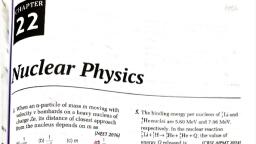
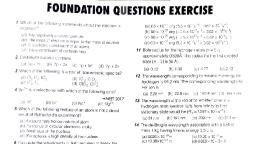
CHAPTER, , ym |, , Atomic Physics ¥5, , , , i Radioactive material A has decay constant, 8A and material B has decay constant i., Initially, they have same number of nuclei., After what time, the ratio of number of, , nuclei of material B to that A will be 1p, e, , ; INEET 2017], 1 1, , ) b C aie, , ea OF en, , 2. The ratio of wavelengths of the last line of, Balmer series and the last line of Lyman, series is INEET 2017], (a2 (b) 1 (c) 4 (d) 0.5, , 3. If an electron in a hydrogen atom jumps, from the 3rd orbit to the 2nd orbit, it emits, a photon of wavelength 2. When it jumps, from the 4th orbit to the 3rd orbit, the, corresponding wavelength of the photon, , will be [NEET 2016], 16 9 20 20, =A (bt) <A =A (d) SA, , @) 55 OG AC) O53, , 4. A proton and an alpha particle both enter a, region of uniform magnetic field B, moving, at right angles to the field B. If the radius of, circular orbits for both the particles is, equal and the kinetic energy acquired by, proton is 1 MeV, the energy acquired by, the alpha particle will be {CBSE AIPMT 2015], , (a) 4 MeV (b) 0.5 MeV (c) 1.5 MeV (d) 1 MeV, , 5. In the spectrum of hydrogen, the ratio of, the longest wavelength in the Lyman, series to the longest wavelength in the, Balmer series is [CBSE AIPMT 2015], , 1 ws, ii€, nn, 2, a) 28, is!, sn, be, h se fe, pe,, nv, py as, a)*, pe, go, pe, a, (, gbe, 4 (b) 9 () a7 5 Ss nvd, “7 ‘ Om ON., 6. Consider 3" orbit of He* (Helium), usin, jeve, non-relativistic approach, the speeq © M2, electron in this orbit will be (given con, K=9x10° constant, Z=2andh (Plan, |,, constant) = 6.6 x 10~** J-s) ‘, [CBSE AIPMT 29;- :, (ay2.92«10% rvs (B) 1.4610 mig | 10, (6) 0.73x10° mis (d) 3.010" ms wh, 7. Hydrogen atom in ground state is excited b, ., “a monochromatic radiation of } =9754 ;, Number of spectral lines in the i ap, spectrum emitted will be [CBSEAIPMT2y ~, (a)3 (b)2 (c)6 (d) 10 >, 8. Ratio of longest wavelengths corresponding c, to Lyman and Balmer series in hydrogen d, spectrum is INEET 2083] 15 7, @& wo oF @& |'s, ar 23 29 3, ex, 9. Electron in hydrogen atom first jumps from, third excited state to second excited state a, and then from second excited to the first, excited state, The ratio of the wavelengths 7, 1,14, emitted in the two cases is sl, [CBSE AIPMT 2002], (7/5 (b) 27/20 27/5 27g, 10. An electron of a stationary hydrogen atom (, passes from the fifth energy level to the ay, , ground level. The velocity 3that the atom, acquired as a result of photon emission, be [CBSE AIPMT 201, , 4, ’
Page 2 :
25hR 25m 24m, gan (0) ey rank 26hA, , (a) 95m ass of electron, R is Rydberg constant, ist! eanck's constant.), , s Jength of the first line of Lyman, phe wave nydrogen atom is equal to that of, * series aad jine of Balmer series fora, , ihe 5000 like ion. The atomic number Z of, nt like ion is [CBSE AIPMT 2011], ros, , nv (0) 1 (c) 2 (d) 3, , . ydrogen atom in the, ne energy a hae Oe ev. The energy of a, oe first excited state will be, [CBSE AIPMT 2010], i6eV (b) -27.2 eV (c) — 54.4 eV(d) -6.8 eV, fa) , , , , , , , , , , , , , , , , , , p ound s, fe” jon 10, , “. \igation energy of the electron in the, , fs, The 1on'™ tom in its ground state is 13.6, , droge ited to hi, , yo he atoms are excited to higher energy, wv.T to emit radiations of 6 wavelengths., levels um wavelength of emitted radiation, ‘ onds to the transition between, resp [CBSE AIPMT 2009], , =3ton=2states (b)N=3ton=1states, Cr ton=1states (d)n=4ton=3states, (n=, , erford scattering experiment, ut — eects of charge Z, and mass, if approaches a target nucleus of charge, 7, and mass Mz, the distance of closest, approach is m. The energy of the projectile, is [CBSE AIPMT 2009], 2) directly proportional to M, x M,, (0) directly proportional to 2,2,, (inversely proportional to Z,, ¢) directly proportional to mass M,, , col, , The ground state energy of hydrogen atom, 's-13.6 eV. When its electron is in the first, excited state, its excitation energy is, , [CBSE AIPMT 2008], (c) 10.2 eV (d) zero, , 6 The total energy of electron in the ground, , ite of hydrogen atom is -13.6 eV. The, , je ®nergy of an electron in the first, , Ws ed state is (CBSE AIPMT 2007], 4V (b)68eV (c) 136 eV (d) 1.7 eV, , aeeime Potential of hydrogen atom is, , ean en atoms in the ground state, , thoton by Monochromatic radiation of, "*RY 12.1 eV, According to Bohr’s, , 34eV (b) 68 eV, , 291, , theory, the spectr, , hydrogen will be ICBSE Aipyy, , (a) two (b) three (C) four, 18. The total energy of an electron i, , excited state of hydrogen is abo:, Its kinetic energy in this state j, , ‘al lines emitted, , T 2006), (9) one, in the first, ut ~ 3.4 ey,, 8, [CBSE AIPMT 2, , (a) -3.4 ev (b) - 6.8 ev (c) 6.8 ev (d) 3.4 a, 19. Energy E of a hydrogen atom with, , quantum number n is given by, , Ru 7138, , = eV. The energy of a Photon ejected, , when the electron, n= 2 state of hydr, , principal, , , , jumps from n =3 state to, ogen, is approximate!, , [CBSE Alp 2004), (a) 1.5ev (b) 0.85 ev !, (c)3.4eV (d) 1.9 ev, 20. The Bohr model of atoms, ICBSE AIPMT 2004], , (a) assumes that the angular momentum of, electrons is quantised, , (b) uses Einstein's Photoelectric equation, , (c) predicts continuous emission spectra for atoms, , (d) predicts the same emission spectra for all, types of atoms, , 21. Which of the following transitions gives, photon of maximum energy?, , [CBSE AIPMT 2000], (a)n=1 ton=2 (b)n=2 ton=1, (c)n=2 ton=6 (d)n=6 ton=2, 22. When electron jumps from n = 4 ton=2, orbit, we get [CBSE AIPMT 2000], , (a) second line of Lyman series, , (b) second line of Balmer series, , (c) second line of Paschen series, , (d) an absorption line of Balmer series, , 23,/In the Bohr’s model of a hydrogen atom,, the centripetal force is furnished by the, Coulomb attraction between the proton, and the electron. If ay is the radius of the, ground state orbit, m is the mass ande is, the charge on the electron, €, is the, vacuum permittivity, the speed of the, , electron is [CBSE AIPMT 1998), 6, (), (a) zero (b) Jean, , 7 oneal, Ya eam r, , , , (c)
Page 3 :
292, , 24. Alin energy of ground electronic state of, 'ydrogen atom is — 136 eV. The energy of, the first excited state will be, - {CBSE AIPMT 1997], (a) — 544eV (b) - 272 eV, (c) - 68 ev (d) - 34eV, , 25. When hydrogen atom is in its first excited, level, its radius is [CBSE AIPMT 1997], () four times, its ground state radius, 'b) twice, its ground state radius, (c) same as its ground sate radius, (d) half of its ground state radius, , 26. When a hydrogen atom is raised from the, , ground state to an excited state, [CBSE AIPMT 1995], , (a) PE decreases and KE increases, (0) PE increases and KE decreases, (c) both KE and PE decrease, , (d) absorption spectrum, , 27. The spectrum obtained from a sodium, vapour lamp is an example of, [CBSE AIPMT 1995], , (a) band spectrum (b) continuous spectrum, (c) emission spectrum (d) absorption spectrum, 28. The radius of hydrogen atom in its ground, state is 5.3 x 10" m. After collision with, an electron it is found to have a radius of, 21.2 x 107"? m. What is the principal, quantum number n of the final state of the, atom ? [CBSE AIPMT 1994], ~, (ajn=4 (b)n=2 (d)n=3, , 29, In Rutherford scattering experiment, what, _/ will be the correct angle for a-scattering for, , an impact parameter, b = 0?, [CBSE AIPMT 1994], , (a) 90° (b) 270 (c) 0° (d) 180°, 30. Hydrogen atoms are excited from ground, state of the principal quantum number 4., , Then, the number of spectral lines observed, will be [CBSE AIPMT 1993], , (a) 3 (b) 6 (c) 5 (d) 2, , 31. Which source is associated with a line, , (c)n=16, , emission spectrum? [CBSE AIPMT 1993], (a) Electric fire (b) Neon street sign, (c) Red traffic light (d) Sun, , 32. The ionisation energy of hydrogen atom is, 13.6 eV. Following Bohr’s theory, the, , ~ (0) 0.85 eV, ss In terms of Bohr radius dp, the radi, , 35., , 37. Energy levels A, B,C of a certain atom, , ow, , NEET Chapterwise Solutions ~ py, , orgy corresponding to a transit;, rhe 3rd and 4th orbit is =, ICBSE Aj ), (b) 151 ey PMT My 0, (A) 0.66 ev rg i, , bet, , (a) 3.40 eV, , * Us be, second Bohr orbit of a hydrogen atom the . (0, , iven b’ ICBSE Ay, ‘“ 4a hs (b) 8a, PMT 195,, (c) V2 a (d) 2a,, The ground state energy of H-atom jg, 13.6 eV. The energy needed to ionise, H-atom from its second excited state é, \, , ICBSE Ai, (a) 1.51eV (aaey M71, , (c) 13.6 eV (d) 12.1 ev, Consider an electron in the nth orbit of , si, hydrogen atom in the Bohr model. The, circumference of the orbit can be i, expressed in terms of de-Broglie, , wavelength A of that electron as N, ICBSE AIPMT 1999), , (a) (0.529)na (b) Vr%_— (0) (13.6)A(d) ma, , 36. The valence electron in alkali metal is a, , [CBSE AIPMT 1990), (b) p-electron, (d) d-electron ., , WY, , (a) f-electron, (c) s-electron, correspond to increasing values of energy Yh, ie. E,< Eg < Ec. IfX4,A2,A3 are the, wavelengths of radiation corresponding to, the transitions C to B, B to AandC toA, respectively, which of the following, relation is correct ? [CBSE AIPMT 1990], d., , Ag =m td, b) Ay = he, , g=Ay the (b) A3 hth, (= +%, , , , (C) Ay + Ay +A5=0, , 38, To explain his theory, Bohr used, , [CBSE AIPMT 1989], (a) conservation of linear momentum, (b) conservation of angular momentum, (c) conservation of quantum frequency, (d) conservation of energy, , 39. The ionisation energy of hydrogen atom is, 13.6 eV, the ionisation energy of helium, atom would be [CBSE AIPMT 1988), , (€)136eV (by272ev ()eBev (d)544e
Page 4 :
2. (c), 12. (a), 22. (>), $3. (a), , Answers, , , , 8. (c) 4. (d) 5. (d) 6. (b) 7. (c) a, 13. (a) 14, (b) 15. (c) 16. (a) 17. (b) 18., 23. (c) 24. (d) 25. (a) 26. (c) 27. (c) 22, 33. (a) 34. (a) 35. (d) 36. (c) 37. (b) 38., , We wee Fn, a?, , (a), (d), (b), (b), , 9. (dy, 19. (d), 29. (da), 39. (dt)