Page 1 :
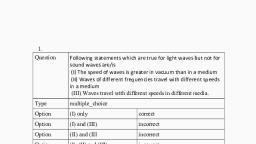
1., Question, , Following statements which are true for light waves but not for, sound waves are/is, (I) The speed of waves is greater in vacuum than in a medium, (II) Waves of different frequencies travel with different speeds, in a medium, (III) Waves travel with different speeds in different media., , Type, , multiple_choice, , Option, , (I) only, , correct, , Option, , (I) and (III), , incorrect, , Option, , (II) and (III, , incorrect, , Option, , (I), (II) and (III), , incorrect, , 1, , 0, , Solution, Marks, 2., Question, , A plane wave front falls on a convex lens. The emergent wave, front is, , Type, , multiple_choice, , Option, , Plane, , incorrect, , Option, , Cylindrical, , incorrect, , Option, , Spherical diverging, , incorrect, , Option, , Spherical converging, , correct, , Marks, , 1, , 0, , 3., Question, , When two light waves meet at a place, , Type, , multiple_choice, , Solution
Page 2 :
Option, , their displacements add up, , correct, , Option, , their intensities add up, , incorrect, , Option, , both will add up, , incorrect, , Option, , Energy becomes zero, , incorrect, , 1, , 0, , Solution, Marks, 4., Question, , The following phenomena which is not explained by Huygens’, construction of wave front is, , Type, , multiple_choice, , Option, , refraction, , incorrect, , Option, , reflection, , incorrect, , Option, , diffraction, , incorrect, , Option, , origin of spectra, , correct, , 1, , 0, , Solution, Marks, 5., Question, , When interference of light takes place, , Type, , multiple_choice, , Option, , Energy is created in the, region of maximum, intensity, , incorrect, , Option, , Energy is destroyed in the, region of maximum, intensity, , incorrect, , Option, , Conservation of energy, , correct
Page 3 :
holds good and energy is, redistributed, Option, , Conservation of energy, doesn’t hold good, , incorrect, , 1, , 0, , Solution, Marks, 6., Question, , The necessary condition for an interference by two sources of, light is that:, , Type, , multiple_choice, , Option, , two light sources must, have the same wavelength, , incorrect, , Option, , two point sources should, have the same amplitude, and same wavelength, , incorrect, , Option, , two sources should have, the same wavelength,, nearly the same amplitude, and have a constant phase, angle difference, , correct, , Option, , the two point sources, should have a randomly, varying phase difference, , incorrect, , 1, , 0, , Solution, Marks, 7., Question, , The following source that can give sustained interference is, , Type, , multiple_choice
Page 4 :
Option, , Two independent laser, sources, , correct, , Option, , Two independent light, bulbs, , incorrect, , Option, , Two sources must be of, larger width, , incorrect, , Option, , Two sources must be far, away from one other, , incorrect, , 1, , 0, , Solution, Marks, 8., Question, , Match list A and list B accurately, LIST A, LIST B, a) spherical wave front e) linear source, b) plane wave front, f) point light source, c) cylindrical wave front g) at infinite distance, , Type, , multiple_choice, , Option, , ( a, f ); ( b, g); ( c, e), , correct, , Option, , ( a, f ); ( b, e); ( c, g), , incorrect, , Option, , ( a, g ); ( b, f); ( c, e), , incorrect, , Option, , ( a, e ); ( b, g); ( c, f), , incorrect, , 1, , 0, , Solution, Marks, , 9., Question, , A: The phase difference between any two points on a wave, front is zero, R: From the source light reaches every point on the wave front, in the same time
Page 5 :
Type, , multiple_choice, , Option, , Both A and R are true, and correct, R is correct explanation of, A, , Option, , Both A and R are true, and incorrect, R is not correct explanation, of A, , Option, , A is true but R is false, , incorrect, , Option, , A is false but R is true, , incorrect, , 1, , 0, , Solution, Marks, 10., Question, , A: In interference pattern intensity of successive fringes due to, achromatic light is not same, R: In interference, only redistribution of energy takes place, , Type, , multiple_choice, , Option, , Both A and R are true, and incorrect, R is correct explanation of, A, , Option, , Both A and R are true, and incorrect, R is correct explanation of, A, , Option, , A is true but R is false, , incorrect, , Option, , A: Primary waves can, travel in all directions in, ether, B: Secondary waves can, travel only in backward in, ether, , correct, , Solution
Page 6 :
Marks, 11., , 1, , 0, , Question, , A: Primary waves can travel in all directions in ether, B: Secondary waves can travel only in backward in ether, , Type, , multiple_choice, , Option, , A is true, B is false, , correct, , Option, , Both A and B are true, , incorrect, , Option, , A is false, B is true, , incorrect, , Option, , Both A and B are false, , incorrect, , Marks, , 1, , 0, , 12., Question, , A wavefront is an imaginary surface where, , Type, , multiple_choice, , Option, , phase is same for all points correct, , Option, , phase changes at constant, rate at all points along the, surface., , incorrect, , Option, , constant phase difference, continuously changes, between the points, , incorrect, , Option, , phase changes all over the, surface, , incorrect, , 1, , 0, , Solution, , Solution, Marks
Page 7 :
13., Question, , Huygen’s wave theory is used, , Type, , multiple_choice, , Option, , to determine the velocity of incorrect, light, , Option, , to find the position of the, wave front, , correct, , Option, , to determine the, wavelength of light, , incorrect, , Option, , to find the focal length of a incorrect, lens., , Solution, Marks, 14., , 1, , 0, , Question, , Light waves spreading from two sources produce steady, interference only if they have, , Type, , multiple_choice, , Option, , congruence, , incorrect, , Option, , coherence, , correct, , Option, , same intensity, , incorrect, , Option, , same amplitude, , incorrect, , 1, , 0, , Solution, Marks, 15., Question, , Which of the following is conserved when light waves interfere, , Type, , multiple_choice
Page 8 :
Option, , momentum, , incorrect, , Option, , amplitude, , incorrect, , Option, , energy, , correct, , Option, , intensity, , incorrect, , 1, , 0, , Solution, Marks, 16., Question, , A young’s double slit experiment uses a monochromatic source., The shape of the interference fringes formed on the screen is a, , Type, , multiple_choice, , Option, , straight line, , correct, , Option, , parabola, , incorrect, , Option, , hyperbola, , incorrect, , Option, , circle, , incorrect, , 1, , 0, , Solution, Marks, 17., Question, , For the sustained interference of light, the necessary condition is, that the two sources should, , Type, , multiple_choice, , Option, , have constant phase, difference only, , incorrect, , Option, , be narrow, , incorrect, , Option, , be close to each other, , incorrect, , Option, , of same amplitude with, constant phase difference, , correct
Page 9 :
Solution, Marks, , 1, , 0, , 18., Question, , Laser light is considered to be coherent because it consists of, , Type, , multiple_choice, , Option, , many wavelengths, , Option, , uncoordinated wavelengths incorrect, , Option, , coordinated waves of, exactly the same, wavelength, , correct, , Option, , divergent beams, , incorrect, , 1, , 0, , incorrect, , Solution, Marks, , 19., Question, , Four different independent waves are represented by, a) y1 = a1 sin 1t, b) y2 = a2 sin 2t, c) y3 = a3 sin 3t, d) y4 = a4 sin ( 4 t + /3), The sustained interference is possible due to, , Type, , multiple_choice, , Option, , a&c, , incorrect, , Option, , a&d, , incorrect, , Option, , c&d, , incorrect, , Option, , not possible with any, combination, , correct
Page 10 :
Solution, Marks, , 1, , 0, , 20., Question, , The contrast in the fringes in any interference pattern depends on, :, , Type, , multiple_choice, , Option, , fringe width, , incorrect, , Option, , wave length, , incorrect, , Option, , intensity ratio of the, sources, , correct, , Option, , distance between the, sources., , incorrect, , 1, , 0, , Solution, Marks, 21., Question, , If monochromatic red light is replaced by green light the fringe, width becomes, , Type, , multiple_choice, , Option, , increase, , incorrect, , Option, , remain same, , correct, , Option, , we cannot say, , incorrect, , Option, , decrease, , incorrect, , 1, , 0, , Solution, Marks, 22.
Page 11 :
Question, , In a Laser beam the photons emitted are, , Type, , multiple_choice, , Option, , incoherent, , incorrect, , Option, , coherent, , correct, , Option, , of same velocity, , incorrect, , Option, , of same wavelength, , incorrect, , 1, , 0, , Solution, Marks, 23., Question, , Two waves having the same wave length and amplitude but, having a constant phase difference with time are known as, , Type, , multiple_choice, , Option, , identical waves, , incorrect, , Option, , incoherent waves, , incorrect, , Option, , coherent waves, , correct, , Option, , collateral waves, , incorrect, , 1, , 0, , Solution, Marks, 24., Question, , When viewed in white light, soap bubble show colours because, of, , Type, , multiple_choice, , Option, , Interference, , correct, , Option, , Scattering, , incorrect, , Option, , Diffraction, , incorrect
Page 12 :
Option, , Dispersion, , incorrect, , 1, , 0, , Solution, Marks, 25., Question, , When petrol drops from a vehicle fall over rain water on road, surface colours are seen because of, , Type, , multiple_choice, , Option, , Dispersion of light, , incorrect, , Option, , Interference of light, , correct, , Option, , Scattering of light, , incorrect, , Option, , Absorption of light, , incorrect, , 1, , 0, , Solution, Marks, 101., Question, , Ratio of intensities of two coherent waves are given by 4:1. The, amplitudes of the two waves is, , Type, , multiple_choice, , Option, , 2:1, , correct, , Option, , 1:2, , incorrect, , Option, , 4:1, , incorrect, , Option, , 1:4, , incorrect, , 1, , 0, , Solution, Marks, 102.
Page 13 :
Question, , The intensities of two light waves are 9 unit and 4 unit, respectively. The ratio of maximum intensity to the minimum, intensity is, , Type, , multiple_choice, , Option, , 9:4, , incorrect, , Option, , 4:9, , incorrect, , Option, , 25 : 1, , correct, , Option, , 1 : 25, , incorrect, , 1, , 0, , Solution, Marks, 103., Question, , Two coherent sources of different intensities send waves that, interfere. The ratio of maximum to minimum intensity is 25. The, intensity ratio of the sources is, , Type, , multiple_choice, , Option, , 25 : 1, , incorrect, , Option, , 5:1, , incorrect, , Option, , 9:4, , correct, , Option, , 625 : 1, , incorrect, , 1, , 0, , Solution, Marks, , 104., Question, , Two coherent sources of intensities I and 4I are superposed then, Ibright /Idark is., , Type, , multiple_choice, , Option, , 5/1, , incorrect
Page 14 :
Option, , 9/1, , correct, , Option, , 5/3, , incorrect, , Option, , 9/3, , incorrect, , 1, , 0, , Solution, Marks, 105., Question, , A beam of light of wavelength 600 nm from a distant source, falls on a single slit 1.0 mm wide and the resulting diffraction, pattern is observed on a screen 2m away. The distance between, the first dark fringes on either side of the central bright fringe is, , Type, , multiple_choice, , Option, , 1.2 cm, , incorrect, , Option, , 1. 2 mm, , incorrect, , Option, , 2.4 cm, , incorrect, , Option, , 2.4 mm, , correct, , 1, , 0, , Solution, Marks, , 106., Question, , Type, , The intensity of interference waves in an interference pattern is, same as I0. The resultant intensity at the point of observation, will be, multiple_choice, , Option, , correct, , Option, , incorrect, , Option, , I, , incorrect, I0
Page 15 :
Option, , I, , incorrect, 2I 0, , Solution, Marks, 107., Question, , 1, , 0, , Two sources of intensity 2I and 8I are used in an interference, experiment. The intensity at a point where the waves from two, (b), is, , Type, , multiple_choice, , Option, , 18I ,10 I ,2 I, , correct, , Option, , 5I ,4 I , I, , incorrect, , Option, , 2I , I ,, , I, 2, , incorrect, , Option, , 2 I ,10 I ,18 I, , incorrect, , 1, , 0, , Solution, Marks, 108., Question, Type, , The intensity produced by two coherent sources of intensity I1, and I2 constructively will be, multiple_choice, , Option, , incorrect, , Option, , incorrect, , Option, , correct, , Option, Solution, , Zero, , incorrect
Page 16 :
Marks, , 1, , 0, , 109., Question, , When two coherent monochromatic light beams of intensities I, and 4 I are superposed, the ratio between maximum and, minimum intensities in the resultant beam is, , Type, , multiple_choice, , Option, , 9:1, , correct, , Option, , 1:9, , incorrect, , Option, , 4:1, , incorrect, , Option, , 1:4, , incorrect, , 1, , 0, , Solution, Marks, 110., Question, , The ratio of amplitude of two waves is 4:3 then ratio of, maximum and minimum intensity in, , Type, , multiple_choice, , Option, , 16:18, , incorrect, , Option, , 18:16, , incorrect, , Option, , 49:1, , correct, , Option, , 94:1, , incorrect, , 1, , 0, , Solution, Marks, 111., Question, , Light waves producing interference have their amplitudes in the, ratio 3 : 2. The intensity ratio maximum and minimum of, interference fringes is
Page 17 :
Type, , multiple_choice, , Option, , 36 : 1, , incorrect, , Option, , 9:4, , incorrect, , Option, , 25 : 1, , correct, , Option, , 6:4, , incorrect, , 1, , 0, , Solution, Marks, 112., Question, , When two coherent waves interfere, the maximum and minimum, intensities are in the ratio 25:16, then, a) the maximum and minimum amplitudes are in the ratio 5 : 4, b) the amplitudes of individual waves are in the ratio 9 : 1, c)the intensities of individual waves are in the ratio 41: 9, d) the intensities of individual waves are in the ratio 81 : 1, , Type, , multiple_choice, , Option, , a, b and c are true, , incorrect, , Option, , a,b and d are true, , correct, , Option, , a and b are true, , incorrect, , Option, , b and c are true, , incorrect, , 1, , 0, , Solution, Marks, 113., Question, , The fringe width of the fringes produced in young’s double slit, experiment conducted for monochromatic light of wavelength, with slit difference d and separation between slits and screen D, is, , Type, , multiple_choice
Page 18 :
Option, , correct, , Option, , incorrect, , Option, , incorrect, , Option, , incorrect, , Solution, Marks, , 1, , 0, , 114., Question, , In YDSE, the intensity of the maxima is I. If the width of each, slit is doubled the intensity of the maxima will be, , Type, , multiple_choice, , Option, , I/2, , incorrect, , Option, , I, , incorrect, , Option, , 4I, , incorrect, , Option, , 2I, , correct, , 1, , 0, , Solution, Marks, 115., Question, , In YDSE, the slit widths are in the ratio of 1: 9. The intensity of, the maxima to that of the minima is, , Type, , multiple_choice, , Option, , 81 : 1, , incorrect, , Option, , 9:1, , incorrect
Page 19 :
Option, , 4:1, , correct, , Option, , 3:1, , incorrect, , 1, , 0, , Solution, Marks, , 116., Question, , Type, , A double slit apparatus is immersed in a liquid of refractive, index 1.33. It has slit separation of 1mm and distance between, the plane of slits and screen 1.33 m. The slits are illuminated by, a parallel beam of light whose wavelength in air is 6300 Å. The, fringe width is, multiple_choice, , Option, , mm, , incorrect, , Option, , 0.63, mm, 1.33, , incorrect, , Option, , 0.63, 2 mm, 1.33, , incorrect, , Option, , 0.63mm, , correct, , 1, , 0, , Solution, Marks, 117., Question, , In a Young’s double slit experiment, 12 fringes are observed to, be formed in a certain region of the screen when light of, wavelength 600 nm is used. If the light of wavelength 400 nm is, used, the number of fringes observed in the same region of the, screen will be, , Type, , multiple_choice, , Option, , 12, , incorrect
Page 20 :
Option, , 18, , correct, , Option, , 24, , incorrect, , Option, , 8, , incorrect, , 1, , 0, , Solution, Marks, 118., Question, , In Young’s double slit experiment, the ratio of maximum to, minimum intensities of the fringe system is 4 :1. The amplitudes, of the coherent sources are in the ratio, , Type, , multiple_choice, , Option, , 4:1, , incorrect, , Option, , 3:1, , correct, , Option, , 2:1, , incorrect, , Option, , 1:1, , incorrect, , 1, , 0, , Solution, Marks, 119., Question, , In young’s double slit experiment using two identical slits, the, intensity at a bright fringe on the screen is I. If one of the slits is, now closed the intensity of the same bright fringe on the screen, will be, , Type, , multiple_choice, , Option, , I, , incorrect, , Option, , I/2, , incorrect, , Option, , I/4, , correct, , Option, , I, 2, , incorrect
Page 21 :
Solution, Marks, , 1, , 0, , 120., Question, , In Young’s double slit experiment the separation between the, slits is halved and the distance between the slits and screen is, doubled . The fringe width is, , Type, , multiple_choice, , Option, , unchanged, , incorrect, , Option, , halved, , incorrect, , Option, , doubled, , incorrect, , Option, , quadrupled, , correct, , 1, , 0, , Solution, Marks, 121., Question, , In Young’s double slit experiment, the two slits act as coherent, sources of equal amplitude ‘a’ and of wavelength . In other, experiment with the same set up, the two slits are sources of, equal amplitude ‘a’ and wavelength , but are incoherent. The, ratio of intensity of light at the mid point of the screen in the first, case to that in the second case is, , Type, , multiple_choice, , Option, , 2 :1, , correct, , Option, , 1:2, , incorrect, , Option, , 3:4, , incorrect, , Option, , 4:3, , incorrect, , 1, , 0, , Solution, Marks
Page 22 :
122., between two sources is, , 2, , . The intensity at a point equidistant, , from the slits in terms of maximum intensity I0 is, Type, , multiple_choice, , Option, , I0, , incorrect, , Option, , I0/2, , correct, , Option, , 3I0/4, , incorrect, , Option, , 3I0, , incorrect, , 1, , 0, , Solution, Marks, 123., Question, , The path difference between two interfering waves at a point on, the screen is, , from central maximum. The ratio of intensity at, , this point and that at the central fringe will be, Type, , multiple_choice, , Option, , 0.75, , correct, , Option, , 7.5, , incorrect, , Option, , 85.3, , incorrect, , Option, , 853, , incorrect, , 1, , 0, , Solution, Marks, , 124., Question, , The fringe width at a distance of 50cm from the slits in young’s, experiment for light of wavelength 6000 A0 is 0.048cm. The
Page 23 :
fringe width at the same distance for, Type, , multiple_choice, , Option, , 0.04 cm, , correct, , Option, , 0.4 cm, , incorrect, , Option, , 0.14 cm, , incorrect, , Option, , 0.45 cm, , incorrect, , 1, , 0, , 0, , will be, , Solution, Marks, 125., Question, , At the polarising angle ( B), angle of refraction is given by, , Type, , multiple_choice, , Option, , 900, , incorrect, , Option, , 90 +, , incorrect, , Option, , 90 –, , correct, , Option, , 90, , incorrect, , 1, , 0, , Solution, Marks