Page 1 :
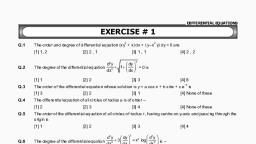
DIFFERENTIAL EQUATIONS, , EXERCISE # 1, Q.1, , 2, , 2, , The order and degree of differential equation (xy + x) dx + ( y–x y) dy = 0 are, [1] 1, 2, , [2] 2 , 1, , [3] 1 , 1, , [4] 2 , 2, , 3, , Q.2, , The degree of the differential equation, [1] 1, , Q.3, , [2] 2, , [4] 6, –x, , [2] 2, , [3] 1, , [4] None of these, , The differential equation of all circles of radius a is of order –, [1] 2, , Q.5, , [3] 3, , The order of the differential equation whose solution is y = a cos x + b sinx + c e is, [1] 3, , Q.4, , d2 y, dy , 1 = 0 is, 2, dx, dx , , [2] 3, , [3] 4, , [4] None of these, , The order of the differential equation of all circles of radius r , having centre on y-axis and passing through the, origin is, [1] 1, , [2] 2, , [3] 3, , [4] 4, , 2, , Q.6, , The degree of the differential equation, [1] 1, , d2 y , d2 y, dy , 3 x 2 log 2 is –, 2, dx, dx , dx , , [2] 2, , [3] 3, 2, , Q.7, , Q.8, , 4, , d2 y dy , 2, The differential equation x 2 y x is of –, dx dx , [1] Degree 2 and order 2, , [2] Degree 1 and order 1, , [3] Degree 4 and order 3, , [4] Degree 4 and order 4, , Which of the following equation is linear, 2, , 2, , d2 y , 2 dy , [1] 2 x 0, dx , dx , , Q.9, , [4] None of these, , [2] y , , [3], , dy y, log x, dx x, , y, , x, is a solution of the differential equation, x 1, , [4] y, , dy, dy , 1 , dx, dx , , 2, , dy, 4 x, dx, , dy, dy, dy, 2 dy, x2, y2, x, y, [2] x, [3] y, [4] x, dx, dx, dx, dx, The differential equation for the line y = mx + c is ( where c is arbitrary constant), 2, [1] y, , Q.10, , [1], , Q.11, , dy, m, dx, , [2], , dy, m 0, dx, , y, The general solution of the differential equation e, , y, , [1] ( e + 1 ) cos x = K, y, , [3] ( e + 1 ) sin x = K, , [3], , dy, 0, dx, , [4] None of these, , dy, e y 1 cot x 0 is, dx, , , , , , y, , [2] ( e + 1 ) cosec x = K, [4] None of these, , 132
Page 2 :
DIFFERENTIAL EQUATIONS, , Q.12, , The solution of the equation, y, , x, , [1] e = e +, Q.13, , x3, +c, 3, , dy, e x y x 2 e y is, dx, y, , x, , [2] e = e + 2x + c, , The solution of the differential equation, x, [1] y e sin x , , y, , x, , 3, , [3] e = e + x + c, , [4] None of these, , dy, e x cos x x tan x is, dx, , x2, log cos x c, 2, , x, [2] y e sin x , , x2, log sec x c, 2, , x2, x2, x, log cos x c, log sec x c, [4] y e sin x , 2, 2, The solution of the differential equation ( 1+ cosx ) dy = ( 1–cos x) dx is, x, [3] y e sin x , , Q.14, , Q.15, , Q.16, , Q.17, , [1] y 2 tan, , x, xc, 2, , [2] y 2 tan x x c, , [3] y 2 tan, , x, xc, 2, , [4] y x 2 tan, , dy, 1, 0 , then If dx , 1 x2, –1, [1] y + sin x = C, –1, [3] x + sin y = 0, , [2] y + 2 sin x + c = 0, 2, –1, [4] x + 2sin y = 1, , dy 3e2x 3e4x, x, is –, dx, e e x, 3x, 3x, [1] y = e + C, [2] – y = e – C, , [3] y = – e + C, , 1, log | 4 + 5 sin x | + C, 5, 1, log | 4 – 5 sec x | + C, 5, , The general solution of differential equation, [1] y = x ( log x + 1) + C, [3] y = x ( log x –1) + C, The general solution of differential equation, [1] y , , Q.20, , –1, , 3x, , 1, 1, cos5 x cos ec 3 x x 1 e x c, 5, 3, , [4] None of these, , dy, = cos x is, dx, , The general solution of differential equation ( 4 + 5 sinx ), , [3] y = –, , Q.19, , 2, , The solution of, , [1] y =, , Q.18, , x, c, 2, , [2] y =, , 1, log | 4 + 5 cos x | + C, 5, , [4] None of these, dy, log x is, dx, [2] y + x ( logx + 1) = C, [4] None of these, dy, 3, 2, x, = sin x cos x + x e is, dx, , [2] y , , 1, 1, cos5 x cos3 x x 1 e x c, 5, 3, , 1, 1, 5, 3, x, [3] y cos x cos x x 1 e c, [4] None of these, 5, 3, 2y, 2, y, The solution of the differential equation x (e –1) dy + ( x –1) e dx = 0 is, y, , –y, , y, , –y, , [1] e + e, , [3] e + e, , = log x –, , x2, +c, 2, , [2] e – e, , = log x +, , x2, +c, 2, , [4] None of these, , y, , –y, , = log x –, , x2, +c, 2, , 133
Page 3 :
DIFFERENTIAL EQUATIONS, , Q.21, , If, , dy, e 2y and y = 0 when x = 5 , the value of x for y = 3 is, dx, 5, , 6, , [1] e, , Q.22, , [2] e + 1, , 2, , 2, , 2, , [2], , d2 y, xy 0, dx 2, , dy 2x, [2] dx y 0, , dy 2y, , 0, dx x, , [4] none of these, , –x, , –x, , (x + c), , dy 2x, [4] dx y 0, , dy 2y, , 0, dx x, , [2] y = xe, , +c, , [3] y = e, , –x, , + cx, , [4] None of these, , Which of the following equation is linear, , [3], , 2, , [2] y , , dy y, log x, dx x, , [4] y, , The solution of the differential equation x, , dy, dy , 1 , dx, dx , , 2, , dy, 4 x, dx, , dy, y x 2 3x 2 is, dx, , [1] xy , , x3 3 2, x 2x c, 3 2, , [2] xy , , x4, x3 x2 c, 4, , [3] xy , , x 4 x3, , x2 c, 4, 3, , [4] xy , , x4, x 3 x 2 cx, 4, 2, , Equation of curve through point ( 1 , 0) which satisfies the differential equation ( 1 + y ) dx – xy dy = 0 , is, 2, , 2, , [1] x + y = 1, , 2, , 2, , [2] x – y =1, , The general solution of the differential equation, , y, [1] logtan c 2sin x, 2, , Q.30, , [3] dy + dx = 0, , dy, y e x is, dx, , The solution of differential equation, , 2, , Q.29, , [4] None of these, , [3], , d2 y , 2 dy , [1] 2 x 0, dx , dx , , Q.28, , [3] 2x + y = 3, , 2, , [1] y = e, , Q.27, , 2, , 2y, , is, x, , The differential equation of the family of curves represented by the equation x y = a is, [1], , Q.26, , [4] loge 6, , A differential equation of first order and first degree is, 2, , Q.25, , 2, , [2] x – y = 0, , dy , [1] x x a 0, dx , Q.24, , e6 9, 2, , The equation of the curve which passes through the point ( 1 , 1) and whose slope is given by, [1] y = x, , Q.23, , [3], , 2, , 2, , [3] 2x + y = 2, , [4] None of these, , dy, xy, xy, sin , sin , , is, dx, 2 , 2 , y, x, [2] logtan c 2sin , 4, , 2, , y , y , x, [4] logtan c 2 sin , [3] logtan c 2sin x, 2, 4, 4, 4, , , , , 2, The differential equation of all conics whose centre lie at the origin is of order, [1] 2, , [2] 3, , [3] 4, , [4] none of these, , 134
Page 4 :
DIFFERENTIAL EQUATIONS, 2, , Q.31, , [1] 1, Q.32, , 2, , d2 y dy , d2 y , x, sin, , , , is, The degree of the differential equation 2 , dx dx , dx , [2] 2, , [3] 3, , [4] none of these, , The order of differential equation whose solution is given by y = c1x + (c2 + c3) e, , logx, , + c4 cos (x + c5),, , where c1, c2 , c3 , c4 and c5 are arbitrary constants is, [1] 2, , Q.33, , [2] 3, , [2] 2, , [4] 4, , [2] y2 = –y, , [3] y2 = –y, , The equation of a curve passing through ( 2 , 7/2) and having gradient 1 –, 2, , [1] y = x + x+1, , Q.36, , [3] 3, , The differential equation corresponding to the curves y = a cos x + b sin x, where a, b are arbitrary, constants, is, [1] y2 = y1, , Q.35, , [4] 5, , The order of differential equation of ellipse whose major and minor axes are along x-axis and y-axis, respectively, is, [1] 1, , Q.34, , [3] 4, , 2, , [2] xy = x + x+ 1, , The solution of the differential equation y, 2, , 2, , [1] y = x –2x +2, , 2, , 2, , [3] xy = x+ 1, , 2, , [4] y2 + y= 0, , 1, at (x, y) is, x2, , [4] none of these, , dy, = x–1 satisfying y[1] = 1 is, dx, , [2] y = 2x – x –1, , 2, , [3] y = x – 2x + 2, , [4] None of these, , , , 135
Page 5 :
DIFFERENTIAL EQUATIONS, , EXERCISE # 2, Q.1, , The differential equation of all the lines in the xy- plane is, , [1], Q.2, , dy, x 0, dx, , [2], , Q.5, , Q.6, , Q.7, , Q.8, , d2 y, 0, dx 2, , [4], , d2 x, C, [2], dy 2, , d3 y d2 x, , 0, [3], dx 3 dy 2, , The differential equation of all ‘ Simple Harmonic Motions ‘ of given period, , [1], , Q.4, , [3], , d2 y, x0, dx 2, , The differential equation of all parabolas whose axes are parallel to y-axis is, , d3 y, 0, [1], dx3, , Q.3, , d2 y, dy, x, 0, dx, dx 2, , d2 x, nx 0, dt 2, , The solution of, , [2], , d2 x, n2 x 0, 2, dt, , [3], , d2 x 2, n x 0, dt 2, , d2 y, dy, 2, C, [4], dx, dx 2, 2, is, n, , [4], , d2 x 1, x 0, dt 2 n2, , dy, sin x y cos x y is, dx, , , x y , [1] log 1 tan , c 0, 2 , , , , x y , [2] log 1 tan , x c, 2 , , , , x y , [3] log 1 tan , x c, 2 , , , [4] None of these, 2, , The solution of ( dy / dx ) = ( 4x + y + 1) is, [1] 4x – y + 1 = 2tan ( 2x – 2c), , [2] 4x – y –1 = 2 tan ( 2x – 2c), , [3] 4x + y + 1 = 2 tan ( 2x + 2c ), , [4] None of these, , The solution of the equation x, , dy, + 3y = x is, dx, , 3, [1] x y , , x4, c 0, 4, , 3, [2] x y , , x4, c, 4, , 3, [3] x y , , x4, 0, 4, , [4] None of these, , [1] (y–1) (x+1) + 2x = 0, , y 1, is x2 x, [2] 2x ( y –1) + x + 1 = 0, , [3] x ( y –1) ( x + 1) + 2 = 0, , [4] None of these, , The equation of the curve through the point ( 1, 0) and whose slope is, , 2, , dy , The order and degree of the differential equation 4 , dx , , , [1] 2 , 2, , [2] 3 , 3, , [3] 2 , 3, , 2/3, , , , d2 y, are, dx 2, , [4] 3 , 2, , 136
Page 6 :
DIFFERENTIAL EQUATIONS, , Q.9, , Q.10, , 2, , 2, , The solution of the differential equation (x – yx ), x 1 1, [1] log c, y x y, , y 1 1, [2] log x x y c, , , 1 1, [3] log xy x y c, , 1 1, [4] log xy x y c, , The solution of, , d2 y, cos x sin x is, dx 2, , [1] y = – cosx + sinx + c1x + c2, , [2] y = –cos x – sin x + c1x + c2, , 2, , 2, , [3] y = cos x – sinx + c1x + c2x, Q.11, , dy 2, 2, +y + xy = 0 is, dx, , [4] y = cos x + sinx + c1 x + c2x, , dy, 2xy, 2, The equation of the curve that passes through the point ( 1, 2) and satisfies the differential equation dx, x 1, , , , , , is, 2, , 2, , [1] y ( x +1) = 4, Q.12, , Q.13, , 2, , [3] y ( x –1) = 4, , [4] None of these, , dy, xy3, The solution of the differential equation dx 2 x y 5 is, , [1] 2 (x – y) + log (x – y) = x + c, , [2] 2 ( x – y ) – log (x – y + 2) = x + c, , [3] 2(x – y) + log (x – y + 2) = x + c, , [4] None of these, , The differential equation of the family of curves , , A, B , where A and B are arbitrary constants, is, r, , [1], Q.14, , [2] y (x +1) + 4 = 0, , d2 1 d, , 0, dr 2 r dr, , [2], , d2 2 d, , 0, dr 2 r dr, , [3], , d2 2 d, , 0, dr 2 r dr, , [4] None of these, , The order of the differential equation whose general solution is given by y = (C1 + C2) cos ( x + C3) – C4 e x C5 ,, where C1 , C2, C3, C4 , C5 are arbitrary constants, is, [1] 5, , Q.15, , [2] 4, , The solution of the equation, [1] ( m + 1) y = x, [3] y = ( x, , Q.16, , m+1, , m+1, , [4] 2, , dy, m, + y tan x = x cos x is, dx, , cos x + c ( m + 1) cos x, , + c) cos x, , [3] 3, , m, , [2] my = ( x + c) cos x, [4] None of these, , y, , y, cos2 , then the, The slope of the tangent at (x , y) to a curve passing through 1, is given by, x, 4, x, equation of the curve is, , e , log , x , , , –1, , [1] y = tan, , –1, , [3] y = x tan, , , e , log , x , , , –1, , [2] y = x tan, , , x , log , e , , , [4] None of these, , 137
Page 7 :
DIFFERENTIAL EQUATIONS, , Q.17, , , , , , x, 2, dy e sin x sin2x, , The solution of, is, dx, y 2log y 1, 2, , x, , 2, , x, , 2, , 2, , [1] y ( log y) – e sin x + c = 0, 2, , [3] y ( log y) + e cos x + c = 0, Q.18, , 2, , [4] None of these, , , 2, , 2, The solution of x 1 y dx y 1 x dy 0 is, , , , , , 1 x2 1 y2 c, , [1], , 2 3/2, , [3] ( 1 + x ), Q.19, , x, , [2] y (log y ) – e cos x + c = 0, , 2 3/2, , + (1 + y ), , [2], =c, , 1 x2 1 y2 c, , [4] None of these, , x2 y2, The slope of the tangent at (x, y) to a curve passing through a point ( 2 , 1) is, then the equation of, 2xy, , the curve is, 2, , 2, , [1] 2 (x – y ) = 3x, Q.20, , d2 y, 0, dx 2, 2, , 2, , 2, , 2, , [4] x( x + y ) = 10, , [2], , d2 x, 0, dy 2, , [3], , dy, 0, dx, , dx, 4) dy 0, , 2, , 2, , [2] 2 e, , [3] 3 e, , 3, , [4] 2 e, , The degree and order of the differential equation of all parabolas whose axis is x-axis are, [1] 2, , Q.23, , 2, , [3] x (x – y ) = 6, , If (x)= ’ (x) and (1) = 2 , then (3) equals, [1] e, , Q.22, , 2, , The differential equation of all non-vertical lines in a plane is, [1], , Q.21, , 2, , [2] 2 (x – y ) = 6y, , [2] 1, 2, 2, , [3] 3 , 2, , [4] none of these, , x, x3, [3] y e C, , [4] None of these, , 2, , The solution of y dx – x dy + 3x y ex3 dx = 0 is, , x, x3, [1] y e C, , x, x3, [2] y e 0, , , , 138
Page 8 :
DIFFERENTIAL EQUATIONS, , EXERCISE # 3, Q.1, , 2, , 3, , 3, , 2, dy , 2d y, , , 1, a, 2, [3] , dx , dx , , [IIT 92], , 2, , 2, , [4] None of these, 3, , [1] x + y = ce, , Q.4, , 2, dy 2 , 2 d y , [2] 1 a 2 , dx , dx , , The solution of the differential equation (2x – 10y ), 2x, , Q.3, , 2, , 3, , 2, dy 2 , 2 d y, [1] 1 a, dx 2, dx , , Q.2, , 2, , The differential equation whose solution is (x – h) + ( y – k) = a is ( where a is a constant), , 2, , 3, , [2] y = 2x + c, , dy, + y = 0 is, dx, 2, 5, [3] xy = 2y + c, , [IIT 93], 2, , [4] x ( y + xy) = 0, , The equation of the curve passing through origin and satisfying the differential equation, [1] y , , 1, 5 tan 4x 5x, tan1 , , 3, 4 3 tan 4x 3, , [2] y , , [3] y , , 1, 3 tan 4x 5x, tan1 , , 3, 4 3 tan 4x 3, , [4] None of these, , dy, = sin ( 10x + 6y) is, dx, , 1, 5 tan 4x 5x, tan1 , , 3, 4 3 tan 4x 3, , [IIT 96], , The order of the differential equation whose general solution is given by, y = (c1 + c2) cos (x + c3) – c4 e, [1] 5, [2] 4, , x c5, , [IIT 98], , , where c1 , c2, c3 , c4 , c5 are arbitrary constant is, [3] 3, , [4] 2, , 2, , Q.5, , Q.6, , dy, dy , y 0 is, The solution of the differential equation x, dx, dx , [1] y = 2, [2] y = 2x, [3] y = 2x – 4, , [IIT 99], 2, , [4] y = 2x – 4, , , dy, d2 y , y, ', , ,, y, ", , , , If x + y = 1 then, dx, dx 2 , , 2, , 2, , 2, , [IIT 2000], 2, , [1] yy’’ – 2(y’) +1 = 0, 2, [3] yy’’ – (y’) –1 = 0, , [2] yy’’ + (y’) + 1 = 0, 2, [4] yy’’ + 2(y’) + 1 = 0, 2, , Q.7, , dy 3, d3 y, , The order and degree of the differential equation 1 3 4 3 are, dx , dx, , [1] 1 ,, , Q.8, , [2] 3 , 1, , The solution of the equation, [1], , Q.9, , 2, 3, , 1 2x, e, 4, , 1, 2, , [4] 1 , 2, , d2 y, e2x, dx 2, , [2], , If y (t) is a solution of ( 1 + t ), [1] , , [3] 3 , 3, , [AIEEE 2002], , 1 2x, e cx d, 4, , [AIEEE 2002], [3], , 1 2x, e cx 2 d, 4, , [4], , 1 2x, e cd, 4, , dy, ty 1 and y (0) = –1, then y(1) is equal to, dt, , 1, [2] e , 2, , [3] e , , 1, 2, , [IIT 2003], , [4], , 1, 2, , 139
Page 9 :
DIFFERENTIAL EQUATIONS, , Q.10, , Q.11, , The degree and order of the differential equation of the family of all parabolas whose axis is x-axis are respectively, [1] 2 , 1, [2] 1 , 2, [3] 3 , 2, [4] 2 , 3, [AIEEE 2003], , , , [1] y etan, , 1, , x, , Q.13, , Q.14, , Q.17, , Q.20, , c, , y, , , , [AIEEE 2003], , 1 2 tan1 y, e, c, 2, 1, , x, , c, [IIT scr. - 2004], , The differential equation for the family of curves x2 + y2 – 2ay = 0 , where a is an arbitrary constant is, [1] (x2 – y2 ) y’ = 2xy, [2] 2(x2 + y2) y’ = xy, [AIEEE 2004], [3] 2(x2–y2) y’ = xy, [4] (x2 + y2)y’ = 2xy, The solution of the differential equation ydx + ( x + x2 y) dy = 0 is, [AIEEE 2004], , 1, [2] xy log y c, , 1, [3] xy c, , [4] log y = cx, , The solution of the equation (x2 + y2) dy = xydx is y = y(x), If y(1) = 1 and y(x0) = e, then x0 is equal to, [IIT scr. - 2005], 2(e 2 1), , [2], , 2(e2 1), , [3], , 1/ 2(e 2 1), , If xdy – ydx = y2dy, y > 0 and y(1) = 1, then y(– 3) is equal to, [1] 1, [2] 2, [3] 3, If x, , dy, = y (log y – log x + 1), then the solution of the equation is, dx, , y, [2] log cx, x, , y, [3] x log cy, x, , [4], , 3e, [IIT scr. - 2005], , [4] 5, [AIEEE 2005], , x, [4] y log y cx, , , 2, , The differential equation representing the family of curve y = 2c(x +, , c ) , where c is a positive parameter, is of, [2] order 2 , degree 2, [IIT 99, AIEEE 2005], [4] degree 4 , order 4, , The differential equation whose solution is Ax2 + By2 = 1, where A and B are arbitrary constants is of, [AIEEE 2006], [1] first order and second degree, [2] first order and first degree, [3] second order and first degree, [4] second order and second degree, The differential equal of all circles passing through the origin and having their centres on the x-axis is, , dy, dx, dy, 2, 2, (3) x y xy, dx, (1), , Q.21, , 1, , is, , [4] y x e tan, , y, , [1] order 1 , degree 3, [3] degree 3, order 3, Q.19, , dy 0, , 1, , x, [1] log y cy, , Q.18, , y, , 2 sin x dy, , If y = y(x) satisfies , = cosx such that y(0) = 1, then y (/2) is equal to, 1 y dx, [1] 2, [2] 3/2, [3] 2/3, [4] 1, , [1], Q.16, , 1, , tan, [2] x e, , 1, [1] xy log y c, Q.15, , , , tan1 x c, , [3] 2x etan, Q.12, , , , 2, tan, Solution of differential equation 1 y dx x e, , dy, dx, dy, 2, 2, (4) x y 3xy, dx, , y 2 x 2 2xy, , The differential equation, , (2), , y 2 x 2 2xy, , 1 y2, dy, , determines a family of circles with :, dx, y, , [1] Variable radii and fixed centre at (0, 1), , [AIEEE 2007], , [IIT-JEE 2007], , [2] Variable radii and fixed centre at (0, –1), , 140
Page 10 :
DIFFERENTIAL EQUATIONS, , [3] fixed radius 1 and variable centres along x-axis [4] fixed radius 1 and variable centres along y-axs, Q.22, , Let a solution y = y(x) of the differential equation, , x x 2 1 dy y y 2 1 dx 0 satisfy y(2) = 2/ 3 ., , , 1, Statement I : y ( x ) sec sec x , 6, , , , Statement II : y(x) is given by, , 1 2 3, 1, , 1 2, y, x, x, , Then correct answer is :, , [IIT-JEE 2008], , [1] Statement I is true, statement II is true and II is a correct explanation for I, [2] Statement I is true, statement II is true but II is not a correct explanation for I, [3] Statement I is true, statement II is false, [4] Statement I is false, statement II is true, Q.23, , The differential equation of the family of circles with fixed radius 5 units and centre on the line y = 2 is :, [AIEEE 2008], 2, , [1] (y – 2) y’ = 25 – (y – 2), , 2, , 2, , 2, , [2] (y – 2) y’ = 25 – (y – 2), , [3] (x – 2)2 y’2 = 25 – (y – 2)2, Q.24, , 2, , [4] (x – 2) y’2 = 25 – (y – 2)2, , The differential equation which represents the family of curves y = c1ec2x, where c1 and c2 are arbitrary constants,, is :, [1] y’’ = y’y, , Q.25, , [AIEEE 2009], [2] yy’’ = y’, , [4] y’ = y2, , [3] yy’’ = (y’)2, , Interval contained in the domain of definition of non-zero solutions of the differential equation (x – 3)2y’ + y = 0, is :, [1] (–, ), , Q.26, , [2] (0, ), , [4] (–, ), , [3] (0, 2), , If y’ = y + 1 and y(0) = 1, then value(s) of y(ln 2) is/are :, [1] 1, , Q.27, , [IIT-JEE 2009], , [2] 2, , [IIT-JEE 2009], , [3] 3, , [4] 4, , Solution of the differential equation, cos x dy = y(sin x – y)dx,, , 0 < x < /2 is :, , [AIEEE 2010], , [1] tan x = (sec x + c) y [2] sec x = (tan x + c) y [3] y sec x = tan x + c, Q.28, , [4] y tan x = sec x + c, , Let f be a real-valued differentiable function on R (the set of all real numbers) such that f(1) = 1. If the y-intercept, of the tangent at any point P(x, y) on the curve y = f(x) is equal to the cube of the abscissa of P, then the value, of f(–3) is equal to :, [1] 9, , [IIT-JEE 2010], [2] –9, , [3] 3, , [4] –3, x, , Q.29, , Let f: [1, ) [2, ) be a differentiable function such that f(1) = 2. If 6 f (t)dt 3xf ( x ) x 3 for all x 1, then, 1, , the value of f(2) is :, Q.30, , [IIT-JEE 2011], , df ( x ), and g(x) is a given non-constant, dx, differentiable function on R with g(0) = g(2) = 0. Then the value of y(2) is :, [IIT-JEE 2011], , Let y’(x) + y(x) g’(x) = g(x) g’(x), y(0) = 0, x R, where f’(x) denotes, , 141
Page 11 :
DIFFERENTIAL EQUATIONS, , Q.31, , Let I be the purchase value of an equipment and V(t) be the value after it has been used for t years. The value, dV (t ), k ( T t) , where k > 0 is a constant and T is, dt, the total life in years of the equipment. Then the scrap value V(T) of the equipment is :, [AIEEE 2011], , V(t) depreciates at a rate given by differential equation, , 2, [1] T , , Q.32, , If, , 1, k, , kT 2, 2, , [3] I , , k ( T t) 2, 2, , [4] e kT, , dy, y 3 0 and y(0) = 2, then y (ln2) is equal to :, dx, , [1] 7, Q.33, , [2] I , , [2] 5, , [AIEEE 2011], , [3] 13, , [4] –2, , The population p(t) at time t of a certain mouse species satisfies the differential equation, , dp(t), 0.5p(t) 450 ., dt, , If p(0) = 850, then the time at which the population becomes zero is :, (1) 2 ln 18, Q.34, , (2) ln 9, , (3), , (4) ln 18, , At present, a firm is manufacturing 2000 items. It is estimated that the rate of change of production P w.r.t., additional number of workers x is given by, new level of production of items is :, (1) 3500, , Q.35, , 1, ln 18, 2, , [AIEEE 2012], , (2) 4500, , dP, 100 12 x . If the firm employs 25 more workers, then the, dx, [JEE Mains 2013], , (3) 2500, , (4) 3000, , y, y, , A curve passes through the point 1, . Let the slope of the curve at each point ( x , y ) be sec , x 0 ., x, x, 6, , Then the equation of the curve is :, , [JEE Adv. – 2013], , 1, y, (1) sin log x , x, 2, , , y, (2) cos ec log x 2, x, , 2y , (3) sec log x 2, x , , 1, 2y , (4) cos log x , 2, x , , ANSWER KEY, EXERCISE - 1, , EXERCISE - 2, , EXERCISE - 3, , 142