Page 1 :
Government of Karnataka, , Department of Public Instruction, , OFFICE OF THE D.D.P.I., KOLAR DISTRICT , KOLAR, , 2021-22, , GLANCE ME ONCE, Subject : MATHEMATICS, , Class: 10th Standard
Page 2 :
-2-, , CONTENTS :, , Unit, No., , Name of the Unit, , Page No., , 1, , ARITHMETIC PROGRESSIONS, , 3-5, , 2, , TRIANGLES, , 6-12, , 3, , PAIR OF LINEAR EQUATIONS IN TWO VARIABLES, , 13-15, , 4, , CIRCLES, , 16-17, , 5, , AREAS RELATED TO CIRCLES, , 18-20, , 6, , CONSTRUCTIONS, , 21-22, , 7, , COORDINATE GEOMETRY, , 23-27, , 10, , QUADRATIC EQUATIONS, , 28-31, , 11, , INTRODUCTION TO TRIGONOMETRY, , 32-35, , 12, , SOME APPLICATIONS OF TRIGONOMETRY, , 36-40, , 13, , STATISTICS, , 41-44, , 15, , SURFACE AREAS AND VOLUMES, , 45-49, , (As per the reduction of 20% of the Syllabus, Unit-8,9 and 14 are not considered for the year 2021-22.)
Page 3 :
-3-, , Unit-1: ARITHMETIC, , PROGRESSION, , Multiple Choice Questions, 1. The nth term of an arithmetic progression with first term ‘a’ and common difference ‘d’, is, (A) an=a+(n-1)d, (B) an=a-(n-1)d, (C) an=a-(n+1)d, (D) an=a+(n+1)d, 2. In an arithmetic progression, if the first term is ‘a’ and the common difference is ‘d’ , then the, sum of its first ‘n’ terms is, (A) =, (B) =, (C), , =, , (D), , 3. If, , =, , are in arithmetic progression, then the common difference is, (B), (C), (D), , (A), , 4. The common difference of the arithmetic progression, 3, 7, 11, 15, …. . is, (A) -4, (B) 3, (C) 4, (D) 5, 5. An arithmetic progression among the following is, (A) 3, 5, 7, 10, . . (B) 3,5,6,9, . ., (C) -2,-1, 0, 3, . ., , (D) 4, 7, 10, 13, . ., , 6. If the nth term of an arithmetic progression is 3n-2, then its 9th term is, (A) 15, (B) 25, (C) 29, (D) 11, 7. If the terms, (A) 6, , are in arithmetic progression then the value of ‘x’ is, (B) 7, (C) 8, (D) 9, , 8. The 25th term of an arithmetic progression, 3, 8, 13, 18, …… is, (A) 25, (B) 123, (C) 128, , (D) 80, , 9. The sum of the first 30 odd natural numbers is, (A) 300, (B) 600, (C) 150, , (D) 900, , 10. The sum of 5+10+15+20+……………………… to 10 terms is, (A) 50, (B) 75, (C) 100, (D) 275, One Mark Questions, 1. Write the formula to find the sum of first ‘n’ terms of an arithmetic progression with the first term, ‘a’ and the last term an., , 2. Write the formula to find the sum of first ‘n’ terms of an arithmetic progression whose the first, term is ‘a’ and the common difference is ‘d’., , 3. If the common difference of an arithmetic progression is 3, then find the value of, =, =
Page 4 :
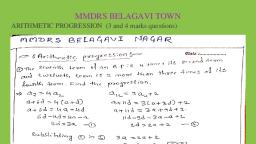
-4-, , Two Marks Questions, 1. If the first and the last term of an A.P are 4 2. Find the 12th term of an A.P, 2, 5, 8, 11, . ., and 40 respectively. Find the sum of first 20 using formula, terms., a=4, l=40, n=20, a=2, d=5–2=3,, n=12, an=a+(n-1)d, Sn= ( a+ l), a12=2+(12-1)3, S20= ( 4+ 40) = 10x44=440, = 2+33 = 35, 3. Find the sum of first 20 terms of the arithmetic 4. Find the 10th term from last (towards the first, series 2+7+12+……………… using the formula. term) of the A.P, 4, 7, 10, 13, . . . 64., From last term, the A.P becomes, a =2, d=5, n=20, 64, . . . 13,10,7,4., a=64 d= 10 – 13= -3 , n=10, Sn= [ 2a+ (n-1)d], an=a+(n-1)d, S20= [ 2(2)+ (20-1)(5)] = 10[4+95], a10=64+(10-1)(-3), = 64 – 27 = 37, = 10[99] = 990, , 5. Examine, whether 92 is a term of the A.P., 2, 5, 8, 11, . ., a=2 d= 5 – 2= 3, Let an =92, an = a + (n-1)d, 92 = 2 + (n-1)3 = 2+ 3n -3, 3n= 93, n= 31, Since n is an whole number, 92 is a term of the A.P 2,5,8,11, . ., Three Marks questions, 1. The interior angles of a quadrilateral are in 2. In an A.P., the 3rd term is 3 and the 5th term is, A.P. The smallest among them is 150. Find the, . Find its 50th term., measure of remaining angles., a3=3, a5 =, a50 = ?, Let the angles be, , a+2d= 3, , By the angle sum property of quadrilateral, , a+4d= -11, , (subtraction), , -2d= 14 =>, , d= -7, , Substituting the value of “d” in a+2d= 3, Substituting the value of “a” in a-3d =15, , a+2(-7)=3 =>, an=, , 0, , The measure of remaining angles 65 , 115, and 165, , 0, , 0, , a50=17+(50-1)(-7), , a=17
Page 5 :
-5-, , Four or Five Marks Questions, 1. In an A.P, the sum of 3rd and 6th term is 28 2. A sum of Rs. 1600 is to be used to give ten, and the sum of 4th and 8th term is 34. Find the cash prizes to the students of a school for their, A.P., overall academic performances. If each prize is, Rs 20 less than its preceding prize, find the value, According to the data, of each of the prizes., a3+ a6 = 28, Here,, a+2d+a+5d=28, Let the amounts of the prizes be, 2a+7d=28 ---------- (1), a4+ a8 = 34, a+3d+a+7d=34, , , Sn=1600,, , 2a+10d=34 ---------- (2), , Sn= [ a+l], , solving (1) and (2), 2a+7d=28, 2a+10d=34, , n=10, , S10=, (subtraction), , => d=2, Substituting the value of “d” in, , Value of each prize is 250,230,210, ------------70, , A.P. is 7, 9, 11, 13, . ., 3. The 4th term of an A.P is 14 and 8th term is 8 4. The sum of three terms of an A.P is 18 and the, less than twice the 5th term. Find the sum of sum of the squares of extremes is 104. Find the, first 25 terms of the A.P., A.P and the sum of first 40 terms., a4=14, a8=2a5 -8, S25 =?, , Let the three terms be, , solving (1) and (2), , a2+d2-2ad+a2+d2+2ad = 104, 2a2+2d2 = 104, , By substituting the value of “d” in, we get, Sn= [ 2a+ (n-1)d], S25=, =, , [ 2x5+ (25-1)3], [ 10+72], , a2+d2 = 54, 62+d2=52, d= ±4, Let, , then the A.P is 2, 6, 10, . . ., , Sum of 40 terms is Sn=, S40=
Page 6 :
-6-, , Unit-2: TRIANGLES, Multiple Choice Questions, 1. If two triangles are congruent, then the ratio of their areas is, (A) 1:1, (B) 1:2, , (C) 2:1, , (D) 2:3, , 2. In two similar triangles, if the corresponding sides are in the ratio 4:9, then the ratio of their, areas is, (A) 81:16, (B) 16:81, (C) 9:4, (D) 2:3, 3. In a ∆ABC, if | = 900 then AB2 =, (A) AB2 + BC2, , (B) AC2 – BC2, , (C), , (D) AC2 + BC2, , 4. In a right angled triangle, if lengths of the perpendicular sides are 3cm and 4cm, then the length, of the hypotenuse is, (A) 5cm, (B) 9cm, (C) 16cm, (D) 7cm, 5. A pole of height 10m casts a shadow of length 4m on the ground. At the same time the length of, the shadow cast by a building of height 50m is, (A) 20m, (B) 10m, (C) 25m, (D) 30m, 6. In the given figure, DE || BC, then, (A), , (B), , (C), , (D), , 7. In the adjoining figure, in ABC, DE BC, if AD = 6cm, BD = 10cm and, AE=3cm then CE is, (A) 5, (B) 3, (C) 6, (D) 10, 8. In the figure, in ∆PQR, |, , = 900, QT┴PR then QT2 =, , (A) PT.PR, , (B) QR.TR, , (C) PR.TR, , (D) PT.RT, , 9. In the adjoining figure, similarity criterion used to say that,, the triangles are similar is, (A) S.S.S., , (B) S.A.S., , (C) A.A.A., , (D) A.S.A., , 10. In triangle ABC ∠B= 900, AC= 4cm, AB= 3cm, measure of BC is., (A) 5cm, (B) 7cm, (C), cm, (D) 1cm
Page 7 :
-7-, , One Mark questions, 1. Write the statement of Pythagoras theorem., In a right triangle, the square of the hypotenuse is equal to the sum of the squares of the, other two sides., 2. Write the statement of Basic proportionality (Thales) theorem., If a line is drawn parallel to one side of a triangle to intersect the other two sides in, distinct points, the other two sides are divided in the same ratio., 3. Each side of a square is 12cm. Find its diagonal., , Two Marks questions, 1., and their areas be 64cm2, , 2. ABC is an isosceles triangle right angled at B., , 2, , and 121cm . If EF=15.4cm then find BC., , Prove that AC2 = 2AB2., In, , ,|, , and, [Given], From Pythagoras Theorem, we have,, , Hence the proof., , 3. In the adjoining figure, in ∆ABC, |, and BD┴AC. Show that BC2=AC.CD, , = 900 4. Given ∆ABC ∆PQR, such that |, |, , [Common angle], , In ∆ABC, [angle sum property], , [By AA-criterion], , |, , +|, , ., , =600 [∆ABC ∆PQR], , | =|, , [BD┴AC], , Hence the proof., , =600. Find the measure of |, , +|, , =1800, , |, , = 800, , =400 and
Page 8 :
-8-, , Three marks questions, 1. In the adjoining figure, DE||AC and DF||AE., Prove that, , 2. In the adjoining figure, AP and BQ are, perpendiculars on AB. prove that, ., , In, , |, , =|, , |, , =|, , , DF||AE, ------(1), , In, , , DE||AC, , [Given], [Vertically opposite angles], [By AA-criterion], , ------(2), From equation (1) and (2), , Hence the proof., 3., In the adjoining figure, in a trapezium, ABCD, AB||CD and AB=2CD. Find the ratio of, the areas of ∆AOB and ∆COD., we have,, |, =|, [Vertically opposite, angles], |, =|, [Alternate angles, AB||DC], [By AA-criterion], , 4., , A ladder of 15m long reaches a window of a, building 12m above the ground. Find the distance of, the foot of the ladder from the base of the wall., Let AC be the ladder and AB be the wall with, the window at A., Also, AC=15m and AB=12m, From Pythagoras Theorem,, , =>, Thus, the distance of the, foot of the ladder from the, base of the wall is 9m., 5. A vertical pole of height 12m casts a shadow of length 8m on the plane ground. At the same time a, tower casts a shadow of length 40m on the plane ground. Find the height of the tower., Length of the vertical pole = AB = 12m, Length of the shadow casts by the pole = BC = 8m, Length of the shadow casts by the tower = EF = 40m, Let the height of the tower = h m, |, |, , =|, =|, , [The angles made by sun at the same time], [By AA-criterion of similarity], , Height of the tower = 60m.
Page 9 :
-9-, , Four or Five marks questions:1. State and prove the Basic proportionality (Thales’) theorem.
Page 10 :
- 10 -, , 2. State and prove the Pythagoras theorem.
Page 11 :
- 11 -, , 3. Prove that “The ratio of the areas of two similar triangles is equal to the ratio of their, corresponding sides”.
Page 12 :
- 12 -, , 4. Prove that “If in two triangles, corresponding angles are equal, then their corresponding, sides are in the same ratio (proportion) and hence the two triangles are similar”., Data:, , To prove:, Construction: Mark points P and Q on DE and DF such that DP=AB and, DQ=AC. Join PQ., , Proof:, [Data], AB=DP, , [Construction], , AC=DQ, , [Construction], [SAS postulate], , BC=PQ, , [By CPCT] -----(1), , [By CPCT], [Data], [Axiom 1], , [Corollary of BPT], [From (1) and construction], Hence the proof.
Page 13 :
- 13 -, , Unit-3:PAIR OF LINEAR EQUATIONS IN TWO VARIABLES, Multiple Choice Questions, 1. A pair of linear equations, , ,, , (B), , (A), , is said to be inconsistent if, (C), , (D), , 2. If two lines representing the pair of linear equations, intersect at a point, then the correct relation among the following is, (A), , (B), , (C), , (D), , 3. The lines representing the pair of linear equations, (A) intersecting lines, (C) parallel lines, , are, (B) perpendicular lines, (D) coincident lines, , 4. The Pair of linear equations, (A) No solution, (C) Exactly one solution, , have, (B) Infinitely many solutions, (D) Two solutions, , One Mark Questions, 1. The graph represents the pair of linear equations in, Write the solution for this pair of equations., Ans :, , and, , ., , 2. Write the general form of pair of linear equations in two variables ‘x’ and ‘y’, , where, real numbers., , are all, , 3. In the pair of linear equations a1x+b1y+c1=0 and a2x+b2y+c2=0, if, number of solutions these equations have., , , then write the, , Ans: Infinitely many solutions., , Two Marks Questions, 1. Solve the following pair of linear 2. Solve by elimination method:, equations by any of the algebraic method:, ----- (1), ----- (2), (addition), Substituting the value of, , in, , and, , Multiplying the equation (1) by 2 we get, Solving equation (2) and (3), (subtraction), Substitute the value of y in, , ,, , we get
Page 14 :
- 14 -, , Three or Four Marks Questions., 1. The cost of 5 oranges and 3 apples is Rs.35 2., and the cost of 2 oranges and 4 apples is Rs. 28., Find the cost of an orange and an apple., , Solve:, , and, , Let the cost of an orange and an apple be, respectively. =>, and, By adding (1) and (2) we get, , x+y = 1 ----- (3), (, Multiply the equation (1) by 4 and equation (2), by 3 we get,, , By subtracting (1) by (2) we get, , ---- (4), (subtraction), Solving (3) and (4), Substituting the value of x in, , By substituting the value of x in (3) or (4) we get, , 3. The sum of two numbers is 50 and their 4. If twice the age of the son is added to age of, difference is 22, find the numbers., the father the sum is 56. But if twice the age of, the father is added to the age of the son, then the, Let the two numbers be, ., sum is 82. Find the ages of the father and the, According to the data, son., Let the age of son be ‘x’ years and, the age of father be ‘y’ years, Solving (1) and (2), Multiply the equation (2) by 2 we get, (addition), By Substituting the value of x in (1) we get, , Solving (1) and (3), By substituting the value of y in (1) we get x=10
Page 15 :
- 15 -, , 5) 4 men and 6 boys can finish a piece of work in, 5 days, while 3 men and 4 boys can finish the, same work in 7 days. Find the time taken by one, man alone or then by 1 boy alone., , 6) Ritu can row, down-stream 20 km in 2, hours, and upstream 4 km in 2 hours. Find her, speed of rowing in still water and the speed of, the current., , Number of days taken by 1 man = x days., Number of days taken by 1 boy = y days., Work done by 1 man in 1 day =, , Let the speed of Ritu in still water be = x km/h., Speed of current be y km/h., The speed of downstream =, km/h., The speed of upstream, =, km/h, , Work done by 1 boy in 1 day =, , ----- (1) ;, Take = a ,, , ----- (2), , = b, then (1) and (2), , becomes, , Time, , =, , t1=, , =2, , ---(1), , t2 =, , = 2 =>, , --- (2), , ----- (3), ----- (4), By solving (3) and (4) we get, , Considering, , 8) Solve graphically:, , 7) Solve graphically:, ., , x, y, , 0, 5, , 1, 3, , 2, 1, , x, y, , 1, 3, , 2, 2, , 3, 1, , x, y, , 1, 4, , 2, 3, , 3, 2, , x, y, , 1, 0, , 2, 1, , 3, 2
Page 16 :
- 16 -, , UNIT-4 :, , CIRCLES, , Multiple Choice Questions, 1 In the figure, TP and TQ are the tangents drawn to a circle with centre O., If ∠POQ = 110o, then the value of ∠ TQ is, A. 70o, , B. 80o, , C. 60o, , D. 140o, , 2 The tangents drawn at the ends of a diameter of a circle are, A. perpendicular to each other, B. parallel to each other C. equal, , D. Not equal, , 3 A straight line which intersects a circle at two distinct points is, A. tangent, B. chord, C. secant, D. diameter, 4 If the angle between the two tangents to a circle is 400 , then the angle between the radii is, A. 900, , B. 1000, , C. 1400, , D. 1800, , 5 Distance between two parallel tangents of a circle of radius 3.5cm is, A. 3.5cm, B. 7cm, C. 10cm, D. 14cm., 6, , In the given figure PA, PC and CD are the tangents to a circle with, centre O. If CD = 5 cm and AP = 3 cm, then length of the tangent PC is, A. 8 cm, , 7, , B. 5 cm, , C. 3 cm, , D. 2 cm, , In the figure, Chord of the circle with centre ‘O’ is, A. XY, , B. OP, , C. MN, , D. AB, , 8 A tangent of length 8 cm is drawn from an external point ‘A’ to a circle of radius 6 cm . Then, the distance between ‘A’ and the centre of the circle is, A. 12 cm, B. 5 cm, C. 10 cm, D. 14 cm, 9 Maximum number of tangents drawn to a circle from an external point is, A. 2, B. 3, C. 4, D. 5, , One Mark Questions, 1 What is the measure of the angle between radius and tangent at the point of contact?, 2 Define the Secant of a Circle., A line that intersects a circle at two points is called a Secant., 3 Define the tangent of a circle., A line that touches a circle at only one point is called a Tangent., 4 Define Point of contact of a circle., The common point of the tangent and the circle is called the Point of contact., , Ans: 90o
Page 17 :
- 17 -, , Three Marks Questions, 1 Prove that “the length of tangents drawn from an external point to a circle are equal.”, : ‘O’ is the centre of the circle, ‘P’ is an, external point. AP and BP are the tangents, , Given, , To Prove : AP = BP, Construction : Join OA, OB and OP., Proof :, In, ∠OAP = ∠OBP = 900, , [Theorem 4.1], , OP = OP, , [Common side], , OA = OB, , [Radii of same circle], [RHS Postulate], , AP=BP, , [CPCT], Hence proved., , 2 Prove that “ the tangent at any point of a circle is perpendicular to the radius through the point of, contact.”, Given, , : XY is the tangent at P to the circle with centre ‘O’, , To Prove : OP _|_ XY, Construction : Mark Any point ‘Q’ on XY, join OQ and, it cuts the circle at R, Proof : OR < OQ, OR = OP, , (Radii of the same circle), , OP < OQ, This holds good for all the points on XY, OP is the least distance, OP _|_ XY
Page 18 :
- 18 -, , UNIT-5 :, , AREAS RELATED TO CIRCLES, , Multiple Choice Questions, 1, , Area of Quadrant of a circle with radius ‘r’ is, A., , 2, , B., , C., , D., , cm, , B., , cm, , C., , cm, , cm, , D., , If the angle of a sector is ‘P’ (in degrees) and radius is ‘R’ then its area is, A., , 5, , B., , Length of the arc of a sector with radius 9 cm and the angle 1200 is, A., , 4, , D., , If the radius of a semicircle is 7cm, the length of its arc is, A., , 3, , C., , x, , B., , x, , C., , x, , x2, , D., , If the ratio of circumference of two circles is 4 : 5 then the ratio of their areas is, A. 4:5, , B. 16:25, , C. 64:125, , D. 5:4, , One Mark Questions, 1, , Write the formula to find the area of the shaded region in the given figure., , 2, , Define the segment of a circle., A segment is a region covered by a chord and a corresponding arc., , 3, , What is meant by a sector of the circle?, The area bounded by two radii and the corresponding arc of a circle is called the Sector., , 4, , 5, , If the diameter of a semicircle is 14cm, then find its perimeter [use, , ], , If the area of a circle and the perimeter are numerically equal, then find the radius of, circle., , that
Page 19 :
- 19 -, , Two Marks Questions ( Use, 1, , unless given), , In a circle of radius 21 cm an arc subtends, 2, 0, an angle 60 at the centre of the circle. Find, the length of the arc formed in the circle., Length of the arc =, , In a circle of radius 21 cm and arc subtends, angle 600 at the centre of the circle, find the, area of sector formed in the circle., , x, , Area of the sector, , x 21, , =, , Area of the sector = 231 sq.cm, , Length of the arc = 22 cm, 3, , X, , In the figure ABCD is a square of side 14 cm . With centre A, B , C & D four circles are drawn, such that each circle touch externally two of the remaining three circles. Find the Area of the, shaded region., Radius of each quadrant =, , = 7 cm, , Area of the shaded region = Area of the square – Area of 4 Quadrants., Area of the shaded region, , Area of the shaded region, , 4, , A drain cover is made from a square metal, plate of side 40 cm having 441 holes of, diameter 1 cm each drilled in it. Find the, area of the remaining square plate., Area of each hole, , 5, , In the figure, a circle is circumscribed, in a square ABCD. If each side of the, square is 14cm find the area of shaded, region, Radius of the circle; r =, r = 7cm, Ar(shaded region) = Ar(Square) – Ar(Circle), , Area of 441 holes =, Area of Square metal plate =, , cm2, , =1600 cm2, , Area of remaining square plate = 1600 – 346.5, = 1253.5 cm2, , Area of the shaded region
Page 20 :
- 20 -, , Three Marks Questions ( Use, 1, , unless given), , Find the area of a quadrant of a circle,, where the circumference of circle is 44cm., Circumference, , 2, , Area of a sector of a circle of radius 14 cm is, 154 cm2. Find the length of the corresponding, arc of the sector., Given,, , Area of sector, , Area of quadrant, =>, , Length of an arc, , Area of quadrant, Length of the arc, 3 OABC is a square inscribed in a quadrant 4 The radii drawn from the end points of a, OPBQ. If OA = 20 cm. (use, chord of a circle subtend an angle of 1200, Ar(Square) =, Radius of the quadrant; r= OB, , at the centre. If the radius of the circle is, 12 cm Find the area of the corresponding, segment of the circle. (use, and, = 1.73 )., Radius, , Ar(Quadrant), , Ar(Quadrant), Ar(Shaded region) =, , ,
Page 21 :
- 21 -, , UNIT-6 :, , CONSTRUCTIONS, , Two Marks Questions, 1 Construct a tangent at any point P, on a circle of radius, , 2, , Draw a line segment of length, line segment in the ratio, , and divide the, , Three Marks Questions, 1 Construct a pair of tangents to a circle of radius, angle of 700., , 2, , Draw a circle of radius, its centre., , which are inclined to each other at an, , and construct a pair of tangents to it from a point, , away from
Page 22 :
- 22 -, , Four Marks Questions, 1 Construct a triangle with sides 5cm, 6cm and 2 Construct a triangle of sides 4cm, 5cm and, 7cm, then a triangle similar to it whose sides are, 6cm and then a triangle similar to it whose, sides are of the corresponding sides of, of the corresponding sides of the first triangle., the first triangle., , 1 Draw a triangle DEF with EF=7 cm, ∠DEF=600 2 Construct a triangle similar to triangle, ABC in which AB =4 cm, ∠ ABC=60o, and DE=6 cm then construct a triangle whose, and BC= 6 cm such that each side of the, sides are of the corresponding sides of the, triangle DEF., , new triangle is, , of the corresponding, , sides of the triangle ABC.
Page 23 :
- 23 -, , UNIT-7 :, , COORDINATE GEOMETRY, , Multiple Choice Questions, 1 The co-ordinates of the mid-point of the line segment joining the points (2,0) and (6,0) is, A. (2,4), , B. (2,6), , C. (4,0), , D. (0,4), , C., , D., , 2 The distance of point (4, -3) from the origin, A., , B., , 3 The perpendicular distance of the point P (2, 3) from the x-axis is, A. 1 unit, , B. 2 units, , C. 3 units, , D. 5 units, , C. (0,1), , D. (1,0), , 4 The Coordinates of the origin is, A. (1,1), , B. (0,0), , 5 The coordinates of a point P on the x-axis are of the form, A., , B., , C., , D., , 6 Area of the triangle with vertices P(0, 6), Q(0,2) and R(2, 0) is, A. 4 square units, , B. 0, , C. 8 square units, , D. 6 square units, , 7 If M(6, 3) is the midpoint of line joining P(-2, 5) and Q(8, y) then y =, A. 4, , B. 3, , 8 Distance of the point, , C. 2, , D. 1, , C), , D., , ) from the origin is, , A., , B), , One Mark Questions, 1 What is the value of the y-coordinate of a point on x-axis?, , Ans: 0, , 2 Write the coordinates of the origin., OR, Write the coordinates of the point of intersection of x-axis and y-axis., 3 Write the coordinates of the midpoint of a line, segment joining the points P (x1,y1) and Q(x2,y2)., , Ans:, 4 Find the distance of the point (3, 4) from, , the origin., Distance from the origin, =>, =>, , 5, , Ans: (0,0), , Find the co-ordinates of the midpoint of, the line segment joining the points ( 0, 8), and (4, 0).
Page 24 :
- 24 -, , Two Marks Questions, 1, , Find the distance between the points, (3,2) and (-5,6)., , 2, , If, , the, , 5, , distance, between, the, points, is 5 units, find the value of ‘p’, , [Squaring on both sides], , units, 3, , Find the area of a triangle with vertices, , 4 Find the coordinates, of the line segment, and, , of the midpoint, joining the points, , 5 Find the radius of the circle whose center is, and if the circle passes through, Radius is the distance between center and any, point on the circle., , =, =, units
Page 25 :
- 25 -, , Three Marks Questions, 1 Find the co-ordinates of the point which divides the line segment joining the point (1,6) and, (4,3) in the ratio 1:2., , =, , 2 If, , are collinear, then find the value of ‘a.’, , If three points are collinear then, Area of the Triangle, , 3 Find the area of the triangle whose vertices are (1, 2), (3, 7) and (5, 3)., , But Area cannot be negative, Area of given triangle is 9 square units
Page 26 :
- 26 -, , 4 In what ratio does the point, ?, , divide the line segment joining the points, , P(x,y) =, , =, and, , =>, , Consider,, , =, :, , =2:7, , 5 Find the value of ‘pʼ if the point A(0, 2) is equidistant from, , Let, Given AB = AC, , =, , [squaring on both sides]
Page 27 :
- 27 -, , Four Marks Questions, 1 Find the area of the triangle formed by joining the mid-points of the triangle whose vertices are, , Midpoint =, K(2, 1),, , L(4, 3), , Midpoint of KL is A =, , =, , = A(3, 2)., , =, , = B(2, 3)., , =, , = C(3, 4)., , K(2, 1) , M(2, 5), Midpoint of KM is B =, L(4, 3),, , M(2, 5), , Midpoint of LM is C =, , A(3, 2), (B(2, 3) and (3, 4), Area of, , =, , Area of, , =, =, =, , =, But area cannot be negative,, , Area of Triangle ABC = 1 square unit., , 2 Show that the points K(4, 5), L(7, 6), M(6, 3) and N(3, 2) are the vertices of a rhombus., , K(4, 5),, KL =, , L(7, 6), =, , L(7, 6),, LM =, , =, , M(6, 3),, , =, , =, , units., , =, , =, , units., , =, , =, , units., , N(3, 2), =, , N(3, 2),, NK =, , units., , M(6, 3), =, , MN =, , =, , K(4, 5), =, , KL = LM = MN = NK, Here all sides are equal., K, L, M and N are the vertices of a Rhombus.
Page 28 :
- 28 -, , Unit-10 : QUADRATIC, , EQUATIONS, , Multiple Choice Questions, 1 The value of the discriminant of a quadratic equation is 3. Then the nature of its roots is, A. Real and Distinct, , B. Real and equal, , C. There is no any root, , D. Imaginary numbers, , 2 The standard form of quadratic equation is, A., , B., , C., , D., , 3 The quadratic equation whose roots are -1 and 2 is, A., C., , B., D., , 4 The standard form of the quadratic equation, , is, , A., B., C., D., 5 “Sum of the squares of two consecutive odd numbers is 130. ” Mathematical form of this, statement is, , 6, , A., , B., , C. x2+(x+2)2=130, , D., , If the roots of ax2 + bx + c = 0 are equal, then the correct relation among the following is, , B. b2 + 4ac = 0, , C., , D. a = b, , One Mark Questions, 1, , Write the standard form of a quadratic equation., , 2 Find the discriminant of the quadratic, equation, , 3, , Ans: ax2 + bx + c = 0 , where, , Find the roots of the quadratic equation, , =, =0, 4 Write the discriminant of the quadratic 5, equation, Ans:, , Write the formula to find the roots of the, quadratic equation, Ans:
Page 29 :
- 29 -, , Two Marks Questions, 1 Solve the quadratic equation, by Factorization method, , 2 Solve the quadratic equation, by Factorization method, , 3 Solve the quadratic equation, by Factorization method, , 4 Solve the quadratic equation, by Factorization method, , 5 Solve, quadratic formula., , by using the 6 Solve, quadratic formula., , by, , or, , or, , using, , the
Page 30 :
- 30 -, , 7 Find the nature of the roots of the 8, , equation, , Find the nature of the roots of the, equation, , =, =, , =, =0, Roots are Real and Equal, , Here, Roots are Real and Distinct, , 9 Find the nature of the roots of the 10 Find the value of ‘k’ if the quadratic equation, has equal roots., equation, Given; Roots are Equal, =, =, Here, The equation has no real roots., , Three Marks Questions, 1 A girl is twice as old as her sister. Four 2, years hence, the product of their ages (in, years) will be 160. Find their present ages., , The altitude of a right triangle is 7 cm less, than its base. If the hypotenuse is 13 cm. find, the other two sides., , Let the present age of sister be ‘x’ years and, girls present age be ‘2x’ years, , Let the base is ‘x‘ cm and altitude is, cm and hypotenuse is 13 cm, , Product of their ages 4 years hence =, , By Pythagoras theorem., , Age cannot be negative =>, Girl’s present age is 12 years and, present age of her sister is 6 years, , Base is 12 cm and Altitude is 5 cm
Page 31 :
- 31 -, , 3 The difference of squares of two positive 4, numbers is 180. The square of small, number is 8 times the big number. Find, the numbers., Let the bigger number be and smaller be, Given, and, , The sum of the squares of two consecutive, positive integers is 13. Find the numbers., Let the numbers be, , =>, =>, The numbers are 18 and 12, , The other number =, The numbers are 2 and 3, , Four Marks Questions, 5 A person on tour has Rs 4200 for his 6, expenses. If he extends his tour for 3 days,, he has to cut down his daily expenses by, Rs 70. Find the original duration of the, tour., original duration of the tour be ‘x’ days., , Given,, , A motor boat whose speed in still water is, 18km/hr, takes 1 hour more to go 24 km, upstream than to return downstream to the, same spot. Find the speed of the stream., Let the speed of the stream be, Speed of the boat in upstream =(18-x)km/hr, Speed of the boat downstream =(18+x) km/hr, , =70, , 4200, The time taken to go upstream =, and the time taken to go downstream =, , Given,, =1, , number of days can’t be negative, =>, , Original duration of the tour is 12, days., , speed can’t be negative, The speed of the stream is 6km/hr
Page 32 :
- 32 -, , Unit-11 : INTRODUCTION, , TO TRIGONOMETRY, , Multiple Choice Questions, 1 If, , then the value of, A., , B., , 2 The value of, , B., and, , A. 0°, 4 If, , D., , C., , D., , is an acute angle then the value of, B. 30°, , is, , C. 45°, , D. 60°, , B., , C. 1, , D. 0, , B., , C., , D., , B., , C., , D., , B., , C., , D., , , then the value of, A., , 5, , C., , is, , A., 3 If, , is, , is, , is equal to, A., , 6, A., 7 The value of, A., , One Mark Questions, 1 Find the value of, , 2 If, where, is an acute, angle then find the value of ., , ., ., , 3 Find the value of (, , )., , ., , 4 If, value, , 900, =>, , , then find the, .
Page 33 :
- 33 -, , Two Marks Questions, 1, , Evaluate:, , 2, , If tan, , , where2A, , 3 If, , A=600,, , B=300, , then, , show, , that, , is an acute angle. Find the value of A., , 4, , Show that, , 5 If, , are interior angles of a triangle, , ABC, then show that,, We know ,, Sum of the interior angles of a Triangle =, , =, = sec A, , 6, , Prove that, , Taking, , on both sides
Page 34 :
- 34 -, , Three Marks Questions, 1, , Show that,, , =, , 2, , ., , Show that,, , L.H.S =, LHS, , x, , =, =, =, =, , =, , +, , = RHS, , 3, , Prove that, L.H.S =, , =, =, =, =, =, , 4, , If, , ,, , Given,, , =>, , then, , show, , that
Page 35 :
- 35 -, , 5, , 6, , Prove that, , =, , Prove that, ., , +, , LHS, , ., , x, , =
Page 36 :
- 36 -, , Unit-12 : SOME APPLICATIONS OF TRIGONOMETRY, Two Marks Questions, 1, , The top of a building is observed from a point on the ground, If the angle of elevation is 300, then find the height of the building., , away from its base., , Let A be the point of observation and C be the top of the building., Then AB=, and |A =300, , = > BC= 100m, height of the building is 100ft., 2, , A kite flying at a height of, above the ground is tied to a point on the ground by a thread, of 100m length without any slack. Find the angle formed by the thread with the ground., Let P be the point on the ground where thread is tied and, R be the position of kite., Then QR=5, and PR= 100m, , = > |P= 600, Thread makes an angle of 600 with the ground., 3, , In an amusement park, there is a slide of height, to the ground. Then, find the length of the slide., , , which is inclined at an angle of 300, , Let QR be the height of the slide and |P is the angle of inclination, PR is the length of the slide, Then QR=6m and |P=300, , = > PR= 12m, The length of the slide is 12m.
Page 37 :
- 37 -, , Three Marks Questions, 1, , The angle of elevation of a cloud is, from a point 60 m above a lake and from the, same point, the angle of depression of the reflection of cloud in the lake is 60 0. Find the, height of the cloud., Let AB be the surface of lake., P be the point of observation. AP=60 m, Let C be the position of cloud. C’ be its reflection, in the lake., CB=C’B, Let CM, , then C’B, In Δ CMP, tan300=, In Δ PMC’ tan600=, =, PM =, , -------(2), , From (1) and (2), , 2, , =, , =>, , CB=CM+MB = 60+60 = 120 m, Height of the cloud from the surface of the lake is 120 m., The top of a tower is observed from two points on the same straight line on the ground., The distances of these points from the base of the tower is, meters. If the angles, of elevation are complementary prove that the height of the tower is, meter., Let CD be the building of height 60 m and, AB be the tower, |FCA = |CAE = 300, |FCB = |CBD = 600, In ΔACE,, , In ΔBCD,, , =, , =>
Page 38 :
- 38 -, , 3, , The angle of elevation of the top of a tower from two points on the ground at distances ‘a’ and, ‘b’ meters from the base of a tower and in the same straight line with it are complementary., Prove that height of the tower is, meter., Height of the tower be ‘x’ m, , Multiplying (i) and (ii), , =>, Height of the tower is, 4, , meter., , The deck of a ship is 10m high from the level of water. A man standing on it observes, the top of a hill with an angle of elevation, and from the same point, he observes the, base of the same hill at an angle of depression, Then, find the distance of the ship, from the hill and also the height of the hill., In ΔADE,, , =, -------(i), In ΔABC,, , =, =>, , ----(ii), , Distance of the ship from the hill =10, Substituting (ii) in (i) gives, => Height of the hill = 30+10 = 40 m., , m
Page 39 :
- 39 -, , Four Marks Questions, 1 From a window 15 m high above the ground in a street, the angles of elevation and depression of, the top and foot of another house on the opposite side of the street are 300 and 450 respectively., Show that the height of the opposite house is 23.66m. (take =1.73), AB – ground, C- position of window, BD – house in the opposite side of the street, |DCE = 300, |ECB = |CBA =450, AC = BE = 15 m, Let BD =, ,, In ΔCDE,, , =, , =>, , In ΔACB,, (since AB =CE), , 2, , An aero plane when flying at a height of 4000 m from the ground passes vertically above, another aero plane at an instant when the angles of the elevation of the two planes from the same, point on the ground are 600 and 450 respectively. Find the vertical distance between the aero, planes at that instance., Let P and Q be the positions of two aero planes,, when Q is vertically below P and OP=4000 m, A be the point of observation on the ground, In ΔAOP, and, in Δ AOQ, , =, OA =, , OQ = OA, , Vertical distance PQ = OP – OQ, PQ =, , =>
Page 40 :
- 40 3, , The angle of elevation of a jet plane from a point A on the ground is 600. After a flight of 30, seconds, the angle of elevation changes to 300. if the jet plane is flying at a constant height of, 3600, m, find the speed of the plane., Let P and Q be the two positions of plane, A be the point of observation, , In Δ ABP,, , =>, , In Δ ACQ,, , =>, , =, , AC = 10800 m, BC = 10800 – 3600, BC = 7200 m, but BC=PQ => Distance travelled is 7200 m, Speed of the plane =, 4, , =, , A person at the top of a hill observes that the angles of depression of two consecutive kilo, metre stones on a road leading to the foot of the hill and on the same vertical plane containing, the position of the observer are 300 and 600. Find the height of the hill., AB – hill, C and D are kilometer stones, AX is the horizontal through A, A is the position of observation, |XAC = |ACD = 300 ,, , |XAD = |ADB = 600, , In ΔABC,, -----(i), In ΔABD,, -------(ii), , .
Page 41 :
- 41 -, , Unit 13: STATISTICS, Multiple Choice Questions, 1 The mean value of 10, 15, 5, 20 and 50 is, (A), , 10, , (B) 5, , (C) 15, , (D) 20, , 2 The median of 7, 3, 6, 14, 13, 11, 19 is, (A) 7, , (B) 13, , (C) 11, , (D) 19, , 3 The mode of 6, 7, 2, 4, 2, 8, 5, 2, 2, 7 is, (A) 7, , (B) 6, , (C) 4, , (D) 2, , 4 The measure of central tendency that gives the middle most value of the data is, A. midpoint, , B. mean, , C. median, , D. mode, , 5 Mode of the given set of scores is, A) Middle most value, C) Most frequent value, , B) Least frequent value, D) None of these, , One Mark Questions, 1. Write the empirical relationship between the three measures of central tendency., 3Median = Mode + 2Mean, 1) 1. 2.Find the median of 24, 31, 17, 29, 36, 39, 17, 24, 29, 31, 36, 39, , 2. 3. Find the class mark of the class interval 40-50
Page 42 :
- 42 -, , Three Marks Questions, 1) Find mean for the following frequency, distribution., Class, Interval, Frequency, Class, Interval, 0-10, 10-20, 20-30, 30-40, 40-50, , 010, 3, , 1020, 5, , 2030, 9, , 3040, 5, , 4050, 3, , 5, 15, 25, 35, 45, , 3) Find the mode of the following, frequency distribution., Class interval, 30-40, 40-50, 50-60, 60-70, 70-80, 80-90, , Class, interval, Frequency, , Frequency, 3, 5, 9, 5, 3, , 2) Find the Median of the following frequency, distribution., , Frequency, 4, 7, 9, 11, 6, 2, , 15, 75, 225, 175, 135, , 0-10 10-20 20-30 30-40 40-50, 4, , 7, , 13, , Class Interval, , Frequency, , 0-10, 10-20, 20-30, 30-40, 40-50, , 4, 7, 13, 9, 3, , 9, , 3, , Cumulative, Frequency, 4, 4+7=11, 11+13=24, 24+9=33, 33+3=36
Page 43 :
- 43 -, , Three Marks Questions, 4) The marks scored by 30 Students of class X, in the Mathematics are given below., , Draw a less than type ogive., Marks, , 0-20, , 20-40, , 40-60, , 60-80, , 80-100, , Number of students, , 5, , 3, , 11, , 2, , 9, , Number of, students, , Marks, Less than 20, , 5, , Less than 40, , 5+3=8, , Less than 60, , 8+11=19, , Less than 80, , 19+2=21, , Less than 100, , 21+9=30, , 5) During the medical check-up of 35, students of a class, their weights were, recorded as follows. Draw a less than type, ogive for the given data., , Weights (in kg), Less than, , 40, , Number of, students, 3, , Less than, , 45, , 5, , Less than, , 50, , 9, , Less than, , 55, , 14, , Less than, , 60, , 28, , Less than, , 65, , 32, , Less than, , 70, , 35
Page 44 :
- 44 -, , 6)Heights of 60 children are given below. Draw a more than type ogive., Height( in cm), , 90-100, , 100-110, , 110-120, , 120-130, , 130-140, , 140-150, , Number of, children, , 5, , 10, , 7, , 24, , 11, , 3, , Number of, children, , Height( in cm), More than or equal to, , 90, , More than or equal to, , 100, , More than or equal to, , 110, , More than or equal to, , 120, , More than or equal to, , 130, , More than or equal to, , 140, , 60, , 7) Details of daily income of 50 workers, in a food industry are given below. Draw, a more than type ogive for the following, data., Daily Income (in Rs.), , Number, of, workers, , 80, , 50, , More than or equal to 100, , 38, , More than or equal to 120, , 24, , More than or equal to 140, , 16, , More than or equal to 160, , 10, , More than or equal to 180, , 0, , More than or equal to
Page 45 :
- 45 -, , Unit 15: SURFACE, , AREA AND VOLUME, , Multiple Choice Questions, 1. The volume of a hemisphere of radius ‘r’ is, (A), (B), (C) 4, , (D), , 2. If two solid hemispheres with same radii of their bases are joined together along their bases, then,, the curved surface area of the new solid formed is, (A), (B), (C), (D), 3. A cylinder and a cone are of same heights and same radii of their bases. If the volume of the, cylinder is 924cm3 then, the volume of the cone is, (A), (B), (C), (D), 4. While conversion of a solid from one shape to another, the volume of the new shape will, (A) increases, (B) decreases, (C) remain unaltered, (D) doubled, 5. The surface area of a sphere of radius, (A), (B), , is, (C), , (D), , 6. If the slant height of a frustum of a cone is 4cm and radii of its two circular ends are 5cm and, 2cm, then its curved surface area is, (A), (B), (C), (D), 7. Three cubes of edge 4 cm are joined end to end, then the volume of the cuboid so formed is, (A), (B), (C), (D), 8. The radius of the base of a cone is 9cm and slant height is 15cm, then its height is, (A) 6cm, , (B) 3cm, , (C) 5cm, , (D) 12cm, , One Mark Questions, 1. A frustum of a cone is of radii of circular ends r1 and r2 and height ‘h’. Then write the formula, to find its volume., Ans:, 2. Find the ratio of the total surface areas of a sphere and a solid hemisphere having equal radii., =, , =, , 3. If the area of base of a right circular cylinder is, volume., Given:, ,, ,, , and its height is 6cm, then find its
Page 46 :
- 46 -, , Two Marks Questions, 1. Two cubes of edge 8cm each are kept together 2. If the total surface area of a cube is, joining their faces to form a cuboid. Find the total, , find its volume., surface area of the cuboid., Given:, , 3. A metal container is in the shape of a frustum of 4. If the total surface area of a hemispherical, a cone of height 21 cm and radii of its circular ends bowl is, then find its radius., are 8 cm and 20 cm. Find its capacity., , Three Marks Questions, 1. The diameter of a solid metallic sphere is 6cm., It is melted and drawn into a wire having diameter, of the uniform cross-section is 0.2cm. Find the, length of the wire., , 2. A big solid metal sphere of diameter 48cm, is melted and casted into small solid spheres of, radius 3cm. Find the number of small solid, spheres so formed.
Page 47 :
- 47 -, , Four Marks Questions, 1. A toy is in the form of a cone of radius 3.5 cm mounted on a hemisphere of same radius. The total, height of the toy is 15.5 cm. Find the total surface area of the toy., , 2. A Toy is made in the shape of a cylinder with one hemisphere stuck to one end and a cone to, the other end. The length of the cylindrical part of the toy is 20cm and its diameter is 10 cm. If, the height of the cone is 12 cm. Find the surface area of the toy.
Page 48 :
- 48 -, , 3. A tent is in the shape of a cylinder surmounted by a conical top of same diameter. If the height, and diameter of cylindrical parts are 2.1 m and 4 m respectively and the slant height of conical part, is, 2.8 m. Find the area of the canvas used for making the tent. Also find the cost of canvas of, the tent at the rate of Rs. 500 per, , 4. A container is shaped like a right circular cylinder having radius of the base 6 cm and height 15, cm is full of ice-cream. The ice-cream is to be filled into cones of height 12 cm and radius 3 cm,, having a hemispherical shape of same radius on the top as in the figure. Find the number of such, cones which can be filled with ice-cream.
Page 49 :
- 49 -, , Five marks questions, 1. A cone is of the radius of its base 12 cm and height 20 cm. If the top of this cone is cut to, form a small cone of radius of base 3 cm, then the remaining part of the solid cone becomes a, frustum. Calculate the volume of the frustum., , 2. A solid consisting of a right cone standing on a hemisphere is placed upright in a right circular, cylinder full of water and touches the bottom as shown in the figure. Find the volume of water left, in the cylinder, if the radius of the cylinder is 60cm and its height is 180cm, the radius of the, hemisphere is 60cm and height of the cone is 120cm, assuming that the hemisphere and the cone, have common base.