Page 1 :
Volumetric Analysis, By: Kulkarni R.S.
Page 2 :
Volumetric Analysis, the volume of a solution of accurately known concentration required to react completely is of with the analyte or solution of substance to be determine., , Terminology of Volumetric Analysis , A. Titration: measured volume of one solution is added to known volume of another solution until the reaction is complete., , B. Standard solution: A reagent used to titrate the analyte.
Page 3 :
Equivalence Point: The point at which the reaction between titrate and titrant is just complete., , Indicator: used to determine the end point of titration. , , Titration Error: It is the smallest difference between equivalence point and end point., Etitration =Vend point- Vequivalence point, , Back Titration: This titration is followed when the direct titration is not possible. For example, the reaction between determined substances and titrant can be too slow, or there can be a problem with end point determination.
Page 4 :
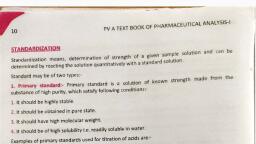
Standards: The solution whose concentration is exactly known is called standard solution, , Primary Standard:, A primary standard is a highly purified chemical or reagent., it has certain properties such as , It is extremely pure , Highly stable, It is anhydrous , It is less hygroscopic , Has very high molecular weight , Can be weighed easily , Should be ready to use and available , Should be preferably non toxic , Should not be expensive
Page 5 :
Secondary Standard: the compound which do not meet all primary standard criteria., , Solution: is homogenous mixture of two or more substance. In this mixture a solute is dissolved in another substance (solvent), , Concentration: Amount of solute in a substance., , Molar solution: one mole of solute per liter of solution.eg: 5M hclaq means 5 moles of HCl per lit of solution., , Normal solution: One equivalent wt of solute per lit of solution. 5N HCL means 5 equivalent of HCL per lit of solution., N= Gram equivalent wt of solute/ volume of solution.
Page 6 :
Requirement for Volumetric Analysis: , 1. Chemical reaction must be simple and should take place by definite chemical equation to form known products. , 2. The reaction should be rapid under the experimental conditions maintained. , 3. There should a marked change in some of the properties of the solution to be analysed at equivalence point. , 4. The reaction should take place essentially to completion under the experimental conditions maintained. , 5. The end point should be well defined either between the reacting substances or by the use of an indicator.
Page 7 :
Classification of volumetric method of analysis, Depending on type of reaction are four main types of reaction, 1.Acid-base or neutralization Titrations, 2. Complexometric Titrations, 3. Precipitation Titrations, 4. Redox Titrations, 5. Non-aqueous Titrations, , 1.Acid-base or neutralization Titrations:, where free bases are reacted with a standard acid (or vice versa). , These reactions involve the combination of hydrogen and hydroxide ions to form water.